
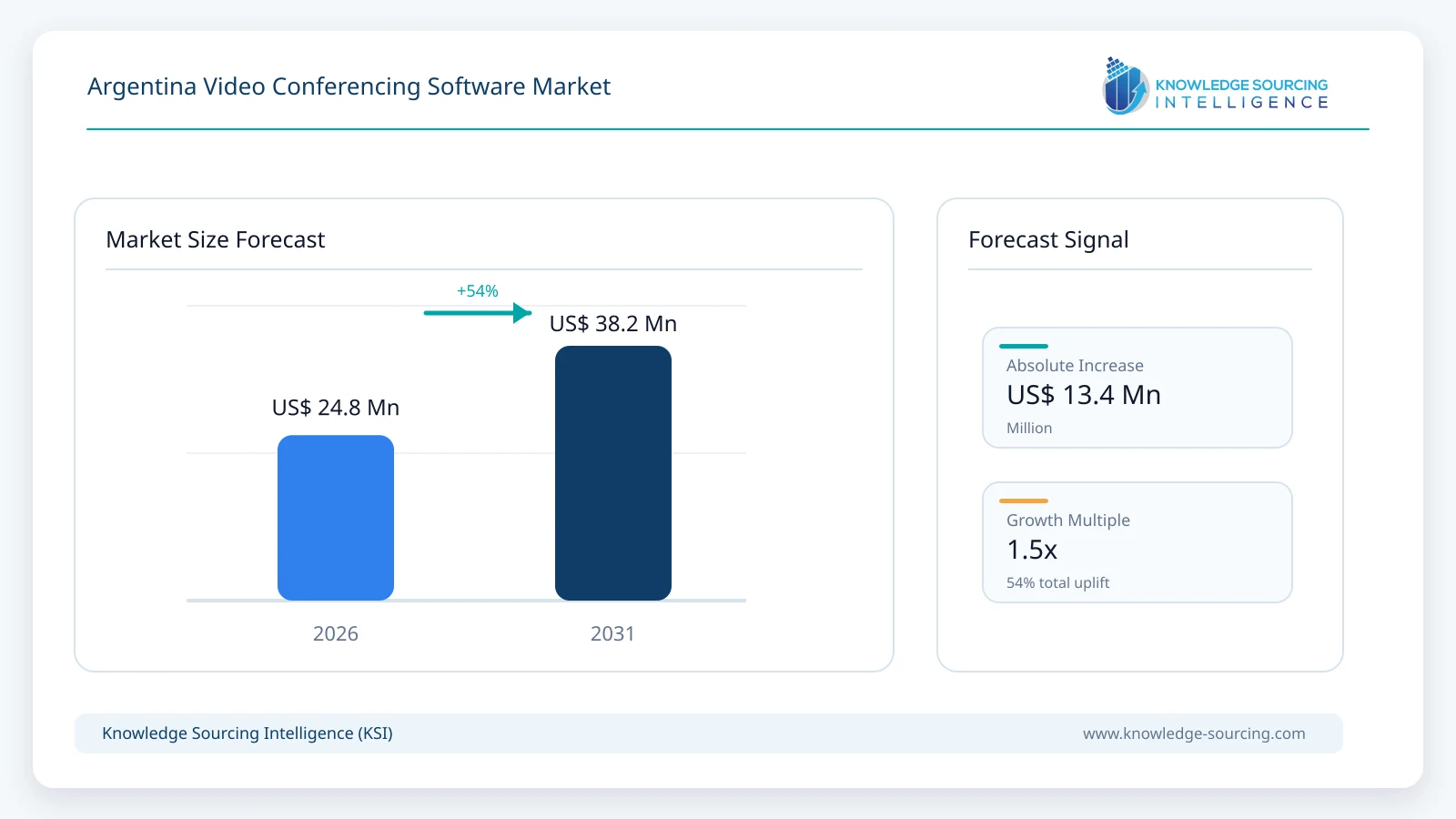
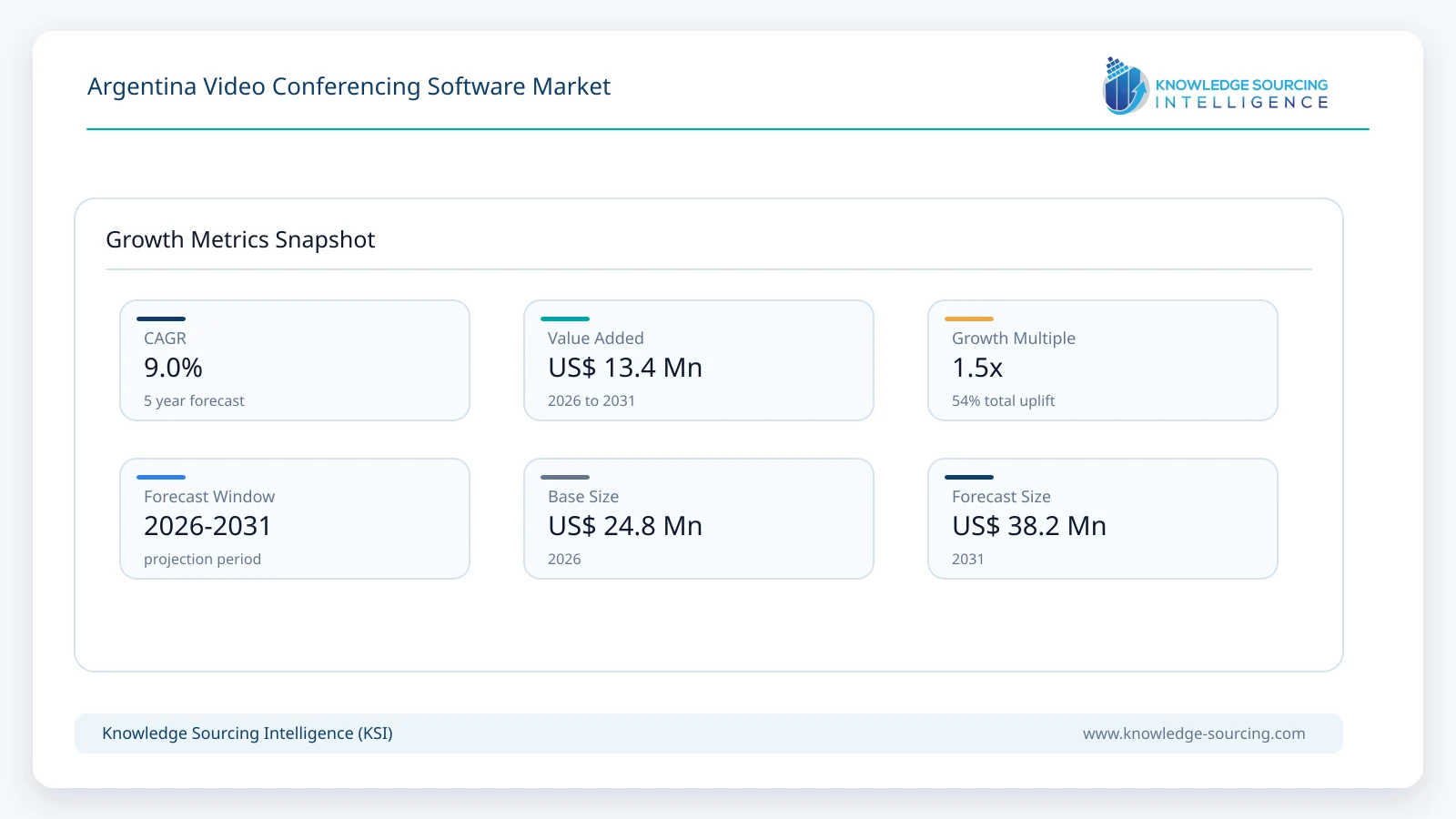
The Argentina video conferencing software market is forecast to grow at a CAGR of 9.0%, reaching USD 38.2 million in 2031 from USD 24.8 million in 2026.
Highlights:
- 1Cloud deployment accounts for approximately 91% of Argentina video conferencing software market value in 2026supported by subscription-based workplace suites and browser-based meeting platforms.
- 2Large enterprises account for approximately 54% of market value in 2026reflecting higher paid-seat penetration, room deployments and premium collaboration requirements.
- 3IT and telecommunications account for approximately 22% of market value in 2026supported by distributed technical teams, software exports and cross-border client collaboration.
- 4BFSI represents one of the largest enterprise demand poolswith collaboration platforms embedded across branch networks, corporate teams and customer-facing operations.
- 5AI-assisted meeting functions are becoming a larger source of premium valueincluding transcription, summaries, action items, meeting search and workflow automation.
Argentina has a large addressable base for paid collaboration software. The country had more than 6.0 million registered private-sector salaried workers in mid-2026, while the knowledge-economy sector alone exceeded 285,000 formal jobs in 2025. Financial services, software, professional services, education, healthcare and export-oriented knowledge businesses account for a disproportionate share of paid collaboration usage because their teams frequently work across offices, clients and international markets.
The commercial market has moved beyond the rapid adoption phase that followed 2020. Enterprises are now standardizing around fewer platforms, often selecting video conferencing as part of Microsoft 365, Google Workspace or a broader unified-communications stack. Microsoft markets Teams Enterprise in Argentina as a standalone product while also bundling Teams into several Microsoft 365 plans. Google Meet is embedded in Google Workspace, and Banco Macro uses Google Meet as part of a Workspace deployment supporting more than 7,700 employees across 460 branches.
Connectivity provides a stronger base for video collaboration than in the earlier forecast period. ENACOM reported around 13 million fixed broadband connections in 2026, including 6.2 million fiber connections, alongside 64.5 million mobile connections. Improving fixed-network quality and wider fiber availability support higher-quality meetings, remote training and hybrid collaboration beyond Buenos Aires and other major business centers.
Market Trends
AI Meeting Intelligence Moves Into Standard Plans
Meeting transcription, summaries, action items and conversational search are becoming standard features across major platforms. Zoom has integrated core AI meeting functions directly into Zoom Workplace paid plans, Google Meet uses Gemini for note-taking and meeting assistance, and Cisco Webex has expanded AI Assistant across meetings and scheduling. Microsoft continues to connect Teams with Microsoft 365 Copilot. The commercial effect is a shift from basic meeting access toward higher-value licenses where meeting content can be searched, summarized and connected to downstream work.
Collaboration Suites Replace Standalone Tools
Enterprises are reducing the number of separate communication applications they manage. Microsoft combines Teams with Microsoft 365, Google Meet operates within Workspace, Zoom Workplace adds chat, phone and productivity tools, and RingCentral integrates meetings with cloud communications. This favors vendors that already control email, calendars, identity, documents or telephony. Standalone meeting products remain viable, but they increasingly need stronger interoperability, AI functions or industry-specific controls to justify a separate subscription.
Meeting-Room Interoperability Gains Importance
Hybrid work has increased the need for conference rooms to connect users across Teams, Zoom, Google Meet and Webex without requiring separate hardware for each platform. Google Meet hardware supports interoperability with Zoom and Webex, while Pexip provides cross-platform connectivity for enterprise meeting rooms. Large Argentine organizations with mixed technology environments are more likely to prioritize platform interoperability as they refresh office meeting spaces and consolidate legacy conferencing equipment.
Security and Data Control Gain Weight in Regulated Sectors
Banks, healthcare organizations, government agencies and other regulated users are placing greater weight on identity controls, recording policies, encryption, retention and data-location options. Zoom introduced an on-premise AI deployment option in 2026 for organizations with stricter data-control requirements, while Cisco continues to position Webex around secure enterprise collaboration. These capabilities allow regulated organizations to adopt AI meeting functions without relying exclusively on unrestricted cloud processing.
Market Drivers
Knowledge-Economy Employment Supports Paid Collaboration Demand
Argentina's knowledge-economy sector exceeded 285,000 formal jobs in 2025 and generated USD 9.6 billion in service exports. Software, professional services and other knowledge-intensive companies work extensively with international customers and distributed teams, making video meetings part of normal client delivery and internal operations. This group also has higher software spending per employee than the broader economy, supporting paid enterprise plans rather than relying only on free meeting tiers.
SME Digitalization Broadens the Customer Base
The national government launched KIT 4.0 in April 2026 to connect SMEs with technology providers and accelerate the adoption of digital tools. Argentina's MiPyME registry contained approximately 1.88 million active certificates in April 2026, although the registry also includes self-employed businesses and monotributistas. The commercially relevant opportunity lies in small and mid-sized firms moving from informal consumer tools toward managed collaboration suites with company accounts, shared calendars, recordings, administration and security controls.
Improved Broadband Expands Reliable Video Usage
ENACOM reported 13 million fixed broadband connections and 6.2 million fiber connections in 2026, with average download speeds doubling over the previous two years. Better connectivity improves meeting reliability for employees outside major corporate offices and supports higher-quality video, screen sharing and remote training. This is particularly important in a geographically large country where organizations operate across multiple provinces and often coordinate with international teams.
Large Enterprises Standardize Collaboration Across Distributed Operations
National banks, technology firms, retailers and industrial companies are deploying common collaboration platforms across branches and offices. Banco Macro, for example, uses Google Workspace and Google Meet across more than 7,700 employees and 460 branches. Similar enterprise deployments generate recurring license revenue and increase demand for administration, identity, recording, room systems and premium meeting functions beyond basic person-to-person calling.
Market Restraints and Challenges
Bundled Platforms Limit Standalone Revenue Growth
Microsoft Teams and Google Meet are frequently purchased as part of broader productivity suites, which reduces the number of customers willing to maintain a separate conferencing subscription. Zoom, Webex, RingCentral and other specialists respond by adding phone, contact-center, AI and workflow functionality, but platform consolidation puts pressure on standalone meeting prices and increases the importance of differentiated enterprise features.
Free Tiers Reduce SME Conversion
Small businesses and independent professionals can meet basic requirements through free versions of Google Meet, Zoom, Teams and other platforms. Paid conversion generally occurs when users need longer meetings, recordings, administration, larger participant limits, webinars, compliance controls or integration with company systems. This keeps the addressable paid market smaller than the total number of organizations using video calls.
Foreign-Currency Software Costs Affect Smaller Buyers
Most leading platforms are priced in US dollars or linked to international software subscriptions. Currency movements, taxes and cross-border payment costs can affect purchasing decisions for small Argentine organizations, particularly where collaboration software competes with other operating expenses. Larger companies are less sensitive because video conferencing is often purchased within broader enterprise software contracts, while smaller firms may downgrade plans or remain on free tiers.
Segment Analysis
By Deployment Model: Cloud
Cloud-based video conferencing software is expected to generate approximately USD 35.5 million by 2031, maintaining an overwhelming share of the market. SaaS delivery allows organizations to add users without maintaining conferencing infrastructure and gives vendors a direct route for rolling out AI, security and interoperability updates. On-premise and private deployments remain relevant in selected government, financial-services and security-sensitive environments, but most organizations use cloud platforms even where identity, recordings or selected data remain under tighter enterprise controls.
By Enterprise Size: Large Enterprises
Large enterprises are forecast to generate approximately USD 19.5 million by 2031. These organizations typically have higher paid-seat penetration and use a broader range of premium features including meeting-room integration, centralized administration, compliance, recordings, webinars and AI assistants. Large banks, telecommunications companies, technology businesses and multinational operations also need interoperability across external clients and international offices. SMEs are expected to gain share gradually as digitalization improves, but their lower paid conversion and extensive use of free tiers keep average revenue per organization substantially below that of large enterprises.
By Industry Vertical: IT and Telecommunications
IT and telecommunications are expected to generate approximately USD 8.0 million by 2031, retaining the largest individual industry position. Argentina's software and knowledge-services sector works heavily with international clients, distributed development teams and remote technical specialists, creating intensive meeting usage. The sector is also more willing to adopt AI-enabled meeting features, integrations and asynchronous collaboration tools early. BFSI, professional services, education and healthcare remain important demand pools, with financial institutions generally generating higher revenue per user because of security, administration and compliance requirements.
Competitive Environment and Analysis
Microsoft holds a strong position because Teams is closely integrated with Microsoft 365, Outlook, identity and enterprise administration. The company also offers Teams Enterprise as a standalone product in Argentina, giving customers flexibility between suite-based and separate purchasing. Google competes through Workspace and Meet, with established Argentine enterprise deployments such as Banco Macro demonstrating the platform's suitability for large distributed organizations.
Zoom remains one of the strongest independent collaboration platforms. Its strategy has expanded beyond meetings into Zoom Workplace, Phone, Rooms, CX and AI-driven workflows. Fiscal 2026 enterprise revenue reached USD 2.93 billion globally, up 6.5%, showing that enterprise customers continue to expand usage even as basic video meetings have become a mature category. Cisco Webex competes strongly in larger organizations that place greater weight on security, room systems and enterprise communications infrastructure.
Zoho Meeting, RingCentral, GoTo Meeting, Dialpad and Intermedia AnyMeeting provide alternatives for SMEs and unified-communications customers, while Pexip competes in secure video and meeting-room interoperability. Slack Huddles creates additional competition for informal internal meetings because video calling is embedded directly inside Slack workflows. Competition is therefore increasingly based on the wider collaboration environment rather than on video quality or participant limits alone.
Recent Developments
July 2026: Microsoft implemented updated Microsoft 365 commercial packaging and pricing while keeping standalone Teams SKUs outside the announced price changes.
June 2026: Zoom introduced AI processing through Zoom AI On-Prem, targeting regulated organizations that require tighter control over meeting and collaboration data.
June 2026: Zoom launched ZoomMate, extending meeting intelligence into agentic search, workflow execution and content creation across Zoom Workplace.
April 2026: Cisco expanded AI Assistant in Webex with automated meeting scheduling, meeting summaries and action-item workflows.
April 2026: Argentina launched KIT 4.0, connecting SMEs with technology providers to accelerate adoption of digital business tools.
Market Outlook
Argentina's video conferencing software market will continue to grow through 2031, but the commercial opportunity is moving away from basic video access. Meeting functionality is becoming part of broader workplace platforms, and revenue growth will increasingly come from premium collaboration, AI assistance, meeting rooms, enterprise administration, webinars and unified communications.
Microsoft and Google will benefit from productivity-suite bundling, while Zoom, Cisco and other specialists will compete through broader communication platforms and differentiated enterprise features. Smaller vendors can remain relevant in SMEs, regulated environments and interoperability use cases, but the market is likely to concentrate around a limited number of primary workplace platforms.
AI will become a standard component of paid collaboration plans rather than a separate novelty. Meeting summaries, transcription and note-taking are already common, while the next stage is connecting meeting decisions directly with calendars, CRM systems, tasks and documents. Vendors that can provide these functions without adding administrative complexity or materially increasing per-user costs should capture a larger share of enterprise spending.
Argentina Video Conferencing Software Market Scope:
| Report Metric | Details |
|---|---|
| Total Market Size in 2026 | USD 24.8 million |
| Total Market Size in 2031 | USD 38.2 million |
| Forecast Unit | Million |
| Growth Rate | 9.0% |
| Study Period | 2021 to 2031 |
| Historical Data | 2021 to 2024 |
| Base Year | 2025 |
| Forecast Period | 2026 – 2031 |
| Segmentation | Deployment Model, Enterprise Size, Industry Vertical |
| Companies |
|
Market Segmentation
By Deployment Model
Cloud
On-Premise and Private Deployment
By Enterprise Size
Small Enterprises
Medium Enterprises
Large Enterprises
By Industry Vertical
IT and Telecommunications
BFSI
Education
Healthcare
Professional Services
Government and Public Sector
Retail and Consumer Services
Manufacturing
Others
Table of Contents
1. INTRODUCTION
1.1. Market Overview
1.2. Market Definition
1.3. Scope of the Study
1.4. Market Segmentation
1.5. Currency
1.6. Assumptions
1.7. Base and Forecast Years Timeline
2. RESEARCH METHODOLOGY
2.1. Research Design
2.2. Research Process
3. EXECUTIVE SUMMARY
3.1. Key Findings
4. MARKET DYNAMICS
4.1. Market Drivers
4.2. Market Restraints
4.3. Market Opportunities
4.4. Porter's Five Forces Analysis
4.5. Industry Value Chain Analysis
4.6. Analyst View
5. ARGENTINA VIDEO CONFERENCING SOFTWARE MARKET BY DEPLOYMENT MODEL
5.1. Introduction
5.2. Cloud
5.3. On-Premise and Private Deployment
6. ARGENTINA VIDEO CONFERENCING SOFTWARE MARKET BY ENTERPRISE SIZE
6.1. Introduction
6.2. Small Enterprises
6.3. Medium Enterprises
6.4. Large Enterprises
7. ARGENTINA VIDEO CONFERENCING SOFTWARE MARKET BY INDUSTRY VERTICAL
7.1. Introduction
7.2. IT and Telecommunications
7.3. BFSI
7.4. Education
7.5. Healthcare
7.6. Professional Services
7.7. Government and Public Sector
7.8. Retail and Consumer Services
7.9. Manufacturing
7.10. Others
8. COMPETITIVE ENVIRONMENT AND ANALYSIS
8.1. Major Players and Strategy Analysis
8.2. Market Share Analysis
8.3. Mergers, Acquisitions, Agreements, and Collaborations
8.4. Competitive Dashboard
9. COMPANY PROFILES
9.1. Microsoft Corporation
9.2. Zoom Communications, Inc.
9.3. Google LLC
9.4. Cisco Systems, Inc.
9.5. Zoho Corporation Pvt. Ltd.
9.6. RingCentral, Inc.
9.7. GoTo Technologies USA, Inc.
9.8. Dialpad, Inc.
9.9. Salesforce, Inc. (Slack Huddles)
9.10. 8x8, Inc.
9.11. Pexip Holding ASA
9.12. Adobe Inc.
9.13. Intermedia.net, Inc.
9.14. TeamViewer SE
9.15. TrueConf LLC
10. APPENDIX
10.1. Currency
10.2. Assumptions
10.3. Base and Forecast Years Timeline
10.4. Research Methodology
10.5. Abbreviations
Navigate
Trusted by the world's leading organizations











