ASEAN Food Processing Machinery Market Size, Share, Trends & Analysis By Type (Pre-Processing Equipment (Cleaning, Grading and Sorting, Peeling and Skinning, Others), Processing Equipment (Mixing and Blending, Extrusion and Forming, Cutting and Grinding, Thermal Processing, Separation and Homogenization, Others), Packaging Equipment), Application (Meat, Poultry and Seafood, Beverage, Dairy, Bakery and Confectionery, Fruit, Vegetable and Nut, Grains and Rice, Others), Mode of Operation (Automatic, Semi-Automatic), and Country
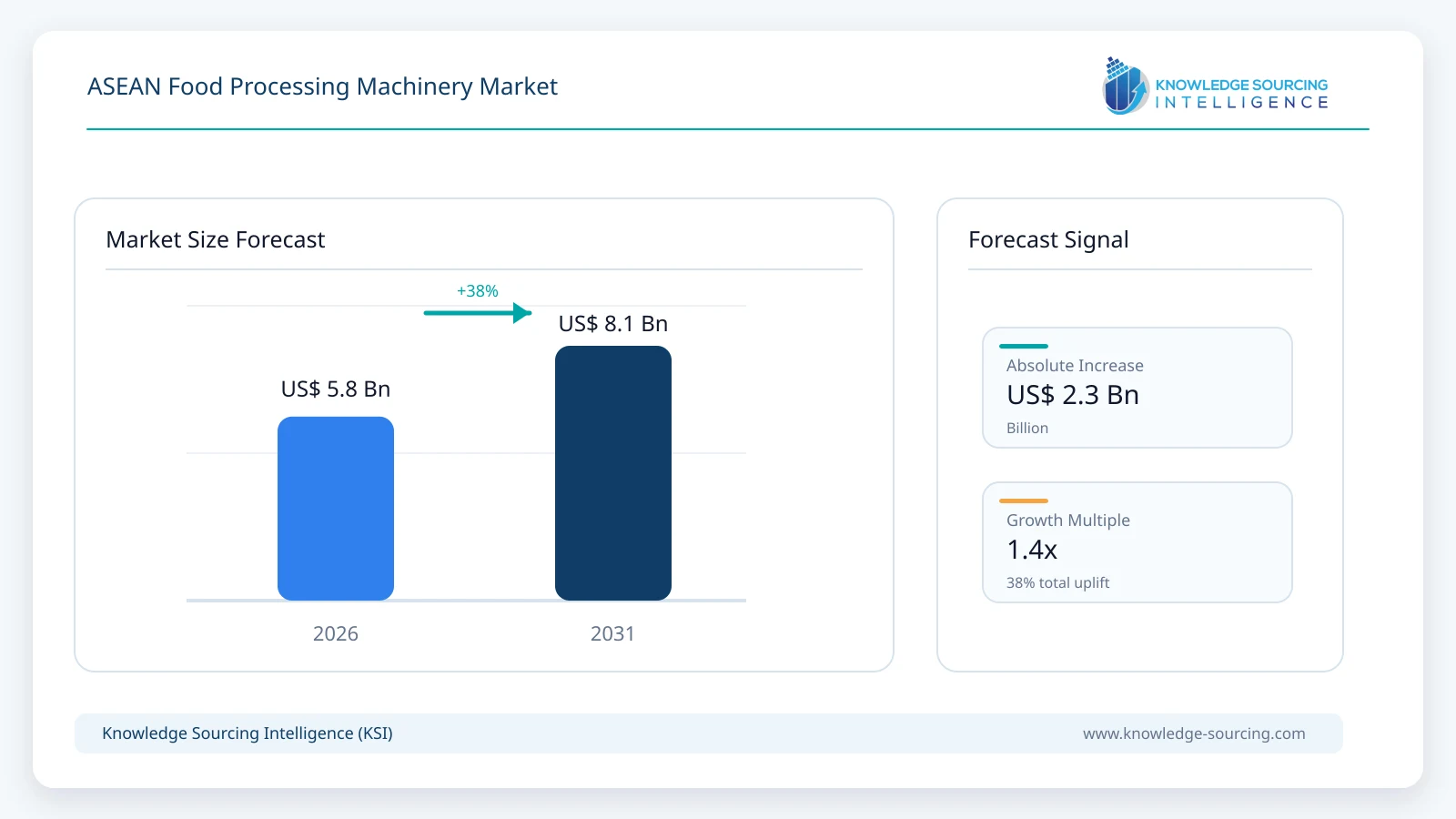
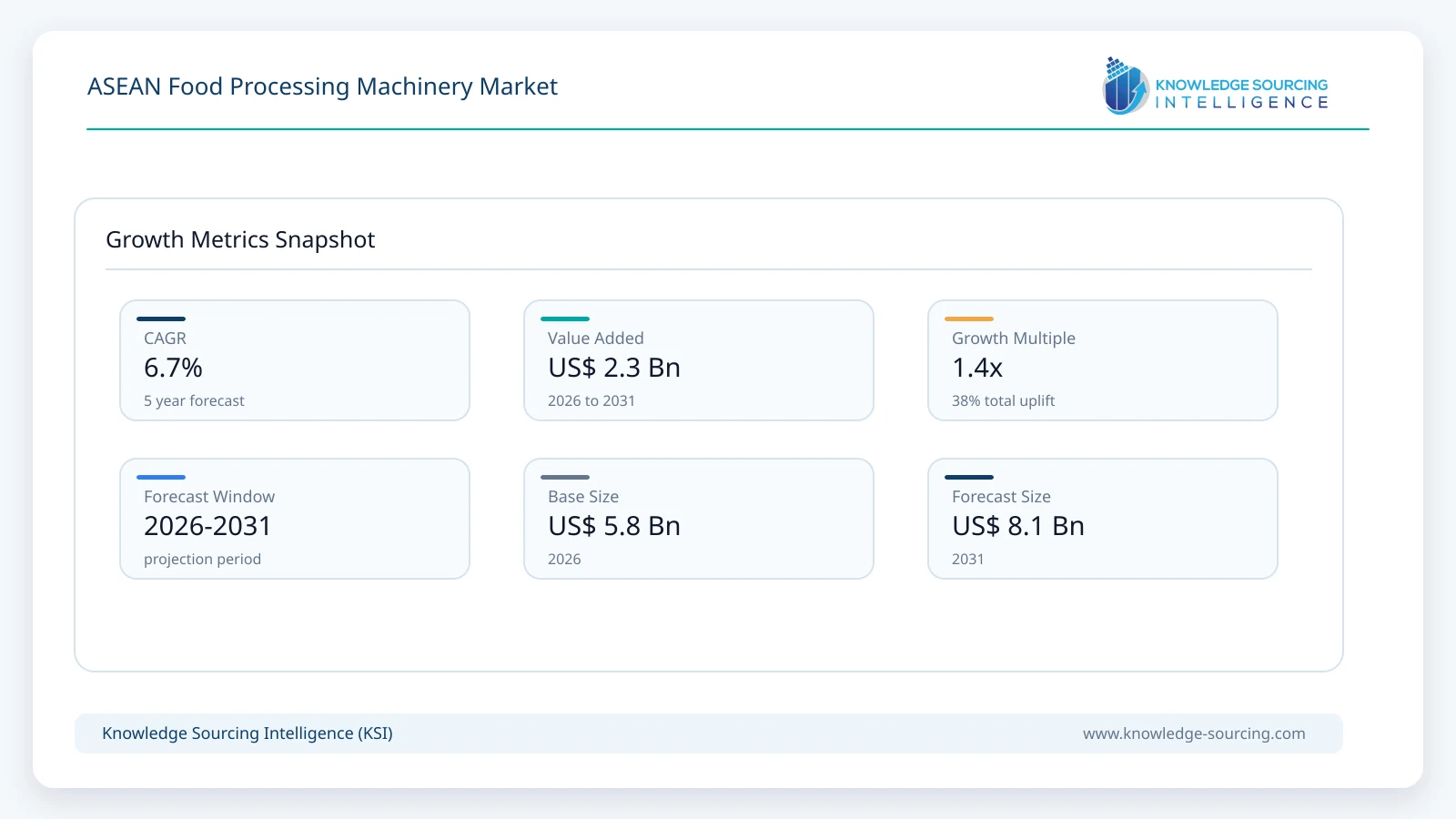
The ASEAN food processing machinery market is forecast to grow at a CAGR of 6.7%, reaching USD 8.10 billion in 2031 from USD 5.85 billion in 2026.
Highlights:
1
Processing equipment accounts for approximately 53% of ASEAN food processing machinery revenue in 2026.
2
Automatic machinery is projected to grow at approximately 7.9% annually through 2031.
3
Meat, poultry and seafood applications generate about USD 1.70 billion of regional machinery demand in 2026.
4
Indonesia accounts for approximately 27% of ASEAN food processing machinery revenue in 2026.
5
Digital controls, machine vision and hygienic automation are increasingly specified in new processing lines.
6
Local service capability and spare-parts availability remain important differentiators for imported equipment suppliers.
Market Overview
Food processing machinery in ASEAN spans a broad range of capital equipment, but purchasing decisions increasingly converge around three requirements: throughput, hygiene and operating cost. Large processors typically evaluate complete line performance rather than the price of an individual machine. This shifts value toward suppliers capable of integrating product handling, cutting or forming, heat treatment, separation, inspection, conveying, packaging and production controls. JBT Marel, GEA, Tetra Pak, Bühler, Krones, MULTIVAC, BAADER and other international suppliers operate across multiple stages of the value chain, while regional specialists and distributors compete on lower capital cost, local adaptation and service response.
The addressable market is structurally larger than machinery sales to new plants alone. ASEAN has a substantial installed base of rice mills, seafood processors, meat and poultry plants, dairy and beverage facilities, bakery operations and packaged-food manufacturers that require periodic replacement, line expansion and efficiency upgrades. In Malaysia, approved investment in food manufacturing reached RM6.3 billion in 2025, and the first half of 2026 already recorded RM4.9 billion, up strongly from the comparable prior-year period. In the Philippines, manufacture of food products represented more than half of manufacturing gross value added in 2024 when food and beverages are combined, and food-production indices continued expanding in 2025 and 2026. These indicators support recurrent machinery demand even when new greenfield investment slows.
Market Trends
Automation is moving from isolated machines to connected processing lines
ASEAN food processors are increasingly automating the hand-off between processing stages rather than installing one high-speed machine while retaining manual transfer, inspection or packing around it. Labor availability, contamination risk and the need for uniform product specifications make end-to-end automation more attractive in seafood, poultry, beverages and packaged foods. At ProPak Asia 2026 in Bangkok, GEA highlighted integrated solutions spanning slicing, packaging, dairy, beverage, bakery, noodles and snack applications, while MULTIVAC presented processing, packaging, cold-chain and digitalization systems at the same regional event. BAADER used Seafood Processing Asia 2026 in Singapore to emphasize automated multi-species processing, higher raw-material utilization and reduced dependence on highly trained manual cutting labor. The commercial direction is therefore toward modular lines that can be expanded as processor volumes increase.
Digital monitoring and resource efficiency are becoming part of machinery specifications
Food processing equipment is increasingly sold with data collection, remote diagnostics, recipe management and predictive-maintenance capabilities. The trend is visible even in smaller manufacturing ecosystems. Singapore refreshed its Food Manufacturing Industry Digital Plan in February 2026 to support more than 1,500 food manufacturers in adopting digital solutions. Equipment suppliers are also focusing on water, energy and product-yield efficiency because utilities and raw materials account for a significant part of processor operating cost. Sorting systems from TOMRA, yield-optimization systems from JBT Marel and BAADER, and cleaning, separation and heat-transfer platforms from Alfa Laval and GEA illustrate how equipment value is increasingly measured by waste reduction and total cost of ownership rather than nameplate throughput alone.
Market Drivers
Expansion of processed-food manufacturing is increasing the installed equipment base
The first structural driver is continued investment in food manufacturing capacity across large ASEAN economies. Malaysia recorded RM6.3 billion of approved food-manufacturing investment in 2025, while approvals in the first half of 2026 reached RM4.9 billion. The Philippines granted Green Lane treatment to 31 food-security projects representing PHP18.7 billion of investment by June 2025, and its food manufacturing output continued to expand through 2026. Vietnam is targeting a larger processing and manufacturing share of GDP by 2030, while ASEAN as a whole continues to attract high levels of manufacturing FDI. Each new plant creates direct requirements for preparation, processing, refrigeration, inspection and packaging systems, while expansion projects generate demand for debottlenecking, capacity additions and line automation.
Rising value-added seafood, meat, beverage and dairy production supports specialized machinery
ASEAN is both a major food-consuming region and an important exporter of seafood, poultry, prepared foods, beverages and agricultural products. Export-oriented processors need equipment capable of achieving repeatable weight, texture, microbial control and foreign-market quality standards. Seafood processing provides a clear example: BAADER continues to target Asia with high-speed portioning, skinning, bone removal, splitting and by-product recovery systems, while JBT Marel competes across fish, meat and poultry primary and secondary processing. In beverages and dairy, Tetra Pak, GEA, Alfa Laval and Krones supply thermal treatment, separation, filling and packaging technologies that reduce operator handling and improve process control. Growth in higher-value ready meals, convenience foods and chilled products further raises machinery intensity per tonne of output.
Market Restraint
High imported-equipment costs and fragmented processor economics slow automation among SMEs
The main restraint is the mismatch between advanced machinery prices and the economics of small and medium-sized processors. Much of ASEAN remains dependent on imported European, Japanese, North American and Chinese equipment, exposing buyers to exchange rates, freight costs and long spare-parts supply chains. Automated systems can also require plant redesign, skilled technicians, reliable utilities and stronger preventive-maintenance practices. Large exporters can justify these costs through higher throughput and lower labor intensity, but smaller processors may continue using semi-automatic equipment or locally fabricated machinery. This creates a two-speed market in which sophisticated integrated lines grow rapidly at the top end while lower-capital equipment retains a meaningful installed base.
Segment Analysis
By Type - Processing Equipment
Processing equipment remains the largest equipment category and is projected to approach USD 4.2 billion in ASEAN revenue by 2031. The segment includes mixers and blenders, cutting and grinding systems, extruders and forming equipment, separators, thermal processing systems, slicers, dicers and other machinery that directly changes the food product. Its scale reflects the breadth of ASEAN food manufacturing, from rice and seafood to beverages, bakery products and prepared meals. Pre-processing equipment remains important for cleaning, sorting, grading, peeling and raw-material handling, particularly in fruit, vegetable, grain and seafood applications. Packaging equipment grows alongside both categories as processors move toward integrated lines with inspection and automated end-of-line handling.
By Application - Meat, Poultry and Seafood
Meat, poultry and seafood remains the largest modeled application and is projected to exceed USD 2.3 billion by 2031. The segment has high equipment intensity because processors require multiple sequential operations such as receiving, grading, cutting, deboning, portioning, chilling, coating, cooking, freezing and packing. Southeast Asia is also a major seafood-processing hub, encouraging investment in yield optimization and automation for species that are still handled manually. Beverage and dairy machinery represent another large pool because of the need for hygienic thermal processing and aseptic or high-speed filling, while bakery, confectionery and snack applications support demand for mixing, depositing, forming and thermal systems.
By Mode of Operation - Automatic
Automatic machinery is expected to represent roughly two-thirds of market value by 2031 as larger processors reduce manual product contact and connect multiple process stages through programmable controls. The category includes fully automated stand-alone machines as well as integrated lines with sensors, machine vision, automated changeovers, data logging and robotic handling. Adoption is fastest in export-oriented plants, multinational facilities and high-volume beverage, protein and packaged-food operations. Semi-automatic machinery remains commercially important for SMEs and low-volume specialty products because it offers lower initial investment and can accommodate frequent product changes without extensive systems integration.
By Geography - Indonesia
Indonesia is projected to remain the largest national market and reach approximately USD 2.1 billion by 2031. Its scale comes from the region's largest population, broad domestic packaged-food demand and a diverse food-processing base covering noodles, beverages, dairy, edible oils, seafood, poultry, bakery products and snacks. Thailand has a higher export orientation in several processed-food categories and consequently strong demand for sophisticated inspection, seafood, poultry and packaging equipment. Vietnam is expected to record one of the faster growth rates as food manufacturing moves toward higher-value processing, while Malaysia combines halal-oriented food production with sustained manufacturing investment. The Philippines provides a large domestic food market and Singapore remains a smaller but high-value center for automation, pilot processing, food technology and regional technical support.
Competitive Environment
Competition combines global full-line suppliers, category specialists and local integrators. JBT Marel has one of the broadest protein-processing positions following the combination of JBT and Marel, covering primary, secondary and further processing, freezing, filling, inspection and packaging technologies. Tetra Pak is particularly strong in liquid food and beverage processing and packaging, GEA spans dairy, beverage, bakery, food preparation and refrigeration, and Bühler maintains strong positions in grains, rice, milling, chocolate and plant-based foods. Krones competes heavily in beverage processing and filling, while MULTIVAC combines processing and packaging systems and BAADER specializes in fish and protein processing.
Regional service footprint is a major competitive factor because processors cannot tolerate extended downtime. Bühler operates multiple branches across Southeast Asia and Oceania from its Singapore base, and Alfa Laval maintains sales and service coverage across Malaysia, Singapore, Indonesia, Thailand, the Philippines and Vietnam. Equipment suppliers increasingly pair hardware with lifecycle services, retrofits, remote monitoring and training. This favors companies that can maintain local engineers and spare-parts inventories, but it also creates opportunities for ASEAN distributors and systems integrators that can represent multiple equipment brands and provide faster field support to mid-sized processors.
Recent Developments
September 2026: BAADER showcased automated seafood-processing systems at Seafood Processing Asia in Singapore, including multi-species splitting, high-speed portioning, skinning and by-product utilization technologies aimed at reducing labor dependence and improving raw-material yield.
June 2026: GEA presented processing and packaging innovations at ProPak Asia in Bangkok across meat, poultry, seafood, bakery, dairy, beverage, noodles and snack applications, reinforcing Thailand's role as a regional machinery showcase and service market.
February 2026: Enterprise Singapore and the Infocomm Media Development Authority launched a refreshed Food Manufacturing Industry Digital Plan to guide more than 1,500 Singapore food manufacturers in digital technology adoption.
July 2025: Tetra Pak launched a second aseptic carton packaging-material production line at its Binh Duong facility in Vietnam following a EUR97 million expansion, more than doubling capacity and broadening support for Vietnam and other Asia-Pacific markets.
January 2025: JBT completed settlement of its takeover offer for Marel and began operating as JBT Marel, creating a broader global food-processing equipment and technology platform serving protein, prepared foods, beverages and packaging applications.
ASEAN Food Processing Machinery Market Scope:
Report Metric
Details
Total Market Size in 2026
USD 5.85 billion
Total Market Size in 2031
USD 8.10 billion
Forecast Unit
Billion
Growth Rate
6.7%
Study Period
2021 to 2031
Historical Data
2021 to 2024
Base Year
2025
Forecast Period
2026 – 2031
Segmentation
Type, Application, Mode Of Operation, Country
Companies
JBT Marel Corporation
Tetra Pak International S.A.
GEA Group AG
Bühler Group
Krones AG
Market Segmentation
By Type
Pre-Processing Equipment
Cleaning
Grading and Sorting
Peeling and Skinning
Others
Processing Equipment
Mixing and Blending
Extrusion and Forming
Cutting and Grinding
Thermal Processing
Separation and Homogenization
Others
Packaging Equipment
By Application
Meat, Poultry and Seafood
Beverage
Dairy
Bakery and Confectionery
Fruit, Vegetable and Nut
Grains and Rice
Others
By Mode of Operation
Automatic
Semi-Automatic
By Country
Indonesia
Thailand
Vietnam
Malaysia
Philippines
Singapore
Rest of ASEAN
Table of Contents
1. EXECUTIVE SUMMARY
2. MARKET SNAPSHOT
2.1. Market Overview
2.2. Market Definition
2.3. Market Segmentation
3. BUSINESS LANDSCAPE
3.1. Market Drivers
3.1.1. Expansion of Processed-Food Manufacturing Is Increasing the Installed Equipment Base
3.1.2. Rising Value-Added Seafood, Meat, Beverage and Dairy Production Supports Specialized Machinery
3.2. Market Restraint
3.2.1. High Imported-Equipment Costs and Fragmented Processor Economics Slow Automation Among SMEs
3.3. Market Opportunities
3.4. Porter's Five Forces Analysis
3.5. Industry Value Chain Analysis
3.6. Policies and Regulations
3.7. Strategic Recommendations
4. TECHNOLOGICAL OUTLOOK
4.1. Machine Vision and Sensor-Based Inspection
4.2. Connected Processing Lines and Predictive Maintenance
4.3. Hygienic Design and Clean-in-Place Systems
4.4. Energy-, Water- and Yield-Efficient Processing
5. ASEAN FOOD PROCESSING MACHINERY MARKET BY TYPE
5.1. Introduction
5.2. Pre-Processing Equipment
5.2.1. Cleaning
5.2.2. Grading and Sorting
5.2.3. Peeling and Skinning
5.2.4. Others
5.3. Processing Equipment
5.3.1. Mixing and Blending
5.3.2. Extrusion and Forming
5.3.3. Cutting and Grinding
5.3.4. Thermal Processing
5.3.5. Separation and Homogenization
5.3.6. Others
5.4. Packaging Equipment
6. ASEAN FOOD PROCESSING MACHINERY MARKET BY APPLICATION
6.1. Introduction
6.2. Meat, Poultry and Seafood
6.3. Beverage
6.4. Dairy
6.5. Bakery and Confectionery
6.6. Fruit, Vegetable and Nut
6.7. Grains and Rice
6.8. Others
7. ASEAN FOOD PROCESSING MACHINERY MARKET BY MODE OF OPERATION
7.1. Introduction
7.2. Automatic
7.3. Semi-Automatic
8. ASEAN FOOD PROCESSING MACHINERY MARKET BY COUNTRY
8.1. Introduction
8.2. Indonesia
8.3. Thailand
8.4. Vietnam
8.5. Malaysia
8.6. Philippines
8.7. Singapore
8.8. Rest of ASEAN
9. COMPETITIVE ENVIRONMENT AND ANALYSIS
9.1. Major Players and Strategy Analysis
9.2. Market Share Analysis
9.3. Mergers, Acquisitions, Agreements and Collaborations