
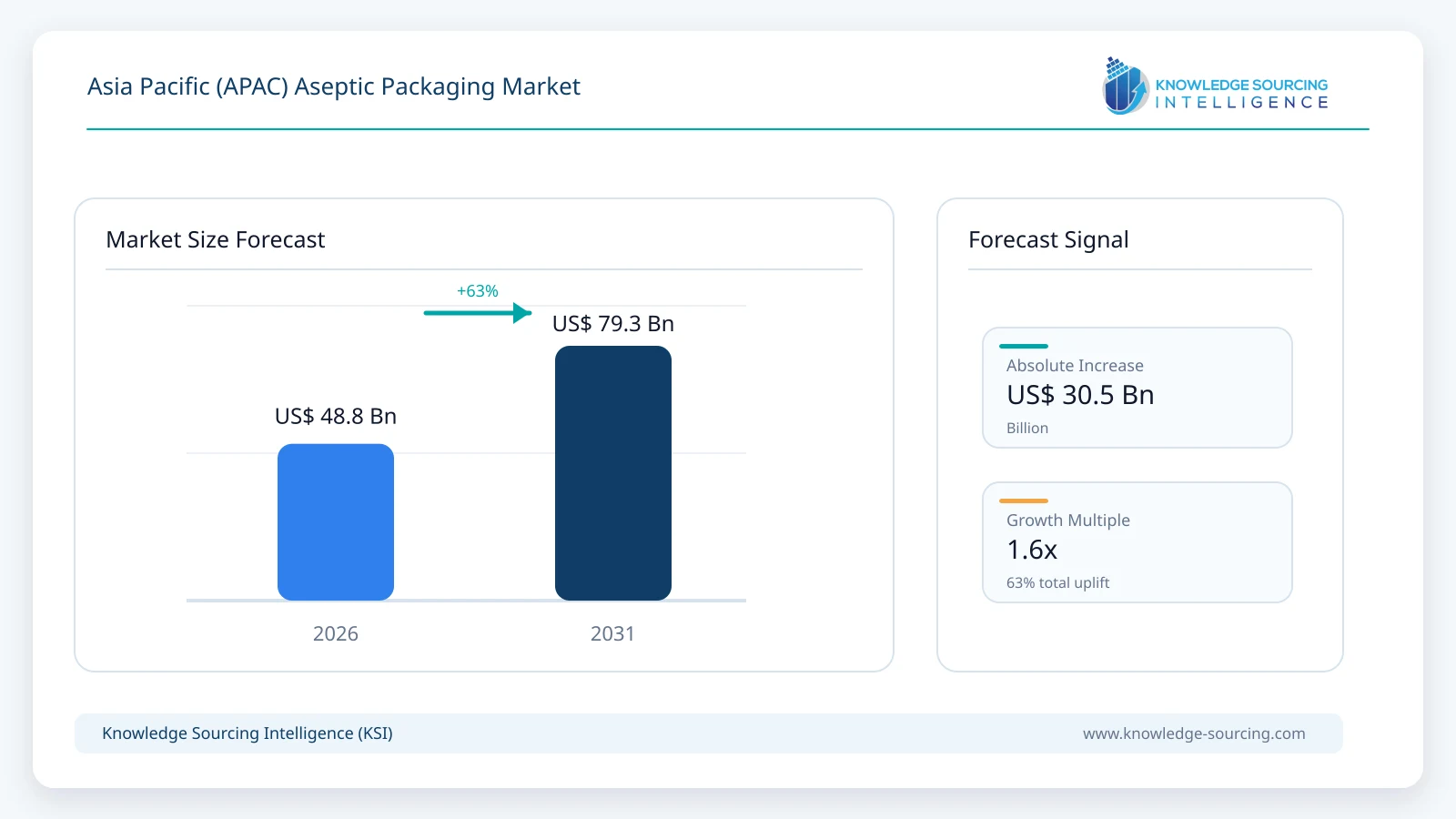
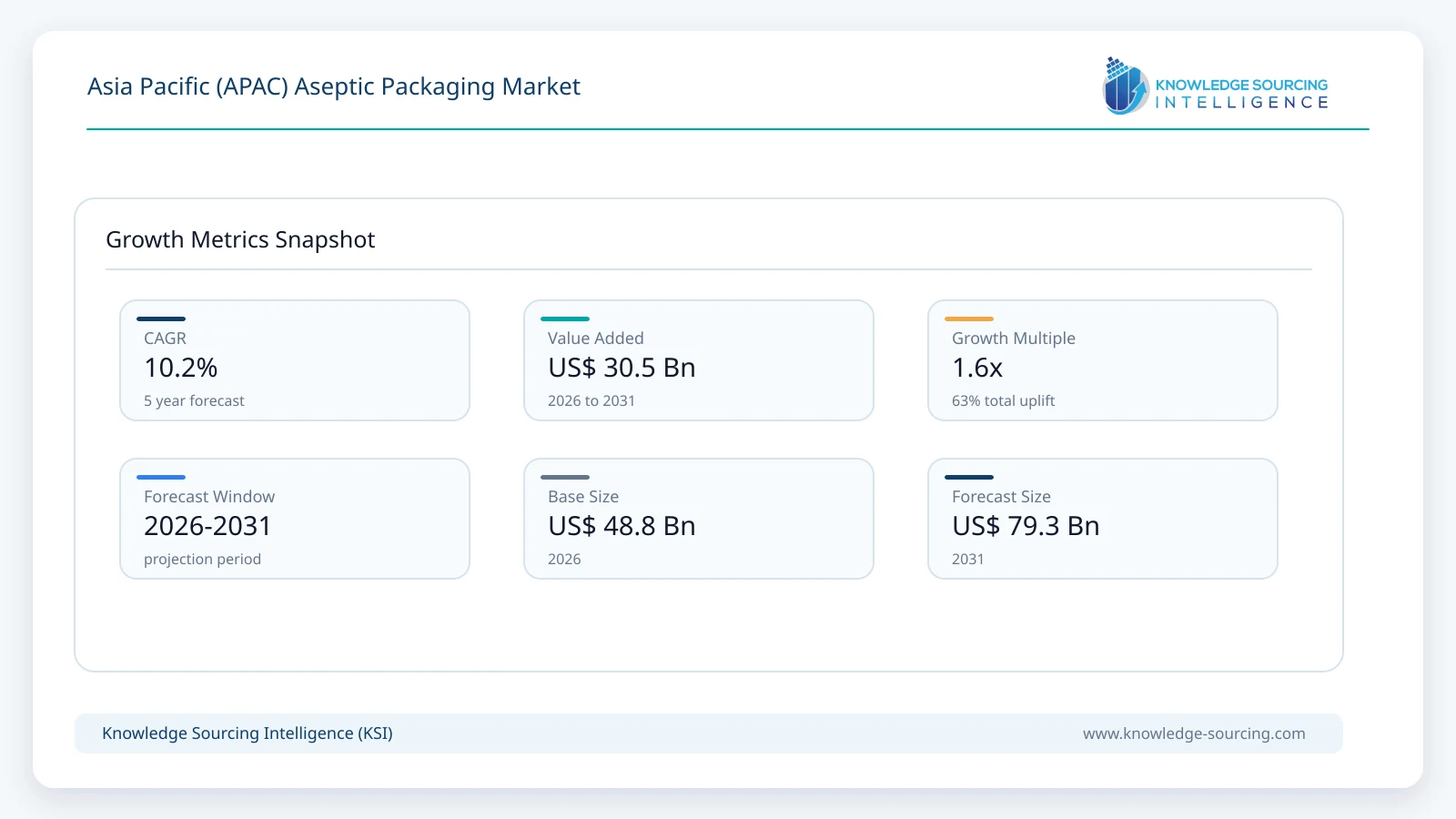
The Asia Pacific (APAC) Aseptic Packaging Market is forecast to grow at a CAGR of 10.2%, reaching USD 79.3 billion in 2031 from USD 48.8 billion in 2026.
Highlights:
- 1Ambient distribution remains a central demand catalyst, particularly for dairy, beverages, nutritional products, and foods distributed across long distances or markets with limited refrigeration.
- 2Paper and paperboard-based aseptic formats remain commercially important, supported by carton infrastructure, lightweight construction, and ongoing development of lower-material and renewable barrier technologies.
- 3China and India represent major procurement opportunities, while Japan, South Korea, Australia, and Southeast Asian economies contribute demand through specialised applications and mature food-processing sectors.
- 4Material engineering is becoming a competitive differentiator, with suppliers developing recyclable structures, recycled polymer content, renewable materials, lower-weight packages, and aluminium-reduced barrier systems.
- 5Regulatory requirements are influencing package specifications, particularly for food-contact safety, recycled materials, chemical migration, labelling, and packaging waste reporting.
- 6Competition increasingly depends on systems capability, including filling equipment, package materials, technical support, format flexibility, local production, and customer-specific development rather than package supply alone.
The Asia Pacific (APAC) aseptic packaging market covers packaging systems designed to maintain commercial sterility of packaged products after controlled sterilisation of the product and packaging components. The market includes aseptic cartons, bottles, bags, pouches, bag-in-box systems, cans, cups, vials, ampoules, prefilled syringes, and other formats manufactured from paper and paperboard, plastic, glass, metal, and other materials. Its principal applications span food, beverages, pharmaceuticals, healthcare products, and selected industrial or specialty products that require extended shelf life, microbial protection, or controlled distribution conditions.
Aseptic packaging has particular commercial relevance in Asia Pacific because product manufacturers operate across markets with very different cold-chain availability, retail structures, consumer purchasing patterns, and logistics economics. Ambient distribution can reduce dependence on refrigerated storage for suitable products, which changes the economics of serving secondary cities, rural markets, export destinations, and convenience-oriented retail channels. For liquid dairy, plant-based beverages, juices, nutritional products, and selected prepared foods, the package is therefore part of the distribution strategy rather than simply a container.
The demand environment is shaped by several buyer groups. Dairy processors and beverage companies purchase aseptic packaging primarily to extend product distribution while maintaining product quality. Pharmaceutical and healthcare manufacturers place greater emphasis on sterility assurance, barrier performance, material compatibility, particulate control, dimensional consistency, and validated production processes. Large food manufacturers also evaluate packaging through total delivered cost, line efficiency, filling speed, material yield, warehouse requirements, product losses, and end-of-life obligations.
Packaging procurement decisions are consequently becoming more multidimensional. A low unit price does not necessarily produce the lowest packaging cost when a supplier's format requires additional filling equipment, slower line speeds, higher rejection rates, specialised transport, or greater inventory. Buyers with established filling infrastructure often prefer suppliers capable of maintaining equipment compatibility, securing material availability, providing technical support, and supporting format changes without extensive production interruptions.
Aseptic packaging also creates a supplier relationship that is more integrated than conventional packaging procurement. Filling equipment, packaging materials, sterilisation systems, closures, technical services, maintenance, and process validation can form one purchasing decision. This structure gives suppliers with broad systems capabilities a commercial advantage, while packaging converters and material specialists compete through format innovation, material efficiency, production reliability, and regional manufacturing capacity.
The beverage industry remains an important demand base. Aseptic cartons are used across milk, flavoured milk, juice, nectars, plant-based beverages, ready-to-drink coffee, tea, nutritional drinks, and other liquid products. Tetra Pak's portfolio illustrates the breadth of this application base, with aseptic formats designed for milk, plant-based beverages, juices, nectars, ready-to-drink tea and coffee, water, and other products. The company also offers filling platforms that support multiple package sizes and openings, allowing producers to adjust formats without replacing the entire production architecture.
The commercial case for aseptic packaging is particularly strong where refrigeration is expensive, unreliable, or unnecessary for the product after processing. UHT processing combined with aseptic filling can allow suitable products to remain stable at ambient conditions. This enables producers to move inventory through conventional warehousing and transport channels while reducing exposure to cold-chain capacity constraints. The resulting economics depend on product formulation, sterilisation requirements, package specifications, filling-line utilisation, freight distances, and local energy costs rather than on packaging price alone.
Sustainability is altering the specification process rather than eliminating aseptic formats. Buyers are examining paperboard content, polymer consumption, barrier layers, recycled content, renewable feedstocks, package weight, recycling compatibility, and the availability of collection infrastructure. The challenge is to reduce material intensity without compromising oxygen, moisture, light, microbial, mechanical, or seal performance.
This tension is driving material development. Tetra Pak introduced a paper-based barrier for an aseptic juice carton in December 2025, replacing the traditional aluminium barrier layer while maintaining protection against oxygen, light, moisture, and bacteria. The development illustrates where packaging technology is moving: sustainability improvements must preserve the functional characteristics that justify aseptic packaging in the first place.
The APAC market also has a strong localisation dimension. China has a large domestic food and beverage manufacturing base and sophisticated packaging supply chains. India combines a large dairy market with expanding packaged beverage consumption and uneven cold-chain infrastructure. Japan and South Korea have mature food-processing industries and demanding material-safety requirements. Southeast Asian markets provide opportunities where urbanisation, packaged food consumption, modern retail, and regional trade support shelf-stable products. Australia and New Zealand have comparatively mature food-safety systems and established packaging compliance requirements.
Market Drivers
Expansion of Shelf-Stable Dairy and Beverage Distribution
The strongest commercial mechanism behind aseptic packaging demand is the ability to distribute suitable products without relying on continuous refrigeration. Dairy and beverage manufacturers can use UHT processing and aseptic filling to produce shelf-stable formats, allowing finished goods to move through ambient logistics networks.
For buyers, the value extends beyond shelf life. Ambient products can reduce warehouse refrigeration requirements, simplify inventory positioning, and facilitate distribution to locations where cold storage is constrained. The economics become more attractive as distribution distances increase or manufacturers seek to consolidate production into fewer plants.
This creates demand for packaging suppliers that can combine high-speed filling with consistent sterilisation performance and reliable material supply. A supplier failure can affect an entire production line, so procurement teams evaluate technical service, machine uptime, quality assurance, and supply continuity alongside package pricing.
Tetra Pak's filling platforms demonstrate this integrated model. Its A1 aseptic platform is designed to combine production capacity, quality, resource efficiency, and lower starting investment, while specific configurations can support products ranging from conventional dairy to higher-viscosity foods.
Growth of Convenience-Oriented Consumption
Urban consumers across Asia Pacific are purchasing more products suited to portable consumption, smaller households, school and workplace use, and convenience-led retail. Aseptic packaging supports this shift through portion formats, resealable closures, lightweight construction, and packages designed for ambient storage.
The commercial effect is particularly visible in beverages. Smaller cartons, bottles, pouches, and flexible formats allow manufacturers to target different consumption occasions without creating entirely separate product categories. The ability to change pack sizes also helps brands serve traditional retail, convenience stores, e-commerce, foodservice, and institutional channels.
SIG's 2025 APAC review provides evidence of this procurement behaviour. The company reported customer demand for new product launches, functional nutrition, drinkable desserts, and snacking formats, while citing pack-size flexibility as a tool for responding to fragmented consumption occasions in China.
Pharmaceutical and Healthcare Packaging Requirements
Aseptic packaging has a distinct value proposition in pharmaceutical and healthcare applications because sterility, contamination control, barrier performance, and material compatibility can directly affect product safety. Packaging specifications are therefore governed by validation requirements and production controls rather than solely by consumer-facing appearance or unit economics.
Demand from healthcare manufacturers can also support higher-value packaging applications. Pharmaceutical packaging buyers may require specialised containers, sterile barrier systems, vials, ampoules, prefilled syringes, and associated components. These applications require tighter quality controls and often have longer qualification cycles than food and beverage packaging.
Investment in regional production capacity can therefore reduce supply risk. Amcor's completion of a healthcare packaging coating facility in Selangor, Malaysia, in April 2025 demonstrates this regionalisation trend. The facility was designed to improve supply security and lead times for healthcare customers in Asia Pacific while producing substrates for medical device packaging.
Packaging Sustainability Requirements
Environmental requirements are becoming part of procurement specifications for aseptic packaging. Brand owners are examining material composition, renewable content, recycled content, package weight, recyclability, and evidence supporting environmental claims.
The important commercial point is that sustainability cannot be evaluated independently from package performance. A material substitution that weakens the barrier system or creates filling-line problems may increase overall costs. Suppliers therefore need to demonstrate that alternative materials can maintain food safety, shelf life, seal integrity, and machine compatibility.
India provides a clear example. Tetra Pak has developed aseptic carton packaging containing 5% certified recycled polymers for the Indian market and states that the material is produced at its ISCC PLUS-certified facility in Chakan. The initiative connects recycled-content requirements with local material sourcing and packaging production.
Regional Manufacturing and Supply-Chain Localisation
Aseptic packaging suppliers are investing closer to large customer bases because shipping packaging materials over long distances can increase freight exposure, working capital, lead times, and supply risk. Local production also enables closer technical support and faster response to package-format changes.
India illustrates this trend. SIG opened its first aseptic carton plant in India in February 2025 following a €90 million investment. The Ahmedabad facility was designed with initial annual capacity of up to four billion aseptic carton packs and was positioned to supply dairy and non-carbonated beverage producers while also serving neighbouring Asian markets.
The facility became fully operational in December 2025, strengthening SIG's domestic supply capability and its potential role as an export hub for nearby Asian markets.
Market Restraints and Challenges
High Initial Capital Requirements
Aseptic production requires specialised processing, sterilisation, filling, packaging, quality control, and validation infrastructure. The initial investment can therefore be difficult for small and mid-sized food manufacturers to justify when production volumes are low or demand is uncertain.
The constraint is not limited to packaging machinery. Producers may also need compatible processing equipment, clean utilities, quality-control systems, trained personnel, spare parts, and technical support. Low line utilisation can materially increase packaging cost per unit.
Suppliers can mitigate this barrier through modular filling platforms, contract manufacturing arrangements, equipment financing, lower-capacity lines, and systems capable of handling multiple package formats. However, capital efficiency remains an important factor when customers compare aseptic production with chilled or conventional packaging alternatives.
Material Complexity and Recycling Constraints
Aseptic cartons can contain multiple layers serving different functions, including structural paperboard, polymer layers, and barrier materials. The combination provides the performance required for shelf-stable products but can complicate collection, sorting, and recycling.
The issue varies substantially by country. Recycling economics depend on collection density, sorting infrastructure, local reprocessors, consumer participation, and the commercial value of recovered materials.
India demonstrates both the challenge and the opportunity. A TERI study commissioned by Tetra Pak reported a 63.66% recycling rate for used beverage cartons across 24 surveyed cities in 2025 and estimated a national rate of 48%. The results were associated with expanded collection centres, material recovery facilities, waste dealers, and recycler networks.
For packaging suppliers, this means recyclability claims increasingly depend on physical waste-management infrastructure rather than package design alone.
Regulatory Fragmentation Across APAC
Asia Pacific does not operate under one unified packaging regulatory framework. Food-contact material requirements, recycling rules, labelling provisions, packaging waste obligations, and chemical restrictions vary between jurisdictions.
This fragmentation increases compliance costs for suppliers serving multiple countries. Packaging manufacturers must maintain material documentation, migration data, specifications, certificates, and customer assurance processes for different regulatory markets.
Japan, for example, operates a positive-list system for food utensils and containers, under which only substances evaluated for safety can be used in covered applications. The Ministry of Health, Labour and Welfare has specified the framework applicable from June 1, 2025.
Suppliers therefore need regulatory teams capable of maintaining country-specific compliance files while avoiding unnecessary duplication in product development.
Volatility in Raw Materials and Energy Costs
Aseptic packaging uses paperboard, polymers, aluminium or other barrier materials, inks, adhesives, closures, glass, and metal depending on format. Prices for these inputs can fluctuate with pulp markets, petrochemical feedstocks, energy costs, exchange rates, and transportation conditions.
For high-volume beverage customers, even small changes in packaging material cost can materially affect margins. Procurement departments consequently negotiate multi-year supply agreements, volume commitments, index-linked pricing, local sourcing, and material substitution clauses.
Suppliers with geographically diversified production and multiple material sources can reduce exposure, but this requires additional inventory planning and qualification work.
Qualification and Line-Compatibility Requirements
Changing an aseptic package supplier is more difficult than switching many conventional packaging inputs because package materials and filling equipment are closely linked. A new material structure may require machine adjustments, new sealing parameters, sterilisation validation, or product shelf-life testing.
This creates switching costs for buyers and protects incumbent supplier relationships. At the same time, it can slow adoption of new sustainable materials because customers need confidence that the alternative will perform consistently under commercial production conditions.
The strategic response is joint development. Suppliers increasingly need to work with food and beverage manufacturers during package design, filling trials, material testing, and commercial scale-up rather than approaching the relationship as a conventional packaging transaction.
Major Segment Analysis
Paper and Paperboard Packaging Material
Paper and paperboard represent a commercially important segment of the APAC aseptic packaging market because carton-based systems combine structural strength, low package weight, efficient palletisation, printable surfaces, and compatibility with established high-speed filling platforms.
The strongest demand comes from liquid dairy and beverage applications. Cartons can provide a stable package for products such as milk, juices, plant-based beverages, nutritional drinks, and ready-to-drink products. Tetra Pak's aseptic portfolio includes formats across these categories and demonstrates the range of volumes, openings, and package geometries available to manufacturers.
From a buyer perspective, paperboard cartons are attractive when distribution efficiency matters. Their low weight relative to many rigid alternatives can reduce transportation requirements, while their rectangular or shaped configurations can support efficient pallet and shelf utilisation. These factors become more valuable when manufacturers distribute products across large geographic territories.
The segment is also undergoing material engineering. Traditional aseptic cartons use multiple layers because paperboard alone cannot provide the necessary moisture, oxygen, light, and microbial barrier. Suppliers are therefore developing structures that reduce the use of fossil-based or difficult-to-recycle components while retaining barrier performance.
Tetra Pak's paper-based barrier development is commercially relevant because it addresses one of the structural limitations of conventional aseptic carton construction. In December 2025, the company announced a paper-based barrier for a juice carton that replaced the traditional aluminium foil layer. The technology was designed to retain protection against oxygen, light, moisture, and bacteria while reducing dependence on fossil-based materials.
The competitive issue is therefore moving from paperboard content alone toward system-level material efficiency. Customers will increasingly compare suppliers on the complete package structure, renewable or recycled content, carbon implications, recyclability, filling performance, and availability of recovery infrastructure.
China's regulatory development also demonstrates the increasing importance of paper and paperboard specifications. China's GB/T 36392-2025 standard for coated paper and board used in food packaging was issued in June 2025 and became effective January 1, 2026. The standard addresses technical requirements for coated paper and board used in food packaging.
For packaging suppliers, this segment therefore offers volume opportunities but also requires continuous investment in barrier technologies, fibre sourcing, recycled-content solutions, coating technologies, and compatibility with existing filling infrastructure.
Regional Analysis
China
China represents a major APAC market because of its extensive dairy, beverage, processed food, and consumer-goods manufacturing base. The country's large domestic market supports both high-volume standard packaging and increasingly differentiated package formats.
Procurement is also being influenced by changes in retail channels. SIG's 2025 APAC review highlighted fragmented consumption occasions in China's FMCG market and cited customer use of customised package sizes for e-commerce and seasonal campaigns. This indicates that filling and packaging flexibility can become a competitive factor when brands operate across multiple sales channels.
Chinese food-contact packaging regulation is also becoming more technically detailed. GB/T 45171-2024, effective July 1, 2025, established a method for determining the temperature at the food-contact surface of plastic materials and articles under microwave heating conditions. GB/T 36392-2025 for coated paper and board became effective in January 2026. These developments illustrate the broader compliance requirements facing packaging producers.
Japan
Japan is a mature packaging market with strong emphasis on food safety, quality consistency, material performance, convenience, and resource efficiency. The positive-list system for food utensils and containers places additional importance on material traceability and approved substances. The framework applicable from June 2025 requires suppliers to align material specifications with the permitted substance system.
Aseptic packaging demand in Japan is therefore likely to favour suppliers capable of meeting demanding quality and documentation requirements rather than suppliers competing solely on price.
India
India is one of the most commercially important growth markets in the APAC aseptic packaging landscape because of its dairy base, packaged beverage market, population scale, urbanisation, and wide variation in cold-chain access.
Local production capacity is expanding. SIG's Ahmedabad aseptic carton facility represents a major investment in domestic packaging production and was designed to serve dairy and non-carbonated beverage manufacturers.
Sustainability regulation is also affecting material specifications. Tetra Pak's certified recycled-polymer carton initiative demonstrates how suppliers are adapting packaging structures to India's circularity requirements.
India's food packaging market is governed by the Food Safety and Standards Authority of India, including the Food Safety and Standards (Packaging and Labelling) Regulations and related food-product standards. FSSAI's current regulatory portal continues to list packaging and labelling requirements as part of its notified food standards framework.
South Korea
South Korea combines advanced food manufacturing, high retail penetration, and sophisticated consumer expectations. Packaging suppliers must therefore balance convenience, material efficiency, recyclability, aesthetics, and food-contact compliance.
SIG's 2025 APAC review reported that Seoul Dairy Cooperative introduced an aluminium-layer-free aseptic carton, which SIG described as the first aseptic carton recognised as recyclable under Korean regulations. This indicates that material architecture and regulatory recyclability are becoming commercial differentiation factors.
Australia and New Zealand
Australia and New Zealand represent comparatively mature food-safety markets where packaging suppliers must demonstrate suitability for food contact and manage chemical migration risks. FSANZ states that packaging must be safe and identifies requirements under the Australia New Zealand Food Standards Code concerning contaminants, food-contact materials, and food safety practices.
FSANZ's monitoring has included packaging chemicals across glass, paper, plastic, and cans, reinforcing the importance of migration assessment and material safety.
Southeast Asia
Indonesia, Thailand, Vietnam, Malaysia, Singapore, and the Philippines offer varied aseptic packaging opportunities. Dairy, beverages, nutritional products, processed foods, and export-oriented manufacturing provide demand, while the degree of cold-chain infrastructure varies considerably.
Singapore provides a particularly clear example of regulatory pressure on packaging data. Under its Mandatory Packaging Reporting scheme, qualifying producers must report packaging introduced into the market by material and packaging form and submit annual 3R plans. For 2026 reporting, companies exceeding the applicable turnover threshold were required to report 2025 packaging data.
Malaysia also has increasing relevance for regional healthcare packaging supply. Amcor's 2025 investment in Selangor demonstrates the country's role as a manufacturing location for specialised packaging serving customers across Asia Pacific.
Indonesia, Thailand, Vietnam, the Philippines, and Malaysia can also benefit from regional manufacturing networks because aseptic packaging suppliers can use local plants to shorten delivery distances and support multinational food and beverage customers operating across multiple ASEAN markets.
Competitive Landscape
The APAC aseptic packaging market has a mixed competitive structure involving global packaging companies, specialised carton manufacturers, equipment-integrated suppliers, and regional producers. Competition is not determined by package price alone because many customers depend on the supplier's filling technology, material specifications, technical support, production reliability, and ability to qualify new formats.
The competitive set covered in this report comprises Amcor plc, SIG Group AG, Tetra Pak, Ecolean AB, Elopak ASA, Greatview Aseptic Packaging Co., Ltd., and Jet Technologies.
The principal competitive model is based on integrated customer relationships. Suppliers seek to secure long-term accounts by combining package development with filling systems, technical services, material supply, and sustainability support. This increases customer switching costs and encourages joint investment in new formats.
Tetra Pak has a broad aseptic carton and filling platform portfolio, with package formats ranging from small portion packs to larger household formats. Its recent development work around paper-based barriers indicates that material technology is becoming an important part of competitive positioning.
SIG's regional position is supported by package-size flexibility, aseptic carton filling infrastructure, and local investment. Its APAC business reported 524 aseptic carton filling machines in the field in 2025, while its Indian manufacturing investment strengthened its ability to supply local and regional customers.
Amcor competes across flexible and rigid packaging applications and has strengthened its APAC healthcare packaging capabilities through investment in Malaysia. Its regional strategy illustrates the importance of local manufacturing for customers that prioritise supply security and shorter lead times.
Elopak's competitive positioning includes carton systems, aseptic filling technology, renewable and recycled polymer development, and regional commercial expansion. Its 2025 annual report reported the introduction of the Pure-Fill A60L aseptic filling machine and continued development of cartons incorporating recycled and renewable polymers.
Ecolean, Greatview Aseptic Packaging, and Jet Technologies contribute to the broader supplier ecosystem through packaging formats, materials, equipment-related capabilities, and regional customer relationships. Their competitive relevance depends on application focus, geographic reach, technical capability, production economics, and the ability to support customer-specific requirements.
Across the competitive field, the most defensible positions are likely to come from combinations of local manufacturing, proprietary material structures, filling-system compatibility, reliable supply, sustainability credentials, and customer development capabilities. Large beverage and dairy producers are unlikely to select suppliers solely on package appearance because production interruptions can impose costs far above the price difference between two packaging materials.
Recent Developments
July 2026: SIG enabled Diamond Cold Storage to launch Indonesia’s first locally produced UHT milk with nata de coco pieces using SIG Drinksplus technology in aseptic cartons, expanding differentiated beverage applications.
May 2026: Actron Industries announced installation of a SIG Midi 12 Aseptic filling line in the Philippines, expanding local co-packing capabilities for juices, teas, dairy beverages and creams.
April 2026: Drools entered India’s fresh pet food category through a ?180 crore investment and Tetra Pak collaboration, becoming Asia’s first pet-food brand to use Tetra Recart aseptic packaging.
March 2026: Tetra Pak expanded aseptic packaging capabilities in Australia and New Zealand as C4C Packaging began regional production of single-serve wine using Tetra Prisma Aseptic 250ml Edge.
February 2026: Tetra Pak extended its paper-based barrier packaging to high-speed A3/Speed lines in Asia, with Maeil Dairies becoming the first customer to adopt the solution for soy milk. Commercial relevance: Extending the material structure to high-speed production improves its commercial applicability and connects sustainability-oriented packaging development with established Asian filling infrastructure.
Regulatory and Policy Environment
Food-contact safety is a foundational regulatory requirement across APAC. The compliance environment covers material composition, chemical migration, manufacturing controls, labelling, contamination prevention, and, in some markets, approved substance lists.
India's regulatory framework is administered by FSSAI. Its notified standards include the Food Safety and Standards (Packaging and Labelling) Regulations and other food-product requirements. For aseptic packaging suppliers, compliance must extend beyond the package material itself to the suitability of packaging for the specific food application.
Japan's positive-list system creates a more explicit material approval requirement. The Ministry of Health, Labour and Welfare's framework applicable from June 1, 2025, permits the use of substances that have undergone the required safety evaluation under the relevant food-contact material system. This places additional emphasis on substance documentation and supplier traceability.
China continues to develop technical standards covering food packaging materials. GB/T 36392-2025 for coated paper and board used in food packaging became effective January 1, 2026. Another standard, GB/T 45171-2024, became effective July 1, 2025, establishing a testing method for the food-contact surface temperature of plastic food-contact materials under microwave heating conditions.
Australia and New Zealand apply food-contact safety requirements through the Australia New Zealand Food Standards Code and related national and state requirements. FSANZ states that food businesses must use packaging that is fit for intended use and does not cause food contamination, while chemical migration remains subject to monitoring and safety assessment.
Packaging waste regulation is becoming another procurement consideration. Singapore's Mandatory Packaging Reporting scheme requires qualifying producers to provide annual packaging information by material and form and submit 3R plans. This creates an administrative and data-management requirement for large packaged-product companies and encourages better packaging material accounting.
The regulatory direction across APAC therefore has two parallel effects. Food-contact rules push suppliers toward better material control and documentation, while environmental requirements encourage lower material intensity, recycled content, improved recyclability, and better reporting. Suppliers that can satisfy both requirements without reducing line performance will have stronger access to multinational food, beverage, pharmaceutical, and healthcare accounts.
Outlook and Strategic Implications
The 2026–2031 outlook for the APAC aseptic packaging market will be shaped less by a single demand variable and more by the interaction between food distribution economics, packaging technology, sustainability regulation, and regional manufacturing investment.
Procurement teams are likely to place greater emphasis on total cost of ownership. Package price will remain important, but buyers will increasingly consider filling-line productivity, machine compatibility, material yield, product losses, warehouse requirements, transportation, recycling obligations, and supply continuity. This will favour suppliers able to demonstrate measurable operational value rather than simply offering lower material prices.
Investment priorities are expected to concentrate on local production and high-speed filling capability. The expansion of SIG's Indian manufacturing footprint shows how suppliers can reduce regional supply exposure while positioning plants as hubs for neighbouring markets. Similar localisation strategies can help suppliers respond to demand volatility and reduce logistics costs.
Material development will remain a major strategic priority. Paper-based barriers, recycled polymers, renewable polymers, reduced-aluminium structures, lower-weight paperboard, and improved recyclable designs are likely to receive continued investment. However, adoption will depend on demonstrated performance under commercial filling conditions.
The strongest opportunities will therefore emerge where sustainability improvements can be introduced without requiring extensive customer-side capital expenditure. A new packaging material that can run on existing high-speed equipment has a substantially easier commercial pathway than one requiring a new filling line.
Cartons are likely to remain important because of established filling infrastructure and their suitability for dairy and beverage applications. At the same time, bottles, pouches, bags, bag-in-box formats, cups, cans, and specialised pharmaceutical packaging will continue to serve applications where package geometry, barrier requirements, product viscosity, dispensing behaviour, or sterility requirements make alternative structures preferable.
Regional diversification will also matter. China and India provide scale, while Japan and South Korea offer technically demanding markets where quality and regulatory compliance support higher-value applications. Southeast Asia offers opportunities linked to food processing, packaged beverages, regional manufacturing, and export-oriented production. Australia and New Zealand remain important for compliance-intensive food applications.
Regulation will remain both a constraint and a market-shaping mechanism. Packaging suppliers will need stronger documentation systems to manage different food-contact requirements across countries. Sustainability reporting and packaging waste rules will also require better measurement of material use, recycled content, and package recovery.
The competitive environment is consequently likely to reward suppliers that combine geographic reach with local execution. Global companies can use scale to fund material research, equipment development, and regulatory capabilities, while regional facilities allow them to respond to local customer requirements. Partnerships with recyclers, food producers, dairy processors, pharmaceutical manufacturers, and waste-management organisations will become increasingly relevant to commercial adoption.
Risks remain around raw-material costs, energy prices, regulatory fragmentation, customer capital expenditure, recycling infrastructure, and qualification timelines. Aseptic packaging suppliers must also manage the risk that sustainability claims advance faster than local collection and recycling systems. Where infrastructure is insufficient, packaging redesign alone may not deliver the expected environmental outcome.
From a strategic perspective, suppliers should prioritise five areas through 2031: regional manufacturing capacity, filling-line efficiency, material simplification, verified circularity solutions, and application-specific technical support. Customers should evaluate suppliers through a total-cost and total-risk framework rather than unit price alone.
The central commercial opportunity is to make aseptic packaging easier to adopt across a broader range of products and geographies while preserving the functional advantages that distinguish it from conventional packaging. Suppliers that can combine shelf-life performance, reliable filling, material efficiency, regulatory compliance, and credible end-of-life pathways will be better positioned to secure long-term customer relationships across Asia Pacific.
Asia Pacific (APAC) Aseptic Packaging Market Scope:
| Report Metric | Details |
|---|---|
| Total Market Size in 2026 | USD 48.8 billion |
| Total Market Size in 2031 | USD 79.3 billion |
| Forecast Unit | Billion |
| Growth Rate | 10.2% |
| Study Period | 2021 to 2031 |
| Historical Data | 2021 to 2024 |
| Base Year | 2025 |
| Forecast Period | 2026 – 2031 |
| Segmentation | Packaging Material, Product, Application, Geography |
| Companies |
|
Market Segmentation
By Packaging Material
- Paper and Paperboard
- Plastic
- Glass
- Metal
- Others
By Product
- Cartons
- Bottles
- Bags
- Pouches
- Bag-in-Box
- Cans
- Cups
- Vials and Ampoules
- Prefilled Syringes
- Others
By Application
- Food
- Beverage
- Pharmaceutical
- Healthcare
- Others
By Geography
- China
- Japan
- India
- South Korea
- Australia
- Indonesia
- Thailand
- Taiwan
- Vietnam
- Malaysia
- Singapore
- Philippines
- New Zealand
- Others
Table of Contents
1. INTRODUCTION
1.1. Market Overview
1.2. Market Definition
1.3. Scope of the Study
1.4. Market Segmentation
1.5. Currency
1.6. Assumptions
1.7. Base Year and Forecast Period
1.8. Key Benefits to the Stakeholder
2. RESEARCH METHODOLOGY
2.1. Research Design
2.2. Research Process
3. EXECUTIVE SUMMARY
3.1. Key Findings
4. MARKET DYNAMICS
4.1. Market Drivers
4.2. Market Restraints
4.3. Porter’s Five Forces Analysis
4.3.1. Bargaining Power of Suppliers
4.3.2. Bargaining Power of Buyers
4.3.3. Threat of New Entrants
4.3.4. Threat of Substitutes
4.3.5. Competitive Rivalry
4.4. Industry Value Chain Analysis
4.5. Analyst Insights
5. ASIA PACIFIC (APAC) ASEPTIC PACKAGING MARKET BY PACKAGING MATERIAL
5.1. Introduction
5.2. Paper and Paperboard
5.3. Plastic
5.4. Glass
5.5. Metal
5.6. Others
6. ASIA PACIFIC (APAC) ASEPTIC PACKAGING MARKET BY PRODUCT
6.1. Introduction
6.2. Cartons
6.3. Bottles
6.4. Bags
6.5. Pouches
6.6. Bag-in-Box
6.7. Cans
6.8. Cups
6.9. Vials and Ampoules
6.10. Prefilled Syringes
6.11. Others
7. ASIA PACIFIC (APAC) ASEPTIC PACKAGING MARKET BY APPLICATION
7.1. Introduction
7.2. Food
7.3. Beverage
7.4. Pharmaceutical
7.5. Healthcare
7.6. Others
8. ASIA PACIFIC (APAC) ASEPTIC PACKAGING MARKET BY GEOGRAPHY
8.1. Introduction
8.2. China
8.3. Japan
8.4. India
8.5. South Korea
8.6. Australia
8.7. Indonesia
8.8. Thailand
8.9. Taiwan
8.10. Vietnam
8.11. Malaysia
8.12. Singapore
8.13. Philippines
8.14. New Zealand
8.15. Others
9. COMPETITIVE ENVIRONMENT AND ANALYSIS
9.1. Major Players and Strategy Analysis
9.2. Market Share Analysis
9.3. Mergers, Acquisitions, Agreements, and Collaborations
9.4. Competitive Dashboard
10. COMPANY PROFILES
10.1. Amcor plc
10.2. SIG Group AG
10.3. Tetra Pak
10.4. Ecolean AB
10.5. Elopak ASA
10.6. Greatview Aseptic Packaging Co., Ltd.
10.7. Jet Technologies
Navigate
Trusted by the world's leading organizations











