
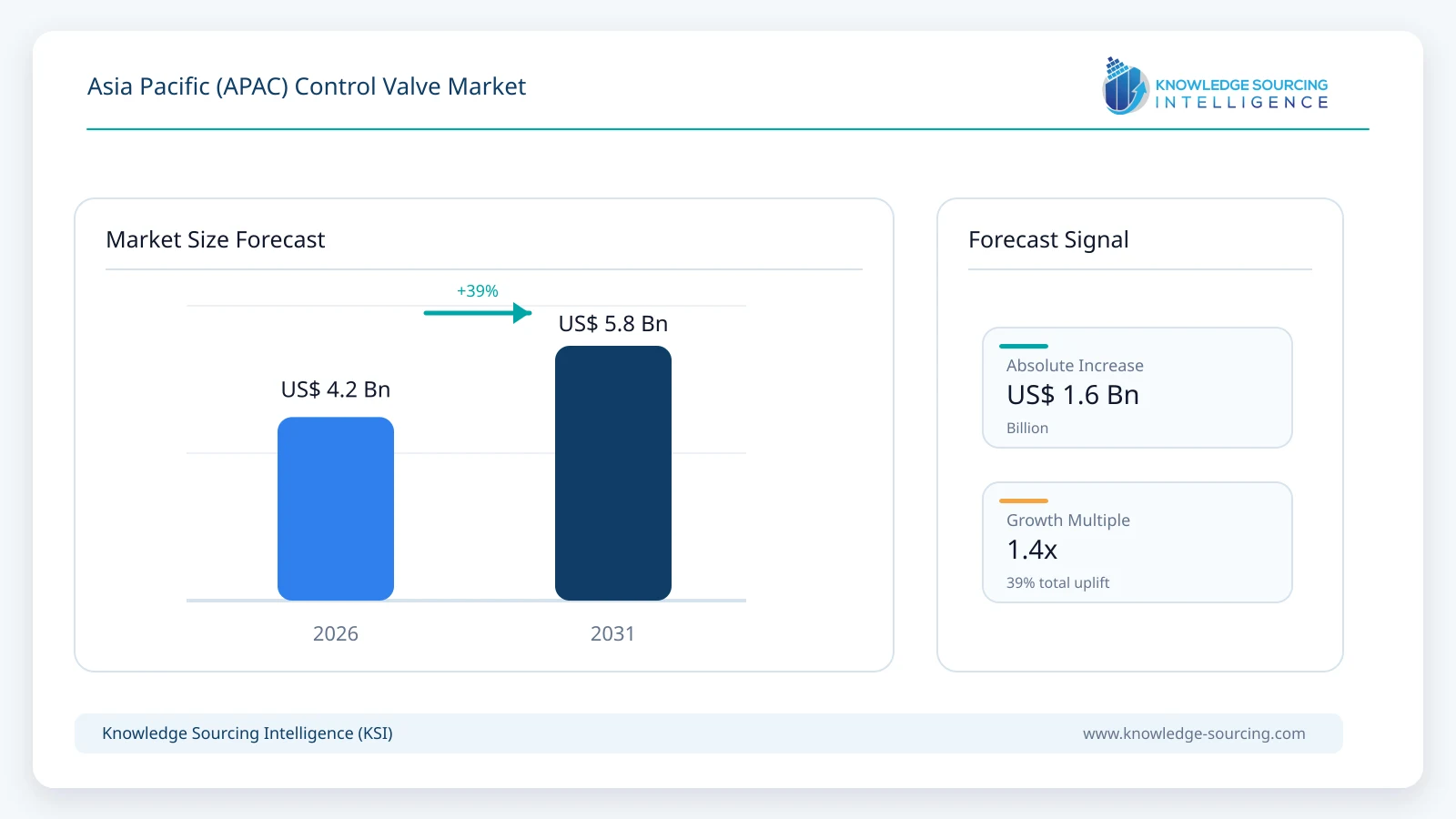
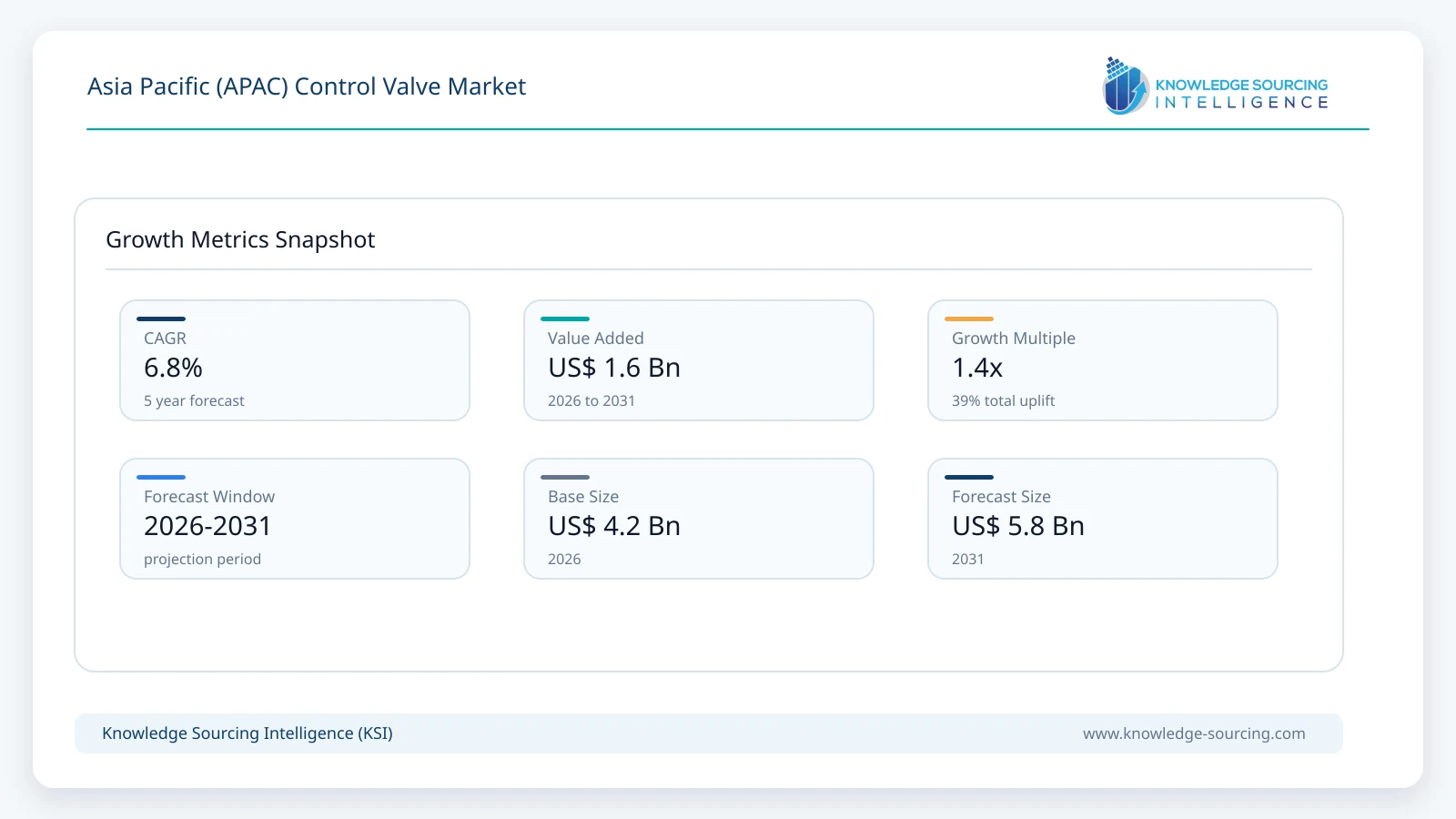
The Asia Pacific (APAC) control valves market is forecast to grow at a CAGR of 6.8%, reaching USD 5.79 billion in 2031 from USD 4.17 billion in 2026.
Highlights:
- 1Rapid expansion of energy, water, and industrial infrastructure continues to support control valve procurement across APAC.
- 2Digitalization of process industries is increasing demand for intelligent control valves with diagnostics and predictive maintenance capabilities.
- 3Oil and gas, power generation, and water treatment remain the principal end-user industries for engineered control valve solutions.
- 4Buyers increasingly prioritize lifecycle cost, reliability, emissions compliance, and aftermarket service over initial purchase price.
- 5Local manufacturing expansion and regional supply-chain diversification are reshaping competitive dynamics across Asia Pacific.
Investment patterns across Asia Pacific continue to favor industries requiring sophisticated flow control equipment. Energy infrastructure expansion, refinery modernization, chemical processing, water treatment projects, mining investments, and industrial manufacturing upgrades are creating sustained procurement opportunities for engineered valve manufacturers. The International Energy Agency reports that energy investment remains elevated across emerging Asian economies, supported by electricity demand growth, industrial expansion, and energy security priorities.
Purchasing decisions have become increasingly performance-oriented rather than price-driven. Industrial operators now evaluate control valves based on operating reliability, lifecycle maintenance costs, digital diagnostics, emissions performance, spare-part availability, and compatibility with distributed control systems (DCS) and industrial automation platforms. These considerations are particularly important in industries where valve failure can interrupt production or create safety risks.
Value creation within the market extends beyond original equipment sales. Engineering services, commissioning, predictive maintenance, retrofit programs, digital monitoring, spare parts, and lifecycle support generate recurring revenue for suppliers. Company disclosures from Emerson and IMI indicate continued emphasis on aftermarket services, severe-service applications, and intelligent valve technologies as customers seek higher plant availability and lower operating costs.
Key Market Indicators
Indicator | Latest Evidence | Commercial Meaning |
Global energy investment | US$3 trillion (2025) | Continued investment supports new industrial process facilities requiring flow control equipment. |
Commercial finance share of energy investment | 75% (2025) | Private-sector capital remains the primary funding source for industrial infrastructure projects. |
IMI Process Automation installed severe-service valves | Over 200,000 valves tracked | Large installed bases generate recurring aftermarket demand across process industries. |
IMI Process Automation order book | £875 million (2025) | Strong project pipeline reflects continued investment in LNG, conventional power, and nuclear applications. |
IMI aftermarket sales contribution | Approximately 45% of revenue | Lifecycle services remain a critical competitive differentiator in industrial valve markets. |
Market Drivers
Expansion of energy infrastructure across Asia Pacific.
Electricity demand continues to increase across China, India, Indonesia, and Southeast Asia, resulting in sustained investment in thermal generation, gas-fired power plants, LNG infrastructure, nuclear facilities, renewable integration, and electricity networks. These projects require large numbers of control valves for boiler systems, steam turbines, fuel handling, cooling systems, and process automation. The International Energy Agency reports continued growth in energy investment across emerging Asia, supported by industrial demand and energy security objectives. Equipment suppliers are responding by expanding engineering capabilities for severe-service applications, digital monitoring, and lifecycle maintenance to secure long-term project participation.
Modernization of process industries through industrial automation.
Manufacturers across refining, petrochemicals, chemicals, pharmaceuticals, and food processing are replacing conventional flow-control equipment with automated valve systems integrated into distributed control systems. Production facilities increasingly require higher operating precision, remote diagnostics, predictive maintenance, and lower unplanned downtime. Emerson identifies intelligent final control technologies, including control valves, actuators, regulators, and safety valves, as core components supporting process reliability and operational efficiency across industrial facilities. Suppliers are also investing in digital service platforms and predictive analytics that improve maintenance planning while reducing plant shutdowns.
Rising investment in water and wastewater infrastructure.
Rapid urban expansion, industrial water consumption, and tightening environmental regulations are increasing investment in municipal and industrial water treatment facilities throughout Asia Pacific. Control valves are essential for filtration, chemical dosing, pumping stations, desalination plants, sludge treatment, and distribution networks. Governments across the region continue expanding water infrastructure to improve service coverage and strengthen wastewater treatment capacity. Procurement increasingly favors corrosion-resistant materials, automated valve actuation, and equipment capable of operating under variable flow conditions, creating opportunities for suppliers offering specialized products with long service intervals.
Growing demand for lifecycle services and aftermarket solutions.
Industrial operators increasingly evaluate suppliers based on total ownership cost rather than equipment price alone. Preventive maintenance, replacement components, retrofit programs, digital condition monitoring, and rapid field service have become important procurement criteria. IMI reports that approximately 45% of company revenue is generated through aftermarket activities, while its installed-base monitoring supports identification of maintenance opportunities across thousands of industrial assets. This shift improves recurring revenue visibility for manufacturers while strengthening long-term customer relationships and increasing switching costs.
Market Restraints and Challenges
Extended qualification and procurement cycles for critical process industries.
Oil and gas, power generation, LNG, nuclear energy, and chemical processing facilities require extensive qualification, testing, certification, and engineering review before approving new valve suppliers. Procurement often involves multiple engineering contractors, plant operators, safety assessments, and regulatory approvals. These extended sales cycles delay revenue realization, particularly for smaller manufacturers with limited engineering resources. Although established suppliers benefit from proven operating histories, new entrants frequently face higher qualification costs before securing commercial contracts.
Persistent supply-chain exposure for engineered valve components.
Control valve production depends on specialized castings, forged materials, precision machining, actuators, sensors, electronic positioners, and high-performance sealing components sourced through global supply networks. Several industrial manufacturers continue identifying supply-chain disruptions, material availability, logistics costs, and supplier concentration as operational risks requiring ongoing mitigation through supplier diversification and inventory management. These constraints can extend delivery schedules for engineered valves serving severe-service industrial applications, particularly during periods of elevated project activity.
Pricing pressure from regional manufacturers.
Asia Pacific has a large base of domestic valve manufacturers capable of supplying standard industrial products at competitive prices. International suppliers compete primarily through engineering expertise, severe-service performance, digital capabilities, certification experience, and lifecycle support rather than price alone. This competitive environment places pressure on operating margins for commodity valve categories while encouraging multinational suppliers to concentrate on technically demanding applications where product reliability and service capabilities outweigh initial acquisition cost.
Increasing compliance requirements for emissions and process safety.
Industrial operators face stricter environmental and safety requirements governing fugitive emissions, functional safety, energy efficiency, and hazardous process operations. Manufacturers must continuously invest in product testing, material qualification, digital diagnostics, certification, and research to maintain compliance across multiple jurisdictions. While these requirements strengthen demand for premium engineered products, they also increase development costs, extend product approval timelines, and create additional barriers for smaller suppliers lacking specialized certification capabilities.
Major Segment Analysis
Oil and Gas End-user
Oil and gas remains one of the most commercially important end-user segments for control valves because upstream production, gas processing, refining, LNG facilities, and pipeline infrastructure all require precise flow regulation under demanding operating conditions. Procurement priorities extend beyond valve performance to include reliability under high pressure and temperature, resistance to corrosion, fugitive emissions compliance, and compatibility with plant automation systems. These requirements favor suppliers with proven engineering capability, comprehensive testing facilities, and established service networks.
Capital investment in LNG export terminals, refinery upgrades, petrochemical complexes, and natural gas infrastructure across China, India, Indonesia, and other Asia Pacific economies continues to support demand for severe-service control valves. Buyers typically require long product qualification cycles, documented operating performance, and lifecycle support agreements before supplier approval. Companies including Emerson, IMI, Crane, and GE Vernova compete by combining engineered valve solutions with digital diagnostics, predictive maintenance, field services, and spare-parts support. These capabilities reduce unplanned shutdowns and maintenance costs, making lifecycle value a decisive purchasing factor rather than initial equipment price.
Regional Analysis
China represents the largest concentration of industrial activity within the Asia Pacific control valve market due to its extensive refining, petrochemical, power generation, chemical manufacturing, and municipal infrastructure base. Continued investment in industrial modernization, LNG terminals, wastewater treatment, and energy infrastructure supports sustained demand for automated flow-control equipment. Domestic manufacturers compete aggressively in standard valve categories, while multinational suppliers remain well positioned in severe-service applications requiring advanced engineering, digital diagnostics, and compliance with international performance standards.
Japan's market is driven primarily by replacement demand rather than large-scale greenfield industrial expansion. Aging industrial facilities, stringent process safety standards, and continued investment in refinery upgrades, chemical processing, and power generation encourage the adoption of high-performance control valves with extended operating life and predictive maintenance capabilities. Buyers generally prioritize product reliability, precision, and lifecycle service over initial acquisition costs, creating opportunities for suppliers with proven operating performance and strong technical support.
India continues to generate demand through expansion of power generation capacity, refinery upgrades, water and wastewater infrastructure, pharmaceuticals, and industrial manufacturing. Government-backed investments in urban infrastructure and industrial corridors are increasing procurement of automated process equipment across multiple sectors. Purchasing decisions increasingly emphasize lifecycle cost, energy efficiency, and compatibility with industrial automation systems, encouraging manufacturers to expand local production, engineering support, and service capabilities.
South Korea, Indonesia, Vietnam, and Taiwan each contribute distinct sources of demand. South Korea's advanced shipbuilding, petrochemical, semiconductor, and power industries require highly reliable control valves for critical industrial processes. Indonesia continues investing in mining, LNG, oil and gas, and power infrastructure, supporting demand for severe-service valve applications. Vietnam's expanding manufacturing base, industrial parks, and water treatment projects are increasing procurement of industrial automation equipment. Taiwan's semiconductor and high-value electronics manufacturing industries require precision flow-control systems capable of maintaining stringent process stability and contamination control. Collectively, these markets are broadening the regional customer base while encouraging suppliers to strengthen local distribution networks, engineering services, and aftermarket support.
Competitive Landscape
Competition in the Asia Pacific control valve market combines global engineering companies with regional manufacturers serving standardized industrial applications. Emerson Electric Co., Crane, GE Vernova, IMI plc, and Pentair compete primarily through engineering capability, severe-service expertise, global certification, digital valve technologies, and comprehensive aftermarket support. Their established installed bases create recurring revenue opportunities through maintenance services, retrofit projects, spare parts, and long-term service agreements.
Regional manufacturers, including Shanghai Thinktank Process Management Co., Ltd. and Shanghai Shinjo Pump & Valve Co., Ltd., strengthen competition by supplying cost-effective products tailored to domestic industrial requirements. International suppliers increasingly localize manufacturing, expand regional engineering centers, diversify supplier networks, and invest in digital service platforms to improve delivery performance and customer support. High qualification requirements in energy, chemical, and LNG applications continue to create barriers to entry, while long-term customer relationships and installed equipment bases increase switching costs for industrial operators.
Recent Developments
July 2026: Valmet completed its acquisition of Severn Group. The acquisition strengthened Valmet's flow control business with severe-service control valve technologies, expanding capabilities for energy, chemicals, mining, and industrial customers across Asia-Pacific, including India.
June 2026: Flowserve completes the acquisition of Trillium Flow Technologies' Valves Division. The acquisition enhanced Flowserve's portfolio of mission-critical control valves and actuators for nuclear and conventional power projects, supporting growing infrastructure investments across Asia-Pacific.
September 2025: CIRCOR International completed the acquisition of Swelore Engineering and Hiro Nisha Systems in India. The acquisition expanded CIRCOR's industrial flow control portfolio, manufacturing footprint, and engineering capabilities serving process industries across the Asia-Pacific region.
Regulatory and Policy Environment
Industrial regulations increasingly influence control valve design, material selection, testing requirements, and purchasing decisions across the Asia-Pacific region. Environmental standards targeting fugitive emissions encourage industrial operators to adopt valve technologies that reduce leakage while maintaining operational reliability. Compliance with international standards issued by organizations such as the International Organization for Standardization (ISO) and the International Electrotechnical Commission remains an important qualification requirement for suppliers participating in energy and industrial infrastructure projects.
Governments across China, India, Japan, South Korea, and Southeast Asia continue expanding investment in electricity generation, water infrastructure, wastewater treatment, and industrial modernization through national development programs. Public procurement increasingly emphasizes equipment reliability, energy efficiency, lifecycle cost, and digital monitoring capabilities. At the same time, local-content policies in selected countries encourage manufacturers to establish regional production facilities, engineering centers, and supplier partnerships to improve market access and strengthen supply-chain resilience.
Safety regulations governing hazardous industrial environments also affect purchasing decisions. Industries including oil and gas, chemicals, mining, and power generation require certified control valves capable of operating safely under high-pressure and corrosive conditions. Suppliers therefore continue investing in product testing, certification, and engineering documentation to satisfy increasingly stringent customer and regulatory requirements.
Outlook and Strategic Implications
Demand fundamentals for the Asia Pacific control valve market are expected to remain supported by continued investment in energy infrastructure, industrial automation, water treatment, mining, and process manufacturing during the 2026-2031 forecast period. Growth opportunities are likely to be strongest where industrial operators modernize aging facilities, expand digital automation, and prioritize operational efficiency, emissions control, and predictive maintenance. While price competition will remain intense for standard valve categories, engineered products serving severe-service applications are expected to retain stronger pricing discipline because qualification requirements, technical complexity, and lifecycle performance remain decisive purchasing factors.
Strategic priorities across the value chain are likely to evolve in several areas:
Manufacturers: Expand regional production capacity, strengthen digital valve technologies, and increase aftermarket service capabilities.
Industrial buyers: Prioritize lifecycle cost, predictive maintenance, equipment reliability, and cybersecurity compatibility over initial purchase price.
Technology providers and system integrators: Develop integrated automation solutions that combine intelligent control valves with plant-wide monitoring and analytics platforms.
Policymakers: Continue supporting industrial modernization, water infrastructure, and energy investment while maintaining environmental and process safety standards.
Investors and distributors: Focus on companies with diversified end-user exposure, established installed equipment bases, and recurring service revenue, as these characteristics generally provide greater resilience against cyclical fluctuations in capital project spending.
Rather than relying solely on new project construction, future market performance will increasingly depend on retrofit activity, digital upgrades, lifecycle services, and the ability of suppliers to provide comprehensive engineering support across the operating life of industrial assets. These factors are expected to reinforce the competitive advantage of manufacturers capable of combining product reliability with regional manufacturing, technical expertise, and long-term customer service.
Asia Pacific (APAC) Control Valve Market Scope:
| Report Metric | Details |
|---|---|
| Total Market Size in 2026 | USD 4.17 billion |
| Total Market Size in 2031 | USD 5.79 billion |
| Forecast Unit | Billion |
| Growth Rate | 6.8% |
| Study Period | 2021 to 2031 |
| Historical Data | 2021 to 2024 |
| Base Year | 2025 |
| Forecast Period | 2026 – 2031 |
| Segmentation | Type, End-User, Country |
| Companies |
|
Market Segmentation
By Type
- Linear Valve
- Globe Valve
- Pinch Valve
- Others
- Rotary Valve
- Ball Valves
- Plug Valves
- Butterfly Valves
By End-User
- Oil and Gas
- Energy and Power
- Water and Wastewater Treatment
- Mining
- Others
By Country
- Japan
- China
- India
- South Korea
- Indonesia
- Vietnam
- Taiwan
- Others
Table of Contents
1. INTRODUCTION
1.1. Market Overview
1.2. Market Definition
1.3. Scope of the Study
1.4. Market Segmentation
1.5. Currency
1.6. Assumptions
1.7. Base and Forecast Years Timeline
1.8. Key Benefits for the Stakeholder
2. RESEARCH METHODOLOGY
2.1. Research Design
2.2. Research Processes
3. EXECUTIVE SUMMARY
3.1. Key Findings
4. MARKET DYNAMICS
4.1. Market Drivers
4.2. Market Restraints
4.3. Porter’s Five Forces Analysis
4.3.1. Bargaining Power of Suppliers
4.3.2. Bargaining Power of Buyers
4.3.3. Threat of New Entrants
4.3.4. Threat of Substitutes
4.3.5. Competitive Rivalry in the Industry
4.4. Industry Value Chain Analysis
4.5. Analyst View
5. ASIA PACIFIC (APAC) CONTROL VALVE MARKET BY TYPE
5.1. Introduction
5.2. Linear Valve
5.2.1. Globe Valve
5.2.2. Pinch Valve
5.2.3. Others
5.3. Rotary Valve
5.3.1. Ball Valves
5.3.2. Plug Valves
5.3.3. Butterfly Valves
6. ASIA PACIFIC (APAC) CONTROL VALVE MARKET BY END-USER
6.1. Introduction
6.2. Oil and Gas
6.3. Energy and Power
6.4. Water and Wastewater Treatment
6.5. Mining
6.6. Others
7. ASIA PACIFIC (APAC) CONTROL VALVE MARKET BY COUNTRY
7.1. Introduction
7.2. Japan
7.3. China
7.4. India
7.5. South Korea
7.6. Indonesia
7.7. Vietnam
7.8. Taiwan
7.9. Others
8. COMPETITIVE ENVIRONMENT AND ANALYSIS
8.1. Major Players and Strategy Analysis
8.2. Market Share Analysis
8.3. Mergers, Acquisitions, Agreements, and Collaborations
8.4. Competitive Dashboard
9. COMPANY PROFILES
9.1. Crane
9.2. General Electric
9.3. IMI PLC
9.4. Pentair
9.5. Emerson Electric Co.
9.6. SHANGHAI THINKTANK PROCESS MANAGEMENT CO., LTD
9.7. Shanghai Shinjo Pump & Valve Co., Ltd.
Navigate
Trusted by the world's leading organizations











