
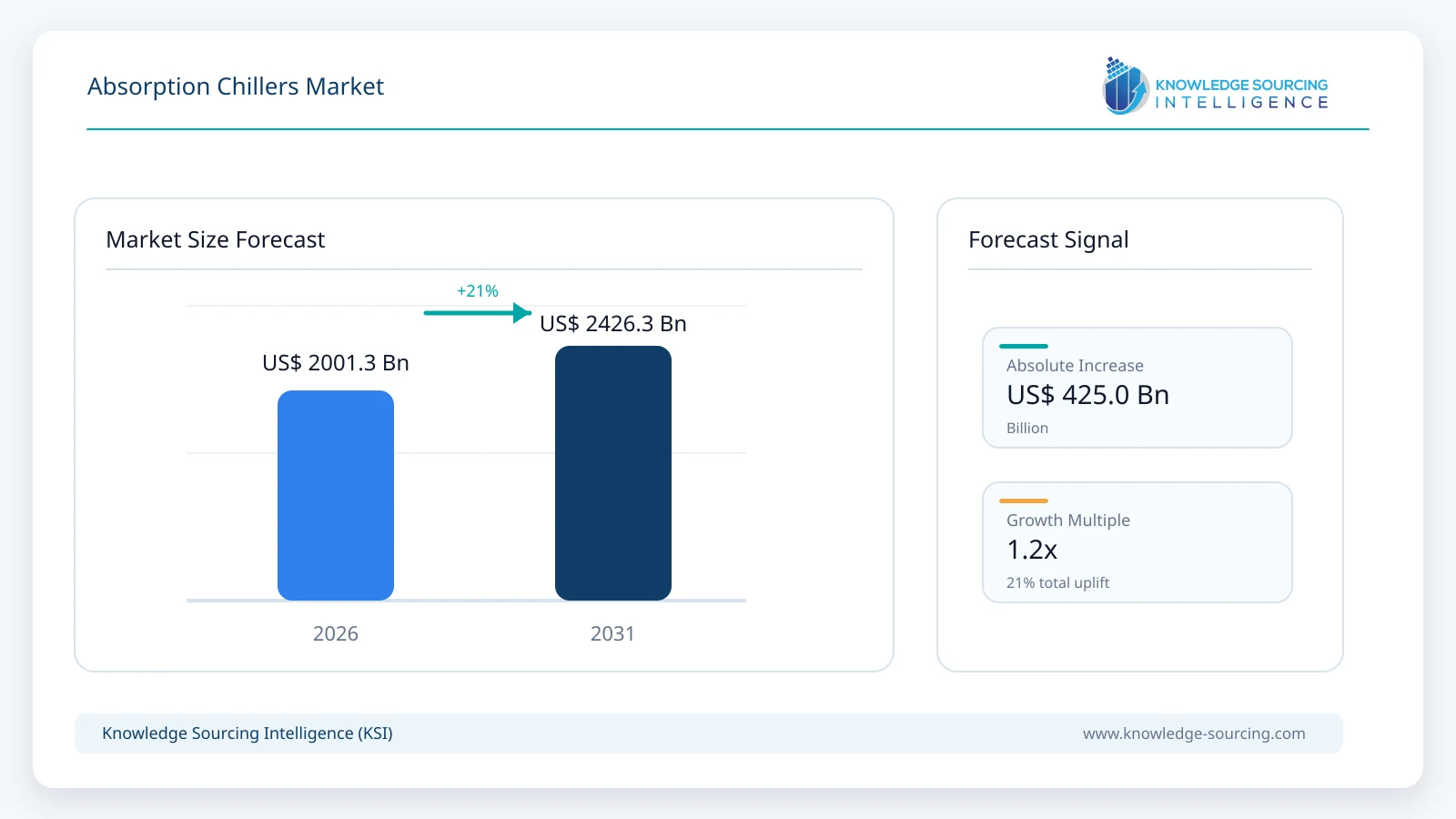
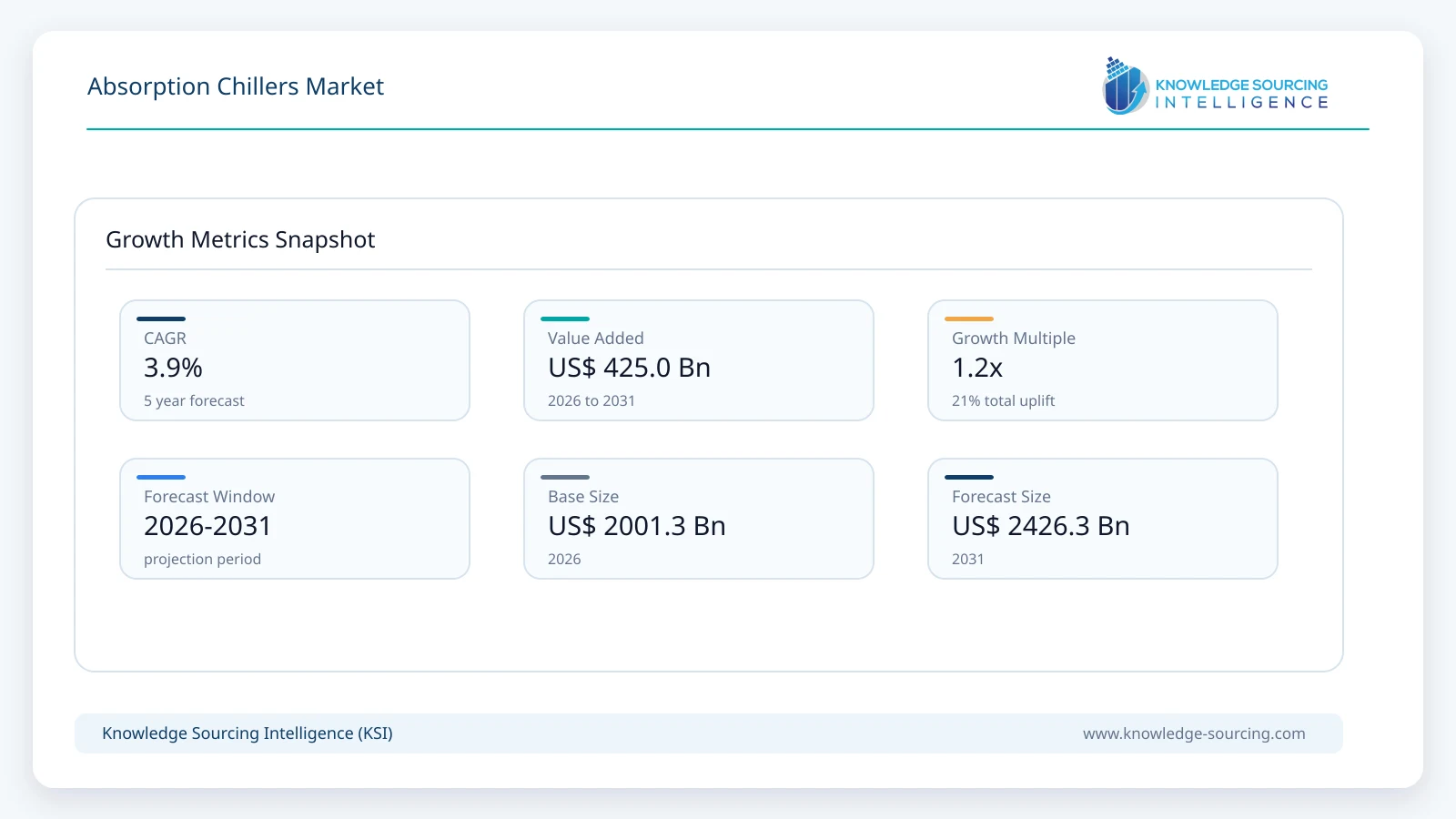
The Absorption Chillers market is set to reach USD 2,426.29 million in 2031, growing at a CAGR of 3.9% between 2026 and 2031, from USD 2,001.25 million in 2026.
Highlights:
- 1Advanced waste heat recoveryenhances absorption chiller efficiency by repurposing industrial by-products for sustainable cooling operations.
- 2Eco-friendly refrigerantsenable zero-GWP operation in absorption chiller systems while maintaining high-performance standards.
- 3Compact modular designssupport flexible deployment in space-constrained commercial and industrial cooling applications.
- 4Robust reliability featuresprovide extended service life for continuous operation in demanding environments.
Market Overview
The global absorption chillers market’s growth is being driven by increasing industrial efforts to improve energy efficiency, recover waste heat, reduce electricity consumption, and decarbonize heating and cooling operations. Absorption chillers use thermal energy rather than electricity as their primary driving source, making them particularly relevant for facilities with available steam, hot water, exhaust gases, or waste heat.
Industrial decarbonization is increasing demand for technologies that can recover and reuse otherwise wasted thermal energy.
Waste heat recovery is a major opportunity for absorption chillers, particularly in energy-intensive manufacturing and process industries. The U.S. Department of Energy estimates that 20%–50% of industrial energy input can be lost as waste heat.
Steam-driven absorption chillers can utilize low-pressure or waste steam to produce chilled water, supporting facilities with simultaneous heating, steam, and cooling requirements.
CHP integration is an important application, as absorption chillers can convert recovered thermal energy from combined heat and power systems into useful cooling.
Industrial process cooling remains a key application, particularly where conventional electrically driven cooling would increase peak electricity demand.
High-temperature heat pumps are gaining attention as an alternative pathway for industrial heat electrification. Their growing adoption is influencing investment decisions within integrated industrial energy systems.
Mechanical vapor recompression (MVR) is increasingly relevant for steam-intensive processes because it enables vapor to be recompressed and reused, reducing the requirement for additional steam generation.
Absorption chillers, high-temperature heat pumps, and MVR can serve complementary roles within customized industrial energy systems rather than being treated as interchangeable technologies.
Customized energy concepts are becoming increasingly important as industrial facilities seek solutions designed around their existing steam, heat, electricity, and cooling flows.
Single-effect and double-effect absorption chillers remain established technologies, while triple-effect systems offer higher efficiency where sufficiently high-temperature heat sources are available.
Working-fluid development continues to focus on improving efficiency, operating temperatures, environmental performance, and system reliability across water/lithium-bromide and ammonia/water configurations.
Digital controls and monitoring are improving system optimization, fault detection, energy management, and predictive maintenance for absorption chiller installations.
Energy-efficiency policies and industrial emissions-reduction initiatives are strengthening the business case for waste-heat recovery and heat-driven cooling technologies.
Chemical, food and beverage, pharmaceutical, petrochemical, oil and gas, manufacturing, and power-generation facilities provide significant opportunities for heat-driven cooling solutions.
Competition is expanding beyond conventional chiller manufacturers, with industrial energy-system providers increasingly competing through heat recovery, process integration, heat pumps, MVR, CHP, controls, and customized energy solutions.
Market Drivers
Growing Industrial Decarbonization Initiatives
The market is increasingly driven by the growing industrial decarbonization efforts. As manufacturers face stringent emissions targets and rising carbon costs, the pressure to reduce carbon emissions from process heat and steam is intensifying. This shift is reshaping demand toward integrated thermal systems that recover waste heat and displace fossil-fired boilers with electrified or heat recovery-based alternatives.
According to the International Energy Agency, industrial process heat accounts for a substantial share of global industrial energy consumption. A significant part of this heat is still produced by burning fossil fuels, making it one of the largest sources of unaddressed industrial emissions. As a result, it is a key target for retrofitting with absorption chillers and implementing heat recovery systems.
Under the EU Emissions Trading System and national carbon pricing schemes, energy-intensive sectors such as chemicals, food and beverage, and pulp and paper face rising costs for fossil-fired steam generation, creating a direct financial incentive to adopt absorption chillers paired with waste heat recovery to reduce both energy consumption and carbon liabilities.
The U.S. Department of Energy's Industrial Decarbonization Roadmap identifies waste heat recovery and high-efficiency thermal technologies, including absorption cooling and high-temperature heat pumps, as priority levers for cutting emissions from manufacturing, particularly in facilities where low-grade waste heat is currently vented rather than reused.
High-temperature heat pumps that deliver process heat above 150°C are increasingly deployed alongside absorption chillers in hybrid configurations, allowing a single facility to address both heating and cooling loads from recovered thermal energy rather than procuring them as separate utilities.
Mechanical vapor recompression (MVR) adoption is expanding in evaporation- and distillation-intensive processes, reducing live steam demand; the resulting low-grade heat streams are frequently routed to absorption chillers, improving overall site energy efficiency and lowering the carbon intensity of cooling.
Customized, site-specific energy concepts integrating absorption chillers with heat pumps, thermal storage, and waste heat recovery are gaining importance as industrial operators seek to optimize their specific heating, steam, and cooling requirements while improving energy efficiency and supporting decarbonization targets.
Natural refrigerant absorption cycles (lithium bromide-water and ammonia-water) are gaining preference in new industrial builds due to their low global warming potential, aligning with the EU F-Gas Regulation's phase-down of high GWP refrigerants used in conventional vapor compression cooling.
Major Segment Analysis
Industrial
By end-user, the absorption chillers market is segmented into industrial, commercial, and residential, where the industrial segment is expected to show considerable growth fueled by the decarbonization initiative undertaken by industrial operators.
Emphasis on energy cost-savings and grid independence supports innovation and development of chiller modules offering high COPs, which is expected to amplify the absorption chiller market scope globally. The industrial segment is expected to show considerable growth fueled by continued focus on decarbonizing industrial heating and steaming processes globally.
| Report Metric | Details |
|---|---|
| Total Market Size in 2026 | USD 2,001.25 million |
| Total Market Size in 2031 | USD 2,426.29 million |
| Forecast Unit | Milion |
| Growth Rate | 3.9% |
| Study Period | 2021 to 2031 |
| Historical Data | 2021 to 2024 |
| Base Year | 2025 |
| Forecast Period | 2026 – 2031 |
| Segmentation | Chiller Type, Capacity, Technology, Working Principle, Application, End-User, Region |
| Companies |
|
Industrial sectors account for nearly 30% of global energy consumption. With robust industrial growth various in global regions, the demand to decarbonize sectors, particularly cement & steel, is increasing, which drives the adoption scope.
Research studies, such as “Quantification of Global Waste Heat and Its Environmental Effect”, indicate that while industrial sectors account for 14% to 15% of global waste heat, the recoverable EL (Effluent/Exhaust Losses) in these sectors are approximately 44%. This presents new growth opportunities.
With nearly 20% to 50% of industrial energy input lost in waste heat, efforts are being made to upgrade industrial plants to improve waste heat recovery. Regions like the EU have implemented EED III (Energy Efficiency Directive) and RED III (Renewable Energy Directive) to reduce industrial heat, which is expected to support market trajectory.
Improved heat-pump deployment in industrial sectors, followed by policy & structural changes to incentivize industrial decarbonization, will positively influence adoption scale, especially in light industries. IEA’s “Heat Pump Monitor 2026” states that global heat pump uptake in light industries will grow from the current 1% to 8% (Under STEPS).
Geographical Outlook
North America: the US
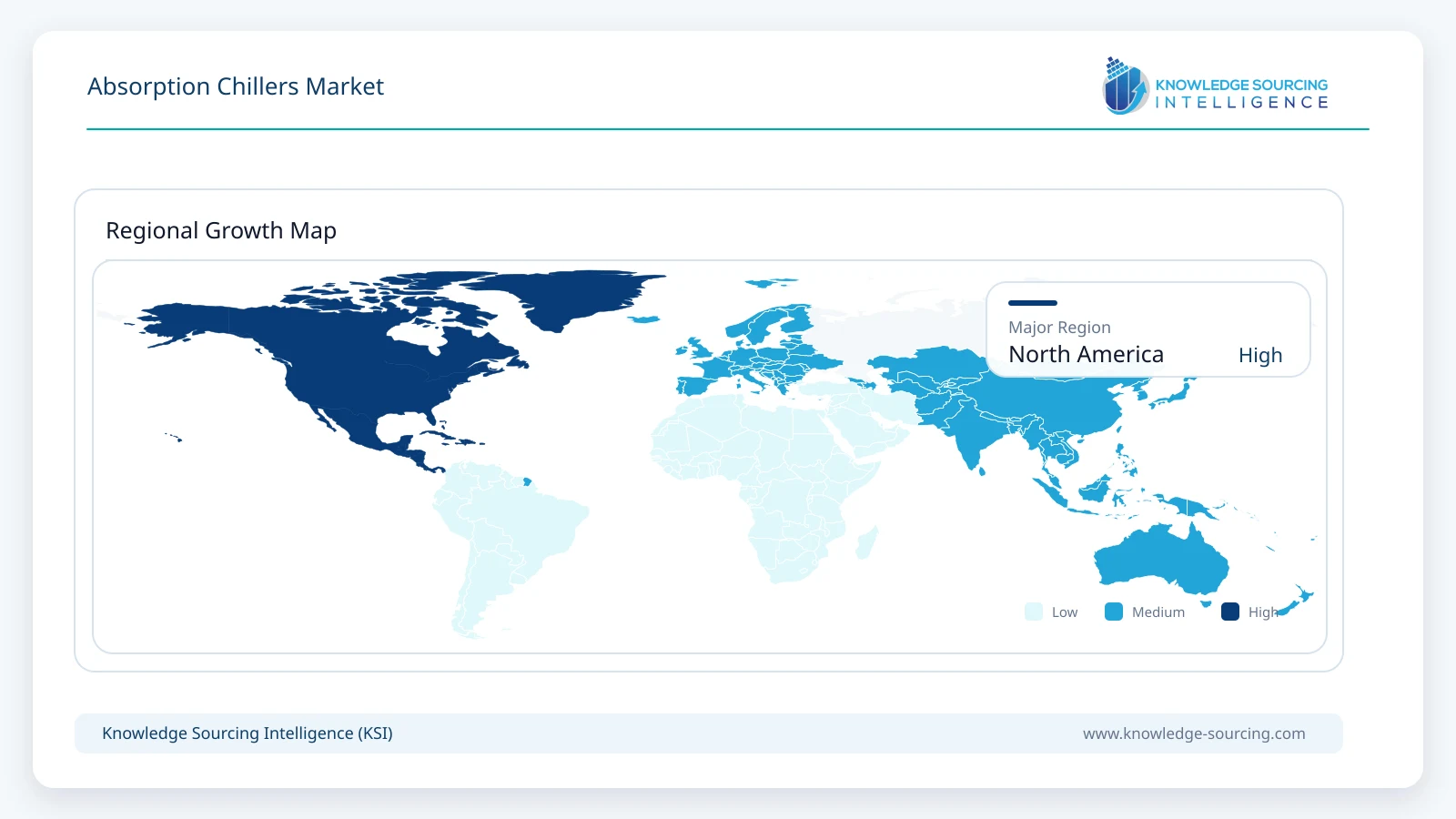
The United States absorption chillers market is projected to experience steady growth fueled by the increasing adoption of energy-efficient cooling systems, growing demand for waste heat recovery, expansion of combined heat and power (CHP) systems, and industrial decarbonization initiatives.
With a diversified portfolio across various sectors, the United States has shown considerable growth in its industrial productivity over the years, thereby amplifying its energy demand. Thus, the growing sustainable shift in sectors will escalate the waste energy recovery scenario in the US, propelling market scope.
The United States has also invested in WTE (Waste-To-Energy) facilities, with nearly 63 active WTEs operating across 18 US states. Absorption chillers are used in such facilities to convert excess thermal heat produced during waste incineration into chilled water for cooling. Efforts to improve WTE strength will stimulate the market trajectory in the US.
Billions of investments in AI workloads and data centers further propel energy consumption in the United States, and according to the “Annual Energy Outlook 2026”, server consumption will reach between 446 BkWh and 818 BkWh by 2050. Such high consumption will increase waste heat generation, thereby positively influencing the market’s demand.
Besides the industrial sector, which accounts for 33% of US energy consumption in 2025 (According to the US Energy Information Administration), the residential sector is also witnessing progression in consumption scale, which is further increasing transmission burden on grids. Hence, absorption chillers provide a significant alternative for cost savings in such scenarios, especially as natural gas consumption as fuel grows.
Ongoing market innovations in chiller chemistries to optimize energy efficiency for specific applications have established a new framework for the US market. For instance, Johnson Electric’s “Absorption Chiller Reference Design Guide” offers a blueprint for converting nearly 57% of waste heat from on-site power generation into productive cooling.
Key Developments
July 2026: Johnson Controls launched its Absorption Chiller Reference Design Guide for data centers, showing how waste heat from on-site generation can provide cooling while reducing electrical cooling demand by up to 44%.
September 2025: Yazaki launched its “world’s smallest class” absorption chiller unit, integrating the Aroace hot-water-fired chiller-heater with auxiliary equipment, cutting installation costs by approximately 30% and footprint by about 70%.
September 2025: Panasonic, Osaka Gas & Daigas Energy: The companies developed an absorption chiller compatible with 0–100% hydrogen/city-gas co-firing, with existing city-gas units potentially upgradeable through component replacement, supporting lower-carbon thermal cooling.
2025: Mitsubishi Heavy Industries Thermal Systems, Ltd. (MHI Thermal Systems), a part of Mitsubishi Heavy Industries (MHI) Group, is pleased to announce the launch of its newly developed magnetic bearing centrifugal chiller, the "ETI-N" series, for the Japanese market.
Company Profiles
Mitsubishi Heavy Industries (MHI), through its Thermal Systems subsidiary, pursues a strategy in the absorption chillers market centered on high-efficiency, large-capacity systems for district heating/cooling and industrial applications, while prioritizing overall thermal solutions that support energy efficiency, waste-heat recovery, and decarbonization.
Historically, MHI focused on advancing lithium bromide-water absorption technology using computational fluid dynamics for superior heat exchangers and lower steam consumption, targeting commercial buildings, factories, and district energy networks in Japan and select international markets. In recent years, the company has shifted greater emphasis toward centrifugal chillers with low-GWP refrigerants and magnetic-bearing designs for data centers and large-scale cooling, integrating absorption expertise into broader sustainable thermal portfolios.
Absorption Chillers Market Scope:
Market Segmentation
By Chiller Type
Direct
Natural Gas
Diesel/Fuel Oil
Indirect
Steam
Hot Water
Waste Heat
By Capacity
Below 100 kW
100 kW to 1,000 kW
Above 1,000 kW
By Technology
Single-Effect
Double-Effect
Triple-Effect
By Working Principle
Ammonia-Water
Lithium Bromide
By Application
Process Cooling
HVAC and Building Cooling
Waste Heat Recovery
Cogeneration / Combined Heat and Power (CHP)
District Cooling
Other Applications
By End-User
Industrial
Commercial
Residential
By Region
North America
USA
Canada
Mexico
South America
Brazil
Argentina
Others
Europe
United Kingdom
Germany
France
Spain
Italy
Others
Middle East and Africa
Saudi Arabia
UAE
Others
Asia Pacific
China
Japan
India
South Korea
Taiwan
Thailand
Indonesia
Others
Table of Contents
1. EXECUTIVE SUMMARY
2. MARKET SNAPSHOT
2.1. Market Overview
2.2. Market Definition
2.3. Scope of the Study
2.4. Market Segmentation
3. MARKET DYNAMICS
3.1. Market Drivers
3.2. Market Restraints
3.3. Market Opportunities
3.4. Porter’s Five Forces Analysis
3.5. Industry Value Chain Analysis
4. BUSINESS LANDSCAPE
4.1. Regulatory and Standards Landscape
4.2. Industrial Decarbonization and Energy Efficiency Landscape
4.3. Pricing and Cost Analysis
4.4. Procurement and Purchasing Landscape
4.5. Distribution and Service Landscape
4.6. Industrial Energy and Steam Process Analysis
5. TECHNOLOGY AND INNOVATION OUTLOOK
5.1. Absorption Chiller Technology Advancements
5.2. Single-Effect, Double-Effect, and Triple-Effect Technologies
5.3. Waste Heat Recovery and Heat-Driven Cooling
5.4. Advanced Heat Exchangers and Materials
5.5. Controls, Automation, and Digitalization
5.6. AI-Enabled Monitoring and Predictive Maintenance
5.7. Emerging Technologies and Future Trends
6. ABSORPTION CHILLERS MARKET BY CHILLER TYPE (2021-2031)
6.1. Introduction
6.2. Direct
6.2.1. Natural Gas
6.2.2. Diseal/Fuel Oil
6.3. Indirect
6.3.1. Steam
6.3.2. Hot Water
6.3.3. Waste Heat
7. ABSORPTION CHILLERS MARKET BY CAPACITY (2021-2031)
7.1. Introduction
7.2. Below 100 kW
7.3. 100 kW to 1,000 kW
7.4. Above 1,000 kW
8. ABSORPTION CHILLERS MARKET BY TECHNOLOGY (2021-2031)
8.1. Introduction
8.2. Single-Effect
8.3. Double-Effect
8.4. Triple-Effect
9. ABSORPTION CHILLERS MARKET BY WORKING PRINCIPLE (2021-2031)
9.1. Introduction
9.2. Ammonia-Water
9.3. Lithium Bromide
10. ABSORPTION CHILLERS MARKET BY APPLICATION (2021-2031)
10.1. Introduction
10.2. Process Cooling
10.3. HVAC and Building Cooling
10.4. Waste Heat Recovery
10.5. Cogeneration / Combined Heat and Power (CHP)
10.6. District Cooling
10.7. Other Applications
11. ABSORPTION CHILLERS MARKET BY END-USER (2021-2031)
11.1. Introduction
11.2. Industrial
11.3. Commercial
11.4. Residential
12. ABSORPTION CHILLERS MARKET BY REGION (2021-2031)
12.1. Introduction
12.2. North America
12.2.1. USA
12.2.2. Canada
12.2.3. Mexico
12.3. South America
12.3.1. Brazil
12.3.2. Argentina
12.3.3. Others
12.4. Europe
12.4.1. United Kingdom
12.4.2. Germany
12.4.3. France
12.4.4. Spain
12.4.5. Italy
12.4.6. Others
12.5. Middle East and Africa
12.5.1. Saudi Arabia
12.5.2. UAE
12.5.3. Others
12.6. Asia Pacific
12.6.1. China
12.6.2. Japan
12.6.3. India
12.6.4. South Korea
12.6.5. Taiwan
12.6.6. Thailand
12.6.7. Indonesia
12.6.8. Others
13. COMPETITIVE ENVIRONMENT AND ANALYSIS
13.1. Major Players and Strategy Analysis
13.2. Market Share Analysis
13.3. Mergers, Acquisitions, Agreements, and Collaborations
13.4. Competitive Dashboard
14. COMPANY PROFILES
14.1. Johnson Controls-Hitachi Air Conditioning
14.2. Thermax Limited
14.3. Broad Air Conditioning Co., Ltd.
14.4. Carrier Global Corporation
14.5. Trane Technologies Plc
14.6. Shuangliang Eco-Energy Systems Co., Ltd.
14.7. Kawasaki Thermal Engineering Co., Ltd.
14.8. Yazaki Energy Systems, Inc.
14.9. Ebara Corporation
14.10. Century Corporation
14.11. Robur S.p.A.
14.12. LG Electronics Inc.
14.13. Mitsubishi Heavy Industries, Ltd.
14.14. Bosch Home Comfort Group
15. RESEARCH METHODOLOGY
16. LIST OF FIGURES
Navigate
Trusted by the world's leading organizations











