
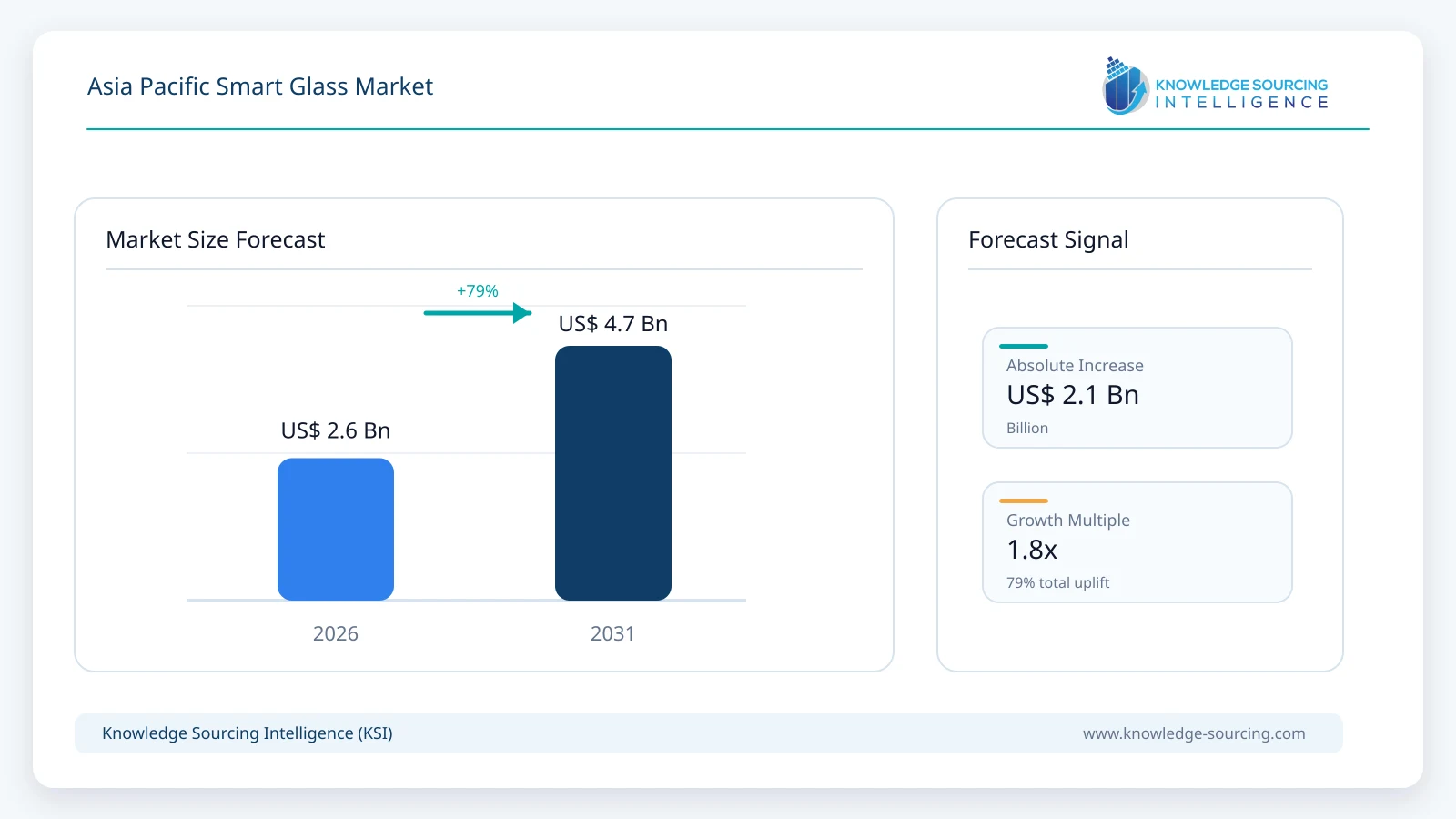
The Asia Pacific Smart Glass Market is forecast to grow at a CAGR of 12.3%, reaching USD 4.65 billion in 2031 from USD 2.60 billion in 2026.
Highlights:
- 1Automotive applications account for approximately 49% of Asia Pacific smart-glass revenue in 2026.
- 2PDLC-based systems represent about 35% of 2026 market value due to automotive and privacy-glass adoption.
- 3China contributes approximately 40% of Asia Pacific market revenue in 2026.
- 4India is expected to be the fastest-growing major country market through 2031.
- 5Asia-Pacific produced around 59.2 million vehicles in 2025, more than 61% of global output.
- 6EV and panoramic-roof adoption are accelerating the shift from passive glazing toward dynamic light control.
Asia Pacific has the strongest industrial foundation for smart-glass scaling because it is simultaneously a major producer of flat glass, automotive glass, vehicles, electronics and construction materials. OICA reported that Asia-Oceania produced approximately 59.2 million motor vehicles in 2025, up 7.6% from 2024 and representing more than 61% of global vehicle production. China alone produced 34.53 million vehicles, India 6.49 million, Japan 8.41 million and South Korea more than 4.1 million. This concentration gives smart-glazing suppliers access to the largest global OEM integration opportunity, especially as panoramic roofs, digital cabins and thermal-management features become more common across premium and upper-mass-market vehicles.
Electric-vehicle adoption strengthens the economics of advanced glazing. The International Energy Agency reported that more than 13 million electric cars were sold in China in 2025 and that electric vehicles represented nearly 55% of new-car sales. China also accounted for roughly three-quarters of global electric-car production. Battery-electric vehicles place greater value on reducing cabin heat load and HVAC energy consumption because thermal-management savings can support driving range and passenger comfort. Smart roofs and side glazing therefore move from aesthetic features toward functional energy-management components, particularly when combined with infrared-reflective coatings and low-emissivity layers.
The architectural market is developing more gradually but has a much larger long-term installed base. China introduced an updated green-product assessment standard for building glass in 2025 and a new national method for evaluating building-glass energy balance in 2026. Japan, South Korea, Singapore, Australia and major Indian cities are also tightening energy-performance expectations for commercial buildings. These policies do not mandate electrochromic or PDLC glass directly, but they increase the economic value of glazing systems that can reduce solar gain, glare and cooling demand while maintaining daylight. Adoption is therefore strongest in airports, premium offices, healthcare, hospitality, high-end residential projects and digitally managed façades rather than across commodity construction.
Market Trends
Automotive Smart Roofs Are Moving Beyond Luxury-Only Applications
Panoramic roofs have become one of the most visible adoption channels for smart glass in Asia Pacific. AGC markets integrated Digital Curtain solutions using SPD or PDLC technologies for roofs, rear windows and side glazing and has highlighted the technology’s ability to reduce solar heat, eliminate mechanical shades and save vehicle weight. Gauzy demonstrated fully operable SPD and PDLC smart sunroofs at CES 2025 and its dual-technology glazing was used in Mercedes-Benz’s Vision V shown at Auto Shanghai 2025. These developments indicate a shift from demonstration projects toward broader OEM engineering programs. China’s intense EV competition is likely to accelerate feature diffusion because domestic brands increasingly use panoramic roofs, intelligent cabins and premium comfort features to differentiate vehicles at lower price points than traditional luxury brands.
Smart Glass Is Becoming Part of a Wider Thermal-Management Stack
The commercial proposition is increasingly based on thermal performance rather than privacy alone. Smart glazing is being combined with low-E and infrared-reflective coatings, laminated safety glass, acoustic interlayers and electronic control units. AGC states that smart roof glazing can reduce HVAC use and improve vehicle range, while its newer panoramic roof concepts combine advanced coatings with dynamically controllable transparency. In buildings, the same logic applies to façades: dynamic glazing can reduce peak cooling loads while preserving daylight and exterior views. This broadens the addressable market from privacy partitions toward energy-management applications, raising average selling value per square metre.
China Is Building a Stronger Standards and Manufacturing Base
China’s manufacturing ecosystem is a key structural advantage. The country is already the world’s largest producer of vehicles, EVs, flat glass and many electronic components used in smart-glazing control systems. The 2025 Green Product Assessment for Building Glass and the 2026 Building Glass Energy Balance calculation method strengthen performance measurement and create a more standardized framework for high-performance glazing. Local fabrication capacity can reduce the integration and installation costs that have constrained smart glass in other regions. The presence of companies such as AGC, Gauzy, Saint-Gobain, Xinyi Glass, CSG Holding and multiple Chinese architectural glass processors also increases the likelihood that active glazing is offered as part of a broader façade or automotive module rather than as a specialist standalone product.
India and Southeast Asia Provide the Next Penetration Wave
India and Southeast Asia remain smaller smart-glass markets than China or Japan but have stronger percentage-growth potential. India produced about 6.49 million vehicles in 2025 and continues to add premium SUVs, EVs, commercial office space, airports and large hospitality projects. Southeast Asian EV markets are also expanding quickly; the IEA reported that electric-car sales in Asia Pacific markets outside China grew strongly in early 2026 and projected more than 50% sales growth for those markets in 2026. Lower smart-glass pricing, local lamination and regional manufacturing partnerships can therefore unlock adoption in applications that previously depended on imported premium systems.
Market Drivers
Automotive Production Scale and EV Feature Competition Expand the Addressable Base
The region’s 59.2 million-vehicle production base gives smart-glass suppliers an unusually large unit opportunity. Even modest penetration of dynamic roofs or privacy glazing can create meaningful volume because adoption is layered onto existing panoramic-roof growth. EV manufacturers also have stronger incentives to manage solar load, reduce HVAC demand and create differentiated digital cabins. As features move from luxury sedans into premium SUVs and upper-mass-market EVs, smart glazing gains both unit volume and geographic reach.
Energy-Efficiency Regulation Raises the Value of Dynamic Building Glazing
Building standards increasingly focus on whole-building energy use, solar gain and cooling efficiency. China’s 2026 energy-balance methodology for building glass is one example of a shift toward measuring performance across climates rather than relying on isolated U-values or shading coefficients. Similar efficiency priorities are present across Japan, South Korea, Singapore, Australia and India. Smart glass remains more expensive than conventional high-performance glazing, but projects with high cooling loads, glare-control requirements or premium occupant-experience objectives can justify the additional cost.
Regional Manufacturing and Electronics Integration Are Reducing Deployment Friction
Asia Pacific’s glass, electronics, film, automotive-component and façade supply chains enable deeper localization. Smart glazing requires more than a coated pane: films, busbars, laminates, controllers, wiring, sensors and software must be integrated into an automotive or building system. Regional production lowers logistics cost and shortens engineering cycles. It also supports modular supply models in which the glass supplier provides a complete controlled glazing assembly rather than a film or pane alone.
Market Restraints
Cost, Durability Qualification and Installation Complexity Limit Mass-Market Penetration
Smart glass continues to carry a significant price premium over conventional laminated, tinted or low-E glazing. Automotive products must pass long durability, optical-quality, temperature, impact and electrical qualification cycles, while architectural installations require specialized controls, wiring and integration with building-management systems. Replacement and repair costs can also be higher. These factors mean adoption expands first where the user values privacy, comfort, design or energy savings sufficiently to justify the premium. The forecast therefore assumes rapid penetration growth from a still-limited base rather than universal substitution for conventional glass.
Segment Analysis
By Technology - Polymer-Dispersed Liquid Crystal (PDLC)
PDLC is estimated to account for approximately 35% of Asia Pacific smart-glass revenue in 2026, making it the largest technology segment. Its principal advantage is rapid switching between transparent and diffused privacy states, which supports automotive roofs and side windows, office partitions, hospitality, healthcare and premium residential applications. The technology can be laminated into automotive-grade glass and paired with electronic controls, while architectural systems can be installed as laminated glazing or retrofit film. Electrochromic glass remains important for variable tint and solar-control applications and is expected to gain share in premium buildings and transport. SPD occupies a smaller but high-value segment, particularly in automotive applications requiring continuously variable shading and strong glare control.
By Application - Automotive
Automotive applications represent roughly 49% of Asia Pacific smart-glass market value in 2026. The segment is supported by the region’s dominant vehicle-production base and by the rapid diffusion of panoramic roofs across China, Japan, South Korea and India. Smart-glass content per vehicle can include roof panels, side windows, rear glazing and integrated display or privacy surfaces. Architectural and construction applications form the second-largest segment and are expected to accelerate as smart glazing becomes integrated into façade energy-management strategies. Transportation applications outside passenger cars, including rail, aviation and marine, remain smaller but support premium pricing because privacy, glare control and cabin comfort are important design requirements.
By Country - China
China is estimated to account for approximately 40% of Asia Pacific smart-glass revenue in 2026. The country combines the world’s largest vehicle-production base, more than 13 million electric-car sales in 2025, major domestic flat-glass production and a large pipeline of premium commercial construction. China’s smart-glass opportunity is therefore broader than automotive alone: office façades, transport hubs, luxury residential towers, healthcare and hospitality also contribute demand. India is expected to record the fastest growth among major markets as vehicle output, EV adoption and premium construction expand from a lower penetration base. Japan and South Korea remain technologically advanced markets with high-quality automotive and architectural glazing demand, while ASEAN and Australia provide additional growth through EV adoption and green-building investment.
Competitive Environment
Competition combines global glass manufacturers, specialist smart-glass technology companies and regional processors. AGC is particularly strong in automotive glazing and markets SPD- and PDLC-based Digital Curtain systems as integrated modules. Saint-Gobain participates through advanced automotive and architectural glazing, while Gauzy supplies SPD and PDLC light-control technologies and has expanded automotive collaborations in China and South Korea. Research Frontiers remains important through SPD intellectual property and licensing. View and Halio are more focused on dynamic architectural glazing, although their direct Asia-Pacific commercial footprint varies by country and project.
Regional glass groups including Xinyi Glass, CSG Holding, Nippon Sheet Glass, Central Glass, Fuyao Glass and Taiwan Glass strengthen local fabrication and OEM integration. Not every company produces proprietary active-glass chemistry; several compete through lamination, coating, processing, automotive module integration or façade delivery. This distinction is important because value is increasingly captured at the system level. Suppliers that can combine glass, film, controls, coatings, electronics and installation support are better positioned than vendors offering only a switching layer.
Recent Developments
April 2026: China published GB/T 47553-2026, introducing a national building-glass energy-balance calculation method for more climate-sensitive performance assessment.
March 2026: China issued GB/T 47395-2026 covering evaluation requirements for energy-saving and carbon-reduction technologies in the flat-glass industry.
2026: Asia-Pacific vehicle production reached a 2025 base of approximately 59.2 million units, strengthening the OEM addressable market for smart glazing.
April 2025: Gauzy smart-glass technology was incorporated into the Mercedes-Benz Vision V concept unveiled in Shanghai, combining SPD and PDLC in one glazing unit.
2025: AGC continued expanding Digital Curtain smart glazing for automotive roofs and windows, including PDLC and SPD options with integrated controls.
Asia Pacific Smart Glass Market Scope
| Report Metric | Details |
|---|---|
| Total Market Size in 2026 | USD 2.60 billion |
| Total Market Size in 2031 | USD 4.65 billion |
| Forecast Unit | Billion |
| Growth Rate | 12.3% |
| Study Period | 2021 to 2031 |
| Historical Data | 2021 to 2024 |
| Base Year | 2025 |
| Forecast Period | 2026 – 2031 |
| Segmentation | Technology, Application, Country |
| Companies |
|
Market Segmentation
By Technology
PDLC
Electrochromic
SPD
Thermochromic
Photochromic and Others
By Application
Automotive
Architecture and Construction
Transportation
Consumer and Specialty Applications
Others
By Country
China
Japan
South Korea
India
Australia
ASEAN
Rest of Asia Pacific
Table of Contents
1. EXECUTIVE SUMMARY
2. MARKET SNAPSHOT
2.1. Market Overview
2.2. Market Definition
2.3. Scope of the Study
2.4. Market Segmentation
3. BUSINESS LANDSCAPE
3.1. Market Drivers
3.1.1. Automotive Production Scale and EV Feature Competition Expand the Addressable Base
3.1.2. Energy-Efficiency Regulation Raises the Value of Dynamic Building Glazing
3.1.3. Regional Manufacturing and Electronics Integration Reduce Deployment Friction
3.2. Market Restraints
3.2.1. Cost, Qualification and Installation Complexity Limit Mass-Market Penetration
3.3. Market Opportunities
3.4. Porter’s Five Forces Analysis
3.5. Industry Value Chain Analysis
3.6. Policies and Regulations
3.7. Strategic Recommendations
4. TECHNOLOGICAL OUTLOOK
4.1. Electrochromic Glass
4.2. Suspended Particle Device (SPD) Glass
4.3. Polymer-Dispersed Liquid Crystal (PDLC) Glass
4.4. Thermochromic and Photochromic Glass
4.5. Control Electronics and Integrated Glazing Modules
5. ASIA PACIFIC SMART GLASS MARKET BY TECHNOLOGY
5.1. Introduction
5.2. PDLC
5.3. Electrochromic
5.4. SPD
5.5. Thermochromic
5.6. Photochromic and Others
6. ASIA PACIFIC SMART GLASS MARKET BY APPLICATION
6.1. Introduction
6.2. Automotive
6.3. Architecture and Construction
6.4. Transportation
6.5. Consumer and Specialty Applications
6.6. Others
7. ASIA PACIFIC SMART GLASS MARKET BY COUNTRY
7.1. Introduction
7.2. China
7.3. Japan
7.4. South Korea
7.5. India
7.6. Australia
7.7. ASEAN
7.8. Rest of Asia Pacific
8. COMPETITIVE ENVIRONMENT AND ANALYSIS
8.1. Major Players and Strategy Analysis
8.2. Market Share Analysis
8.3. Partnerships, Product Launches and OEM Integration
8.4. Competitive Dashboard
9. COMPANY PROFILES
9.1. AGC Inc.
9.2. Saint-Gobain S.A.
9.3. Gauzy Ltd.
9.4. Research Frontiers Inc.
9.5. Nippon Sheet Glass Co., Ltd.
9.6. Fuyao Glass Industry Group Co., Ltd.
9.7. Xinyi Glass Holdings Limited
9.8. CSG Holding Co., Ltd.
9.9. Central Glass Co., Ltd.
9.10. Taiwan Glass Industry Corporation
9.11. Gentex Corporation
9.12. View, Inc.
9.13. Halio, Inc.
9.14. Polytronix, Inc.
9.15. Smartglass International Ltd.
9.16. RavenWindow
9.17. ChromoGenics AB
9.18. Glass Apps, LLC
10. APPENDIX
10.1. Currency
10.2. Assumptions
10.3. Base and Forecast Years Timeline
10.4. Key Benefits for Stakeholders
10.5. Research Methodology
10.6. Abbreviations
Navigate
Trusted by the world's leading organizations











