
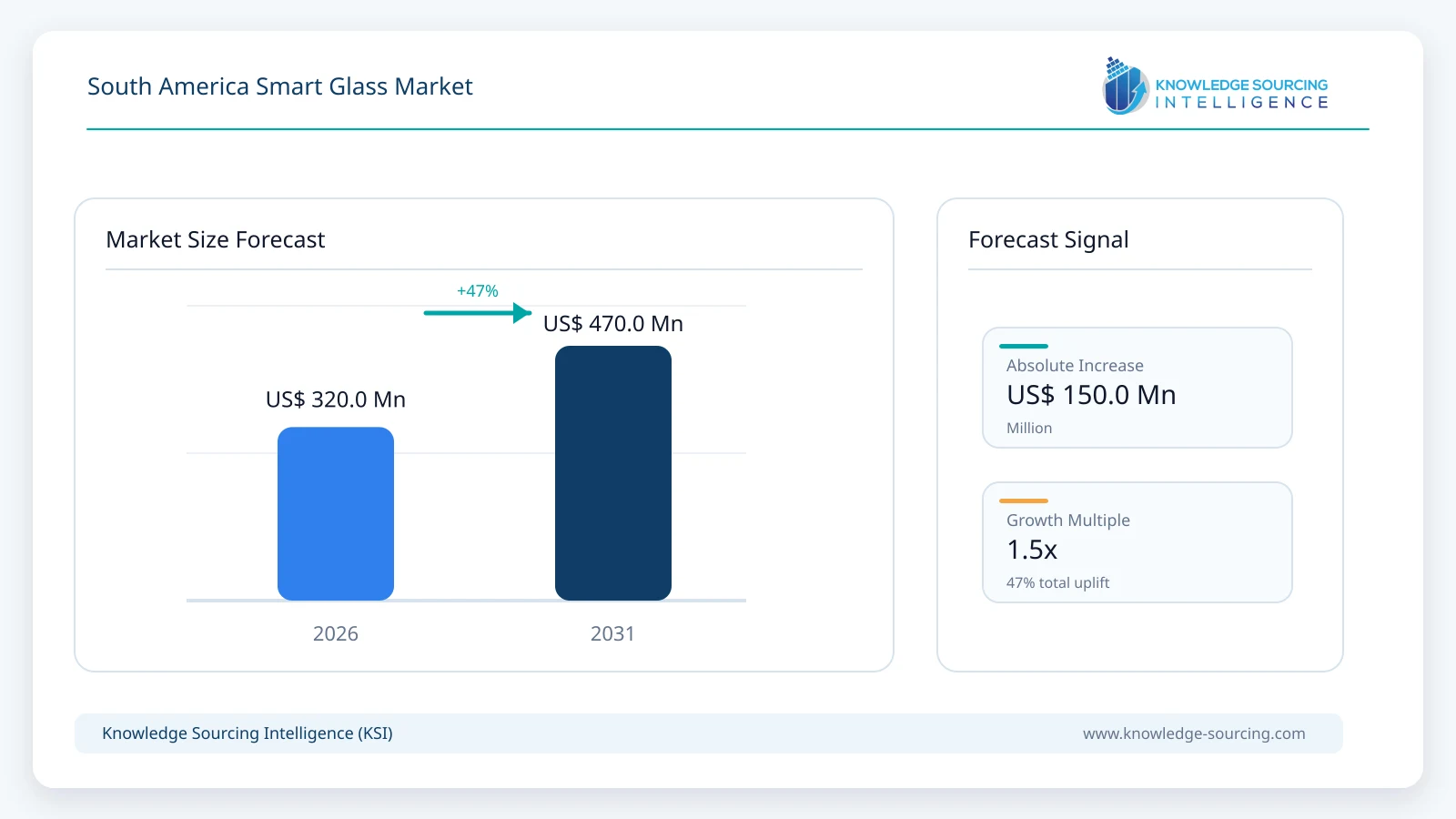
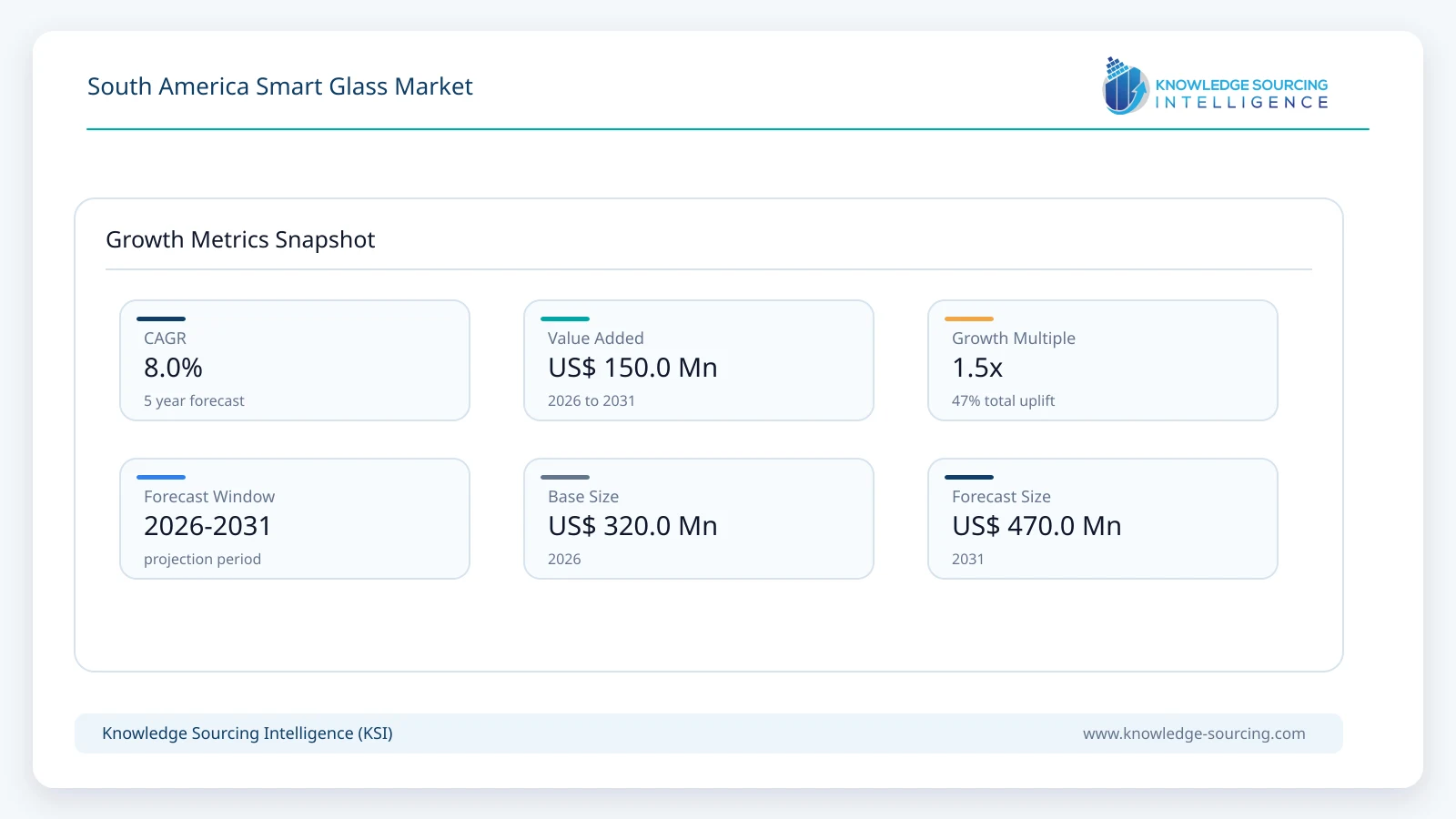
The South America smart glass market is estimated at USD 320 million in 2026 and is projected to reach USD 470 million by 2031, growing at approximately 8.0% annually.
Highlights:
- 1Electrochromic technology accounts for approximately 51% of South America smart-glass revenue in 2026.
- 2Automotive applications generate approximately USD 109 million of regional market value in 2026.
- 3PDLC smart glass is projected to expand at about 9.4% annually through 2031.
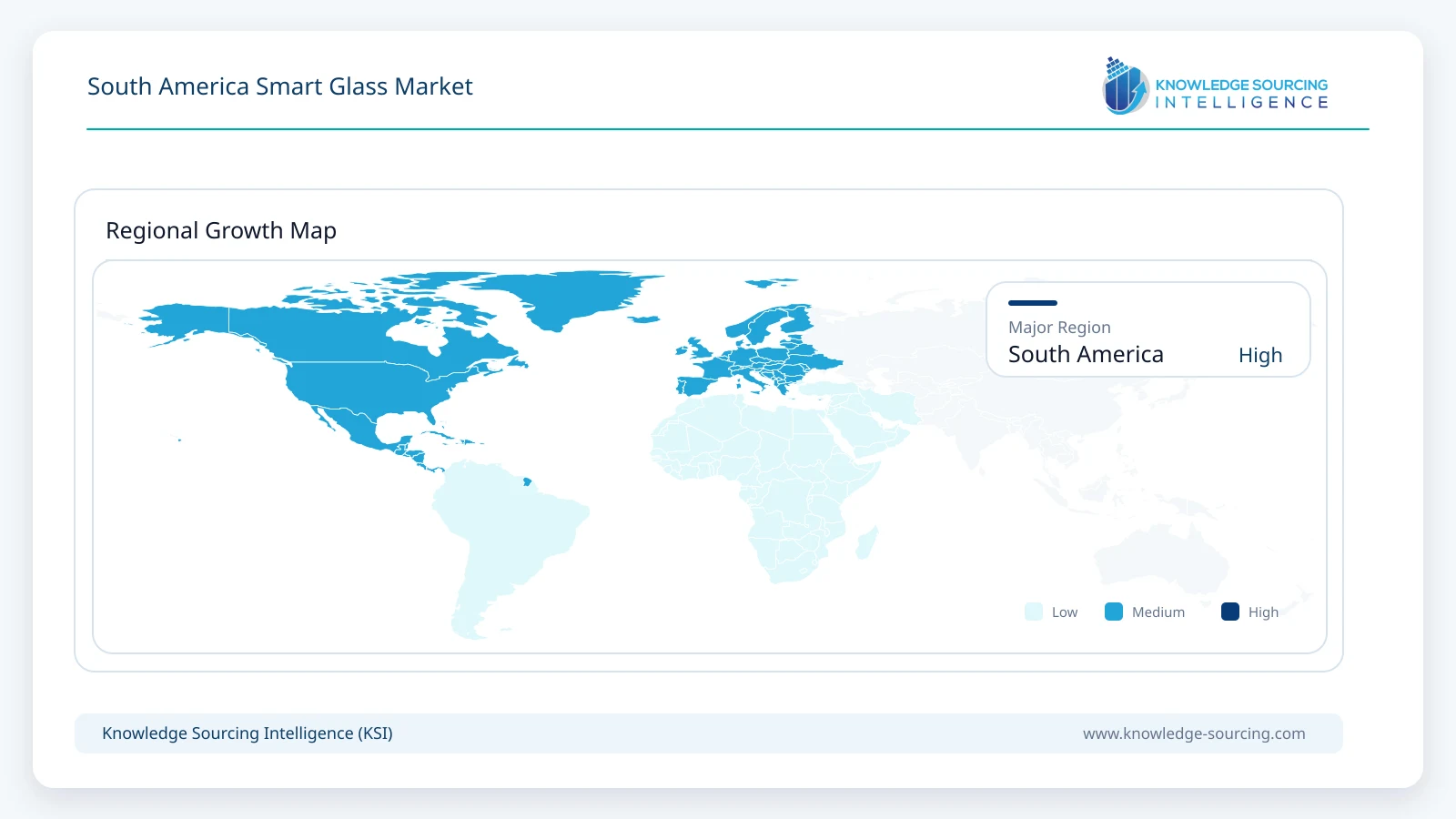
- 4Brazil contributes approximately 64% of South America smart-glass revenue in 2026.
- 5Brazilian vehicle registrations are projected to exceed three million units during 2026.
- 6High imported-system costs keep smart glazing concentrated in premium vehicles and commercial projects.
South America's smart-glass opportunity sits at the intersection of a large conventional glass market and a much smaller dynamic-glazing segment. Brazil is the commercial centre because it combines the region's largest automotive industry, a sizeable flat-glass manufacturing and processing base, major office and healthcare construction, and the deepest network of multinational glazing suppliers. Argentina, Chile and Colombia form the next tier, but their demand is more project-specific and dependent on imported finished units, films, controls or coated glass. For this reason, KSI does not treat total flat glass, automotive glass or energy-efficient coated glass as smart-glass revenue. Only glazing with a controllable or responsive optical state is included.
The automotive channel provides the clearest scale anchor. ANFAVEA reported that Brazil produced 2.644 million vehicles in 2025 and revised its 2026 domestic-registration outlook upward to more than 3 million units. That does not mean smart glass is standard equipment: adoption remains concentrated in premium panoramic roofs, auto-dimming mirrors, selected sunroofs, HUD-related glazing and emerging light-control surfaces. However, the vehicle base establishes a large addressable platform for suppliers such as Gentex, Gauzy, AGC, Saint-Gobain Sekurit and NSG/Pilkington as global OEM technologies migrate into locally sold vehicles. Electrification and larger glazed roof areas strengthen the value proposition because heat and glare management directly affect cabin comfort and air-conditioning load.
Architecture develops differently. Brazil's construction sector returned to growth in early 2026, with CBIC reporting a 2.9% quarter-on-quarter increase in the first quarter after a weak end to 2025. Sustainable-building standards are also becoming more formalized. Brazil published ABNT NBR 17296 for sustainability in flat glass in May 2026 under the Selo Verde Brasil framework, while Chile and Colombia continue expanding green-building and LEED-oriented programs. These developments improve the specification environment for advanced façades and interior privacy glazing, but they do not remove the main barrier: dynamic glass remains substantially more expensive than conventional solar-control glass, blinds or applied films. Consequently, commercial offices, healthcare, hospitality, luxury residential projects and high-value transport applications account for a disproportionate share of demand.
Market Trends
Automotive Smart Glass Is Moving Beyond Mirrors Toward Larger Glazed Surfaces
Electrochromic mirrors are the most established smart-glass application in mobility, but the technology set is widening. Gentex now demonstrates film-based electrochromic sunroofs and dimmable visors in addition to its large auto-dimming mirror base. Gauzy has moved SPD smart glass into serial production on the Cadillac CELESTIQ and has introduced prefabricated smart-glass stacks intended to simplify integration by Tier-1 glass processors and vehicle manufacturers. Its Mercedes-Benz Vision V demonstrator combines SPD and PDLC across a large portion of the vehicle glazing. These global developments matter to South America because premium vehicles are typically the first route through which advanced glazing reaches the region. Local penetration will depend on model mix and imported-component economics, but the technology is increasingly compatible with panoramic roofs, EV thermal management, privacy and display functions rather than being restricted to mirrors.
Commercial Interiors Are Broadening the Role of PDLC Privacy Glass
PDLC has a different economic proposition from electrochromic façade glass. It switches rapidly between transparent and diffuse states, making it suitable for conference rooms, healthcare partitions, hospitality, premium bathrooms and other interior spaces where visual privacy is more important than solar control. The technology can also be supplied as laminated smart glass or retrofit film, reducing project complexity compared with replacing a full façade. This is relevant in South America, where imported high-specification dynamic façades can be difficult to justify but high-value interior fit-outs remain active. PDLC therefore gains share through localized fabrication and retrofit channels even though electrochromic systems retain higher average selling prices in exterior architectural and transport applications.
Smart Glass Procurement Is Becoming More Closely Linked to Sustainability Metrics
Dynamic glazing has historically been sold on aesthetics, privacy and occupant comfort. Procurement is increasingly tied to measurable solar-gain, daylight and energy-performance outcomes. Saint-Gobain continues to position SageGlass around automatic sunlight management and reduced cooling demand, while thermochromic suppliers such as RavenWindow emphasize passive heat and glare control without electrical wiring. In South America, the opportunity is strongest where developers are already pursuing LEED, WELL, local sustainability standards or low-carbon financing. Chile's 2025 Green Building Market Report and Colombia's continuing LEED activity illustrate a more mature specification environment. The effect is gradual rather than immediate: smart glass is moving from a design novelty toward one of several building-envelope technologies that can support verified environmental performance.
Market Drivers
Brazilian Automotive Scale Creates a Large Addressable Platform for Advanced Glazing
Brazil's vehicle industry is the largest in South America and remains the main volume channel for automotive glazing. ANFAVEA reported 2.644 million vehicles produced in 2025 and, after stronger-than-expected demand in the first half of 2026, raised its forecast for domestic registrations to above 3 million vehicles. Smart-glass penetration remains low relative to conventional windshields, side glass and sunroofs, but the addressable installed base is sufficiently large for premium technologies to scale without requiring mass-market adoption. As panoramic roofs, HUD systems, sensor-integrated glass and EV thermal-management features become more common globally, regional OEM programs and imported premium models create a steady route for electrochromic and SPD content.
Green-Building and Cooling Requirements Support Higher-Performance Facades
South American commercial buildings operate across climates where glare and cooling loads can be material operating costs. Dynamic glazing can reduce solar heat gain while preserving daylight and exterior views, giving it a differentiated role in offices, airports, hospitals, hospitality and institutional buildings. Brazil's sustainability standard for flat glass, Chile's continued expansion of green-building programs and Colombia's LEED-oriented urban initiatives strengthen the design environment for high-performance glazing. Adoption is still selective because conventional low-E, reflective or shaded façades remain cheaper, but smart glass becomes more attractive in projects that value premium occupant experience, façade transparency and automated building controls.
A Regional Glass-Processing Base Reduces Some Integration Barriers
Brazil hosts substantial automotive and architectural glass operations from multinational suppliers and domestic processors, including NSG/Pilkington and Saint-Gobain businesses. This does not mean electrochromic or SPD layers are widely manufactured locally, but it gives the market established capabilities in lamination, tempering, glazing integration and automotive quality systems. Smart-glass suppliers increasingly design films and stacks that can be incorporated by existing processors rather than requiring a vertically integrated smart-window factory. Gauzy's prefabricated smart-glass stack strategy is an example of this shift. Over time, easier integration should reduce project risk and allow regional fabricators to participate in higher-value smart-glazing supply chains.
Market Restraints
Imported Technology, Currency Volatility and High Installed Cost Limit Mainstream Adoption
Most advanced electrochromic films, SPD materials, controllers and specialized processing inputs are sourced from outside South America. The delivered cost is therefore exposed to exchange rates, tariffs, logistics and relatively small order volumes. Brazil has active anti-dumping measures covering several automotive and flat-glass import categories, illustrating the broader trade complexity surrounding the regional glass market. Smart glass can cost several times more than conventional glazing, and many projects can achieve acceptable solar control through low-E glass, external shading or applied films at lower upfront cost. This keeps the market concentrated in applications where privacy, dynamic tinting, premium design or automation provides value beyond energy savings alone.
Specification, Controls and After-Sales Capability Remain Uneven
A smart-glass installation is not only a pane of glass. Active systems may require power, controls, sensors, building-management integration, commissioning and specialist troubleshooting. Architects and façade contractors need to understand switching performance, tint range, wiring, lamination, edge sealing and replacement procedures. The regional installer and integrator base is improving but remains shallower than in North America, Europe or parts of Asia. This raises perceived project risk and can make developers prefer established shading systems. Suppliers able to provide local technical support, certified processors and clear lifecycle warranties are therefore better positioned than companies selling smart films as isolated components.
South America Smart Glass Market Segment Analysis
By Technology
Electrochromic Glass
Electrochromic glass is the largest technology segment in South America because of its established use in auto-dimming mirrors and its suitability for premium exterior glazing where variable tint and solar control are more important than instant privacy. KSI estimates electrochromic revenue at approximately USD 163 million in 2026. Automotive mirrors provide the most mature volume base, while architectural applications have higher unit values but remain project-led. The segment benefits from continued product development by Gentex, Saint-Gobain SageGlass, AGC and other global glass companies. Growth is constrained by cost and switching-speed requirements in some applications, which creates room for SPD in automotive roofs and PDLC in interior privacy. Nevertheless, electrochromic systems remain the most commercially established active smart-glass category across the region.
By Application
Automotive
Automotive is the largest individual application, supported primarily by Brazil's vehicle market and premium imports across the region. Demand includes auto-dimming mirrors, dimmable roofs and sun visors, light-control sunroof modules and emerging smart-glazing surfaces integrated with displays or sensors. Brazil's production scale creates the largest installed platform, while Argentina contributes through its own automotive manufacturing base and regional supply chains. The application grows faster than conventional automotive glass because smart content per vehicle rises even when vehicle unit growth is moderate. KSI expects penetration to remain concentrated in premium and upper-mid vehicles through 2031 rather than becoming a mass-market standard across all models.
By Country
Brazil
Brazil is estimated to generate approximately USD 205 million of smart-glass revenue in 2026. Its lead reflects the combination of automotive production, the largest construction economy in South America, local glass-processing capacity and a greater number of premium commercial developments.
Architecture and automotive each provide meaningful demand, while healthcare, corporate interiors and hospitality support PDLC privacy installations. Brazil's new sustainability standard for flat glass and continued expansion of property financing can improve the specification environment, but high interest rates and imported smart-glass costs limit the speed of adoption. Argentina, Chile and Colombia follow at materially smaller values, with Chile standing out for green-building maturity and Colombia for LEED-oriented urban development.
Competitive Environment
The competitive structure is global because the highest-value smart-glass technologies are controlled by international material, film and glazing companies, while regional fabricators and installers provide lamination, framing, controls and project integration. Gentex is strongest in automotive electrochromics and ships tens of millions of electrochromic devices globally. Gauzy combines PDLC and SPD technologies and has expanded from films into complete smart-glass stacks, automotive serial production, aeronautics and architecture. Research Frontiers licenses SPD technology, while Saint-Gobain markets SageGlass dynamic architectural glazing and participates in automotive glass through Sekurit. AGC and NSG/Pilkington combine advanced automotive and architectural glass capability with large-scale global processing networks.
The architectural segment is more fragmented. Polytronix and Smartglass International compete in privacy and switchable glazing, ChromoGenics offers electrochromic façade solutions, RavenWindow focuses on thermochromic glazing, and Halio positions fast-switching electrochromic systems for buildings. In South America, winning projects depends less on local manufacturing scale than on the availability of processors and installers capable of delivering finished units, controls and warranties. This favors suppliers that can certify local partners and adapt products to regional façade and electrical practices.
Recent Developments
September 2026: Brazil maintained anti-dumping measures on selected imported float-glass products, reinforcing the importance of regional processing economics and supply-chain planning.
July 2026: ANFAVEA raised its Brazilian 2026 vehicle-registration forecast to above three million units after stronger first-half domestic demand.
June 2026: NSG Group introduced Pilkington Mirai One, a lower-embodied-carbon float-glass platform for architectural applications.
May 2026: Brazil published ABNT NBR 17296 for sustainable flat glass under the Selo Verde Brasil program.
April 2026: Saint-Gobain highlighted expanded SageGlass dynamic-glazing use for skylights and high-solar-load architectural applications.
January 2026: Gentex presented next-generation film-based electrochromic sunroofs and dimmable visors at CES 2026.
July 2025: Gauzy and Research Frontiers moved SPD smart glass into serial production on the Cadillac CELESTIQ and introduced a prefabricated automotive smart-glass stack.
South America Smart Glass Market Scope:
| Report Metric | Details |
|---|---|
| Total Market Size in 2026 | USD 320 million |
| Total Market Size in 2031 | USD 470 million |
| Forecast Unit | Million |
| Growth Rate | 8.0% |
| Study Period | 2021 to 2031 |
| Historical Data | 2021 to 2024 |
| Base Year | 2025 |
| Forecast Period | 2026 – 2031 |
| Segmentation | Technology, Application, Country |
| Companies |
|
Market Segmentation
BY TECHNOLOGY
Thermochromic Glass
Suspended Particle Device (SPD) Glass
Electrochromic Glass
Liquid Crystal / PDLC Glass
Photochromic Glass
Others
BY APPLICATION
Automotive
Architecture and Construction
Transportation
Power Generation
Consumer Electronics
Others
BY COUNTRY
Brazil
Argentina
Chile
Colombia
Rest of South America
Table of Contents
1. EXECUTIVE SUMMARY
2. MARKET SNAPSHOT
2.1. Market Overview
2.2. Market Definition
2.3. Scope of the Study
2.4. Market Segmentation
3. BUSINESS LANDSCAPE
3.1. Market Drivers
3.1.1. Brazilian Automotive Scale Creates a Large Addressable Platform for Advanced Glazing
3.1.2. Green-Building and Cooling Requirements Support Higher-Performance Facades
3.1.3. A Regional Glass-Processing Base Reduces Some Integration Barriers
3.2. Market Restraints
3.2.1. Imported Technology, Currency Volatility and High Installed Cost Limit Mainstream Adoption
3.2.2. Specification, Controls and After-Sales Capability Remain Uneven
3.3. Market Opportunities
3.4. Porter's Five Forces Analysis
3.5. Industry Value Chain Analysis
3.6. Policies and Regulations
3.7. Strategic Recommendations
4. TECHNOLOGICAL OUTLOOK
4.1. Electrochromic Glass
4.2. Suspended Particle Device (SPD) Glass
4.3. Polymer Dispersed Liquid Crystal (PDLC) Glass
4.4. Thermochromic Glass
4.5. Photochromic and Other Responsive Glazing
5. SOUTH AMERICA SMART GLASS MARKET BY TECHNOLOGY
5.1. Introduction
5.2. Thermochromic Glass
5.3. Suspended Particle Device (SPD) Glass
5.4. Electrochromic Glass
5.5. Liquid Crystal / PDLC Glass
5.6. Photochromic Glass
5.7. Others
6. SOUTH AMERICA SMART GLASS MARKET BY APPLICATION
6.1. Introduction
6.2. Automotive
6.3. Architecture and Construction
6.4. Transportation
6.5. Power Generation
6.6. Consumer Electronics
6.7. Others
7. SOUTH AMERICA SMART GLASS MARKET BY COUNTRY
7.1. Introduction
7.2. Brazil
7.3. Argentina
7.4. Chile
7.5. Colombia
7.6. Rest of South America
8. COMPETITIVE ENVIRONMENT AND ANALYSIS
8.1. Major Players and Strategy Analysis
8.2. Market Share Analysis
8.3. Mergers, Acquisitions, Agreements and Collaborations
8.4. Competitive Dashboard
9. COMPANY PROFILES
9.1. Saint-Gobain / SageGlass and Sekurit
9.2. Gentex Corporation
9.3. AGC Inc.
9.4. NSG Group / Pilkington
9.5. Gauzy Ltd.
9.6. Research Frontiers Incorporated
9.7. Guardian Glass
9.8. Polytronix, Inc.
9.9. Smartglass International Ltd.
9.10. Halio, Inc.
9.11. ChromoGenics AB
9.12. RavenWindow
9.13. Corning Incorporated
9.14. Pleotint, LLC
9.15. Glasstech, Inc.
9.16. Vision Systems (Gauzy Group)
9.17. Vitro Architectural Glass
9.18. Cristalglass / regional smart-glass integrators
10. APPENDIX
10.1. Currency
10.2. Assumptions
10.3. Base and Forecast Years Timeline
10.4. Key Benefits for Stakeholders
10.5. Research Methodology
10.6. Abbreviations
Navigate
Trusted by the world's leading organizations











