
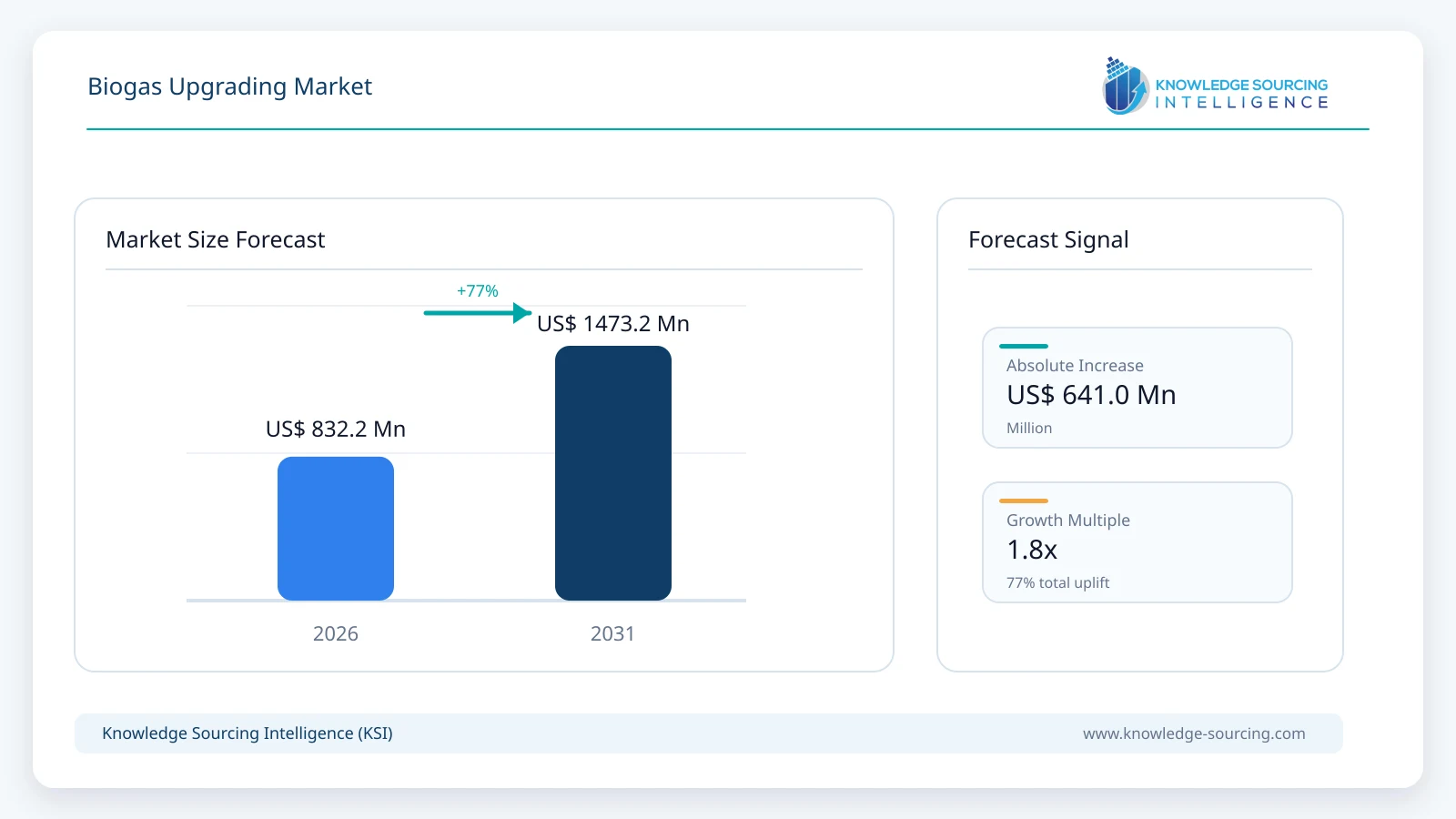
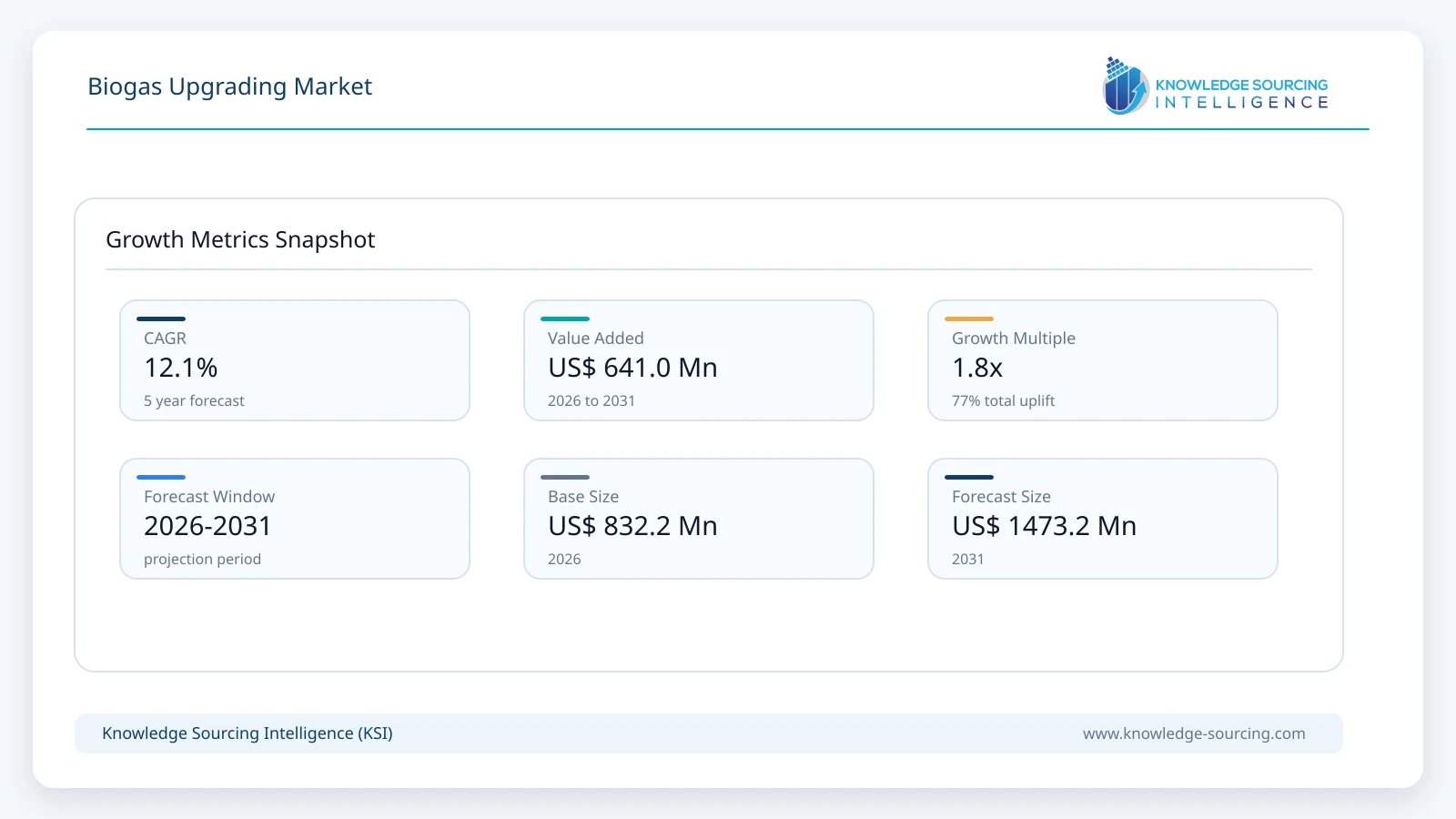
The Biogas Upgrading Market is forecast to grow at a CAGR of 12.1%, reaching USD 1,473.2 million in 2031 from USD 832.2 million in 2026.
Highlights:
- 1Leading technology segmentWater Scrubbing remains the most widely adopted upgrading technology, accounting for 27.0% of the Biogas Upgrading Market in 2026, with revenues reaching approximately USD 0.22 billion, driven by its proven efficiency and cost-effectiveness in biomethane production.
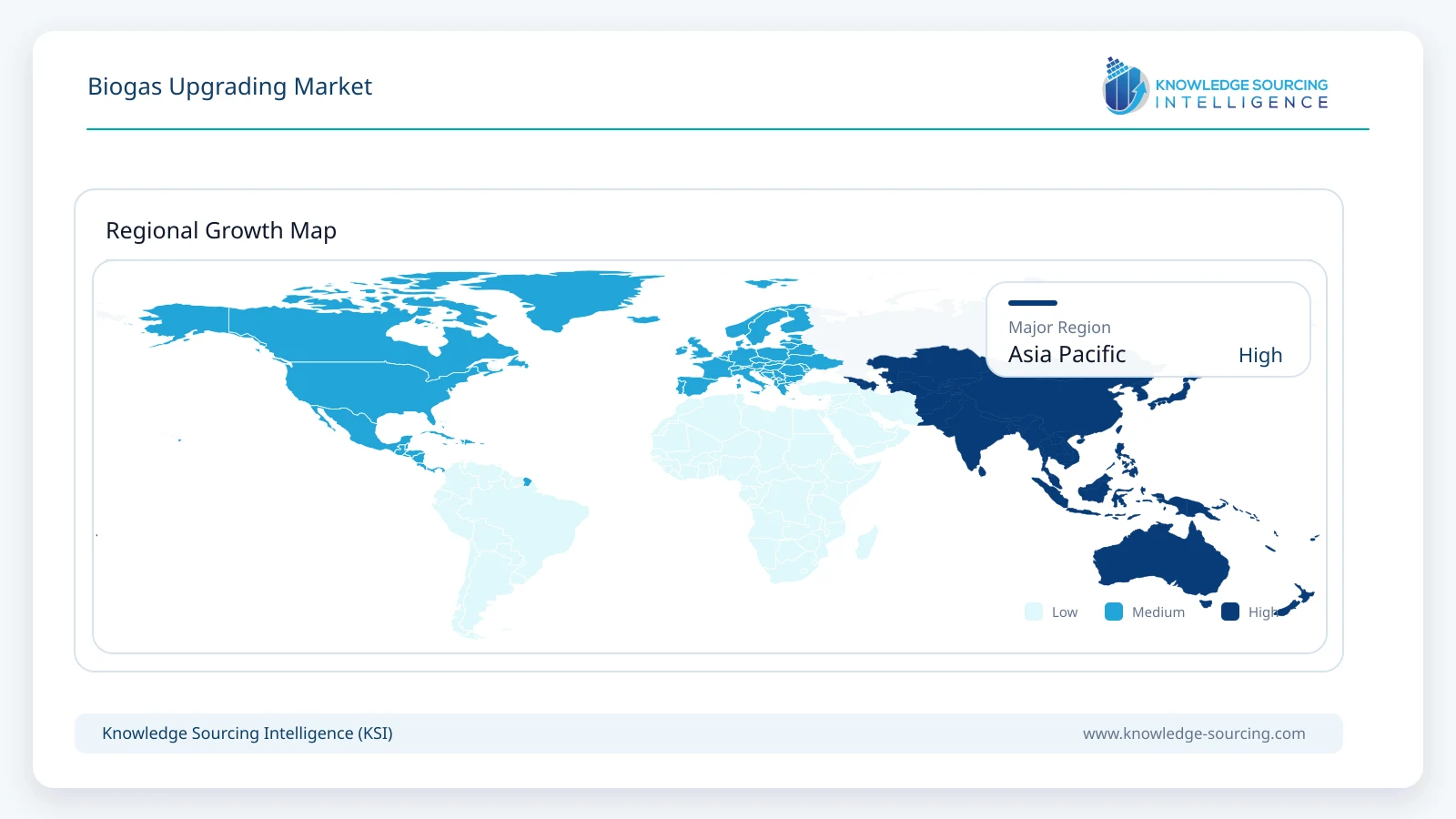
- 2Fastest-growing regional marketAsia Pacific is set to deliver the strongest expansion over the forecast period, advancing at a CAGR of 15.5% through 2031. The region's share is expected to climb from 23.0% in 2026 to 26.7% by 2031, supported by increasing renewable gas investments and supportive government policies.
- 3Largest plant capacity categoryMedium-scale facilities dominate the industry structure, generating USD 0.36 billion in 2026 and maintaining a 43.0% market share through 2031, highlighting their suitability for commercial and municipal biogas upgrading projects.
- 4Strongest application opportunityGrid Injection represents the principal end-use segment, valued at USD 0.35 billion in 2026 and projected to reach USD 0.61 billion by 2031. The segment is forecast to expand at a CAGR of 11.8%, reflecting growing integration of biomethane into national gas networks.
- 5End-use diversificationPipeline injection together with bio-CNG and bio-LNG infrastructure is enabling upgraded biomethane to serve low-carbon transport, marine, and industrial fuel markets while capturing price premiums unavailable to conventional CHP systems.
- 6Value-chain evolutionThe market is shifting from a niche add-on to power-only plants into the primary value-creation layer of the biogas chain, driven by renewable-gas mandates, carbon credits, Guarantees of Origin, and corporate decarbonization commitments.
Biogas upgrading is the process of purifying raw biogas generated from agricultural residues, livestock manure, food and organic waste, wastewater sludge, and landfill gas by removing carbon dioxide, water, hydrogen sulfide, and other contaminants to produce biomethane. According to the International Energy Agency (IEA), biomethane is a near-pure methane fuel and a drop-in substitute for natural gas, allowing it to use existing gas infrastructure and natural-gas-compatible applications. The IEA’s 2025 analysis also highlights that upgrading is the dominant pathway for biomethane production globally.
The commercial value of upgrading comes from converting a lower-energy-content raw gas into a higher-quality renewable gas that can be injected into natural gas networks, compressed for vehicle applications, or further processed for other energy uses. The U.S. Environmental Protection Agency (EPA) confirms that renewable natural gas (RNG) is produced by increasing methane concentration through the removal of water vapor, carbon dioxide, hydrogen sulfide, and other impurities. Once upgraded, RNG can be transported through natural gas pipelines and used as a substitute for conventional natural gas. This broader range of end uses gives biogas producers an alternative to using raw biogas solely for onsite heat and power generation.
The technology landscape consists of several commercially established approaches, with water scrubbing, pressure swing adsorption (PSA), chemical or solvent scrubbing, and membrane separation representing the principal CO2-removal technologies. The IEA specifically identifies water scrubbing, membrane separation, and PSA among the established methods used to produce biomethane. Water scrubbing separates CO2 from methane through differences in gas solubility, using pressurised water to absorb CO2 while allowing methane to remain in the product gas. PSA uses adsorbent materials under changing pressure conditions to selectively retain CO2 and other impurities. These technologies have established commercial applications across different plant sizes and feedstock conditions.
Chemical scrubbing uses solvents such as amines to absorb CO2 and subsequently regenerate the solvent through heat or other process steps. This approach can achieve high-quality biomethane but requires consideration of solvent management and regeneration energy. Membrane separation uses selective membranes through which CO2 and other smaller or more permeable molecules preferentially pass while methane is retained in the product stream. Its modular configuration and suitability for decentralized installations make membrane systems particularly relevant as biomethane projects expand across agricultural, wastewater, and waste-management applications. The U.S. Department of Energy also identifies water scrubbing, amine systems, PSA, cryogenic separation, and membrane separation as technologies used to upgrade biogas for pipeline and fueling requirements.
Recent developments indicate that the market is moving toward greater deployment of biomethane rather than treating biogas solely as a fuel for onsite combined heat and power. The IEA reported in 2025 that EU biomethane production increased by 14% in 2024, substantially faster than overall EU biogas production. It also reported that around 95% of new biogas plants expected to come online are producing renewable natural gas, demonstrating the increasing orientation of new capacity toward upgraded gas. In Europe, the European Commission continues to target 35 billion cubic metres of sustainable biomethane production and use annually by 2030, while emphasizing investment in upgrading technologies and integration with gas networks.
Government support is also strengthening project economics. In the United Kingdom, Ofgem's Green Gas Support Scheme continues to support new anaerobic-digestion biomethane plants that inject eligible biomethane into the gas grid, with applications permitted until March 2028. In India, the Ministry of New and Renewable Energy states that biogas can be purified to approximately 98% methane and compressed at high pressure to produce compressed biogas (CBG). Government data further show that 59 CBG plants with a combined capacity of 684.33 tonnes per day were commissioned during 2025 through November, highlighting continuing capacity additions in the upgraded-biogas segment.
The market is therefore increasingly shaped by the availability of organic feedstocks, gas-grid access, renewable-fuel policies, methane-emission reduction requirements, and the economics of upgrading versus onsite power generation. At the same time, methane management remains an important technical consideration. The IEA estimates that methane emissions associated with upgrading units can range from approximately 0.2% to 3%, depending on technology and operating conditions, creating opportunities for improved gas-tight equipment, leak detection and repair, and methane-recovery systems. Overall, continued policy support, expanding biomethane demand, waste-management priorities, and technological improvements are strengthening the commercial case for biogas upgrading across centralized and decentralized projects.
Market Dynamics
Market Drivers
Binding regional targets, such as the EU's REPowerEU biomethane target of 35 billion cubic meters by 2030, are shrinking the timeframe for making investment decisions and helping to prioritize the development of upgrading projects over power-only biogas projects.
The increasing pipeline injection and buildout of bio-CNG and bio-LNG enables bio-gas upgrading to address the growing need for biomethane as a low-carbon transport fuel, including in the marine and industrial sectors.
Carbon credits and Guarantees of Origin (GOS) and Corporate Decarbonization Commitments (CDCs) are driving more carbon credit markets and new corporate decarbonization commitments, that will further enhance the project economics and speed up investments decisions for upgraded biomethane.
Market Restraints & Opportunities
High capital costs and long payback periods continue to be the biggest limiting factor in spreading these technologies, especially among smaller agricultural and wastewater-treatment-plant operators considering upgrading investments versus power-only alternatives that have lower initial costs.
However, commercialization of next-generation upgrading technologies, expansion of bio-CNG and bio-LNG infrastructure and growth of the adoption of these technologies in emerging markets and decentralized energy systems hold significant long-term opportunity, especially given the continued reduction of the capital cost for the smaller-scale, farm-level deployment of membrane and hybrid upgrading systems.
Key Developments
June 2026: On the occasion of World Environment Day, Maruti Suzuki India Limited, announced two biogas projects, reinforcing its commitment to building a clean energy ecosystem.
April 2026: Evonik has signed a large-scale agreement to supply its SEPURAN® Green membranes and patented technology to MTC Orec Sdn Bhd (MTCO), a prominent biogas upgrading plant producer based in Malaysia. Co-owned and managed by VentureTECH, an entity funded by the Malaysian government, MTCO is a key designer and builder of biogas upgrading plants, with plans to further expand this renewable energy technology across Asia.
March 2026: Greenlane Renewables Inc. announced its customer, Orizon Valorização de Resíduos S.A., a leading platform in integrated circular economy and energy transition solutions, today inaugurated its new biomethane plant at Ecoparque Jaboatão in Pernambuco, Brazil, featuring a complete biogas upgrading system supplied by Greenlane.
Market Segmentation
By Technology: Water Scrubbing
Water scrubbing is estimated to remain the leading technology segment in the Biogas Upgrading Market, reaching USD 0.35 billion by 2031 and accounting for approximately 24.0% of the market. Its strong position is supported by its established commercial deployment and ability to remove carbon dioxide and other water-soluble impurities without requiring chemical additives or heat. Greenlane Renewables states that its Cascade H?O water-wash system uses counter-flow water to upgrade biogas and can achieve methane recovery of up to 99%, while operating in a closed loop to limit energy consumption.
Water scrubbing also benefits from its applicability across different biogas feedstocks, including agricultural waste, food waste, wastewater, and landfill gas. Greenlane has specifically developed water-wash solutions for variable feedstocks and identifies agriculture, including dairy and hog manure, as an important biogas source for its upgrading systems.
Greenlane Renewables offers biogas upgrading systems based on water wash, pressure swing adsorption, and membrane separation, allowing projects to select technologies according to feedstock characteristics, gas composition, flow rate, and end-use requirements. Its water-wash technology is designed to produce pipeline-quality renewable natural gas and can support applications where upgraded biomethane is injected into natural gas networks or used as transportation fuel.
DMT International also provides biogas upgrading technology through its CarboRex®MS membrane-based system, which converts biogas into high-purity biomethane for injection into natural gas grids or use as transportation fuel. The company reports deployment of its systems across the UK, United States, and Europe, highlighting the continued development of multiple upgrading technologies for grid and mobility applications.
By Technology: Membrane Separation
Membrane separation is emerging as a rapidly expanding biogas upgrading technology, supported by its suitability for compact, modular, and decentralized installations. Its ability to separate carbon dioxide from methane with high efficiency, while maintaining relatively low electricity consumption and avoiding the need for chemical-based separation processes, makes it suitable for diverse biogas facilities. Membrane Separation is estimated at USD 0.26 billion in 2026, representing 31.0% of the Biogas Upgrading Market, and is projected to reach USD 0.57 billion by 2031.
Bright Renewables offers membrane-based biogas upgrading systems through its PurePac range, including compact and scalable configurations for different biogas flow requirements. Its three-stage membrane technology separates CO? from methane and is designed to achieve methane recovery of at least 99.5%, with reported electricity consumption of 0.26 kWh/Nm³ of raw biogas. The company also offers the PurePac Compact for smaller-scale installations, with a prefabricated and compact design that supports quick installation at new or existing facilities.
By End-Use Application: Grid Injection
Grid injection is one of the most significant end-use applications for the Biogas Upgrading Market, accounting for an estimated 42.0% share in 2026, with its share projected to remain substantial at 41.5% by 2031. Upgraded biogas, or biomethane, can be injected into existing natural gas networks because it is compatible with conventional gas infrastructure and end-use equipment. This allows producers to access established transmission and distribution systems while supporting the substitution of fossil natural gas with renewable gas. The European Commission specifically identifies biomethane's compatibility with existing gas infrastructure and highlights the importance of scaling up sustainable upgrading and grid injection.
The application is expected to maintain strong demand as governments and energy companies expand renewable-gas infrastructure and introduce policies supporting biomethane production and grid integration. The IEA reports that global biogas and biomethane production is expected to expand through 2030, with biomethane benefiting from its ability to use existing natural-gas grids and equipment.
At the same time, growth in low-carbon fuel infrastructure is creating additional opportunities for upgraded biogas in bio-CNG and bio-LNG, particularly for heavy-duty transportation, marine applications, and industrial fuel consumption. Biomethane's compatibility with natural-gas vehicles and its potential to replace fossil gas in difficult-to-electrify applications further supports its adoption across these sectors.
Regional Analysis
North America Market Analysis
North America represents an important and expanding market, supported by a growing base of renewable natural gas (RNG) projects across the United States and Canada. The U.S. has operating RNG projects using landfill gas and agricultural biogas, while California remains a key project development area, with more than 50 farm-based RNG projects planned or under construction. Federal Renewable Fuel Standard incentives and state-level programs such as California’s Low Carbon Fuel Standard further support investment in biogas upgrading. North America is estimated at USD 0.20 billion in 2026, representing a 24.0% share, and is projected to reach USD 0.34 billion by 2031 at an 11.0% CAGR.
Europe Market Analysis
With the EU's REPowerEU biomethane ambition of 35 billion cubic meters by 2030 and the well-established feed-in and grid-injection infrastructure in Germany, France and Nordics, the region currently represents significant share of global revenue.
Asia-Pacific Market Analysis
Asia-Pacific is expanding as governments pursue waste-to-energy and renewable-gas policies to manage growing volumes of organic waste while strengthening energy security across major economies. India is accelerating compressed biogas development through initiatives such as GOBARdhan and SATAT, with the government approving a ?23,731 crore national scheme in August 2026 to scale domestic CBG production and support waste-to-energy projects. These measures are supporting investment in biogas upgrading, purification, and grid- or transport-ready renewable gas. The regional Biogas Upgrading Market is estimated at USD 0.19 billion in 2026 and is projected to reach USD 0.39 billion by 2031, reflecting rising demand for cleaner gaseous fuels, organic-waste utilization, and integration of upgraded biogas into existing gas infrastructure. India’s expanding CBG ecosystem, including 1,908 registered plants as of August 2026, further strengthens the region’s potential for upgrading technologies.
Middle East and Africa Market Analysis
The Middle East and Africa are seeing early-stage investment in biogas upgrading tied to circular-economy and renewable-energy diversification initiatives, led by the UAE and Saudi Arabia.
South America Market Analysis
South America represents an emerging market for biogas upgrading, with Brazil's agricultural waste volumes and expanding renewable-fuel policy support driving growing investment in upgrading capacity.
List of Companies
Greenlane Renewables
DMT International
Bright Renewables
EnviTec Biogas
HoSt Holding
PlanET Biogastechnik
Ammongas
Biofrigas Sweden
Gasum
WELTEC BIOPOWER
Competitive Landscape
Greenlane Renewables
Greenlane Renewables supplies biogas upgrading systems, including its GreenStream product line, to agricultural, landfill, and wastewater-treatment biogas producers, with strong recent commercial momentum in the North American dairy and agricultural segment.
DMT International
DMT International provides biogas upgrading equipment and engineering services supporting pipeline-injection and vehicle-fuel biomethane applications across European and international project deployments.
EnviTec Biogas
EnviTec Biogas designs, builds, and operates biogas and biomethane production facilities, combining anaerobic digestion expertise with upgrading technology integration for agricultural and municipal waste feedstocks.
Analyst View
The Biogas Upgrading market is shifting from a niche complement to power-only biogas plants into the primary value-creation layer of the biogas value chain, as binding renewable-gas mandates and transport-fuel demand redirect capital toward pipeline-quality biomethane production. Europe's REPowerEU target and North America's expanding RNG facility base are the two structural anchors of near-term growth, while membrane and hybrid technologies are steadily lowering the capital threshold for smaller-scale, decentralized deployment. Vendors that combine proven upgrading technology, flexible plant-capacity offerings, and strong positioning in both pipeline-injection and transport-fuel end markets are best positioned to lead the next phase of market growth.
Biogas Upgrading Market Scope:
| Report Metric | Details |
|---|---|
| Total Market Size in 2026 | USD 832.2 million |
| Total Market Size in 2031 | USD 1,473.2 million |
| Forecast Unit | Million |
| Growth Rate | 12.1% |
| Study Period | 2021 to 2031 |
| Historical Data | 2021 to 2024 |
| Base Year | 2025 |
| Forecast Period | 2026 – 2031 |
| Segmentation | Technology, Plant Capacity, Feedstock, End-Use Application, Geography |
| Companies |
|
Market Segmentation
By Technology
Water Scrubbing
Pressure Swing Adsorption (PSA)
Chemical Scrubbing
Membrane Separation
Others
By Plant Capacity
Small-Scale
Medium-Scale
Large-Scale
By Feedstock
Agricultural Waste & Energy Crops
Landfill Gas
Sewage Sludge & Wastewater
Food & Municipal Solid Waste
By End-use Application
Grid Injection
Bio-CNG / Bio-LNG Transport Fuel
Industrial & Power Generation
Others
By Geography
North America
USA
Canada
Mexico
Europe
Germany
France
United Kingdom
Netherlands
Others
Asia Pacific
China
India
Japan
South Korea
Others
Middle East and Africa
UAE
Saudi Arabia
Others
South America
Brazil
Others
Table of Contents
1. EXECUTIVE SUMMARY
2. MARKET SNAPSHOT
2.1. Market Overview
2.2. Market Definition
2.3. Scope of the Study
2.4. Market Segmentation
3. BUSINESS LANDSCAPE
3.1. Market Drivers
3.2. Market Restraints
3.3. Market Opportunities
3.4. Porter's Five Forces Analysis
3.5. Industry Value Chain Analysis
3.6. Policies and Regulations
3.7. Strategic Recommendations
4. TECHNOLOGICAL OUTLOOK
4.1. Membrane Separation & Hybrid Upgrading Systems
4.2. Digital Monitoring & Process Automation
4.3. Bio-CNG & Bio-LNG Infrastructure
4.4. Decentralized Farm-Scale Upgrading
5. BIOGAS UPGRADING MARKET BY TECHNOLOGY
5.1. Introduction
5.2. Water Scrubbing
5.3. Pressure Swing Adsorption (PSA)
5.4. Chemical Scrubbing
5.5. Membrane Separation
5.6. Others
6. BIOGAS UPGRADING MARKET BY PLANT CAPACITY
6.1. Introduction
6.2. Small-Scale
6.3. Medium-Scale
6.4. Large-Scale
7. BIOGAS UPGRADING MARKET BY FEEDSTOCK
7.1. Introduction
7.2. Agricultural Waste & Energy Crops
7.3. Landfill Gas
7.4. Sewage Sludge & Wastewater
7.5. Food & Municipal Solid Waste
8. BIOGAS UPGRADING MARKET BY END-USE APPLICATION
8.1. Introduction
8.2. Grid Injection
8.3. Bio-CNG / Bio-LNG Transport Fuel
8.4. Industrial & Power Generation
8.5. Others
9. BIOGAS UPGRADING MARKET BY GEOGRAPHY
9.1. Introduction
9.2. North America
9.2.1. USA
9.2.2. Canada
9.2.3. Mexico
9.3. Europe
9.3.1. Germany
9.3.2. France
9.3.3. United Kingdom
9.3.4. Netherlands
9.3.5. Others
9.4. Asia Pacific
9.4.1. China
9.4.2. India
9.4.3. Japan
9.4.4. South Korea
9.4.5. Others
9.5. Middle East and Africa
9.5.1. UAE
9.5.2. Saudi Arabia
9.5.3. Others
9.6. South America
9.6.1. Brazil
9.6.2. Others
10. COMPETITIVE ENVIRONMENT AND ANALYSIS
10.1. Major Players and Strategy Analysis
10.2. Market Share Analysis
10.3. Mergers, Acquisitions, Agreements, and Collaborations
10.4. Competitive Dashboard
11. COMPANY PROFILES
11.1. Greenlane Renewables
11.2. DMT International
11.3. Bright Renewables
11.4. EnviTec Biogas
11.5. HoSt Holding
11.6. PlanET Biogastechnik
11.7. Ammongas
11.8. Biofrigas Sweden
11.9. Gasum
11.10. WELTEC BIOPOWER
12. APPENDIX
12.1. Currency
12.2. Assumptions
12.3. Base and Forecast Years Timeline
12.4. Key Benefits for the Stakeholders
12.5. Research Methodology
12.6. Abbreviations
Navigate
Trusted by the world's leading organizations











