
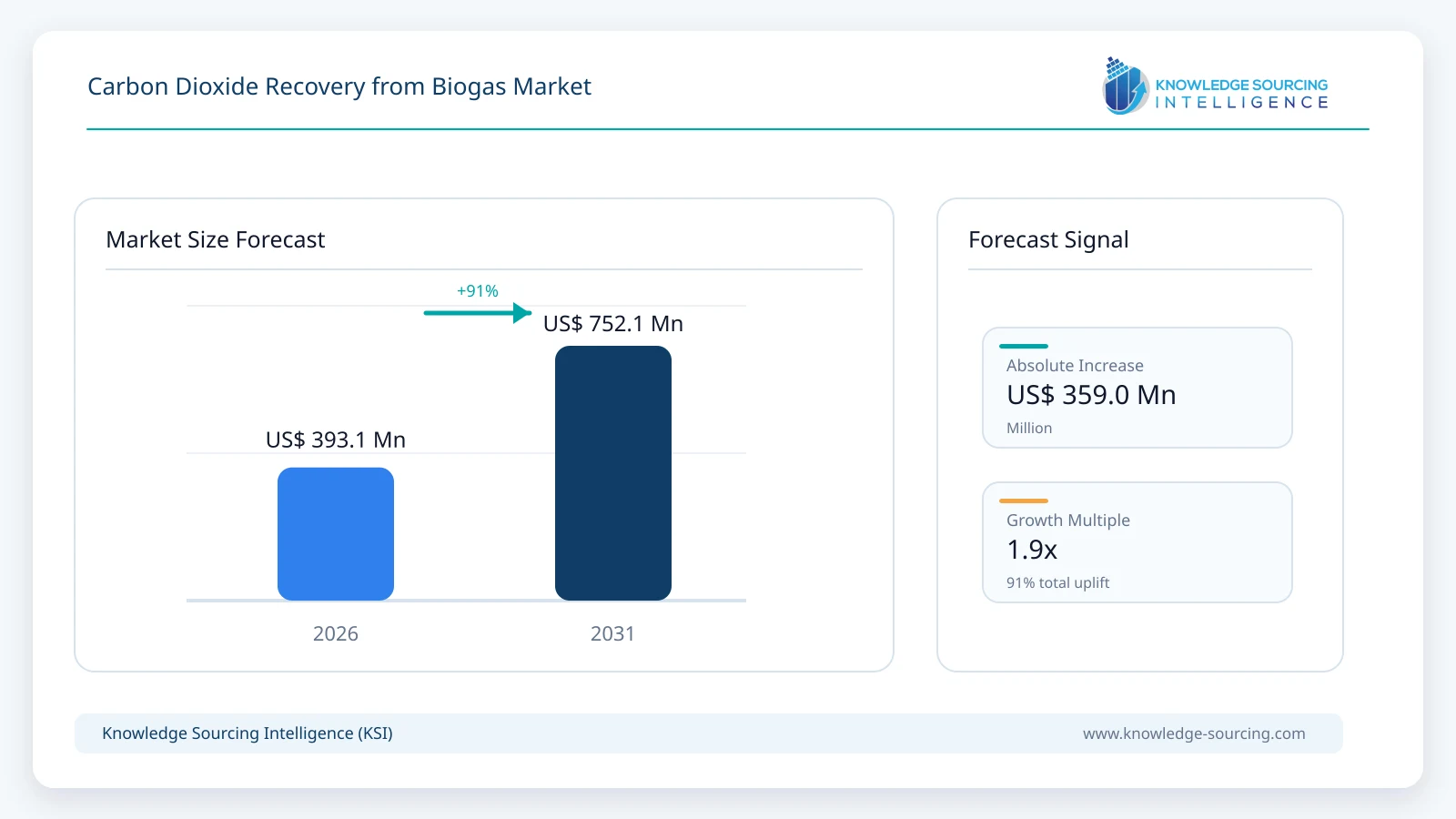
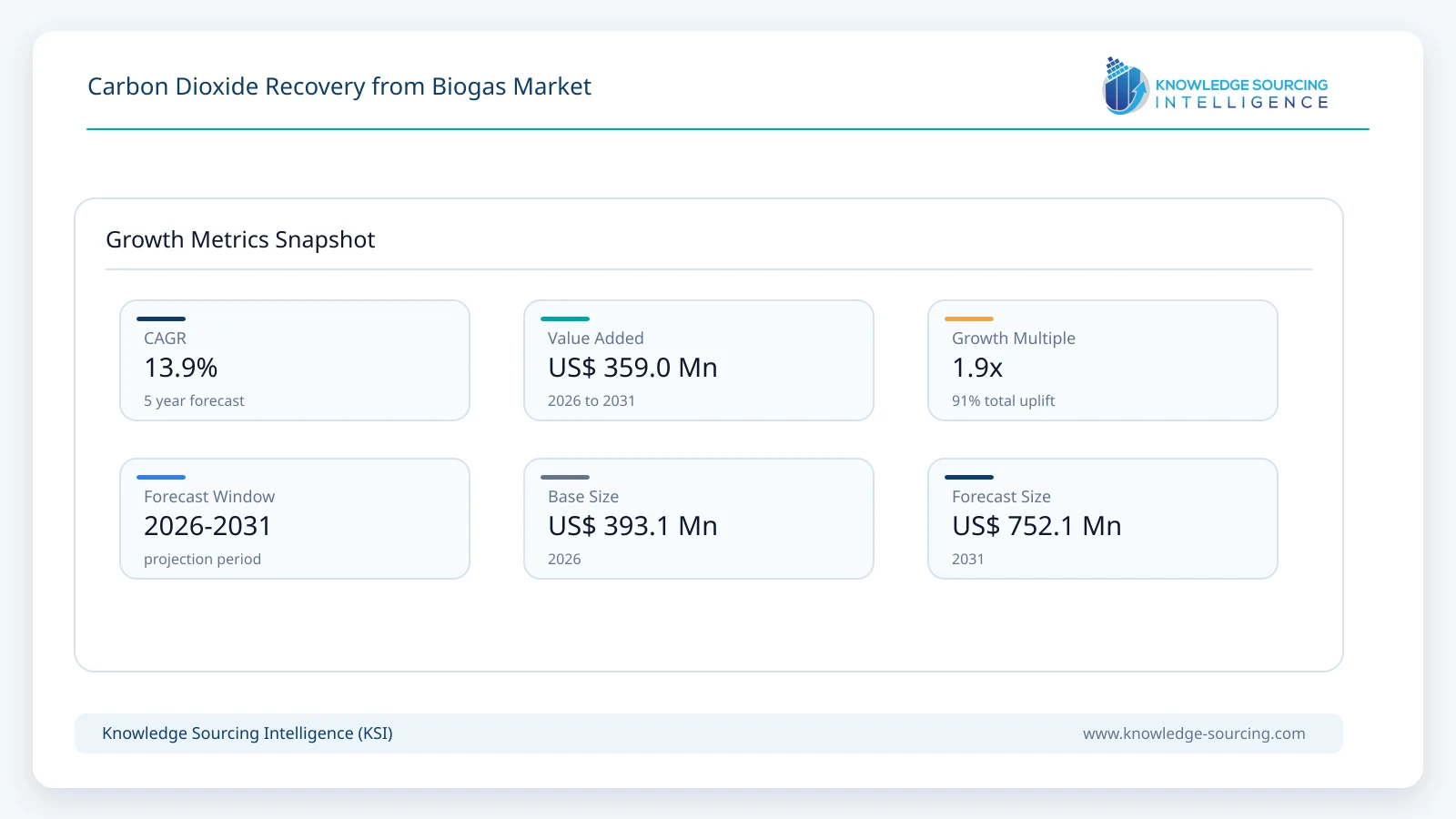
The Carbon Dioxide Recovery from Biogas Market is forecast to grow at a CAGR of 13.9%, reaching USD 752.1 million in 2031 from USD 393.1 million in 2026.
Highlights:
- 1The biomethane produced from the biogas results in a significant, regular biogenic CO2 secondary stream to recover liquid CO2 at every biogas upgrading plant.
- 2The most common technology employed for producing consistent food grade liquid CO2 is cryogenic liquefaction, employing extremely low temperatures and high pressures; this technology also enhances overall methane recovery at the methane upgrading plant.
- 3Beyond new-built CO2 upgrading plants, modular and containerized CO2 recovery units are also openings for retrofitting at existing biogas upgrading plants, increasing the addressable installed base beyond just new plants.
- 4Europe is the global leader in biogas deployment and CO2 recovery deployment but CO2 separation membrane capacity expansion looks set to focus more on North American demand with the expansion of biogas upgrading capacity in the U.S.
Carbon dioxide recovery from biogas is the separation, purification and liquefaction of the CO2 stream that was previously vented in the biogas upgrading process to turn it into a sellable, food grade or industrial grade liquid CO2 product. The recovered CO2 stream usually passes through one of several separation methods also used during the upgrading step, most commonly membrane separation or amine/chemical scrubbing, followed by drying and purification to remove trace levels of contaminants, and then liquification, typically by cryogenic cooling to ~-170 °C under pressure, to provide consistent food grade quality liquid CO2 for use in food and beverage carbonation, dry ice production, greenhouse enrichment, and industrial applications. Due to the different boiling points of methane and CO2, cryogenic separation and liquefaction can be performed simultaneously for an overall biogas upgrading plant with improved methane recovery system, thus CO2 recovery systems can be used as an additional revenue-generating application and as an efficiency improvement component of a biogas upgrading system.
CO2 recovery is now becoming more commonly sold as a component of an integrated system and not as a discrete product line. Biogas upgrading plants of different size can implement CO2 recovery with little additional new civil infrastructure investment, as can natural-refrigerant liquefaction approaches that use CO2 as the refrigerant, rather than Freon or ammonia, for their smaller environmental impact than conventional refrigeration-based liquefaction.
Market Dynamics
Market Drivers
Tightening Food-Grade CO2 Supply and Rising Prices: Periodic shortages of food-grade CO2 due to disruptions in ammonia production have encouraged commercial interest in biogenic CO2 as an alternative supply source for food and beverage, dry ice and industrial applications, which are more decentralized and reliable.
Carbon Intensity Scoring Under Low-Carbon Fuel Standards: Programs that assign a carbon intensity score to renewable fuel production, such as California's Low Carbon Fuel Standard, would also incentivize biogas upgrading facility to upgrade its biogenic CO2 into renewable fuel by capturing and using the CO2 output, thereby improving the carbon intensity score of the facility and resulting credit value.
Upgrading a plant to recover CO2 from the upgrading process is already a part of their plant and the incremental capital and operating cost of adding liquid CO2 is relatively low compared to the revenue expected from the liquid CO2, which is an increasingly standard economic calculation when considering a new build or retrofit biogas upgrading project.
Market Restraints & Opportunities
Some significant constraints include capital costs for cryogenic liquefaction equipment, the requirement for a consistent degree of food-grade purity that demands further purification steps besides CO2 separation, and logistics costs of transportation of liquid CO2 to end markets, especially for smaller or geographically remote biogas upgrading facilities.
However, the commercialization of compact and modular liquefaction units, expanding low-carbon fuel standard and carbon-credit programs that reward CO2 utilization, and growing corporate demand for verified biogenic CO2 as a lower-carbon alternative to fossil-derived industrial CO2 represent substantial long-term opportunity, particularly as biogas upgrading capacity continues to expand across Europe and North America.
Key Developments
October 2026: Clarke Energy, a Rehlko company, has successfully commissioned its first membrane-based biogas upgrading plant in India, marking a significant milestone in the country's clean energy transition. The facility is located at a municipal solid waste anaerobic digestion site operated by Srinivas Waste Management Services Private Limited (SWMS) in Chetpet, Chennai.
Market Segmentation
By Technology: Cryogenic Liquefaction
Cryogenic liquefaction holds the leading technology position for producing consistent, food-grade liquid CO2 from biogas upgrading plants, using extremely low temperatures and high pressures to liquefy CO2 while allowing methane to remain gaseous due to their differing boiling points.
HoSt Group provides an add-on solution for the recovery and liquation of CO2 with the improvement of methane recovery by providing continuous food grade liquid CO2 and CO2 upgrading.
Pentair's BioComplete platform provides integrated biogas upgrading and carbon dioxide (CO2) recovery technology, and produces food-grade CO2 as an additional revenue stream that lowers carbon intensity.
By Technology: Membrane Separation
The Food and Agriculture Organisation (FAO) has seen membrane separation as an enabling technology for CO2 recovery that is becoming more important with high methane recovery rates and low methane slip and lower operating costs compared to chemical scrubbing technologies.
Solveno Technologies offers standard CO2 recovery units ranging in size from 350kg/h to 4500kg/h specifically for carbon capture requirements of biogas upgrading production plants.
With high hydrogen-sulfide resistance and durability, UBE Corporation provides polyimide hollow-fiber CO2 separation membranes designed for use in more than 200 biogas upgrading plants worldwide in challenging biogas applications.
By End-Use Application: Food & Beverage Grade CO2
Food and beverage-grade CO2 is one of the biggest end-use applications for the recovered biogenic CO2, as biogas producers can obtain higher prices than industrial-grade CO2 because recovered biogenic CO2 is of a high enough grade for use in carbonation, dry ice manufacture and food applications.
Beyond food and beverage use cases, the addressable market for recovered biogenic CO2 is expected to widen as CO2 use in the greenhouse is rapidly increasing and CO2 use in industry is growing.
Regional Analysis
North America Market Analysis
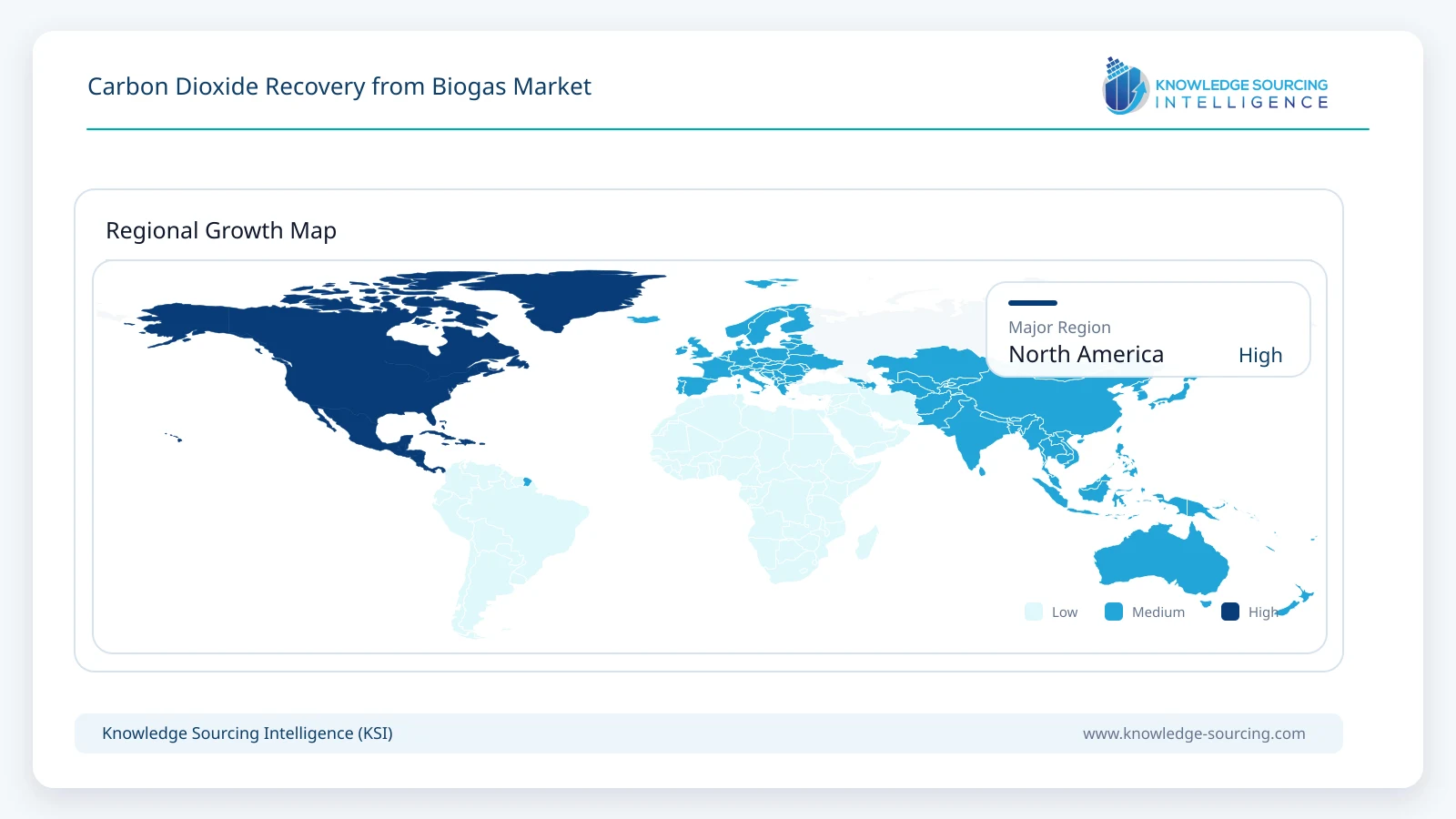
North America has now become a rapidly growing market for biogas CO2 recovery, as biogas upgrading capacity increases, California's Low Carbon Fuel Standard provides incentives for reducing carbon intensity, and CO2 separation membrane manufacturers are seeing new capacity growth to meet North American demand.
Europe Market Analysis
North America has now become a rapidly growing market for biogas CO2 recovery, as biogas upgrading capacity increases, California's Low Carbon Fuel Standard provides incentives for reducing carbon intensity, and CO2 separation membrane manufacturers are seeing new capacity growth to meet North American demand.
Asia-Pacific Market Analysis
Asia-Pacific is growing as validation of the membrane technology is expanding to both domestic and export biogas markets and Japan and China are investing in CO2 separation membrane manufacturing capacity.
Middle East and Africa Market Analysis
Early-stage investments are also being made in biogas CO2 recovery in the Middle East and Africa region, which are linked to larger circular economy and industrial gas diversification projects.
South America Market Analysis
New development opportunities for biogas CO2 recovery are found in South America, where the number of biogas upgrading plants is also increasing, generating some initial demand for CO2 recovery and liquefaction plants.
List of Companies
HoSt Group
Pentair
Solveno Technologies
UBE Corporation
Toray Industries
Air Liquide
Linde
Greenlane Renewables
DMT International
EnviTec Biogas
Competitive Landscape
HoSt Group
HoSt Group supplies CO2 recovery and liquefaction technology as an essential add-on to biogas upgrading and carbon capture systems, producing consistent food-grade liquid CO2 while enhancing the overall methane recovery of the associated upgrading plant.
Pentair
Pentair offers integrated biogas upgrading and CO2 recovery technology under its BioComplete platform, combining biomethane production with food-grade CO2 output to provide biogas producers with an additional carbon-intensity-lowering revenue stream.
Solveno Technologies
Solveno Technologies provides standardized CO2 recovery units with capacities from 350 to 4,500 kilograms of CO2 per hour, alongside membrane-based biogas separation systems designed to maximize methane yield and minimize methane slip.
Analyst View
The Carbon Dioxide Recovery from Biogas market represents a structural shift in how the biogas industry values its own byproducts, converting what was historically a vented emission into a meaningful secondary revenue stream with favorable capture economics relative to other carbon-capture applications. Because the CO2 separation step is already inherent to biogas upgrading, the incremental cost of adding liquefaction and purification capacity is comparatively modest against the revenue potential from food-grade CO2 sales and improved carbon-intensity scoring under low-carbon fuel standard programs. Vendors that combine proven liquefaction technology, modular and retrofit-friendly system design, and strong positioning across both new-build and existing biogas upgrading facilities are best positioned to lead the next phase of market growth.
Carbon Dioxide Recovery from Biogas Market Scope:
| Report Metric | Details |
|---|---|
| Total Market Size in 2026 | USD 393.1 million |
| Total Market Size in 2031 | USD 752.1 million |
| Forecast Unit | Million |
| Growth Rate | 13.9% |
| Study Period | 2021 to 2031 |
| Historical Data | 2021 to 2024 |
| Base Year | 2025 |
| Forecast Period | 2026 – 2031 |
| Segmentation | Technology, Plant Capacity, End-Use Application, Geography |
| Companies |
|
Market Segmentation
By Technology
By Plant Capacity
By End-use Application
By Geography
Table of Contents
1. EXECUTIVE SUMMARY
2. MARKET SNAPSHOT
2.1. Market Overview
2.2. Market Definition
2.3. Scope of the Study
2.4. Market Segmentation
3. BUSINESS LANDSCAPE
3.1. Market Drivers
3.2. Market Restraints
3.3. Market Opportunities
3.4. Porter's Five Forces Analysis
3.5. Industry Value Chain Analysis
3.6. Policies and Regulations
3.7. Strategic Recommendations
4. TECHNOLOGICAL OUTLOOK
4.1. Cryogenic CO2 Liquefaction
4.2. Membrane-Based CO2 Separation
4.3. Natural-Refrigerant Liquefaction Systems
4.4. Modular & Containerized CO2 Recovery Units
5. CARBON DIOXIDE RECOVERY FROM BIOGAS MARKET BY TECHNOLOGY
5.1. Introduction
5.2. Cryogenic Liquefaction
5.3. Membrane Separation
5.4. Chemical / Amine Scrubbing
5.5. Others
6. CARBON DIOXIDE RECOVERY FROM BIOGAS MARKET BY PLANT CAPACITY
6.1. Introduction
6.2. Compact-Scale
6.3. Medium-Scale
6.4. Large-Scale
7. CARBON DIOXIDE RECOVERY FROM BIOGAS MARKET BY END-USE APPLICATION
7.1. Introduction
7.2. Food & Beverage Grade CO2
7.3. Industrial Grade CO2
7.4. Greenhouse CO2 Enrichment
7.5. Dry Ice Production
7.6. Others
8. CARBON DIOXIDE RECOVERY FROM BIOGAS MARKET BY GEOGRAPHY
8.1. Introduction
8.2. North America
8.2.1. USA
8.2.2. Canada
8.2.3. Mexico
8.3. South America
8.3.1. Brazil
8.3.2. Others
8.4. Europe
8.4.1. Germany
8.4.2. Netherlands
8.4.3. France
8.4.4. Others
8.5. Middle East and Africa
8.5.1. UAE
8.5.2. Saudi Arabia
8.5.3. Others
8.6. Asia Pacific
8.6.1. China
8.6.2. Japan
8.6.3. India
8.6.4. Others
9. COMPETITIVE ENVIRONMENT AND ANALYSIS
9.1. Major Players and Strategy Analysis
9.2. Market Share Analysis
9.3. Mergers, Acquisitions, Agreements, and Collaborations
9.4. Competitive Dashboard
10. COMPANY PROFILES
10.1. HoSt Group
10.2. Pentair
10.3. Solveno Technologies
10.4. UBE Corporation
10.5. Toray Industries
10.6. Air Liquide
10.7. Linde
10.8. Greenlane Renewables
10.9. DMT International
10.10. EnviTec Biogas
11. APPENDIX
11.1. Currency
11.2. Assumptions
11.3. Base and Forecast Years Timeline
11.4. Key Benefits for the Stakeholders
11.5. Research Methodology
11.6. Abbreviations
Navigate
Trusted by the world's leading organizations











