
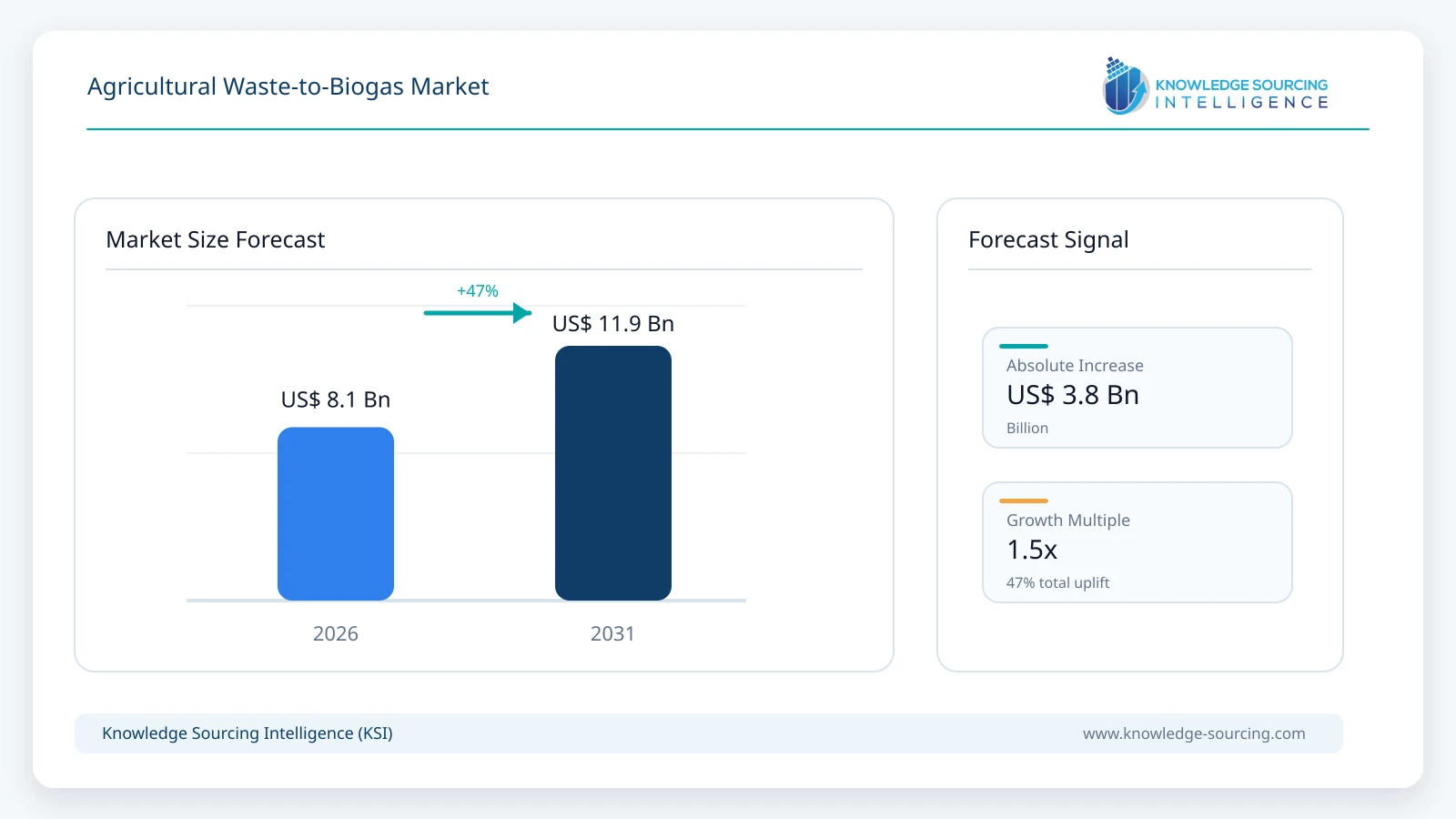
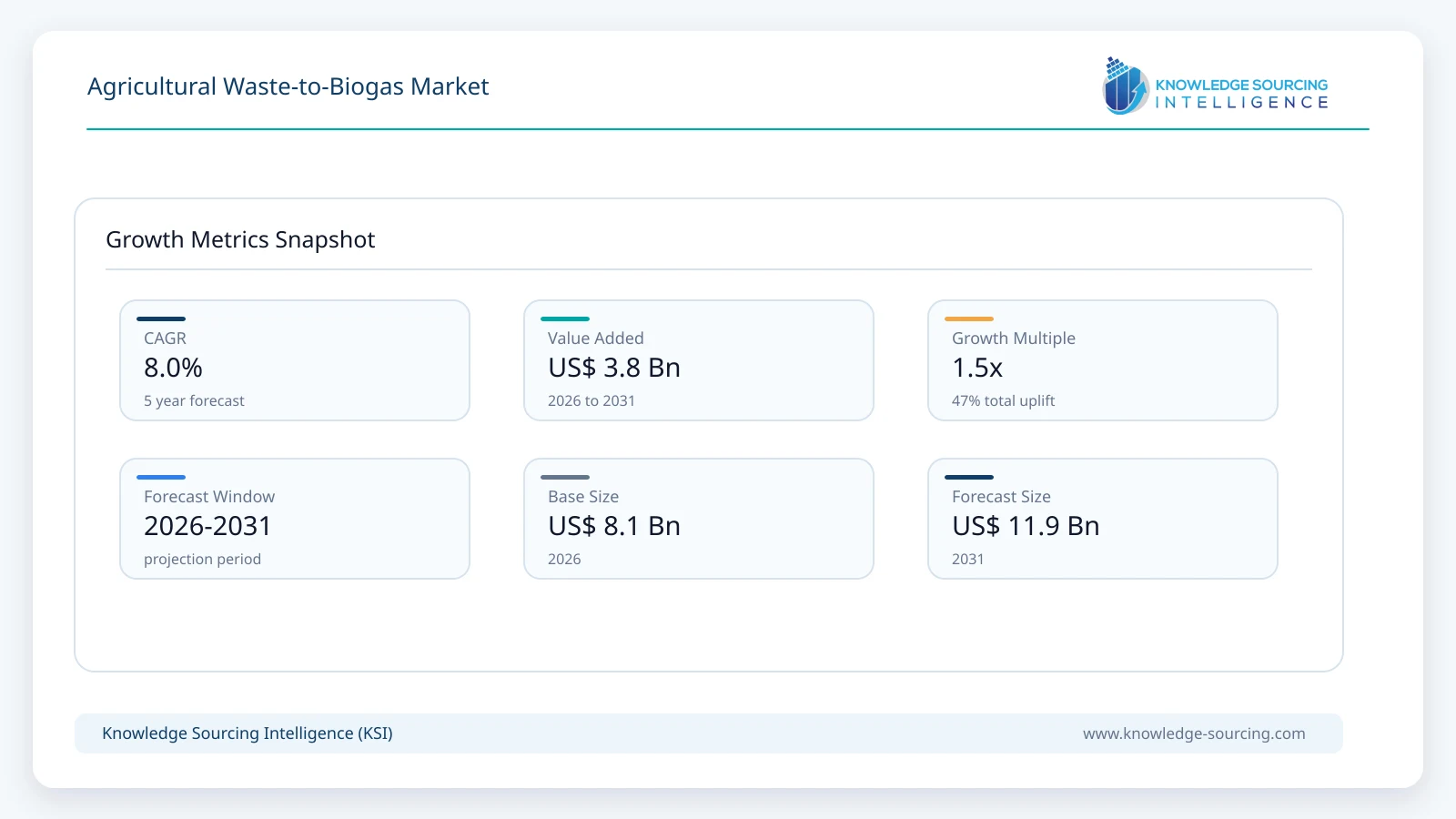
The Agricultural Waste-to-Biogas Market is forecast to grow at a CAGR of 8.0%, reaching USD 11.92 billion in 2031 from USD 8.11 billion in 2026.
Highlights:
- 1Most of the existing installations are wet anaerobic digestion plants that are able to process liquid manure, and the dry anaerobic digestion process technology is the most rapidly expanding because of the growing use of crop residues and less watery feedstocks in agriculture.
- 2The sub-0.5 MW plant capacity segment has the largest increase in plant numbers, indicating the growing availability of decentralized, compact biogas technology for individual agricultural operations.
- 3North America is seeing the highest regional growth as U.S. dairy and swine facilities turn to anaerobic digestion for Renewable Fuel Standard RIN and local low-carbon fuel standard incentives.
- 4Regional market value for biogas in Europe remains the highest, as the agricultural use of biogas is already well established and biogas policy is supportive.
The process of converting agricultural waste to biogas is based on anaerobic digestion, which is a biological process that converts organic wastes in the absence of oxygen to produce biogas, which consists of 60-70% methane with carbon dioxide and trace gases, while digestate is one of the highly nutritious by-products of the process, which can be added to the agricultural land as fertilizer, thereby effectively closing the nutrient loop within the entire agricultural operation. In 2025, wet anaerobic digestion systems that work with high-moisture feedstocks like liquid manure accounted for about 59% of the total installations, whereas dry anaerobic digestion systems were better suited to drier feedstocks, such as crop residues and energy crops, are showing the highest projected growth.
Market Dynamics
Market Drivers
National and regional methane-reduction mandates for agriculture are creating incentives for farmers and agribusinesses to reduce emissions of methane before it enters the atmosphere by implementing anaerobic digestion as a technology that can comply with the requirements.
Renewable Fuel Credits and Low-Carbon Fuel Standard Incentives: Incentives like the U.S. Renewable Fuel Standard's RIN credit system and state-level low-carbon fuel standard are providing direct economic benefits for agricultural biogas producers, especially those in dairy and swine enterprises, to capture and monetize methane emissions via anaerobic digestion and biomethane upgrading.
Beyond energy generation, the inclusion of biogas and digestate, which is rich in nutrients, is increasing the attractiveness of the technology for farmers who want to use less synthetic fertilizer and reduce the nutrient load from their manure and crop residues.
Market Restraints & Opportunities
Capital costs, feedstock supply-chain logistics, related to the seasonal availability of crop residues, and the technical complexity of co-digesting mixed agricultural feedstocks, are all significant constraints, especially for smaller individual farm systems considering anaerobic digestion for its potential to reduce greenhouse-gas emissions from manure.
However, the costs of smaller agricultural digesters are still declining as the technology becomes more compact and modular, and renewable-fuel credit programs are being expanded; corporate decarbonization pledges are driving demand in the marketplace for verified low-carbon agricultural feedstocks as municipal and industrial waste-to-biogas projects continue to grow; and as more digesters are built, the capital barrier is being lowered for smaller farms.
Key Developments
March 2026: Climate Fund Managers, a climate-focused blended finance investment manager, has committed USD 32.2 million from its EU-supported Climate Investor Two Construction Equity Fund to Akaia Green Fuels, a commercial-scale waste-to-biogas facility in Uttar Pradesh, northern India. This initiative reflects the European Union’s strong partnership with India on climate action, a priority reaffirmed at the 16th India–EU Summit. Through the partnership, the EU is accelerating decarbonization, supporting industrial transition, scaling up green hydrogen and expanding renewable energy.
Market Segmentation
By Feedstock: Agricultural Residues & Crop Waste
Agricultural residues (straw, husks, stalks and other crop waste) represent the biggest single-feedstock with an assured supply and the economic potential for using them as fuel instead of open burning and disposal.
EnviTec Biogas has developed its design and engineering capabilities for biogas and biomethane production plants to combine anaerobic digestion know-how with feedstock-handling systems tailored to agricultural waste and residue streams.
PlanET Biogas Group provides anaerobic digestion plants and feedstock pre-treatment systems for the agricultural biogas companies in the various combinations of crop-residue and manure of livestock.
By Process Technology: Wet Anaerobic Digestion
Most of the current agricultural biogas cases are wet anaerobic digesters that are ideally suited for using livestock liquid manure, the most common biogas feedstock in the livestock industry.
WELTEC BIOPOWER presents wet anaerobic digestion plants, which are made of stainless steel and can be operated with agricultural and livestock-manure feedstocks in European and international markets.
By Plant Capacity: 0.5-2 MW
The 0.5-2 MW segment is the biggest installed, most relevant to the feedstock volumes of individual farms or small agricultural-cooperative operations.
HoSt Holding manufactures anaerobic digestion and biogas upgrading plants sized for agricultural cooperative and mid-sized farming operations.
Regional Analysis
North America Market Analysis
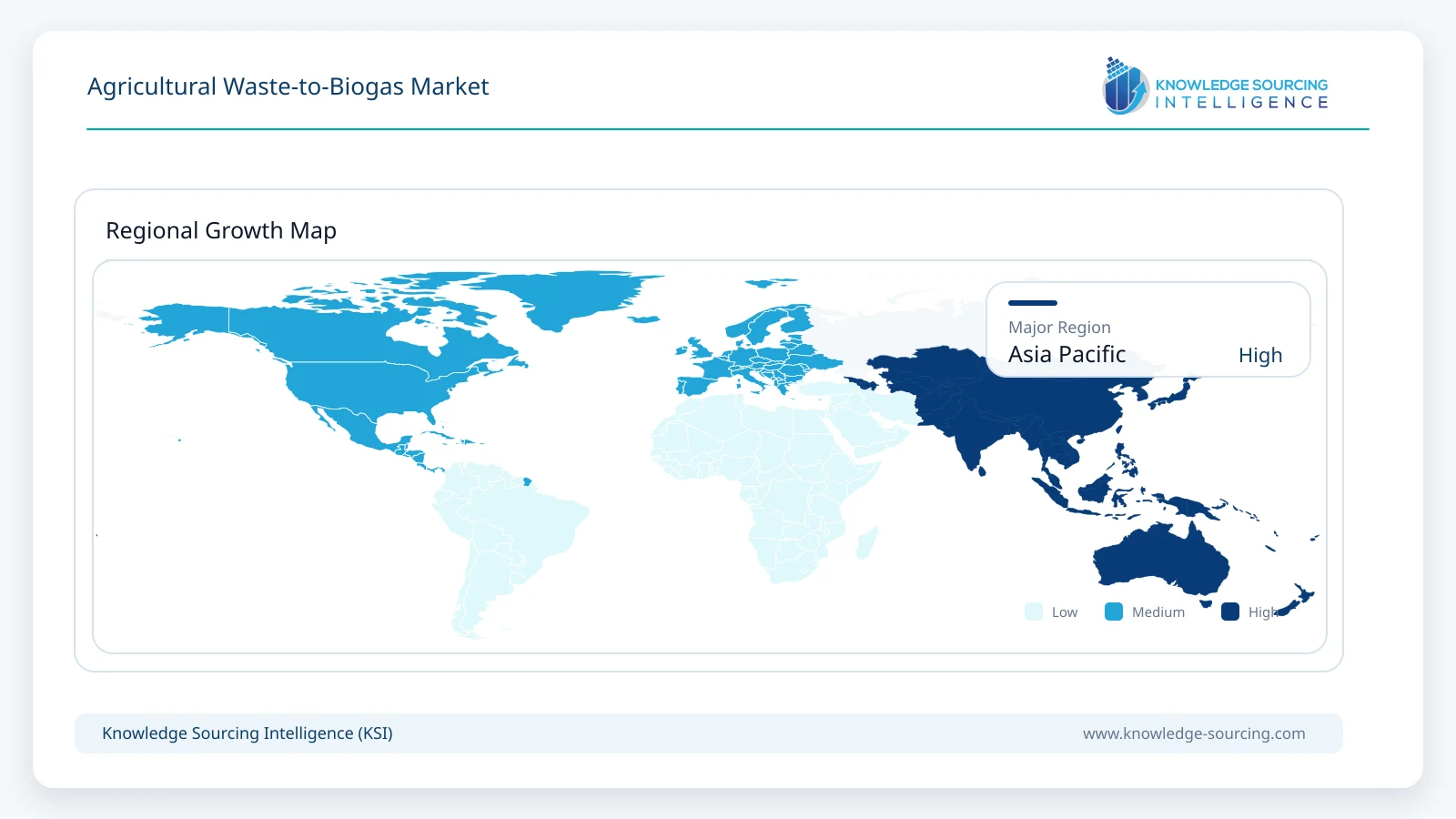
U.S. dairy and swine producers implementing anaerobic digestion to gain Renewable Fuel Standard RIN credits and state-level low-carbon fuel standard incentives from the California State Government, especially in the Midwest, are contributing to North America's fastest regional growth.
Europe Market Analysis
Germany's pioneering agricultural biogas and established feed-in tariff (FIT) soft law will support the significant regional market value share of Europe, which will be sustained by the EU's REPowerEU biomethane goal to continue using agricultural feedstock.
Asia-Pacific Market Analysis
Asia-Pacific is growing as China and India implement programs to burn less crop residue and provide better access to rural energy in their rural areas, accounting for the second largest share of the global biogas plant market.
Middle East and Africa Market Analysis
Early-stage investments in agricultural waste to biogas are increasingly being made in the Middle East and Africa in line with the development of a circular economy and energy access programs.
South America Market Analysis
Brazil's large agricultural residues, coupled with the increasing scope of renewable-fuel policy incentives, is making South America a high-growth region for investments in agricultural biogas potential.
List of Companies
EnviTec Biogas
PlanET Biogas Group
WELTEC BIOPOWER
HoSt Holding
Greenlane Renewables
Ammongas
Biofrigas Sweden
Gasum
Bright Renewables
DMT International
Competitive Landscape
EnviTec Biogas
EnviTec Biogas designs, builds, and operates biogas and biomethane production facilities, combining anaerobic digestion expertise with feedstock-handling systems suited to agricultural waste, crop residues, and livestock-manure feedstock streams.
PlanET Biogas Group
PlanET Biogas Group supplies anaerobic digestion plants and feedstock pre-treatment systems supporting agricultural biogas producers across a wide range of crop-residue and livestock-manure feedstock combinations globally.
WELTEC BIOPOWER
WELTEC BIOPOWER supplies stainless-steel wet anaerobic digestion systems designed specifically for agricultural and livestock-manure feedstock processing, with installations across European and international agricultural markets.
Analyst View
The Agricultural Waste-to-Biogas market sits at the intersection of two durable policy trends, methane emission reduction targeting agriculture and livestock, and renewable-fuel credit programs that create direct financial incentives for farmers to capture and monetize biogas. Agricultural residues and livestock manure together represent the single largest feedstock category underpinning global biogas production, and the fastest-growing segments, sub-0.5 MW farm-scale digesters and dry anaerobic digestion suited to crop residues, point toward continued decentralization of biogas capacity closer to the point of feedstock generation. Vendors that combine proven anaerobic digestion technology, feedstock-flexible design, and strong positioning to capture renewable-fuel credit revenue streams are best positioned to lead the next phase of market growth.
Agricultural Waste-to-Biogas Market Scope:
| Report Metric | Details |
|---|---|
| Total Market Size in 2026 | USD 8.11 billion |
| Total Market Size in 2031 | USD 11.92 billion |
| Forecast Unit | Billion |
| Growth Rate | 8.0% |
| Study Period | 2021 to 2031 |
| Historical Data | 2021 to 2024 |
| Base Year | 2025 |
| Forecast Period | 2026 – 2031 |
| Segmentation | Feedstock, Process Technology, Plant Capacity, Application, Geography |
| Companies |
|
Market Segmentation
By Feedstock
By Process Technology
By Plant Capacity
By Application
By Geography
Table of Contents
1. EXECUTIVE SUMMARY
2. MARKET SNAPSHOT
2.1. Market Overview
2.2. Market Definition
2.3. Scope of the Study
2.4. Market Segmentation
3. BUSINESS LANDSCAPE
3.1. Market Drivers
3.2. Market Restraints
3.3. Market Opportunities
3.4. Porter's Five Forces Analysis
3.5. Industry Value Chain Analysis
3.6. Policies and Regulations (U.S. Renewable Fuel Standard, EU REPowerEU Biomethane Target, Methane Reduction Commitments, State Low-Carbon Fuel Standards)
3.7. Strategic Recommendations
4. TECHNOLOGICAL OUTLOOK
4.1. Wet vs. Dry Anaerobic Digestion
4.2. Farm-Scale Modular Digesters
4.3. Co-Digestion of Mixed Agricultural Feedstocks
4.4. Digestate Valorization & Nutrient Recovery
5. AGRICULTURAL WASTE-TO-BIOGAS MARKET BY FEEDSTOCK
5.1. Introduction
5.2. Agricultural Residues & Crop Waste
5.3. Livestock Manure
5.4. Energy Crops
5.5. Others
6. AGRICULTURAL WASTE-TO-BIOGAS MARKET BY PROCESS TECHNOLOGY
6.1. Introduction
6.2. Wet Anaerobic Digestion
6.3. Dry Anaerobic Digestion
7. AGRICULTURAL WASTE-TO-BIOGAS MARKET BY PLANT CAPACITY
7.1. Introduction
7.2. Below 0.5 MW
7.3. 0.5 to 2 MW
7.4. Above 2 MW
8. AGRICULTURAL WASTE-TO-BIOGAS MARKET BY APPLICATION
8.1. Introduction
8.2. Electricity Generation
8.3. Heat Generation
8.4. Upgraded Biomethane / Vehicle Fuel
8.5. Others
9. AGRICULTURAL WASTE-TO-BIOGAS MARKET BY GEOGRAPHY
9.1. Introduction
9.2. North America
9.2.1. USA
9.2.2. Canada
9.2.3. Mexico
9.3. South America
9.3.1. Brazil
9.3.2. Others
9.4. Europe
9.4.1. Germany
9.4.2. France
9.4.3. United Kingdom
9.4.4. Others
9.5. Middle East and Africa
9.5.1. UAE
9.5.2. Saudi Arabia
9.5.3. Others
9.6. Asia Pacific
9.6.1. China
9.6.2. India
9.6.3. Japan
9.6.4. Others
10. COMPETITIVE ENVIRONMENT AND ANALYSIS
10.1. Major Players and Strategy Analysis
10.2. Market Share Analysis
10.3. Mergers, Acquisitions, Agreements, and Collaborations
10.4. Competitive Dashboard
11. COMPANY PROFILES
11.1. EnviTec Biogas
11.2. PlanET Biogas Group
11.3. WELTEC BIOPOWER
11.4. HoSt Holding
11.5. Greenlane Renewables
11.6. Ammongas
11.7. Biofrigas Sweden
11.8. Gasum
11.9. Bright Renewables
11.10. DMT International
12. APPENDIX
12.1. Currency
12.2. Assumptions
12.3. Base and Forecast Years Timeline
12.4. Key Benefits for the Stakeholders
12.5. Research Methodology
12.6. Abbreviations
Navigate
Trusted by the world's leading organizations











