BRICS Orthopedic Prosthetics Market - Strategic Insights and Forecasts (2026-2031)
BRICS Orthopedic Prosthetics Market Size, Share, Forecasts and Trends Analysis By Type (Feet, Knee, Limb Systems, Ankles and Adapters, Cosmesis, Liners, Others), By Technology (Conventional, Electric-Powered, Hybrid, Customized Technologies), By End User (Hospitals, Prosthetic Clinics, Rehabilitation Centres, Home Care), and Country
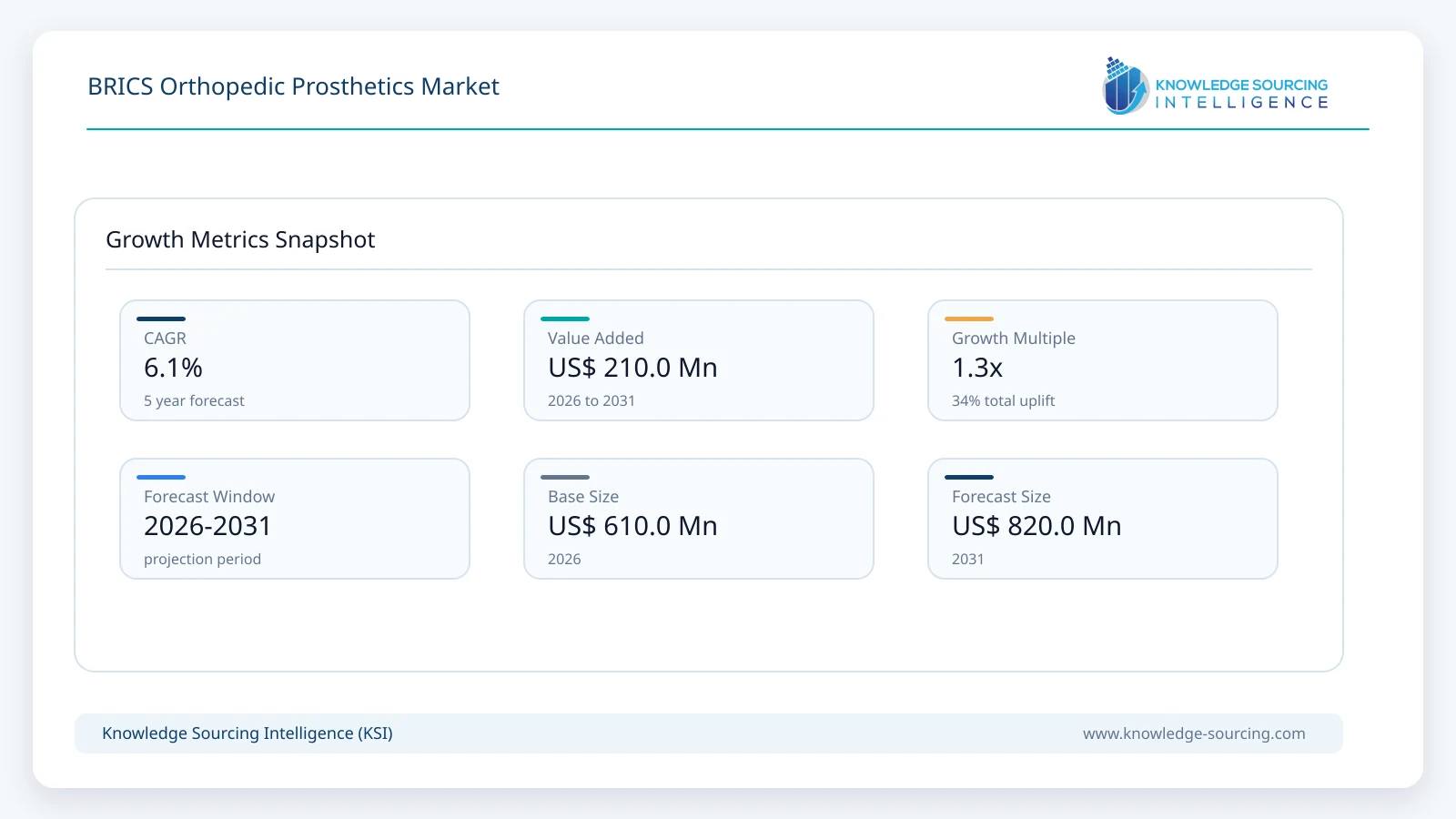
The BRICS Orthopedic Prosthetics Market is forecast to grow at a CAGR of 6.1%, reaching USD 820.0 million in 2031 from USD 610 million in 2026.
Highlights:
1
Complete limb systems account for approximately one-third of market revenue in 2026.
2
Conventional prosthetic technologies remain the largest category because affordability drives public procurement.
3
China contributes approximately 40% of the five-country market value in 2026.
4
India is the fastest-growing major country as public distribution and private clinic networks expand.
5
Microprocessor-controlled knees and advanced feet increase average value per high-complexity fitting.
6
Digital scanning and computer-aided manufacturing are reducing socket-development time and improving repeatability.
Market Overview
Orthopedic prosthetic demand across the five-country BRICS grouping is structurally diverse. China combines the largest addressable population with a broad domestic rehabilitation device industry and an increasingly formal standards framework. India combines a large unmet need with public programs that subsidize assistive devices and a growing network of specialist private prosthetic centres. Russia has increased attention to prosthetic and rehabilitation capacity, including modern modular devices and microprocessor-controlled knees for complex cases. Brazil has a developed private orthopaedic-technology channel alongside public rehabilitation services, while South Africa remains smaller in value but supports demand for imported advanced components through specialist prosthetic practices.
Public provision remains central to market volume, particularly for conventional lower-limb systems, while private payment and supplementary healthcare support a larger share of advanced components. India’s ADIP scheme includes artificial limbs, prostheses and orthoses and provides higher assistance limits for high-end prostheses. Russia moved in 2025 toward electronic certificates or direct provision for technical rehabilitation devices and updated the permitted service-life rules for prostheses and prosthetic-orthotic products. In China, GB/T 16432-2025 aligned the national classification of assistive products with ISO 9999:2022, while the Ministry of Civil Affairs established a process for regular updates to the national assistive-products catalogue.
Technology adoption is increasing unevenly. Mechanical knees, solid-ankle-cushioned-heel feet and standard modular systems remain essential because they are durable and economical, but higher-function users are gaining access to carbon-composite feet, hydraulic ankles, microprocessor knees, powered or myoelectric upper-limb systems and multi-articulating hands. The commercial opportunity therefore depends not only on the number of new amputees but also on replacement cycles, component upgrades, socket refitting, rehabilitation services and the ability of clinicians to match advanced devices to functional needs.
Selected Segment Estimates
Dimension
Selected Subsegment
2026 Indicator
Forecast Interpretation
By Type
Complete Limb Systems
~33% of market revenue
Largest value pool; combines multiple components within complete fittings.
By Technology
Conventional
~57% of market revenue
Retains scale through affordability and public procurement.
By Technology
Electric-Powered / Microprocessor
~18% of market revenue
Outgrows the market as advanced knees and upper-limb systems gain access.
By End User
Prosthetic Clinics
~46% of market revenue
Largest channel because fitting, alignment and follow-up require specialist expertise.
By Country
China
~40% of market revenue
Largest country market; standards and rehabilitation investment support continued upgrades.
By Country
India
~25% of market revenue
Fastest major-country expansion through public programs and private clinical networks.
Market Dynamics
Public Assistive-Device Programs Expand Access to Prosthetic Fitting
Government-backed access programs are a major demand driver because prosthetic fittings require both hardware and clinical services. India’s ADIP program distributes artificial limbs, prostheses and orthoses through implementing agencies including the Artificial Limbs Manufacturing Corporation of India (ALIMCO), national institutes, hospitals and disability rehabilitation centres. The ARJUN platform reports more than 3.39 million cumulative ADIP beneficiaries across assistive-device categories. Russia has also simplified access to technical rehabilitation devices through electronic certificates and direct state provision, while specialized prosthetic-rehabilitation centres are being expanded. These programs support baseline volumes and create a pathway for patients to progress from basic devices to higher-function replacements.
Diabetes, Vascular Disease and Trauma Sustain the Need for Lower-Limb Prostheses
Lower-limb prosthetics remain the core demand pool because limb loss is associated with road and occupational trauma, diabetic complications, peripheral vascular disease, infections and military injury. The underlying drivers differ by country, but the commercial consequence is similar: a continuing requirement for transtibial and transfemoral sockets, feet, knees, liners and replacement components. Population ageing increases the relevance of stable, low-maintenance devices, while younger trauma patients create demand for dynamic-response feet, hydraulic systems and higher-activity knees. Because prostheses require periodic socket modification and component replacement, the installed user base also creates recurring demand independent of the number of first-time amputees.
Advanced Components Increase Value Per Fitting
The technology mix is moving gradually toward higher-value components. Ottobock’s Genium X4 and newer knee platforms, Blatchford’s Avior and Linx systems, PROTEOR’s QUATTRO 2 and increasingly capable myoelectric upper-limb systems illustrate the widening functional range available to clinicians. These products can improve stability, terrain adaptation, gait symmetry and user confidence, but they also require assessment, programming and follow-up. Adoption therefore increases revenue not only through higher component prices but also through fitting and rehabilitation intensity. The strongest opportunity is among users whose employment, mobility level or rehabilitation goals justify measurable functional benefits.
Affordability and Uneven Clinical Capacity Constrain Advanced Adoption
The principal restraint is the gap between the cost of advanced prosthetic technology and the reimbursement or household resources available in many parts of the five countries. Public systems often prioritize durable conventional devices that can serve a larger number of users, while microprocessor knees, advanced feet and multi-articulating hands require substantially greater spending. Clinical capacity is also uneven: advanced devices need experienced prosthetists, gait training, programming and reliable after-sales support. Imported components add exposure to currency movements, logistics and replacement-part availability, limiting adoption outside major cities and specialist centres.
Socket Fit, Maintenance and Replacement Remain Lifecycle Challenges
Prosthetic performance depends heavily on socket fit and continued clinical adjustment. Residual-limb volume changes, weight change, skin issues and wear can require socket modification even when the knee or foot remains functional. Advanced electronics add batteries, chargers, software and waterproofing requirements that must be supported over several years. Suppliers with local technical teams, loaner programs, training and dependable spare-parts availability therefore hold an advantage over vendors that compete primarily on the initial device. Digital scanning and computer-aided design can improve repeatability, but they do not eliminate the need for skilled clinical assessment.
Segment Analysis
By Type - Complete Limb Systems
Complete limb systems represent the largest value segment because a clinically finished prosthesis combines several revenue-generating components: socket interfaces, adapters, a knee where required, a foot or ankle module, liners, cosmesis and alignment hardware. Integrated systems are particularly important in above-knee fittings where component compatibility affects safety and gait performance. Blatchford’s Linx illustrates the premium end of this category by coordinating knee and ankle control, while modular mechanical systems remain the larger volume opportunity across public and value-conscious channels. Through 2031, complete systems should retain the largest share even as individual advanced knees and feet grow faster.
By Technology - Conventional and Electric-Powered Systems
Conventional prosthetic technology remains the largest category in 2026 because mechanical knees, basic modular systems and standard feet provide dependable function at accessible cost. Electric-powered and microprocessor-controlled systems are the faster-growing segment, especially in transfemoral prosthetics and upper-limb applications. Their expansion is supported by better sensors, longer battery life, improved water resistance and software-guided setup. Growth will remain selective rather than universal because the clinical benefit must justify higher acquisition and maintenance cost. Hybrid systems combining mechanical structures with electronic control also gain relevance as manufacturers seek a balance between function, durability and affordability.
By End User - Prosthetic Clinics
Specialist prosthetic clinics account for the largest share because device selection is only one part of treatment. Casting or scanning, socket fabrication, alignment, gait assessment, programming, rehabilitation coordination and follow-up all influence outcomes. Hospital and rehabilitation-centre channels are important for new amputees and complex trauma cases, but long-term prosthetic care often migrates to specialist facilities. India’s expanding private prosthetic clinic networks and Ottobock Care’s multi-city footprint illustrate this service-intensive model. Clinics that can support both conventional and microprocessor technologies are positioned to capture replacement and upgrade demand over the user lifecycle.
Technology and Demand Indicators
Indicator
Latest Development
Market Impact
India public access
ARJUN reports more than 3.39 million cumulative ADIP beneficiaries.
Large public assistive-device channel supports baseline prosthetic demand.
China standards
GB/T 16432-2025 took effect on June 30, 2025 and aligns with ISO 9999:2022.
Clearer product classification supports procurement and catalogue modernization.
Russia rehabilitation capacity
First integrated prosthetic-rehabilitation centre opened in June 2025; ten centres are planned by 2027.
Expands access to modern modular and microprocessor-controlled devices.
Advanced knees
Ottobock, Blatchford and PROTEOR introduced or expanded next-generation microprocessor knee platforms in 2026.
Raises the functional ceiling and average value of advanced fittings.
Industry investment
CVC agreed to acquire a majority stake in WillowWood in June 2026.
Supports R&D, international expansion and broader product portfolios.
Digital fitting
CAD/CAM scanning, socket design and remote device data are spreading across leading clinical networks.
Improves repeatability and strengthens service revenue around devices.
China Market Analysis
China is the largest country market in the five-country grouping, contributing approximately 40% of 2026 revenue. Its advantage comes from population scale, a broad domestic rehabilitation and assistive-device ecosystem, growing elderly and disability-related demand, and the ability to manufacture a wide range of mechanical rehabilitation products locally. Policy is also becoming more structured. The national standard GB/T 16432-2025 replaced the 2016 edition of the assistive-product classification standard in June 2025 and is equivalent to ISO 9999:2022. The Ministry of Civil Affairs subsequently established a procedure for dynamic updates to the national assistive-products catalogue, explicitly allowing innovative products to be added as technology and user needs change.
China’s volume market remains price sensitive, which favors conventional components and locally manufactured systems, but higher-value prosthetics have room to expand in major urban rehabilitation centres. Microprocessor knees, carbon-fibre feet, myoelectric hands and digitally designed sockets are most relevant where users have higher functional requirements or greater purchasing support. The competitive structure therefore spans domestic manufacturers at the value end and international technology companies in premium devices. Through 2031, the country should retain the largest absolute contribution to market growth, with the strongest value expansion coming from technology upgrades rather than a simple increase in basic device volumes.
Competitive Landscape
The market combines global prosthetic-technology leaders with regional manufacturers and public-sector suppliers. Ottobock has the broadest premium portfolio across knees, feet, upper-limb systems and clinical services and maintains direct operations in Brazil, India, China and South Africa. Embla Medical, through the Össur brand, competes in lower-limb components and socket-interface products, while Blatchford is strong in integrated limb systems, hydraulic ankles and microprocessor knees. PROTEOR, Fillauer, WillowWood, College Park and Streifeneder broaden competition across knees, feet, liners, upper-limb systems and fabrication components.
Local capability is especially important at the value end of the market. India’s ALIMCO manufactures upper- and lower-limb prosthetic components and supports public distribution through national programs. Competitive advantage increasingly depends on the combination of component technology and clinical support rather than the hardware alone. Suppliers that train prosthetists, maintain local inventories, provide programming tools and offer reliable warranty or replacement services can penetrate advanced segments more effectively. The market remains fragmented at the clinic and fabrication level, leaving room for global suppliers to grow through distributor partnerships, clinical education and localized service networks.
Recent Developments
July 2026: Ottobock introduced dynion explore, a new prosthetic knee designed for adolescents.
July 2026: PROTEOR introduced QUATTRO 2, its next-generation microprocessor knee, with worldwide availability scheduled from September 2026.
June 2026: CVC Catalyst agreed to acquire a majority stake in WillowWood to support product development and international expansion.
May 2026: Blatchford showcased Avior, Linx and its current lower-limb prosthetic portfolio at OTWorld 2026.
June 2025: Russia accelerated the expansion of its specialized high-tech prosthetic and rehabilitation network, utilizing Rostec’s Orthopaedic Innovative Technology Center (CITO) to advance full-cycle production of functional and microprocessor-based modern modular prostheses.
June 2025: China implemented GB/T 16432-2025, updating the national classification and terminology standard for assistive products.
BRICS Orthopedic Prosthetics Market Scope:
Report Metric
Details
Total Market Size in 2026
USD 610.0 million
Total Market Size in 2031
USD 820.0 million
Forecast Unit
Million
Growth Rate
6.1%
Study Period
2021 to 2031
Historical Data
2021 to 2024
Base Year
2025
Forecast Period
2026 – 2031
Segmentation
Type, Technology, End User, Country
Companies
Ottobock SE & Co. KGaA
Embla Medical hf. (Össur)
Blatchford Limited
PROTEOR
Fillauer LLC
WillowWood Global LLC
College Park Industries
Streifeneder ortho.production GmbH
Artificial Limbs Manufacturing Corporation of India (ALIMCO)
Market Segmentation
By Type
Feet
Knee
Limb Systems
Ankles and Adapters
Cosmesis
Liners
Others
By Technology
Conventional
Electric-Powered
Hybrid
Customized Technologies
By End User
Hospitals
Prosthetic Clinics
Rehabilitation Centres
Home Care
By Country
Brazil
Russia
India
China
South Africa
Table of Contents
1. EXECUTIVE SUMMARY
2. MARKET SNAPSHOT
2.1. Market Overview
2.2. Market Segmentation
3. BUSINESS LANDSCAPE
3.1. Market Drivers
3.1.1. Public Assistive-Device Programs Expand Access to Prosthetic Fitting
3.1.2. Diabetes, Vascular Disease and Trauma Sustain the Need for Lower-Limb Prostheses
3.1.3. Advanced Components Increase Value Per Fitting
3.2. Market Restraints
3.2.1. Affordability and Uneven Clinical Capacity Constrain Advanced Adoption
3.2.2. Socket Fit, Maintenance and Replacement Remain Lifecycle Challenges
3.3. Market Opportunities
3.4. Porter’s Five Forces Analysis
3.5. Industry Value Chain Analysis
3.6. Regulatory and Reimbursement Landscape
4. TECHNOLOGICAL OUTLOOK
4.1. Microprocessor-Controlled Knees
4.2. Powered and Myoelectric Upper-Limb Prostheses
4.3. Advanced Feet and Hydraulic Ankles
4.4. Digital Scanning and CAD/CAM Socket Fabrication
4.5. Sensors, Connectivity and Remote Monitoring
5. BRICS ORTHOPEDIC PROSTHETICS MARKET BY TYPE
5.1. Feet
5.2. Knee
5.3. Limb Systems
5.4. Ankles and Adapters
5.5. Cosmesis
5.6. Liners
5.7. Others
6. BRICS ORTHOPEDIC PROSTHETICS MARKET BY TECHNOLOGY
6.1. Conventional
6.2. Electric-Powered
6.3. Hybrid
6.4. Customized Technologies
7. BRICS ORTHOPEDIC PROSTHETICS MARKET BY END USER
7.1. Hospitals
7.2. Prosthetic Clinics
7.3. Rehabilitation Centres
7.4. Home Care
8. BRICS ORTHOPEDIC PROSTHETICS MARKET BY COUNTRY
8.1. Brazil
8.2. Russia
8.3. India
8.4. China
8.5. South Africa
9. COMPETITIVE ENVIRONMENT AND ANALYSIS
9.1. Major Players and Strategy Analysis
9.2. Market Share Analysis
9.3. Mergers, Acquisitions, Agreements and Collaborations
9.4. Competitive Dashboard
10. COMPANY PROFILES
10.1. Ottobock SE & Co. KGaA
10.2. Embla Medical hf. (Össur)
10.3. Blatchford Limited
10.4. PROTEOR
10.5. Fillauer LLC
10.6. WillowWood Global LLC
10.7. College Park Industries
10.8. Streifeneder ortho.production GmbH
10.9. Artificial Limbs Manufacturing Corporation of India (ALIMCO)