
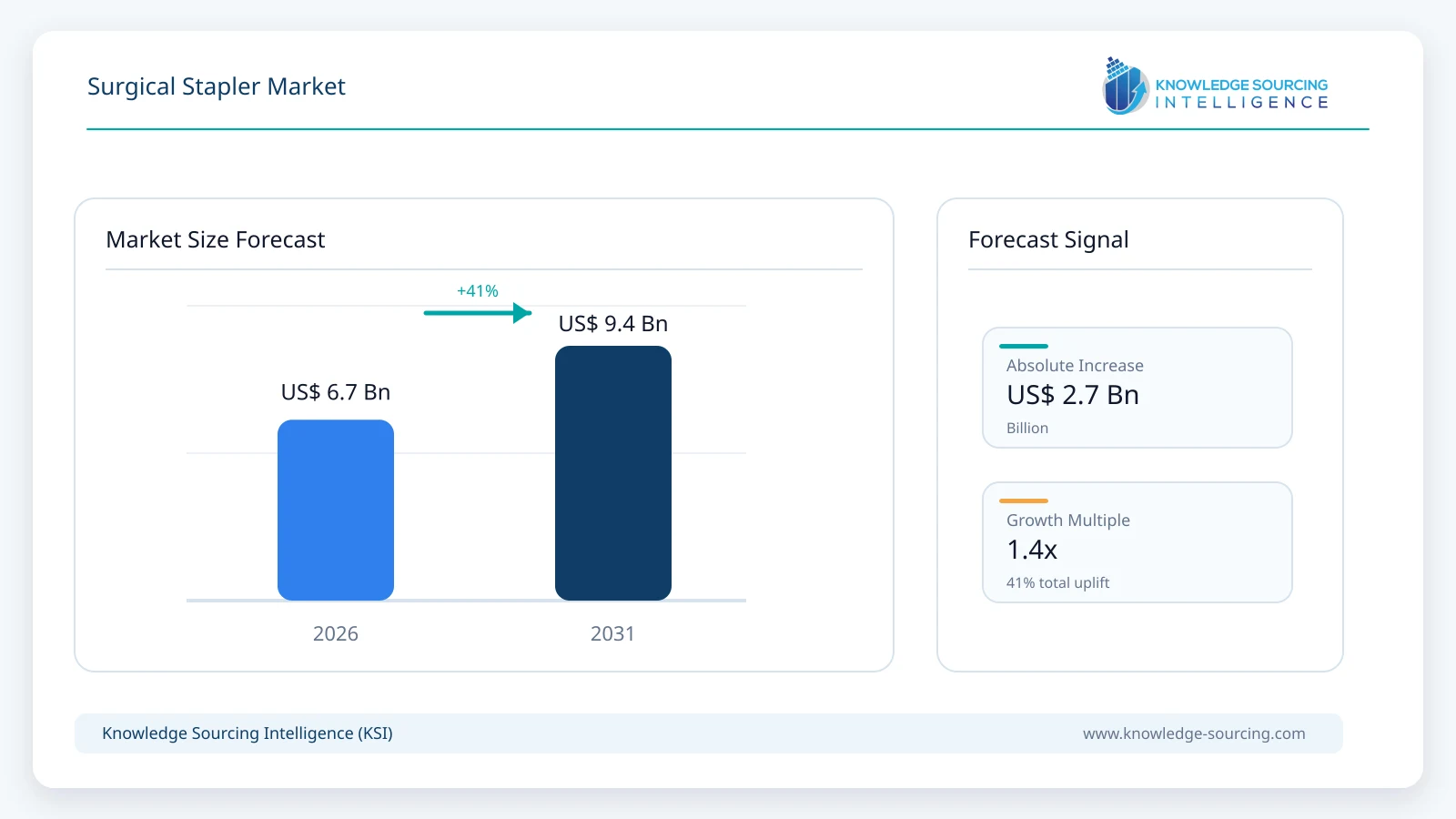
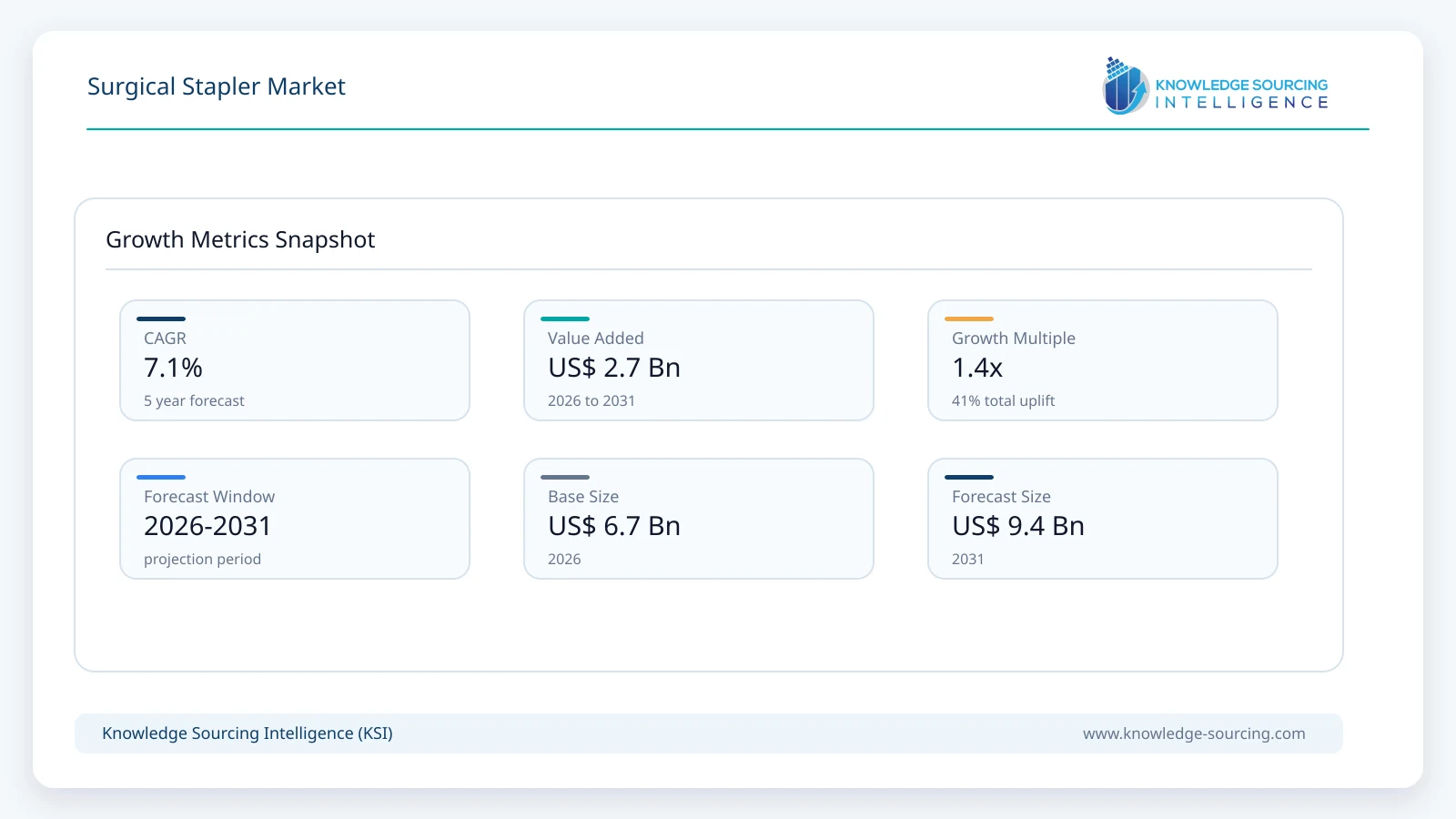
The Global Surgical Stapler market is forecast to grow at a CAGR of 7.1%, reaching USD 9.41 billion in 2031 from USD 6.68 billion in 2026.
Highlights:
- 1The growing number of minimally invasive and robotic-assisted surgical procedures continues to strengthen demand for advanced surgical stapling systems.
- 2Powered surgical staplers represent one of the most commercially valuable product categories because of their ability to improve consistency during complex procedures.
- 3Asia Pacific offers considerable long-term opportunities owing to expanding hospital infrastructure, rising surgical volumes, and broader healthcare investment.
- 4Product development increasingly focuses on tissue-specific staple formation, improved articulation, ergonomic design, and digital feedback features that support surgical precision.
- 5Regulatory compliance with stringent medical device quality standards remains a decisive factor influencing procurement decisions across developed healthcare markets.
- 6Competition is shaped by product performance, clinical evidence, surgeon familiarity, distribution capabilities, and long-term hospital purchasing agreements rather than price alone.
The surgical stapler market represents a critical segment of the global surgical devices industry, supplying mechanical wound closure systems that improve procedural efficiency, tissue approximation, and haemostasis across a broad range of surgical interventions. Surgical staplers are routinely used in open and minimally invasive procedures involving the gastrointestinal tract, thoracic cavity, cardiovascular system, gynaecology, bariatric surgery, orthopaedics, and trauma care. Compared with conventional suturing, stapling devices can reduce operative time, provide consistent staple formation, and support standardized surgical techniques, making them an integral component of modern operating rooms.
Demand is primarily influenced by procedural volume rather than replacement cycles. Hospitals, ambulatory surgical centres, and specialty clinics procure stapling devices according to surgical case mix, surgeon preference, reimbursement policies, and long-term supply agreements. Procurement teams increasingly evaluate products on clinical performance, compatibility with existing surgical platforms, total procedure cost, training requirements, and supply reliability. The transition towards value-based healthcare has shifted purchasing decisions from unit pricing alone to overall procedural efficiency, complication reduction, and post-operative outcomes.
The expansion of minimally invasive surgery has materially altered product demand. Laparoscopic and robotic-assisted procedures require specialised stapling systems capable of operating within confined anatomical spaces while maintaining precise tissue compression and staple formation. As hospitals continue investing in advanced operating theatres and robotic surgery programmes, compatible powered stapling technologies have become an important purchasing consideration. Manufacturers are responding by integrating ergonomic improvements, enhanced articulation, digital feedback mechanisms, and tissue-sensing capabilities into premium product portfolios.
Demographic trends also underpin long-term market demand. Population ageing has contributed to higher incidences of colorectal diseases, obesity, cardiovascular disorders, cancer, and degenerative conditions requiring surgical intervention. Improvements in access to healthcare across emerging economies are expanding surgical capacity, increasing the utilisation of disposable surgical consumables, including stapling devices. Government investments in hospital infrastructure and surgical workforce development further support procedural growth, particularly in Asia Pacific and selected Middle Eastern countries.
Industry economics are characterised by recurring consumable revenues. While reusable systems remain relevant in certain healthcare facilities, disposable staplers and staple reload cartridges generate continuous procurement demand because they are consumed during each surgical procedure. This recurring revenue structure encourages manufacturers to develop broad product ecosystems that improve customer retention through platform compatibility and long-term purchasing contracts.
Competition extends beyond product innovation to encompass clinical education, regulatory compliance, manufacturing quality, and supply chain resilience. Hospitals increasingly favour suppliers capable of providing consistent product availability, surgeon training programmes, technical support, and evidence demonstrating favourable clinical outcomes. Consequently, market leadership depends on balancing technological differentiation with dependable manufacturing capacity and global distribution capabilities.
Market Drivers
Rising Surgical Procedure Volumes Supported by Demographic and Disease Trends
The growing prevalence of chronic diseases requiring operative treatment remains one of the strongest commercial drivers for surgical staplers. Colorectal cancer, obesity, cardiovascular disorders, gastrointestinal diseases, and thoracic conditions frequently require surgical intervention where stapling devices improve tissue closure efficiency. Simultaneously, ageing populations across developed and emerging economies are increasing demand for elective and emergency surgical procedures.
Healthcare providers are expanding surgical capacity to reduce waiting lists while improving operating theatre productivity. Hospitals therefore favour technologies that reduce operative duration without compromising clinical performance. Manufacturers benefit from this trend by supplying specialised stapling systems tailored to distinct surgical disciplines, increasing procedural adoption across multiple therapeutic areas.
The commercial implication is sustained procedural demand that supports recurring purchases of disposable staplers and reload cartridges, creating predictable revenue streams independent of capital equipment replacement cycles.
Expansion of Minimally Invasive and Robotic Surgery
The global shift towards minimally invasive surgery has substantially increased demand for specialised surgical staplers capable of functioning within restricted anatomical spaces. Laparoscopic and robotic procedures require enhanced articulation, precise tissue compression, and reliable staple formation that conventional closure techniques may not consistently achieve.
Healthcare providers increasingly invest in robotic surgical platforms to improve procedural precision, reduce patient recovery time, and shorten hospital stays. Consequently, surgeons require stapling devices compatible with these advanced operating environments.
Manufacturers are responding through product innovation focused on powered firing mechanisms, improved articulation, enhanced tissue compression technology, and digital feedback systems. These developments strengthen supplier competitiveness while encouraging hospitals to adopt integrated procedural solutions that improve operating room efficiency.
Greater Emphasis on Surgical Quality and Clinical Outcomes
Healthcare systems increasingly evaluate surgical performance using quality indicators including complication rates, anastomotic leakage, wound healing, blood loss, and hospital readmissions. Reliable tissue closure technologies directly influence many of these clinical metrics.
Hospitals therefore seek stapling devices supported by clinical evidence demonstrating procedural consistency and dependable staple formation across different tissue types. Purchasing committees frequently incorporate surgeon feedback alongside published clinical data when selecting preferred suppliers.
This emphasis encourages manufacturers to invest in product validation, surgeon education, and post-market surveillance. Clinical differentiation has consequently become an important competitive advantage in premium procurement programmes.
Growth in Hospital Infrastructure Across Emerging Economies
Investment in healthcare infrastructure across Asia Pacific, the Middle East, and parts of Latin America is expanding access to surgical services. Governments are increasing healthcare expenditure, constructing tertiary hospitals, and strengthening specialised surgical departments to address growing patient demand.
Private healthcare providers are also expanding multi-specialty hospital networks that routinely perform gastrointestinal, bariatric, orthopaedic, and cardiovascular procedures requiring stapling devices. Rising healthcare insurance coverage in several developing economies further supports procedural volumes.
As surgical capacity expands, procurement of disposable surgical consumables grows proportionately, creating opportunities for manufacturers capable of offering reliable supply chains, competitive pricing strategies, and comprehensive clinical support programmes.
Market Restraints and Challenges
High Product Costs and Hospital Budget Constraints
Advanced powered staplers and specialised reload cartridges represent a substantial procedural expense compared with conventional sutures. Public hospitals operating under constrained healthcare budgets often conduct detailed cost-benefit analyses before approving widespread adoption.
Price sensitivity is particularly evident in lower-income healthcare systems where reimbursement may not fully compensate for premium surgical consumables. Procurement teams therefore evaluate total procedural economics rather than device performance alone.
Manufacturers address this challenge by expanding product portfolios across multiple price segments, offering long-term purchasing contracts, and demonstrating clinical evidence supporting reduced complication rates and improved operating room efficiency.
Product Recalls and Stringent Regulatory Compliance
Medical devices used during surgical procedures are subject to rigorous regulatory oversight because product failures may directly affect patient safety. Manufacturing defects, staple formation inconsistencies, or quality control issues can result in product recalls, increased regulatory scrutiny, and reputational damage.
Compliance requires continuous investment in manufacturing validation, supplier qualification, quality management systems, and post-market monitoring. Smaller manufacturers may face greater financial pressure in meeting evolving regulatory expectations across multiple jurisdictions.
Although these requirements strengthen overall product safety, they increase development costs, extend approval timelines, and raise barriers for new market entrants.
Supply Chain Complexity for Precision Components
Modern surgical staplers consist of precision-engineered components requiring specialised manufacturing processes and strict quality assurance. Supply disruptions affecting medical-grade metals, polymers, precision springs, or sterilisation services can interrupt production schedules.
Global healthcare providers increasingly prioritise supply continuity following disruptions experienced in recent years. Consequently, procurement decisions now consider manufacturing resilience alongside product performance.
Manufacturers are responding by diversifying supplier networks, increasing regional production capacity, and strengthening inventory management systems to minimise disruption risks while maintaining consistent product availability.
Training Requirements and Surgeon Preference
Successful adoption depends not only on product availability but also on surgeon familiarity and procedural confidence. Advanced powered staplers incorporate additional functionality that may require structured clinical training before routine use.
Hospitals introducing new stapling platforms often invest in educational programmes, simulation laboratories, and clinical support to facilitate adoption. However, experienced surgeons may continue using established systems with which they have extensive procedural experience.
This reliance on user preference creates longer procurement cycles and increases the importance of clinical education, technical support, and evidence-based product differentiation for manufacturers seeking to expand market share.
Major Segment Analysis
Powered Surgical Staplers
Powered surgical staplers represent the most commercially significant segment because they address the growing demand for procedural consistency in complex surgical interventions. Unlike manual devices, powered systems provide controlled staple firing with reduced hand force, helping surgeons achieve more uniform tissue compression and staple formation. These advantages are particularly valuable in colorectal, thoracic, bariatric, and robotic-assisted procedures where tissue thickness varies and precision directly influences clinical outcomes.
Buyer demand is strongest among tertiary hospitals and high-volume surgical centres that perform advanced laparoscopic and robotic operations. Procurement decisions increasingly consider clinical evidence demonstrating reduced tissue trauma, improved staple-line integrity, ergonomic benefits for surgeons, and compatibility with existing surgical workflows. Although powered staplers command higher acquisition costs, many healthcare providers evaluate them on the basis of overall procedural economics rather than device price alone. Shorter operating times, reduced surgeon fatigue, and fewer intraoperative adjustments can offset higher procurement expenditure in facilities with large surgical volumes.
Competition within this segment is driven by technological differentiation rather than incremental price reductions. Manufacturers continue to introduce intelligent firing mechanisms, adaptive tissue compression, improved articulation, enhanced reload systems, and digital feedback capabilities that assist surgeons in selecting appropriate firing conditions. Integration with robotic-assisted surgical platforms further strengthens the commercial importance of powered staplers as hospitals expand investments in advanced operating theatres.
Recurring demand for compatible reload cartridges also improves long-term revenue visibility for suppliers. Once a healthcare provider standardises a stapling platform, switching costs increase because of surgeon familiarity, staff training requirements, and inventory management considerations. This creates sustained procurement relationships between manufacturers and healthcare institutions while encouraging continuous product upgrades that remain compatible with existing clinical workflows.
Regional Analysis
North America
North America maintains a leading position owing to its high surgical procedure volumes, widespread adoption of minimally invasive surgery, and established reimbursement systems. Hospitals routinely invest in advanced surgical technologies that improve procedural efficiency and patient outcomes. Purchasing decisions are supported by multidisciplinary value analysis committees that evaluate clinical evidence, product reliability, regulatory compliance, and lifecycle costs. The region also benefits from strong manufacturer presence, established distribution networks, and continuous product innovation. However, pricing pressure from healthcare cost containment programmes encourages hospitals to negotiate long-term purchasing agreements and seek measurable clinical value.
Europe
European demand is supported by mature healthcare systems, ageing populations, and increasing adoption of enhanced recovery after surgery protocols. Regulatory compliance under the European Union Medical Device Regulation (EU MDR) has strengthened quality requirements while extending approval timelines for manufacturers. Hospitals continue investing in minimally invasive surgery, although procurement decisions remain highly sensitive to public healthcare budgets and national reimbursement policies. Western Europe demonstrates greater adoption of premium powered staplers, whereas several Central and Eastern European markets continue balancing clinical performance with affordability.
Asia Pacific
Asia Pacific presents the strongest long-term expansion opportunity due to growing healthcare expenditure, increasing surgical capacity, and rising access to specialised care. China and India continue expanding tertiary hospitals while investing in advanced operating room infrastructure. Japan and South Korea maintain high adoption of technologically advanced surgical equipment supported by sophisticated healthcare systems. Domestic manufacturing capabilities are also expanding across several countries, increasing competition alongside established multinational suppliers. Despite favourable demand fundamentals, disparities in reimbursement coverage and healthcare infrastructure continue to influence purchasing behaviour across different national markets.
Middle East & Africa
Healthcare investment programmes across Gulf Cooperation Council countries are strengthening demand for advanced surgical equipment through hospital expansion, medical tourism initiatives, and specialist healthcare development. Large public healthcare projects increasingly procure premium surgical technologies for newly established tertiary hospitals. South Africa remains an important regional market because of its comparatively developed healthcare infrastructure. Nevertheless, budget limitations, unequal healthcare access, and dependence on imported medical devices continue to constrain wider regional adoption.
South America
Brazil represents the largest regional market, supported by an extensive hospital network and growing demand for minimally invasive procedures within both public and private healthcare sectors. Argentina also maintains consistent demand for surgical consumables despite periodic economic volatility. Currency fluctuations, import regulations, and healthcare funding constraints influence procurement decisions throughout the region. Consequently, suppliers frequently compete through distributor partnerships, flexible commercial arrangements, and broad product portfolios that address varying hospital budget requirements.
Competitive Landscape
The surgical stapler market exhibits moderate to high competitive concentration, with established multinational medical technology companies competing alongside regional manufacturers and specialised surgical device suppliers. Competition extends well beyond product specifications, encompassing clinical evidence, manufacturing quality, regulatory compliance, surgeon education, and long-term customer relationships.
Manufacturers differentiate their portfolios through powered stapling systems, tissue-specific reload technologies, ergonomic instrument design, articulation capabilities, and compatibility with minimally invasive and robotic-assisted procedures. Product reliability remains a primary purchasing consideration because device performance directly affects patient safety and surgical outcomes. Consequently, suppliers invest substantially in engineering validation, quality assurance, and post-market surveillance to strengthen customer confidence.
Strategic partnerships with hospitals, academic medical centres, and surgical training institutions support technology adoption by familiarising surgeons with new platforms before broader commercial deployment. Clinical education programmes have become an important competitive tool, particularly for advanced powered stapling systems that require procedural training.
Geographic expansion remains another important competitive strategy. Companies continue strengthening manufacturing capabilities, regional distribution networks, and local regulatory expertise to improve supply continuity and support growing demand across emerging healthcare markets. The competitive landscape includes CONMED Corporation, B. Braun Melsungen AG, Ethicon (Johnson & Johnson MedTech), Frankenman International Limited, Intuitive Surgical, Inc., Medtronic plc, Meril Life Sciences Pvt. Ltd., Smith+Nephew plc, Teleflex Incorporated, Welfare Medical Ltd., Purple Surgical, Reach Surgical, Inc., Grena Ltd., and Lexington Medical, Inc.
Recent Developments
April 2026: Johnson & Johnson received European CE Mark approval for the ETHICON™ 4000 Stapler, enabling commercial expansion across the European Union and supporting broader adoption in open and minimally invasive surgery.
November 2025: Medtronic announced the limited launch of the Signia™ Circular Stapler with Tri-Staple™ technology, incorporating real-time tissue feedback and intelligent stapling capabilities for gastrointestinal anastomosis. The product expands intelligent surgical instrumentation within advanced operating rooms.
June 2025: Ethicon (Johnson & Johnson MedTech) launched the ETHICON™ 4000 Stapler in the United States, introducing proprietary 3D stapling technology and redesigned reloads to improve staple-line integrity across open and laparoscopic procedures. The launch strengthens competition in premium powered stapling systems.
Regulatory and Policy Environment
The surgical stapler market operates under stringent medical device regulations intended to ensure patient safety, manufacturing consistency, and long-term product performance. In the United States, the Food and Drug Administration (FDA) requires manufacturers to demonstrate substantial equivalence or obtain appropriate regulatory clearance before commercialisation. Manufacturers must also maintain quality management systems, implement corrective and preventive action processes, and conduct post-market surveillance where required.
Within Europe, compliance with the European Union Medical Device Regulation (EU MDR 2017/745) has increased documentation requirements relating to clinical evidence, traceability, risk management, and post-market clinical follow-up. Although these regulations strengthen confidence in approved devices, they have also increased regulatory costs and extended market entry timelines for manufacturers.
Internationally, compliance with ISO 13485 quality management requirements and sterilisation standards has become essential for global market access. Many countries additionally require local product registration, import licensing, and conformity assessment before procurement by public healthcare systems.
Government investment programmes supporting surgical infrastructure, hospital modernisation, and minimally invasive surgery indirectly stimulate demand for advanced stapling technologies. At the same time, reimbursement policies and health technology assessments increasingly require evidence demonstrating improved clinical and economic outcomes before premium products receive broad purchasing approval.
Outlook and Strategic Implications
Commercial prospects for the surgical stapler market will increasingly depend on procedural complexity rather than simple surgical volume growth. As healthcare providers continue expanding minimally invasive, robotic-assisted, and outpatient surgical services, demand will shift toward intelligent stapling platforms capable of delivering greater procedural consistency and workflow efficiency.
Investment priorities are expected to concentrate on powered stapling systems, advanced reload technologies, digital feedback mechanisms, and products designed specifically for robotic surgery. Manufacturers capable of combining engineering innovation with strong clinical evidence and dependable global manufacturing networks will be well positioned to strengthen long-term customer relationships.
Procurement strategies are also evolving. Hospitals increasingly evaluate suppliers through total value assessments that incorporate clinical outcomes, operating room productivity, training support, product availability, and long-term service reliability. This approach favours manufacturers offering integrated product ecosystems rather than standalone devices.
Nevertheless, suppliers must continue addressing pricing pressures, regulatory complexity, and supply chain resilience. Healthcare providers remain focused on balancing technological advancement with affordability, particularly within publicly funded health systems and emerging economies.
Over the next five years, competitive differentiation will depend on consistent product quality, surgeon confidence, regulatory compliance, and platform integration with modern surgical technologies. Companies that successfully align innovation with measurable clinical and economic value are expected to strengthen their position within an increasingly evidence-driven procurement environment.
Surgical Stapler Market Scope
| Report Metric | Details |
|---|---|
| Total Market Size in 2026 | USD 6.68 billion |
| Total Market Size in 2031 | USD 9.41 billion |
| Forecast Unit | Billion |
| Growth Rate | 7.1% |
| Study Period | 2021 to 2031 |
| Historical Data | 2021 to 2024 |
| Base Year | 2025 |
| Forecast Period | 2026 – 2031 |
| Segmentation | Product, Mechanism, Usage, Application, End User, Geography |
| Companies |
|
Market Segmentation
By Product
By Mechanism
By Usage
By Application
By End User
By Geography
Table of Contents
1. EXECUTIVE SUMMARY
2. MARKET SNAPSHOT
2.1. Market Overview
2.2. Market Definition
2.3. Scope of the Study
2.4. Market Segmentation
3. BUSINESS LANDSCAPE
3.1. Market Drivers
3.2. Market Restraints
3.3. Market Opportunities
3.4. Porter’s Five Forces Analysis
3.5. Industry Value Chain Analysis
3.6. Policies and Regulations
3.7. Strategic Recommendations
4. TECHNOLOGICAL ADVANCEMENTS
5. SURGICAL STAPLER MARKET BY PRODUCT
5.1. Introduction
5.2. Linear Surgical Staplers
5.3. Circular Surgical Staplers
5.4. Endoscopic Cutter Staplers
5.5. Skin Staplers
5.6. Staple Reloads
6. SURGICAL STAPLER MARKET BY MECHANISM
6.1. Introduction
6.2. Manual Surgical Staplers
6.3. Powered Surgical Staplers
7. SURGICAL STAPLER MARKET BY USAGE
7.1. Introduction
7.2. Disposable Surgical Staplers
7.3. Reusable Surgical Staplers
8. SURGICAL STAPLER MARKET BY APPLICATION
8.1. Introduction
8.2. General and Abdominal Surgery
8.3. Obstetrics and Gynecological Surgery
8.4. Cardiac and Thoracic Surgery
8.5. Orthopedic Surgery
8.6. Other Surgical Applications
9. SURGICAL STAPLER MARKET BY END USER
9.1. Introduction
9.2. Hospitals
9.3. Ambulatory Surgical Centers
9.4. Specialty Clinics
9.5. Other End Users
10. SURGICAL STAPLER MARKET BY GEOGRAPHY
10.1. Introduction
10.2. North America
10.2.1. By Product
10.2.2. By Mechanism
10.2.3. By Usage
10.2.4. By Application
10.2.5. By End User
10.2.6. By Country
10.2.6.1. USA
10.2.6.2. Canada
10.2.6.3. Mexico
10.3. South America
10.3.1. By Product
10.3.2. By Mechanism
10.3.3. By Usage
10.3.4. By Application
10.3.5. By End User
10.3.6. By Country
10.3.6.1. Brazil
10.3.6.2. Argentina
10.3.6.3. Others
10.4. Europe
10.4.1. By Product
10.4.2. By Mechanism
10.4.3. By Usage
10.4.4. By Application
10.4.5. By End User
10.4.6. By Country
10.4.6.1. Germany
10.4.6.2. United Kingdom
10.4.6.3. France
10.4.6.4. Italy
10.4.6.5. Spain
10.4.6.6. Others
10.5. Middle East and Africa
10.5.1. By Product
10.5.2. By Mechanism
10.5.3. By Usage
10.5.4. By Application
10.5.5. By End User
10.5.6. By Country
10.5.6.1. Saudi Arabia
10.5.6.2. UAE
10.5.6.3. South Africa
10.5.6.4. Others
10.6. Asia Pacific
10.6.1. By Product
10.6.2. By Mechanism
10.6.3. By Usage
10.6.4. By Application
10.6.5. By End User
10.6.6. By Country
10.6.6.1. China
10.6.6.2. Japan
10.6.6.3. India
10.6.6.4. South Korea
10.6.6.5. Australia
10.6.6.6. Others
11. COMPETITIVE ENVIRONMENT AND ANALYSIS
11.1. Major Players and Strategy Analysis
11.2. Market Share Analysis
11.3. Mergers, Acquisitions, Agreements, and Collaborations
11.4. Competitive Dashboard
12. COMPANY PROFILES
12.1. CONMED Corporation
12.2. B. Braun Melsungen AG
12.3. Ethicon (Johnson & Johnson MedTech)
12.4. Frankenman International Limited
12.5. Intuitive Surgical, Inc.
12.6. Medtronic plc
12.7. Meril Life Sciences Pvt. Ltd.
12.8. Smith+Nephew plc
12.9. Teleflex Incorporated
12.10. Welfare Medical Ltd.
12.11. Purple Surgical
12.12. Reach Surgical, Inc.
12.13. Grena Ltd.
12.14. Lexington Medical, Inc.
13. APPENDIX
13.1. Currency
13.2. Assumptions
13.3. Base and Forecast Years Timeline
13.4. Key Benefits for Stakeholders
13.5. Research Methodology
13.6. Abbreviations
Navigate
Trusted by the world's leading organizations











