
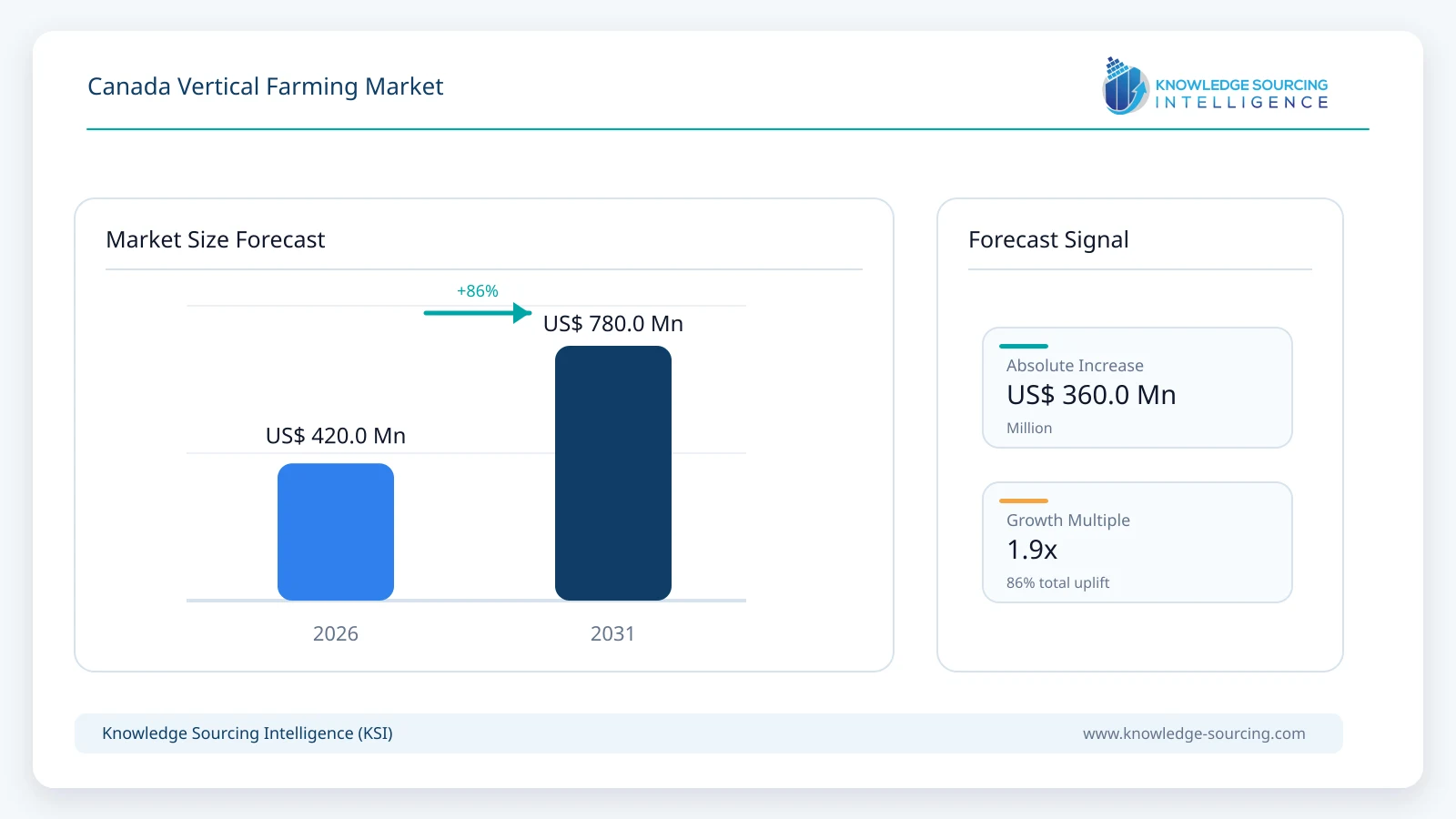
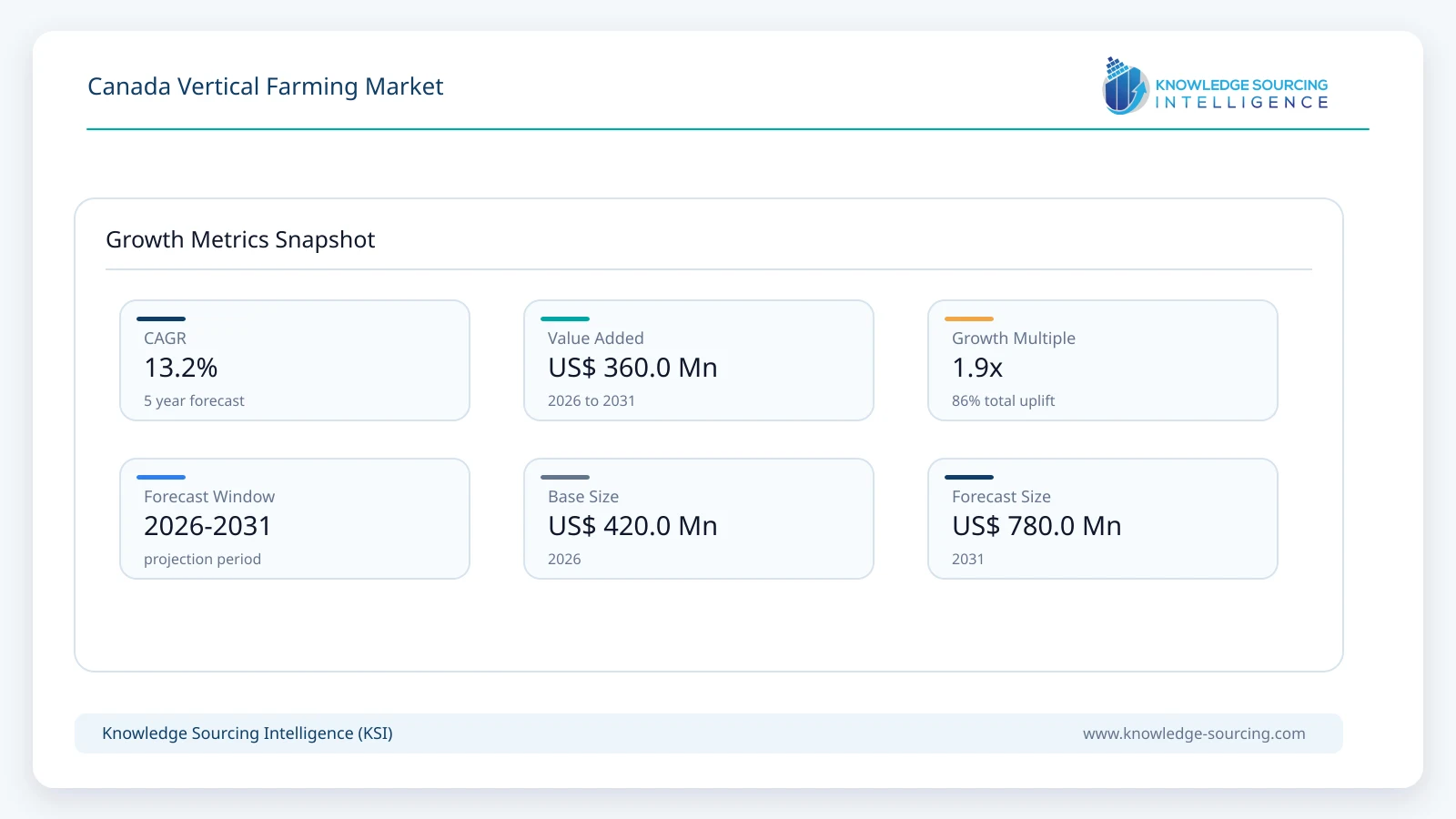
The Canada vertical farming market is projected to expand at a CAGR of 13.2%, increasing from USD 420.0 million in 2026 to USD 780.0 million by 2031.
Highlights:
- 1Hydroponic systems account for approximately 64% of Canada's vertical farming revenue in 2026.
- 2Building-based vertical farms represent about 74% of market value in 2026, ahead of container-based systems.
- 3Leafy greens and herbs generate approximately USD 230 million of market value in 2026.
- 4Ontario accounts for approximately 61% of the national market in 2026, supported by population density and established CEA infrastructure.
- 5Aeroponic systems are projected to expand at approximately 16.2% annually through 2031 from a smaller base.
- 6Federal CEA funding and higher electricity costs are simultaneously accelerating technology adoption and raising efficiency requirements.
Market Overview
Vertical farms combine controlled lighting, nutrient delivery, climate control, water recirculation, and software-based crop management in enclosed environments. Commercial systems range from large building-based farms supplying grocery networks to modular container farms deployed by schools, remote communities, institutions and local food businesses. Hydroponics remains the dominant growing method because it is commercially established, relatively easy to standardize across leafy-green crops, and compatible with both large facilities and modular farms. Aeroponics and hybrid systems are used where operators prioritize root-zone oxygenation, water efficiency, or higher-density crop architectures.
Canada has a strong technical base for controlled-environment agriculture. Agriculture and Agri-Food Canada describes the country's indoor agriculture sector as technologically advanced, while Statistics Canada reported 35.9 million square metres of greenhouse area in 2025. The vertical-farming segment remains much smaller than greenhouse production because fully indoor systems rely more heavily on artificial lighting and electricity. That cost structure concentrates commercial production in higher-value, short-cycle crops and in locations where proximity, food security or year-round reliability offsets the energy penalty.
The market therefore has two distinct commercial models. Large operators such as GoodLeaf Farms and Elevate Farms focus on branded fresh produce and high-throughput commercial facilities. Modular-system companies such as Growcer sell or operate containerized farms that can be deployed closer to local demand. Growcer states that its systems are built in Canada for year-round operation across extreme climates and combine hardware, remote monitoring, training, and support. This modular model is particularly relevant in northern and remote communities where transport costs and produce freshness materially affect food availability.
Market Trends
Automation Is Becoming Central to Vertical-Farm Economics
Automation is moving from an optional productivity enhancement to a core cost-control requirement. Labour, climate management and lighting are major operating-cost categories, and Canadian policy now explicitly supports the adoption of robotics, automation and digital growing tools within controlled-environment agriculture. Elevate Farms positions autonomous production, photobiology and closed-loop growing as the core of its technology platform, while Growcer combines remote monitoring with standardized modular hardware. The direction of travel is toward fewer manual crop-handling steps, tighter environmental control and greater use of software to stabilize yield and labour requirements.
Food Security Is Broadening the Market Beyond Urban Premium Greens
Vertical farming in Canada is no longer limited to urban premium-produce concepts. The federal National Food Security Strategy explicitly identifies vertical farms and other enclosed growing spaces as tools for expanding year-round fruit and vegetable production, including in rural and northern communities. Growcer's commercial model is already concentrated on modular food infrastructure, and Agriculture and Agri-Food Canada continues to support controlled-environment projects in northern settings. This broadens the market from grocery-focused farms toward community food systems, institutional projects and public-private infrastructure.
The Sector Is Consolidating Around Platforms With Proven Operating Models
The North American vertical-farming industry has experienced closures and restructuring, making operating discipline more important than rapid facility expansion. Canadian companies are increasingly emphasizing technology platforms, unit economics, and acquisition of established operating assets. Elevate Farms states that it acquired Fieldless Farms in 2026, combining a Canadian greens brand with its autonomous farming platform. Growcer acquired Freight Farms assets in 2025, expanding its modular-farm network. These moves indicate a market that is shifting toward consolidation of proven systems rather than the earlier model of capital-intensive expansion at any cost.
Market Drivers
Federal Controlled-Environment Agriculture Investment Supports Technology Adoption
Canada's 2026 National Food Security Strategy introduced a CAD 750 million Controlled Environment Agriculture Growth Pathway over seven years. The largest stream is intended to support technology adoption, including automation, robotics, lighting and digital growing tools, as well as upgrades and new facilities. The strategy sets a target to double controlled-environment agriculture production value sold to the Canadian market from CAD 774 million in 2024 to CAD 1.55 billion in 2032. Vertical farms will compete with high-tech greenhouses for this investment, but the program improves the financing environment for technologies that reduce labour and energy costs.
Year-Round Local Production Addresses Import Dependence and Climate Constraints
Canada imports substantial volumes of fresh produce during periods when domestic field production is constrained by climate. Controlled indoor production reduces seasonal exposure and shortens transport distances for crops that can be grown economically under artificial light. Leafy greens, herbs, and selected specialty vegetables fit this model because they have short growth cycles, relatively high value per kilogram, and significant freshness loss during long-distance distribution. Northern and remote communities add a separate use case because transport costs and supply interruptions can make local production economically relevant even when electricity costs are high.
Market Restraint
Electricity and Capital Intensity Limit Crop Economics
The principal constraint remains the cost of operating fully indoor farms. Statistics Canada reported that electricity costs for greenhouse producers increased 21.2% in 2025, while natural gas and other fuel costs also rose. Vertical farms are more exposed to electricity prices than conventional greenhouses because artificial lighting is a primary energy input. Lighting, HVAC, dehumidification, pumping, and automation systems also increase upfront capital requirements. These economics restrict the crop mix and make utilization rates critical. Farms that cannot maintain high yields, efficient labour use and reliable sales channels can struggle to absorb fixed costs, which is why lettuce, herbs and microgreens remain more commercially common than lower-value staple crops.
Segment Analysis
By Growing Mechanism - Hydroponics
Hydroponics remains the largest growing mechanism because it is technically mature, widely supported by equipment vendors, and suitable for both deep-water culture and nutrient-film systems used in leafy-green production. The technology supports recirculating nutrient solutions, standardized crop recipes, and relatively predictable yield cycles. Growcer's modular farms use hydroponic systems, while large indoor operators also rely on hydroponic architectures for greens. Aeroponics is growing faster from a smaller base as operators seek lower water use and improved oxygen availability around roots, but system complexity and nozzle reliability can raise maintenance requirements.
By Facility Type - Building-Based Vertical Farms
Building-based facilities remain the largest category because commercial operators need enough growing area, packaging capacity and automation infrastructure to supply major grocery and foodservice customers consistently. These farms typically use multi-level racks, dedicated HVAC and water-treatment systems, automated seeding or harvesting equipment and centralized packing areas. Container farms form a smaller but faster-expanding category because deployment is modular, permitting can be simpler, and projects can be located near schools, remote communities, institutions or smaller population centres without requiring a large industrial building.
By Crop Type - Leafy Greens and Herbs
Leafy greens and herbs dominate commercial vertical-farm production because their short crop cycles, compact plant structure and high value per growing area fit artificial-light environments. Lettuce, arugula, kale, basil, cilantro, microgreens and Asian greens are common products across Canadian indoor farms. Higher-value berries and fruiting crops are attracting research and investment, but they require more energy, pollination management and longer crop cycles. The federal CEA strategy may broaden the commercial crop mix over time if lighting efficiency and automation reduce production costs.
By Province - Ontario
Ontario remains Canada's principal vertical-farming market because it combines the country's largest population base with established greenhouse expertise, major grocery distribution networks and access to technical labour. GoodLeaf operates in Ontario and Elevate Farms' Canadian operations include Cornwall through its Fieldless acquisition. British Columbia and Quebec provide additional urban demand and controlled-environment expertise, while Alberta and the Prairie provinces are more relevant for modular systems and institutional projects. Northern territories remain small in revenue terms but strategically important for food-security applications.
Competitive Environment
The competitive landscape combines commercial growers, technology-platform developers and modular-farm suppliers rather than a single homogeneous peer group. GoodLeaf Farms competes primarily through branded fresh greens and large-scale Canadian production. Elevate Farms combines autonomous vertical-farming technology with operating facilities and, following its 2026 acquisition of Fieldless Farms, a Canadian consumer brand. Growcer focuses on modular hydroponic farms, training, remote monitoring and support, with an installed base across Canada and other markets. Just Vertical operates at the smaller indoor-garden and compact-farm end of the spectrum.
Equipment and component competition extends beyond Canadian-headquartered companies. Signify, ams OSRAM, Heliospectra and other lighting suppliers compete for high-efficiency horticultural lighting, while Priva, Hoogendoorn, Argus Controls and Schneider Electric participate in climate control, automation and facility-management layers used across controlled-environment agriculture. This means competitive advantage is increasingly determined by system integration, operating data, crop recipes and service capability rather than any single hardware component.
Recent Developments
June 2026: The Government of Canada announced a CAD 750 million Controlled Environment Agriculture Growth Pathway within the National Food Security Strategy, including support for automation, robotics, lighting and digital growing tools.
April 2026: Statistics Canada reported that total Canadian greenhouse area reached 35.9 million square metres in 2025, while greenhouse vegetable and fruit sales rose 10.0% to CAD 3.1 billion.
2026: Agriculture and Agri-Food Canada continued to support northern controlled-environment agriculture initiatives, including food-production research linked to the Naurvik facility in Nunavut.
2026: Elevate Farms stated that it acquired Fieldless Farms, combining its autonomous vertical-farming technology with an established Canadian fresh-greens brand and operating presence in Cornwall, Ontario.
2026: Growcer highlighted expansion of its modular-farm network following its 2025 acquisition of Freight Farms assets, creating a larger installed base of community and institutional vertical farms.
Canada Vertical Farming Market Scope:
| Report Metric | Details |
|---|---|
| Total Market Size in 2026 | USD 420.0 million |
| Total Market Size in 2031 | USD 780.0 million |
| Forecast Unit | Million |
| Growth Rate | 13.2% |
| Study Period | 2021 to 2031 |
| Historical Data | 2021 to 2024 |
| Base Year | 2025 |
| Forecast Period | 2026 – 2031 |
| Segmentation | Growing Mechanism, Facility Type, Crop Type, Province |
| Companies |
|
Market Segmentation
By Growing Mechanism
Hydroponics
Aeroponics
Aquaponics and Other Systems
By Facility Type
Building-Based Vertical Farms
Container-Based Vertical Farms
Other Modular Systems
By Crop Type
Leafy Greens and Herbs
Microgreens
Fruits and Fruiting Vegetables
Other Crops
By Province
Ontario
British Columbia
Quebec
Alberta
Other Provinces and Territories
Table of Contents
1. EXECUTIVE SUMMARY
2. MARKET SNAPSHOT
2.1. Market Overview
2.2. Market Definition
2.3. Market Segmentation
3. BUSINESS LANDSCAPE
3.1. Market Drivers
3.1.1. Federal Controlled-Environment Agriculture Investment Supports Technology Adoption
3.1.2. Year-Round Local Production Addresses Import Dependence and Climate Constraints
3.2. Market Restraint
3.2.1. Electricity and Capital Intensity Limit Crop Economics
3.3. Market Opportunities
3.4. Porter's Five Forces Analysis
3.5. Industry Value Chain Analysis
3.6. Policies and Regulations
3.7. Strategic Recommendations
4. TECHNOLOGICAL OUTLOOK
4.1. LED Horticultural Lighting
4.2. Automated Crop Handling
4.3. AI-Based Climate and Crop Control
4.4. Modular and Container Farming Systems
5. CANADA VERTICAL FARMING MARKET BY GROWING MECHANISM
5.1. Introduction
5.2. Hydroponics
5.3. Aeroponics
5.4. Aquaponics and Other Systems
6. CANADA VERTICAL FARMING MARKET BY FACILITY TYPE
6.1. Introduction
6.2. Building-Based Vertical Farms
6.3. Container-Based Vertical Farms
6.4. Other Modular Systems
7. CANADA VERTICAL FARMING MARKET BY CROP TYPE
7.1. Introduction
7.2. Leafy Greens and Herbs
7.3. Microgreens
7.4. Fruits and Fruiting Vegetables
7.5. Other Crops
8. CANADA VERTICAL FARMING MARKET BY PROVINCE
8.1. Introduction
8.2. Ontario
8.3. British Columbia
8.4. Quebec
8.5. Alberta
8.6. Other Provinces and Territories
9. COMPETITIVE ENVIRONMENT AND ANALYSIS
9.1. Major Players and Strategy Analysis
9.2. Market Share Analysis
9.3. Mergers, Acquisitions, Agreements and Collaborations
9.4. Competitive Dashboard
10. COMPANY PROFILES
10.1. GoodLeaf Farms
10.2. Elevate Farms
10.3. Growcer
10.4. Just Vertical
10.5. CubicFarms Systems Corp.
10.6. Signify N.V.
10.7. ams OSRAM AG
10.8. Heliospectra AB
10.9. Priva Holding B.V.
10.10. Hoogendoorn Growth Management
10.11. Argus Control Systems Ltd.
10.12. Schneider Electric SE
10.13. Netafim Ltd.
10.14. Autogrow
10.15. Urban Crop Solutions
11. APPENDIX
11.1. Currency
11.2. Assumptions
11.3. Base and Forecast Years Timeline
11.4. Key Benefits for Stakeholders
11.5. Research Methodology
11.6. Abbreviations
Navigate
Trusted by the world's leading organizations











