
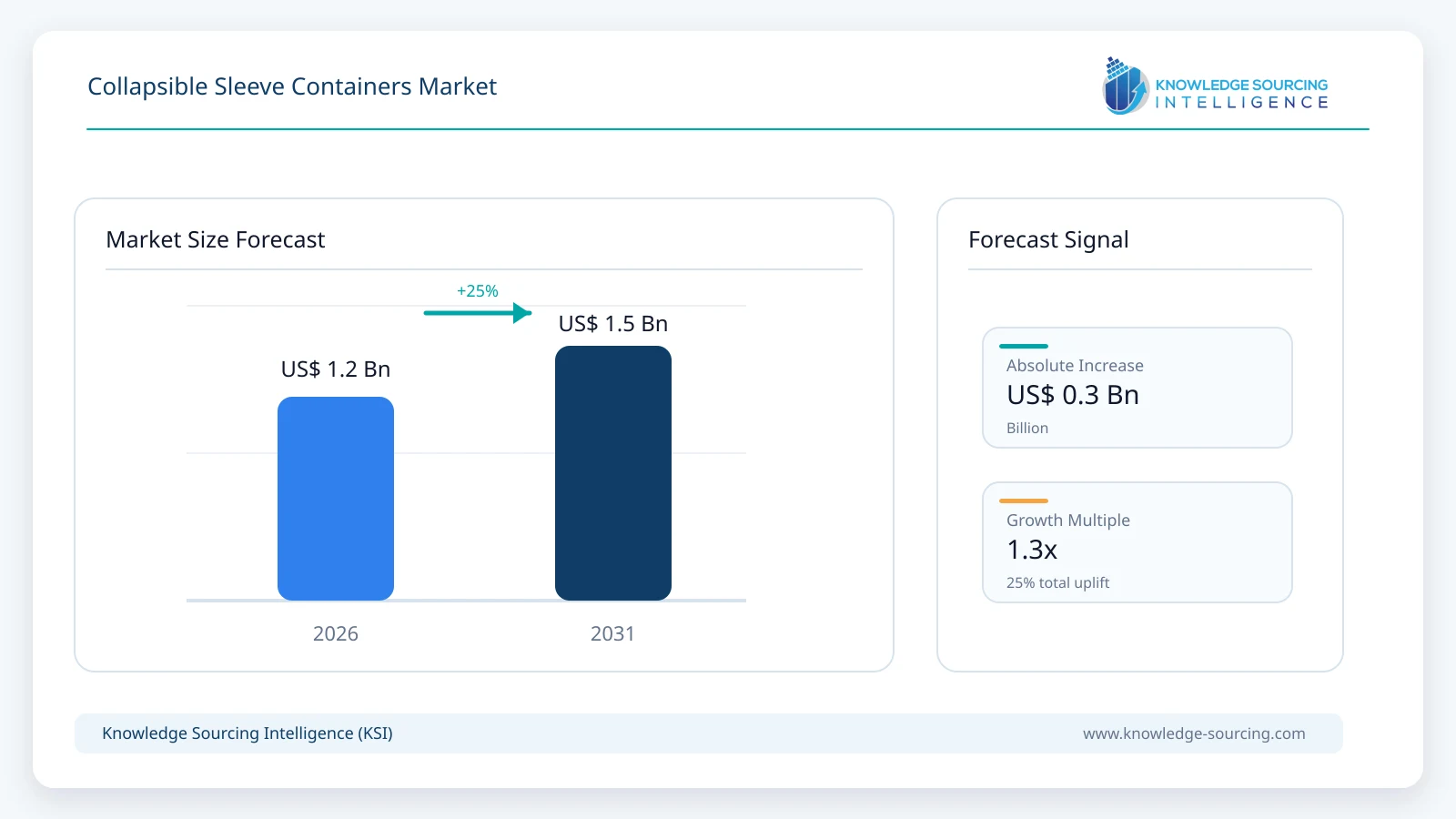
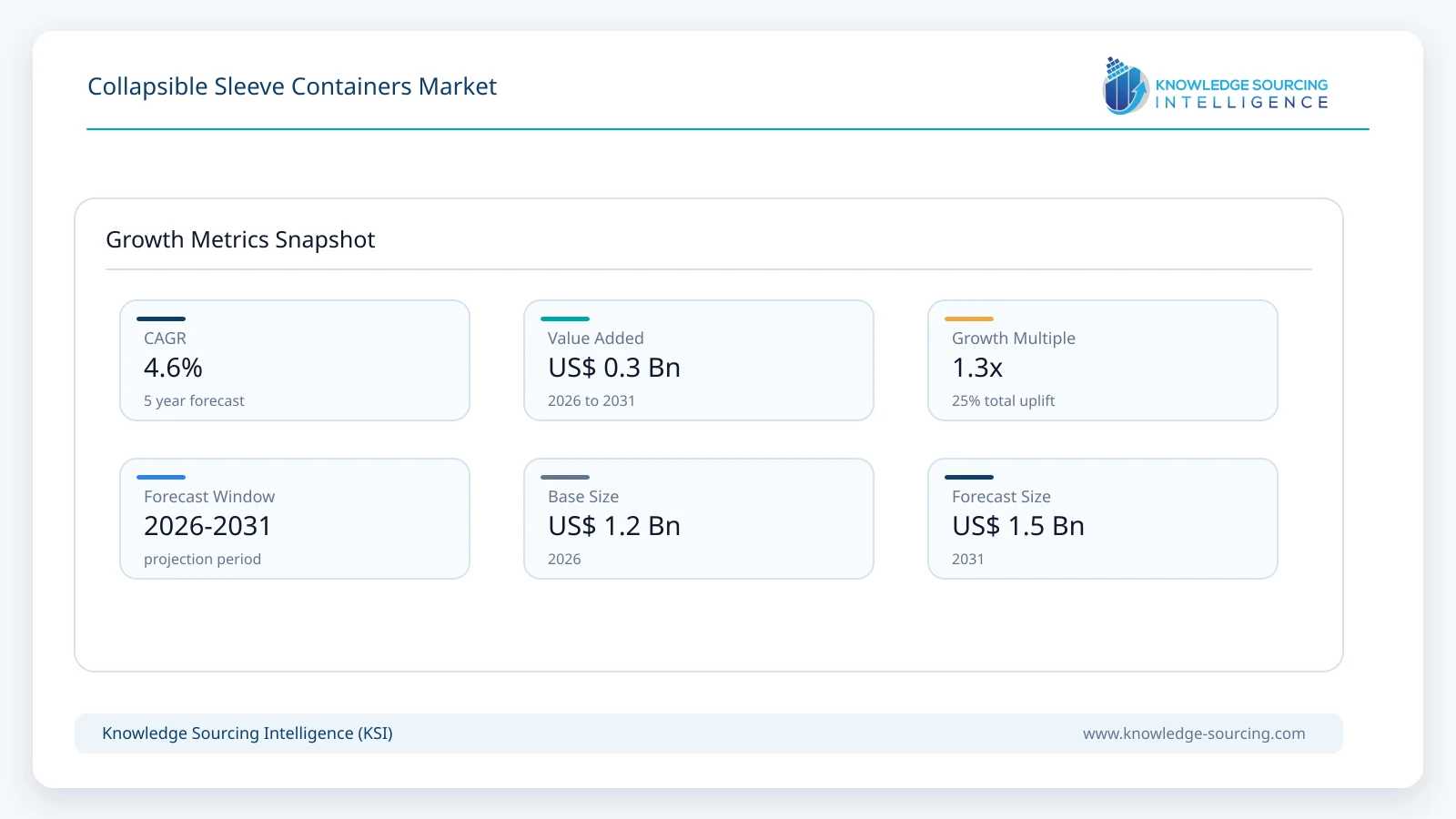
The collapsible sleeve containers market is forecast to grow at a CAGR of 4.6%, reaching USD 1.5 billion in 2031 from USD 1.2 billion in 2026.
Highlights:
- 1Structured plastic and corrugated-plastic sleeve systems account for approximately 65% of market value in 2026, supported by durability, moisture resistance and repeated closed-loop use.
- 2Standard pallet-footprint systems account for more than two-thirds of market demand, led by 1200 × 1000 mm / 48 × 40 inch and 1200 × 800 mm formats.
- 3Automotive represents approximately 30% of market demand in 2026, with industrial manufacturing providing another substantial demand pool.
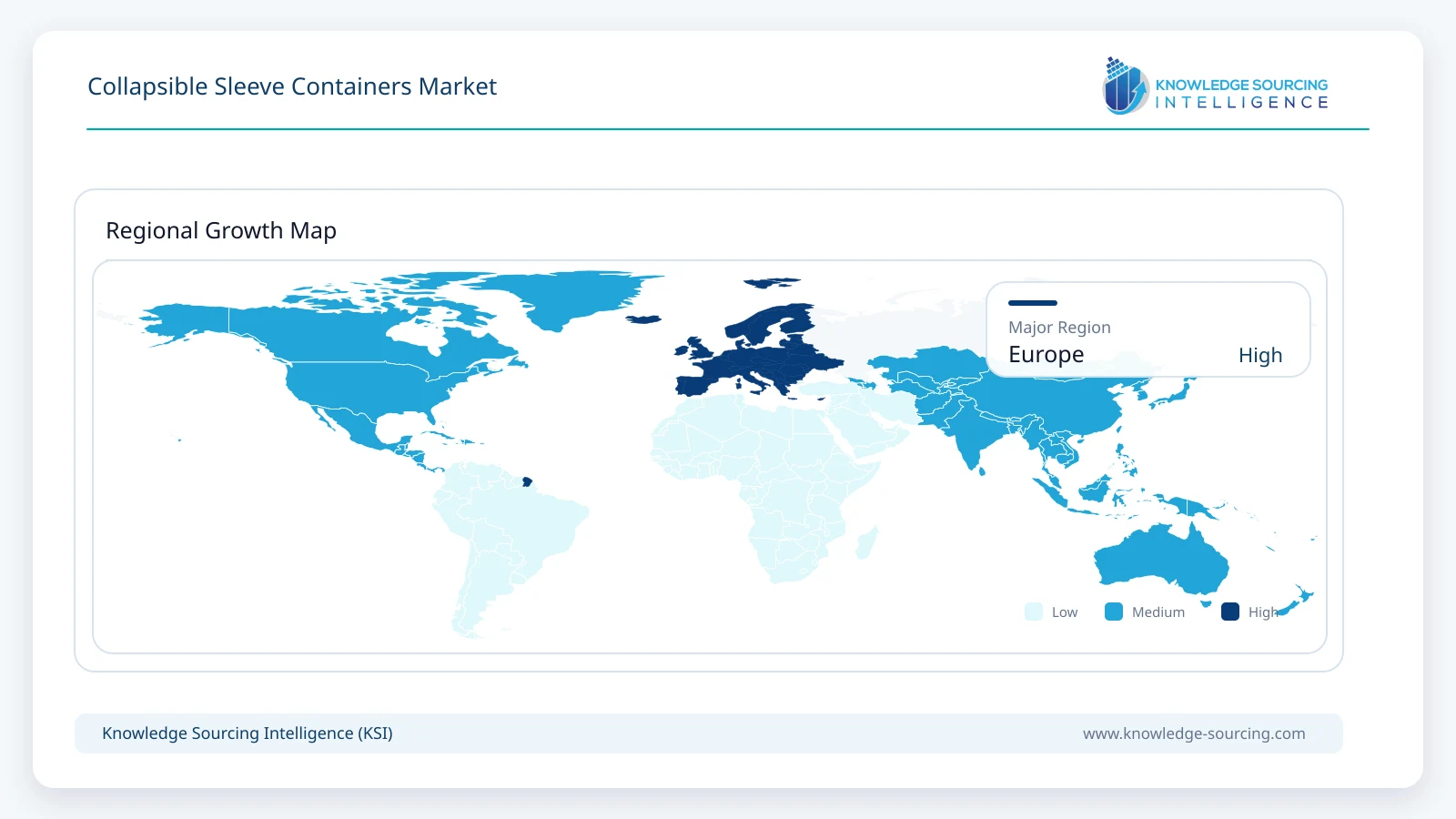
- 4Europe accounts for approximately 34% of global market value in 2026, supported by mature reusable transport packaging networks and increasingly stringent packaging-reuse requirements.
- 5IoT-enabled asset tracking, automation-compatible dunnage and recycled-plastic construction are becoming more important purchasing criteria.
Market Overview
Collapsible sleeve containers are reusable transport packaging systems consisting primarily of a rigid or semi-rigid pallet base, a collapsible sleeve and a top cap or lid. The sleeve usually folds flat between the pallet and lid when the container is empty, reducing the cube required for storage and reverse logistics. Products can incorporate access doors, partitions, protective dunnage, straps, identification plates, RFID tags and application-specific inserts.
The market should be distinguished from the much broader collapsible bulk-container and reusable plastic-crate markets. Fully molded foldable large containers, rigid bulk bins, conventional plastic crates and intermediate bulk containers are excluded unless they use the characteristic pallet-plus-sleeve-plus-lid construction. This narrower definition better reflects products sold by companies such as ORBIS, Nefab, Cabka, Tri-Wall, IPL Schoeller and specialist returnable-packaging suppliers.
The existing market estimate remains commercially plausible when compared with the scale of the wider reusable transport packaging supplier base. IPL and Schoeller Allibert combined into IPL Schoeller with more than USD 1.4 billion in 2024 pro forma revenue, although only part of this revenue relates to sleeve packs and reusable transport packaging. Cabka generated EUR 180.8 million in 2025 revenue from a portfolio of more than 150 reusable transport packaging products, while Nefab reports annual turnover of approximately USD 966 million across its broader packaging and logistics-solutions business. These figures support a global sleeve-pack market around USD 1.2 billion without requiring the inclusion of unrelated reusable crates, pallets or primary packaging.
Market Trends
• Reverse-Logistics Efficiency Is Becoming the Core Purchasing Metric
The strongest commercial case for sleeve packs is often not the initial packaging cost but the reduction in empty-return volume. A conventional rigid bulk container occupies approximately the same cube whether full or empty, while a sleeve pack folds down between its pallet and lid.
ORBIS states that its OpteBulk sleeve packs can allow up to 120% more containers per trailer than rigid plastic knockdown alternatives on return journeys. ID Plastics reports return-volume reductions of approximately 65% to 80%, depending on sleeve-pack configuration. RPP’s Uni-Pak systems can typically reuse sleeves 50 to more than 100 times, while the plastic pallet and top are described as having approximately ten-year life expectancies.
This means purchasing decisions increasingly rely on total cost per trip rather than the unit purchase price. High return-frequency routes, particularly supplier-to-OEM and plant-to-plant movements, provide the strongest economics.
• Automotive Packaging Is Moving Toward Automation-Compatible Sleeve Systems
Automotive remains one of the strongest applications because components frequently circulate between component manufacturers, sequencing facilities, and vehicle plants. EV production adds new requirements around batteries, motors, electronics, thermal-management components, and sensitive assemblies.
Returnable packaging is increasingly being engineered around robotic handling. Packaging Solutions Inc. describes an EV and automotive application where a collapsible sleeve pack was selected over a rigid bin and metal rack because it met parts-per-container requirements while improving trailer utilization and costing materially less than an equivalent rack. Custom EPP dunnage and locating features were engineered so machine-vision and robotic grippers could reliably access components.
Nefab similarly describes sleeve packs with engineered inserts designed to maintain part orientation and leave robotic pickup points accessible. This changes the value proposition from simply transporting components to supporting automated production flows.
• Asset Tracking Is Moving Into Reusable Container Fleets
As returnable packaging fleets increase in value and geographic complexity, manufacturers need better visibility into container location, dwell time, condition and availability. Lost assets and containers trapped at supplier locations can materially reduce the return on a reusable packaging program.
IPL Schoeller’s SmartLink platform can provide real-time container visibility, including whether a container is full or folded and selected environmental conditions. Its automotive offering explicitly links asset tracking with just-in-time delivery and packaging-fleet utilization. Nefab similarly offers tags and trackers as options for returnable sleeve systems.
IoT therefore adds a software and service layer to what has traditionally been a physical packaging market, although the container itself remains the primary source of market value.
• Recycled Content Is Becoming More Important in Pallets, Lids and Sleeves
Reusable packaging reduces expendable-material consumption, but buyers are increasingly evaluating the materials used to manufacture the reusable asset itself. Cabka specializes in converting difficult-to-recycle plastics into pallets and large containers, while ORBIS offers sleeve-pack systems that can incorporate recycled plastics.
IPL Schoeller states that its returnable products are designed for long-term reuse and recyclability and is increasing recycled material content across its product range. This strengthens the lifecycle case for reusable systems but also requires material formulations that preserve impact resistance, load performance, and dimensional consistency over many trips.
Segment Analysis
• By Sleeve Material: Structured and Corrugated Plastic
Structured and corrugated plastic sleeve systems account for approximately 65% of market value in 2026 and represent the largest material category. Polypropylene and polyethylene-based sleeves provide moisture resistance, cleanability, dimensional stability and repeated-use capability, making them well suited to automotive, industrial, pharmaceutical and long-loop logistics.
Nefab describes its systems as using rigid corrugated plastic sleeves with reusable plastic pallets and lids. ORBIS uses its Tri-Clone structured-core material, while Cabka’s CabCube range uses durable reusable plastic sleeve constructions. Tri-Wall offers both corrugated-fibre and honeycomb-plastic sleeve alternatives.
Heavy-duty fibreboard and composite sleeves retain a meaningful position where lower weight, replacement economics and application-specific protection are important. Uni-Pak systems, for example, combine thermoformed plastic pallets and lids with heavy-duty triple-wall corrugated sleeves.
• By Footprint: Standard Pallet-Size Systems
Standard pallet-compatible formats account for more than two-thirds of global demand. The most commercially important footprints include approximately 1200 × 1000 mm / 48 × 40 inch, European 1200 × 800 mm formats and related automotive-standard dimensions.
The current KSI segmentation based solely on 48 × 40 × 30, 48 × 40 × 34 and 48 × 40 × 45 inch boxes is therefore too narrow for a global report. ORBIS sells OpteBulk products in 48 × 40 inch, 1200 × 1000 mm and other footprints, while IPL Schoeller’s BoxerPac is offered in both 1200 × 1000 and 1200 × 800 configurations. Tri-Wall’s Uni-Pak range includes numerous North American, metric and customized footprints.
Custom formats remain commercially important for oversized components, automotive sequences, white goods and applications where the packaging must interface with specialized racks or automation.
• By End User: Automotive
Automotive accounts for approximately 30% of market value in 2026 and remains the largest individual end-user industry. Sleeve packs fit automotive logistics particularly well because vehicles contain numerous components sourced through repeatable supplier-to-plant routes where empty packaging must return to the supplier.
IPL Schoeller specifically positions BoxerPac sleeve systems for lighter automotive parts such as injection-molded interior components and works with automotive manufacturers, Tier 1 suppliers and pooling operators. ORBIS positions OpteBulk for automotive, white goods and industrial applications, while Nefab’s North American returnable-packaging expansion is explicitly targeting automotive and advanced manufacturing.
Industrial manufacturing represents another major demand pool, followed by retail and logistics, food and beverage, chemicals and pharmaceuticals. Food applications remain relevant, but they should not be presented as the dominant global sleeve-pack end market without stronger evidence.
Market Drivers
• Regulation Is Increasing the Commercial Value of Reusable Transport Packaging
The European Union’s Packaging and Packaging Waste Regulation creates a direct structural driver for reusable industrial packaging. From 1 January 2030, economic operators using qualifying transport packaging within the EU must ensure that at least 40% is reusable packaging within a reuse system, with an aspirational target of 70% by 2040. The covered formats explicitly include pallets, foldable plastic boxes, boxes, trays and other transport packaging.
The regulation also imposes stronger reuse requirements for transport packaging used between sites of the same business, linked enterprises and certain domestic B2B movements. These requirements materially strengthen the investment case for durable collapsible systems in European industrial supply chains.
• Return Freight and Warehouse Space Have Measurable Economics
Sleeve packs reduce the cube occupied by empty packaging, allowing significantly more units to return in the same trailer and reducing floor-space requirements at factories and warehouses.
A commercially available 48 × 40 × 45 inch Uni-Pak, for example, collapses to approximately 12 inches and is specified at 60 assembled units versus 400 collapsed units in a 53-foot trailer, illustrating the magnitude of return-logistics efficiency achievable in suitable applications.
The benefit becomes especially important in long-distance closed loops where empty packaging transport would otherwise represent a material cost.
• Manufacturers Are Replacing Expendable Industrial Packaging
Sleeve packs compete directly with disposable corrugated pallet boxes, wooden packaging and single-trip protective systems. Their economics improve as the number of reuse cycles rises.
Nefab positions sleeve packs as a reusable alternative to traditional corrugated boxes and crates, while ORBIS explicitly markets OpteBulk as a replacement for limited-use wood pallet and Gaylord systems. Closed-loop manufacturing networks provide the most attractive conditions because container recovery can be managed reliably.
Market Restraints
• Reusable Packaging Requires a Managed Return Loop
A reusable container only generates economic value if it returns to the shipper and completes enough cycles. Long dwell times, asset loss, cross-border imbalance and poor reverse-logistics coordination can undermine total-cost savings.
This makes sleeve packs less attractive for highly fragmented distribution networks or one-way shipments where the sending company has limited control over the recipient. Pooling, RFID and IoT tracking can reduce this constraint but introduce additional management requirements.
• Initial Capital Cost Is Higher Than Expendable Packaging
Sleeve packs typically require a larger upfront expenditure than single-use corrugated pallet boxes. Current commercial examples of standard Uni-Pak systems are priced around USD 159-179 per unit before specialized dunnage, tracking systems and large-order adjustments. Customized automotive packs can cost considerably more.
The financial case therefore depends on expected trips, repair rates, empty-return costs, asset loss and packaging damage. Applications with uncertain reuse frequency may continue using expendable packaging.
Regional Outlook
• Europe
Europe accounts for approximately 34% of global market value in 2026 and is the largest regional market. The region combines mature automotive and industrial supply chains with high reusable-packaging penetration and a regulatory environment increasingly supportive of transport-packaging reuse.
The PPWR became applicable from 12 August 2026, establishing requirements around recyclability, waste reduction and reuse that strengthen the long-term outlook for returnable transport packaging.
Europe also hosts important suppliers including IPL Schoeller, Cabka and Nefab’s extensive European operations. Nefab acquired Slovak packaging company Vallos in April 2026, expanding its ability to supply industrial customers including lithium-ion battery, energy and engineering applications.
North America remains a closely comparable market, supported by automotive, durable goods, warehousing and industrial logistics. Nefab opened a 137,600-square-foot manufacturing and engineering hub in Wixom, Michigan, in May 2026 to expand returnable plastic packaging and protective solutions for automotive and advanced manufacturing.
Asia Pacific represents a large long-term opportunity because of its manufacturing scale, particularly in China, Japan, India, South Korea and Southeast Asia, but reusable sleeve-pack spending per manufacturing unit remains less mature in parts of the region.
Competitive Landscape
The market contains a mix of large reusable-packaging groups, packaging-engineering companies and regional specialists.
IPL Schoeller is a major global reusable-packaging participant following the combination of IPL and Schoeller Allibert. The combined company reports more than USD 1.4 billion of 2024 revenue and 26 production facilities across North America, the UK and Europe. Its sleeve-oriented portfolio includes BoxerPac and broader foldable large-container systems.
Nefab provides modular sleeve packs alongside engineered dunnage and logistics services and operates in more than 39 countries. ORBIS Corporation supplies the OpteBulk range in North America and positions sleeve packs around automotive, industrial and reusable inbound logistics. Cabka sells the CabCube sleeve-pack family and generated EUR 180.8 million of company revenue in 2025.
Tri-Wall supplies Uni-Pak systems using plastic or heavy-duty corrugated sleeves. SSI SCHAEFER, RPP Containers, Sohner Plastics, ID Plastics and regional engineering suppliers provide additional competition.
Competitive differentiation increasingly depends on collapse ratio, load performance, automation compatibility, customized dunnage, recycled material content, asset tracking and regional engineering support.
Recent Developments
August 2026: the EU’s Packaging and Packaging Waste Regulation became applicable, strengthening reuse and recyclability requirements across European packaging markets.
August 2026: ORBIS announced that its OpteBulk 1200 × 1000 sleeve-pack system would be among the reusable packaging solutions showcased at PACK EXPO International 2026, alongside automation-focused pallets, totes and custom trays.
May 2026: Nefab opened a 137,600-square-foot manufacturing and engineering campus in Wixom, Michigan, expanding North American capacity for reusable plastic packaging and protective systems.
April 2026: Nefab acquired Vallos in Slovakia, expanding its industrial packaging capabilities and European customer coverage.
2025: IPL and Schoeller Allibert combined to create IPL Schoeller, bringing together primary and reusable transport packaging operations with more than USD 1.4 billion in combined 2024 revenue.
Market Outlook
The collapsible sleeve containers market is forecast to grow from USD 1.2 billion in 2026 to USD 1.5 billion in 2031, representing a CAGR of 4.6%. The market is relatively mature in established automotive and industrial logistics networks, which limits headline growth compared with newer packaging categories, but structural support from reusable packaging mandates, reverse-logistics economics and automation continues to expand the addressable opportunity.
Plastic and structured-polymer sleeves remain the largest material category through 2031, while fibreboard-based systems retain a role where lower weight and lower replacement cost are important. Standard pallet-footprint designs dominate, but customized systems remain commercially significant in automotive, electronics, batteries and complex industrial equipment.
The most important change through 2031 is likely to be the transition from a simple reusable container toward a managed logistics asset. RFID and IoT tracking, customized inserts, machine-compatible part presentation and recycled materials increase the economic value of the packaging system beyond its physical shell.
Collapsible Sleeve Containers Market Scope:
| Report Metric | Details |
|---|---|
| Total Market Size in 2026 | USD 1.2 billion |
| Total Market Size in 2031 | USD 1.5 billion |
| Forecast Unit | USD Billion |
| Growth Rate | 4.6% |
| Study Period | 2021 to 2031 |
| Historical Data | 2021 to 2024 |
| Base Year | 2025 |
| Forecast Period | 2026 – 2031 |
| Segmentation | Sleeve Material, Footprint, End-User, Geography |
| Companies |
|
Market Segmentation
By Sleeve Material
Structured / Corrugated Plastic
Heavy-Duty Fibreboard and Composite
Other Materials
By Footprint
1200 × 1000 mm / 48 × 40 inch and Equivalent
1200 × 800 mm / European Pallet Format
Automotive and Regional Standard Formats
Customized and Oversized Formats
By End User
Automotive
Industrial Manufacturing
Electronics and Electrical Equipment
Food and Beverage
Chemicals and Pharmaceuticals
Retail, Warehousing and Logistics
Others
By Geography
North America
United States
Canada
Mexico
South America
Brazil
Argentina
Others
Europe
Germany
United Kingdom
France
Italy
Spain
Poland
Others
Middle East and Africa
Saudi Arabia
UAE
South Africa
Others
Asia Pacific
China
Japan
India
South Korea
Thailand
Indonesia
Others
Table of Contents
1. INTRODUCTION
1.1. Market Overview
1.2. Market Definition and Revenue Boundary
1.3. Scope of the Study
1.4. Market Segmentation
1.5. Currency
1.6. Assumptions
1.7. Base and Forecast Years
2. RESEARCH METHODOLOGY
2.1. Research Design
2.2. Secondary Research
2.3. Primary Research
2.4. Supplier Revenue and Product Analysis
2.5. Container Volume and Pricing Analysis
2.6. End-Use and Regional Modelling
2.7. Data Triangulation and Validation
3. EXECUTIVE SUMMARY
3.1. Key Findings
3.2. Collapsible Sleeve Containers Market Size, 2026-2031
3.3. Sleeve Material Outlook
3.4. Footprint Outlook
3.5. End-User Outlook
3.6. Regional Opportunity Summary
4. MARKET DYNAMICS
4.1. Market Drivers
4.1.1. Reusable Transport Packaging Regulation
4.1.2. Reverse-Logistics and Warehouse Cost Reduction
4.1.3. Replacement of Expendable Industrial Packaging
4.2. Market Restraints
4.2.1. Return-Loop and Asset-Recovery Requirements
4.2.2. Higher Initial Capital Cost
4.3. Market Opportunities
4.4. Porter’s Five Forces Analysis
4.5. Industry Value Chain Analysis
4.6. Packaging Pooling and Fleet Management
4.7. Regulatory and Sustainability Environment
5. TECHNOLOGY AND DESIGN OUTLOOK
5.1. Structured Plastic and Corrugated Plastic Sleeves
5.2. Heavy-Duty Corrugated and Composite Sleeves
5.3. Custom Protective Dunnage
5.4. Automation-Compatible Container Design
5.5. RFID and IoT Asset Tracking
5.6. Recycled-Content Pallets, Lids and Sleeves
6. COLLAPSIBLE SLEEVE CONTAINERS MARKET BY SLEEVE MATERIAL
6.1. Structured / Corrugated Plastic
6.2. Heavy-Duty Fibreboard and Composite
6.3. Other Materials
7. COLLAPSIBLE SLEEVE CONTAINERS MARKET BY FOOTPRINT
7.1. 1200 × 1000 mm / 48 × 40 inch and Equivalent
7.2. 1200 × 800 mm / European Pallet Format
7.3. Automotive and Regional Standard Formats
7.4. Customized and Oversized Formats
8. COLLAPSIBLE SLEEVE CONTAINERS MARKET BY END USER
8.1. Automotive
8.2. Industrial Manufacturing
8.3. Electronics and Electrical Equipment
8.4. Food and Beverage
8.5. Chemicals and Pharmaceuticals
8.6. Retail, Warehousing and Logistics
8.7. Others
9. COLLAPSIBLE SLEEVE CONTAINERS MARKET BY GEOGRAPHY
9.1. North America
9.1.1. United States
9.1.2. Canada
9.1.3. Mexico
9.2. South America
9.2.1. Brazil
9.2.2. Argentina
9.2.3. Others
9.3. Europe
9.3.1. Germany
9.3.2. United Kingdom
9.3.3. France
9.3.4. Italy
9.3.5. Spain
9.3.6. Poland
9.3.7. Others
9.4. Middle East and Africa
9.4.1. Saudi Arabia
9.4.2. UAE
9.4.3. South Africa
9.4.4. Others
9.5. Asia Pacific
9.5.1. China
9.5.2. Japan
9.5.3. India
9.5.4. South Korea
9.5.5. Thailand
9.5.6. Indonesia
9.5.7. Others
10. COMPETITIVE ENVIRONMENT AND ANALYSIS
10.1. Major Players and Strategy Analysis
10.2. Sleeve-Pack Product Portfolio Comparison
10.3. Standard versus Customized Solutions
10.4. Automotive and Industrial Packaging Capabilities
10.5. Automation and Protective Dunnage Capabilities
10.6. IoT and Asset-Tracking Integration
10.7. Recycled Material and Circularity Positioning
10.8. Mergers, Acquisitions and Capacity Expansion
10.9. Competitive Dashboard
11. COMPANY PROFILES
11.1. IPL Schoeller
11.2. Nefab Group
11.3. ORBIS Corporation
11.4. Cabka N.V.
11.5. Tri-Wall Group
11.6. SSI SCHAEFER
11.7. RPP Containers
11.8. Sohner Plastics
11.9. ID Plastics
11.10. Monoflo International
12. APPENDIX
12.1. Market Definition and Scope
12.2. Revenue Inclusion and Exclusion Criteria
12.3. Product and Material Definitions
12.4. Currency and Conversion Assumptions
12.5. Base Year and Forecast Period
12.6. Market Estimation Approach
12.7. Primary and Secondary Research Framework
12.8. Segment Reconciliation
12.9. Data Triangulation and Validation
Navigate
Trusted by the world's leading organizations











