
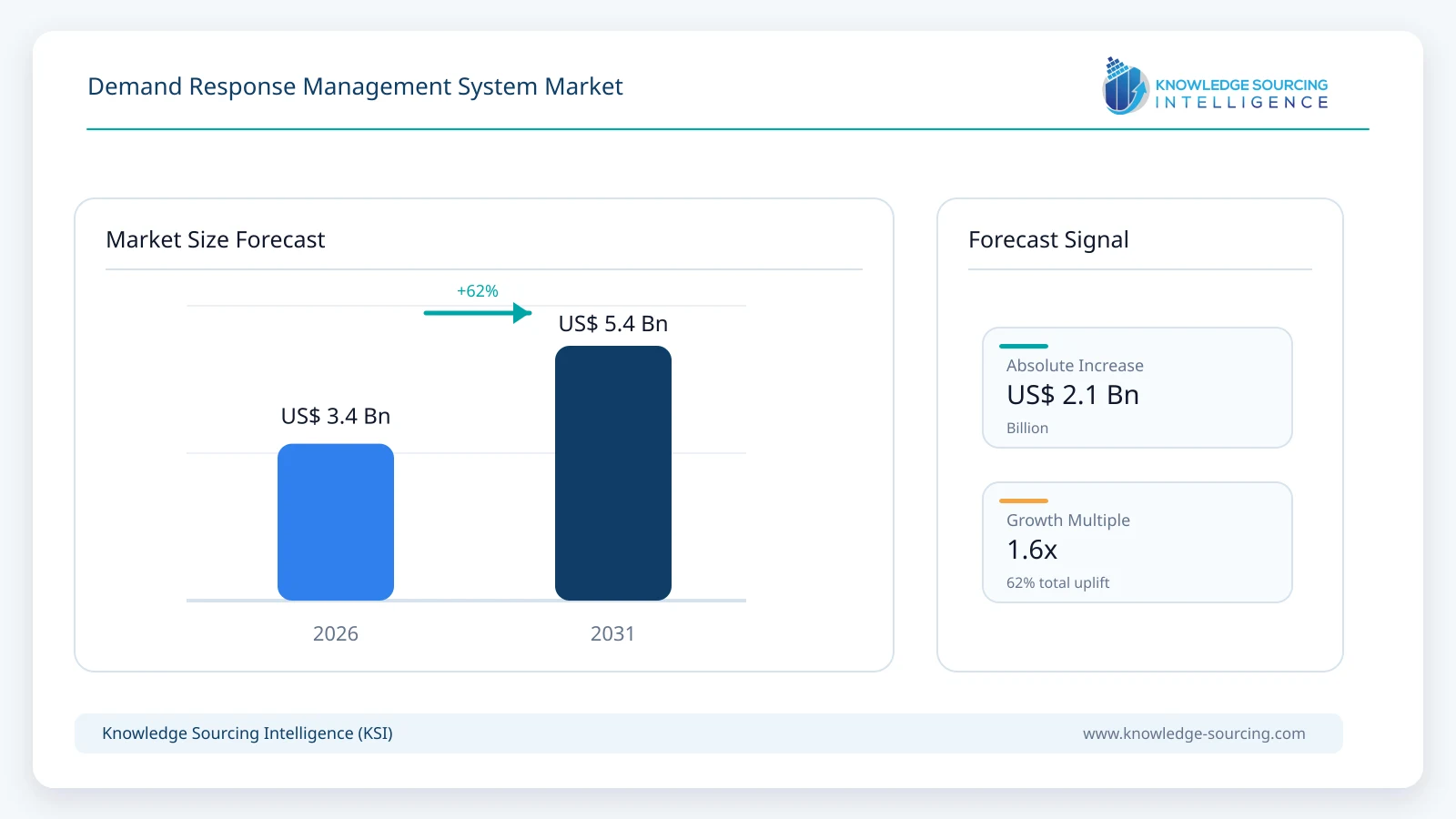
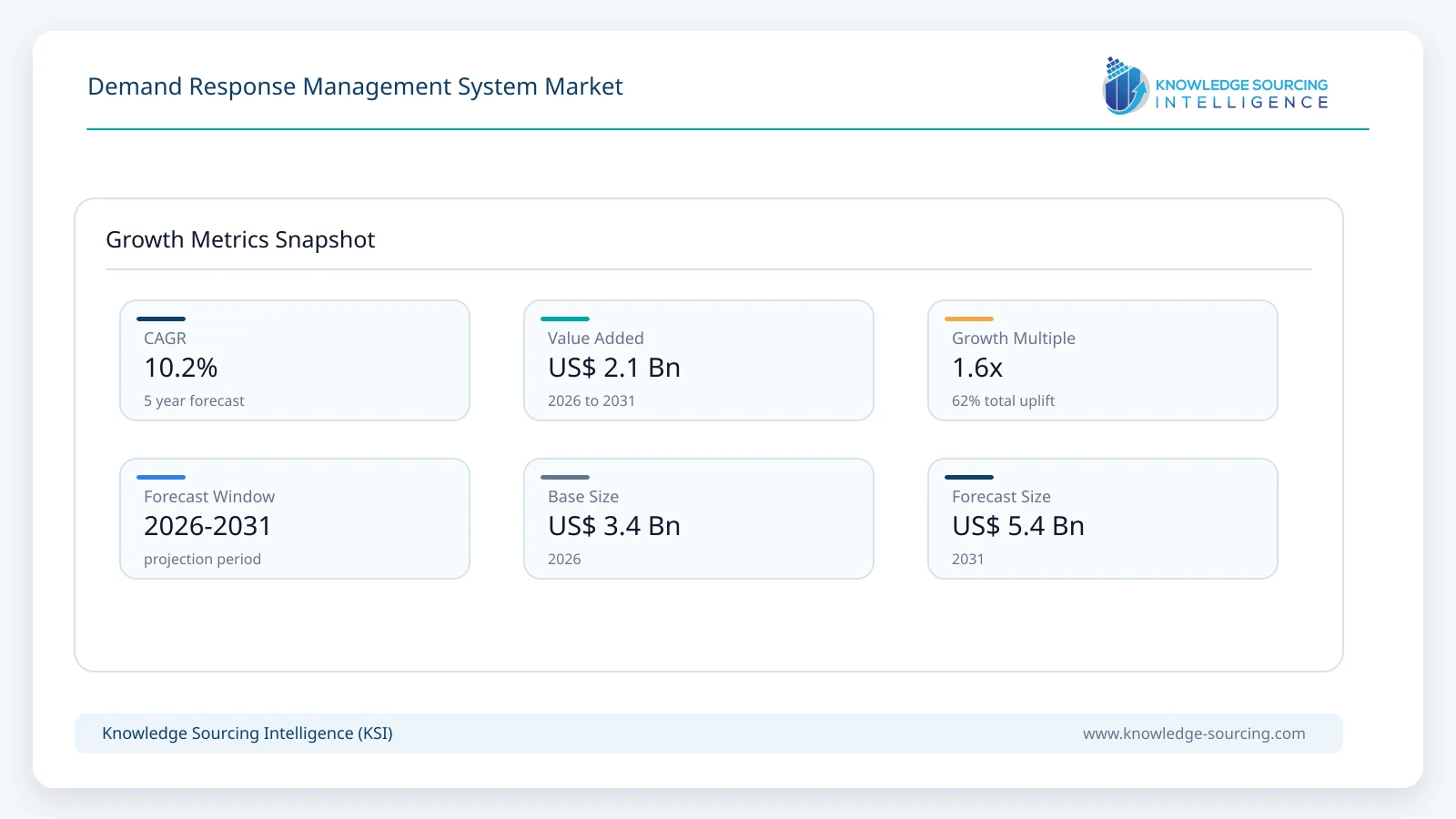
The Demand Response Management System Market is projected to increase from USD 3.35 billion in 2026 to USD 5.44 billion by 2031, growing at a CAGR of 10.2%.
Highlights:
- 1Automated demand response has become increasingly important to utility companies that are looking for a quicker way to manage the load on their systems and have more control over the loads which are considered flexible.
- 2The primary customer base for DRMS platforms is utility companies and power suppliers. These organizations use DRMS platforms as a tool to control the highest level of electricity consumption during periods of high demand, while platforms help ensure the overall stability of the electrical system.
- 3Capacity Demand Response Programs assist utilities and market operators in securing load reduction when there is high system demand.
- 4Data centers and other types of industrial businesses provide an opportunity to utilize demand flexibility as long as the types of load being shifted do not impact the business's ability to operate successfully.
A demand response management system (DRMS) is a software-based solution designed to help electric utilities and participating customers manage their electricity consumption by planning, initiating, coordinating, monitoring, and evaluating modifications to electricity usage. DRMSs can accommodate both utility-driven programs and market-based flexibility options. Depending on the deployment of the DRMS, it can utilize direct load control, customer notification, automatic building controls, industrial energy-management systems, smart meters, or aggregator-managed distributed energy resources.
A standard DRMS typically has features for enrolling customers and their devices, configuring programs, projecting loads, sending out events, managing communication, measuring how well the system performs, providing reports, and assisting with settlements. Some of the more sophisticated DRMS have integration capabilities with other systems such as Advanced Metering Infrastructure (AMI), DERMS, utility control center software, customer engagement software, and/or electricity-market interfaces. The ultimate goal is to turn flexible electricity use into a manageable resource that can respond to utility grid conditions.
The market is comprised of three segments, which include hardware, software, and service. The hardware segment consists of field equipment such as smart meters, load control switches, gateways, and communication devices, while the software segment provides support for program administration, forecasting, dispatching, customer engagement, analytics, measurement, and verification. Finally, the service segment offers program design, integration, implementation, customer enrollment, managed operations, and continuous optimization.
Demand response programs may be categorized according to the purpose they are designed to achieve. Economic programs promote changes in consumption as a result of changes in the price of electricity or new market opportunities. Capacity programs provide demand reductions to assist with meeting peak-capacity or resource-adequacy requirements. Ancillary-service programs utilize available flexible loads to participate in providing balancing, frequency response, or additional grid-support services when allowed by the market rules.
There are many other factors that affect the success of demand response programs besides just whether software is available. Some of those include metering infrastructure, communications, customer involvement, compensation plans, regulatory approval, and the ability to confirm that the customer has reduced their load. According to FERC, demand response is defined as modifications in electricity consumption from normal usage patterns if there were no price signals or incentives offered to consumers. It can occur under conditions where there are high wholesale prices, or there is a threat to the reliability of the electric grid.
Market Dynamics
Market Drivers
Growing demand for electricity and peak load management needs: Electric power requirements are rising due to increased electricity use by data centers, industry, transportation, heating, among others. High-load demands can create added strain on power production, transmission, and distribution systems during peak load periods caused by extreme weather conditions. DRMS platforms enable utility companies to schedule reductions in electricity usage when the system is experiencing a large amount of load. Reducing the reliance on peaker units and additional transmission/distribution capabilities may be achieved through the implementation of demand-response programs. Utility companies utilize forecasting models to predict when demand-response actions will be needed.
Increasing renewable energy integration and demand-side flexibility: The rise in solar and wind generation leads to the need for reliable grid connections, substations for voltage control, power quality management, and synchronization. With a demand response system, using flexible loads can help maintain the balance of the electric system as the amount of electricity produced by renewables varies. Automated systems can manage the controls for thermostats, electric vehicle chargers, battery storage, and certain types of industrial equipment.
Growth of connected devices and smart metering: Smart meters generate interval consumption data which may assist utilities in identifying flexible loads and assessing program performance. Through the use of two-way communications, smart meters enable utilities to connect their customers’ equipment to demand response programs. In addition to creating additional controllable resources such as smart thermostats, load control switches, electric vehicle chargers, and building management systems, AMI integration can enhance customer enrollment, target events, and measure and verify.
Increased usage of automatic demand response: Conventional programs are usually dependent upon the use of price signals, notifications to customers, and manual operation. Automated demand response programs link dispatching instructions directly to devices and/or controls that are compatible. Automated programs have been shown to reduce the time it takes to respond to grid events and to create consistency during those same grid events. Utilities can then target specific customer groups or device types with the support for the utility's network. Oracle Utilities Customer Program Management Cloud Service provides a platform for managing the administration of demand response programs, the process of enrolling customers into these programs, and the ability to manage the controllable devices.
Market Restraints & Opportunities
The ability of a utility company to manage customer energy demands is dependent upon whether customers are willing to make changes to their usage of power. If incentives are too small, or program rules are too complex for people to comprehend, participation will likely remain low.
The integration of DRMS platforms into other systems like AMI, billing, customer information, SCADA, DERMS, and building-management systems is frequently required. Many of the existing legacy utility systems have different communication standards as well as data structures. These differences in communication standards and data structures will create difficulties when trying to integrate with the new DRMS platform. The integration process can also take much longer than planned due to the complexity of integrating with many different types of devices. Additionally, multi-vendor environments will require constant maintenance, software updates, and interoperability management.
The growth in data center development creates additional electrical load and increases the value of flexible load management. DRMS platforms have the ability to manage various cooling, battery, backup-power, and non-essential loads while maintaining critical operations. In addition to data centers, there exist several other types of large electricity users such as manufacturers and commercial buildings which provide potential for automated demand response.
Key Developments
June 2026: Uplight stated that it managed 350 MW of load from 45 demand response events and 16 utility programs in the past summer. In addition to being ready for the 2026 season, the company also reported that there are almost 1 million registered devices in its demand response program and expects to run about 1,600 events.
May 2025: Abu Dhabi’s Department of Energy launched the second phase of its Demand Response Pilot Project in partnership with Energy Pool and Guidehouse. This 12-month pilot was designed to target more than 250 megawatts of flexible demand capacity at more than 30 commercial and industrial facilities.
Demand Response Management System Market Segmentation
The market is segmented by component, technology type, end user, and geography.
By Component
Software
Software is projected to be the largest component segment because software is used to coordinate customers, devices, program rules, dispatch events, consumption data, and performance measurements for demand response programs.
DRMS is an application that supports the processes of configuring programs, enrolling customers into those programs, forecasting load on the system, scheduling events related to the program, coordinating the actions of devices used in the program, measuring and verifying performance of the program, reporting on the program, and settling financial transactions associated with the program. When integrated with advanced metering infrastructure (AMI), customer information systems (CIS), distributed energy resources management systems (DERMS), and/or building management systems (BMS), DRMS provides utilities with the ability to control and manage a wider variety of flexible load types.
Itron’s IntelliSOURCE platform provides an operating environment for demand-response operations, energy efficiency, and distributed energy resource management. Likewise, Oracle Utilities Customer Program Management Cloud Service provides support for customer program management and for enrolling and administering control devices.
By Technology
Automated Demand Response
Automated Demand Response is forecasted to experience rapid growth among all other segments in terms of being a growth-driving technology, as utility companies are looking for ways to respond to demand more quickly, execute those responses on an ongoing basis, and have better control over multiple interconnected devices.
Automated systems send commands to compatible devices and control platforms so as to reduce the need for customers to manually operate these systems. Automation can also be used in different ways depending on how the program is designed. It can automate thermostat settings, HVAC systems, electric vehicle charging stations, batteries, and industrial loads. In addition, automated event execution can provide more current data regarding customer involvement and reduced loads.
Honeywell's DemandSites platform provides support for demand response operations via metering, load control capabilities, and customer interaction. EnergyHub provides automation support for the dispatching of demand response and the performance measurement of aggregated distributed energy resources.
By End User
Utilities and Power Providers
Utilities and power producers should continue as the most significant end user segment since they are responsible for managing the reliability of the electrical systems, peak load, client services, and the ability to adjust consumption on the consumer's side.
Utilities utilize DRMS platforms to recruit participants, estimate potential load reductions, schedule demand response programs, track program results, and evaluate the effectiveness of the program. Integration with AMI and other grid management programs will allow for demand response to help lower peak loads for the entire system, while also allowing for more focused load control at the local level.
Landis+Gyr’s Power Center integrates load-control devices, two-way communications, and software to help manage and assess demand-response programs. Schneider Electric’s EcoStruxure Energy Profiler Online provides utility customer support with energy reporting, utility engagement, and demand response capabilities for both commercial and industrial utility customers.
Regional Analysis
North America Market Analysis
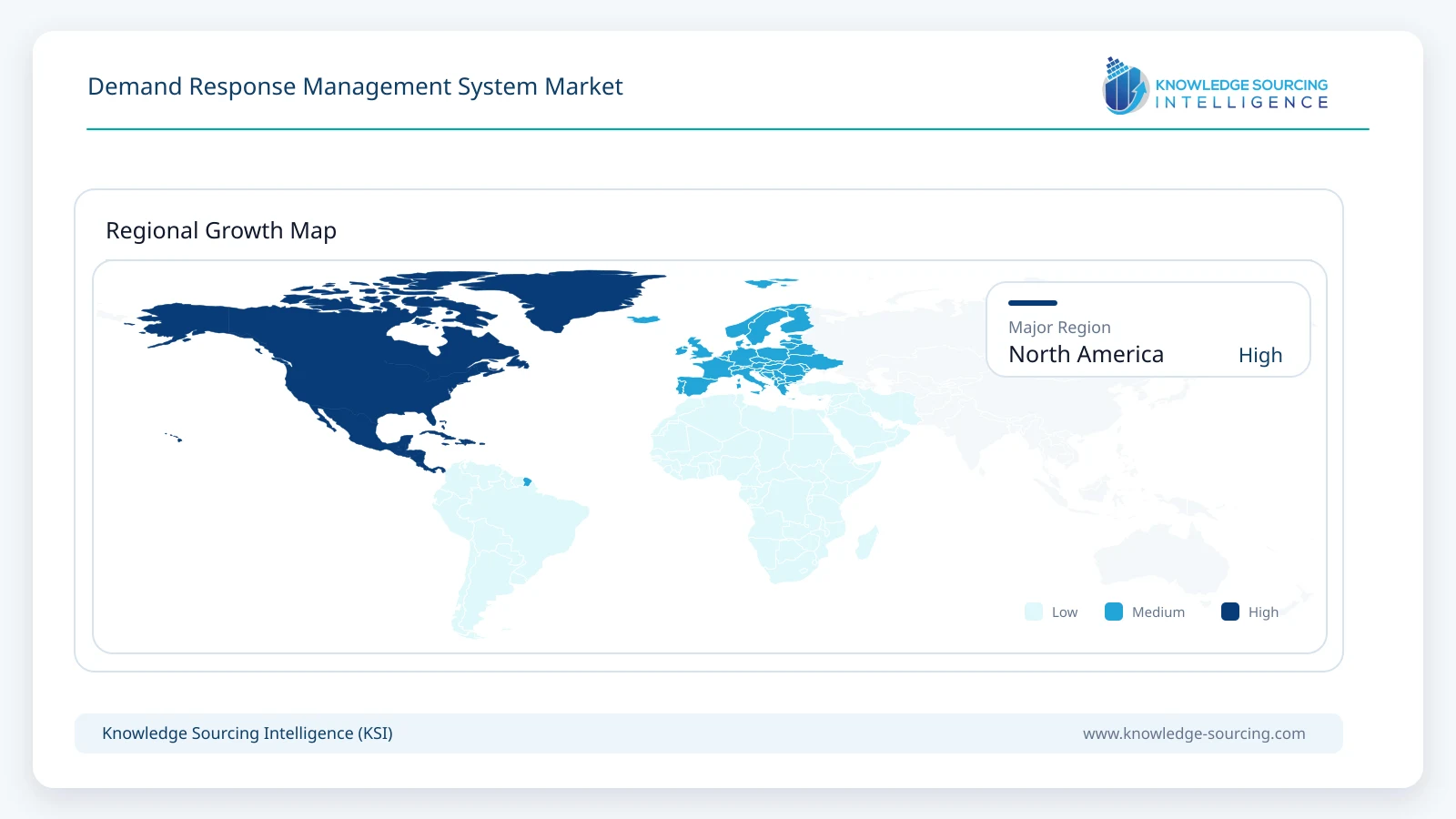
North America is a key region for demand response management systems as it has established electricity markets, advanced metering infrastructure, utility-sponsored flexibility programs, and is seeing an increase in the number of data centers and electrified industries. The United States has a very robust ecosystem of demand response providers, aggregators, and software platforms. Utilities are increasing the automation of their peak demand management programs, which helps with improving reliability during severe weather events. Aggregators are also developing portfolios of residential, commercial, and industrial resources that can be utilized in utility programs and wholesale-market services.
South America Market Analysis
The South American DRMS market is expanding in response to the modernization of electric markets, the expansion of renewable energy sources, and the growing demand for flexibility on the consumer side. Brazil is an important market for DRMS development due to its vast electric system, which has a rising need to coordinate generation, consumption, and operation of the electric system. DRMS can provide commercial and industrial consumers with methods to control their energy expenses and contribute to the reliability of the electric system when demand is at its peak. As variable renewable generation continues to expand in the region, there will be more opportunities for consumers to move some of their energy usage to times of higher energy availability.
Europe Market Analysis
The European market for DRMS is driven by the integration of renewable energy, the fluctuation in prices for electricity, the desire to achieve energy efficiency goals, and the need to provide flexibility in the way that people consume electricity. DR enables consumers to adjust their electricity usage based on when there is a lot of renewable energy being generated or when demand is very high. Both utilities and aggregated providers of flexible resources such as EV charging, building heating, cooling, battery storage, and industrial load are working together more frequently to coordinate these flexible resources.
Middle East and Africa Market Analysis
Electricity-demand growth, industrialization, refrigeration and cooling needs, the expansion of renewable energy generation, and upgrades to electrical grids are all driving the Middle East and Africa electricity market. There are many opportunities for demand response in the Gulf region, especially through the large number of commercial buildings, industrial plants, and high-energy-consuming infrastructure. Demand response could assist electric utilities with managing peak load and improving the efficiency of existing electrical grid systems.
Asia Pacific Market Analysis
The Asia-Pacific area represents a key growth sector with its rapid urbanization, expanding industrial base, increasing demand for electricity, and growing deployment of renewable energy sources. Different market structures and levels of demand-response development among China, India, Japan, South Korea, and Australia will result in different business opportunities for companies that provide solutions to these issues. Additionally, industrial facilities represent large potential load flexibility, whereas commercial buildings and data centers are driving the need for smarter energy management systems.
List of Companies
Schneider Electric
Oracle Corporation
Itron Inc.
Siemens AG
Honeywell International Inc
GE Vernova
Landis+Gyr
Uplight, Inc.
EnergyHub
CPower
Schneider Electric
Schneider Electric offers technology solutions to help customers manage their energy use and improve the reliability of the power grid using EcoStruxure technology. EcoStruxure DERMS provides technology that allows users to monitor, forecast, and control distributed energy resources (DERs), while EcoStruxure Energy Profiler Online is a technology solution that enables commercial and industrial customers to report on their energy usage, interact with their utility company, and participate in demand response programs.
Oracle Corporation
Oracle provides demand-response program management capabilities via Oracle Utilities Customer Program Management Cloud Service and associated Edge DERMS technologies. The technology suite supports customer and device enrollment, program administration, event management, and coordination of controllable assets such as thermostats, EV chargers, and batteries.
Itron Inc.
Itron offers demand response management via IntelliSOURCE. This system provides support for demand response, energy efficiency, and distributed energy resource operations for residential, small business, and commercial/industrial customers. Additionally, Itron is currently developing IntelliFLEX as an even more comprehensive grid edge platform. It will integrate AMI data, network information, DER telemetry, forecasting, and real-time controls.
Analyst View
The Demand Response Management System Market is transitioning from being a manual process to becoming a more automated process that uses software to allow utilities to have more control over managing their peak demand, integrating renewable energy sources, and adding new types of electricity loads. The transition is being driven by the use of software, automated demand response, and the implementation of utility-led programs. There will be many opportunities for growth based on customers participating in these programs, smart-meter coverage exists within the utility, rules are established for the market, accurately measure responses, and the systems can be integrated with other systems such as DERMS and virtual power plants.
Demand Response Management System Market Scope:
| Report Metric | Details |
|---|---|
| Total Market Size in 2026 | USD 3.35 billion |
| Total Market Size in 2031 | USD 5.44 billion |
| Forecast Unit | USD Billion |
| Growth Rate | 10.2% |
| Study Period | 2021 to 2031 |
| Historical Data | 2021 to 2024 |
| Base Year | 2025 |
| Forecast Period | 2026 – 2031 |
| Segmentation | Component, Technology Type, Type, End User, Geography |
| Companies |
|
Market Segmentation
By Component
Hardware
Software
Services
By Technology Type
Conventional Demand Response
Automated Demand Response
By Type
Economic Demand Response Programs
Capacity Demand Response Programs
Ancillary Demand Response Programs
Others
By End User
Utilities & Power Providers
Energy Aggregators
Manufacturing
Data Centers
Healthcare
Retail
Government & Public Infrastructure
Others
By Geography
North America
USA
Canada
Mexico
South America
Brazil
Argentina
Others
Europe
United Kingdom
Germany
France
Italy
Others
Middle East and Africa
Saudi Arabia
UAE
Others
Asia Pacific
China
Japan
India
South Korea
Australia
Others
Table of Contents
1. EXECUTIVE SUMMARY
2. MARKET SNAPSHOT
2.1. Market Overview
2.2. Market Definition
2.3. Scope of the Study
2.4. Market Segmentation
3. MARKET DYNAMICS
3.1. Market Drivers
3.2. Market Restraints
3.3. Market Opportunities
3.4. Porter’s Five Forces Analysis
3.5. Industry Value Chain Analysis
4. BUSINESS LANDSCAPE
4.1. Regulatory & Grid Market Framework Landscape
4.2. Demand Response Management System Software, Hardware & Service Ecosystem
4.3. Smart Metering, Communication & Demand Response Technology Supply Chain Analysis
4.4. Import/Export Analysis
4.5. Strategic Recommendations
5. TECHNOLOGICAL OUTLOOK
5.1. Automated Demand Response & Real-Time Load Management Technologies
5.2. AI-Enabled Demand Forecasting, Optimization & Predictive Demand Response Technologies
5.3. DER, Battery Storage & Electric Vehicle Integrated Demand Response Technologies
5.4. Advanced Communication, Interoperability & Grid-Edge Demand Response Technologies
5.5. Digitalized, Smart & Autonomous Demand Response Management Technologies
6. DEMAND RESPONSE MANAGEMENT SYSTEM MARKET BY COMPONENT
6.1. Introduction
6.2. Hardware
6.3. Software
6.4. Services
7. DEMAND RESPONSE MANAGEMENT SYSTEM MARKET BY TECHNOLOGY TYPE
7.1. Introduction
7.2. Conventional Demand Response
7.3. Automated Demand Response
8. DEMAND RESPONSE MANAGEMENT SYSTEM MARKET BY TYPE
8.1. Introduction
8.2. Economic Demand Response Programs
8.3. Capacity Demand Response Programs
8.4. Ancillary Demand Response Programs
8.5. Others
9. DEMAND RESPONSE MANAGEMENT SYSTEM MARKET BY END USER
9.1. Introduction
9.2. Utilities & Power Providers
9.3. Energy Aggregators
9.4. Manufacturing
9.5. Data Centers
9.6. Healthcare
9.7. Retail
9.8. Government & Public Infrastructure
9.9. Others
10. DEMAND RESPONSE MANAGEMENT SYSTEM MARKET BY GEOGRAPHY
10.1. Introduction
10.2. North America
10.2.1. USA
10.2.2. Canada
10.2.3. Mexico
10.3. South America
10.3.1. Brazil
10.3.2. Argentina
10.3.3. Others
10.4. Europe
10.4.1. United Kingdom
10.4.2. Germany
10.4.3. France
10.4.4. Italy
10.4.5. Others
10.5. Middle East and Africa
10.5.1. Saudi Arabia
10.5.2. UAE
10.5.3. Others
10.6. Asia Pacific
10.6.1. China
10.6.2. Japan
10.6.3. India
10.6.4. South Korea
10.6.5. Australia
10.6.6. Others
11. COMPETITIVE ENVIRONMENT AND ANALYSIS
11.1. Major Players and Strategy Analysis
11.2. Market Share Analysis
11.3. Mergers, Acquisitions, Agreements, and Collaborations
11.4. Competitive Dashboard
12. COMPANY PROFILES
12.1. Schneider Electric
12.2. Oracle Corporation
12.3. Itron Inc.
12.4. Siemens AG
12.5. Honeywell International Inc
12.6. GE Vernova
12.7. Landis+Gyr
12.8. Uplight, Inc.
12.9. EnergyHub
12.10. CPower
13. APPENDIX
13.1. Currency
13.2. Assumptions
13.3. Base and Forecast Years Timeline
13.4. Key benefits for the stakeholders
13.5. Research Methodology
Navigate
Trusted by the world's leading organizations











