
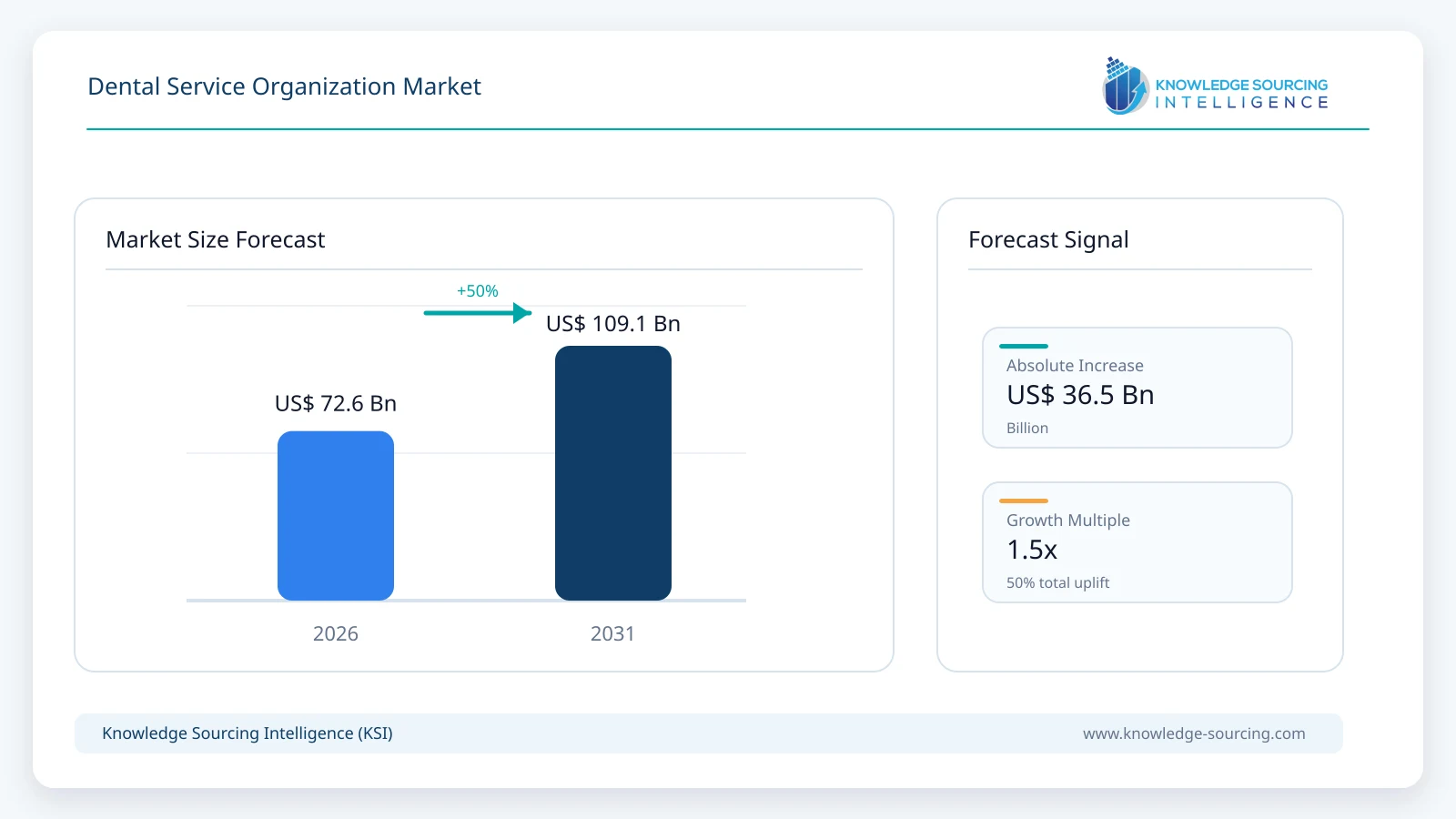
The Dental Service Organization Market is expected to grow at a CAGR of 8.5%, reaching a market size of USD 109.1 billion in 2031 from USD 72.6 billion in 2026.
Highlights:
- 1Medical supplies procurement accounts for approximately 31% of global DSO service value in 2026.
- 2Doctor-partnership and affiliate models are projected to grow about 10.5% annually through 2031.
- 3General dentistry generates approximately USD 38.5 billion of DSO-supported market value in 2026.
- 4North America accounts for approximately 47% of global DSO market value in 2026.
- 5U.S. DSO affiliation reached 16.1% of dentists in 2024, continuing a multi-year increase.
- 6Early-career dentists show materially higher DSO affiliation, strengthening the future recruitment pipeline.
Market Overview
A DSO is an entity that manages some or all non-clinical functions for one or more dental practices. The affiliated practice may retain its existing name and local clinical leadership, or it may operate under a common consumer brand. The defining feature is not practice size but the external management of functions such as payroll, hiring, billing, marketing, purchasing, compliance, information systems, and facility support. This distinction is important because large multi-location practices can operate without a DSO, while a single-location practice may be DSO-affiliated if an outside organization manages its business operations.
The United States remains the most developed DSO market. American Dental Association Health Policy Institute data show that 16.1% of U.S. dentists were DSO-affiliated in 2024, up materially from earlier years, and affiliation is much higher among dentists early in their careers. Scale is also increasing among leading operators. Heartland Dental ended 2025 supporting more than 1,900 practices, MB2 Dental surpassed 800 partner practices, and Aspen Dental supports close to 1,100 locations. Outside the United States, Dentalcorp built a network approaching 600 Canadian practices before its 2026 take-private transaction, Colosseum Dental operates more than 620 clinics across eleven European markets, and PortmanDentex supports more than 370 practices across the United Kingdom and Ireland.
Market Trends
Doctor-equity and partnership models are broadening the affiliation proposition
The DSO transaction model is moving beyond a simple sale of a practice to a centralized corporate buyer. Partnership structures increasingly allow dentists to retain local branding, continue as owners, or reinvest a portion of transaction proceeds into a larger organization. MB2 Dental has built its model around doctor partnership and shared ownership rather than full clinical standardization, while Dentalcorp historically used a partnership structure with dentists retaining economic participation in the wider platform. Heartland Dental also emphasizes clinical autonomy and preservation of local practice identity. These structures can improve dentist retention and make affiliation more attractive to owners who want liquidity or administrative support without fully exiting practice leadership. They also change the economics of consolidation because DSOs compete on equity participation, governance, autonomy, and growth support as well as headline acquisition multiples.
Technology platforms are becoming network infrastructure rather than standalone practice tools
Large DSOs are increasingly using centralized technology to coordinate patient acquisition, scheduling, revenue-cycle management, procurement, performance analytics, recruiting and clinical workflow support across dispersed practices. The scale advantage is most visible where a common platform can reduce duplicated administrative work while providing location-level benchmarking. AI is also moving into imaging support, patient communications, and appointment operations, although clinical decision-making remains under licensed dentists. Heartland has deployed technologies such as VideaAI and iTero across supported practices, while other groups are investing in common data platforms and digital marketing systems. The commercial implication is that technology spending is shifting from optional software procurement toward a core integration capability: organizations that cannot standardize data, billing and workflow after an acquisition may fail to capture the operating efficiencies assumed in the transaction case.
Market Drivers
Administrative complexity and changing dentist career preferences increase affiliation demand
The business burden of operating an independent dental practice has increased as owners manage recruiting, wage pressure, billing, compliance, cybersecurity, payer administration, equipment investment, and marketing alongside clinical work. This is occurring while younger dentists show lower ownership rates and greater willingness to work in larger organizations. ADA data for 2024 show DSO affiliation at 16.1% across U.S. dentists, with approximately 26.5% of dentists up to ten years out of dental school affiliated with a DSO. The difference by career stage creates a structural recruitment advantage for organized groups because the incoming dentist workforce is more accustomed to employment, partnership, and shared-services models than prior generations. DSOs can convert this preference into growth by providing recruiting, credentialing, continuing education, and administrative infrastructure that is difficult for small practices to reproduce economically.
Scale economics, capital access and succession needs support continued practice consolidation
Dental practices require recurring capital for imaging systems, scanners, chairs, laboratory relationships, software and facility upgrades. Larger organizations can spread technology investment across a broader patient base, negotiate supply contracts and centralize administrative staff. The addressable economic base is substantial: U.S. dental-services spending reached approximately USD 189 billion in 2024, according to CMS data analyzed by the ADA, and dental spending continues to grow. At the same time, established owners increasingly use affiliation as a succession route, monetizing part of the practice while remaining clinically active. This combination of underlying dental expenditure, retiring practice owners, and capital-intensive technology supports both acquisition-led DSOs and partnership models. The strongest operators are increasingly focused on regional density and same-practice growth rather than relying exclusively on acquisition volume.
Market Restraint
Leverage, integration risk and fragmented ownership regulation constrain acquisition-led growth
Rapid consolidation can create financial and operational strain when acquisition debt, labor costs and integration requirements rise faster than practice cash flow. The 2026 restructuring of Dental Care Alliance illustrates this risk: the transaction reduced funded debt by more than USD 1.1 billion, added USD 95 million of new capital and extended maturities to 2031. Operators must also navigate state-specific corporate-practice restrictions, professional ownership requirements, and different structures for management-service agreements. These constraints increase legal and compliance costs and can limit the extent to which clinical and business functions are centralized. Integration presents an additional challenge because over-standardization may cause dentist departures or weaken local brands, while insufficient standardization prevents the DSO from realizing shared-service economics. Financing discipline, clinician retention and post-acquisition integration are therefore becoming as important as the pace of new affiliations.
Segment Analysis
By Service Type - Medical Supplies Procurement
Medical supplies procurement is projected to generate approximately USD 34.3 billion in DSO service value by 2031. Centralized purchasing is one of the most direct scale benefits available to dental groups because practices repeatedly purchase restorative materials, consumables, implants, orthodontic products, infection-control supplies, and laboratory services. Larger DSOs can aggregate volumes, negotiate preferred-vendor pricing, and reduce variation in stock management while still allowing clinicians to retain control over clinically sensitive product choices. Procurement also connects with equipment financing and technology deployment, allowing groups to standardize selected scanners, imaging systems and digital workflows across new locations. Human resources and revenue-cycle services are smaller in direct spend but increasingly strategic because recruiting shortages and billing complexity affect the ability of practices to convert patient demand into productive chair time.
By Ownership Model - Corporate Dental Service Organizations
Corporate and full-service DSO structures are projected to represent approximately USD 70 billion of market value by 2031 and remain the largest ownership model. Their scale comes from national and regional networks that centralize support functions and use a repeatable affiliation or de novo development process. However, the faster expansion is occurring in doctor-partnership and hybrid structures that preserve meaningful dentist equity or local ownership. MB2 Dental is a prominent example of this approach, while dentalcorp historically incorporated partner-dentist ownership within its broader platform. The distinction between corporate DSO, dental partnership organization and management service organization is becoming less rigid as groups adopt combinations of minority investment, joint venture, affiliation and full-acquisition structures to match seller preferences and state ownership rules.
By End User - General Dentists
General dentistry is projected to account for approximately USD 56.0 billion of DSO market value by 2031. The segment remains the largest because general practices generate recurring preventive, restorative and emergency-care demand and provide a referral base for specialty services. Large platforms such as Heartland Dental and Aspen Dental have built extensive general-dentistry networks, while multi-specialty groups increasingly add orthodontics, oral surgery, endodontics, implants and pediatric care around those patient relationships. Specialty DSOs are growing faster from a smaller base because complex procedures can benefit from centralized referral management, expensive equipment, specialist recruiting and regional density. Orthodontics and oral and maxillofacial surgery already show higher U.S. DSO affiliation rates than general dentistry, indicating that specialist consolidation is moving beyond the early-stage phase.
By Geography - North America'
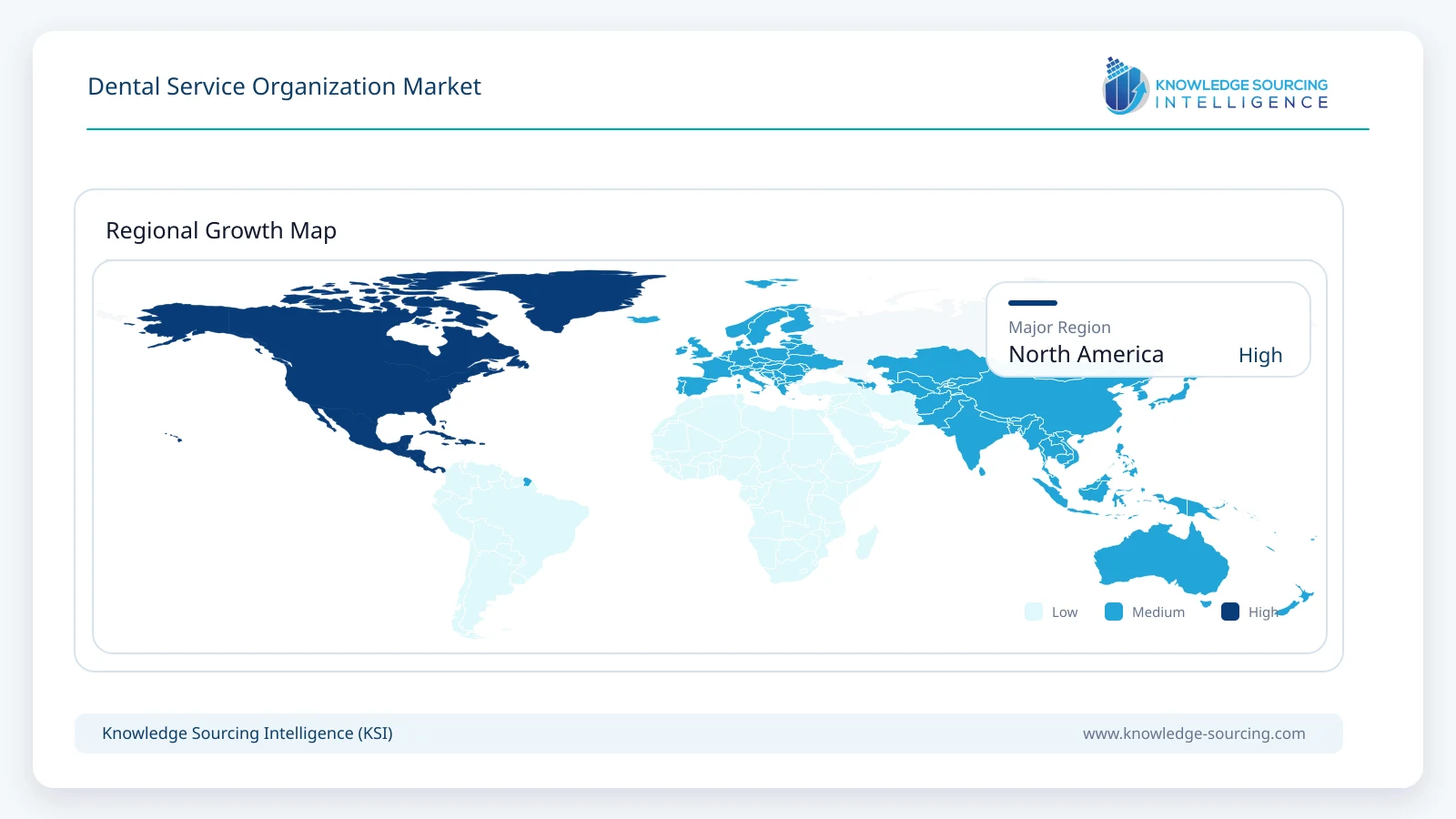
North America is projected to reach approximately USD 50.4 billion in DSO market value by 2031. The region combines a large dental-care expenditure base, established private-practice ownership, active private-equity participation and a mature ecosystem of DSO operators, lenders, suppliers and practice brokers. The United States is the largest market, with Heartland, Aspen, Pacific Dental Services, MB2, Dental Care Alliance and other multi-state groups continuing to expand through affiliations and de novo openings. Canada has also developed a scaled consolidation model: dentalcorp had reached roughly 590 locations by late 2025 before being acquired by GTCR in January 2026. Europe is consolidating through groups including Colosseum Dental and PortmanDentex, while Asia Pacific remains more fragmented but is moving toward organized chains as urban dental demand, private investment and digital infrastructure increase.
Competitive Environment
Competition is increasingly defined by the value proposition offered to dentists rather than patient-facing brand scale alone. Heartland Dental competes through comprehensive non-clinical support and local practice identity, Aspen Dental emphasizes de novo development under a common consumer brand, Pacific Dental Services combines supported practices with integrated technology and specialty capabilities, and MB2 Dental differentiates through doctor partnership and equity participation. Dentalcorp provides a large Canadian platform, while Colosseum Dental and PortmanDentex demonstrate that multi-market dental-group models are scaling across Europe. This diversity means that no single ownership template dominates every geography or dentist segment.
Capital structure and integration capability are becoming important competitive filters. Organizations that expanded rapidly during low-interest-rate periods now face greater scrutiny over leverage, same-practice growth, clinician turnover and the quality of central support. The strongest platforms are therefore investing in recruiting, continuing education, data infrastructure, revenue-cycle management and procurement rather than treating central services only as overhead reduction. Regional density also matters because it improves marketing efficiency, specialist referrals, staff sharing and management coverage. As consolidation continues, the next competitive phase is likely to favor DSOs that can demonstrate measurable improvement in practice economics while preserving clinical autonomy and local patient trust.
Recent Developments
September 2026: Colosseum Dental Group announced Arjen Radder as its incoming CEO, effective October 2026, as the group operates more than 630 clinics and 50 laboratories across 11 European markets.
June 2026: Dental Care Alliance completed a strategic transaction that reduced funded debt by more than USD 1.1 billion, secured USD 95 million of new capital and extended debt maturities to 2031.
April 2026: Heartland Dental added six de novo practices and five affiliations across multiple U.S. states, continuing expansion of its supported-practice network.
January 2026: GTCR completed its acquisition of dentalcorp in a transaction valuing the company at approximately C$2.2 billion in equity value and C$3.3 billion in enterprise value.
January 2026: MB2 Dental reported that it had surpassed 800 partner practices, reinforcing the scale of the doctor-partnership model within U.S. dental consolidation.
Dental Service Organization Market Scope:
| Report Metric | Details |
|---|---|
| Total Market Size in 2026 | USD 72.6 billion |
| Total Market Size in 2031 | USD 109.1 billion |
| Forecast Unit | Billion |
| Growth Rate | 8.5% |
| Study Period | 2021 to 2031 |
| Historical Data | 2021 to 2024 |
| Base Year | 2025 |
| Forecast Period | 2026 – 2031 |
| Segmentation | Service Type, Ownership Model, End-User, Geography |
| Companies |
|
Market Segmentation
By Service Type
Human Resources
Marketing and Branding
Accounting and Revenue-Cycle Management
Medical Supplies Procurement
IT, Compliance and Other Services
By Ownership Model
Corporate Dental Service Organizations (CDSOs)
Dental Partnership and Management Organizations (DPOs/DMOs)
By End User
General Dentists
Oral and Maxillofacial Surgeons
Orthodontists and Endodontists
Pediatric and Other Dental Specialists
By Geography
North America
USA
Canada
Mexico
South America
Brazil
Argentina
Others
Europe
United Kingdom
Germany
France
Spain
Italy
Others
Middle East and Africa
Saudi Arabia
UAE
Israel
Others
Asia Pacific
China
India
Japan
South Korea
Indonesia
Thailand
Others
Table of Contents
1. EXECUTIVE SUMMARY
2. MARKET SNAPSHOT
2.1. Market Overview
2.2. Market Definition
2.3. Market Segmentation
3. BUSINESS LANDSCAPE
3.1. Market Drivers
3.1.1. Administrative Complexity and Changing Dentist Career Preferences Increase Affiliation Demand
3.1.2. Scale Economics, Capital Access and Succession Needs Support Continued Practice Consolidation
3.2. Market Restraint
3.2.1. Leverage, Integration Risk and Fragmented Ownership Regulation Constrain Acquisition-Led Growth
3.3. Market Opportunities
3.4. Porter's Five Forces Analysis
3.5. Industry Value Chain Analysis
3.6. Policies and Regulations
3.7. Strategic Recommendations
4. TECHNOLOGICAL OUTLOOK
4.1. AI-Enabled Practice Management and Imaging Support
4.2. Centralized Revenue-Cycle and Patient-Engagement Platforms
4.3. Digital Procurement and Inventory Management
4.4. Cloud-Based Multi-Location Analytics
5. DENTAL SERVICE ORGANIZATION MARKET BY SERVICE TYPE
5.1. Introduction
5.2. Human Resources
5.3. Marketing and Branding
5.4. Accounting and Revenue-Cycle Management
5.5. Medical Supplies Procurement
5.6. IT, Compliance and Other Services
6. DENTAL SERVICE ORGANIZATION MARKET BY OWNERSHIP MODEL
6.1. Introduction
6.2. Corporate Dental Service Organizations (CDSOs)
6.3. Dental Partnership and Management Organizations (DPOs/DMOs)
7. DENTAL SERVICE ORGANIZATION MARKET BY END USER
7.1. Introduction
7.2. General Dentists
7.3. Oral and Maxillofacial Surgeons
7.4. Orthodontists and Endodontists
7.5. Pediatric and Other Dental Specialists
8. DENTAL SERVICE ORGANIZATION MARKET BY GEOGRAPHY
8.1. Introduction
8.2. North America
8.2.1. USA
8.2.2. Canada
8.2.3. Mexico
8.3. South America
8.3.1. Brazil
8.3.2. Argentina
8.3.3. Others
8.4. Europe
8.4.1. United Kingdom
8.4.2. Germany
8.4.3. France
8.4.4. Spain
8.4.5. Italy
8.4.6. Others
8.5. Middle East and Africa
8.5.1. Saudi Arabia
8.5.2. UAE
8.5.3. Israel
8.5.4. Others
8.6. Asia Pacific
8.6.1. China
8.6.2. India
8.6.3. Japan
8.6.4. South Korea
8.6.5. Indonesia
8.6.6. Thailand
8.6.7. Others
9. COMPETITIVE ENVIRONMENT AND ANALYSIS
9.1. Major Players and Strategy Analysis
9.2. Market Share Analysis
9.3. Mergers, Acquisitions, Agreements and Collaborations
9.4. Competitive Dashboard
10. COMPANY PROFILES
10.1. Heartland Dental
10.2. The Aspen Group
10.3. Pacific Dental Services
10.4. MB2 Dental
10.5. dentalcorp
10.6. Colosseum Dental Group
10.7. PortmanDentex
10.8. Dental Care Alliance
10.9. Smile Brands Inc.
10.10. InterDent Service Corporation
10.11. Great Expressions Dental Centers
10.12. Affordable Care, LLC
10.13. Benevis
10.14. 42 North Dental
10.15. Specialty1 Partners
10.16. Guardian Dentistry Partners
10.17. Sage Dental
10.18. Marquee Dental Partners
11. APPENDIX
11.1. Currency
11.2. Assumptions
11.3. Base and Forecast Years Timeline
11.4. Key Benefits for Stakeholders
11.5. Research Methodology
11.6. Abbreviations
Navigate
Trusted by the world's leading organizations











