
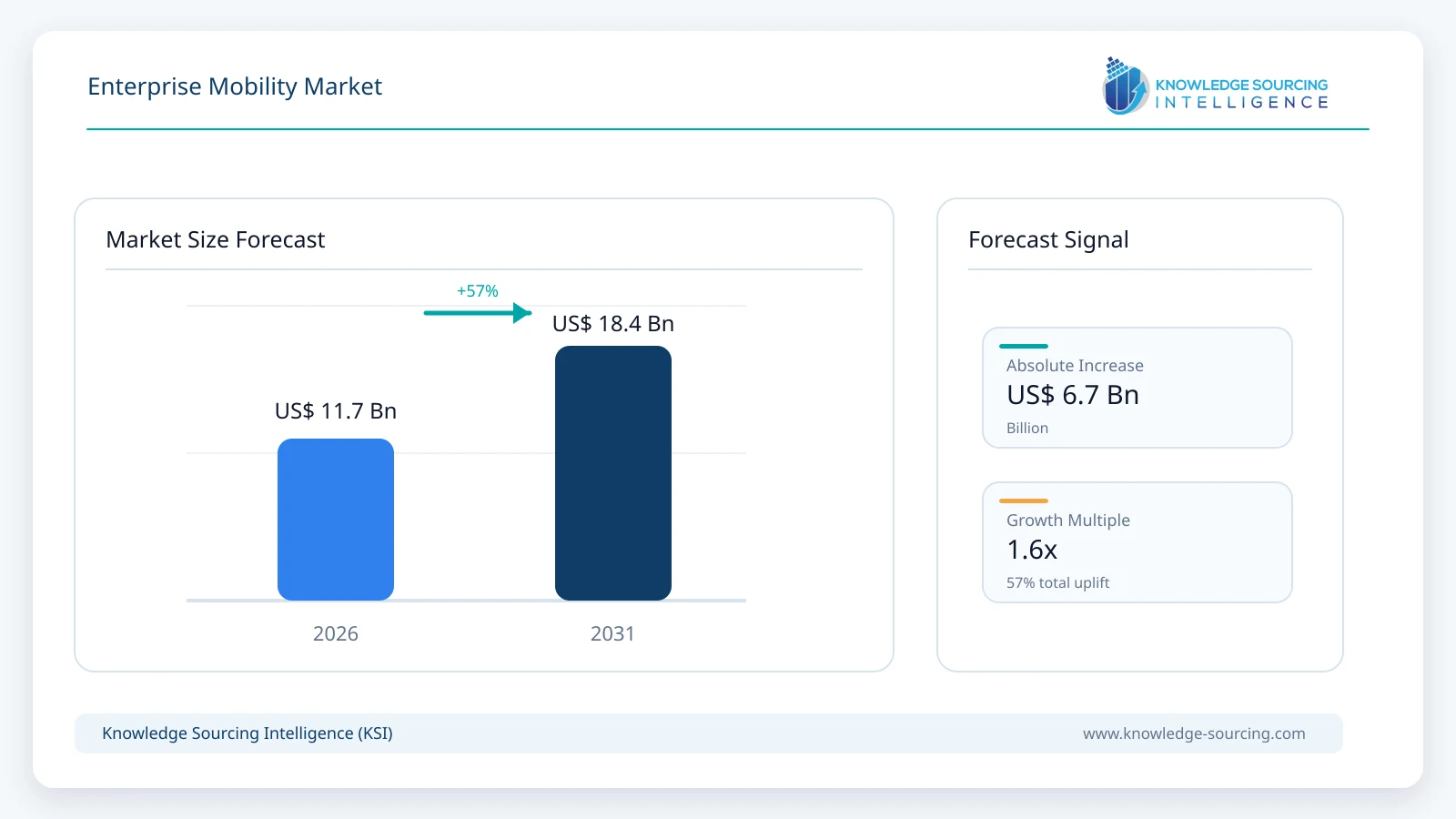
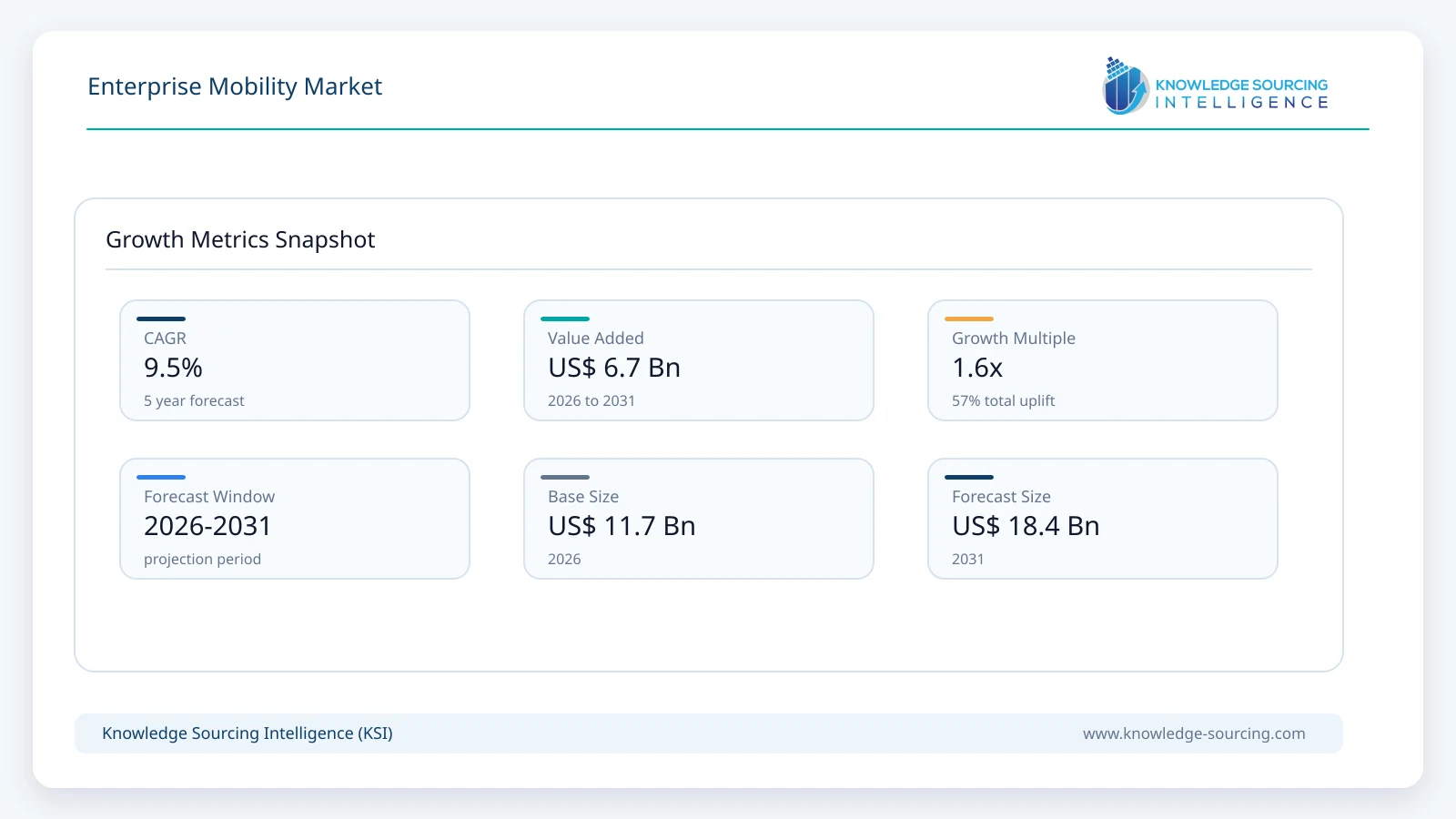
The global enterprise mobility market is estimated at USD 11.7 billion in 2026 and is projected to reach USD 18.4 billion by 2031, growing at a CAGR of 9.5% during 2026-2031.
Highlights:
- 1Software accounts for an estimated 72% share of enterprise mobility revenue in 2026.
- 2UEM and MDM platforms represent about 48% of 2026 enterprise mobility revenue.
- 3Cloud deployments account for nearly 81% of enterprise mobility revenue in 2026.
- 4Large enterprises generate approximately 64% of global enterprise mobility spending in 2026.
- 5BFSI represents an estimated 18% share of enterprise mobility spending in 2026.
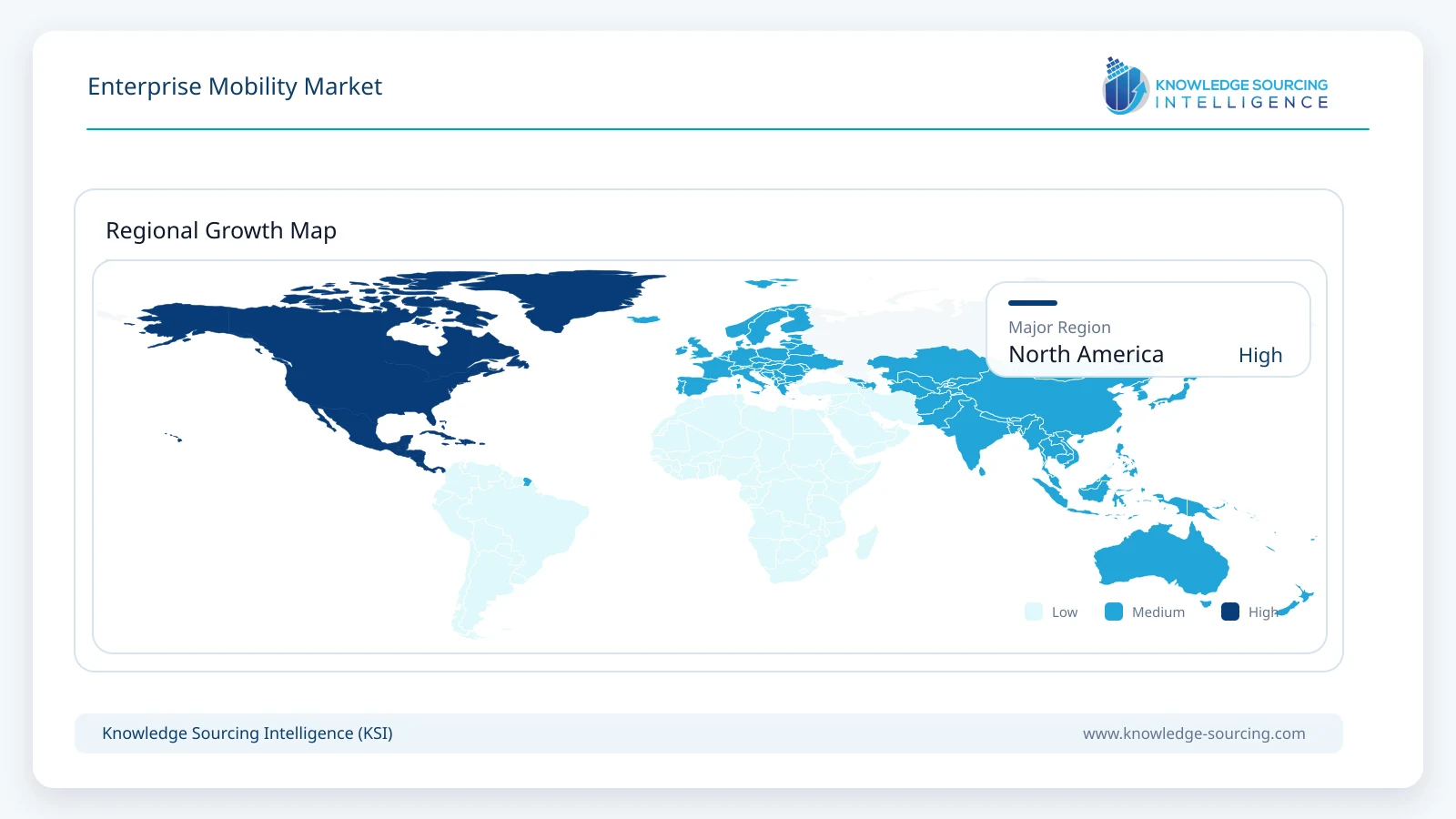
- 6North America accounts for approximately 40% of global enterprise mobility revenue in 2026.
The market is being reshaped by the convergence of traditional mobile device management with broader unified endpoint management, zero-touch provisioning, application governance, mobile threat controls, identity-aware access, analytics, and remote support. Enterprise mobility is therefore no longer limited to smartphones and tablets; current platforms increasingly manage Windows, macOS, Linux, ChromeOS, rugged Android devices, shared frontline devices, kiosks, wearables, and selected IoT endpoints through a common policy layer.
Public operating evidence supports a multi-billion-dollar software market without requiring device hardware to be counted. Jamf generated USD 627.4 million of revenue in 2024 and USD 527.6 million in the first nine months of 2025, with subscription revenue accounting for 98% of third-quarter 2025 revenue. SOTI reports more than 17,000 customers and over 22 million mobile devices under management, while Samsung states that Knox is used to manage more than 150 million devices across over 35,000 businesses. Omnissa reports 26,000 customers for its digital-work platform, and Microsoft prices standalone Intune Plan 1 at USD 8 per user per month, although a large portion of Intune is bundled into Microsoft 365 and must therefore be valued at an effective bundled allocation rather than list price.
These anchors indicate a commercial pool that excludes device hardware but is materially larger than a narrow standalone MDM-only market. The forecast assumes continued expansion of multi-OS endpoint management, advanced UEM features, frontline-device management, security convergence, and managed mobility services, offset by bundling pressure from Microsoft and other platform vendors.
Market Drivers and Trends
Unified endpoint management is replacing mobile-only administration
The strongest structural driver is the transition from mobile-only MDM toward UEM platforms capable of managing phones, tablets, laptops, desktops, rugged devices, shared endpoints, and selected IoT assets. Microsoft Intune, Omnissa Workspace ONE, IBM MaaS360, Ivanti Neurons for UEM, SOTI MobiControl, ManageEngine Endpoint Central, Hexnode, and Scalefusion all now position device administration around multi-operating-system endpoint control rather than a smartphone-only model. This consolidation allows enterprises to replace fragmented tools, centralize policy enforcement, and reduce operational overhead.
Frontline and rugged-device fleets create business-critical mobility demand
Retail, logistics, manufacturing, aviation, healthcare, and field-service organizations increasingly depend on rugged Android devices, shared tablets, vehicle-mounted computers, scanners, and other mobile endpoints for daily operations. SOTI reports more than 22 million mobile devices under management, while customer deployments range from large retail estates to mission-critical field fleets. Because downtime on these devices can stop warehouse, delivery, production, or point-of-service workflows, enterprise mobility spending increasingly includes remote diagnostics, application deployment, battery intelligence, kiosk controls, and managed support.
Mobility management is converging with security and identity controls
Enterprise mobility platforms increasingly enforce conditional access, device compliance, mobile application protection, identity-linked policies, encryption, secure containers, and zero-trust workflows. Microsoft is embedding more advanced endpoint-management capabilities into Microsoft 365 E3 and E5 from July 2026, while BlackBerry continues to position UEM around sovereign and high-assurance communications. The commercial opportunity is therefore expanding from basic device enrollment toward a broader endpoint-governance layer, although general-purpose identity and endpoint-security revenue remains outside this market unless directly associated with mobility management.
AI and automation are moving endpoint administration toward autonomous operations
The 2025-2026 product cycle shows a rapid move toward AI-assisted policy management, troubleshooting, scripting, analytics, and remediation. Jamf announced AI-era management and automation capabilities at JNUC 2026; Hexnode introduced agentic-AI orchestration and a Context Layer during 2026; IBM MaaS360 added automated scripting and expanded cloud management functions; and Omnissa has continued to add AI and automation to Workspace ONE. These capabilities support higher-value subscription tiers and increase the role of analytics and automation within the enterprise mobility stack.
Market Restraints
Platform bundling creates pricing pressure
Microsoft Intune is included in major Microsoft 365 enterprise bundles and Microsoft is adding advanced endpoint-management features to E3 and E5 subscriptions. This can lower the effective price enterprises assign to endpoint management and makes it difficult for independent vendors to compete on basic MDM functionality alone. Specialists increasingly differentiate through Apple depth, rugged-device support, sovereign deployment, remote support, kiosk controls, or advanced automation.
Migration complexity and heterogeneous device estates slow consolidation
Large organizations often operate multiple UEM products, legacy endpoint-management tools, custom applications, rugged operating systems, and region-specific compliance policies. Migrating thousands of endpoints without disrupting frontline operations can require staged rollouts, coexistence tools, professional services, and extensive testing. This complexity supports services revenue but can also extend decision cycles and delay full platform consolidation.
Global Enterprise Mobility Market Segment Analysis
By Offering
Software
Software is the largest offering segment, with estimated 2026 revenue of approximately USD 8.4 billion. The segment includes subscription and license revenue for UEM, MDM, MAM, mobile-content controls, endpoint analytics, remote support, application distribution, and mobility-specific security functions. Software remains the principal value pool because most leading products are recurring cloud subscriptions, while services are concentrated around implementation, migration, support, and managed operations.
By Core Function
UEM and MDM
UEM and MDM platforms form the largest functional segment, with estimated 2026 revenue of approximately USD 5.6 billion. The category has expanded beyond smartphones to cover Windows, macOS, ChromeOS, Linux, rugged Android, shared devices, kiosks, and selected IoT endpoints. Microsoft Intune, Omnissa Workspace ONE, IBM MaaS360, Ivanti Neurons for UEM, SOTI MobiControl, ManageEngine, Samsung Knox, Hexnode, and Scalefusion are among the active platforms shaping this segment.
By Deployment
Cloud
Cloud deployment is estimated at approximately USD 9.5 billion in 2026. Cloud UEM simplifies zero-touch provisioning, distributed administration, rapid feature delivery, and multi-region device management, making it the default deployment model for most new implementations. On-premise and sovereign deployments remain relevant in government, defense, regulated industries, and environments requiring local control of management infrastructure.
By Enterprise Size
Large Enterprises
Large enterprises account for an estimated USD 7.5 billion of 2026 market revenue. Complex multi-country fleets, large frontline workforces, regulatory requirements, heterogeneous operating systems, and integration with identity, security, service-management, and HR systems increase both software and services spending per customer. Examples include PepsiCo's more than 400,000 devices managed through Microsoft Intune and East Japan Railway's fleet of more than 100,000 devices managed with Workspace ONE.
By End User
BFSI
BFSI is estimated at approximately USD 2.1 billion in 2026 and represents the largest single end-user vertical. Banks, insurers, payment companies, and financial institutions require secure BYOD, mobile application governance, device compliance, data separation, conditional access, and strong auditability. The sector's high regulatory burden supports premium UEM, secure container, identity-linked, and managed-service deployments.
By Geography
North America
North America is estimated at approximately USD 4.7 billion in 2026. The region combines high enterprise software spending with large installed bases for Microsoft Intune, Jamf, Omnissa Workspace ONE, IBM MaaS360, Ivanti, Cisco Meraki Systems Manager, BlackBerry UEM, and multiple specialist platforms.
Enterprise adoption is also supported by mature cloud infrastructure, extensive remote and hybrid work, strong cybersecurity spending, and broad use of managed mobility services.
Competitive Environment
The market is led by large platform vendors and specialist enterprise mobility providers. Microsoft benefits from bundling and broad enterprise distribution; Omnissa retains a large Workspace ONE installed base; IBM and Ivanti compete across multi-platform UEM; Jamf is differentiated by Apple depth; SOTI is strong in rugged and business-critical mobile devices; Samsung combines device-level controls with Knox Suite; and BlackBerry maintains a differentiated position in sovereign, government, and high-assurance mobility.
The specialist layer remains active. ManageEngine, Hexnode, Scalefusion, 42Gears, Kandji, Cisco Meraki Systems Manager, and Miradore address combinations of UEM, Apple management, kiosk control, SMB requirements, MSP use cases, and endpoint automation. Workspace ONE is now under Omnissa rather than VMware, and Jamf became privately held following Francisco Partners' January 2026 acquisition.
Recent Developments
September 2026: Jamf announced new AI-governance, programmable management, automated application deployment, and autonomous endpoint-management capabilities at JNUC 2026.
September 2026: Hexnode announced Hexnode Synapse, extending agentic-AI orchestration across IT and security operations.
August 2026: Scalefusion published its 2026 mid-year platform update, expanding unified management across Windows, Apple, Linux, identity, and endpoint security.
August 2026: IBM MaaS360 added remote script execution for Windows and macOS through Action Orchestrator in its 10.91 cloud release.
July 2026: Microsoft began rolling selected advanced Intune capabilities into Microsoft 365 E3 and E5, increasing bundling pressure in endpoint management.
May 2026: Jamf appointed Beth Tschida as CEO following the company's transition to private ownership under Francisco Partners.
Market Outlook
The enterprise mobility market is expected to grow steadily through 2031 as organizations consolidate endpoint tools, expand frontline mobility, automate device operations, and integrate mobility policy with identity and security. The strongest value creation is expected in cloud UEM, managed mobility, rugged and shared-device administration, application governance, remote support, and AI-assisted endpoint operations.
The addressable software and services pool should expand faster than traditional MDM as enterprise mobility becomes part of a broader unified endpoint and digital-workspace architecture.
Global Enterprise Mobility Market Scope:
| Report Metric | Details |
|---|---|
| Total Market Size in 2026 | USD 11.7 billion |
| Total Market Size in 2031 | USD 18.4 billion |
| Forecast Unit | Billion |
| Growth Rate | 9.5% |
| Study Period | 2021 to 2031 |
| Historical Data | 2021 to 2024 |
| Base Year | 2025 |
| Forecast Period | 2026 – 2031 |
| Segmentation | Offering, Core Function, Deployment, Enterprise Size, End User, Geography |
| Companies |
|
Market Segmentation
By Offering
Software
Services
By Core Function
Unified Endpoint Management / Mobile Device Management
Mobile Application Management
Mobile Content and Access Management
Mobility Security and Compliance
Analytics, Automation and Remote Support
By Deployment
Cloud
On-Premise / Sovereign
By Enterprise Size
Large Enterprises
Small and Medium Enterprises
By End User
BFSI
Retail
Manufacturing
Transportation and Logistics
Healthcare
IT and Telecommunications
Government and Public Sector
Others
By Geography
North America
United States
Canada
Mexico
South America
Brazil
Argentina
Others
Europe
United Kingdom
Germany
France
Italy
Spain
Others
Middle East and Africa
Saudi Arabia
United Arab Emirates
South Africa
Others
Asia Pacific
China
Japan
India
South Korea
Southeast Asia
Australia
Others
Table of Contents
1. INTRODUCTION
1.1. Market Overview
1.2. Market Definition
1.3. Scope of the Study
1.4. Market Inclusions and Exclusions
1.5. Currency and Study Period
2. RESEARCH METHODOLOGY
2.1. Research Design
2.2. Secondary and Primary Research
2.3. Market Estimation and Validation
3. EXECUTIVE SUMMARY
3.1. Market Size and Growth
3.2. Key Findings
4. MARKET DYNAMICS
4.1. Market Drivers
4.2. Market Restraints
4.3. Market Opportunities
4.4. Technology Trends
5. ENTERPRISE MOBILITY MARKET BY OFFERING
5.1. Software
5.2. Services
6. ENTERPRISE MOBILITY MARKET BY CORE FUNCTION
6.1. Unified Endpoint Management / Mobile Device Management
6.2. Mobile Application Management
6.3. Mobile Content and Access Management
6.4. Mobility Security and Compliance
6.5. Analytics, Automation and Remote Support
7. ENTERPRISE MOBILITY MARKET BY DEPLOYMENT
7.1. Cloud
7.2. On-Premise / Sovereign
8. ENTERPRISE MOBILITY MARKET BY ENTERPRISE SIZE
8.1. Large Enterprises
8.2. Small and Medium Enterprises
9. ENTERPRISE MOBILITY MARKET BY END USER
9.1. BFSI
9.2. Retail
9.3. Manufacturing
9.4. Transportation and Logistics
9.5. Healthcare
9.6. IT and Telecommunications
9.7. Government and Public Sector
9.8. Others
10. ENTERPRISE MOBILITY MARKET BY GEOGRAPHY
10.1. North America
10.1.1. United States
10.1.2. Canada
10.1.3. Mexico
10.2. South America
10.2.1. Brazil
10.2.2. Argentina
10.2.3. Others
10.3. Europe
10.3.1. United Kingdom
10.3.2. Germany
10.3.3. France
10.3.4. Italy
10.3.5. Spain
10.3.6. Others
10.4. Middle East and Africa
10.4.1. Saudi Arabia
10.4.2. United Arab Emirates
10.4.3. South Africa
10.4.4. Others
10.5. Asia Pacific
10.5.1. China
10.5.2. Japan
10.5.3. India
10.5.4. South Korea
10.5.5. Southeast Asia
10.5.6. Australia
10.5.7. Others
11. COMPETITIVE ENVIRONMENT AND ANALYSIS
11.1. Market Positioning
11.2. Product and Platform Benchmarking
11.3. Mergers, Acquisitions and Strategic Developments
11.4. Recent Developments
12. COMPANY PROFILES
12.1. Microsoft Corporation
12.2. Omnissa LLC
12.3. International Business Machines Corporation
12.4. Ivanti, Inc.
12.5. Jamf
12.6. SOTI Inc.
12.7. Samsung Electronics Co., Ltd.
12.8. BlackBerry Limited
12.9. Zoho Corporation / ManageEngine
12.10. Cisco Systems, Inc.
12.11. Mitsogo Inc. / Hexnode
12.12. ProMobi Technologies Pvt. Ltd. / Scalefusion
12.13. 42Gears Mobility Systems Pvt. Ltd.
12.14. Kandji, Inc.
12.15. GoTo / Miradore
Navigate
Trusted by the world's leading organizations











