
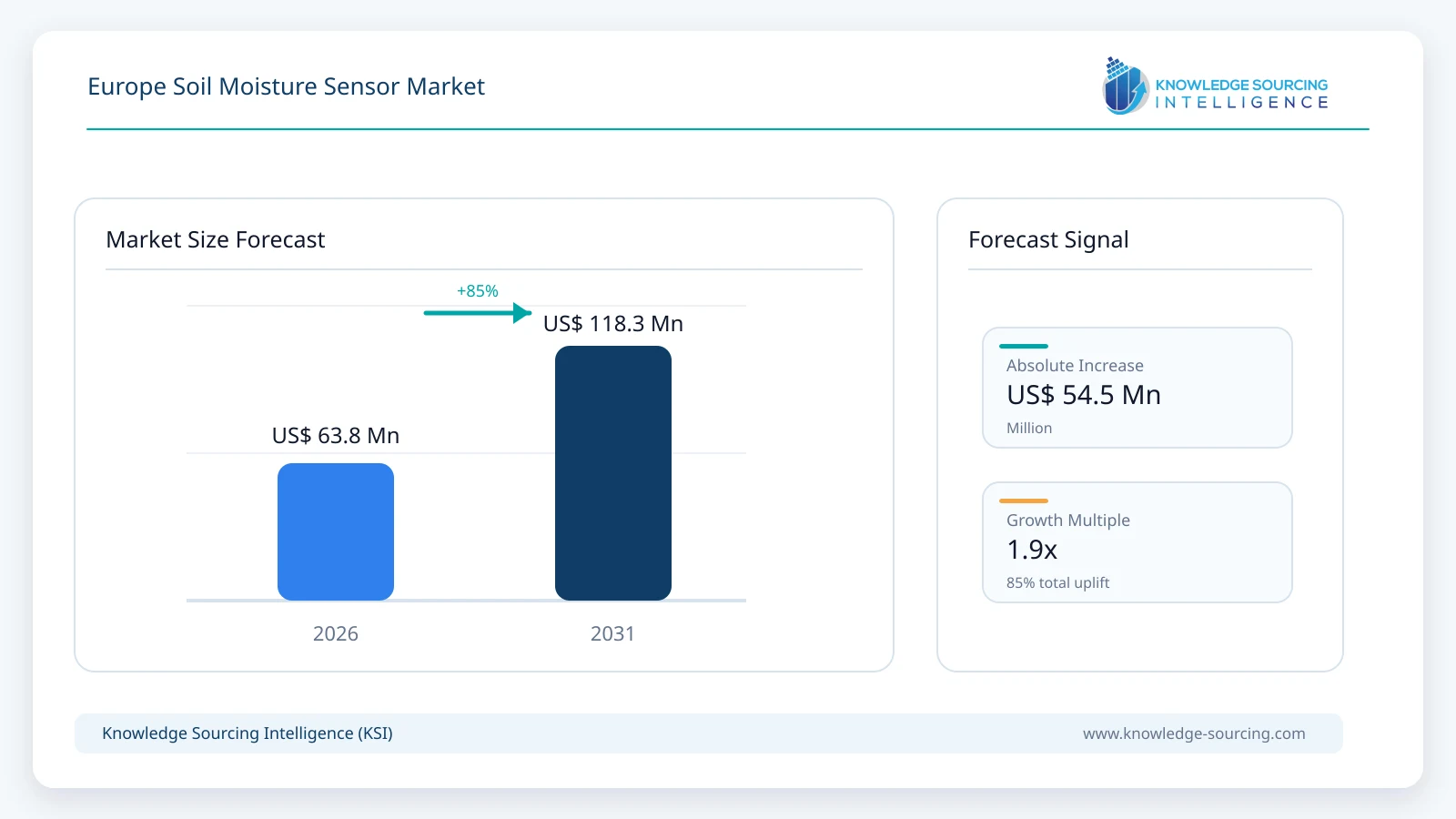
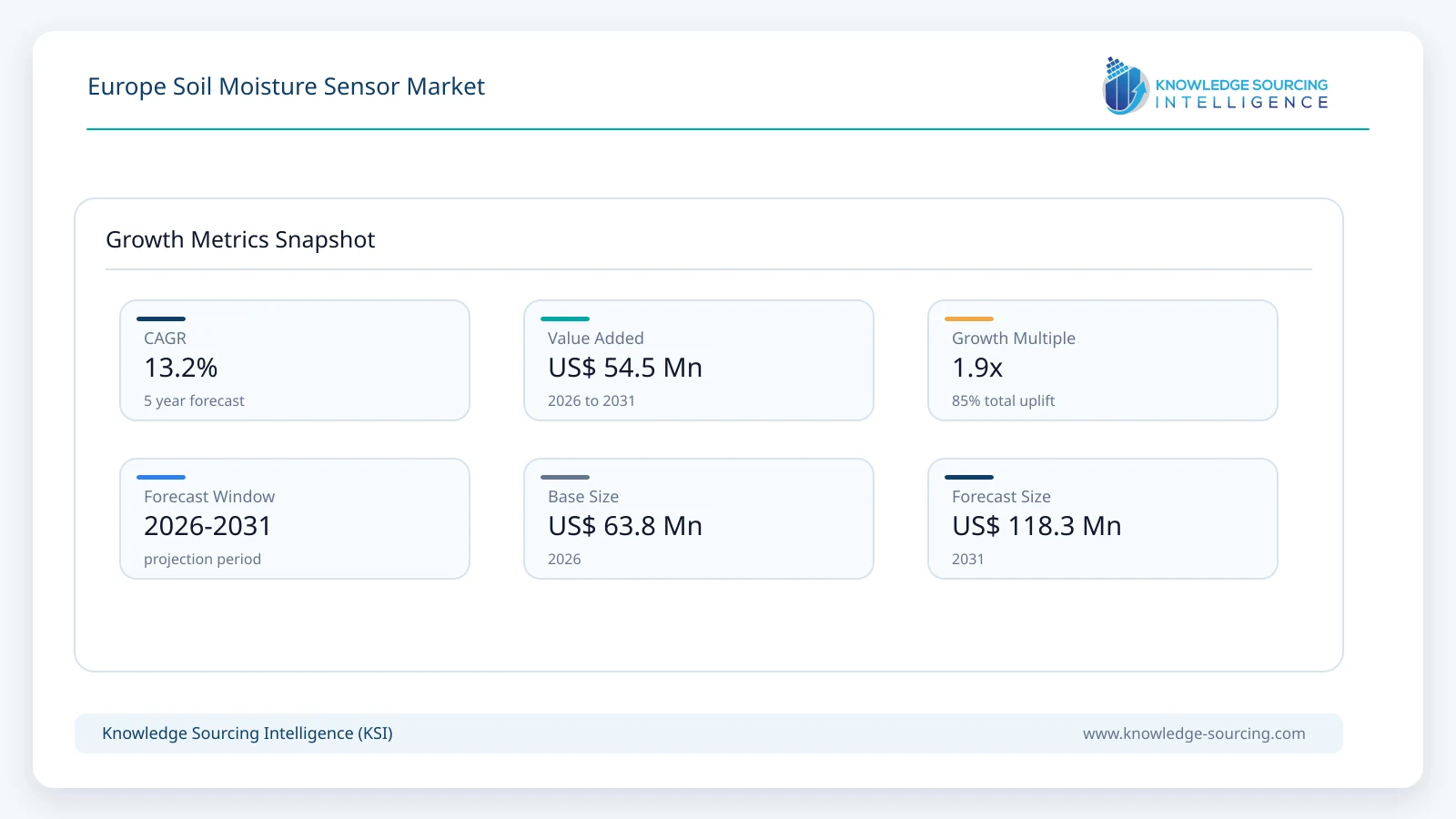
The European soil moisture sensor market is forecast to grow at a CAGR of 13.2%, reaching USD 118.3 million in 2031 from USD 63.8 million in 2026.
Highlights:
- 1Precision agriculture investment and climate adaptation policies continue to strengthen demand for soil moisture sensing technologies across Europe.
- 2Agricultural users remain the largest commercial customer group, supported by irrigation optimization and resource efficiency requirements.
- 3Wireless connectivity, cloud-based farm management platforms, and remote monitoring capabilities are expanding commercial deployment opportunities.
- 4Regulatory initiatives promoting sustainable water use and environmental monitoring are encouraging broader adoption beyond agriculture.
- 5Product differentiation increasingly depends on measurement accuracy, durability, software integration, and long-term calibration stability.
The market includes water potential sensors that measure soil water tension and volumetric moisture sensors that determine the amount of water contained within the soil. Product selection depends on crop type, soil characteristics, measurement accuracy, installation requirements, communication capability, and compatibility with farm management software.
Commercial demand is led by agricultural producers seeking to optimize irrigation scheduling while complying with evolving environmental requirements governing groundwater use and nutrient management. Construction, forestry, landscaping, sports turf management, research institutions, and environmental agencies also represent important customer groups, although procurement patterns differ considerably from agricultural buyers. Public research organizations generally prioritize measurement precision and long-term data consistency, whereas commercial operators place greater emphasis on ease of installation, maintenance requirements, and lifecycle cost.
European climate variability has increased the commercial importance of continuous soil monitoring. The European Environment Agency has reported that prolonged drought events and increasing water stress are affecting agricultural productivity across multiple regions, encouraging investments in technologies that improve irrigation decisions. At the same time, the European Union continues to support digital agriculture through the Common Agricultural Policy (CAP), precision farming initiatives, and sustainability objectives that encourage efficient resource management. These policy measures are strengthening demand for technologies capable of delivering reliable field-level information for operational decision-making.
Competition increasingly extends beyond sensor hardware. Suppliers are differentiating their offerings through cloud connectivity, wireless communication, software integration, data analytics, and technical support services that simplify deployment across farms of different sizes. Buyers increasingly evaluate complete monitoring solutions rather than standalone sensing devices, encouraging manufacturers to expand digital capabilities alongside hardware performance.
Key Market Indicators
Indicator | Latest Evidence | Commercial Meaning |
EU agricultural land | Approximately 157 million hectares (2023) | Extensive cultivated area supports long-term demand for precision irrigation technologies. |
Area under organic farming in the EU | Nearly 17.7 million hectares (2023) | Sustainable farming practices increase interest in data-driven irrigation management. |
Europeans affected by increasing drought risk | Recurring drought conditions across much of Europe | Water-efficient irrigation technologies are becoming more commercially relevant. |
Copernicus European Soil Moisture monitoring | Operational continent-wide monitoring | Public investment in soil monitoring strengthens technology awareness and validation. |
Common Agricultural Policy (CAP) funding | 2023–2027 implementation period | Financial support encourages adoption of digital agricultural technologies where eligible. |
Market Drivers
Water scarcity is increasing investment in irrigation optimization technologies
Recurring drought conditions across Southern and Western Europe have increased attention on irrigation efficiency rather than expansion of water withdrawals. The European Environment Agency continues to identify water scarcity and prolonged drought as important environmental risks affecting agriculture, while the European Commission has strengthened policies supporting sustainable water management. These developments encourage growers to adopt soil moisture monitoring systems that improve irrigation timing and reduce unnecessary water application. Sensor manufacturers have responded by expanding wireless product portfolios and integrating monitoring platforms with automated irrigation controllers, allowing growers to make field-specific irrigation decisions while reducing water consumption.
Precision agriculture programs are expanding deployment of digital field monitoring
Precision agriculture has moved beyond large commercial farms as equipment manufacturers, software developers, and agricultural technology suppliers introduce scalable digital farming solutions suitable for medium-sized operations. The Common Agricultural Policy continues to encourage environmentally sustainable agricultural practices, while national digital farming initiatives support investments in technologies that improve resource efficiency. Soil moisture sensors provide one of the core datasets used in precision irrigation systems because they allow farmers to combine field measurements with weather forecasts and crop requirements. Suppliers increasingly provide integrated platforms combining sensors, telemetry, cloud analytics, and mobile applications instead of marketing individual sensing devices.
Environmental monitoring requirements are broadening demand outside agriculture
Commercial demand is expanding beyond farming applications as environmental agencies, research institutions, forestry organizations, and infrastructure operators require continuous soil moisture measurements for monitoring and risk assessment. Copernicus Land Monitoring Service provides operational soil moisture information across Europe, while national environmental organizations increasingly incorporate field-based observations into hydrological and ecological monitoring activities. Research organizations typically require high measurement accuracy and long-term calibration stability, encouraging manufacturers to develop products capable of supporting scientific monitoring alongside commercial agricultural applications. This diversification reduces dependence on seasonal agricultural purchasing cycles and broadens the addressable customer base.
Wireless connectivity is changing customer purchasing priorities
Farm operators increasingly expect sensors to function as components within broader digital farm management systems rather than as standalone measurement instruments. Wireless communication technologies, low-power networks, cloud-based dashboards, and mobile applications simplify installation while reducing maintenance requirements across geographically dispersed fields. Company product announcements indicate continued investment in remote monitoring capabilities and interoperability with irrigation controllers and agricultural management software. Buyers increasingly evaluate software functionality, battery life, communication reliability, and integration capability alongside measurement performance, encouraging suppliers to compete through complete monitoring ecosystems rather than hardware specifications alone.
Market Restraints and Challenges
Measurement accuracy remains highly dependent on soil characteristics and calibration
Sensor performance varies according to soil texture, salinity, organic matter content, temperature, and installation practices, requiring careful calibration to maintain measurement accuracy across different environments. Several manufacturers acknowledge that reliable measurements depend on proper installation procedures and calibration appropriate to local soil conditions. These technical requirements increase implementation complexity for users lacking specialist expertise and may extend deployment timelines for large agricultural operations. Service providers and distributors increasingly offer installation, calibration, and technical support services to reduce operational risks and improve long-term measurement reliability.
High initial deployment costs limit adoption among smaller farms
Although soil moisture monitoring can reduce irrigation costs over time, the initial investment associated with sensors, gateways, communication infrastructure, software subscriptions, and installation remains a constraint for smaller agricultural enterprises. Economic returns depend on farm size, crop value, irrigation intensity, and local water costs, creating uneven adoption across European agricultural markets. Manufacturers increasingly introduce modular product portfolios that allow customers to begin with limited deployments before expanding monitoring coverage, while distributors offer bundled packages combining hardware, connectivity, and technical support to reduce implementation barriers.
Data interoperability remains an operational challenge
Agricultural operations increasingly utilize multiple digital platforms including irrigation controllers, weather stations, satellite imagery, machinery telematics, and farm management software. Integrating these systems into a unified decision-support environment remains challenging because communication protocols and software architectures differ among suppliers. Buyers therefore prioritize products capable of supporting standardized communication interfaces and compatibility with existing agricultural technology infrastructure. Manufacturers continue investing in open integration capabilities and cloud-based software services to improve interoperability, although seamless integration remains an important competitive differentiator across the European market.
Major Segment Analysis
Agriculture
Agriculture represents the most commercially important application for soil moisture sensors in Europe because irrigation efficiency, crop productivity, and water conservation increasingly depend on field-level soil data. Farmers are adopting both water potential and volumetric moisture sensors to improve irrigation scheduling, minimize water losses, and support crop-specific management practices. High-value horticultural crops, vineyards, orchards, greenhouse cultivation, and irrigated arable farming generate particularly strong demand because irrigation decisions directly influence yield quality and production costs. Increasing use of variable-rate irrigation systems and precision farming software has further strengthened the value of continuous soil moisture monitoring.
Purchasing decisions vary according to farm size, irrigation infrastructure, and crop type. Large commercial farms generally prioritize sensor accuracy, wireless connectivity, integration with weather stations, and compatibility with farm management platforms, whereas smaller farms place greater emphasis on affordability, ease of installation, and maintenance requirements. Manufacturers are responding through modular product portfolios, cloud-enabled monitoring services, and subscription-based software platforms that reduce implementation complexity. While construction, landscaping, forestry, and environmental monitoring continue to create additional demand, agricultural applications remain the principal source of recurring equipment sales, software subscriptions, and after-sales service revenue for most suppliers operating in Europe.
Regional Analysis
Country | Primary Demand Driver | Principal Market Constraint |
United Kingdom | Precision agriculture and environmental monitoring | Weather variability and fragmented farm investment |
Germany | Digital farming adoption and high-value crop production | High integration and system compatibility requirements |
France | Irrigation management and sustainable agriculture policies | Regional differences in irrigation intensity |
Spain | Water scarcity and intensive irrigated agriculture | High upfront investment for smaller farms |
Italy | Vineyard, orchard, and horticultural irrigation | Farm fragmentation and uneven technology adoption |
Rest of Europe | CAP-supported modernization and environmental monitoring | Differences in digital infrastructure and purchasing capacity |
United Kingdom
Precision agriculture continues to gain commercial importance across the United Kingdom as growers seek to improve irrigation efficiency while managing increasingly variable weather conditions. Research organizations, agricultural technology developers, and environmental agencies also contribute to demand through field monitoring programs and long-term soil observation projects. Adoption is strongest among commercial farms already investing in digital farm management systems, where soil moisture data complements weather forecasting and crop management software. Smaller agricultural enterprises remain comparatively cautious because investment decisions are closely linked to measurable operational savings.
Germany
Germany represents an important market for technologically advanced soil moisture monitoring solutions due to widespread adoption of precision agriculture, strong agricultural engineering capabilities, and continued investment in digital farming technologies. Buyers generally require sensors capable of integrating with existing machinery, weather stations, and farm management platforms rather than standalone monitoring devices. Industrial research institutions and environmental monitoring organizations also generate demand for high-accuracy instruments used in long-term soil and climate studies. Suppliers therefore compete on measurement reliability, interoperability, and technical support in addition to hardware performance.
France
Agricultural modernization programs and sustainable water management initiatives continue to support demand for soil moisture sensors across France. Irrigated crop production, vineyards, orchards, and research institutions represent important customer groups requiring reliable field-level moisture measurements. Water resource management policies increasingly encourage efficient irrigation practices, creating favorable conditions for digital monitoring technologies. Demand nevertheless varies between regions because irrigation intensity differs according to crop type, climate, and local water availability, requiring suppliers to tailor product portfolios for different agricultural environments.
Spain
Spain remains one of Europe's most commercially important markets for soil moisture monitoring because agriculture operates under persistent water resource constraints in many producing regions. Irrigated fruit, vegetable, olive, and vineyard production requires accurate irrigation scheduling to maintain crop quality while reducing water consumption. Water availability has become a strategic production factor for many growers, increasing interest in continuous monitoring technologies capable of supporting precision irrigation. Although the commercial case for sensor deployment is generally strong, smaller agricultural producers may delay investment because of equipment costs and implementation expenses.
Italy
Demand in Italy is supported by extensive horticultural production, vineyards, orchards, and specialty crops where irrigation management directly affects crop quality and market value. Producers increasingly incorporate soil moisture monitoring into precision agriculture programs to improve irrigation efficiency while complying with environmental objectives governing water use. Adoption levels vary considerably between agricultural regions depending on farm size, irrigation infrastructure, and digital technology investment. Suppliers offering user-friendly software platforms and reliable technical support are better positioned to expand deployment among medium-sized agricultural enterprises.
Rest of Europe
Other European countries continue to expand adoption of soil moisture sensing technologies through agricultural modernization programs, research activities, forestry management, and environmental monitoring initiatives. Several Central and Northern European countries are incorporating digital agriculture into broader sustainability strategies supported by the Common Agricultural Policy and national funding mechanisms. Commercial demand remains uneven because differences in irrigation requirements, farm structure, and digital infrastructure influence purchasing decisions. Manufacturers increasingly rely on regional distributors and specialized agricultural technology partners to improve market access across these diverse national markets.
Competitive Landscape
The European soil moisture sensor market is characterized by competition based on measurement accuracy, application expertise, digital integration, and long-term product reliability rather than price alone. Established manufacturers continue to strengthen their positions by expanding wireless connectivity, cloud-based monitoring capabilities, and compatibility with precision agriculture platforms. Product differentiation increasingly depends on calibration stability, sensor durability under varying soil conditions, software functionality, and technical support services that reduce deployment complexity.
METER Group Inc., Delta-T Devices, Campbell Scientific, Skye Instruments Ltd., Eijkelkamp Soil & Water, OTT HydroMet, Acclima, IMKO Micromodultechnik, and Sensoterra compete across different customer segments, including agriculture, environmental monitoring, research institutions, and infrastructure applications. Several suppliers are expanding digital service offerings alongside hardware to strengthen recurring revenue through software subscriptions, cloud analytics, and remote monitoring services. Partnerships with irrigation equipment manufacturers, agricultural technology providers, research organizations, and regional distributors continue to improve customer reach while supporting integrated precision agriculture solutions. High technical expertise, established customer relationships, calibration capability, and product validation across diverse soil conditions remain important barriers for new entrants.
Recent Developments
April 2026: CropX introduced the Apex multi-depth soil moisture sensor with configurable sensing depths and continuous root-zone monitoring. Fully integrated into the CropX digital agronomy platform, it supports precision irrigation across European farming operations.
March 2026: ThirdReality launched its Smart Soil Moisture Sensor Gen2. The device delivers improved measurement accuracy and reliable soil monitoring capabilities for smart European irrigation applications.
November 2025: Pessl Instruments: Launch of METOS 5 – Introduced at Agritechnica 2025 in Germany, the METOS 5 represents the next generation of environmental monitoring. This modular station features enhanced soil moisture sensor compatibility and seamless integration with the FieldClimate platform. It focuses on extreme durability and fast, "plug-and-play" installation for European farmers managing irrigation and water stress.
November 2025: Precision irrigation leader Reinke and ag-tech firm CropX announced a major technical integration within the European market. By linking CropX’s high-precision soil moisture sensors directly into the Rein Cloud 3 irrigation interface, the partnership allows growers to execute automated, data-driven irrigation commands based on real-time sub-soil moisture levels.
Regulatory and Policy Environment
European regulatory policy increasingly encourages efficient water management, sustainable agricultural production, and digital monitoring technologies without prescribing specific sensing equipment. The Common Agricultural Policy (2023–2027) supports investments that improve environmental performance, resource efficiency, and farm resilience, creating favorable conditions for precision irrigation technologies where national implementation measures provide financial assistance. Soil moisture monitoring aligns with broader CAP objectives by enabling more efficient irrigation scheduling and supporting evidence-based farm management practices.
The European Green Deal, the Farm to Fork Strategy, and the Biodiversity Strategy further reinforce sustainable resource management by promoting efficient use of water and agricultural inputs. At the operational level, the Water Framework Directive continues to influence national water management policies, encouraging irrigation practices that reduce pressure on freshwater resources. Product suppliers must also comply with applicable European legislation governing electronic equipment, electromagnetic compatibility, hazardous substances, and waste electrical and electronic equipment before placing products on the European market. Compliance with these requirements has become a standard commercial expectation for both domestic manufacturers and international suppliers.
Outlook and Strategic Implications
Commercial demand for soil moisture sensors in Europe is expected to remain closely linked to improvements in irrigation efficiency, digital agriculture adoption, and environmental resource management rather than simple expansion of cultivated land. Climate variability, increasing pressure on water resources, and broader implementation of precision farming technologies are likely to encourage continued investment in field-level monitoring systems across both established and emerging agricultural markets.
Future competition will extend beyond sensor accuracy alone. Suppliers capable of combining reliable hardware with cloud-based analytics, automated irrigation integration, predictive decision-support tools, and responsive technical service are likely to strengthen their competitive position. Interoperability with existing agricultural software ecosystems will become increasingly important as farms deploy multiple connected technologies.
Strategic priorities during the forecast period are expected to include:
Expansion of wireless and low-power monitoring networks across agricultural operations.
Greater integration between soil moisture sensors, weather stations, satellite observations, and farm management platforms.
Development of subscription-based digital services that generate recurring revenue beyond hardware sales.
Broader adoption of precision irrigation technologies within medium-sized farms through simplified installation and lower implementation costs.
Continued collaboration between manufacturers, agricultural technology providers, irrigation equipment suppliers, and research organizations to improve product performance and support sustainable water management objectives.
Europe Soil Moisture Sensor Market Scope:
| Report Metric | Details |
|---|---|
| Total Market Size in 2026 | USD 63.8 million |
| Total Market Size in 2031 | USD 118.3 million |
| Forecast Unit | Million |
| Growth Rate | 13.2% |
| Study Period | 2021 to 2031 |
| Historical Data | 2021 to 2024 |
| Base Year | 2025 |
| Forecast Period | 2026 – 2031 |
| Segmentation | Type, Application, Country |
| Companies |
|
Market Segmentation
By Type
- Water Potential Sensor
- Volumetric Moisture Sensor
By Application
- Agriculture
- Construction
- Sports
- Research
- Weather Forecasting
- Others
By Country
- United Kingdom
- Germany
- France
- Spain
- Others
Table of Contents
1. Introduction
1.1. Market Overview
1.2. Market Definition
1.3. Market Segmentation
2. Research Methodology
2.1. Research Data
2.2. Assumptions
3. Executive Summary
3.1. Research Highlights
4. Market Dynamics
4.1. Market Drivers
4.2. Market Restraints
4.3. Porter's Five Forces Analysis
4.3.1. Bargaining Power of Suppliers
4.3.2. Bargaining Power of Buyers
4.3.3. Threat of New Entrants
4.3.4. Threat of Substitutes
4.3.5. Competitive Rivalry in the Industry
4.4. Industry Value Chain Analysis
5. Europe Soil Moisture Sensor Market Analysis, By Type
5.1. Introduction
5.2. Water Potential Sensor
5.3. Volumetric Moisture Sensor
6. Europe Soil Moisture Sensor Market Analysis, By Application
6.1. Introduction
6.2. Agriculture
6.3. Construction and Mining
6.4. Forestry
6.5. Landscaping and Ground Care
6.6. Sports
6.7. Research and Environmental Monitoring
6.8. Residential
6.9. Others
7. Europe Soil Moisture Sensor Market Analysis, By Country
7.1. Introduction
7.2. United Kingdom
7.3. Germany
7.4. France
7.5. Spain
7.6. Italy
7.7. Rest of Europe
8. Competitive Intelligence
8.1. Major Players and Strategy Analysis
8.2. Emerging Players and Market Lucrative
8.3. Mergers, Acquisitions, Agreements, and Collaborations
8.4. Vendor Competitiveness Matrix
9. Company Profiles
9.1. METER Group Inc.
9.2. Delta -T Devices
9.3. Campbell Scientific
9.4. Skye Instruments Ltd
9.5. Eijkelkamp Soil & Water
9.6. OTT HydroMet
9.7. Acclima
9.8. IMKO Micromodultechnik
9.9. Sensoterra
Navigate
Trusted by the world's leading organizations











