
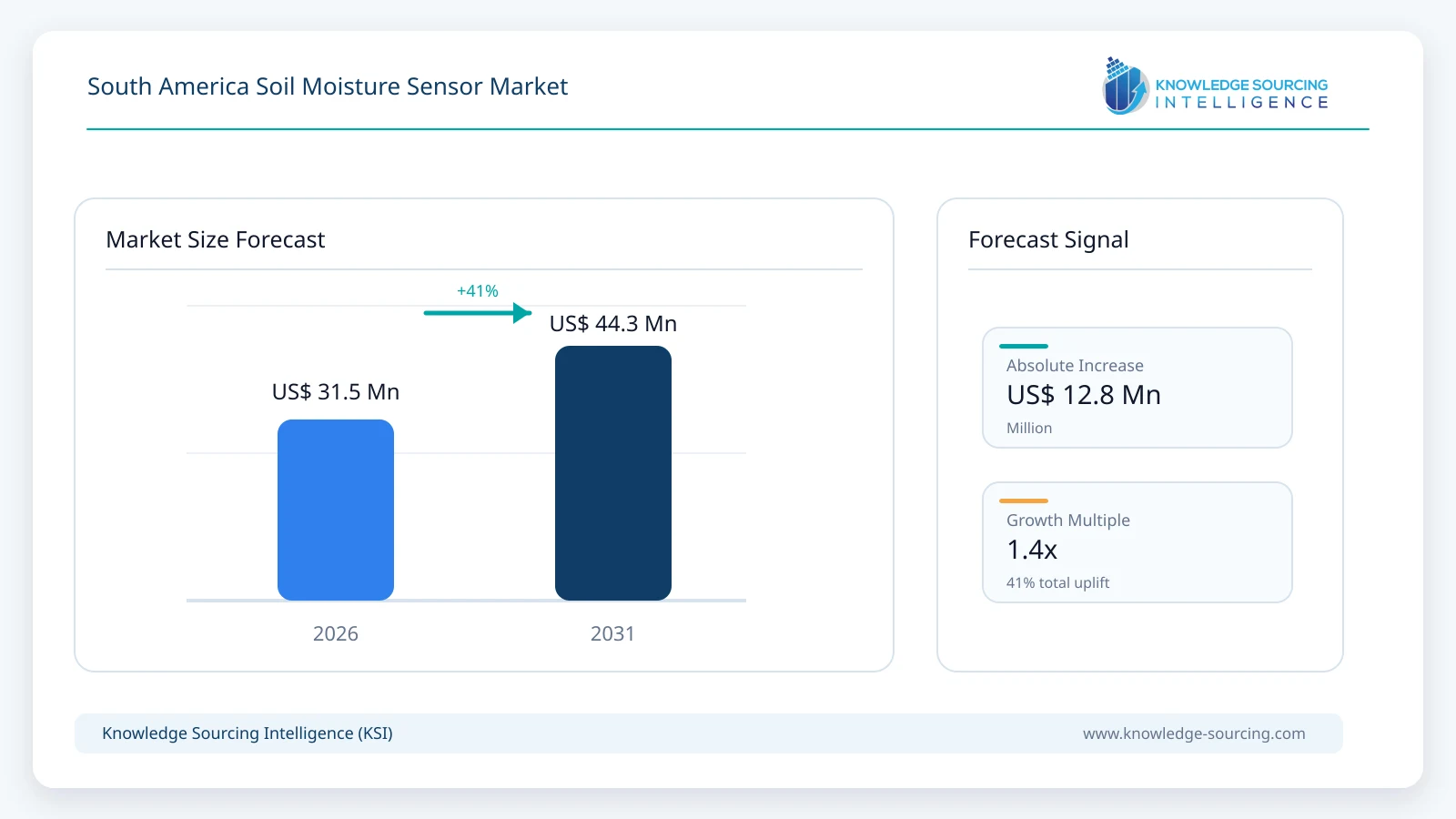
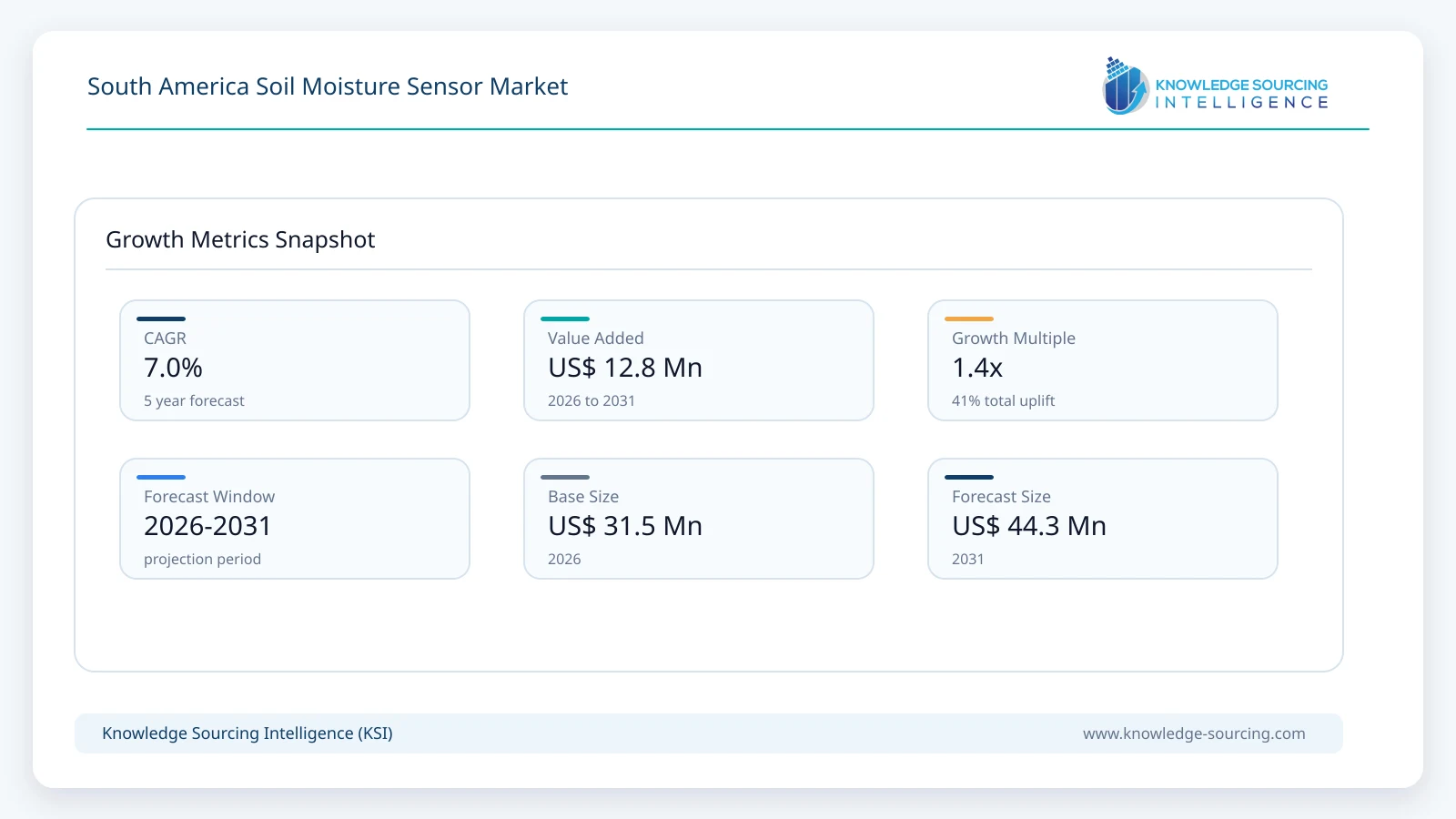
The South-America Soil Moisture Sensor Market is forecast to grow at a CAGR of 7.0%, reaching USD 44.3 million in 2031 from USD 31.5 million in 2026.
Highlights:
- 1Precision irrigation practices are increasing demand for soil moisture sensing technologies across commercial agriculture.
- 2Government-backed digital agriculture initiatives support wider adoption of sensor-based farm management solutions.
- 3Water conservation requirements are encouraging growers to optimize irrigation scheduling using field-based monitoring.
- 4Agriculture remains the most commercially important application because irrigation efficiency directly affects crop productivity and input costs.
- 5Brazil accounts for the largest concentration of commercial opportunities owing to its extensive agricultural production and precision farming investments.
Demand is concentrated within commercial agriculture, particularly among producers cultivating high-value crops, export-oriented fruit plantations, vineyards, sugarcane, coffee, soybeans, maize, and horticultural products. Construction firms, environmental agencies, research institutions, and sports turf managers also deploy soil moisture sensors, although these applications account for a comparatively smaller share of demand. Purchasing decisions increasingly emphasize measurement accuracy, sensor durability, compatibility with wireless monitoring platforms, ease of installation, maintenance requirements, and integration with precision irrigation systems.
Government agencies and agricultural research organizations continue to encourage digital farming through irrigation modernization, climate-resilient agriculture, and resource-efficiency initiatives. The Food and Agriculture Organization (FAO) has expanded smart irrigation projects across Latin America that integrate field sensors into water management practices, while Brazil's Brazilian Agricultural Research Corporation (EMBRAPA) continues to develop and promote digital agriculture technologies for commercial farming. These initiatives strengthen the business case for sensor deployment by demonstrating measurable improvements in irrigation management and resource efficiency.
Commercial value across the market is distributed among sensor manufacturers, irrigation equipment suppliers, precision agriculture technology providers, software developers, distributors, and agricultural service providers. Increasing integration between sensors, cloud-based farm management platforms, telemetry systems, and automated irrigation controllers is shifting competition beyond hardware specifications toward complete decision-support solutions that improve farm productivity and operational efficiency.
Key Market Indicators
Indicator | Latest Evidence | Commercial Meaning |
Digital agriculture support | EMBRAPA continues expanding digital agriculture programs (2024–2025) | Strengthens adoption of sensor-enabled farm management across Brazil. |
Smart irrigation initiatives | FAO projects active across Latin America (2024–2025) | Encourages precision irrigation and efficient water use. |
Primary demand sector | Agriculture remains the principal commercial application | Irrigation optimization represents the largest source of purchasing activity. |
Technology integration | Increasing linkage with IoT and automated irrigation systems | Expands demand beyond standalone sensors toward integrated solutions. |
Commercial buyers | Large farms, research institutes, irrigation contractors, and agribusinesses | Purchasing decisions increasingly prioritize lifecycle value rather than initial equipment cost. |
Key indicator: FAO continues promoting sensor-supported smart irrigation projects across Latin America.
Commercial meaning: Public-sector demonstration projects reduce adoption barriers and increase confidence in precision irrigation technologies.
Market Drivers
Expansion of precision irrigation across commercial agriculture.
Commercial farms are replacing calendar-based irrigation schedules with field measurements that improve water application accuracy and crop management. Soil moisture sensors provide continuous information on root-zone conditions, allowing irrigation to respond to actual crop requirements rather than estimated demand. EMBRAPA has expanded digital agriculture research covering precision farming, irrigation management, and data-driven crop production, while FAO projects across Latin America continue promoting smart irrigation practices that incorporate soil monitoring technologies. Large soybean, sugarcane, coffee, fruit, and horticulture producers increasingly seek integrated irrigation systems that reduce water consumption while maintaining crop quality, creating sustained demand for reliable sensing equipment and supporting associated software and automation services.
Water resource management policies are increasing investment in monitoring technologies.
Agricultural water use faces greater scrutiny as governments and water authorities seek higher irrigation efficiency under changing climatic conditions. Rather than expanding irrigation volumes, many public initiatives now emphasize better management of existing water resources through measurement, scheduling, and monitoring. Soil moisture sensors help producers document irrigation practices, avoid unnecessary water application, and improve compliance with local water management objectives. Equipment suppliers increasingly position sensors alongside automated irrigation controllers and remote telemetry systems, allowing farms to optimize pumping schedules, reduce energy consumption, and improve fertilizer utilization. This combination strengthens customer interest in complete irrigation management platforms instead of standalone sensing devices.
Digital farm management platforms are reshaping buyer requirements.
Purchasing decisions increasingly extend beyond sensor accuracy to include software compatibility, wireless communication, cloud connectivity, and long-term data management. Large agricultural enterprises seek solutions that combine soil moisture measurements with weather observations, irrigation control, crop analytics, and mobile decision-support applications. Manufacturers have responded by developing sensors capable of integrating with Internet of Things (IoT) networks, telemetry systems, and farm management software. This shift creates recurring commercial opportunities through software subscriptions, calibration services, technical support, and system upgrades, while raising competitive emphasis on interoperability and service capability rather than hardware performance alone. Company product strategies increasingly reflect customer demand for integrated precision agriculture ecosystems instead of individual monitoring instruments.
Market Restraints and Challenges
High upfront investment limits adoption among small and medium-sized farms.
Although soil moisture sensors can improve irrigation efficiency and reduce long-term operating costs, the initial expense of purchasing sensors, data loggers, communication modules, and automated irrigation equipment remains a barrier for many producers. Small and medium-sized farms often prioritize investments with immediate production benefits, particularly during periods of volatile commodity prices. Several precision agriculture technology providers continue to expand scalable product portfolios and distributor networks to improve affordability, yet adoption outside large commercial operations remains uneven. This challenge primarily affects market penetration rather than technical capability, and suppliers increasingly offer modular systems that allow customers to expand deployments over time.
Installation, calibration, and maintenance requirements increase ownership costs.
Reliable soil moisture measurement depends on proper sensor selection, installation depth, calibration for different soil types, and periodic maintenance. Variations in soil texture, salinity, organic matter, and field conditions can affect measurement accuracy if sensors are deployed without site-specific calibration. Agricultural service providers and research organizations continue to emphasize proper installation and interpretation of sensor data to maximize irrigation benefits. These technical requirements increase implementation costs for growers lacking in-house expertise and encourage demand for installation, calibration, and after-sales support services. Suppliers with established technical assistance networks therefore gain an advantage when competing for larger commercial irrigation projects.
Limited digital infrastructure constrains advanced precision agriculture deployment.
Many modern soil moisture monitoring systems depend on wireless connectivity, cloud-based software, and remote data transmission. Rural areas with inconsistent mobile coverage or limited digital infrastructure may not fully benefit from these capabilities, particularly where farms operate across geographically dispersed locations. Growers in such areas often continue using standalone sensors that require manual data collection rather than fully connected monitoring platforms. Manufacturers are addressing this challenge through low-power communication technologies, offline data logging, and hybrid monitoring solutions, but infrastructure limitations continue to influence purchasing decisions and delay adoption of more sophisticated precision agriculture systems.
Major Segment Analysis
Agriculture
Agriculture represents the most commercially important application segment because irrigation management directly influences crop yield, water use efficiency, fertilizer utilization, and production costs. Commercial producers cultivating soybeans, coffee, sugarcane, fruits, vegetables, vineyards, and other high-value crops increasingly use soil moisture sensors to optimize irrigation schedules based on field conditions rather than fixed watering intervals. Buyers generally prioritize measurement accuracy, long-term reliability, compatibility with irrigation controllers, and integration with digital farm management platforms when evaluating suppliers.
Large commercial farms often procure complete precision irrigation systems that combine moisture sensors with weather stations, telemetry equipment, cloud-based analytics, and automated irrigation controls. Smaller producers, by contrast, typically adopt standalone sensors or phased installations because capital investment remains a key consideration. Suppliers therefore compete through product durability, ease of calibration, technical support, and software compatibility rather than price alone. Performance within this segment has a direct influence on overall market demand because agricultural customers account for the largest share of sensor installations and generate recurring revenue opportunities through maintenance, calibration, software services, and system upgrades.
Regional Analysis
Country/Region | Main Demand Signal | Principal Constraint |
Brazil | Large-scale commercial agriculture and precision irrigation adoption | Uneven adoption among smaller farms due to investment costs |
Argentina | Irrigated agriculture and increasing digital farm management practices | Economic uncertainty affecting capital equipment purchases |
Chile | Water scarcity driving efficient irrigation technologies | Higher deployment costs for advanced integrated systems |
Others | Expansion of commercial farming and environmental monitoring applications | Limited technical support and digital infrastructure in some markets |
Brazil
Brazil represents the largest commercial opportunity within the South American soil moisture sensor market because of its extensive agricultural production, expanding precision farming practices, and continued investment in digital agriculture. EMBRAPA has strengthened research and technology development in digital farming, irrigation management, and precision agriculture, supporting wider awareness of sensor-based irrigation practices. Commercial producers of soybeans, sugarcane, coffee, cotton, fruits, and vegetables increasingly integrate soil moisture monitoring into irrigation systems to improve productivity and reduce water consumption. Demand also benefits from a relatively well-developed agricultural equipment distribution network and growing availability of integrated precision farming solutions.
Argentina
Argentina's market is supported by its large agricultural sector, particularly grain production and irrigated crop cultivation that increasingly rely on precision farming technologies to improve operational efficiency. Commercial farms continue adopting digital farm management tools to optimize irrigation scheduling, reduce input costs, and improve resource utilization. However, investment decisions remain sensitive to broader economic conditions, exchange-rate fluctuations, and financing availability, which can delay purchases of higher-value precision agriculture equipment. Suppliers therefore compete by offering scalable systems and distributor-supported technical services suited to different farm sizes.
Chile
Chile presents strong commercial potential because water availability remains a critical operational issue for agricultural producers, particularly within fruit, vineyard, and horticultural production. Efficient irrigation has become a strategic priority as growers seek to maximize crop quality while managing limited water resources. Soil moisture sensors support this objective by enabling field-level irrigation decisions based on measured soil conditions rather than fixed schedules. Buyers typically prioritize highly accurate sensors, durable field performance, and compatibility with automated irrigation infrastructure, although the cost of integrated monitoring systems can slow adoption among smaller agricultural enterprises.
Others
Other South American countries contribute to market demand through expanding commercial agriculture, irrigation modernization, environmental monitoring, and agricultural research activities. Adoption levels vary according to irrigation infrastructure, farm size, government support, and access to precision agriculture technologies. In several markets, distributors and local system integrators play an important role by providing installation, calibration, maintenance, and technical support services that help reduce implementation barriers. Continued investment in irrigation efficiency and climate-resilient agricultural practices is expected to create additional opportunities for soil moisture sensor suppliers across these developing markets.
Competitive Landscape
The South America soil moisture sensor market is technology-driven and moderately fragmented, with competition centered on measurement accuracy, long-term reliability, compatibility with irrigation systems, and technical support rather than price alone. The Toro Company, Irrometer Company Inc., Acclima, Inc., Delta-T Devices Ltd., Sentek Technologies, Stevens Water Monitoring Systems, Inc., METER Group Inc., and Campbell Scientific, Inc. compete through differentiated sensor technologies, established distribution networks, and integration with precision agriculture platforms.
Suppliers are expanding wireless connectivity, cloud compatibility, and automated irrigation interfaces to address changing customer requirements. Product portfolios increasingly combine hardware with software, telemetry, calibration, and technical support services, allowing vendors to strengthen long-term customer relationships. Competition is also influenced by distributor capability because installation support, maintenance, and agronomic guidance are often important purchasing considerations for commercial farms. Technical expertise, product reliability under diverse soil conditions, and compatibility with third-party irrigation systems remain important barriers for new entrants, particularly when competing for large agricultural projects requiring long-term operational performance.
Recent Developments
April 2026: CropX introduced the Apex multi-depth soil moisture sensor with configurable sensing depths and continuous root-zone monitoring. Integrated with the CropX platform, it supports precision irrigation for major South American agricultural crops.
November 2025: Mahindra expanded its South American footprint by officially entering the Argentinian tractor and tech market. Leveraging its manufacturing base in Brazil, the company introduced a suite of "affordable precision" tools, including soil moisture monitoring kits designed for small-to-medium-scale farmers, challenging established high-cost Western sensor providers in the region.
Regulatory and Policy Environment
Agricultural water management policies across South America increasingly emphasize efficient irrigation, resource conservation, and climate resilience rather than expansion of water consumption. These priorities encourage the adoption of technologies capable of improving irrigation scheduling through field-based measurements. Public research organizations, agricultural extension programs, and government-supported innovation initiatives continue to promote precision agriculture as part of broader strategies to improve farm productivity and environmental sustainability.
Brazil maintains one of the region's most active institutional frameworks for digital agriculture through EMBRAPA, which supports research, technology validation, and knowledge transfer relating to precision farming and irrigation management. Regional cooperation initiatives involving FAO and national agricultural institutions further encourage the application of digital technologies that improve water-use efficiency and strengthen agricultural resilience. Although regulatory requirements governing soil moisture sensors themselves remain relatively limited, broader policies addressing water management, agricultural modernization, and sustainable farming practices continue to create favorable conditions for market expansion.
Outlook and Strategic Implications
Commercial demand for soil moisture sensors is expected to strengthen through 2031 as agricultural producers continue improving irrigation efficiency, reducing input costs, and adopting data-driven farm management practices. Precision irrigation is likely to remain the principal source of market demand, supported by continued investment in digital agriculture, increasing climate variability, and growing pressure to improve water productivity across commercial farming operations.
Future competition will increasingly depend on complete solution capability rather than sensor performance alone. Buyers are expected to prioritize suppliers capable of delivering integrated platforms combining soil moisture monitoring, weather data, automated irrigation control, cloud analytics, and responsive technical support. Companies that strengthen software compatibility, wireless connectivity, and after-sales service networks are likely to improve customer retention and generate recurring revenue through maintenance, calibration, and subscription-based digital services.
Several strategic implications emerge for industry participants:
Manufacturers: Expand interoperable sensor platforms, improve calibration efficiency, and strengthen local technical support capabilities.
Distributors and system integrators: Increase value through installation services, agronomic consulting, and long-term maintenance contracts rather than equipment sales alone.
Agricultural producers: Prioritize solutions offering measurable improvements in irrigation efficiency, operational reliability, and compatibility with existing irrigation infrastructure.
Technology providers: Develop scalable digital agriculture platforms that integrate field sensors with analytics, automation, and remote monitoring to support data-driven irrigation decisions.
Continued collaboration among research institutions, government agencies, irrigation specialists, and technology developers is expected to improve product accessibility and encourage wider deployment of soil moisture monitoring solutions across South American agriculture, reinforcing the market's long-term commercial potential.
South America Soil Moisture Sensor Market Scope:
| Report Metric | Details |
|---|---|
| Total Market Size in 2026 | USD 31.5 million |
| Total Market Size in 2031 | USD 44.3 million |
| Forecast Unit | Million |
| Growth Rate | 7.0% |
| Study Period | 2021 to 2031 |
| Historical Data | 2021 to 2024 |
| Base Year | 2025 |
| Forecast Period | 2026 – 2031 |
| Segmentation | Type, Application, Country |
| Companies |
|
Market Segmentation
By Type
- Water Potential Sensor
- Volumetric Moisture Sensor
By Application
- Agriculture
- Construction
- Sports
- Research
- Weather Forecasting
- Others
By Country
- Brazil
- Argentina
- Others
Table of Contents
1. Introduction
1.1. Market Overview
1.3. Market Definition
1.4. Market Segmentation
2. Research Methodology
2.1. Research Data
2.2. Assumptions
3. Executive Summary
3.1. Research Highlights
4. Market Dynamics
4.1. Market Drivers
4.2. Market Restraints
4.3. Porters Five Forces Analysis
4.3.1. Bargaining Power of Suppliers
4.3.2. Bargaining Power of Buyers
4.3.3. Threat of New Entrants
4.3.4. Threat of Substitutes
4.3.5. Competitive Rivalry in the Industry
4.4. Industry Value Chain Analysis
5. South America Soil Moisture Sensor Market Analysis, By Type
5.1. Introduction
5.2. Water Potential Sensor
5.3. Volumetric Moisture Sensor
6. South America Soil Moisture Sensor Market Analysis, By Application
6.1. Introduction
6.2. Agriculture
6.3. Construction
6.4. Sports and Turf Management
6.5. Research
6.6. Meteorology and Environmental Monitoring
6.7. Others
7. South America Soil Moisture Sensor Market Analysis, By Country
7.1. Introduction
7.2. Brazil
7.3. Argentina
7.4. Chile
7.5. Others
8. Competitive Intelligence
8.1. Major Players and Strategy Analysis
8.2. Emerging Players and Market Lucrative
8.3. Mergers, Acquisitions, Agreements, and Collaborations
8.4. Vendor Competitiveness Matrix
9. Company Profiles
9.1. The Toro Company
9.2. Irrometer Company Inc.
9.3. Acclima, Inc.
9.4. Delta-T Devices Ltd.
9.5. Sentek Technologies
9.6. Stevens Water Monitoring Systems, Inc.
9.7. Meter Group Inc.
9.8. Campbell Scientific, Inc.
Navigate
Trusted by the world's leading organizations











