
The Extended Detection and Response Market is forecast to grow at a CAGR of 34.1%, reaching USD 30.9 billion in 2031 from USD 7.11 billion in 2026.
Highlights:
- 1Market-leading offeringNative XDR Solutions takes the lead, capturing 45.0% of the market in 2026 with a market value of USD 2.30 billion, reflecting strong demand for integrated threat detection and response capabilities.
- 2Fastest growth aheadCloud-Based deployment is emerging as the fastest-growing segment, advancing at a 24.6% CAGR through 2031 as organizations increasingly shift security operations to scalable cloud environments.
- 3Enterprise dominance by 2031Large Enterprises are projected to reach USD 8.86 billion by 2031, retaining a commanding 63.7% market share as complex IT environments drive greater XDR adoption.
- 4North America at the forefrontNorth America generates USD 2.20 billion in 2026, representing 43.0% of the market, supported by high cybersecurity spending and the widespread adoption of advanced threat-detection technologies.
XDR builds on the endpoint-centric model of traditional EDR by capturing and correlating endpoint, network, server, cloud workload, identity system and email telemetry data into a single incident view from multiple security control points. XDR platforms minimize dozens of individual alerts to a handful of high-fidelity incidents in order to enhance SOC efficiency. They provide automated correlation and leverage AI-driven analytics. Use of XDR enables organizations to report measurably faster incident investigation and response compared to a siloed stack of tools, and this difference is growing as attackers focus on the gaps between disparate security products.
The market is split into two structures, Native XDR and open/multi-vendor XDR. Native XDR platforms from vendors such as CrowdStrike and SentinelOne provide the greatest amount of telemetry correlation at the expense of using a single vendor's endpoint and cloud agents, while open XDR platforms will ingest data from a customer's existing multi-vendor stack but at the cost of some correlation depth. Secondly, self-managed versus managed XDR (MXDR), a growing service market in which SMEs with limited resources and manpower are outsourcing their ongoing monitoring and response to managed security service providers built on XDR platforms. Operational technology (OT) security, which includes industrial control systems (ICS), SCADA, and cyber-physical systems in particular, is expanding at a faster rate, with several analysts forecasting it will hit about USD 25 billion by 2026 and continue to grow with a compound annual growth rate (CAGR) in the mid-teens as traditional air gapped assumptions are coming to a crashing end across energy, manufacturing, and utility sectors.
Market Dynamics
Market Drivers
The number and complexity of data breaches, ransomware attacks and multi-stage attacks that move laterally between endpoint, network and cloud are growing, forcing enterprises to adopt comprehensive detection platforms that correlate signals that traditional point solutions do not.
The cloud migration and hybrid work trend, where enterprise workloads are increasingly moving to the cloud and multi-cloud, and employees are increasingly working remotely, is expanding the attack surface and creating a need for a unified view of visibility across on-premise, cloud, and remote endpoints via XDR platforms.
For security teams struggling with alert fatigue due to dozens of disparate point tools, XDR (Extended Detection and Response) represents a new way to streamline alerts and create high fidelity, correlated incidents that dramatically improve mean time to detect (MTTD) and mean time to respond (MTTR).
Market Restraints & Opportunities
Some of the top challenges facing organizations are vendor lock-in issues with native XDR platforms, integration complexity when adding XDR on top of a multi-vendor security stack, and the continued lack of advanced security analysts adept at using XDR correlation and threat-hunting workflows.
However, there is significant opportunity on the horizon, especially given the progress of open/multi-vendor XDR architectures, which do not require full vendor lock-in; the proliferation of managed XDR services, which enable SMEs to leverage enterprise-grade detection without investing in an in-house SOC; and ongoing advances in AI/ML, which enhance the accuracy of correlation.
Market Segmentation
By Offering: Native XDR Solutions
Native XDR solutions account for the largest offering share, with a 46.1% share in 2031 and a segment value of USD 6.41 billion, supported by a 22.7% CAGR as enterprises increasingly prioritize first-party telemetry from endpoints, networks, cloud and identity systems.
With CrowdStrike, organizations gain a cloud-native XDR platform based on its Falcon endpoint agent, combining behavioral analytics and threat intelligence across cloud workloads and identity systems for real-time detection and response.
Palo Alto Networks offers Cortex XDR, integrating endpoint, network, and cloud telemetry with automated investigation and response capabilities across hybrid enterprise environments.
SentinelOne provides an AI-driven XDR platform that combines autonomous endpoint response with expanding cloud and identity detection capabilities.
By Deployment: Cloud-Based
Cloud-based deployment is the fastest-growing segment, supported by organizations seeking scalable, faster-to-deploy, and lower infrastructure overhead XDR platforms compared with on-premise alternatives. The segment is valued at USD 3.58 billion in 2026 and is projected to reach USD 10.74 billion by 2031, reflecting strong adoption across enterprises.
Microsoft integrates XDR capabilities across its Defender product family, extending unified detection across cloud, identity, and OT environments for organizations standardized on the Microsoft security stack.
By Attack Surface Coverage: Cloud Workload Detection
Cloud workload detection is the fastest-growing attack surface coverage segment as enterprises accelerate multi-cloud adoption and require unified visibility spanning containers, serverless functions, and cloud infrastructure alongside traditional endpoints.
Fortinet extends FortiXDR detection and response capabilities across its broader security fabric, combining AI-powered analytics with coordinated response across network and cloud environments.
Regional Analysis
North America Market Analysis
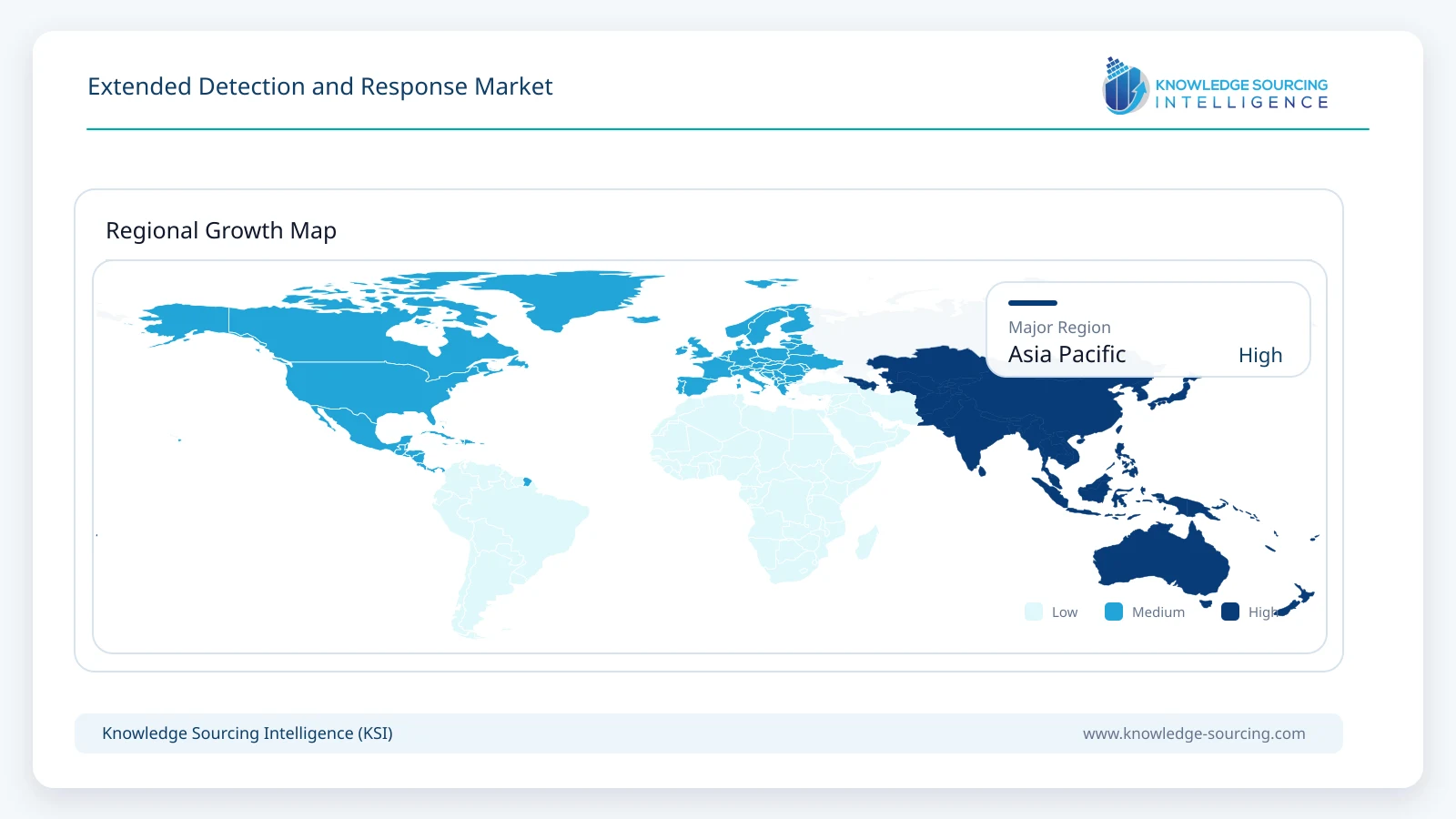
North America holds the largest regional share at 39.2% in 2031, supported by a strong presence of leading XDR platform vendors, high enterprise security spending, and stringent compliance requirements across BFSI and healthcare.
Europe Market Analysis
Europe's market is expanding as enterprises align security operations modernization with GDPR and NIS2 compliance obligations, with the United Kingdom, Germany, and France leading regional XDR adoption.
Asia-Pacific Market Analysis
Asia-Pacific is expected to register strong growth at a 26.9% CAGR, supported by expanding digital economies, rising enterprise cloud adoption, and increasing investment in security operations center modernization across China, India, Japan, and South Korea.
Middle East and Africa Market Analysis
The Middle East and Africa are seeing rising XDR adoption as part of broader national cybersecurity strategies and smart-city digital infrastructure investment, led by the UAE and Saudi Arabia.
South America Market Analysis
South America represents a growing market for XDR adoption, with expanding enterprise and financial-sector investment in unified threat detection platforms in Brazil and other regional markets.
Recent Developments
August 2026: Sophos made its rebuilt Sophos XDR generally available, powered by Secureworks Taegis analytics, adding thousands of detectors, redesigned analyst workflows, and integrated SOAR playbooks.
July 2026: Microsoft Defender XDR introduced AI-agent security capabilities, including AI-agent posture risk assessment, runtime threat detection, and real-time protection for Agent 365 tooling servers.
May 2026: Palo Alto Networks released Cortex XDR 5.1, adding new capabilities to its XDR platform and extending integrated detection, investigation, and response across endpoint and broader security telemetry.
List of Companies
CrowdStrike
Palo Alto Networks
SentinelOne
Microsoft
Trend Micro
Fortinet
Cisco
Sophos
Trellix
Cybereason
Competitive Landscape
CrowdStrike
CrowdStrike delivers a cloud-native extended detection and response platform built on its Falcon agent, combining behavioral analytics and cloud-native threat intelligence to unify endpoint, cloud, and identity detection in real time.
Palo Alto Networks
Palo Alto Networks offers Cortex XDR, an AI-driven platform integrating endpoint, network, and cloud telemetry with automated investigation and response across hybrid enterprise environments.
SentinelOne
SentinelOne provides an AI-powered XDR platform combining autonomous endpoint detection and response with expanding cloud workload and identity threat detection capabilities.
Analyst View
The Extended Detection and Response market is transitioning from a differentiated EDR feature into the default architecture for enterprise security operations, as organizations consolidate disconnected point tools into unified detection platforms. The divide between native XDR and open/multi-vendor XDR will continue to shape vendor strategy, while the rapid growth of managed XDR services is extending enterprise-grade detection to small and mid-sized organizations that cannot staff a 24/7 SOC. Vendors that combine deep first-party telemetry, AI-driven correlation accuracy, and flexible managed-service delivery are best positioned to lead the next phase of market growth.
Extended Detection and Response Market Scope:
| Report Metric | Details |
|---|---|
| Total Market Size in 2026 | USD 7.11 billion |
| Total Market Size in 2031 | USD 30.9 billion |
| Forecast Unit | Billion |
| Growth Rate | 34.1% |
| Study Period | 2021 to 2031 |
| Historical Data | 2021 to 2024 |
| Base Year | 2025 |
| Forecast Period | 2026 – 2031 |
| Segmentation | Offering, Deployment, Attack Surface Coverage, Organization Size, End-User Vertical, Geography |
| Companies |
|
Market Segmentation
By Offering
Native XDR Solutions
Open / Multi-Vendor XDR Solutions
Services (Managed XDR, Professional Services)
By Deployment
Cloud-Based
On-Premise
By Attack Surface Coverage
Endpoint Detection
Network Detection
Cloud Workload Detection
Identity & Email Detection
By Organization Size
Large Enterprises
Small & Medium-Sized Enterprises (SMEs)
By End-User Vertical
BFSI
IT & ITeS
Healthcare
Government & Defense
Retail & E-Commerce
Others
By Geography
North America
USA
Canada
Mexico
Europe
Germany
France
United Kingdom
Others
Asia Pacific
China
India
Japan
South Korea
Others
Middle East and Africa
UAE
Saudi Arabia
Others
South America
Brazil
Others
Table of Contents
1. EXECUTIVE SUMMARY
2. MARKET SNAPSHOT
2.1. Market Overview
2.2. Market Definition
2.3. Scope of the Study
2.4. Market Segmentation
3. BUSINESS LANDSCAPE
3.1. Market Drivers
3.2. Market Restraints
3.3. Market Opportunities
3.4. Porter's Five Forces Analysis
3.5. Industry Value Chain Analysis
3.6. Policies and Regulations (Data Breach Notification Laws, GDPR, NIS2 Directive, Sector-Specific Compliance Mandates)
3.7. Strategic Recommendations
4. TECHNOLOGICAL OUTLOOK
4.1. AI-Driven Threat Correlation & Automated Response
4.2. Open / Multi-Vendor XDR Architectures
4.3. Managed XDR (MXDR) Services
4.4. Identity-Threat Detection and Response (ITDR) Integration
5. EXTENDED DETECTION AND RESPONSE MARKET BY OFFERING
5.1. Introduction
5.2. Native XDR Solutions
5.3. Open / Multi-Vendor XDR Solutions
5.4. Services (Managed XDR, Professional Services)
6. EXTENDED DETECTION AND RESPONSE MARKET BY DEPLOYMENT
6.1. Introduction
6.2. Cloud-Based
6.3. On-Premise
7. EXTENDED DETECTION AND RESPONSE MARKET BY ATTACK SURFACE COVERAGE
7.1. Introduction
7.2. Endpoint Detection
7.3. Network Detection
7.4. Cloud Workload Detection
7.5. Identity & Email Detection
8. EXTENDED DETECTION AND RESPONSE MARKET BY ORGANIZATION SIZE
8.1. Introduction
8.2. Large Enterprises
8.3. Small & Medium-Sized Enterprises (SMEs)
9. EXTENDED DETECTION AND RESPONSE MARKET BY END-USER VERTICAL
9.1. Introduction
9.2. BFSI
9.3. IT & ITeS
9.4. Healthcare
9.5. Government & Defense
9.6. Retail & E-Commerce
9.7. Others
10. EXTENDED DETECTION AND RESPONSE MARKET BY GEOGRAPHY
10.1. Introduction
10.2. North America
10.2.1. USA
10.2.2. Canada
10.2.3. Mexico
10.3. Europe
10.3.1. Germany
10.3.2. France
10.3.3. United Kingdom
10.3.4. Others
10.4. Asia Pacific
10.4.1. China
10.4.2. India
10.4.3. Japan
10.4.4. South Korea
10.4.5. Others
10.5. Middle East and Africa
10.5.1. UAE
10.5.2. Saudi Arabia
10.5.3. Others
10.6. South America
10.6.1. Brazil
10.6.2. Others
11. COMPETITIVE ENVIRONMENT AND ANALYSIS
11.1. Major Players and Strategy Analysis
11.2. Market Share Analysis
11.3. Mergers, Acquisitions, Agreements, and Collaborations
11.4. Competitive Dashboard
12. COMPANY PROFILES
12.1. CrowdStrike
12.2. Palo Alto Networks
12.3. SentinelOne
12.4. Microsoft
12.5. Trend Micro
12.6. Fortinet
12.7. Cisco
12.8. Sophos
12.9. Trellix
12.10. Cybereason
13. APPENDIX
13.1. Currency
13.2. Assumptions
13.3. Base and Forecast Years Timeline
13.4. Key Benefits for the Stakeholders
13.5. Research Methodology
13.6. Abbreviations
Navigate
Trusted by the world's leading organizations











