
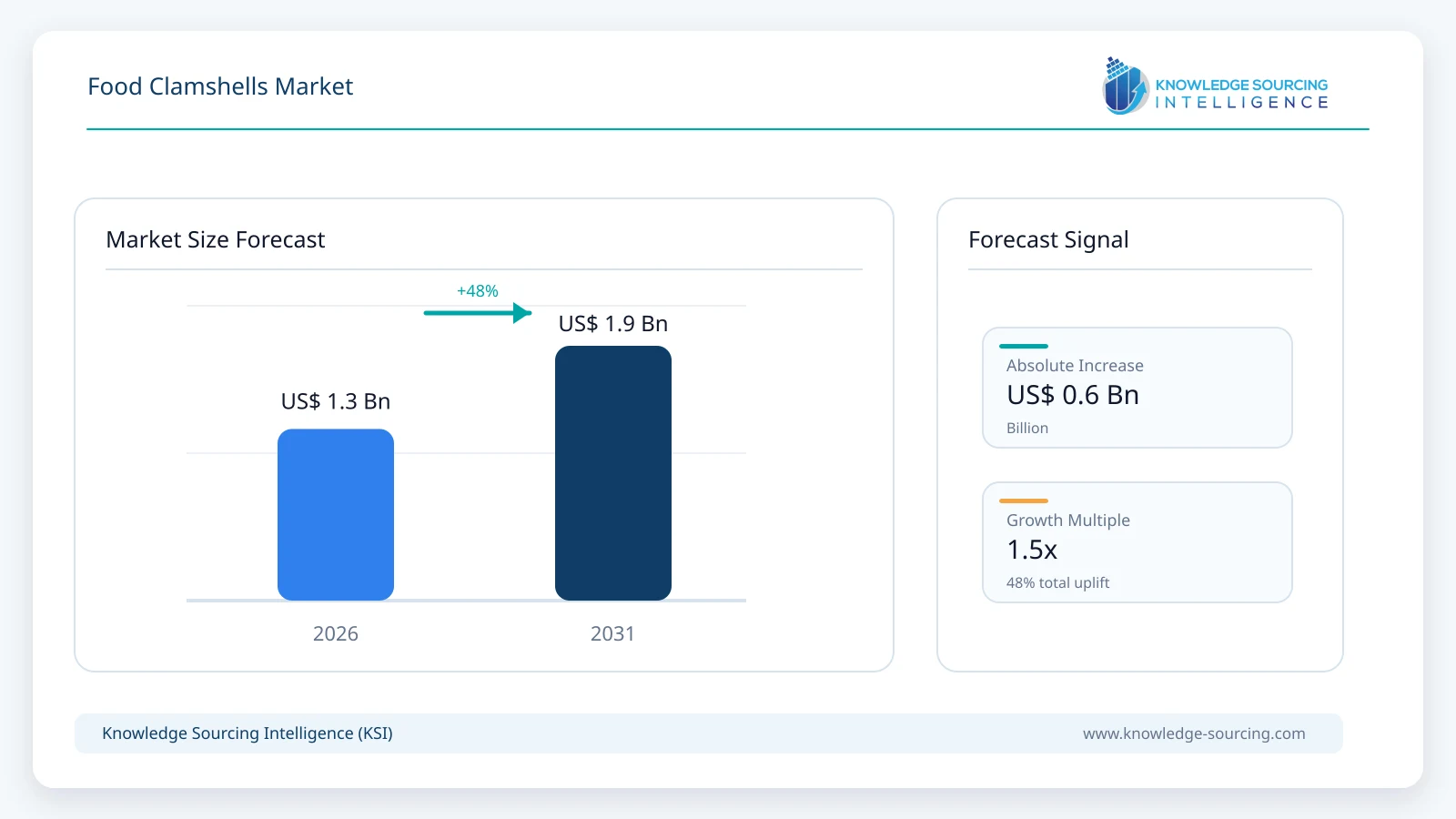
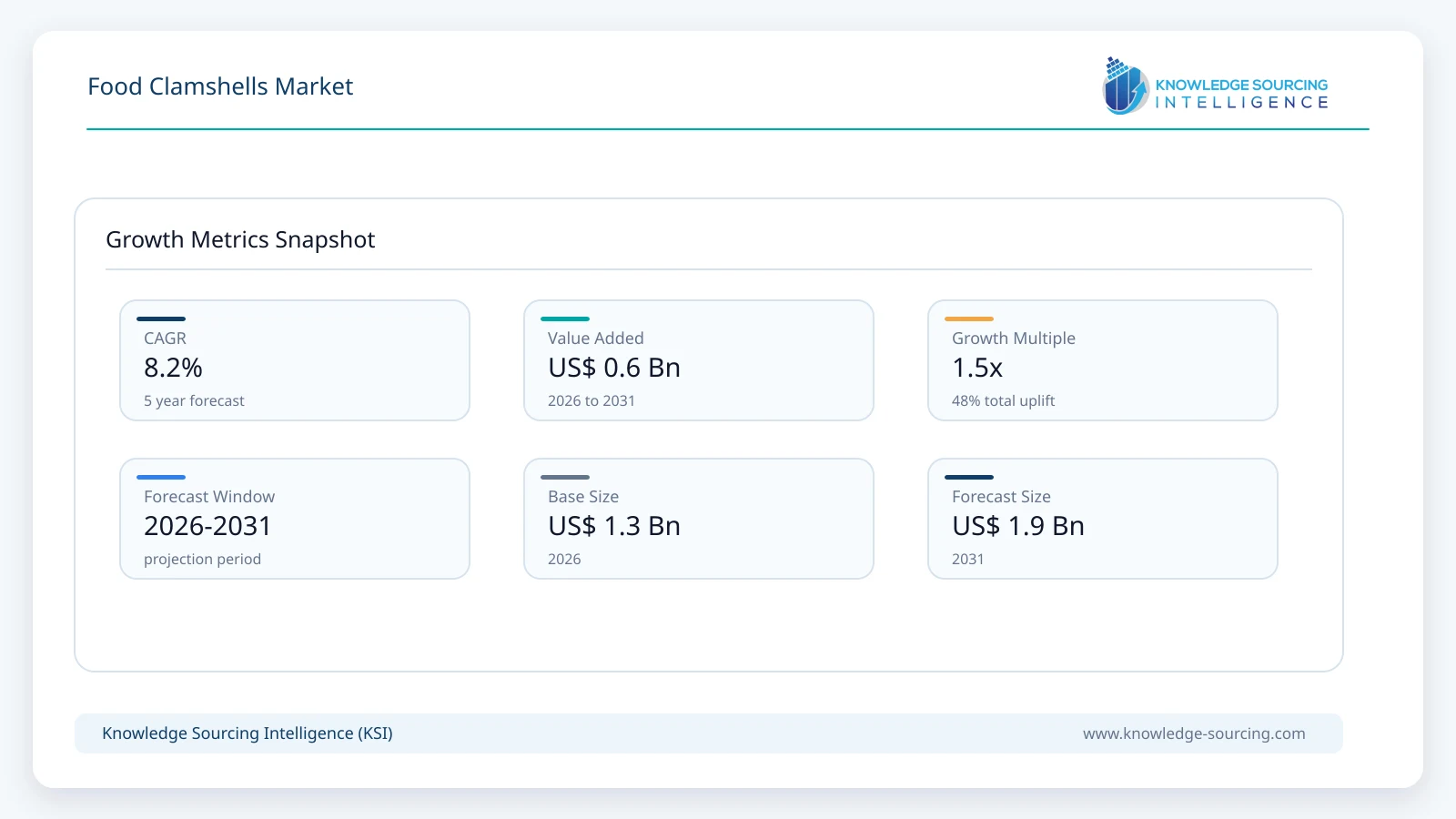
The Food Clamshells Market is forecast to grow at a CAGR of 8.2%, reaching USD 1.90 billion in 2031 from USD 1.28 billion in 2026.
Highlights:
- 1Food clamshell demand is expanding as foodservice, fresh produce, bakery, prepared foods, and takeaway channels increasingly require convenient, protective, and display-oriented packaging.
- 2Manufacturers are shifting toward recyclable PET, post-consumer recycled materials, molded fiber, and paper-based formats as packaging regulations and brand sustainability targets increasingly influence purchasing decisions.
- 3North America remains a major market, supported by a large foodservice industry, established packaged-food supply chains, extensive retail distribution, and strong demand for ready-to-eat and convenience-oriented foods.
- 4Packaging designs are increasingly incorporating improved ventilation, tamper resistance, stackability, lightweight structures, secure closures, and material optimization to balance food protection, shelf life, functionality, and recyclability.
Food Clamshells Market Key Highlights:
A food clamshell is a packaging container generally consisting of a base and hinged lid that closes around food or fresh produce. The format is widely used for products such as berries, grapes, cherries, salads, bakery products, sandwiches, prepared meals, desserts, nuts, cut fruit, and other ready-to-eat foods. Depending on the application, clamshells can be manufactured from PET, recycled PET (rPET), polypropylene (PP), polystyrene and other plastics, molded fiber, paper-based materials, or combinations of materials. The hinged format provides a single-unit package that can simplify filling, transportation, merchandising, opening, and disposal.
The defining commercial advantage of a clamshell is its ability to combine product visibility and physical protection in one package. Clear plastic clamshells allow consumers and retailers to inspect the contents before purchase, while the rigid structure can reduce crushing, bruising, contamination, and product movement during distribution. For fresh produce, ventilation can be incorporated into the lid and base to support airflow and freshness. For prepared foods and bakery products, secure closures and stackable geometries can improve handling efficiency and reduce leakage or product damage.
The food clamshell market refers to the global industry involved in the manufacturing, converting, distribution, and sale of hinged containers designed for food and fresh-produce applications. The market includes packaging supplied to food processors, fresh-produce growers and packers, supermarkets, convenience stores, bakeries, restaurants, quick-service restaurants, catering businesses, institutional foodservice operators, and other food retailers. Demand is influenced by foodservice activity, fresh-food consumption, ready-to-eat meal adoption, packaging regulations, material availability, recycling infrastructure, food-safety requirements, and the total cost of packaging.
Government data illustrate the size of the underlying food ecosystem supporting demand for convenient food packaging. According to the U.S. Department of Agriculture Economic Research Service (USDA ERS), inflation-adjusted U.S. food spending reached USD 2.51 trillion in 2025. Food-away-from-home spending reached USD 1.41 trillion, compared with USD 1.10 trillion for food-at-home spending, meaning food away from home accounted for 56.3% of total food expenditures in 2025.
This does not mean that all food-away-from-home spending translates directly into clamshell demand; however, it demonstrates the scale of the foodservice ecosystem in which takeaway, prepared-food, delivery, catering, and convenience packaging operate. USDA ERS also reported that inflation-adjusted foodservice sales increased to USD 1.41 trillion in 2025 from USD 818 billion in 1997, representing a 73.0% increase. Limited-service foodservice sales reached USD 516.1 billion in 2025, highlighting the continuing importance of convenience-oriented food channels.
The market is therefore being shaped by a combination of packaging functionality and broader changes in how food is prepared, purchased, transported, displayed, and consumed. At the same time, sustainability is becoming more closely connected to package design rather than simply material substitution. Recyclability, recycled content, lightweighting, material efficiency, collection infrastructure, and compliance with evolving packaging legislation are increasingly becoming part of packaging procurement decisions.
Food Clamshells Market Drivers:
Growth of Foodservice, Takeaway, and Ready-to-Eat Consumption: The expansion of foodservice, takeaway, delivery, prepared meals, and convenience-oriented food retail is creating sustained demand for packaging that can protect food between preparation and consumption. Clamshells can be particularly suitable for salads, sandwiches, bakery products, desserts, prepared meals, and other foods requiring fast filling and secure closure. USDA ERS reported that food away from home represented 56.3% of U.S. food expenditures in 2025, while inflation-adjusted foodservice sales reached USD 1.41 trillion.
Convenience and On-the-Go Consumption: Consumers increasingly purchase food that can be transported and consumed outside the home. Clamshells provide an integrated lid and base, reducing the need for separate packaging components. Their relatively simple opening and closing mechanism also supports applications where consumers need quick access to food. For foodservice operators, the format can simplify packaging workflows and reduce the number of individual packaging components required for selected products.
Food Safety, Hygiene, and Product Protection: Food packaging is expected to provide an appropriate barrier between the product and external contamination during handling, storage, transportation, and retail display. The hinged design can help keep the package closed after filling, while rigid structures can reduce crushing and physical damage. Food-contact compliance is also becoming increasingly important. In the United States, the U.S. Food and Drug Administration maintains an inventory of food-contact substances authorized under 21 CFR and separate programs for food-contact substance notifications and related authorizations.
Transparency and Product Visibility: Transparent clamshells provide consumers with direct visibility of the packaged food. This characteristic is particularly valuable for fresh berries, grapes, cherries, bakery products, salads, desserts, and prepared foods where appearance strongly influences purchasing decisions. Packaging suppliers are combining clear materials with structural features such as stackable surfaces, secure closures, and customized geometries to improve shelf presentation without compromising product protection.
Fresh Produce Protection and Shelf-Life Management: Fresh produce is one of the most established applications for clamshell packaging. Ventilation openings can be designed into the lid and base to support airflow, while rigid structures help protect delicate produce from crushing and bruising. Current commercial product portfolios demonstrate the continued use of clamshell formats for berries, grapes, cherries, fresh-cut fruit, salads, and other produce. For example, current Amcor product specifications describe PET clamshell formats with ventilation, corner locks, stackability, and product visibility for fresh fruit applications.
Growth of Recycled and Recyclable Packaging Formats: Material circularity is increasingly influencing the development of food clamshells. PET and rPET remain important because clear PET packaging can provide transparency, rigidity, lightweighting, and established recycling pathways in markets with appropriate collection infrastructure. Placon's current food packaging portfolio, for example, includes clamshell products manufactured with post-consumer recycled PET, while its 2026 stock food packaging catalog includes FDA food-grade recycled PET material made from curbside-collected bottles and thermoforms.
Packaging Regulation and Recyclability Requirements: Regulatory developments are accelerating packaging redesign. The European Union's Packaging and Packaging Waste Regulation (PPWR) began applying on August 12, 2026. The regulation establishes requirements covering packaging sustainability, recyclability, recycled content, waste prevention, labeling, and producer responsibility. It also introduces measures related to substances of concern, including restrictions on certain PFAS in food-contact packaging.
Demand for Lightweight and Material-Efficient Packaging: Food producers and retailers are seeking packaging that maintains structural integrity while reducing material consumption. Thermoforming technology allows manufacturers to engineer thin-wall packaging with defined ribs, stacking features, closures, and product-specific geometries. Lightweighting can reduce packaging material requirements and transportation weight, although the optimal design depends on product protection, food-contact requirements, recycling systems, and package performance.
Customization and Brand Differentiation: Food manufacturers and retailers increasingly use packaging as a point of product differentiation. Clamshells can accommodate labels, sleeves, printing, embossing, shape modifications, and customized dimensions. Transparent packaging can also increase shelf visibility without requiring the entire package to be printed. These characteristics make clamshells useful for premium fresh produce, bakery, confectionery, prepared foods, and branded ready-to-eat products.
Operational Efficiency Across Food Supply Chains: A hinged clamshell can combine the container and closure in a single component, supporting efficient filling, sealing, stacking, transportation, and merchandising. For high-volume applications, standardized dimensions and automated packaging lines can further improve throughput. Food producers and retailers therefore evaluate clamshells not only on material price but also on filling speed, stacking density, damage rates, storage requirements, product loss, and labor requirements.
Increasing Focus on Food Waste Prevention: Packaging design is increasingly evaluated according to its ability to protect food and maintain quality throughout the supply chain. The sustainability performance of a package cannot be evaluated solely by the material used because premature food spoilage can create substantial resource losses. Proper ventilation, secure closure, structural protection, and appropriate package sizing can therefore contribute to food-loss prevention in selected applications.
Food Clamshells Market Products Offered by Key Companies:
Placon Crystal Seal Dimensions Divided Clamshell: Placon currently offers a divided hinged clamshell for cookies, dessert bars, sliced bread, and other bakery products. The product uses EcoStar post-consumer recycled PET and carries a #1 resin code, combining product visibility with recyclable PET construction and a divided structure designed to limit product movement.
Placon Hinged and Food Clamshell Formats: Placon's 2026 stock food packaging catalog includes multiple hinged bases, cookie trays, muffin containers, divided clamshells, and other thermoformed food packaging formats. The portfolio demonstrates the continuing use of clear rigid packaging across bakery and prepared-food applications.
Amcor/Berry Global PET Fruit Clamshells: Amcor's current packaging solutions portfolio includes PET fruit clamshells for applications such as berries, cherries, grapes, and other fresh produce. The formats use lightweight clear PET, ventilation features, secure corner locks, and stackable structures. The products are positioned within Berry Global's B Circular range and emphasize recyclable PET construction.
Amcor/Berry Global Foldover Salad Containers: Current Foldover and Salad Foldover formats are designed for fresh salads, poke bowls, fresh-cut fruit, prepared foods, and related chilled-food applications. These products use clear PET, hinged-lid construction, precise snap-fit closures, and stackable designs for retail presentation and food protection.
Progressive Growth in the Ready-to-Eat and Takeout Food Sector:
The ready-to-eat and takeaway food sector is emerging as a major demand center for food clamshell packaging because food operators increasingly need formats that combine speed, hygiene, transportability, and product presentation. Salads, sandwiches, bakery items, cut fruit, desserts, prepared meals, and other chilled or ambient foods can be packaged in hinged containers that provide an integrated closure and allow consumers to view the contents.
The broader foodservice market provides a strong structural foundation for this demand. USDA ERS estimates that inflation-adjusted U.S. food-away-from-home sales reached USD 1.41 trillion in 2025. Limited-service establishments generated USD 516.1 billion in inflation-adjusted food sales in the same year.
USDA data also indicate that food-away-from-home sales increased in all 50 U.S. states in 2024 on a per-capita basis, while national food-away-from-home spending continued to represent a larger share of total food expenditures. This broad geographic demand supports packaging consumption across restaurants, convenience food outlets, supermarkets, institutional foodservice, catering, and prepared-food retailers.
However, the ready-to-eat opportunity is not limited to restaurants. Grocery retailers increasingly use transparent rigid containers for prepared salads, cut fruit, bakery products, desserts, deli foods, and grab-and-go meals. This creates demand for packaging that performs in both retail merchandising and transportation environments. Clamshells are particularly relevant where consumers need to inspect the product before purchasing it.
Packaging suppliers are consequently developing designs that balance visibility with material efficiency. Current commercial offerings include vented fresh-produce clamshells, recyclable PET salad containers, divided bakery clamshells, and stackable prepared-food formats. This indicates that future market development will depend less on a single universal clamshell design and more on application-specific engineering for product protection, shelf life, logistics, and end-of-life requirements.
Food Clamshells Market Geographical Outlook:
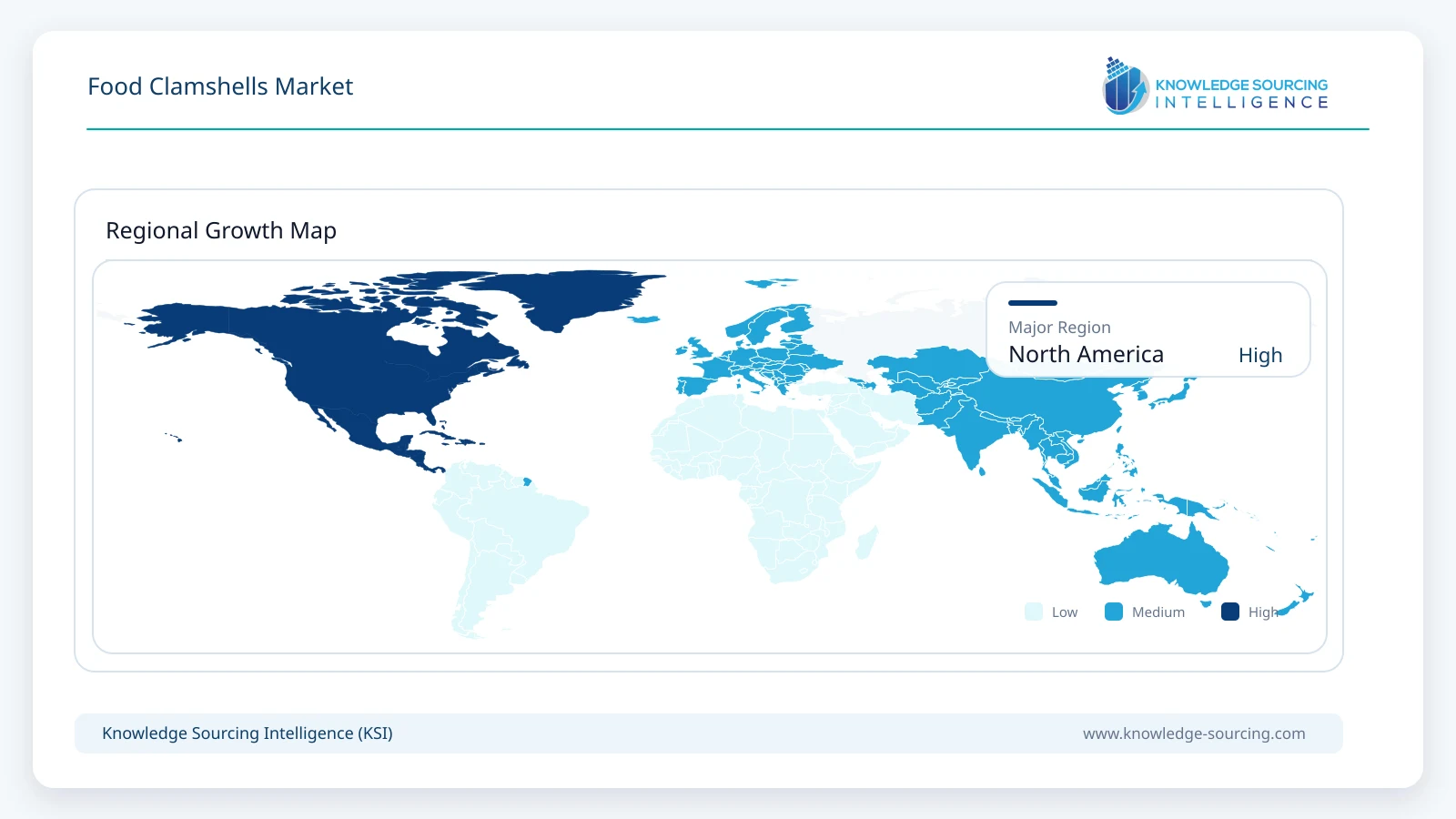
North America is expected to hold a significant share:
North America remains a major food clamshell market because of its mature foodservice infrastructure, extensive supermarket and convenience-store networks, established fresh-produce supply chains, large packaged-food industry, and high penetration of takeaway and ready-to-eat food. The United States represents the largest demand base within the region, supported by substantial food-away-from-home and food-at-home spending.
USDA ERS reported that U.S. foodservice sales reached USD 1.41 trillion on an inflation-adjusted basis in 2025, compared with USD 1.10 trillion in food-at-home sales. Food away from home accounted for 56.3% of total U.S. food expenditures in 2025. This large foodservice ecosystem supports demand for food packaging used in restaurants, catering, prepared meals, institutional foodservice, and other immediate-consumption channels.
North America's established recycling infrastructure for PET also supports continued demand for recyclable rigid plastic clamshells in suitable applications. At the same time, the market is experiencing increasing pressure to reduce virgin plastic consumption, improve recycled content, and demonstrate credible end-of-life pathways. As a result, competition is shifting toward packaging designs that can meet performance requirements while using rPET, lightweight structures, or alternative fiber-based materials where commercially and technically feasible.
The regional competitive environment is also supported by manufacturers with established thermoforming, foodservice, fresh-produce, and fiber-packaging capabilities. Placon's 2026 product portfolio demonstrates continued development of recycled-PET food clamshells, while Smurfit Westrock is expanding paper-based produce packaging solutions designed around product protection, airflow, storage efficiency, and reduced plastic use.
Europe represents another strategically important region because packaging legislation is accelerating the transition toward recyclable, resource-efficient, and lower-impact packaging. The EU PPWR began applying on August 12, 2026, creating a harmonized regulatory framework covering packaging throughout its life cycle. The European Commission has also published implementation guidance to help businesses interpret and comply with the new rules.
The regulatory environment is expected to increase the importance of design-for-recycling, material efficiency, recycled content, and documentation across the European food clamshell supply chain. The transition may create opportunities for recyclable PET, rPET, fiber-based packaging, and other formats that can demonstrate compliance while maintaining the performance required for fresh and prepared foods.
Asia Pacific is expected to remain an important growth region as urbanization, modern grocery retail, food delivery, organized foodservice, fresh-produce distribution, and packaged ready-to-eat foods expand. The region includes highly developed packaging markets alongside rapidly developing economies, resulting in diverse material preferences and regulatory environments. Manufacturers with flexible production capabilities are therefore positioned to address both conventional plastic clamshell demand and the growing requirement for recyclable and fiber-based alternatives.
Latin America and the Middle East & Africa are also expected to benefit from increasing organized retail, foodservice modernization, fresh-produce distribution, and demand for convenient food packaging. However, market development in these regions is more closely influenced by packaging costs, local recycling infrastructure, availability of recycled resin, import conditions, and food supply-chain requirements.
Recent Developments:
September 2026: Huhtamaki appointed Thomas Morin as President of Fiber Packaging and a member of its Global Executive Team, effective September 1, 2026. The company continues to invest in its fiber packaging activities, including opportunities in food and fresh-produce packaging.
September 2026: Sealed Air introduced CRYOVAC ZeroPrep for foodservice condiment dispensing. While the product is a flexible pouch rather than a clamshell, the launch demonstrates the company's continuing focus on reducing preparation and cleanup requirements and improving foodservice packaging efficiency.
August 2026: The European Union's Packaging and Packaging Waste Regulation began applying across the EU on August 12, 2026. The new framework covers packaging sustainability, recyclability, waste prevention, labeling, and producer responsibilities, while also introducing restrictions concerning PFAS in food-contact packaging.
July 2026: Huhtamaki reported that its Fiber Packaging segment continued to record positive development in the first half of 2026. H1 2026 net sales for Fiber Packaging reached EUR 197.4 million, up from EUR 190.1 million in H1 2025, while comparable net sales increased 6%. The company stated that it was continuing investments to capture opportunities in egg and fruit packaging markets.
May 2026: Placon marked its 60th anniversary and highlighted its long-standing role in thermoformed packaging, including its history with retail clamshells and post-consumer recycled PET packaging. The company continues to position sustainable thermoformed packaging as a core capability across food, retail, and medical applications.
January 2026: Sealed Air marked the 85th anniversary of its CRYOVAC brand food packaging business and stated that its forward-looking focus includes sustainable materials, smarter systems, and partnerships intended to address food waste and evolving food-packaging requirements.
2026: Placon's current food packaging catalog includes multiple hinged food containers and clamshell formats, including a divided clamshell made using FDA food-grade recycled PET derived from curbside-collected bottles and thermoforms. The portfolio demonstrates continued commercial development of recycled-PET food packaging rather than a complete shift away from rigid plastics.
2026: Smurfit Westrock continues to promote paper-based fresh-produce packaging solutions designed to protect products, support airflow and moisture control, improve storage and transportation efficiency, and reduce plastic use. Its produce portfolio includes punnets and other paper-based formats serving fruit and vegetable applications.
List of Top Food Clamshells Companies:
Amcor plc
Placon
Huhtamaki
Smurfit Westrock plc
Novolex
Klöckner Pentaplast
The competitive landscape includes manufacturers specializing in thermoformed rigid plastics, recycled PET, foodservice packaging, fiber-based packaging, fresh-produce packaging, and flexible packaging. Competitive differentiation is increasingly based on material efficiency, recyclability, recycled content, product protection, closure performance, ventilation, manufacturing scale, customization capabilities, food-contact compliance, and the ability to support customers' sustainability targets.
A notable competitive trend is the convergence between traditional plastic clamshell manufacturers and broader sustainable-packaging suppliers. Companies are not necessarily abandoning plastic altogether; instead, they are increasingly developing rPET, recyclable PET, lightweight structures, fiber alternatives, and application-specific formats. This approach reflects the fact that food packaging requirements vary substantially by product. A berry package, for example, may require ventilation and high visibility, while a bakery clamshell may prioritize rigidity, stacking, and protection against crushing.
Market Outlook:
The Food Clamshells Market is expected to maintain a positive growth trajectory through 2031 as convenience food consumption, fresh-produce distribution, prepared meals, bakery products, takeaway food, and retail-ready foods continue to require protective and easy-to-handle packaging. The underlying foodservice opportunity remains substantial, with USDA ERS reporting USD 1.41 trillion in inflation-adjusted U.S. food-away-from-home sales in 2025.
At the same time, the market is entering a more demanding phase in which growth will depend on packaging performance as well as sustainability credentials. The EU PPWR, for example, began applying in August 2026 and places greater emphasis on recyclability, recycled content, material efficiency, producer responsibility, and restrictions on substances of concern. Similar policy and customer-driven pressures are encouraging packaging producers globally to reassess material selection and package design.
Consequently, the next phase of food clamshell market development is likely to be characterized by a portfolio approach rather than a single dominant replacement material. Recycled PET and recyclable PET are expected to remain important where transparency, rigidity, moisture resistance, and established recycling systems provide advantages. Fiber and paper-based solutions are likely to gain share in applications where their environmental and regulatory attributes can be delivered without compromising food protection. Meanwhile, thermoforming technology will continue to support lightweighting, customized geometry, ventilation, stacking, and integrated closure designs.
The companies best positioned to capture future growth will increasingly be those capable of demonstrating measurable packaging performance while addressing recyclability, recycled content, regulatory compliance, food safety, and total supply-chain economics. This combination of convenience, protection, visibility, operational efficiency, and circularity will remain central to the evolution of the global Food Clamshells Market through 2031.
Food Clamshells Market Scope:
| Report Metric | Details |
|---|---|
| Total Market Size in 2026 | USD 1.28 billion |
| Total Market Size in 2031 | USD 1.90 billion |
| Forecast Unit | Billion |
| Growth Rate | 8.2% |
| Study Period | 2021 to 2031 |
| Historical Data | 2021 to 2024 |
| Base Year | 2025 |
| Forecast Period | 2026 – 2031 |
| Segmentation | Material Type, Application, Product Type, Geography |
| Companies |
|
Market Segmentation
By Material Type
Plastic
Paper & Paperboard
By Application
Fruits and Vegetables
Ready-to-Eat Food
Bakery and Confectionery
Frozen Food
Others
By Product Type
Mock Clamshells
2-piece Clamshells
Tri-Fold Clamshells
By Geography
North America
USA
Canada
Mexico
South America
Brazil
Argentina
Others
Europe
Germany
France
United Kingdom
Spain
Italy
Others
Middle East and Africa
Saudi Arabia
UAE
South Africa
Others
Asia Pacific
China
India
Japan
South Korea
Indonesia
Thailand
Others
Table of Contents
1. EXECUTIVE SUMMARY
2. MARKET SNAPSHOT
2.1. Market Overview
2.2. Market Definition
2.3. Scope of the Study
2.4. Market Segmentation
3. BUSINESS LANDSCAPE
3.1. Market Drivers
3.2. Market Restraints
3.3. Market Opportunities
3.4. Porter's Five Forces Analysis
3.5. Industry Value Chain Analysis
3.6. Policies and Regulations
3.7. Sustainability Landscape
3.8. Strategic Recommendations
4. TECHNOLOGICAL OUTLOOK
4.1. Introduction
4.2. Thermoforming Technologies
4.3. Recycled Plastic and Recycled Content Technologies
4.4. Paper-Based and Molded Fiber Forming Technologies
4.5. Barrier and Coating Technologies
4.6. Ventilation and Freshness Technologies
4.7. Closure and Tamper-Evident Technologies
4.8. Automation and Packaging-Line Technologies
5. FOOD CLAMSHELLS MARKET BY MATERIAL TYPE
5.1. Introduction
5.2. Plastic
5.3. Paper and Paperboard
5.4. Molded Fiber
5.5. Other Materials
6. FOOD CLAMSHELLS MARKET BY APPLICATION
6.1. Introduction
6.2. Fruits and Vegetables
6.3. Prepared and Ready-to-Eat Foods
6.4. Bakery and Confectionery
6.5. Foodservice and Takeaway
6.6. Frozen and Chilled Foods
6.7. Others
7. FOOD CLAMSHELLS MARKET BY PRODUCT TYPE
7.1. Introduction
7.2. Hinged and Fold-Over Clamshells
7.3. Two-Piece Clamshells
7.4. Tri-Fold Clamshells
7.5. Other Clamshell Formats
8. FOOD CLAMSHELLS MARKET BY GEOGRAPHY
8.1. Introduction
8.2. North America
8.2.1. United States
8.2.2. Canada
8.2.3. Mexico
8.3. South America
8.3.1. Brazil
8.3.2. Argentina
8.3.3. Others
8.4. Europe
8.4.1. Germany
8.4.2. France
8.4.3. United Kingdom
8.4.4. Italy
8.4.5. Spain
8.4.6. Others
8.5. Middle East and Africa
8.5.1. Saudi Arabia
8.5.2. UAE
8.5.3. South Africa
8.5.4. Others
8.6. Asia Pacific
8.6.1. China
8.6.2. India
8.6.3. Japan
8.6.4. South Korea
8.6.5. Indonesia
8.6.6. Thailand
8.6.7. Others
9. COMPETITIVE ENVIRONMENT AND ANALYSIS
9.1. Major Players and Strategy Analysis
9.2. Market Share Analysis
9.3. Mergers, Acquisitions, Agreements, and Collaborations
9.4. Product and Technology Benchmarking
9.5. Competitive Dashboard
10. COMPANY PROFILES
10.1. Amcor plc
10.2. Placon
10.3. Huhtamaki
10.4. Smurfit Westrock plc
10.5. Novolex
10.6. Klöckner Pentaplast
10.7. Parksons Packaging Ltd.
10.8. VisiPak
10.9. Dordan Manufacturing Company
10.10. TOPPAN Holdings Inc.
11. APPENDIX
11.1. Currency
11.2. Assumptions
11.3. Base Year and Forecast Period
11.4. Key Benefits for Stakeholders
11.5. Research Methodology
11.6. Abbreviations
LIST OF FIGURES
LIST OF TABLES
Navigate
Trusted by the world's leading organizations











