
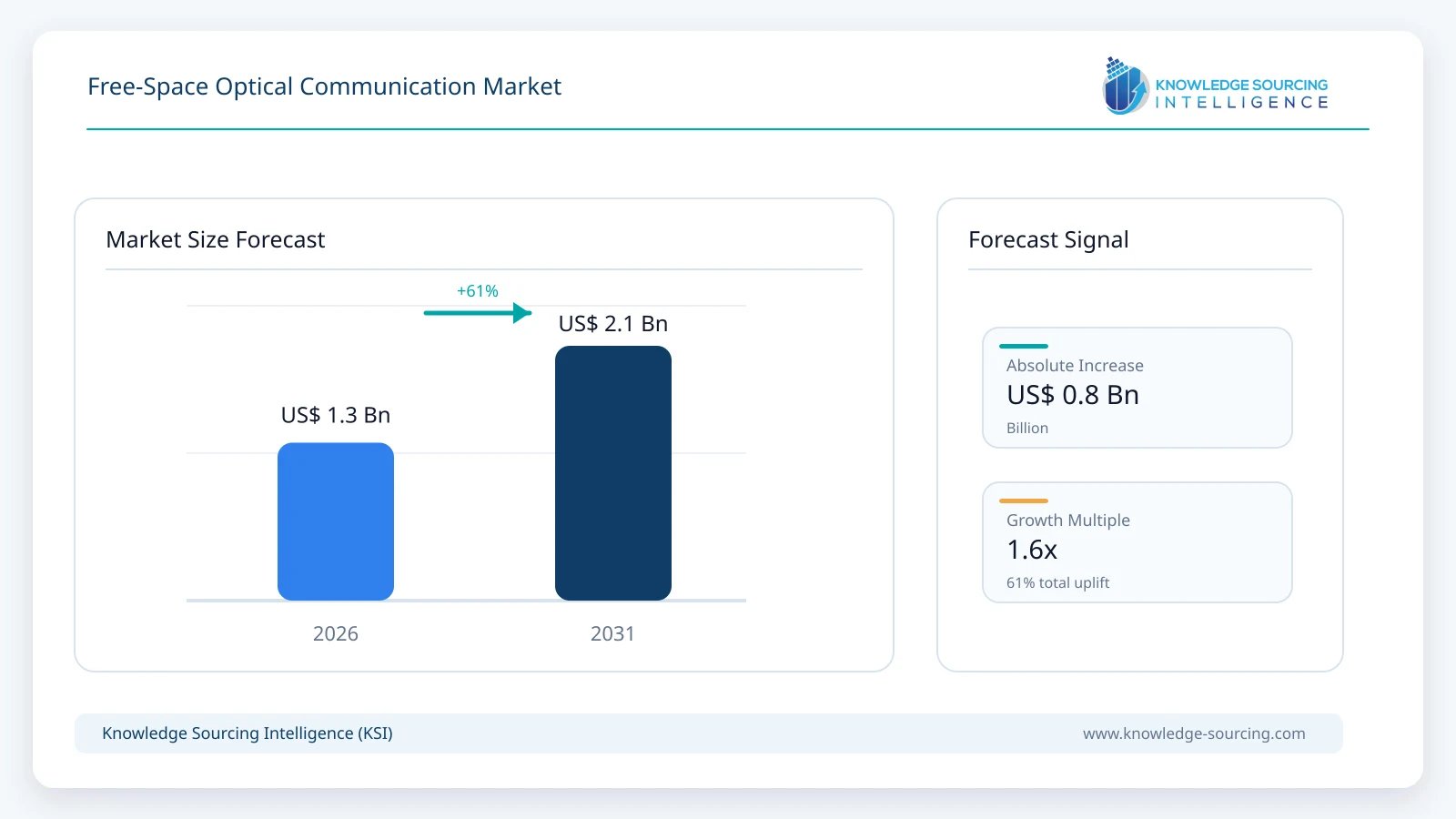
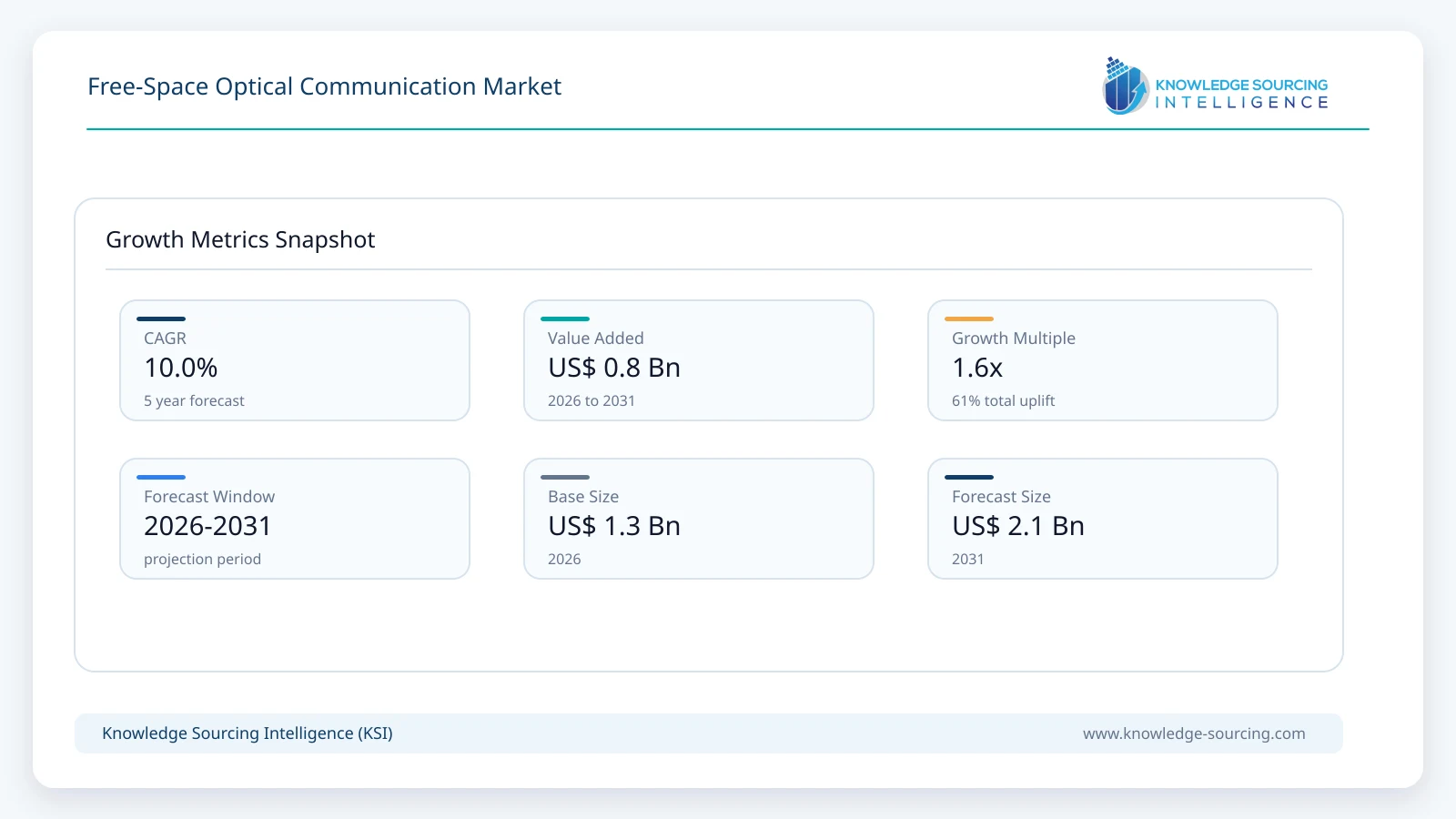
The Free-Space Optical Communication Market is projected to increase at a CAGR of around 10.0% to reach around USD 1.32 billion in 2026 and USD 2.13 billion in 2031.
Highlights:
- 1Leading componentOptical Transmitters & Laser Diodes represent 22.0% of the 2026 market, equivalent to USD 0.29 billion, maintaining their position as the largest component segment.
- 2Fastest-growing applicationSatellite & Inter-Satellite Communication is projected to advance at a 14.2% CAGR through 2031, reflecting growing demand for high-speed, reliable optical links in space communications.
- 32031 growth trajectoryShort-Range FSO is expected to reach USD 1.05 billion by 2031, retaining the largest transmission-range share at 49.3%.
- 4Regional market leadershipNorth America accounts for USD 0.51 billion in 2026, representing 39.0% of the market, supported by increasing deployment of optical communication technologies across advanced connectivity applications.
Free-Space Optical Communication is based on the transmission of infrared or visible light between a pair of optical transceivers, which must be in sight of each other. It does not need to be added to trenches or right-of-way as with fiber; it does not require a spectrum license as is the case with RF microwave links; it is immune to interference and jamming, which is why it is used heavily in defense and intelligence applications, and is easy to install and maintain. The main technical challenge is “atmospheric attenuation” as fog, heavy rains and scintillations can cause degradation or even complete disruption to a link, so the market is now shifting toward hybrid FSO-RF solutions, adaptive optics and multi-beam/aperture diversity designs that can guarantee a link during bad weather.
There are two application clusters that are causing current capital investment. Terrestrial and urban connections. Telecom carriers and enterprises are utilizing FSO for 5G small-cell backhaul, data center interconnects, temporary event networks, and last-mile connections in situations where it is cost-prohibitive or time-prohibitive to lay fiber for these applications. Second, and growing in magnitude in dollars, are airborne optical links, including, LEO broadband constellations, defense proliferated-warfighter-space-architecture programs, and space agency plans to put optical links in satellites to connect between satellites (inter-satellite links or ISLs) and optical ground stations, with optical links having lower size, weight and power (SWaP) than equivalent RF payloads.
Regulatory tailwinds are also present. The lack of spectrum licensing requirements in most countries means that the approval process for FSO is less stringent than for RF systems, and a few telecom regulators have indicated that FSO/optical wireless could be used to help narrow urban and rural connectivity gaps without the need for additional spectrum licenses.
Market Dynamics
Market Drivers
The proliferation of broadband and defense LEO constellations is creating unprecedented demand for space-qualified optical inter-satellite terminals, capable of multi-Gbps throughput, with only a small fraction of the power consumption of equivalent RF payloads. Multi-year procurement of terminals is being anchored by programs of national space agencies and the U.S. Space Development Agency.
Fiber trenching is expensive, slow, and impractical in dense urban cores, historic areas, and difficult terrain conditions, and is impractical in some areas. FSO provides a fiber equivalent bandwidth solution without the complications of licensing requirements which is being used an increasing number of times by telecom operators for 5G small-cell backhaul and temporary network deployments.
Market Restraints & Opportunities
Sensitivity of the atmosphere is the fundamental limitation, the same factors that affect RF and fiber links can also impact atmospheric links and make installation and maintenance more difficult than with fiber or RF links.
However, this reliability gap is being closed progressively with the development of adaptive optics, deformable mirrors, hybrid RF/FSO failover architectures and AI-based link optimization. Growth in government spending on secure, license-free space and terrestrial communications infrastructure and commercialization of quantum-key-distribution-capable optical terminals is a huge emerging opportunity, especially in defense, satellite broadband and data-center interconnect applications.
Market Segmentation
By Component: Optical Transmitters & Laser Diodes
The largest portion of the components is occupied by the transmitters, because they represent the basic light-generation and modulation equipment used in all FSO links, and ongoing advancements in laser diodes, beam-shaping optics, and modulators are the main drivers for improving range and throughput.
Mynaric AG develops industrial-scale laser communication terminals for space, air and ground platforms and provides the satellites constellation programs for government and defense customers and for commercial applications.
Cailabs supplies advanced optical ground stations and adaptive-optics beam-shaping technology supporting satellite-to-ground laser communication.
CACI International Inc. develops and manufactures optical communications terminals and has demonstrated space-to-space optical links for U.S. government proliferated LEO programs.
By Platform: Space-Based (Satellite) FSO
Space-based platforms are the fastest-growing segment, projected to increase from USD 0.53 billion in 2026 to USD 1.0 billion by 2031, at a CAGR of 13.7%. Growth is driven by the rapid deployment of LEO broadband and defense constellations, as optical inter-satellite links reduce latency and power consumption compared with RF alternatives while enabling high-capacity mesh connectivity across satellite fleets.
Thales Alenia Space integrates optical communication payloads for European Space Agency and commercial satellite programs, supporting high-capacity inter-satellite and downlink connectivity.
Tesat-Spacecom GmbH supplies laser communication terminals for government and commercial satellite operators across Europe and allied defense programs.
BridgeComm, Inc. develops cost-effective, interoperable optical wireless communication terminals designed to support large LEO constellations and global data-relay services.
By Application: Defense & Government Secure Communications
Defense and government end-users hold the largest application share at 25.9% in 2031, driven by continued demand for secure, high-capacity laser links supporting terrestrial tactical networks and space-based intelligence, surveillance, and reconnaissance communication.
The growing adoption of commercial 5G backhaul, satellite broadband, and data center interconnect applications is steadily diversifying the market beyond its traditional defense and aerospace base.
Regional Analysis
North America Market Analysis
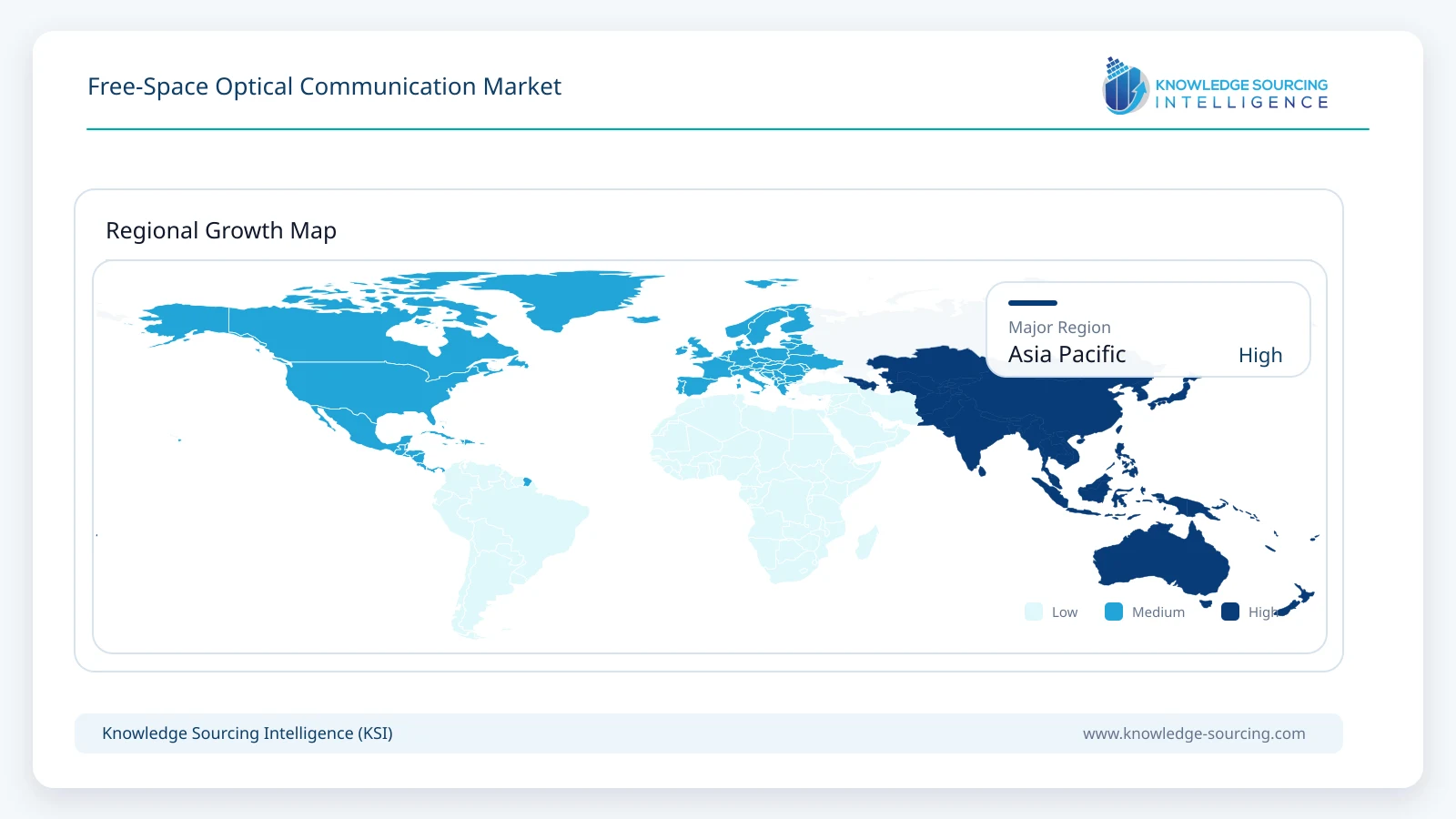
North America holds the largest regional share at 37.9% in 2031, growing at a 9.4% CAGR, supported by strong U.S. government and defense investment, LEO constellation operators, and telecom infrastructure modernization.
Europe Market Analysis
Europe is a center of laser-terminal manufacturing and space-agency demand, anchored by Germany (Mynaric, Tesat-Spacecom), France (Thales Alenia Space, Cailabs), and the European Space Agency's ScyLight optical communication program.
Asia-Pacific Market Analysis
Asia-Pacific is expanding rapidly, with its share rising from 27.0% in 2026 to 30.1% in 2031, driven by national space programs, smart-city fiber-gap initiatives, and telecom operator interest in FSO for urban 5G backhaul.
Middle East and Africa Market Analysis
The Middle East, led by the UAE and Saudi Arabia, is emerging as a strategic market as smart-city development and digital-government initiatives drive investment in high-capacity wireless optical infrastructure without new spectrum licensing.
South America Market Analysis
South America represents an early-stage but growing opportunity, with interest in FSO as a fiber-gap-bridging tool for urban connectivity in Brazil and other regional telecom markets.
Recent Developments
August 2026: ESA selected Lumino Technologies to lead development of affordable, mass-production-ready optical ground stations for optical and quantum satellite networks under its NG-OGS Accelerator project.
July 2026: NASA selected SpaceX to provide two Starlink mini laser terminals for Artemis III, enabling high-bandwidth optical downlinks of 4K imagery and video from Orion to Earth.
July 2026: ESA expanded cooperation with the National Observatory of Athens to construct additional optical ground stations in Greece, strengthening infrastructure for European optical satellite communications networks.
April 2026: Airbus Defence and Space and Space Compass established a strategic partnership focused on next-generation space-to-space and space-to-ground optical connectivity, including high-capacity Earth-observation data services.
March 2026: TESAT delivered its first SCOT135 optical communication terminal, designed for MEO and GEO missions with optical output up to 40 W and communication distances reaching 80,000 km.
List of Companies
Mynaric AG
CACI International Inc.
Thales Alenia Space
Tesat-Spacecom GmbH
BridgeComm, Inc.
Cailabs
fSONA Networks
Wireless Excellence Limited
Trimble Inc.
ViaSat Inc.
Competitive Landscape
Mynaric AG
Mynaric is a Munich-headquartered aerospace and communications technology company, now operating under Rocket Lab ownership, specializing in industrial-scale laser communication terminals for space, air, and ground platforms used across government, defense, and commercial satellite networks.
CACI International Inc.
CACI is a U.S. government-focused technology and expertise provider that designs, manufactures, and demonstrates optical communications terminals, including space-to-space laser links for proliferated LEO defense architectures, supported by a dedicated Orlando, Florida manufacturing facility.
Thales Alenia Space
Thales Alenia Space is a France/Italy-based satellite manufacturer and system integrator that develops optical communication payloads for the European Space Agency and commercial satellite constellations, supporting high-capacity inter-satellite and ground links.
Analyst View
The Free-Space Optical Communication market sits at an inflection point between niche defense/aerospace use and mainstream commercial deployment. Long-term growth is anchored by structural demand: LEO constellation expansion, defense modernization budgets, and persistent fiber infrastructure gaps in dense urban and emerging markets. The vendors that pair reliable hybrid FSO-RF architectures with AI-optimized beam control and space-qualified manufacturing scale are best positioned to capture the coming decade's growth.
Free-Space Optical Communication Market Scope:
| Report Metric | Details |
|---|---|
| Total Market Size in 2026 | USD 1.32 billion |
| Total Market Size in 2031 | USD 2.13 billion |
| Forecast Unit | Billion |
| Growth Rate | 10.0% |
| Study Period | 2021 to 2031 |
| Historical Data | 2021 to 2024 |
| Base Year | 2025 |
| Forecast Period | 2026 – 2031 |
| Segmentation | Component, Platform, Transmission Range, Application, Geography |
| Companies |
|
Market Segmentation
By Component
Optical Transmitters & Laser Diodes
Optical Receivers & Detectors
Modulators & Beam-Shaping Devices
Optical Terminals & Telescopes
Others
By Platform
Terrestrial (Ground-to-Ground) FSO
Space-Based (Satellite) FSO
Airborne FSO
By Transmission Range
Short-Range FSO
Long-Range FSO
By Application
Defense & Government Secure Communications
Telecom Backhaul & Last-Mile Connectivity
Satellite & Inter-Satellite Communication
Data Center Interconnect
Others
By Geography
North America
USA
Canada
Mexico
Europe
Germany
France
United Kingdom
Others
Asia Pacific
China
Japan
South Korea
India
Others
Middle East and Africa
UAE
Saudi Arabia
Others
South America
Brazil
Others
Table of Contents
1. EXECUTIVE SUMMARY
2. MARKET SNAPSHOT
2.1. Market Overview
2.2. Market Definition
2.3. Scope of the Study
2.4. Market Segmentation
3. BUSINESS LANDSCAPE
3.1. Market Drivers
3.2. Market Restraints
3.3. Market Opportunities
3.4. Porter's Five Forces Analysis
3.5. Industry Value Chain Analysis
3.6. Policies and Regulations
3.7. Strategic Recommendations
4. TECHNOLOGICAL OUTLOOK
4.1. Adaptive Optics & Beam-Steering
4.2. Hybrid FSO-RF Architectures
4.3. AI-Enabled Link Optimization
4.4. Quantum Key Distribution over Optical Links
5. FREE-SPACE OPTICAL COMMUNICATION MARKET BY COMPONENT
5.1. Introduction
5.2. Optical Transmitters & Laser Diodes
5.3. Optical Receivers & Detectors
5.4. Modulators & Beam-Shaping Devices
5.5. Optical Terminals & Telescopes
5.6. Others
6. FREE-SPACE OPTICAL COMMUNICATION MARKET BY PLATFORM
6.1. Introduction
6.2. Terrestrial (Ground-to-Ground) FSO
6.3. Space-Based (Satellite) FSO
6.4. Airborne FSO
7. FREE-SPACE OPTICAL COMMUNICATION MARKET BY TRANSMISSION RANGE
7.1. Introduction
7.2. Short-Range FSO
7.3. Long-Range FSO
8. FREE-SPACE OPTICAL COMMUNICATION MARKET BY APPLICATION
8.1. Introduction
8.2. Defense & Government Secure Communications
8.3. Telecom Backhaul & Last-Mile Connectivity
8.4. Satellite & Inter-Satellite Communication
8.5. Data Center Interconnect
8.6. Others
9. FREE-SPACE OPTICAL COMMUNICATION MARKET BY GEOGRAPHY
9.1. Introduction
9.2. North America
9.2.1. USA
9.2.2. Canada
9.2.3. Mexico
9.3. Europe
9.3.1. Germany
9.3.2. France
9.3.3. United Kingdom
9.3.4. Others
9.4. Asia Pacific
9.4.1. China
9.4.2. Japan
9.4.3. South Korea
9.4.4. India
9.4.5. Others
9.5. Middle East and Africa
9.5.1. UAE
9.5.2. Saudi Arabia
9.5.3. Others
9.6. South America
9.6.1. Brazil
9.6.2. Others
10. COMPETITIVE ENVIRONMENT AND ANALYSIS
10.1. Major Players and Strategy Analysis
10.2. Market Share Analysis
10.3. Mergers, Acquisitions, Agreements, and Collaborations
10.4. Competitive Dashboard
11. COMPANY PROFILES
11.1. Mynaric AG
11.2. CACI International Inc.
11.3. Thales Alenia Space
11.4. Tesat-Spacecom GmbH
11.5. BridgeComm, Inc.
11.6. Cailabs
11.7. fSONA Networks
11.8. Wireless Excellence Limited
11.9. Trimble Inc.
11.10. ViaSat Inc.
12. APPENDIX
12.1. Currency
12.2. Assumptions
12.3. Base and Forecast Years Timeline
12.4. Key Benefits for the Stakeholders
12.5. Research Methodology
12.6. Abbreviations
Navigate
Trusted by the world's leading organizations











