
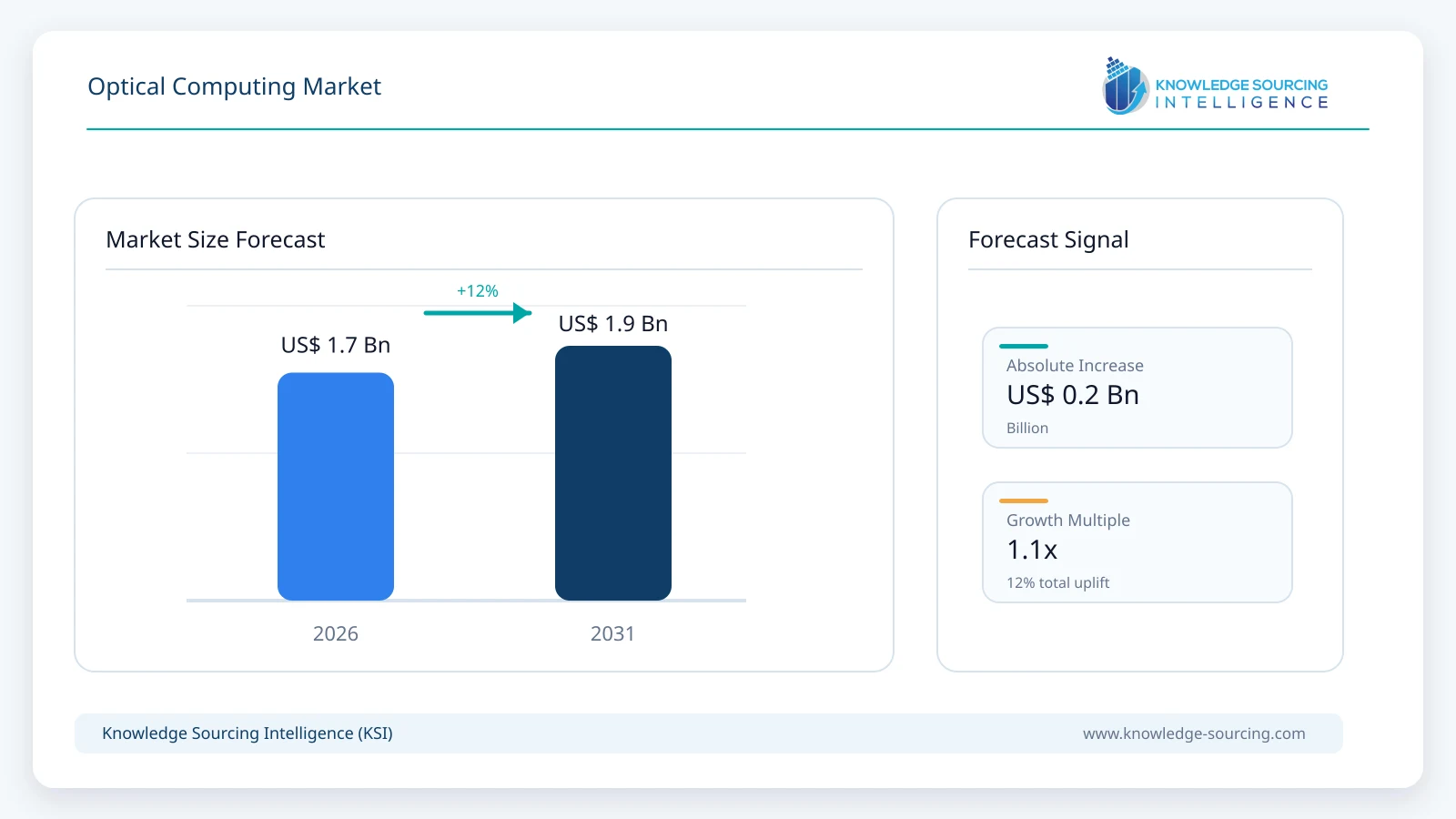
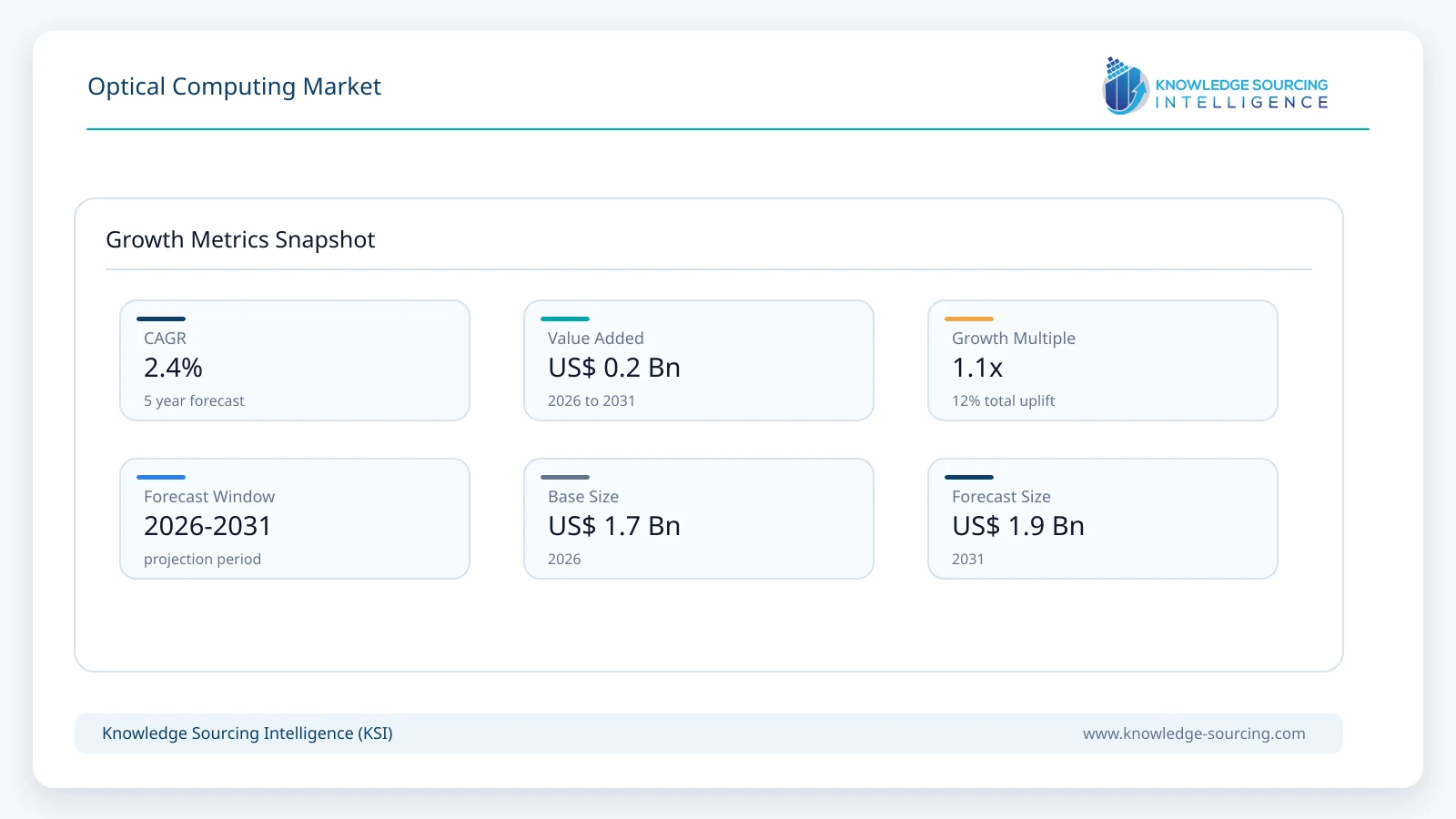
The Optical Computing Market is forecast to grow at a CAGR of 2.4%, reaching USD 1.9 billion in 2031 from USD 1.7 billion in 2026.
Highlights:
- 1Commercial ramp of 800G co-packaged optics in hyperscale data centers in 2025-2026 has been a clear structural milestone from research demonstration to production deployment of optical computing technology.
- 2In 2025, the largest component market share of optical AI accelerator technology is expected to be photonic processor chips and accelerator ASICs, and optical interconnect and photonic fabric components is the fastest-growing component category.
- 3The integration of Lightmatter into NVIDIA's NVLink Fusion ecosystem in the month of June 2026 demonstrates increasing mainstream acceptance of optical computing technology by the developers of optical computing solutions and the mainstream AI infrastructure platform.
- 4In 2025-26, the listing of Xanadu on the NASDAQ as the world's first publicly traded company to develop photonic quantum computers and the publication in Nature of PsiQuantum's breakthrough in the field of quantum photonic circuits are both noteworthy structural advances in the optical and photonic computing market.
Built on light-based signal transmission and computing, optical computing chips enable ultra-high bandwidth, low latency and significantly lower power consumption than silicon-based processors, directly addressing the terabit per second data streams produced by cloud services and hyperscale data centers. The co-packaged optics (CoPo) architecture incorporates optical engines alongside switching silicon, instead of having to use separate pluggable transceiver modules, thereby saving power and increasing interconnect density, and this form of packaging is commercially ramped at the hyperscale data center scale. As the bandwidth demand between compute nodes continues to increase as AI cluster architectures grow, optical interconnects and photonic fabric components are one of the fastest-growing categories for components.
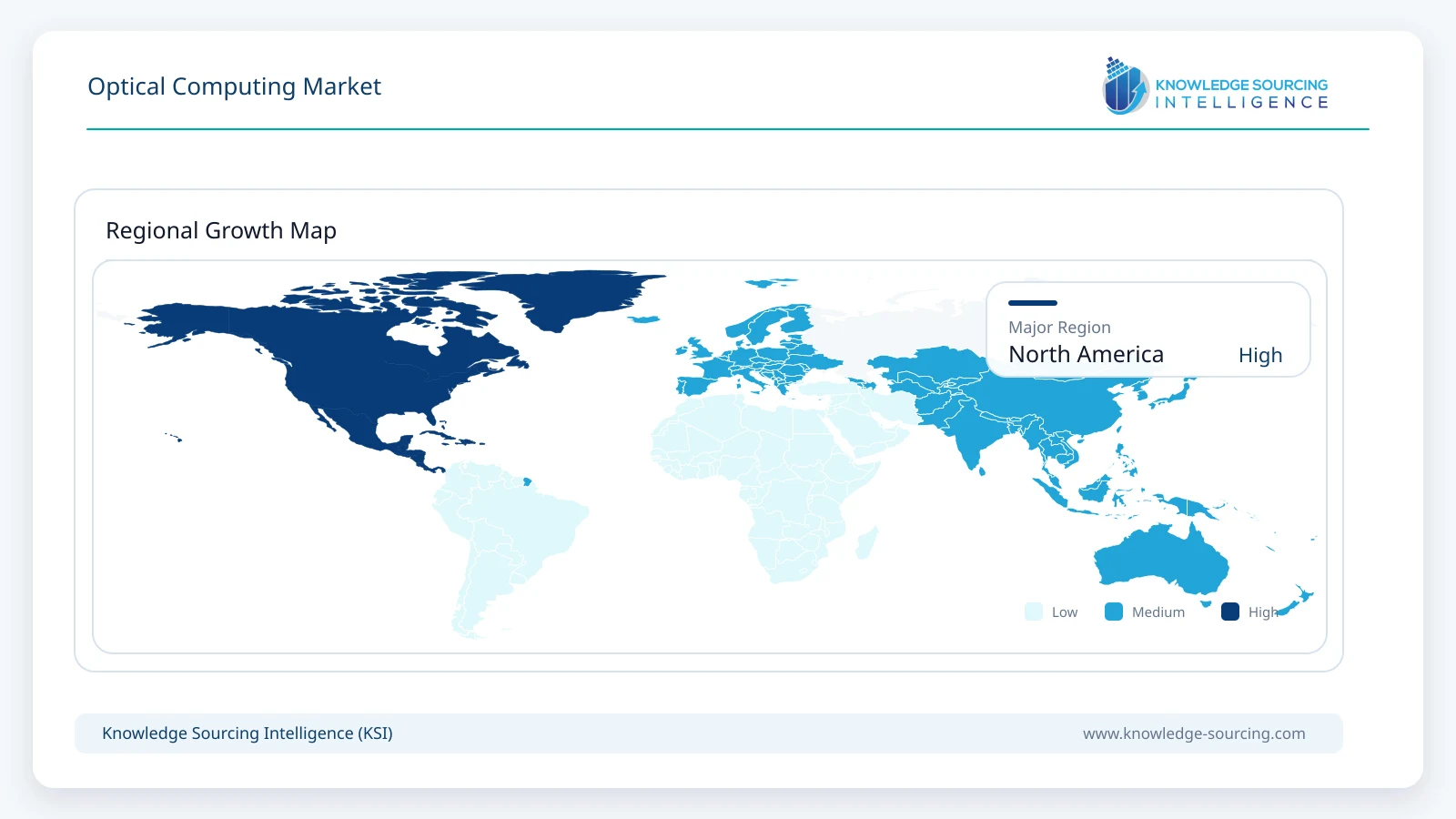
Photonic processor chips and optical AI accelerator ASICs accounted for the largest market share of optical AI accelerator components in 2025, and optical interconnect and photonic fabric components are expected to be the fastest-growing component category as AI infrastructure scales. By end-market, the data center and cloud computing infrastructure segment is the strongest, and North America is the largest market, supported by partnerships among semiconductor firms, photonic companies, foundries and research institutes to create a base of next-generation optical computing technologies, as well as domestic infrastructure and capacity-building initiatives.
Market Dynamics
Market Drivers
AI-driven data traffic goes exponential: The bandwidth needs of AI training and inference workloads at hyperscale data centers are growing rapidly, and optical versions of AI computing chips and interconnect and networks are emerging to meet these needs with significantly less power consumption than traditional electronics options.
Commercial Ramp of Co-Packaged Optics: The commercial ramp of co-packaged optics at hyperscale data center scale is proving the practical viability and value of optical computing architectures, and driving adoption beyond the early adopters of hyperscalers.
There is increasing collaborative development between optical computing chip suppliers and mainstream AI hardware and infrastructure suppliers, which is driving greater mainstream adoption of photonic technology over specialized applications.
Market Restraints & Opportunities
Initial capital requirements for investment in a photonic foundry, manufacturing of precision optical components at commercial yield, and specialized packaging and integration requirements compared to more developed electronic semiconductor manufacturing are significant barriers to quicker market scale-up.
However, large amounts of capital flowing into photonic foundries, strategic partnerships between top semiconductor firms and ongoing silicon photonics platform investments from technology vendors all point to significant long-term opportunity, as data center operators come to recognize optical interconnects as a necessary component of their infrastructure rather than an optional add-on for AI-scale computing.
Key Developments
September 2026: CollPlant Biotechnologies Ltd. announced the successful closing of its previously announced acquisition of LightSolver Ltd., an Israeli deep-tech company pioneering a fundamentally new computing paradigm based on lasers.
April 2026: Lumai, the optical compute company addressing scalable AI, announced its Lumai Iris inference server, the world’s first optical computing system to successfully run billion-parameter large language models (LLMs) in real time. This marks a milestone in AI infrastructure,
March 2026: NVIDIA and Coherent Corp. announced a multiyear strategic agreement to advance the frontier of advanced optics technologies, including manufacturing capacity and research and development, to enable next-generation AI infrastructure.
Market Segmentation
The market is segmented by component, technology, application, and geography.
By Component: Photonic Processor Chips & Accelerator ASICs
The biggest components are the photonic processor chips and accelerator ASICs, which serve as the fundamental computational hardware for light-based matrix products and other optical computation functions that are essential for AI acceleration.
Lightmatter, Inc. is a company that creates photonic AI accelerator chips, with commercial prototypes that have been developed that replace the cores of GPUs with nanophotonic tensor cores for AI training and inference applications.
Celestial AI, Inc. is a developer of photonic fabric and optical interconnect technology for high bandwidth, chip-to-chip communication for AI and high-performance computing infrastructure.
By Component: Optical Interconnect & Photonic Fabric
As the bandwidth requirements between compute nodes in AI cluster architectures continue to rise, optical interconnects and photonic fabric parts are the fastest growing component category in GPUs.
Ayar Labs, Inc. is a developer of optical I/O technology that aims to enhance the efficiency of communicating between chips, lower power usage, and speed up the deployment of optical connectivity into AI and high-performance computing systems.
By Application: Data Centers & Hyperscale Computing
Data centers and hyperscale computing infrastructure represent the leading application segment, as operators adopt optical computing chips and co-packaged optics to address escalating AI-driven data traffic and power-consumption constraints.
Broadcom Inc. supplies silicon photonics-powered co-packaged optics, including its Bailly platform, integrated with switching silicon to reduce power consumption and improve interconnect density for hyperscale data center infrastructure.
Regional Analysis
North America Market Analysis
North America maintains a leading market position, supported by collaboration between semiconductor manufacturers, photonic firms, foundries, and research centers developing next-generation optical computing technology, alongside efforts to build domestic semiconductor manufacturing infrastructure and capacity.
Europe Market Analysis
Europe's market is advancing through research institute collaboration and semiconductor industry investment programs, with European Commission support for photonic device manufacturers reinforcing regional technology development.
Asia-Pacific Market Analysis
Asia-Pacific is registering rapid growth, driven by semiconductor manufacturer investment, expanding photonic foundry capacity, and government-backed research initiatives across China, Japan, and other regional markets.
Middle East and Africa Market Analysis
The Middle East and Africa are seeing early-stage investment in optical computing technology tied to broader national technology diversification and data center infrastructure development initiatives.
South America Market Analysis
South America represents an emerging market for optical computing, with growing enterprise and academic research interest in photonic and optical technology applications in Brazil and other regional markets.
List of Companies
Lightmatter, Inc.
Lightelligence Inc.
Celestial AI, Inc.
Ayar Labs, Inc.
Intel Corporation
Broadcom Inc.
Cisco Systems, Inc.
NVIDIA Corporation
Lumentum Holdings Inc.
Infinera Corporation
Competitive Landscape
Lightmatter, Inc.
Lightmatter, Inc. develops photonic AI accelerator chips, demonstrating commercial prototypes that replace conventional GPU cores with nanophotonic tensor cores, and joined NVIDIA's NVLink Fusion ecosystem in June 2026 to support co-packaged optical connectivity for AI infrastructure.
Celestial AI, Inc.
Celestial AI, Inc. develops photonic fabric and optical interconnect technology supporting high-bandwidth chip-to-chip communication for AI and high-performance computing infrastructure applications.
Ayar Labs, Inc.
Ayar Labs, Inc. develops optical I/O technology improving chip-to-chip communication efficiency and reducing power consumption, expanding commercialization through strategic collaborations across AI and high-performance computing systems.
Analyst View
The Optical Computing market has moved decisively beyond research demonstration into commercial production infrastructure, marked by the ramp of 800G co-packaged optics at hyperscale data centers and Broadcom's demonstrated 70% power reduction and 8x efficiency improvement with its Bailly platform. The convergence of escalating AI bandwidth demands, maturing silicon photonics manufacturing, and deepening strategic partnerships between optical computing developers and mainstream AI infrastructure providers, exemplified by Lightmatter's NVLink Fusion integration, points toward optical interconnects and accelerators becoming standard rather than exceptional components of AI-scale data center architecture. North America's concentration of semiconductor manufacturers, photonic firms, and foundries continues to anchor global technology development, while Asia-Pacific's expanding photonic foundry capacity signals a broadening manufacturing base. Vendors that combine proven optical computing hardware, scalable photonic foundry partnerships, and integration with mainstream AI infrastructure platforms are best positioned to lead the next phase of market growth.
Optical Computing Market Scope:
| Report Metric | Details |
|---|---|
| Total Market Size in 2026 | USD 1.7 billion |
| Total Market Size in 2031 | USD 1.9 billion |
| Forecast Unit | USD Billion |
| Growth Rate | 2.4% |
| Study Period | 2021 to 2031 |
| Historical Data | 2021 to 2024 |
| Base Year | 2025 |
| Forecast Period | 2026 – 2031 |
| Segmentation | Component, Technology, Application, Geography |
| Companies |
|
Market Segmentation
By Component
Photonic Processor Chips & Accelerator ASICs
Optical Interconnect & Photonic Fabric
Optical Modulators & Detectors
Software & Control Systems
By Technology
Co-Packaged Optics
Optical AI Accelerators
Silicon Photonics
Others
By Application
Data Centers & Hyperscale Computing
AI Training & Inference
Telecommunications
High-Performance Computing
Others
By Geography
North America
USA
Canada
Mexico
South America
Brazil
Others
Europe
Germany
France
United Kingdom
Others
Middle East and Africa
UAE
Saudi Arabia
Others
Asia Pacific
China
India
Japan
Others
Table of Contents
1. EXECUTIVE SUMMARY
2. MARKET SNAPSHOT
2.1. Market Overview
2.2. Market Definition
2.3. Scope of the Study
2.4. Market Segmentation
3. BUSINESS LANDSCAPE
3.1. Market Drivers
3.2. Market Restraints
3.3. Market Opportunities
3.4. Porter's Five Forces Analysis
3.5. Industry Value Chain Analysis
3.6. Policies and Regulations
3.7. Strategic Recommendations
4. TECHNOLOGICAL OUTLOOK
4.1. Co-Packaged Optics for Data Centers
4.2. Optical AI Accelerators & Photonic Fabric
4.3. Silicon Photonics Foundry Scale-Up
4.4. Optical Interconnect Bandwidth Advances (800G, 1.6T)
5. OPTICAL COMPUTING MARKET BY COMPONENT
5.1. Introduction
5.2. Photonic Processor Chips & Accelerator ASICs
5.3. Optical Interconnect & Photonic Fabric
5.4. Optical Modulators & Detectors
5.5. Software & Control Systems
6. OPTICAL COMPUTING MARKET BY TECHNOLOGY
6.1. Introduction
6.2. Co-Packaged Optics
6.3. Optical AI Accelerators
6.4. Silicon Photonics
6.5. Others
7. OPTICAL COMPUTING MARKET BY APPLICATION
7.1. Introduction
7.2. Data Centers & Hyperscale Computing
7.3. AI Training & Inference
7.4. Telecommunications
7.5. High-Performance Computing
7.6. Others
8. OPTICAL COMPUTING MARKET BY GEOGRAPHY
8.1. Introduction
8.2. North America
8.2.1. USA
8.2.2. Canada
8.2.3. Mexico
8.3. South America
8.3.1. Brazil
8.3.2. Others
8.4. Europe
8.4.1. Germany
8.4.2. France
8.4.3. United Kingdom
8.4.4. Others
8.5. Middle East and Africa
8.5.1. UAE
8.5.2. Saudi Arabia
8.5.3. Others
8.6. Asia Pacific
8.6.1. China
8.6.2. India
8.6.3. Japan
8.6.4. Others
9. COMPETITIVE ENVIRONMENT AND ANALYSIS
9.1. Major Players and Strategy Analysis
9.2. Market Share Analysis
9.3. Mergers, Acquisitions, Agreements, and Collaborations
9.4. Competitive Dashboard
10. COMPANY PROFILES
10.1. Lightmatter, Inc.
10.2. Lightelligence Inc.
10.3. Celestial AI, Inc.
10.4. Ayar Labs, Inc.
10.5. Intel Corporation
10.6. Broadcom Inc.
10.7. Cisco Systems, Inc.
10.8. NVIDIA Corporation
10.9. Lumentum Holdings Inc.
10.10. Infinera Corporation
11. APPENDIX
11.1. Currency
11.2. Assumptions
11.3. Base and Forecast Years Timeline
11.4. Key Benefits for the Stakeholders
11.5. Research Methodology
11.6. Abbreviations
Navigate
Trusted by the world's leading organizations











