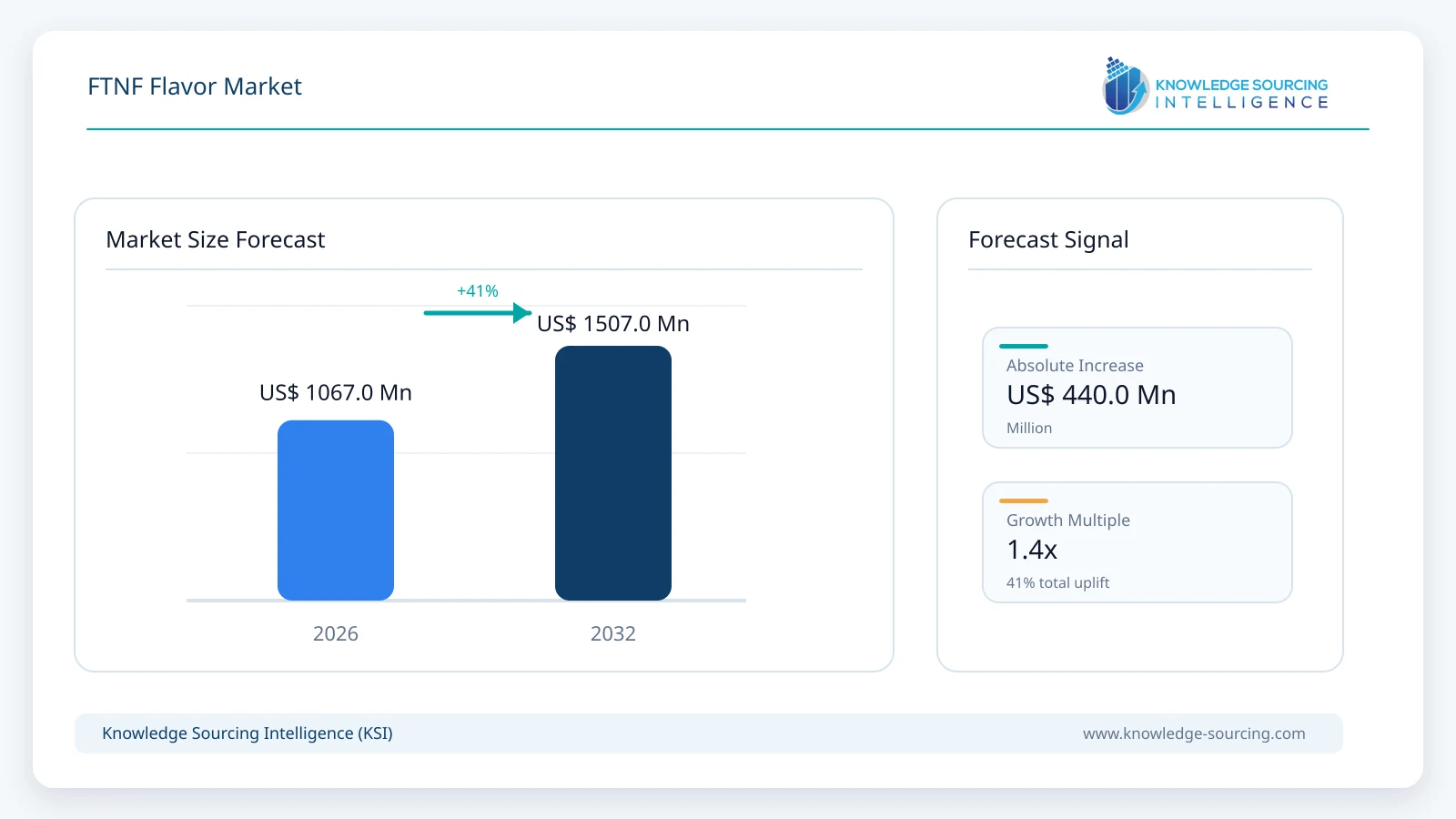
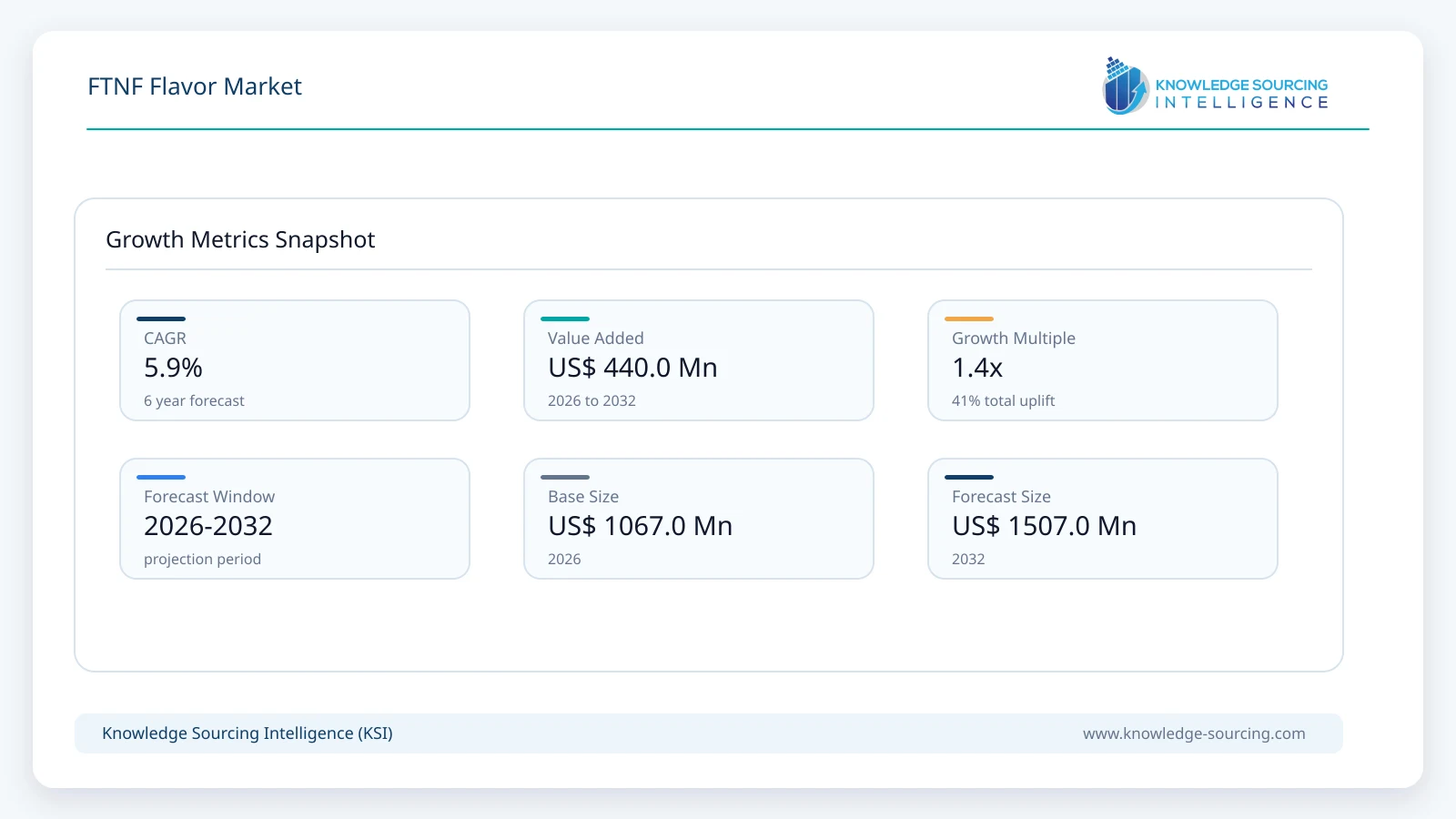
The FTNF (From The Named Fruit) flavor ingredients market is estimated at USD 1,067 million in 2026 and projected to reach USD 1,507 million by 2032, representing a 5.9% compound annual growth rate during the forecast period.
Highlights:
- 1Beverage applications are estimated at US$644 million in 2026, or 60.3% of FTNF flavor ingredient revenue.
- 2Beverage demand is projected to reach US$922 million by 2032, growing at a 6.17% CAGR.
- 3Authentic fruit-source requirements support premium formulations, but replacement and WONF blends create substantial pricing pressure.
- 4Citrus harvest variability directly affects peel-oil and recovered-essence supply, lead times and contracted ingredient costs.
- 5EU natural-source labeling rules and US characterizing-flavor requirements make documentation commercially important.
- 6Supplier advantage increasingly depends on fruit-origin traceability, recovery technology and year-round specification consistency.
This market consists of natural flavor materials derived from their declared named fruit, including fruit essences, aroma water phases, recovered volatiles, genuine fruit oils, extracts and selected concentrates sold principally to food and beverage manufacturers. It does not count synthetic flavor substitutes, finished beverages, juice concentrate sold principally for its sugar and solids content, or flavors labeled with other natural flavors. Demand depends on the ability of processors to recover a distinct aroma fraction from real fruit and preserve it through bottling, storage or food processing.
In the European Union, a named natural flavor designation generally requires at least 95% of its flavoring component from that named source under Regulation (EC) No 1334/2008. The supplier designation FTNF often communicates an even narrower, 100%-from-source composition, depending on the documented product specification. In the United States, FDA rules distinguish natural flavor origin from characterizing-flavor label statements, so an FTNF sales claim should not be represented as an automatic exemption from ingredient-labeling requirements. Procurement teams therefore examine source certificates, processing records and product declarations before paying a provenance premium.
The industry’s economics are determined by the fruit-processing chain rather than end-consumer demand alone. Orange and lemon oils can be recovered from peel during juice processing, while water-phase essences recover volatile aromatics that would otherwise escape during concentration. A shortage of suitable fruit can raise raw material cost, reduce aroma yields and tighten specialty grades simultaneously. Conversely, a larger crop may increase recoverable supply without creating equivalent demand for every flavor fraction. In April 2026, Fundecitrus confirmed 292.94 million 40.8-kilogram boxes of oranges in Brazil’s principal citrus belt for the completed 2025/26 season, underscoring the importance of crop cycles to ingredient availability. In parallel, USDA projected global orange-juice production near 1.4 million tonnes for 2025/26 on a 65-degree-Brix basis. These statistics indicate fruit-processing scale, but they are not themselves FTNF revenue or flavor-ingredient shipment figures. Value creation comes from isolation, standardization, quality assurance and reliable delivery to formulators.
The addressable opportunity is therefore most defensible when measured as specialized fruit-derived aroma materials sold at ingredient prices. A broader definition that includes every natural fruit flavor, synthetic fruit-like flavor and finished fruit beverage would be several times larger but would not answer the same procurement question. The competition also differs between high-volume orange oil and customized berry extracts. Citrus processors can recover aroma alongside their juice operation, while non-citrus flavor specialists often depend on contract sourcing, batch-specific extraction and smaller lot sizes. Customer specifications add further variation through concentration, water solubility, shelf-life requirements and whether an essence is sold as a standalone ingredient or integrated into a compounded flavor. Large flavor houses influence formulation standards and can buy FTNF fractions from specialist processors, but their reported Taste or Taste & Wellbeing revenues include many non-FTNF categories. Those divisional figures are consequently useful for commercial scale checks, not a direct measure of the FTNF market.
Market Dynamics
The most important growth driver is demand for fruit authenticity in premium beverages and foods. Juice brands use recovered essences to restore volatile notes lost during heating and concentration; flavored waters and fruit drinks use authentic extracts to reinforce recognizable citrus, tropical and berry profiles. Sensory performance must nevertheless survive pasteurization, acidic matrices, packaging interactions and distribution. A clean source declaration has little economic value if the product fails stability tests or requires an uneconomic dose to achieve the desired flavor. For suppliers, the strongest commercial position comes from combining access to the fruit stream with concentration, separation and application-testing capabilities. Döhler and Prodalim explicitly describe FTNF/FTNJ products, oils and water phases in their ingredient portfolios, while Evera by Citrosuco sells orange-derived Tastelift essence. Their product descriptions illustrate a genuine market rather than a generic natural-flavors category. The shift favors suppliers who can document origin and performance under actual manufacturing conditions, including concentrate reconstitution and low-sugar formulations.
Volatility in citrus supply remains the chief constraint on predictable procurement. Greening disease, adverse weather and differences in fruit quality affect the availability and profile of oil-bearing peel and recoverable volatiles. Fruit prices alone can mislead a buyer: flavor recovery rates, terpene composition, oxidation characteristics and downstream processing losses also influence delivered cost per kilogram. Citrus aroma is additionally sensitive to storage temperature and flavor stability, so product testing and inventory management affect the margin retained by processors. Competing products intentionally exploit this constraint. dsm-firmenich markets Orange NextGen as a natural alternative to FTNF orange oils, while Treatt has positioned its Orange WONF range as a lower-cost or supply-stable option. Such products are commercially important substitutes but should not be counted as sales of genuine from-the-named-fruit flavor materials. Brands balancing authenticity with price may use FTNF only in strategic lines or formulations where label and sensory benefits outweigh the cost differential.
Expansion opportunities lie in the fractionation and utilization of existing fruit-processing streams. Fruit essences, cold-pressed oils and water phases can be sold in distinct specifications rather than treated as a single undifferentiated commodity. Recovery technologies enable processors to capture aromas during concentration, standardize the blend and offer customers seasonal continuity. Additional product value can come from traceable origins, application-specific concentration and suitable solubility for clear beverages. Outside citrus, flavors made from berries, apple, mango, passion fruit and pineapple offer a different growth profile because smaller harvests and less standardized processing may support higher unit prices. However, claims of rapid global adoption should be evaluated cautiously: neither trade databases nor public company statements provide a clean statistical category for genuine FTNF ingredients. What is observable is the breadth of product launches, dedicated fruit-extract portfolios and manufacturers’ willingness to differentiate authentic fruit fractions from substitutes. Those factors support gradual market growth rather than assuming every natural flavor demand trend converts to FTNF sales.
Product and Technology Economics
Citrus-derived FTNF products include cold-pressed orange, lemon, lime and grapefruit oils, folded oils, recovered essences and concentrated water phases. Their economics depend on raw fruit availability, recovery efficiency, fractionation yield and the desired sensory standard. The same orange processing run can produce juice, peel oil and aroma fractions, but these outputs should be assigned separate revenues only when sold as identifiable products. When an aroma fraction is reintegrated into the producer’s own juice, its value is not necessarily a third-party FTNF sale. Non-citrus fruit extracts, distillates and essences require different handling. Red fruits and tropical materials can have limited fresh-fruit shelf life, stronger harvest seasonality and narrower batch volumes, increasing the importance of freezing, concentration and quality preservation. Plant-Ex explicitly differentiates FTNF products from 95/5 natural named-source flavors and WONF blends. That technical distinction supports a market segmentation based on citrus and non-citrus fruit origin, rather than the contradictory “natural versus synthetic FTNF” categories previously used in broader descriptions.
Application Analysis
Beverages
Beverages form the principal end-use application, estimated at US$644 million in 2026, equal to 60.3% of global FTNF ingredient revenue, and projected to reach US$922 million by 2032 at a 6.17% CAGR. The segment spans fruit juice and nectar flavor restoration, premium fruit-flavored water, juice drinks, selected carbonated beverages and other formulation uses requiring an identified fruit source. Its competitive economics are distinctive: processors often recover volatile fractions during fruit concentration, then sell or reintroduce those aromas to restore a fresh flavor profile after thermal processing. The beverage producer pays not simply for a fruit label but for stable flavor at a controlled dosage, appropriate water solubility and predictable results during its commercial shelf life. Authentic orange essence can create a stronger provenance claim, but supply interruptions may lead formulators toward 95/5 or WONF alternatives. A genuine FTNF segment must exclude those replacement blends even when the finished beverage retains a similar sensory profile. Supplier contracts consequently center on documented raw-material origin, equivalent sensory intensity, quality consistency and capacity through adverse harvest years.
Orange remains commercially important because of the scale of global citrus processing and the need to restore familiar flavor notes in juice products. However, growth is not uniform across all beverage subcategories. Premium waters and reduced-sugar drinks may buy concentrated extracts to retain recognizable fruit characteristics without increasing juice solids, whereas mass-market products can be more sensitive to cost-in-use and may choose other natural flavors. The price-versus-provenance trade-off changes with the strength of the claim displayed on the label, the customer’s margin target and local regulation. Suppliers offering multiple fruit profiles, particularly lemon, lime, berries and tropical fruits, can reduce dependence on a single orange season. Product innovation also extends to aroma solubility, emulsification and thermally stable extracts, but these processes must be tested against the specific FTNF claim. Growing beverage production alone will not determine demand: the proportion of formulations using only named-fruit components and the net aroma volume per finished liter are the decisive variables.
Other Food Applications
Dairy and frozen desserts, bakery, confectionery and other foods together form the balance of the addressed market. Their purchasing patterns differ from beverages because fruit flavor can be combined with higher-fat matrices, baked products or sweeteners that alter aroma release. In yogurt and ice cream, processors may seek a recognizably authentic berry or tropical-fruit note without using enough fruit preparation to dominate texture and sugar content. Bakery applications require flavor fractions that can withstand mixing, heat and longer storage; a delicate water phase may have less value than an appropriately protected or concentrated extract. Confectionery formulations favor stability in high-sugar and acidic systems, with a different dosage profile from clear beverages. These segments provide opportunities for specialized non-citrus extracts, although the true incremental FTNF share must be separated from broader natural-flavor purchases. Supplier support in bench testing, shelf-life evaluation and regulatory documentation is often the decisive commercial service attached to the sale of an otherwise small ingredient quantity.
Regional Market Outlook
North America
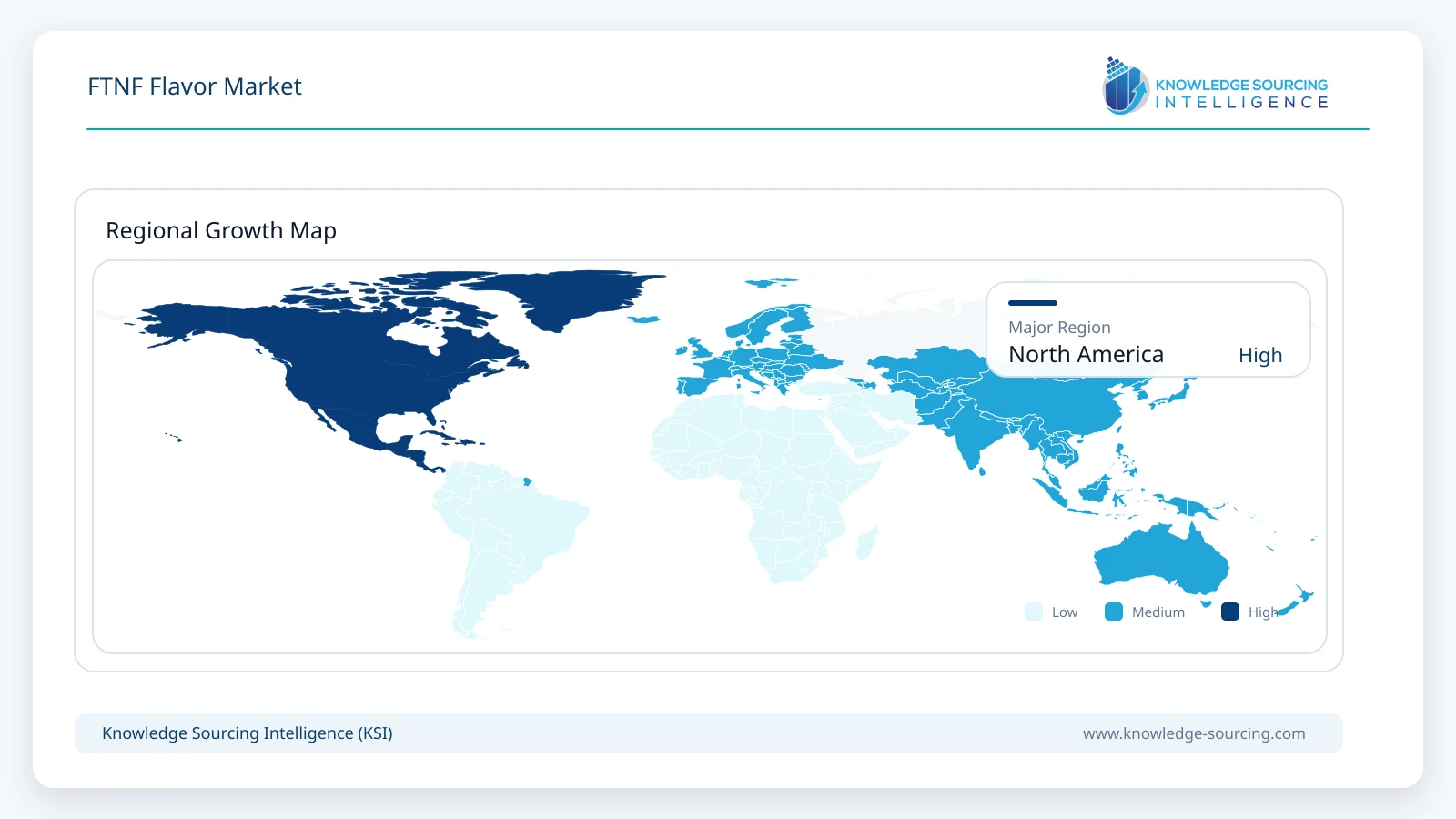
The United States anchors regional demand through its beverage and packaged-food manufacturing base, diverse consumer fruit preferences and the commercial importance of characterizing-flavor claims. Large food companies use supplier audits and documentation to establish what qualifies for a natural-source statement, and specialty ingredient makers benefit from this scrutiny when their extracts are traceable. Canada provides a smaller market with close integration into US manufacturing and procurement, while Mexico combines beverage manufacturing with fruit processing and natural-ingredient supply. Imports, tariffs and seasonal availability can influence contract costs across the region, especially where concentrated aroma inputs come from Brazil or other fruit-producing locations. The United States is also an active market for cost-stable orange-style replacements, creating a direct competitive test for genuine FTNF products. Accordingly, regional growth is better explained by formulation specifications and sourcing agreements than by a general claim that all natural beverage volumes are increasing.
South America
Brazil is central to global citrus-derived aroma supply because its orange-processing industry can generate juice, peel oil and recovered aromatic fractions at industrial scale. The region’s role is consequently both that of an ingredient producer and an export base serving customers in North America and Europe. Brazil’s 2025/26 orange crop recovery improved the physical supply backdrop, but crop disease and fluctuating export economics remain important constraints. Argentina contributes lemon-processing capability and potential fruit-derived ingredient supply, while other South American countries offer tropical-fruit inputs for specialist extracts. Regional value does not track the total value of juice exports: FTNF revenue is earned when a qualifying aroma ingredient is sold, not when fruit juice is shipped. Producers able to capture more aroma from existing processing streams can improve value per tonne of fruit without relying on higher fresh-fruit output alone. This value-chain advantage depends on qualified grades and reliable customers, rather than extraction capacity in isolation.
Europe
Europe has a relatively developed regulatory and processing environment for fruit-derived flavor materials. The European Union’s source-specific natural-flavor rules create a clear reason for manufacturers to document fruit origin and distinguish FTNF extracts from wider natural-flavor blends. Germany and France are significant markets for beverage ingredients and industrial food formulations, while Italy and Spain contribute citrus-processing expertise and access to fruit supply. The United Kingdom remains relevant to specialized natural flavor development and distribution, including suppliers such as Plant-Ex and Treatt. In premium product categories, fruit provenance can justify an ingredient premium, but cost pressure remains acute when European buyers can substitute a compliant 95/5 flavor or WONF formulation. Manufacturers therefore compete through both product authenticity and consistency of delivered flavor. For cross-border sales, technical documentation, labeling interpretation and the suitability of each extract for the end-product category determine which supplier can enter a given customer formulation.
Middle East and Africa
Demand across the Middle East and Africa is concentrated in beverage manufacturing, imported fruit-based ingredients and selected local processing hubs. Saudi Arabia and the UAE are significant commercial destinations for beverage ingredients, while citrus-growing and processing countries elsewhere in the region can contribute raw-material supply. Customers often prioritize stable delivery, technical service and the ability to meet local food standards. Fruit-source authenticity can support premium beverages, especially in product lines emphasizing recognizable citrus or tropical profiles, but price sensitivity and dependence on imports limit the pace of switching from conventional natural flavors. Supply-chain risk is also different from markets with extensive local fruit processing: imported specialty water phases and extracts require suitable shipping conditions, shelf-life management and distributor inventories. Direct contracts with manufacturers and specialized ingredient distributors remain more commercially relevant than consumer-style online purchasing channels.
Asia Pacific
Asia Pacific combines large beverage-manufacturing markets with a wide range of fruit-processing capabilities. China and India support demand for natural fruit notes in juice drinks, flavored waters and packaged food, while Japan and South Korea provide higher-specification product-development environments for premium extracts. Indonesia and Thailand have tropical-fruit supply and regional beverage manufacturing, supporting opportunities for mango, pineapple and passion-fruit profiles. However, fruit availability does not automatically imply domestic FTNF ingredient production: commercial extraction, aroma preservation, application testing and customer qualification are necessary stages. Japanese buyers may place particular emphasis on consistency and detailed raw-material documentation, whereas price-sensitive applications elsewhere can favor alternatives using other natural flavor materials. The strongest regional opportunities are likely to emerge when processors integrate fruit-origin recovery with value-added formulation support, rather than simply exporting fresh fruit or commodity juice concentrate.
Competitive Landscape and Outlook
The competitive market includes dedicated fruit-ingredient processors and specialist flavor-extract manufacturers rather than only the largest global flavor houses. Döhler, Prodalim, Evera by Citrosuco, Agrumaria Reggina, Treatt, Plant-Ex, Panteley Toshev and Arome America have identifiable products or documented capabilities related to named-fruit flavors, fruit-derived essences or extracts. Their positions vary: vertically integrated citrus processors control access to recovered aroma streams, while specialist flavor firms emphasize formulation, extraction and sensory tailoring. Large flavor groups, including Givaudan and IFF, remain significant in adjacent flavor categories, but their published total Taste revenues cannot be presented as FTNF market shares. dsm-firmenich’s Orange NextGen and Treatt’s WONF products illustrate a parallel competitive channel of substitutes, not genuine FTNF revenue. Supplier comparisons should examine the extent of named-source origin, fruit species and provenance, process, effective dosage, sensory stability and whether the product is sold as a discrete ingredient or a composite formulation.
Competition is expected to shift toward more efficient aroma recovery, reproducible product specifications and reliable contracting through difficult crop years. The sales proposition is strongest for applications where named-fruit provenance demonstrably affects labeling, consumer perception or a premium product’s flavor. Procurement teams will still benchmark cost-in-use against less restrictive alternatives; consequently, higher product purity alone will not assure volume growth. Integrated processors can obtain a cost advantage when aroma fractions are recovered alongside juice and peel oil production, while smaller flavorists may outperform on custom extracts and faster formulation support. Customers are also likely to distinguish verified named-fruit ingredient origin from generalized clean-label language, reducing the value of vague marketing claims. Future revenue depends on fruit availability, the adoption of authentic-source formulations, concentration factors and average realized ingredient prices. The sector offers a credible specialty-growth opportunity, but the commercial boundary must remain narrower than the full natural-flavors industry.
Recent Developments
April 2026: Fundecitrus confirmed that the 2025/26 orange season in Brazil’s main citrus belt closed at 292.94 million 40.8-kg boxes, improving the harvest base for juice and citrus aroma processing.
February 2026: IFF reported US$2.48 billion in FY2025 Taste segment sales, providing a broad flavor-industry benchmark but not a separate FTNF revenue disclosure.
January 2026: Givaudan reported CHF 3.642 billion in FY2025 Taste & Wellbeing sales, highlighting the scale of the wider flavor market against which named-fruit ingredients compete.
FTNF Flavor Market Scope
| Report Metric | Details |
|---|---|
| Total Market Size in 2026 | USD 1,067 million |
| Total Market Size in 2032 | USD 1,507 million |
| Forecast Unit | Million |
| Growth Rate | 5.9% |
| Study Period | 2021 to 2032 |
| Historical Data | 2021 to 2024 |
| Base Year | 2025 |
| Forecast Period | 2026 – 2032 |
| Segmentation | Fruit Source, Product Form, Application, Sales Channel, Geography |
| Companies |
|
Market Segmentation
By Fruit Source
Citrus-Derived FTNF
Non-Citrus Fruit-Derived FTNF
By Product Form
Essential and Essence Oils
Water-Phase Essences and Distillates
Fruit Extracts, Concentrates and Fractions
By Application
Beverages
Dairy and Frozen Desserts
Bakery
Confectionery
Other Foods
By Sales Channel
Direct Manufacturer Contracts
Ingredient Distributors and Specialty Agents
By Geography
North America
United States
Canada
Mexico
South America
Brazil
Argentina
Others
Europe
Germany
France
United Kingdom
Spain
Italy
Others
Middle East and Africa
Saudi Arabia
UAE
Others
Asia Pacific
China
India
Japan
South Korea
Indonesia
Thailand
Others
Table of Contents
1. EXECUTIVE SUMMARY
2. MARKET SNAPSHOT
2.1. Market Overview
2.2. Market Definition and Named-Fruit Claim
2.3. Scope of the Study
2.4. Market Segmentation
3. BUSINESS LANDSCAPE
3.1. Market Drivers
3.2. Market Restraints
3.3. Market Opportunities
3.4. Porter’s Five Forces Analysis
3.5. Industry Value Chain Analysis
3.6. Fruit-Source Labeling and Regulations
3.7. Strategic Recommendations
4. TECHNOLOGICAL OUTLOOK
4.1. Cold-Pressed Oils and Fruit Essences
4.2. Aroma Recovery and Water-Phase Concentration
4.3. Solubility, Stability and Sensory Testing
5. FTNF FLAVOR MARKET BY FRUIT SOURCE
5.1. Introduction
5.2. Citrus-Derived FTNF
5.3. Non-Citrus Fruit-Derived FTNF
6. FTNF FLAVOR MARKET BY PRODUCT FORM
6.1. Introduction
6.2. Essential and Essence Oils
6.3. Water-Phase Essences and Distillates
6.4. Fruit Extracts, Concentrates and Fractions
7. FTNF FLAVOR MARKET BY APPLICATION
7.1. Introduction
7.2. Beverages
7.3. Dairy and Frozen Desserts
7.4. Bakery
7.5. Confectionery
7.6. Other Foods
8. FTNF FLAVOR MARKET BY SALES CHANNEL
8.1. Introduction
8.2. Direct Manufacturer Contracts
8.3. Ingredient Distributors and Specialty Agents
9. FTNF FLAVOR MARKET BY GEOGRAPHY
9.1. Introduction
9.2. North America
9.2.1. United States
9.2.2. Canada
9.2.3. Mexico
9.3. South America
9.3.1. Brazil
9.3.2. Argentina
9.3.3. Others
9.4. Europe
9.4.1. Germany
9.4.2. France
9.4.3. United Kingdom
9.4.4. Spain
9.4.5. Italy
9.4.6. Others
9.5. Middle East and Africa
9.5.1. Saudi Arabia
9.5.2. UAE
9.5.3. Others
9.6. Asia Pacific
9.6.1. China
9.6.2. India
9.6.3. Japan
9.6.4. South Korea
9.6.5. Indonesia
9.6.6. Thailand
9.6.7. Others
10. COMPETITIVE ENVIRONMENT AND ANALYSIS
10.1. Major Players and Strategy Analysis
10.2. Manufacturer and Specialist Supplier Benchmarking
10.3. Alternatives and Substitutes
10.4. Competitive Dashboard
11. COMPANY PROFILES
11.1. Döhler Group
11.2. Prodalim Group
11.3. Citrosuco (Evera)
11.4. Agrumaria Reggina
11.5. Treatt plc
11.6. Plant-Ex Ingredients
11.7. Panteley Toshev Ltd.
11.8. Arome America LLC
12. APPENDIX
12.1. Currency
12.2. Forecast and Base Years
12.3. Research Methodology
12.4. Abbreviations
Navigate
Trusted by the world's leading organizations