
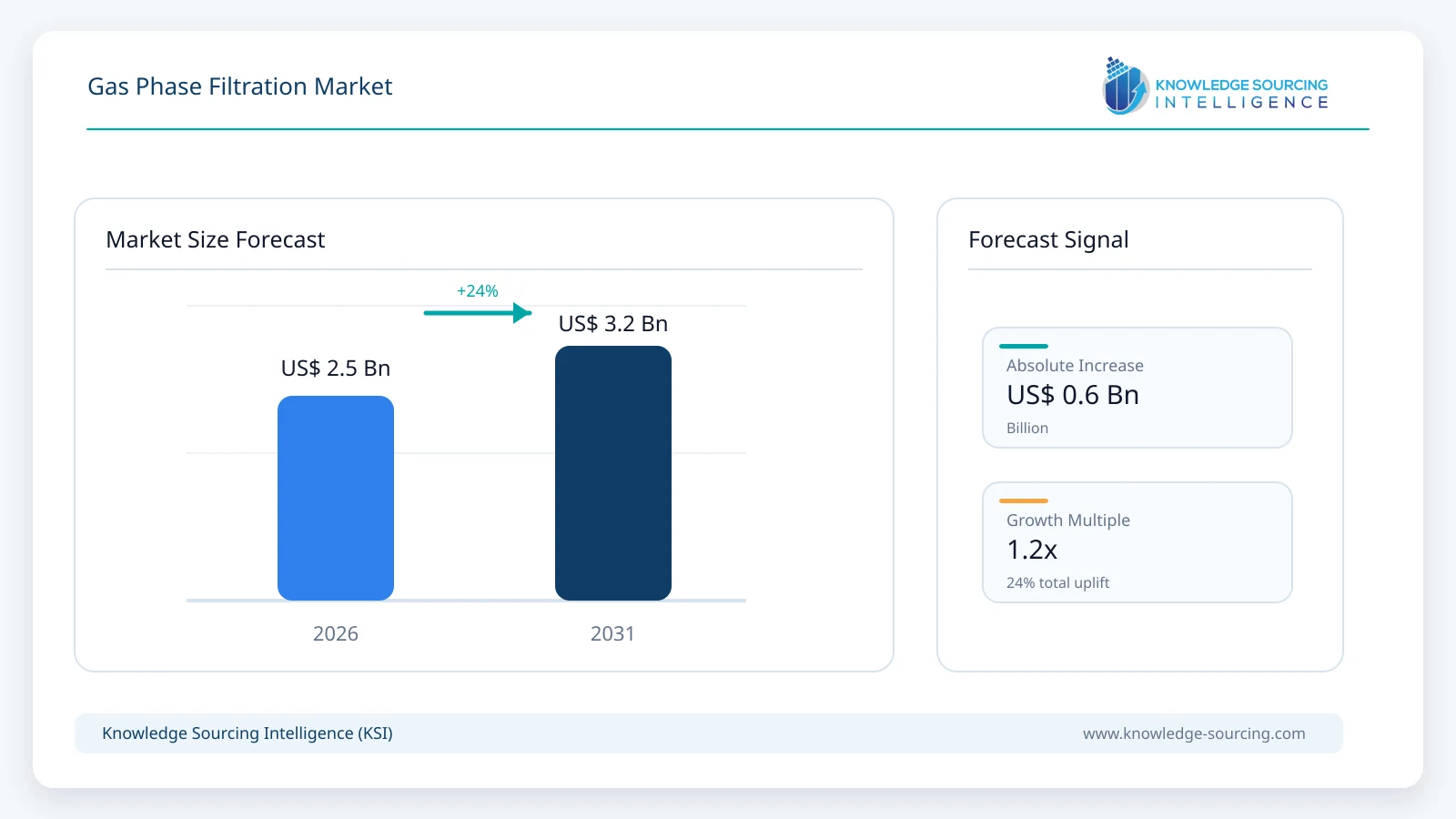
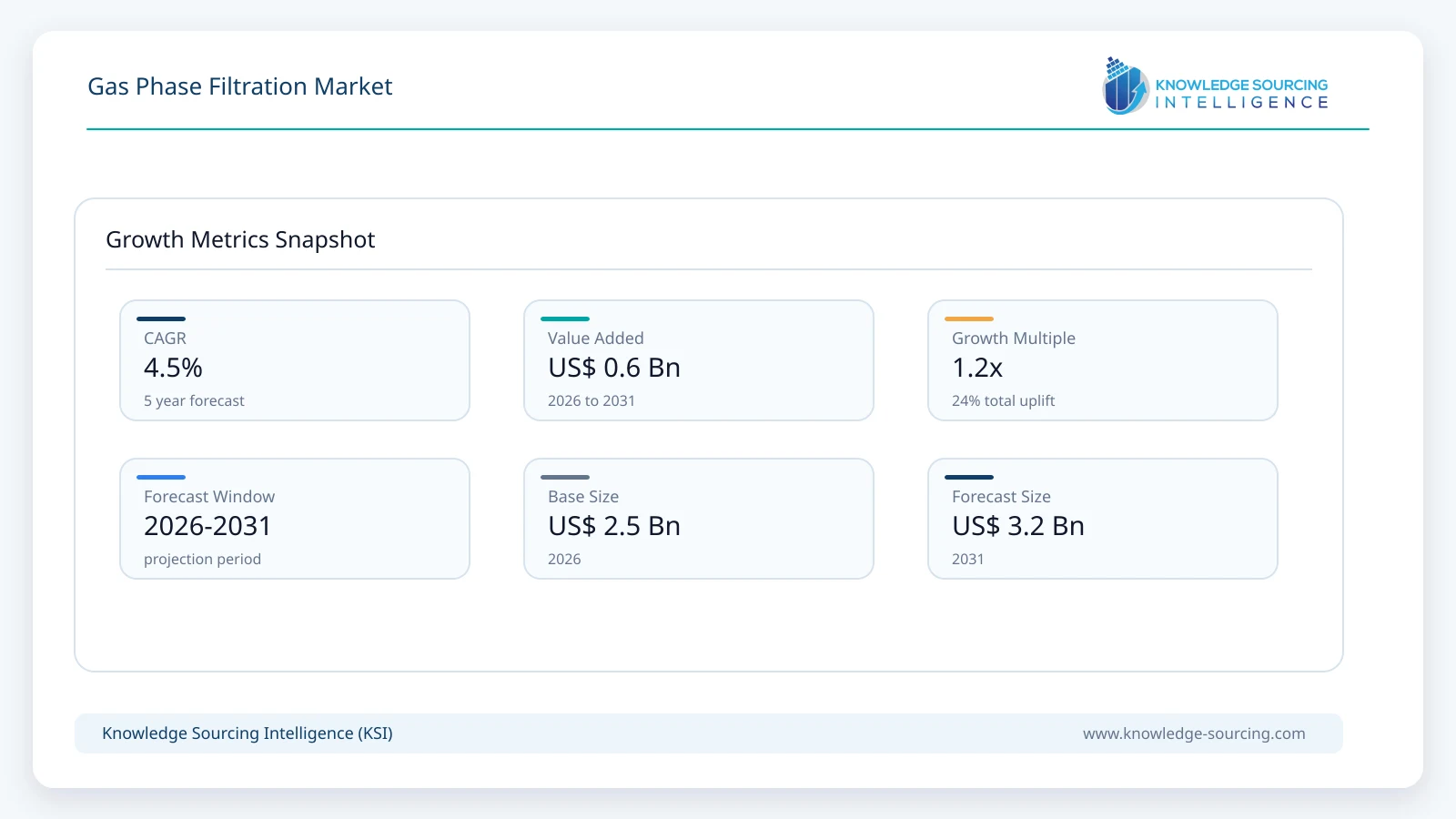
The Gas Phase Filtration Market is growing at a CAGR of 4.47%, from USD 2.54 billion in 2026 to USD 3.16 billion by 2031.
Highlights:
- 1Packed Bed Filters account for approximately 62% of market value in 2026, supported by high adsorbent capacity and established industrial corrosion-control applications.
- 2Combination Filters are projected to grow at approximately 5.7% annually through 2031, supported by applications requiring simultaneous particulate and molecular contaminant removal.
- 3Activated Carbon remains the largest filtration-media category, while blended media records the strongest growth as facilities seek broader contaminant coverage.
- 4Corrosion and Toxic Gas Control represents approximately USD 1.70 billion in 2026 and remains the principal application.
- 5Chemicals and Petrochemicals represent the largest individual end-user category, while Semiconductor Manufacturing records the strongest growth.
- 6Asia Pacific remains the largest regional market, supported by semiconductor, electronics, chemicals and industrial manufacturing.
- 7Real-time corrosion monitoring and condition-based media replacement are becoming increasingly important alongside the filtration system itself.
- 8ANSI/ASHRAE Standard 145.2-2025 provides an updated full-scale laboratory method for comparing gas-phase air-cleaning devices.
Gas phase filtration, also referred to as molecular or chemical filtration, removes gaseous contaminants that conventional particulate filters cannot effectively capture. Activated carbon, impregnated activated alumina, potassium permanganate media and blended chemisorption materials are used to control hydrogen sulfide, sulfur dioxide, nitrogen oxides, ammonia, chlorine, volatile organic compounds, formaldehyde, ozone and other molecular contaminants across industrial and commercial environments.
The commercial requirement extends well beyond general indoor air quality. Corrosive gases can damage printed circuit boards, electrical contacts, control equipment and manufacturing systems at concentrations too low to create obvious human exposure symptoms. Semiconductor fabrication plants, data centres, chemical and petrochemical facilities, pulp and paper mills and utility control rooms therefore use gas phase filtration as an equipment-reliability and process-protection measure rather than simply an air-cleaning product. Camfil, Purafil, Freudenberg and Bry-Air all currently position molecular filtration around corrosion control for sensitive electronics and industrial control environments.
The addressable market is expanding particularly strongly around advanced electronics. SEMI’s Q2 2026 300mm Fab Outlook projects global 300mm front-end equipment spending of approximately USD 142 billion in 2026, up 25%, with installed capacity continuing to expand. Global semiconductor equipment billings reached a record USD 40.53 billion in Q2 2026, 23% above the prior year. These investments increase the number and complexity of facilities where airborne molecular contamination can affect process yield, sensitive equipment and electronics reliability.
Data-centre expansion provides a second high-growth demand layer. The IEA estimates global data-centre electricity use increased to around 485 TWh in 2025 and projects consumption to roughly double to around 950 TWh by 2030. The scale of infrastructure being added increases the installed base of servers, power electronics and circuit boards exposed to potentially corrosive environments, particularly where outside-air cooling or polluted ambient conditions increase gaseous contaminant exposure.
Market Growth Drivers and Trends
Semiconductor Manufacturing Is Increasing Molecular Contamination Control Requirements
Semiconductor manufacturing is one of the most technically demanding environments for air filtration. Modern fabs require precise control of particulates and airborne molecular contaminants because acids, bases, condensable organic compounds and other gases can affect process equipment, wafer surfaces and sensitive electronics. Gas phase filtration is therefore deployed in cleanroom make-up air, recirculation systems, control rooms and equipment-protection applications rather than functioning as a conventional comfort-air filter.
The investment cycle is currently supportive. SEMI’s Q2 2026 outlook tracks more than 400 300mm fabs and production lines and projects global front-end equipment spending of approximately USD 142 billion during 2026. Memory investment is increasing particularly strongly as AI infrastructure raises demand for HBM, DRAM and higher-layer NAND, with 300mm memory equipment spending expected to exceed USD 50 billion during 2026.
Gas phase filtration does not grow mechanically with total fab capital expenditure, but every new clean manufacturing environment increases the potential installed base for molecular filtration, corrosion monitoring and replacement media. Freudenberg’s DuoPleat Plus, for example, is specifically positioned for semiconductor production, data centres and other sensitive areas requiring simultaneous particle and molecular contaminant control.
Data-Centre Expansion Is Increasing Corrosion-Control Demand
Data centres are increasingly important to gas phase filtration because dense electronic environments are vulnerable to low concentrations of sulfur-bearing and other corrosive gases. Printed circuit boards, conductors and contacts can deteriorate over time even where temperature and humidity are properly controlled.
Camfil notes that sulfur dioxide, nitrogen oxides, hydrogen sulfide and ozone can contribute to copper creep, dendrite formation and intermittent electrical failure. Its current data-centre guidance increasingly connects maintaining a G1 corrosivity classification under ISA 71.04 with server integrity, equipment warranty considerations and operational resilience. Purafil similarly positions gas phase filtration as a means of protecting telecom and data-centre electronics from corrosion-related downtime and failure.
The market opportunity grows alongside physical data-centre capacity. The IEA’s current outlook projects worldwide data-centre electricity consumption to rise from approximately 485 TWh in 2025 to about 950 TWh in 2030, with AI-focused facilities growing substantially faster than conventional computing infrastructure. Higher rack densities require larger cooling and airflow volumes, increasing the importance of understanding contaminant exposure where ambient air enters the facility.
Corrosion Monitoring Is Moving Filtration Toward Condition-Based Maintenance
Traditional gas phase filtration often relies on scheduled media replacement based on design assumptions or elapsed operating time. Newer systems increasingly combine filtration with continuous or periodic monitoring so facilities can measure actual corrosivity and replace adsorbent media according to environmental conditions.
Camfil’s AirImage-COR platform provides real-time corrosion classification using copper and silver sensors and can connect directly to building-management systems. Its 2026 AirImage-COR D configuration removes wireless hardware entirely for restricted or high-integrity environments while retaining real-time ISA 71.04 classification and wired integration. Freudenberg’s ChemWatch similarly monitors copper and silver corrosion rates alongside temperature, humidity and differential pressure.
The commercial significance is that the filtration product becomes part of a broader contamination-management system. Suppliers can combine media selection, monitoring, predictive replacement and service rather than competing only on the volume of activated carbon or permanganate media installed.
Industrial Safety and Equipment Reliability Sustain Chemical-Filtration Demand
Chemical plants, refineries, fertilizer facilities, wastewater plants, pulp mills and other process industries can generate hydrogen sulfide, sulfur dioxide, chlorine, ammonia, nitrogen oxides and volatile organic compounds. These gases create separate risks for people, electronic controls and the wider facility.
Purafil highlighted this issue in April 2026 following a fatal hydrogen-sulfide release at an industrial facility in West Virginia, emphasizing the role that gas-phase filtration can play as part of a wider exposure-control strategy. Gas filtration cannot substitute for process containment, detection or emergency-response systems, but it can reduce ambient concentrations in control rooms and other protected environments when systems are designed for the specific contaminant load.
Bry-Air’s current chemical-media portfolio demonstrates how application-specific this requirement has become. Different activated-carbon and impregnated-alumina formulations are designed for hydrogen sulfide, sulfur dioxide, chlorine, ammonia, formaldehyde, VOCs and other contaminant groups, making contaminant chemistry a central part of system design.
Updated Testing Standards Improve Performance Comparability
Gas phase filtration has historically been more difficult to compare than particulate filtration because media performance depends on contaminant chemistry, concentration, humidity, temperature, contact time and adsorbent capacity.
ANSI/ASHRAE Standard 145.1-2024 provides a test method for loose granular sorptive media, while ANSI/ASHRAE Standard 145.2-2025 establishes a full-scale laboratory method for measuring the performance of in-duct gas-phase air-cleaning devices. The standard specifies testing against one or more gaseous contaminants and provides procedures for calculating and reporting upstream and downstream removal efficiency.
More consistent testing strengthens the market for engineered solutions because buyers can evaluate products using standardized performance data rather than relying entirely on manufacturer-specific claims.
Market Restraints
Adsorbent Media Has Finite Capacity
Unlike many mechanical filters that create an obvious increase in pressure drop as particles accumulate, chemical adsorbents can lose contaminant-removal capacity without an equally visible physical indication. Activated carbon and impregnated media eventually become saturated or chemically exhausted and need replacement.
Replacement frequency varies materially according to contaminant type, concentration, humidity, temperature and airflow. Underestimating contaminant load can shorten service life substantially, while replacing media too early increases operating cost.
This creates a strong case for monitoring but also makes lifecycle economics less predictable than the initial system price suggests.
System Performance Is Highly Application Specific
There is no universal gas-phase medium capable of removing every contaminant with equal efficiency. Activated carbon performs well for many organic vapours, while impregnated alumina and permanganate media are often selected for specific acidic, sulfur-bearing or reactive gases.
Facilities containing mixtures of hydrogen sulfide, sulfur dioxide, ammonia and VOCs may therefore need multiple media stages or blended formulations. Circul-Aire’s deep-bed scrubbers and Bry-Air’s product ranges are both designed around application-specific combinations rather than a single standardized adsorbent.
Incorrect media selection can produce acceptable performance against one contaminant while leaving another inadequately controlled, increasing the importance of site testing and specialist engineering.
Pressure Drop and Airflow Affect Operating Economics
Gas phase filters require sufficient contact between contaminated air and adsorbent media. Deep beds increase media capacity but can also increase resistance to airflow, raising fan-energy requirements.
Manufacturers are consequently developing combination filters and bonded or honeycomb structures intended to increase active media area while controlling pressure drop. Freudenberg’s DuoPleat Plus combines particle and molecular filtration in one product, while Bry-Air’s honeycomb chemical filters are positioned specifically around lower pressure drop than traditional granular packed beds.
The energy trade-off is particularly important in data centres and other facilities operating air-handling systems continuously.
Initial Engineering and Installation Cost Can Limit Adoption
Gas phase filtration systems may require contaminant testing, dedicated housings, pressurization systems, air-quality monitoring and recurring replacement media in addition to the filters themselves. These requirements make the installed solution more expensive than basic particulate filtration.
Large semiconductor, chemical and data-centre operators can justify this expenditure through avoided downtime and equipment protection. Smaller commercial facilities may find the economic benefit more difficult to quantify, particularly where corrosion or odour events are intermittent.
This creates a market in which adoption is much deeper in mission-critical environments than in ordinary commercial buildings.
Spent Media Requires Appropriate Handling and Disposal
Adsorbent media physically captures or chemically reacts with airborne contaminants. The resulting spent material may contain sulfur compounds, hydrocarbons or other substances requiring appropriate handling according to the application and local regulation.
The environmental profile therefore depends not only on the filter itself but on media life, replacement frequency and disposal procedures. Longer-life media and condition-based replacement can reduce waste, while inaccurate replacement schedules can increase material consumption unnecessarily.
Gas Phase Filtration Market Segmentation Analysis
By Type
Packed Bed Filters Remain the Largest Type
Packed Bed Filters account for approximately 62% of market value in 2026 and remain the largest gas phase filtration architecture. The configuration allows large quantities of granular activated carbon, impregnated alumina or other chemical media to be installed within an airflow path, providing long contact times and high contaminant-holding capacity.
This makes packed beds particularly suitable for chemical plants, pulp and paper facilities, wastewater treatment, refineries and other applications with persistent gaseous contaminant loads. Circul-Aire’s deep-bed systems, Camfil’s ProCarb products and Purafil’s module-based filtration systems demonstrate the continued importance of high-media-capacity designs where maximizing filter life is more important than minimizing physical footprint.
Combination Filters Record the Strongest Growth
Combination Filters are projected to grow at approximately 5.7% annually through 2031. Their growth reflects demand for systems capable of controlling particulate and gaseous contaminants within one compact filtration stage, particularly where HVAC space is limited.
Freudenberg’s DuoPleat Plus combines molecular media with an upstream particulate layer and is used across semiconductor, fuel-cell and data-centre applications. AAF’s VaporClean similarly combines molecular adsorption with particulate efficiency in a compact box-filter configuration.
The architecture reduces the need for separate filter banks and is increasingly attractive in retrofit projects and high-density technical facilities.
By Media
Activated Carbon Remains the Largest Media Category
Activated Carbon accounts for approximately 51% of market value in 2026, reflecting its broad usefulness against VOCs, hydrocarbons, odours and a range of other gaseous contaminants. It is available as loose granular media, bonded composites, honeycomb structures and blended formulations, allowing suppliers to adapt surface area, contact time and pressure drop to different operating conditions.
Camfil states that activated carbon and activated alumina form the active basis of most of its molecular filter portfolio, while AAF’s VaporClean uses impregnated carbon blends targeted toward specific contaminants.
Blended Media Record the Strongest Growth
Blended Media are projected to grow at approximately 6.0% annually through 2031 as customers increasingly require filtration against several contaminant classes simultaneously.
A mixed industrial environment may contain sulfur gases, VOCs, ammonia and oxidizing contaminants that cannot be addressed optimally by one adsorbent chemistry. Suppliers therefore combine activated carbon with impregnated alumina, permanganate and other materials to broaden contaminant coverage without requiring several independent filtration systems.
The trend is particularly relevant in semiconductor, data-centre and industrial-control applications where the consequence of incomplete gas removal can be equipment failure rather than simply an odour complaint.
By Application
Corrosion & Toxic Gas Control Dominates the Application Mix
Corrosion & Toxic Gas Control represents approximately USD 1.70 billion in 2026 and is both the largest and faster-growing application within the existing segmentation.
The commercial value of filtration is highest where molecular contaminants threaten equipment reliability, production continuity or human safety. Data centres seek to prevent corrosion of printed circuit boards and contacts, semiconductor plants protect highly sensitive process environments, and industrial control rooms use filtration to isolate electronics from sulfur, chlorine and other reactive gases.
The increasing use of continuous corrosion monitoring strengthens this application further because facilities can connect measured environmental conditions directly with filtration performance and media replacement rather than relying entirely on fixed maintenance intervals.
By End-User
Chemicals & Petrochemicals Remain the Largest End-User
Chemicals & Petrochemicals account for approximately 23% of market value in 2026, equivalent to roughly USD 584.7 million. Facilities in this sector can generate multiple corrosive and toxic contaminants while depending heavily on distributed control systems, instrumentation and electrical equipment that need reliable environmental protection.
Gas phase filtration is used in control rooms, electrical rooms and air-handling systems to reduce exposure to hydrogen sulfide, sulfur dioxide, chlorine, ammonia and related gases. Bry-Air, Purafil and Circul-Aire all maintain specific solutions for chemically aggressive industrial environments.
Semiconductor Manufacturing Records the Strongest Growth
Semiconductor Manufacturing is projected to grow at approximately 7.5% annually through 2031, materially faster than the overall market.
The segment benefits from two reinforcing factors: rapid investment in new fabrication capacity and increasingly demanding contamination-control requirements. SEMI expects global 300mm front-end equipment spending to reach a record level in 2026, with AI-related memory, advanced logic and regional capacity expansion driving new fabs and production lines.
Airborne molecular contamination control therefore becomes relevant not only to cleanroom quality but to process stability, equipment reliability and production yield, supporting greater filtration value per facility.
Geographical Outlook
Asia Pacific Remains the Largest Regional Market
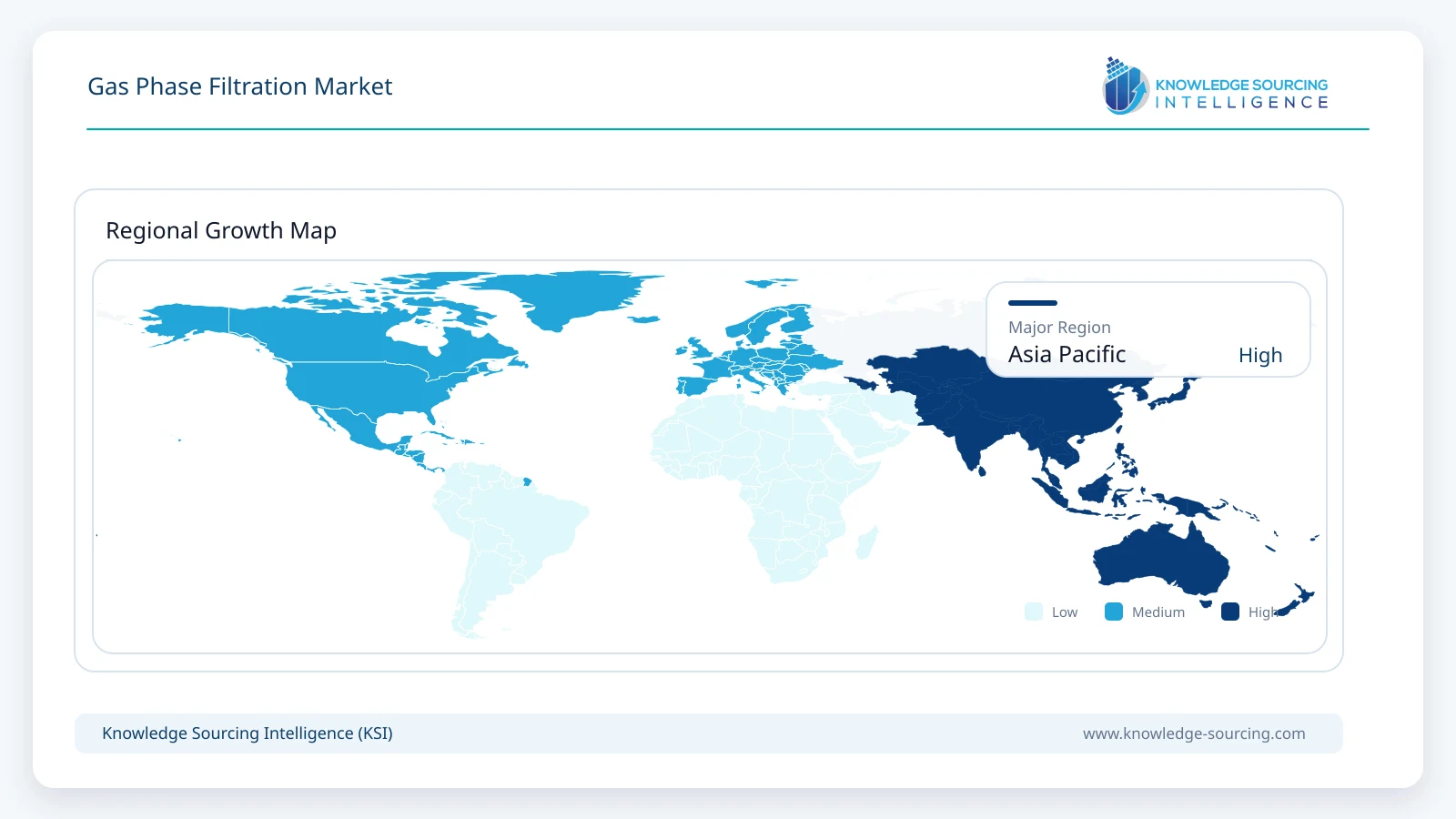
Asia Pacific accounts for approximately 40% of global market value in 2026. China, Taiwan, South Korea and Japan combine large semiconductor and electronics manufacturing industries with chemicals, metals, energy and other process sectors that require gas-phase contamination control.
SEMI’s current fab outlook reinforces the region’s position. China is expected to remain the world’s largest semiconductor-equipment spending market in 2026, while Korea and Taiwan continue investing heavily in memory and leading-edge logic capacity.
India and Southeast Asia add demand from data centres, chemicals, refineries and electronics manufacturing, while regional suppliers such as Bry-Air strengthen the local engineering base.
Middle East & Africa Record the Strongest Regional Growth
Middle East & Africa is projected to grow at approximately 6.0% annually through 2031 from a smaller installed base. Gulf economies combine large petrochemical, refining and fertilizer industries with rapidly expanding data-centre infrastructure, creating applications for corrosion control across industrial and electronic environments.
The growth opportunity remains concentrated rather than uniform across the region. Saudi Arabia and the UAE provide the strongest commercial markets, while industrial and telecom applications in South Africa and selected African economies add incremental demand.
Recent Developments
September 2026, SEMI reported that global semiconductor-equipment billings reached USD 40.53 billion in Q2 2026, increasing 23% year on year and marking a second consecutive record quarter. The expansion strengthens the medium-term installed base for high-specification molecular contamination control in semiconductor facilities.
June 2026, SEMI projected worldwide 300mm memory equipment investment to exceed USD 50 billion during 2026, supported by HBM, DDR5 and advanced data-storage demand associated with AI infrastructure.
April 2026, Camfil published updated data-centre guidance emphasizing maintenance of G1-classified environments to reduce corrosion-related failures in increasingly dense server infrastructure.
April 2026, Purafil highlighted the role of advanced gas-phase filtration in industrial facilities following a major hydrogen sulfide release in West Virginia, reinforcing the importance of filtration as part of broader hazardous-gas risk management.
During 2026, Camfil introduced the AirImage-COR D configuration for high-integrity environments, providing real-time ISA 71.04 corrosion classification through wired connections without integrated wireless hardware.
Competitive Environment
The Gas Phase Filtration Market combines global air-filtration groups, specialist molecular-filtration suppliers and chemical-media manufacturers. Camfil, AAF International and Freudenberg operate broad international portfolios covering molecular filters, adsorption media, monitoring systems and industrial air filtration, allowing them to address data centres, semiconductor facilities and process industries through established global service networks.
Purafil remains one of the most specialized corrosion-control participants, with media, monitoring instruments, positive-pressure systems and modular chemical filtration focused on electronics, industrial and commercial applications. Bry-Air has a similarly strong specialization across India and international markets, combining granular media, honeycomb filters and packaged gas-phase filtration systems.
Circul-Aire and PureAir Filtration compete strongly in engineered dry-scrubber and deep-bed systems where high adsorbent capacity and contaminant-specific media are required. Parker Hannifin and Donaldson add broader industrial-filtration capabilities, while MANN+HUMMEL, MayAir, Kalthoff and EMW participate across advanced HVAC and industrial clean-air applications.
The media side of the market is also strategically important. Kuraray/Calgon Carbon, Jacobi Carbons and Molecular Products provide activated carbon, adsorbents and chemically treated media that can be incorporated into filtration systems supplied by equipment manufacturers.
Competition through 2031 is increasingly likely to shift from selling filters alone toward providing complete contamination-control programmes. Media selection, site testing, corrosion monitoring, predictive replacement and long-term service can generate greater customer value than a standalone filter housing, particularly in semiconductor fabs, data centres and process-control environments where equipment downtime is expensive.
Analyst View
The Gas Phase Filtration Market is projected to increase, representing steady rather than explosive market growth. The underlying requirement is nevertheless becoming more technically important because a growing proportion of demand comes from environments where airborne molecular contaminants can affect electronics, process reliability and production yield.
Traditional packed-bed systems retain the largest market position because high media capacity remains important in chemicals, petrochemicals and heavy industry. Combination filters grow faster as semiconductor fabs, data centres and retrofit HVAC applications seek simultaneous particulate and molecular control without adding large filter banks.
Activated carbon remains the dominant filtration medium, while blended adsorbents gain share because real industrial air streams rarely contain only one contaminant. The same shift toward broader contaminant management is visible in monitoring technology, where corrosion sensors increasingly provide facilities with direct evidence of environmental conditions and support condition-based media replacement.
Semiconductor manufacturing is the strongest incremental end-user opportunity. Record fab investment and the continuing expansion of advanced memory and logic manufacturing create additional high-specification clean environments in which molecular contamination control has direct operational value. Asia Pacific therefore remains the market’s centre of gravity, while the Middle East provides faster growth from petrochemical, fertilizer, refining and emerging data-centre applications.
Gas Phase Filtration Market Scope:
| Report Metric | Details |
|---|---|
| Total Market Size in 2026 | USD 2.54 billion |
| Total Market Size in 2031 | USD 3.16 billion |
| Forecast Unit | Billion |
| Growth Rate | 4.47% |
| Study Period | 2021 to 2031 |
| Historical Data | 2021 to 2024 |
| Base Year | 2025 |
| Forecast Period | 2026 – 2031 |
| Segmentation | Type, Media, Application, End-User |
| Companies |
|
Market Segmentation
By Type
Packed Bed Filters
Combination Filters
By Media
Activated Carbon
Potassium Permanganate
Blend
By Application
Corrosion & Toxic Gas Control
Odor Control
By End-User
Pulp & Paper Industry
Chemicals & Petrochemicals Industry
Metals & Mining Industry
Food & Beverages Industry
Healthcare Industry
Utilities Industry
Semiconductor Manufacturing Industry
Data Centers
Others
By Geography
North America
United States
Canada
Mexico
South America
Brazil
Argentina
Others
Europe
Germany
Netherlands
United Kingdom
France
Others
Middle East and Africa
Saudi Arabia
UAE
South Africa
Others
Asia Pacific
China
Japan
Taiwan
South Korea
India
Singapore
Others
Table of Contents
1. EXECUTIVE SUMMARY
2. MARKET SNAPSHOT
2.1. Market Overview
2.2. Market Definition
2.3. Scope of the Study
2.4. Market Segmentation
3. BUSINESS LANDSCAPE
3.1. Market Drivers
3.2. Market Restraints
3.3. Market Opportunities
3.4. Porter’s Five Forces Analysis
3.5. Industry Value Chain Analysis
3.6. Standards and Regulations
3.7. Strategic Recommendations
4. TECHNOLOGICAL OUTLOOK
4.1. Activated Carbon and Chemisorption Media
4.2. Multi-Media and Blended Adsorbents
4.3. Combination Particulate/Molecular Filters
4.4. Real-Time Corrosion Monitoring
4.5. Condition-Based Media Replacement
5. GAS PHASE FILTRATION MARKET BY TYPE
5.1. Introduction
5.2. Packed Bed Filters
5.3. Combination Filters
6. GAS PHASE FILTRATION MARKET BY MEDIA
6.1. Introduction
6.2. Activated Carbon
6.3. Potassium Permanganate
6.4. Blend
7. GAS PHASE FILTRATION MARKET BY APPLICATION
7.1. Introduction
7.2. Corrosion & Toxic Gas Control
7.3. Odor Control
8. GAS PHASE FILTRATION MARKET BY END-USER
8.1. Introduction
8.2. Pulp & Paper Industry
8.3. Chemicals & Petrochemicals Industry
8.4. Metals & Mining Industry
8.5. Food & Beverages Industry
8.6. Healthcare Industry
8.7. Utilities Industry
8.8. Semiconductor Manufacturing Industry
8.9. Data Centers
8.10. Others
9. GAS PHASE FILTRATION MARKET BY GEOGRAPHY
9.1. Introduction
9.2. North America
9.2.1. United States
9.2.2. Canada
9.2.3. Mexico
9.3. South America
9.3.1. Brazil
9.3.2. Argentina
9.3.3. Others
9.4. Europe
9.4.1. Germany
9.4.2. Netherlands
9.4.3. United Kingdom
9.4.4. France
9.4.5. Others
9.5. Middle East and Africa
9.5.1. Saudi Arabia
9.5.2. UAE
9.5.3. South Africa
9.5.4. Others
9.6. Asia Pacific
9.6.1. China
9.6.2. Japan
9.6.3. Taiwan
9.6.4. South Korea
9.6.5. India
9.6.6. Singapore
9.6.7. Others
10. COMPETITIVE ENVIRONMENT AND ANALYSIS
10.1. Major Players and Strategy Analysis
10.2. Market Share Analysis
10.3. Product and Technology Benchmarking
10.4. Mergers, Acquisitions, Agreements and Collaborations
10.5. Competitive Dashboard
11. COMPANY PROFILES
11.1. Daikin Industries
11.2. Camfil AB
11.3. Freudenberg Filtration Technologies
11.4. Purafil, Inc.
11.5. Bry-Air (Asia) Pvt. Ltd.
11.6. Circul-Aire Inc.
11.7. PureAir Filtration, LLC
11.8. Parker Hannifin Corporation
11.9. Donaldson Company, Inc.
11.10. MANN+HUMMEL
11.11. MayAir Group plc
11.12. Kalthoff Luftfilter und Filtermedien GmbH
11.13. EMW Filtertechnik GmbH
11.14. Kuraray Co., Ltd.
11.15. Jacobi Carbons Group
11.16. Molecular Products Group
12. APPENDIX
12.1. Currency
12.2. Assumptions
12.3. Base and Forecast Years Timeline
12.4. Key Benefits for Stakeholders
12.5. Research Methodology
12.6. Abbreviations
Navigate
Trusted by the world's leading organizations











