
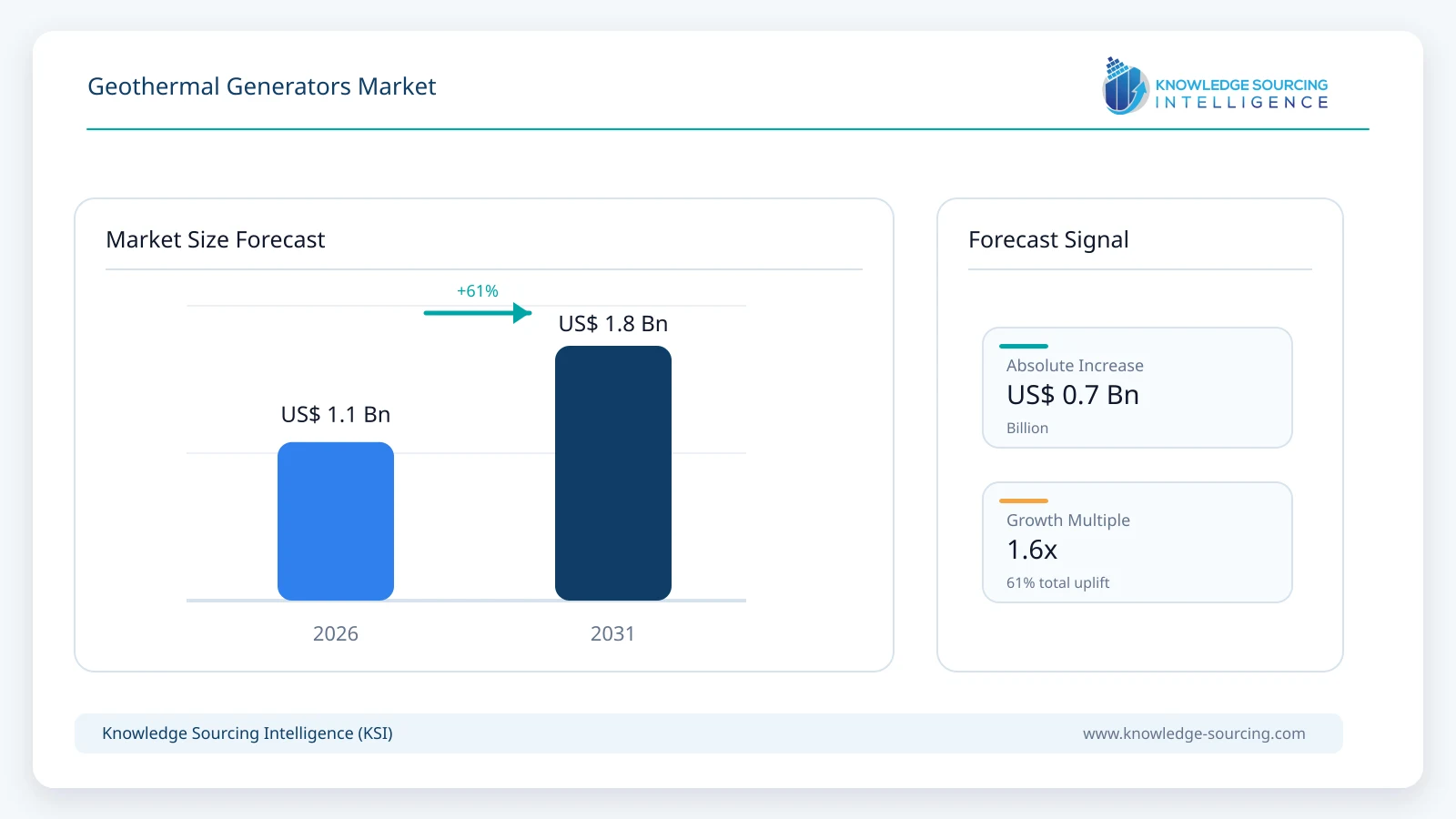
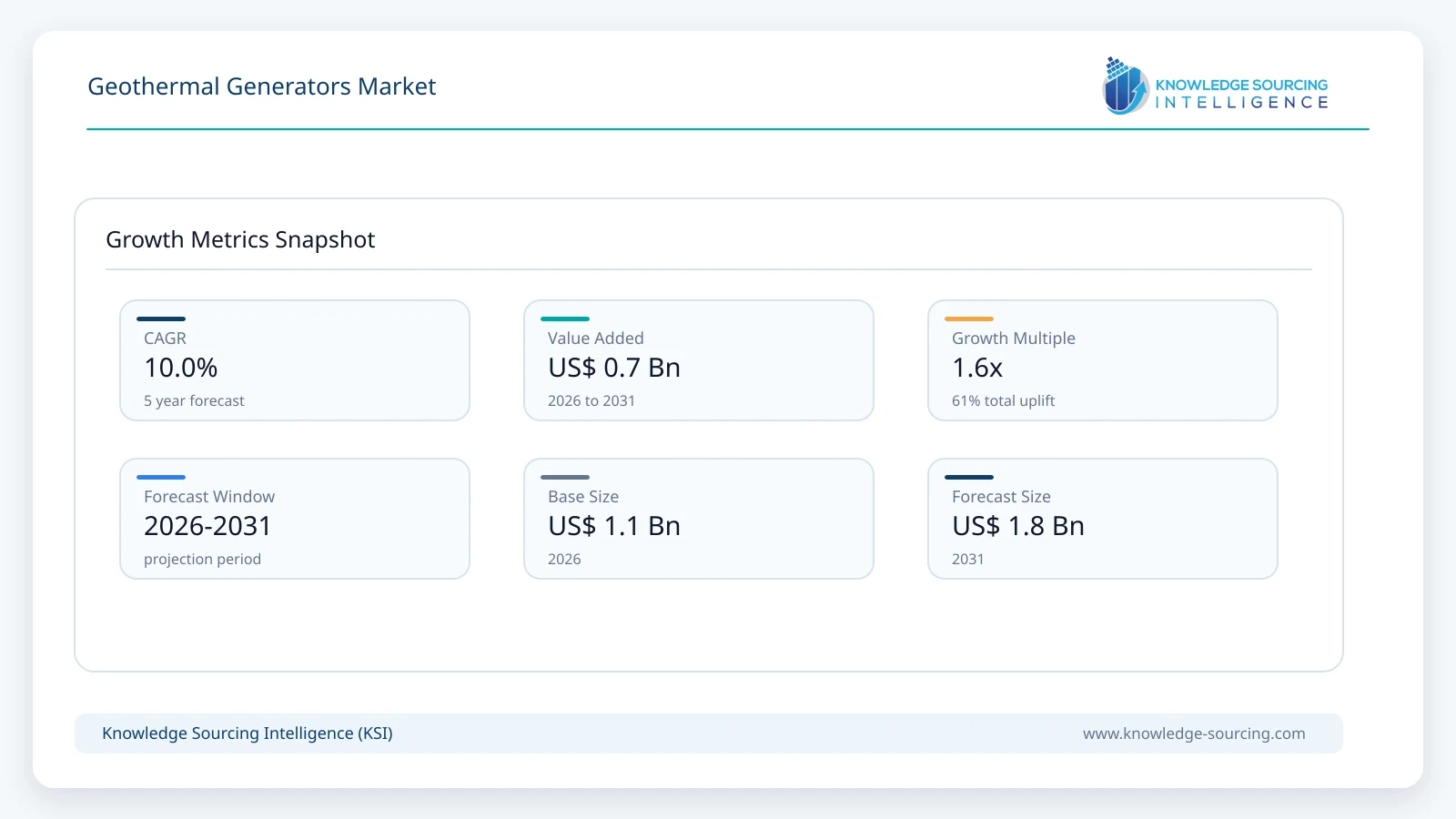
The geothermal generators market is forecast to grow from USD 1.12 billion in 2026 to USD 1.80 billion in 2031, representing a CAGR of 10.0% during the forecast period.
Highlights:
- 1Flash-steam turbine-generator systems remain the largest technology segment in 2026, accounting for an estimated 46.0% of market revenue, supported by large hydrothermal projects in Indonesia, the Philippines, Kenya, New Zealand and other high-enthalpy regions.
- 2Binary and ORC systems are the fastest-growing technology segment, with an estimated 13.4% CAGR through 2031 as lower-temperature resources, EGS and modular power-block architectures expand the addressable market.
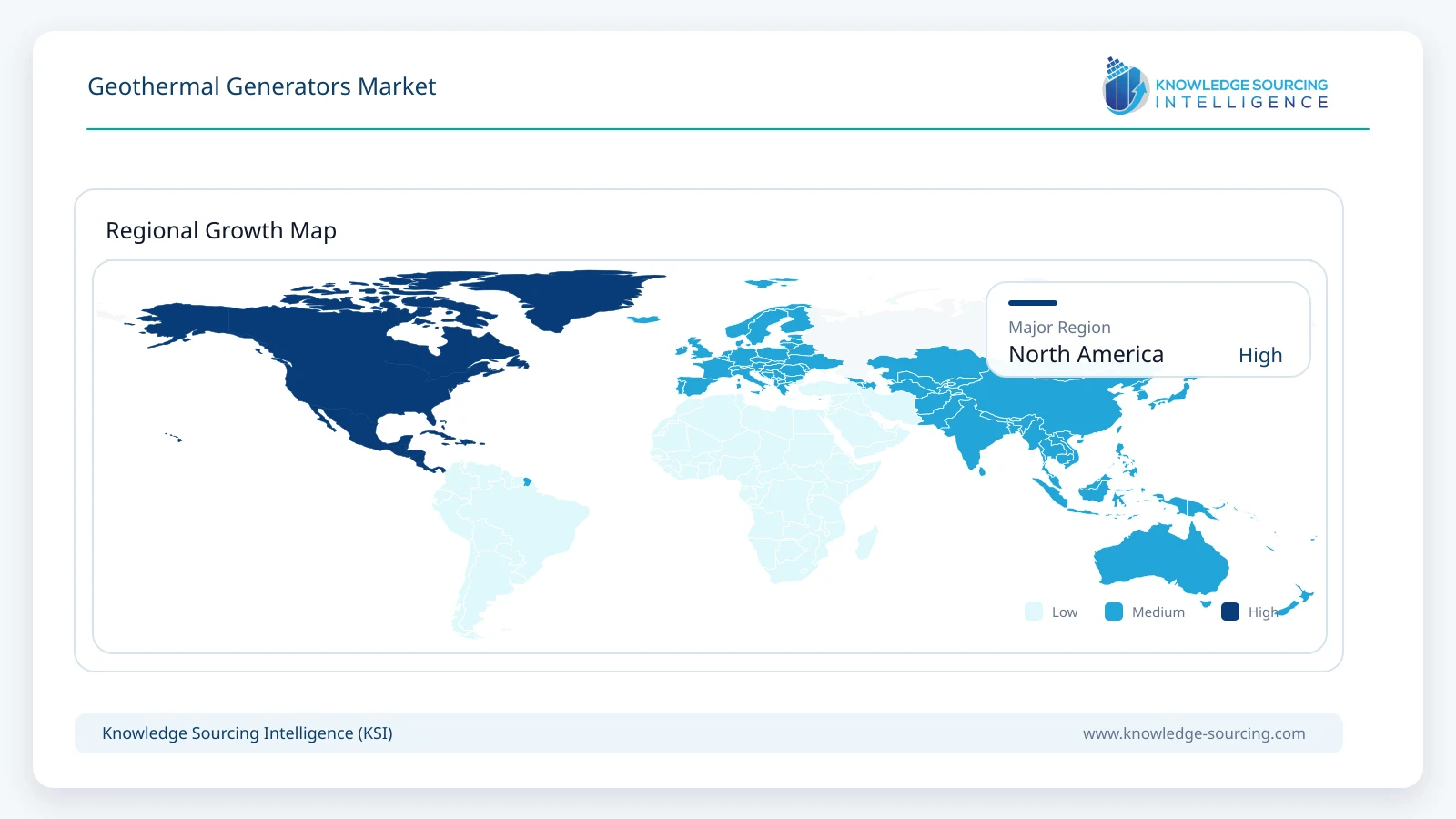
- 3Asia Pacific is the largest regional market in 2026 due to sustained development in Indonesia, the Philippines, Japan and New Zealand, while North America is expected to record the fastest growth as next-generation geothermal projects move into commercial-scale deployment.
- 4The supplier landscape is broadening beyond traditional geothermal steam-turbine OEMs as ORC specialists, turboexpander suppliers and modular power-generation companies compete for EGS and brownfield expansion projects.
Market Overview
Geothermal electricity remains a small share of global renewable capacity, but it is differentiated by high utilization and dispatchable output. IRENA reported approximately 15.4 GW of geothermal power capacity at the end of 2024 and about 320 MW of new capacity commissioned during the year. Newly commissioned geothermal plants in IRENA's 2024 cost database recorded an 88% weighted-average capacity factor, reinforcing the role of geothermal as firm renewable generation rather than an intermittent resource.
The equipment market is entering a period of stronger project activity. IEA expects annual geothermal capacity additions in 2030 to reach a record level approximately three times the 2024 increase. This is being supported by conventional development in countries with established hydrothermal resources and by new-generation systems that apply horizontal drilling, reservoir engineering and modular surface power plants to resources that were previously uneconomic or inaccessible.
The change is particularly important for generator suppliers because EGS and lower-temperature projects tend to favor repeatable binary power blocks. The U.S. Department of Energy notes that next-generation geothermal could materially expand accessible resources, while Fervo Energy's Cape Station development is creating a commercial reference for standardized 50-60 MW ORC blocks. In April 2026, Turboden and Fervo announced a framework covering up to 35 GeoBlocks totaling 1.75 GW, demonstrating a procurement model that can shift geothermal surface-generation equipment from project-by-project customization toward repeatable platform supply.
Market Drivers
Commercialization of next-generation geothermal and EGS
The strongest incremental demand signal is the transition of enhanced geothermal systems from demonstration toward commercial deployment. DOE has cited substantial cost reductions in drilling and reservoir development and identifies surface power plant cost as a distinct component of EGS economics. Commercial developers are now placing multi-unit equipment orders rather than single demonstration-unit orders. This creates demand for standardized turbines, expanders, generators, controls and heat-to-power packages, while also encouraging OEMs to increase manufacturing capacity and shorten lead times.
Conventional geothermal additions and field optimization
Conventional geothermal development remains important, particularly in Indonesia and other Asia Pacific markets. Fuji Electric received a 2025 contract for key geothermal equipment, including a steam turbine and generator, for Muara Laboh Stage 2 in Indonesia. Toshiba has also secured recent Indonesian orders for Wayang Windu Unit 3 and Patuha Unit 2. Alongside new plants, operators are adding binary bottoming units to capture energy from separated brine and are replacing aging turbine-generator sets, supporting demand even where completely new geothermal fields are limited.
Need for firm low-emission power
Electricity systems are adding large volumes of solar and wind capacity, increasing the strategic value of renewable generation that can operate continuously. Geothermal projects typically provide high capacity factors and can support data centers, industrial loads and grid reliability without fuel-price exposure. This value proposition is strengthening interest in geothermal PPAs and in generator technologies that can operate efficiently across changing well temperatures, pressures and flows.
Market Restraints
Long development timelines and resource risk: geothermal exploration, permitting, drilling and reservoir confirmation can delay equipment orders and create uneven annual demand.
High site specificity: steam chemistry, non-condensable gases, scaling, corrosion, temperature and flow rates often require project-specific turbine and generator engineering.
Small historical annual additions: despite strong long-term potential, geothermal deployment remains far below solar and wind volumes, limiting manufacturing scale for some specialized equipment.
Capital intensity and financing risk: even where surface power equipment is commercially mature, subsurface uncertainty can affect project bankability and procurement timing.
Segment Analysis
By Conversion Technology
Flash-steam turbine-generator systems account for an estimated 46.0% of 2026 market revenue, making them the largest segment. Flash technology remains the standard choice for high-temperature liquid-dominated hydrothermal resources and is used in major geothermal fleets across Indonesia, the Philippines, Kenya and other established markets. Large unit sizes and technically demanding steam conditions support a comparatively high equipment value per project.
Binary/ORC expander-generator systems are projected to grow fastest, at an estimated 13.4% CAGR from 2026 to 2031. Binary plants can exploit lower-temperature resources and separated brines while keeping geothermal fluid isolated from the turbine working fluid. The technology is also central to several next-generation geothermal developments. Turboden, Baker Hughes, Ormat, Exergy, Siemens Energy, Atlas Copco, Kaishan and other suppliers are expanding ORC or turboexpander offerings for this opportunity.
By Unit Output
The 10-50 MW class is becoming strategically important because it aligns with modular binary power blocks, wellhead developments and phased geothermal expansion. Larger >50 MW units remain important in high-enthalpy flash projects, while smaller units below 10 MW serve wellhead generation, distributed projects, demonstration plants and certain brownfield recovery applications.
By Project Type
Greenfield plants remain the main source of generator demand, but brownfield expansion and repowering represent a meaningful recurring market. Aging geothermal fleets require turbine rotor replacement, corrosion-resistant upgrades, generator refurbishment and efficiency improvements. Binary bottoming systems can also increase output from existing fields without requiring an entirely new geothermal resource.
Geographic Analysis
Asia Pacific
Asia Pacific is estimated to account for approximately 44% of geothermal generator revenue in 2026. Indonesia is the largest near-term equipment opportunity in the region, supported by a large project pipeline and recent turbine-generator orders involving Fuji Electric, Toshiba, Ormat and other suppliers. The Philippines continues to optimize mature fields through binary additions, while Japan and New Zealand support demand for conventional, binary and replacement equipment.
North America
North America is expected to record the fastest growth through 2031. The United States has the world's largest installed geothermal fleet and therefore a meaningful aftermarket and repowering base. More importantly, next-generation geothermal is creating new-build demand. Fervo's Cape Station development and the associated equipment awards to Turboden and Baker Hughes illustrate the move toward multi-unit ORC procurement at scales much larger than historical binary projects.
Europe
European demand is concentrated in Italy, Iceland, Türkiye, Germany and emerging projects that integrate geothermal power with district heating or lithium extraction. Binary systems are particularly relevant because many European resources are medium-temperature. Turboden's 32 MWe award for Vulcan Energy's Lionheart project in Germany illustrates the crossover between geothermal power generation and strategic industrial applications.
Middle East & Africa and Latin America
East Africa remains an important conventional geothermal market, led by Kenya and supported by additional resource development across the Rift Valley. Latin America offers opportunities in Mexico, Central America and Andean markets, though project execution can be uneven. Generator demand in these regions includes both new equipment and rehabilitation of existing geothermal fleets.
Competitive Environment
Competition is divided between established steam turbine-generator OEMs and specialists in binary/ORC power conversion. Conventional high-enthalpy projects favor suppliers with geothermal steam-path experience, corrosion-resistant materials, large generators and long installed references. Binary projects place greater emphasis on working-fluid optimization, turboexpander efficiency, modularity, heat-exchanger integration and controls.
The competitive structure is changing as EGS developers seek repeatable surface architectures. Long-term framework agreements can give selected vendors visibility over multi-gigawatt pipelines, while traditional OEMs are responding with expanded ORC offerings and geothermal-specific service capabilities. Aftermarket performance is also important because geothermal equipment operates continuously in corrosive environments and plant owners value lifetime support, retrofit capability and output recovery.
Recent Developments
April 2026: Turboden and Fervo Energy announced a three-year framework agreement for ORC units covering up to 35 standardized GeoBlocks totaling 1.75 GW. The agreement expands the visible equipment pipeline for next-generation geothermal in the United States.
September 2025: Baker Hughes announced an award from Fervo Energy to supply equipment for five approximately 60 MWe ORC plants at Cape Station Phase II, including turboexpanders and BRUSH generators.
May 2025: Fuji Electric received an order to manufacture and supply geothermal generation equipment, including a steam turbine and generator, for the Muara Laboh Stage-2 project in Indonesia.
The geothermal generators market is moving from a relatively narrow hydrothermal-equipment niche toward a broader power-conversion market that includes conventional steam turbines, modular ORC systems, wellhead units and equipment for EGS. Conventional projects will continue to provide large individual orders, particularly in Asia Pacific, while North American next-generation geothermal could materially increase annual equipment volumes if current multi-project pipelines convert into construction.
The most important structural change through 2031 is expected to be the rising share of binary and ORC systems. Their ability to use lower-temperature resources, support standardized module sizes and integrate with EGS makes them well suited to the next phase of geothermal deployment. At the same time, the installed base of conventional plants will sustain a recurring retrofit and replacement market for steam turbines, generators and corrosion-resistant components.
Geothermal Generators Market Scope
| Report Metric | Details |
|---|---|
| Total Market Size in 2026 | USD 1.12 billion |
| Total Market Size in 2031 | USD 1.80 billion |
| Forecast Unit | Billion |
| Growth Rate | 10.0% |
| Study Period | 2021 to 2031 |
| Historical Data | 2021 to 2024 |
| Base Year | 2025 |
| Forecast Period | 2026 – 2031 |
| Segmentation | Conversion Technology, Unit Output, Project Type, Geography |
| Companies |
|
Market Segmentation
By Conversion Technology
Flash Steam Turbine-Generator Systems
Binary / Organic Rankine Cycle (ORC) Expander-Generator Systems
Dry Steam Turbine-Generator Systems
Hybrid and Other Power-Conversion Systems
By Unit Output
Up to 10 MW
Above 10 MW to 50 MW
Above 50 MW
By Project Type
Greenfield Power Plants
Brownfield Expansion and Bottoming-Cycle Projects
Replacement, Retrofit and Repowering
By Geography
North America
United States
Canada
Mexico
South America
Chile
Argentina
Other South American Markets
Europe
Italy
Iceland
Türkiye
Germany
Other European Markets
Middle East and Africa
Kenya
Ethiopia
Other Middle East and African Markets
Asia Pacific
Indonesia
Philippines
Japan
New Zealand
Other Asia Pacific Markets
Table of Contents
1. INTRODUCTION
1.1 Market Definition and Scope
1.2 Market Segmentation
1.3 Currency and Units
1.4 Base Year and Forecast Period
2. RESEARCH METHODOLOGY
3. EXECUTIVE SUMMARY
3.1 Key Research Highlights
4. MARKET DYNAMICS
4.1 Market Drivers
4.1.1 Commercialization of Enhanced Geothermal Systems and Next-Generation Geothermal
4.1.2 Expansion of Conventional Hydrothermal Capacity
4.1.3 Growing Need for Firm Low-Emission Power
4.1.4 Repowering and Optimization of Existing Geothermal Fields
4.2 Market Restraints
4.2.1 Exploration and Reservoir Risk
4.2.2 Long Permitting and Development Timelines
4.2.3 Corrosion, Scaling and Site-Specific Engineering Requirements
4.3 Market Opportunities
4.3.1 Modular ORC Power Blocks for EGS
4.3.2 Binary Bottoming Systems for Existing Fields
4.3.3 Geothermal Power for Data Centers and Industrial Loads
4.4 Industry Value Chain Analysis
5. GEOTHERMAL GENERATORS MARKET, BY CONVERSION TECHNOLOGY
5.1 Introduction
5.2 Flash Steam Turbine-Generator Systems
5.3 Binary / Organic Rankine Cycle (ORC) Expander-Generator Systems
5.4 Dry Steam Turbine-Generator Systems
5.5 Hybrid and Other Power-Conversion Systems
6. GEOTHERMAL GENERATORS MARKET, BY UNIT OUTPUT
6.1 Up to 10 MW
6.2 Above 10 MW to 50 MW
6.3 Above 50 MW
7. GEOTHERMAL GENERATORS MARKET, BY PROJECT TYPE
7.1 Greenfield Power Plants
7.2 Brownfield Expansion and Bottoming-Cycle Projects
7.3 Replacement, Retrofit and Repowering
8. GEOTHERMAL GENERATORS MARKET, BY GEOGRAPHY
8.1 North America
8.1.1 United States
8.1.2 Canada
8.1.3 Mexico
8.2 South America
8.2.1 Chile
8.2.2 Argentina
8.2.3 Other South American Markets
8.3 Europe
8.3.1 Italy
8.3.2 Iceland
8.3.3 Türkiye
8.3.4 Germany
8.3.5 Other European Markets
8.4 Middle East and Africa
8.4.1 Kenya
8.4.2 Ethiopia
8.4.3 Other Middle East and African Markets
8.5 Asia Pacific
8.5.1 Indonesia
8.5.2 Philippines
8.5.3 Japan
8.5.4 New Zealand
8.5.5 Other Asia Pacific Markets
9. COMPETITIVE ENVIRONMENT AND ANALYSIS
9.1 Major Players and Strategy Analysis
9.2 Technology and Product Positioning
9.3 Recent Contracts, Partnerships and Capacity Expansion
9.4 Competitive Landscape
10. COMPANY PROFILES
10.1 Ormat Technologies, Inc.
10.2 Fuji Electric Co., Ltd.
10.3 Toshiba Energy Systems & Solutions Corporation
10.4 Mitsubishi Power, Ltd.
10.5 Turboden S.p.A.
10.6 Baker Hughes Company
10.7 Exergy International S.r.l.
10.8 Siemens Energy AG
10.9 Ansaldo Energia S.p.A.
10.10 Kaishan Group Co., Ltd.
10.11 Atlas Copco Gas and Process
10.12 Enertime SA
10.13 Triveni Turbine Limited
10.14 Taiyo Electric Co., Ltd.
10.15 Cryostar SAS
11. APPENDIX
Navigate
Trusted by the world's leading organizations











