
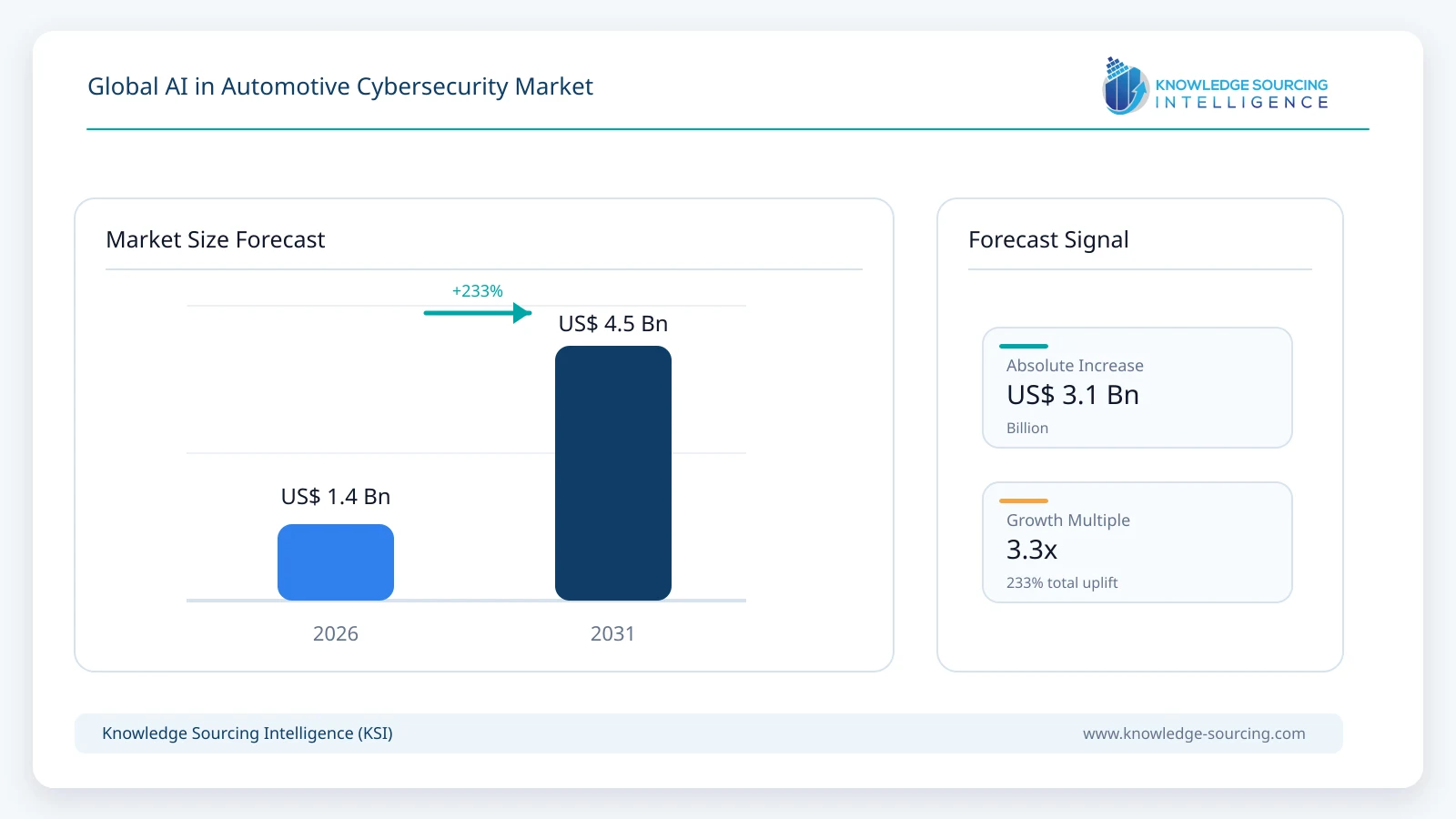
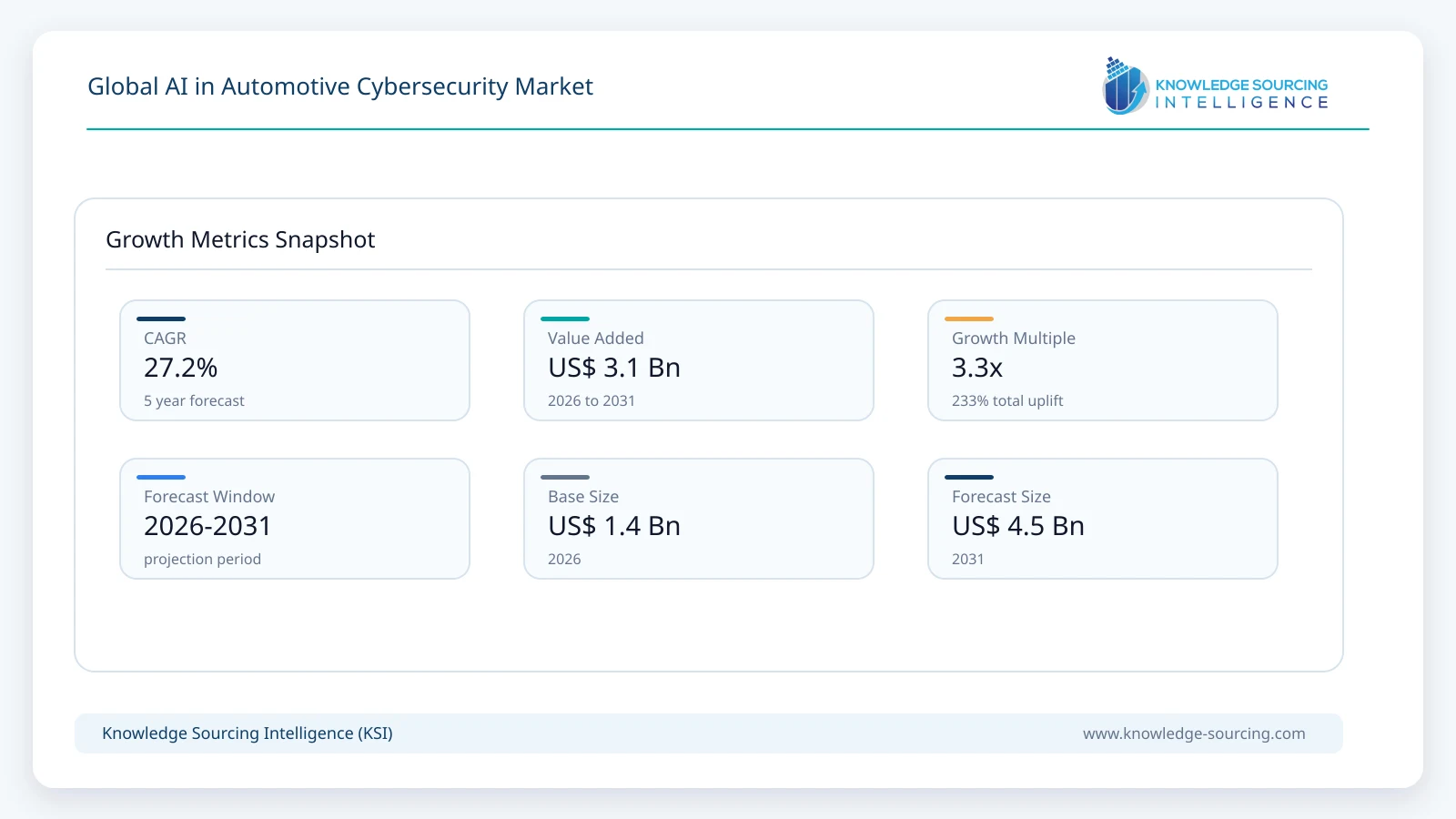
The Global AI in Automotive Cybersecurity Market is anticipated to grow from USD 1.35 billion in 2026 to USD 4.50 billion by 2031, at a CAGR of 27.2%.
Highlights:
- 1AI is moving automotive cybersecurity from rules-based detection toward behavioral, predictive and context-aware threat analysis.
- 2Vehicle security operations centers increasingly require AI to process telemetry across vehicles, cloud services and enterprise systems.
- 3VicOne reported 610 major automotive cyber incidents in 2025, with cross-region and multi-business incidents more than tripling.
- 4Upstream Security reported that ransomware attacks targeting automotive and smart mobility more than doubled during 2025.
- 5Edge AI is increasingly embedded directly into electronic control units for real-time intrusion detection and autonomous response.
- 6AI-assisted threat analysis and risk assessment can reduce manual effort required for ISO/SAE 21434 and UN R155 compliance workflows.
- 7Generative and agentic AI introduce new attack surfaces, creating demand for security controls that protect both vehicles and AI models.
- 8Software-defined vehicles expand the post-production market for continuous monitoring, vulnerability prioritization and cyber incident response.
Automotive cybersecurity is changing as vehicles become persistent software platforms rather than fixed electronic products. Centralized compute, over-the-air updates, cloud APIs, app ecosystems and connected charging infrastructure create a continuous stream of software changes and telemetry. Traditional signature-based controls remain necessary, but they are increasingly supplemented by machine learning models that detect behavioral anomalies, correlate events across multiple domains and prioritize suspicious activity before a known attack signature exists.
Artificial intelligence is being applied across both product development and post-production security. During vehicle development, AI can support automated asset mapping, Threat Analysis and Risk Assessment (TARA), vulnerability triage and compliance evidence generation. After vehicles enter service, AI-based Vehicle Detection and Response (VDR), Extended Detection and Response (XDR) and Vehicle Security Operations Center (VSOC) platforms monitor fleet behavior and correlate in-vehicle signals with backend, mobile application and enterprise data.
The technology also creates a dual security challenge. AI helps defenders identify attacks more quickly, but AI-enabled vehicle functions introduce model, data and interface risks of their own. Automotive security teams therefore need to protect not only conventional software and network communications but also large language model interfaces, perception systems, AI-powered cockpits and automated decision systems.
AI Cybersecurity Capability Comparison
AI Capability | Primary Automotive Use | Deployment Point | Commercial Value |
Anomaly and Intrusion Detection | Identify abnormal CAN, Ethernet, ECU and application behavior | In-vehicle / edge | Detects unknown and zero-day attack patterns beyond static signatures |
Vehicle Detection and Response | Correlate fleet, cloud and vehicle events | Cloud / VSOC | Improves investigation speed and fleet-wide incident prioritization |
AI-Assisted TARA and Compliance | Automate asset mapping, threat paths, controls and evidence | Engineering / CSMS | Reduces manual cybersecurity assessment workload |
Vulnerability Prioritization | Rank software and supply-chain vulnerabilities by vehicle impact | Cloud / engineering | Focuses remediation on vulnerabilities that materially affect deployed vehicles |
Predictive Threat Intelligence | Anticipate attack techniques and emerging exposure | Cloud / SOC | Supports proactive mitigation and security planning |
AI Model and GenAI Protection | Detect prompt, model, data and AI-service attacks | Vehicle / cloud | Protects AI-powered cockpit and software-defined vehicle functions |
Market Dynamics
Software-Defined Vehicles Require Continuous Detection Rather Than One-Time Validation
Automotive cybersecurity increasingly extends beyond vehicle launch. Software-defined vehicles receive frequent updates, connect to external services and use centralized compute platforms that can expose multiple functions to the same vulnerability. Continuous monitoring allows manufacturers to identify abnormal fleet behavior, investigate newly disclosed vulnerabilities and determine whether affected software is deployed across specific vehicles. AI becomes valuable because the volume of telemetry and software dependencies is difficult to analyze manually at fleet scale.
Regulation and Standards Increase the Need for Scalable Cybersecurity Workflows
UN Regulation No. 155 requires manufacturers operating in participating markets to maintain a Cybersecurity Management System, while ISO/SAE 21434 provides lifecycle cybersecurity engineering requirements for road vehicles. The standard covers concept, development, production, operation, maintenance and decommissioning. As software inventories and supplier dependencies expand, AI-assisted assessment platforms can reduce the time needed to update threat models, prioritize vulnerabilities and maintain evidence for cybersecurity cases.
AI-Enabled Vehicles Create New Security Risks
Vehicle manufacturers are introducing AI-powered assistants, perception systems, predictive services and autonomous functions. These capabilities create additional risks around model manipulation, untrusted inputs, privacy, training data and connections between AI services and vehicle functions. VicOne and P3 demonstrated automotive-grade security for AI-driven cockpits at CES 2026, while industry work increasingly focuses on securing AI components alongside conventional vehicle networks.
False Positives, Explainability and Safety Constraints Limit Full Automation
Automotive security systems cannot respond aggressively to every anomaly because inappropriate intervention can affect vehicle availability or safety. Machine learning models also need to explain why activity is considered suspicious and distinguish genuine attacks from unusual but legitimate vehicle behavior. Human oversight therefore remains important, particularly when AI recommendations lead to software blocking, fleet-wide remediation or regulatory reporting.
Technology Outlook
Edge AI Intrusion Detection
Edge AI places machine learning close to the electronic control unit or vehicle network so suspicious behavior can be identified with minimal latency. VicOne and Trustonic launched a layered ECU-level solution in April 2026 combining xCarbon intrusion detection and prevention, a trusted execution environment and edge AI. The approach allows vehicle signals to be correlated locally while preserving a protected environment for security operations.
AI-Enabled Vehicle Detection and Response
Vehicle Detection and Response platforms combine in-vehicle telemetry with cloud, backend and external threat intelligence. PlaxidityX vCore and Upstream Security's mobility-focused XDR platform use analytics to provide fleet-wide visibility and prioritize threats. The technology is becoming important as cyber incidents increasingly span vehicles, cloud systems, mobile services and enterprise infrastructure rather than remaining inside one ECU.
Automated Threat Analysis and Risk Assessment
TARA is traditionally expert-intensive because teams must identify assets, attack paths, controls and residual risk across complex electronic architectures. AI-assisted tools can automate portions of this work while keeping cybersecurity engineers in the review loop. L&T Technology Services' CySAF uses knowledge-grounded AI agents for asset mapping, threat analysis, control mapping and remediation generation, while VicOne and Saphira are linking live supplier vulnerabilities to TARA reassessment.
AI Security for Intelligent Cockpits and GenAI
In-vehicle generative AI introduces interfaces that can receive open-ended user input and interact with cloud services, vehicle data or applications. Security therefore needs to address model misuse, data leakage, malicious prompts and unsafe tool access. Automotive cybersecurity vendors are beginning to combine conventional runtime protection with AI-model and cockpit security as large language model-based assistants move into production vehicles.
Global AI in Automotive Cybersecurity Market Segment Analysis
By AI Function
Threat detection and anomaly analytics are among the most mature AI applications because connected vehicles generate large volumes of network and behavioral data. Vulnerability prioritization and TARA automation are growing rapidly as software-defined vehicle development increases the number of components and dependencies that security teams must assess. AI-model security remains earlier in commercialization but is becoming more important as generative AI enters the cockpit.
By Security Domain
In-vehicle security uses AI for Controller Area Network (CAN), Ethernet, electronic control unit and application monitoring. Cloud and backend security focuses on APIs, connected services and fleet platforms, while VSOC solutions correlate information across both domains. Supply-chain security is also gaining importance because vulnerabilities in third-party libraries and supplier software can affect large numbers of vehicles simultaneously.
By Vehicle Architecture
Software-defined vehicles create the strongest use case because centralized compute and frequent software updates increase both data availability and cyber exposure. Connected conventional vehicles also use AI-based monitoring, particularly through cloud platforms. Autonomous and highly automated vehicles add further requirements because cybersecurity events can affect sensor processing, decision systems and operational availability.
By End User
Vehicle manufacturers are the principal buyers of fleet-scale detection, CSMS and VSOC platforms. Tier 1 suppliers use AI-assisted cybersecurity engineering and component-level protection to meet OEM requirements. Fleet operators and mobility providers increasingly need monitoring for connected vehicle services, while engineering-service companies use AI to accelerate security assessment and compliance work.
By Deployment
Cloud-based AI is well suited to fleet correlation, threat intelligence and vulnerability analysis, while edge AI supports low-latency in-vehicle detection. Hybrid architectures are likely to remain important because automotive cybersecurity requires both immediate local protection and fleet-wide context. Data sovereignty and safety requirements can also influence where models are deployed.
Market and Demand Indicators
Indicator | Latest Development | Market Impact |
Cyber incident scale | VicOne recorded 610 automotive cyber incidents in 2025, including 161 cross-region or multi-business cases. | Raises demand for cross-domain analytics rather than isolated ECU security. |
Automotive vulnerabilities | VicOne reported 1,384 automotive vulnerabilities during 2025. | Increases the workload for AI-assisted prioritization and TARA updates. |
Ransomware pressure | Upstream Security reported in February 2026 that automotive and smart-mobility ransomware attacks more than doubled in 2025. | Supports continuous threat monitoring and AI-based incident detection. |
OEM AI cyber adoption | Stellantis announced on April 16, 2026 that it would strengthen its global cyber defense center with AI-driven analytics. | Demonstrates direct OEM investment in AI-based cyber operations. |
Edge AI protection | VicOne and Trustonic launched an ECU-level IDPS, trusted execution environment and edge-AI solution on April 14, 2026. | Shows AI cybersecurity moving directly into vehicle compute platforms. |
Cybersecurity standardization | ISO/SAE 21434 defines lifecycle cybersecurity engineering requirements for road-vehicle electrical and electronic systems. | Creates recurring engineering and compliance workflows that AI tools can automate. |
Europe Market Analysis
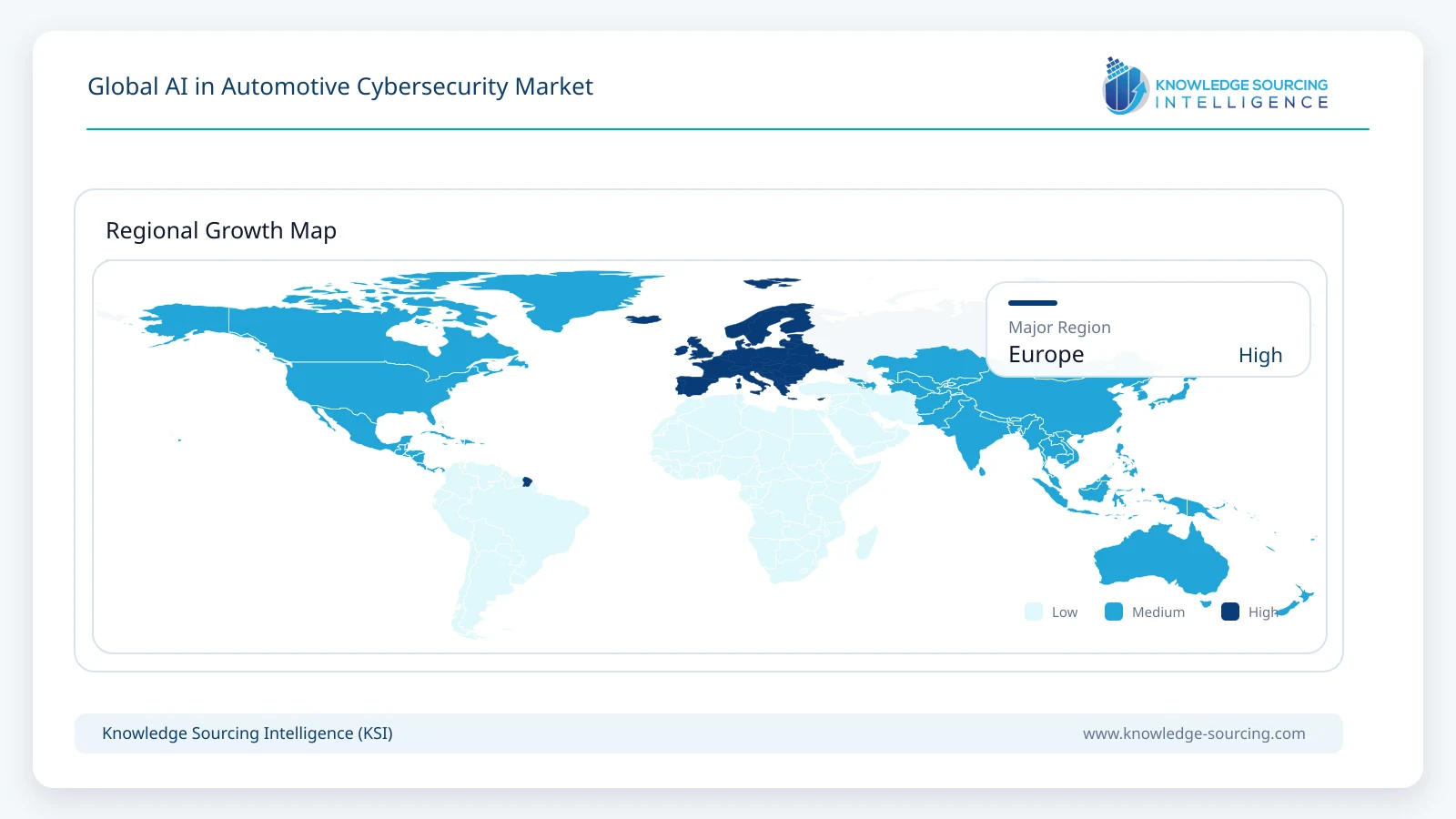
Europe is a major market for AI-enabled automotive cybersecurity because cybersecurity requirements are closely tied to vehicle type approval and software-defined vehicle programs. UN Regulation No. 155 establishes requirements around cybersecurity and Cybersecurity Management Systems, while ISO/SAE 21434 provides a widely used engineering framework across vehicle lifecycles. European OEMs and suppliers therefore need security processes that can scale across multiple platforms, suppliers and post-production software updates.
The region also contains a dense ecosystem of automotive cybersecurity specialists and engineering suppliers. Argus Cyber Security, ETAS, Vector Informatik and other European or Europe-focused companies support in-vehicle protection, cybersecurity engineering and operational monitoring. In January 2026, Skoda partnered with Upstream Security to consolidate cyber threat intelligence and risk information across its connected-vehicle ecosystem, reflecting a shift toward unified, data-driven cybersecurity operations.
AI adoption is expected to be strongest in VSOC analytics, vulnerability management, cybersecurity assessment and software-defined vehicle runtime protection. The increasing use of generative AI inside infotainment and cockpit systems will create an additional market for model-aware security controls, while regulatory evidence requirements will continue to support AI-assisted engineering and compliance platforms.
Competitive Landscape
The market includes specialist automotive cybersecurity vendors, engineering-tool providers, enterprise security companies and automotive software suppliers. Upstream Security, VicOne and PlaxidityX compete in AI-powered fleet monitoring, threat detection and response. Argus Cyber Security, ETAS, AUTOCRYPT, Karamba Security and C2A Security address different combinations of in-vehicle protection, security operations and cybersecurity lifecycle management. L&T Technology Services and VxLabs are using AI to automate assessment and compliance workflows.
Competition is increasingly based on automotive context rather than generic machine-learning capability. Effective platforms must understand vehicle architecture, software bills of materials, communication protocols, fleet configurations, supplier dependencies and regulatory evidence. Vendors with access to large-scale vehicle telemetry and vulnerability datasets can improve prioritization and anomaly detection, while engineering-focused platforms differentiate through integration with development tools and TARA processes.
Recent Developments
June 3, 2026: PlaxidityX announced that its AI-powered vCore Vehicle Cyber Protection system had received the 2026 AutoTech & Wards Cybersecurity Excellence Award.
May 28, 2026: VicOne and Saphira announced an integration linking supplier vulnerability detection with live Threat Analysis and Risk Assessment updates for automotive OEMs and Tier 1 suppliers.
April 23, 2026: VicOne and Intellias announced a partnership integrating advanced intrusion detection and AI protection capabilities into Intellias' software-defined vehicle technology platform.
April 16, 2026: Stellantis and Microsoft announced a five-year collaboration that includes AI-driven analytics for Stellantis' global cyber defense center covering vehicles, customers and operations.
April 14, 2026: VicOne and Trustonic launched an ECU-level layered cybersecurity solution combining intrusion detection and prevention, a trusted execution environment and edge AI.
January 13, 2026: Skoda selected Upstream Security to centralize cyber threat intelligence and risk information across its connected-vehicle ecosystem.
January 5, 2026: VicOne and P3 digital services announced a CES 2026 demonstration of automotive-grade AI security for AI-driven intelligent cockpits.
Global AI in Automotive Cybersecurity Market Scope:
| Report Metric | Details |
|---|---|
| Total Market Size in 2026 | USD 1.35 billion |
| Total Market Size in 2031 | USD 4.50 billion |
| Forecast Unit | USD Billion |
| Growth Rate | 27.2% |
| Study Period | 2021 to 2031 |
| Historical Data | 2021 to 2024 |
| Base Year | 2025 |
| Forecast Period | 2026 – 2031 |
| Segmentation | AI Function, Security Domain, Vehicle Architecture, End User, Deployment, Geography |
| Companies |
|
Market Segmentation
By AI Function
Anomaly and Intrusion Detection
Vehicle Detection and Response
TARA and Compliance Automation
Vulnerability Prioritization
Predictive Threat Intelligence
AI Model and GenAI Protection
By Security Domain
In-Vehicle Security
Cloud and Backend Security
Vehicle Security Operations Center
Supply-Chain and Software Vulnerability Security
Application and API Security
By Vehicle Architecture
Connected Vehicles
Software-Defined Vehicles
Autonomous and Highly Automated Vehicles
By End User
Automotive OEMs
Tier 1 and Tier 2 Suppliers
Fleet and Mobility Operators
Engineering and Cybersecurity Service Providers
By Deployment
Cloud
In-Vehicle / Edge
Hybrid
By Geography
North America
United States
Canada
Mexico
South America
Brazil
Argentina
Rest of South America
Europe
Germany
United Kingdom
France
Italy
Rest of Europe
Middle East and Africa
Saudi Arabia
United Arab Emirates
South Africa
Rest of Middle East and Africa
Asia Pacific
China
Japan
India
South Korea
Rest of Asia Pacific
Table of Contents
1. EXECUTIVE SUMMARY
2. MARKET SNAPSHOT
2.1. Market Overview
2.2. Market Segmentation
3. BUSINESS LANDSCAPE
3.1. Market Drivers
3.1.1. Software-Defined Vehicles Require Continuous Detection Rather Than One-Time Validation
3.1.2. Regulation and Standards Increase the Need for Scalable Cybersecurity Workflows
3.1.3. AI-Enabled Vehicles Create New Security Risks
3.2. Market Restraints
3.2.1. False Positives, Explainability and Safety Constraints Limit Full Automation
3.3. Market Opportunities
3.4. Porter's Five Forces Analysis
3.5. Industry Value Chain Analysis
3.6. Regulatory and Standards Landscape
4. TECHNOLOGICAL OUTLOOK
4.1. Edge AI Intrusion Detection
4.2. AI-Enabled Vehicle Detection and Response
4.3. Automated Threat Analysis and Risk Assessment
4.4. AI Security for Intelligent Cockpits and GenAI
5. GLOBAL AI IN AUTOMOTIVE CYBERSECURITY MARKET BY AI FUNCTION
5.1. Anomaly and Intrusion Detection
5.2. Vehicle Detection and Response
5.3. TARA and Compliance Automation
5.4. Vulnerability Prioritization
5.5. Predictive Threat Intelligence
5.6. AI Model and GenAI Protection
6. GLOBAL AI IN AUTOMOTIVE CYBERSECURITY MARKET BY SECURITY DOMAIN
6.1. In-Vehicle Security
6.2. Cloud and Backend Security
6.3. Vehicle Security Operations Center
6.4. Supply-Chain and Software Vulnerability Security
6.5. Application and API Security
7. GLOBAL AI IN AUTOMOTIVE CYBERSECURITY MARKET BY VEHICLE ARCHITECTURE
7.1. Connected Vehicles
7.2. Software-Defined Vehicles
7.3. Autonomous and Highly Automated Vehicles
8. GLOBAL AI IN AUTOMOTIVE CYBERSECURITY MARKET BY END USER
8.1. Automotive OEMs
8.2. Tier 1 and Tier 2 Suppliers
8.3. Fleet and Mobility Operators
8.4. Engineering and Cybersecurity Service Providers
9. GLOBAL AI IN AUTOMOTIVE CYBERSECURITY MARKET BY DEPLOYMENT
9.1. Cloud
9.2. In-Vehicle / Edge
9.3. Hybrid
10. GLOBAL AI IN AUTOMOTIVE CYBERSECURITY MARKET BY GEOGRAPHY
10.1. North America
10.1.1. United States
10.1.2. Canada
10.1.3. Mexico
10.2. South America
10.2.1. Brazil
10.2.2. Argentina
10.2.3. Rest of South America
10.3. Europe
10.3.1. Germany
10.3.2. United Kingdom
10.3.3. France
10.3.4. Italy
10.3.5. Rest of Europe
10.4. Middle East and Africa
10.4.1. Saudi Arabia
10.4.2. United Arab Emirates
10.4.3. South Africa
10.4.4. Rest of Middle East and Africa
10.5. Asia Pacific
10.5.1. China
10.5.2. Japan
10.5.3. India
10.5.4. South Korea
10.5.5. Rest of Asia Pacific
11. COMPETITIVE ENVIRONMENT AND ANALYSIS
11.1. Major Players and Strategy Analysis
11.2. Market Share Analysis
11.3. Product Development, Partnerships and Platform Integration
11.4. Competitive Dashboard
12. COMPANY PROFILES
12.1. Upstream Security Ltd.
12.2. VicOne Corporation
12.3. PlaxidityX
12.4. Argus Cyber Security Ltd.
12.5. AUTOCRYPT Co., Ltd.
12.6. C2A Security Ltd.
12.7. Karamba Security Ltd.
12.8. ETAS GmbH
12.9. Vector Informatik GmbH
12.10. Keysight Technologies, Inc.
12.11. L&T Technology Services Limited
12.12. VxLabs
12.13. Microsoft Corporation
12.14. Intellias
12.15. HARMAN International
12.16. Cybellum Technologies Ltd.
12.17. Synopsys, Inc.
12.18. Trend Micro Incorporated
13. RECENT DEVELOPMENTS
14. APPENDIX
14.1. Currency
14.2. Assumptions
14.3. Base and Forecast Years Timeline
14.4. Abbreviations
Navigate
Trusted by the world's leading organizations











