
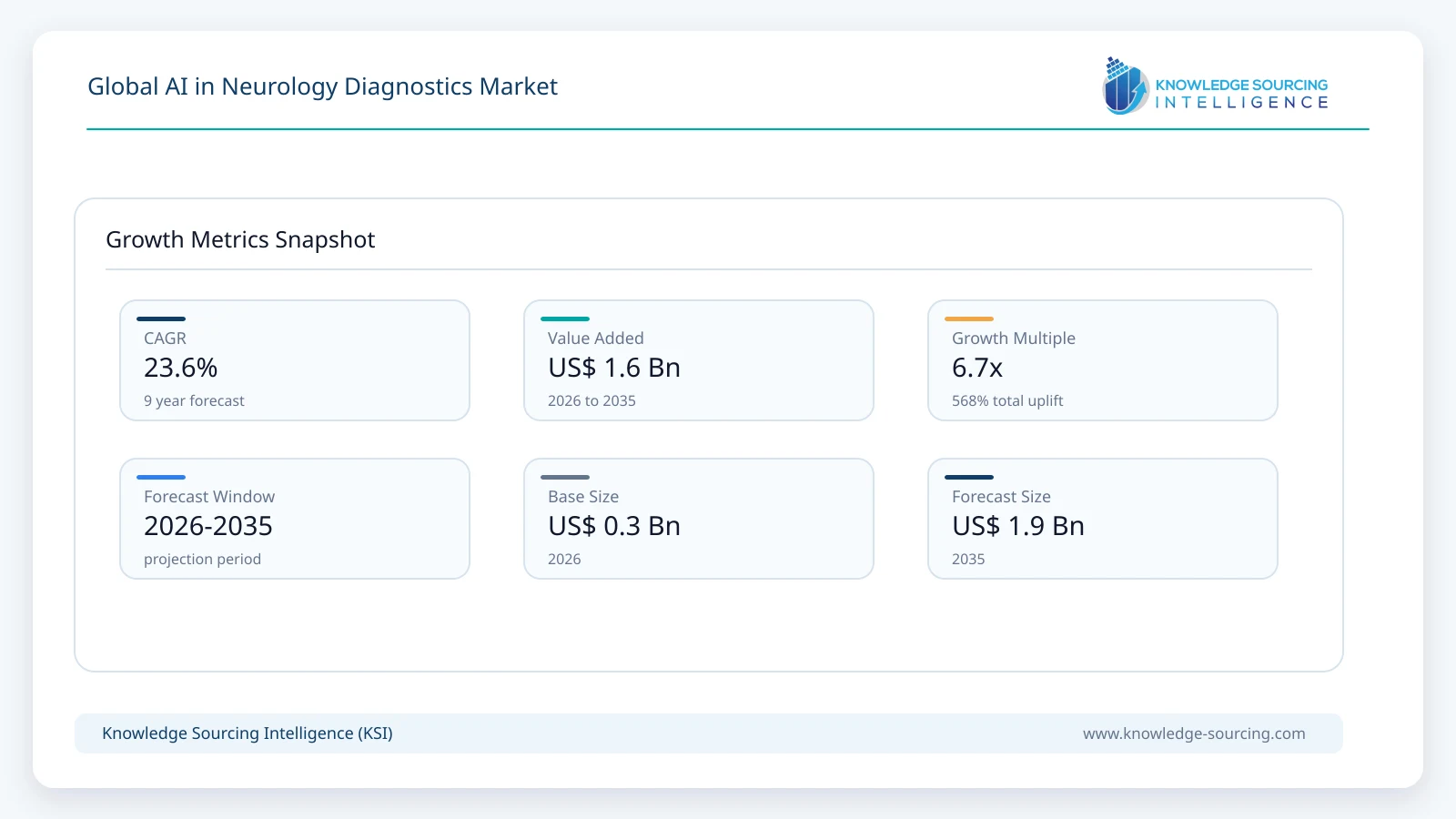
The Global AI in Neurology Diagnostics Market is projected to grow at a CAGR of 23.6% during the forecast period, increasing from USD 0.28 billion in 2026 to USD 1.87 billion by 2035.
Highlights:
- 1Rising neurological disease prevalence is increasing diagnostic workloads, which is accelerating demand for automated image interpretation and triage systems.
- 2Stroke remains a major adoption catalyst because treatment effectiveness depends on rapid detection and intervention.
- 3Hospitals are deploying AI-enabled workflow solutions to address specialist shortages and imaging backlogs.
- 4Regulatory clearances for stroke and neuroimaging algorithms are expanding commercial deployment opportunities.
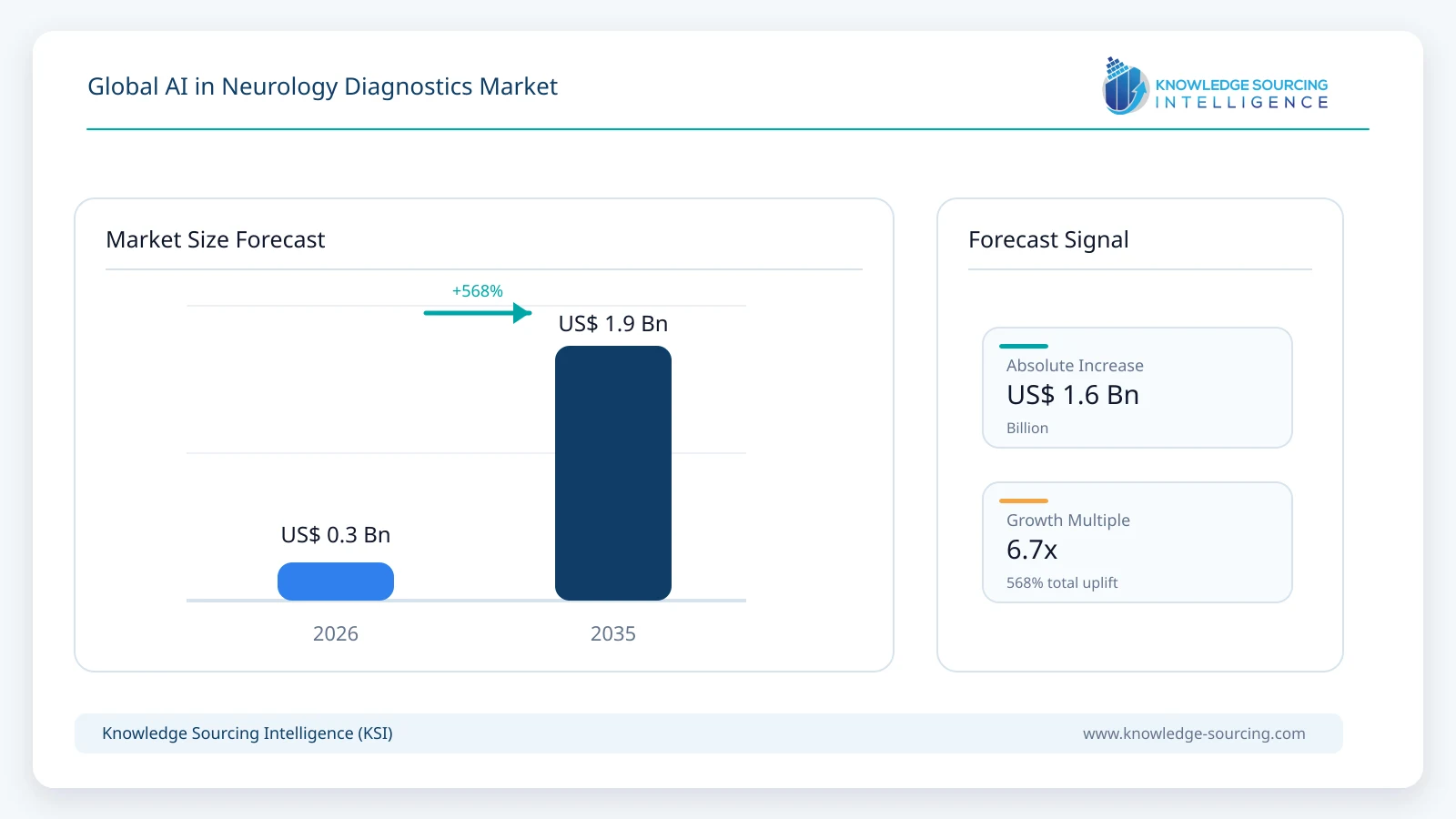
Neurological disorders represent one of the largest global healthcare burdens. The demand for AI-based neurology diagnostics is increasing because diagnostic accuracy depends heavily on specialist interpretation capacity. Healthcare systems face growing imaging volumes, while neurologist and neuroradiologist availability remains uneven across regions. This imbalance is encouraging providers to deploy automated detection and prioritization tools that accelerate diagnosis without proportionally increasing workforce requirements.
Regulatory agencies increasingly recognize AI as a clinical decision-support technology rather than solely an imaging enhancement tool. As a result, vendors are expanding FDA-cleared and CE-marked solutions across stroke detection, intracranial hemorrhage identification, brain volumetry, multiple sclerosis monitoring, and dementia assessment. Regulatory acceptance is reducing adoption barriers and strengthening reimbursement discussions in major healthcare markets.
AI diagnostics are becoming strategically important because neurological outcomes frequently depend on treatment timing. Stroke management requires rapid imaging interpretation, and delayed identification can significantly affect functional recovery. This clinical dependency is supporting investment in automated triage platforms that identify critical findings and notify care teams in near real time.
Market Dynamics
Market Drivers
Escalating Global Neurological Disease Burden: Neurological disorders represent a growing healthcare challenge. Disease prevalence is increasing because populations are aging and survival rates are improving across multiple chronic conditions. Healthcare systems face larger diagnostic volumes as a result. Providers are implementing AI-assisted neurology platforms to maintain diagnostic throughput. The outcome is stronger demand for scalable neurological imaging analytics.
Time-Critical Nature of Stroke Diagnosis: Stroke management depends on rapid diagnosis and treatment selection. Imaging workloads are increasing in emergency departments because stroke screening protocols require immediate evaluation. Traditional interpretation workflows create delays during peak periods. Hospitals are deploying AI-based large vessel occlusion and intracranial hemorrhage detection tools to accelerate triage. The result is broader integration of AI into acute stroke pathways.
Shortage of Neurology and Neuroradiology Expertise: Specialist availability varies significantly across healthcare systems. Imaging demand is expanding faster than workforce capacity in many regions. Diagnostic variability becomes a concern under these conditions. Healthcare providers are adopting AI-enabled decision-support systems to standardize interpretation and prioritize urgent cases. This trend strengthens utilization of AI-assisted diagnostic workflows.
Expansion of Quantitative Neuroimaging: Neurological disease management increasingly depends on measurable biomarkers. Clinicians are seeking objective assessments for disease progression and treatment response. Manual volumetric analysis remains resource-intensive. AI platforms are automating quantification processes and improving reproducibility. The outcome is increasing adoption across neurodegenerative and demyelinating disorders.
Market Restraints
Clinical validation requirements remain extensive, increasing commercialization timelines.
Integration with heterogeneous hospital IT and imaging infrastructures creates deployment complexity.
Data privacy, algorithm transparency, and liability concerns continue limiting adoption in certain healthcare systems.
Market Opportunities
AI-Enabled Dementia Assessment: Dementia prevalence is increasing because populations are aging. Earlier diagnosis becomes increasingly important for therapeutic planning and patient management. Conventional assessment methods create variability across institutions. AI-driven volumetric and cognitive imaging tools are improving objective evaluation. This trend creates significant growth opportunities in neurodegenerative disease diagnostics.
Expansion into Emerging Healthcare Systems: Neurology specialist shortages remain pronounced across middle-income countries. Imaging demand is increasing as diagnostic infrastructure expands. Workforce limitations constrain service delivery. Cloud-based AI solutions are enabling broader access to advanced neurological assessment. The result is an expanding addressable market.
Multimodal Clinical Decision Support: Neurological diagnosis increasingly depends on imaging, clinical records, laboratory information, and longitudinal outcomes. Data complexity is increasing across care pathways. AI vendors are developing multimodal platforms that combine these datasets. This evolution supports more comprehensive neurological decision support.
Integration with Precision Neurology: Personalized treatment approaches require deeper disease characterization. Biomarker-based stratification is becoming increasingly important. AI platforms are enabling advanced pattern recognition across imaging datasets. This capability creates opportunities in precision neurology and targeted therapeutic management.
Disease & Epidemiology Analysis
Neurological disorders constitute one of the largest sources of global disability. More than 3 billion individuals were living with neurological conditions in 2021, while neurological diseases became the leading cause of illness and disability worldwide.
Stroke remains the most commercially significant indication for AI diagnostics. The World Health Organization reported approximately 93.8 million stroke cases globally in 2021 and approximately 11.9 million new stroke cases during the same year. Lifetime stroke risk continues increasing, creating sustained demand for rapid diagnostic technologies.
Neurodegenerative diseases are contributing additional diagnostic demand because aging populations increase the prevalence of Alzheimer's disease, dementia, and Parkinson's disease. These conditions require longitudinal monitoring, volumetric assessment, and earlier detection capabilities that align closely with AI-enabled imaging analytics.
Treatment Guidelines Landscape
Disease Area | Guideline Focus | Relevance to AI Diagnostics |
Stroke | Rapid imaging and treatment pathways | Supports AI-enabled triage |
Neurological Disorders | Integrated neurological care framework | Encourages scalable diagnostic tools |
Dementia | Early assessment and diagnosis | Supports quantitative imaging tools |
Market Segmentation
By Technology
Machine Learning and Deep Learning represent the leading technology segment because neurological diagnosis increasingly depends on pattern recognition across large imaging datasets. Imaging complexity is increasing as multimodal MRI and CT protocols expand. Manual interpretation creates variability under these conditions. Healthcare providers are deploying deep learning algorithms that identify subtle abnormalities and automate lesion characterization. The outcome is broader adoption across stroke, dementia, and neuro-oncology applications.
By Indication
Stroke represents the dominant indication because treatment effectiveness depends heavily on diagnosis speed. Emergency imaging volumes are increasing as stroke awareness and screening protocols expand. Conventional workflows create bottlenecks during high-volume periods. Hospitals are implementing AI-based triage and notification systems that prioritize critical cases. This dynamic strengthens stroke-focused AI investment and commercialization activity.
By End User
Hospitals represent the largest end-user segment because acute neurological care depends on integrated imaging, emergency medicine, and specialist coordination. Patient volumes are increasing across tertiary care centers. Diagnostic turnaround requirements create operational pressure. Healthcare systems are deploying enterprise-wide AI platforms to streamline imaging workflows and support clinical decision-making. The result is sustained hospital-centered adoption.
Regional Analysis
North America Market Analysis
North America represents the most mature market because regulatory pathways for AI-enabled medical software are well established. Neurological disease burden remains substantial, which increases demand for rapid diagnostic solutions. Stroke programs are expanding use of AI-assisted triage because treatment timing directly influences outcomes. Technology vendors are increasing commercialization activity through FDA-cleared products and integrated workflow platforms. The region maintains leadership in clinical adoption, reimbursement discussions, and enterprise-scale implementation.
Europe Market Analysis
Europe maintains strong demand because aging demographics increase the prevalence of stroke, dementia, and neurodegenerative disorders. Imaging volumes are growing across public healthcare systems. Workforce constraints create pressure on radiology and neurology services. Healthcare providers are adopting AI-enabled diagnostic tools to improve efficiency and standardization. Regulatory alignment through medical device frameworks supports commercialization while encouraging evidence-based deployment.
Asia Pacific Market Analysis
Asia Pacific represents the fastest-expanding opportunity because neurological disease prevalence is increasing across large population bases. Diagnostic infrastructure is improving across major healthcare markets. Specialist shortages remain significant in many countries. Providers are implementing AI solutions to extend neurological expertise beyond tertiary centers. The combination of expanding imaging capacity and digital health investment supports long-term market growth.
Rest of the World
The Rest of the World market remains influenced by access disparities. Neurological disease burden continues increasing across developing healthcare systems. Advanced specialist availability remains limited in many regions. Cloud-enabled AI deployment models are improving accessibility to diagnostic support. Governments and healthcare organizations are investing in digital health infrastructure, which creates opportunities for scalable neurology diagnostics platforms.
Regulatory Landscape
The regulatory environment increasingly treats AI-based neurology diagnostics as Software as a Medical Device (SaMD). Regulatory agencies require evidence demonstrating safety, clinical performance, and workflow reliability before commercialization. This framework is encouraging vendors to invest heavily in validation studies and real-world evidence generation.
The U.S. FDA remains one of the most influential regulatory bodies for neurology AI. Multiple stroke-focused products from companies including Aidoc, Viz.ai, and Brainomix have received regulatory clearances for specific neurological applications. These approvals establish clinical credibility and support broader hospital adoption.
European regulatory requirements under the Medical Device Regulation continue emphasizing clinical evidence, post-market surveillance, and algorithm transparency. These standards are increasing development costs while strengthening long-term market confidence.
Pipeline Analysis
Product development pipelines are increasingly moving beyond acute stroke detection toward comprehensive neurological assessment. Vendors are developing algorithms for dementia characterization, multiple sclerosis progression monitoring, epilepsy assessment, and neuro-oncology applications. This expansion reflects growing demand for longitudinal disease management capabilities.
Multimodal AI platforms are becoming a major focus area because neurological diagnosis rarely depends on imaging alone. Developers are integrating imaging data with clinical information and workflow analytics. These efforts are improving diagnostic context and supporting broader clinical decision support.
Research activity continues expanding across advanced neuroimaging datasets. Industry and academic collaborations increasingly focus on prognostic modeling, treatment-response prediction, and quantitative biomarker development. These initiatives are expected to broaden the clinical utility of AI in neurology over the forecast period.
Competitive Landscape
Viz.ai
Viz.ai differentiates itself through workflow orchestration and stroke-network connectivity. The company combines AI detection with care coordination capabilities, which enables rapid communication among emergency physicians, neurologists, and intervention teams. Its portfolio includes Viz LVO, Viz ICH, and related solutions supporting acute neurological care. Strategic emphasis on treatment acceleration positions the company strongly within time-critical stroke management pathways.
Aidoc
Aidoc focuses on enterprise radiology AI and has established a strong presence in neurological imaging triage. FDA-cleared stroke applications support identification of large vessel occlusion and intracranial hemorrhage. The company continues expanding integrated workflow capabilities that connect imaging findings with clinical response processes. This approach strengthens adoption among large healthcare systems.
Brainomix
Brainomix specializes in stroke imaging analytics and treatment decision support. Its e-Stroke and Brainomix 360 platforms emphasize workflow optimization and rapid treatment assessment. Strategic partnerships with healthcare providers and technology companies support commercialization. The company maintains a strong focus on evidence-based stroke care innovation.
icometrix
icometrix differentiates itself through quantitative neuroimaging and longitudinal disease monitoring. The icobrain portfolio supports objective assessment across multiple neurological disorders. The company benefits from growing demand for biomarker-driven clinical management and neurodegenerative disease monitoring.
Qure.ai
Qure.ai leverages deep-learning expertise across imaging applications. Its neurology-focused solutions support automated interpretation and workflow enhancement. The company benefits from expanding adoption in emerging healthcare systems where specialist availability remains constrained.
Cortechs.ai
Cortechs.ai focuses on advanced neuroimaging quantification through products such as NeuroQuant. Its technologies support volumetric analysis and objective disease monitoring. The company remains well positioned in neurodegenerative disease assessment and precision neurology workflows.
Siemens Healthineers
Siemens Healthineers integrates neurology AI into broader imaging ecosystems through solutions such as AI-Rad Companion Brain. The company benefits from extensive imaging infrastructure penetration and enterprise customer relationships. Platform integration strengthens competitive positioning.
GE HealthCare
GE HealthCare leverages the Edison digital ecosystem to support AI-enabled neurological imaging workflows. Strong hospital relationships and enterprise deployment capabilities provide strategic advantages. The company continues expanding AI integration across diagnostic imaging environments.
Key Developments
April 2026: The FDA granted De Novo classification to Neuropacs, a first-in-class AI-based MRI diagnostic aid for Parkinsonian syndromes, making it the first AI-powered imaging tool approved to help differentiate Parkinson's disease from atypical Parkinsonian disorders like multiple system atrophy and progressive supranuclear palsy.
December 2025: UCL researchers developed an AI model that significantly speeds up diagnosis of neurodegenerative brain disorders by analyzing brain MRI scans to detect patterns of shrinkage, reducing the diagnostic process from months to minutes and helping clinicians more accurately diagnose conditions like Alzheimer's, frontotemporal dementia, and posterior cortical atrophy.
November 2025: Philips and Cortechs.ai extended their partnership to advance quantitative neuroimaging and strengthen Philips' leadership in precision diagnostics in neurology, integrating Cortechs' AI-powered brain measurement technology into Philips' MR imaging workflow to provide automated, accurate quantification of brain volume changes for monitoring neurodegenerative diseases.
Strategic Insights and Future Market Outlook
The market increasingly depends on the convergence of imaging analytics, workflow automation, and clinical decision support. Healthcare providers are seeking solutions that reduce interpretation delays while improving diagnostic consistency. This requirement is shifting competition away from standalone algorithms toward integrated neurological care platforms.
Demand is expanding beyond acute stroke applications because healthcare systems increasingly recognize the value of quantitative neuroimaging in chronic disease management. Dementia, Parkinson's disease, multiple sclerosis, and neuro-oncology applications are creating new commercialization opportunities. Vendors that demonstrate measurable clinical and operational outcomes are likely to gain adoption advantages.
Regulatory acceptance, growing neurological disease prevalence, and continued investment in digital healthcare infrastructure support long-term market expansion. Companies capable of integrating imaging intelligence with broader clinical workflows are expected to strengthen their market positions between 2026 and 2035.
The Global AI in Neurology Diagnostics Market remains fundamentally driven by the need to manage the rising neurological disease burden with limited specialist resources. AI increasingly serves as an operational and clinical multiplier, enabling faster diagnosis, more consistent interpretation, and scalable neurological care delivery across healthcare systems worldwide.
Global AI in Neurology Diagnostics Market Scope:
| Report Metric | Details |
|---|---|
| Total Market Size in 2026 | USD 0.28 billion |
| Total Market Size in 2035 | USD 1.87 billion |
| Forecast Unit | USD Billion |
| Growth Rate | 23.6% |
| Study Period | 2021 to 2035 |
| Historical Data | 2021 to 2024 |
| Base Year | 2025 |
| Forecast Period | 2026 – 2035 |
| Segmentation | Technology, Diagnostic Modality, Indication, Geography |
| Companies |
|
Market Segmentation
By Geography
Key Countries Analysis
Regulatory & Policy Landscape
Table of Contents
1. EXECUTIVE SUMMARY
1.1 Market Overview
1.2 Key Findings
1.3 Executive Insights
1.4 Market Snapshot by Technology
1.5 Market Snapshot by Application
1.6 Market Snapshot by End User
1.7 Regional Market Highlights
1.8 Competitive Landscape Summary
1.9 Key Strategic Recommendations
1.10 Future Growth Outlook
2. DISEASE & EPIDEMIOLOGY ANALYSIS
2.1 Introduction to Neurological Disorders
2.2 Global Neurological Disease Burden Overview
2.3 Epidemiology of Major Neurological Disorders
2.3.1 Stroke
2.3.2 Alzheimer's Disease and Other Dementias
2.3.3 Parkinson's Disease
2.3.4 Epilepsy
2.3.5 Multiple Sclerosis
2.3.6 Brain Tumors
2.3.7 Traumatic Brain Injury (TBI)
2.3.8 Migraine and Chronic Headache Disorders
2.3.9 Neurodegenerative Disorders
2.3.10 Neuromuscular Disorders
2.4 Incidence Analysis by Disease Type
2.5 Prevalence Analysis by Disease Type
2.6 Mortality and Disability Burden Assessment
2.7 Diagnostic Gap Assessment
2.8 Impact of Aging Population on Neurological Disease Burden
2.9 Unmet Needs in Neurology Diagnostics
2.10 AI Adoption Impact on Neurological Disease Detection and Management
3. MARKET DYNAMICS
3.1 Market Overview
3.2 Market Drivers
3.2.1 Rising Prevalence of Neurological Disorders
3.2.2 Growing Demand for Early Disease Detection
3.2.3 Advancements in Artificial Intelligence and Machine Learning Algorithms
3.2.4 Increasing Utilization of Neuroimaging Technologies
3.2.5 Expansion of Digital Health Infrastructure
3.2.6 Shortage of Neurology Specialists and Radiologists
3.3 Market Restraints
3.3.1 Data Privacy and Security Concerns
3.3.2 Algorithm Bias and Validation Challenges
3.3.3 High Implementation Costs
3.3.4 Regulatory Approval Complexities
3.3.5 Limited Interoperability Across Healthcare Systems
3.4 Market Opportunities
3.4.1 AI-Based Imaging Interpretation Solutions
3.4.2 Real-World Evidence Integration
3.4.3 Cloud-Based Neurology Diagnostic Platforms
3.4.4 Emerging Markets Adoption Potential
3.4.5 Personalized Neurology Diagnostics
3.5 Market Challenges
3.5.1 Clinical Workflow Integration Issues
3.5.2 Limited Availability of High-Quality Training Data
3.5.3 Reimbursement Uncertainty
3.5.4 Physician Acceptance and Trust Concerns
3.6 Porter's Five Forces Analysis
3.7 PESTLE Analysis
3.8 Value Chain Analysis
3.9 Technology Adoption Framework
4. COMMERCIAL & MARKET ACCESS
4.1 Reimbursement Landscape Overview
4.2 Market Access Challenges for AI Diagnostics
4.3 Health Technology Assessment (HTA) Considerations
4.4 Pricing Models for AI Diagnostic Platforms
4.5 Stakeholder Analysis
4.5.1 Healthcare Providers
4.5.2 Hospitals and Health Systems
4.5.3 Diagnostic Imaging Centers
4.5.4 Payers and Insurers
4.5.5 Government Agencies
4.6 Procurement and Purchasing Trends
4.7 Commercialization Strategies
4.8 Strategic Partnerships and Collaborations
5. INNOVATION & PIPELINE LANDSCAPE
5.1 Overview of AI Innovation in Neurology Diagnostics
5.2 Emerging Artificial Intelligence Technologies
5.2.1 Deep Learning
5.2.2 Machine Learning
5.2.3 Natural Language Processing
5.2.4 Computer Vision
5.2.5 Generative AI Applications
5.3 AI Development Pipeline Assessment
5.4 Pipeline Analysis by Development Stage
5.4.1 Early Development
5.4.2 Clinical Validation Stage
5.4.3 Regulatory Review Stage
5.4.4 Commercial Launch Stage
5.5 Pipeline Analysis by Modality
5.5.1 Imaging-Based AI Diagnostics
5.5.2 EEG-Based AI Diagnostics
5.5.3 Digital Biomarker Platforms
5.5.4 Multimodal Diagnostic Platforms
5.6 Pipeline Analysis by Mechanism of Action
5.6.1 Pattern Recognition Algorithms
5.6.2 Predictive Analytics Models
5.6.3 Automated Image Segmentation Systems
5.6.4 Clinical Decision Support Systems
5.7 Patent Landscape Analysis
5.8 AI Research and Development Trends
5.9 Future Innovation Opportunities
6. TREATMENT LANDSCAPE
6.1 Current Diagnostic Pathway in Neurology
6.2 Role of AI in Diagnostic Workflows
6.3 Conventional Diagnostic Modalities
6.3.1 Magnetic Resonance Imaging (MRI)
6.3.2 Computed Tomography (CT)
6.3.3 Positron Emission Tomography (PET)
6.3.4 Electroencephalography (EEG)
6.3.5 Cerebrospinal Fluid Biomarkers
6.3.6 Neuropsychological Testing
6.4 AI-Enabled Diagnostic Approaches
6.5 Clinical Utility Assessment
6.6 Comparative Analysis of Conventional and AI-Assisted Diagnostics
6.7 Diagnostic Guidelines and Clinical Practice Trends
6.8 Future Evolution of Neurology Diagnostic Pathways
7. GLOBAL AI IN NEUROLOGY DIAGNOSTICS MARKET SIZE & FORECAST
7.1 Market Size Analysis (Historical)
7.2 Market Size Analysis (Current Year)
7.3 Market Forecast Analysis
7.4 Market Forecast by Technology
7.5 Market Forecast by Application
7.6 Market Forecast by End User
7.7 Market Forecast by Geography
7.8 Scenario Analysis
7.8.1 Conservative Scenario
7.8.2 Base Case Scenario
7.8.3 Optimistic Scenario
7.9 Market Attractiveness Analysis
8. GLOBAL AI IN NEUROLOGY DIAGNOSTICS MARKET SEGMENTATION
8.1 By Technology
8.1.1 Machine Learning & Deep Learning
8.1.2 Natural Language Processing
8.1.3 Computer Vision
8.1.5 Others
8.2 By Diagnostic Modality
8.2.1 MRI-Based AI Diagnostics
8.2.2 CT-Based AI Diagnostics
8.2.3 PET-Based AI Diagnostics
8.2.4 Others
8.3 By Indication
8.3.1 Stroke
8.3.2 Alzheimer's Disease & Dementia
8.3.3 Parkinson's Disease
8.3.4 Epilepsy
8.3.5 Multiple Sclerosis
8.3.6 Brain Tumors
8.3.7 Traumatic Brain Injury
8.3.8 Other Neurological Disorders
8.4 By End User
8.4.1 Hospitals
8.4.2 Neurology Clinics
8.4.3 Diagnostic Imaging Centers
8.4.4 Others
9. GEOGRAPHICAL ANALYSIS (REGIONAL LEVEL)
9.1 North America
9.1.1 Market Size and Growth Analysis
9.1.2 Key Demand Drivers
9.1.3 Regional Regulatory Overview
9.1.4 Competitive Intensity Assessment
9.2 Europe
9.2.1 Market Size and Growth Analysis
9.2.2 Key Demand Drivers
9.2.3 Regional Regulatory Overview
9.2.4 Competitive Intensity Assessment
9.3 Asia-Pacific
9.3.1 Market Size and Growth Analysis
9.3.2 Key Demand Drivers
9.3.3 Regional Regulatory Overview
9.3.4 Competitive Intensity Assessment
9.4 Latin America
9.4.1 Market Size and Growth Analysis
9.4.2 Key Demand Drivers
9.4.3 Regional Regulatory Overview
9.4.4 Competitive Intensity Assessment
9.5 Middle East & Africa
9.5.1 Market Size and Growth Analysis
9.5.2 Key Demand Drivers
9.5.3 Regional Regulatory Overview
9.5.4 Competitive Intensity Assessment
10. KEY COUNTRIES ANALYSIS
10.1 United States
10.1.1 Market Size
10.1.2 Epidemiology Overview
10.1.3 Regulatory Framework
10.1.4 Reimbursement Landscape
10.1.5 Key Companies and Product Presence
10.2 Canada
10.2.1 Market Size
10.2.2 Epidemiology Overview
10.2.3 Regulatory Framework
10.2.4 Reimbursement Landscape
10.2.5 Key Companies and Product Presence
10.3 Germany
10.3.1 Market Size
10.3.2 Epidemiology Overview
10.3.3 Regulatory Framework
10.3.4 Reimbursement Landscape
10.3.5 Key Companies and Product Presence
10.4 United Kingdom
10.4.1 Market Size
10.4.2 Epidemiology Overview
10.4.3 Regulatory Framework
10.4.4 Reimbursement Landscape
10.4.5 Key Companies and Product Presence
10.5 France
10.5.1 Market Size
10.5.2 Epidemiology Overview
10.5.3 Regulatory Framework
10.5.4 Reimbursement Landscape
10.5.5 Key Companies and Product Presence
10.6 Italy
10.6.1 Market Size
10.6.2 Epidemiology Overview
10.6.3 Regulatory Framework
10.6.4 Reimbursement Landscape
10.6.5 Key Companies and Product Presence
10.7 Spain
10.7.1 Market Size
10.7.2 Epidemiology Overview
10.7.3 Regulatory Framework
10.7.4 Reimbursement Landscape
10.7.5 Key Companies and Product Presence
10.8 China
10.8.1 Market Size
10.8.2 Epidemiology Overview
10.8.3 Regulatory Framework
10.8.4 Reimbursement Landscape
10.8.5 Key Companies and Product Presence
10.9 Japan
10.9.1 Market Size
10.9.2 Epidemiology Overview
10.9.3 Regulatory Framework
10.9.4 Reimbursement Landscape
10.9.5 Key Companies and Product Presence
10.10 India
10.10.1 Market Size
10.10.2 Epidemiology Overview
10.10.3 Regulatory Framework
10.10.4 Reimbursement Landscape
10.10.5 Key Companies and Product Presence
10.11 South Korea
10.11.1 Market Size
10.11.2 Epidemiology Overview
10.11.3 Regulatory Framework
10.11.4 Reimbursement Landscape
10.11.5 Key Companies and Product Presence
10.12 Australia
10.12.1 Market Size
10.12.2 Epidemiology Overview
10.12.3 Regulatory Framework
10.12.4 Reimbursement Landscape
10.12.5 Key Companies and Product Presence
10.13 Brazil
10.13.1 Market Size
10.13.2 Epidemiology Overview
10.13.3 Regulatory Framework
10.13.4 Reimbursement Landscape
10.13.5 Key Companies and Product Presence
10.14 Mexico
10.14.1 Market Size
10.14.2 Epidemiology Overview
10.14.3 Regulatory Framework
10.14.4 Reimbursement Landscape
10.14.5 Key Companies and Product Presence
10.15 Saudi Arabia
10.15.1 Market Size
10.15.2 Epidemiology Overview
10.15.3 Regulatory Framework
10.15.4 Reimbursement Landscape
10.15.5 Key Companies and Product Presence
10.16 South Africa
10.16.1 Market Size
10.16.2 Epidemiology Overview
10.16.3 Regulatory Framework
10.16.4 Reimbursement Landscape
10.16.5 Key Companies and Product Presence
11. REGULATORY & POLICY LANDSCAPE
11.1 Regulatory Overview for AI-Based Medical Devices and Diagnostics
11.2 United States FDA Regulatory Framework
11.2.1 Software as a Medical Device (SaMD) Regulations
11.2.2 AI/ML-Based Medical Device Guidance
11.3 European Union MDR Framework
11.3.1 CE Marking Requirements
11.3.2 AI Act Implications for Healthcare
11.4 Japan PMDA Regulatory Framework
11.5 India CDSCO Regulatory Framework
11.6 China NMPA Regulatory Framework
11.7 Cybersecurity and Data Governance Requirements
11.8 Clinical Validation Requirements
11.9 Regulatory Challenges and Future Developments
12. COMPETITIVE LANDSCAPE
12.1 Market Share Analysis
12.2 Competitive Benchmarking
12.3 Product Portfolio Analysis
12.4 Technology Differentiation Assessment
12.5 Strategic Collaborations and Partnerships
12.6 Mergers and Acquisitions
12.7 Funding and Investment Landscape
12.8 Recent Product Launches and Regulatory Approvals
12.9 SWOT Analysis of Leading Participants
13. COMPANY PROFILES
13.1 Viz.ai
13.1.1 Company Overview
13.1.2 Approved Products (Viz LVO, Viz ICH, Viz CTP and related cleared solutions)
13.1.3 Key Neurological Applications
13.1.4 Regulatory Approvals and Certifications
13.1.5 Pipeline and Future Development Programs
13.1.6 Strategic Developments
13.2 Aidoc
13.2.1 Company Overview
13.2.2 Approved Products for Neuroimaging Triage and Detection
13.2.3 Key Neurological Applications
13.2.4 Regulatory Status
13.2.5 Pipeline Programs
13.2.6 Strategic Developments
13.3 Brainomix
13.3.1 Company Overview
13.3.2 e-Stroke Platform
13.3.3 Key Neurological Applications
13.3.4 Regulatory Status
13.3.5 Pipeline Programs
13.3.6 Strategic Developments
13.4 icometrix
13.4.1 Company Overview
13.4.2 icobrain Portfolio
13.4.3 Key Neurological Applications
13.4.4 Regulatory Status
13.4.5 Pipeline Programs
13.4.6 Strategic Developments
13.5 Qure.ai
13.5.1 Company Overview
13.5.2 Neuroimaging AI Solutions
13.5.3 Key Neurological Applications
13.5.4 Regulatory Status
13.5.5 Pipeline Programs
13.5.6 Strategic Developments
13.6 Cortechs.ai
13.6.1 Company Overview
13.6.2 NeuroQuant and Related Solutions
13.6.3 Key Neurological Applications
13.6.4 Regulatory Status
13.6.5 Pipeline Programs
13.6.6 Strategic Developments
13.7 Siemens Healthineers
13.7.1 Company Overview
13.7.2 AI-Rad Companion Brain and Related Solutions
13.7.3 Key Neurological Applications
13.7.4 Regulatory Status
13.7.5 Pipeline Programs
13.7.6 Strategic Developments
13.8 GE HealthCare
13.8.1 Company Overview
13.8.2 Edison Platform and Neurology AI Applications
13.8.3 Key Neurological Applications
13.8.4 Regulatory Status
13.8.5 Pipeline Programs
13.8.6 Strategic Developments
13.9 Philips
13.9.1 Company Overview
13.9.2 AI-Enabled Neurology Imaging Solutions
13.9.3 Key Neurological Applications
13.9.4 Regulatory Status
13.9.5 Pipeline Programs
13.9.6 Strategic Developments
13.10 Canon Medical Systems
13.10.1 Company Overview
13.10.2 AI-Assisted Neurology Diagnostic Solutions
13.10.3 Key Neurological Applications
13.10.4 Regulatory Status
13.10.5 Pipeline Programs
13.10.6 Strategic Developments
14. FUTURE OUTLOOK
14.1 Future Market Projections
14.2 Evolution of AI-Driven Neurology Diagnostics
14.3 Emerging Clinical Applications
14.4 Role of Foundation Models and Generative AI
14.5 Personalized Neurology Diagnostics Outlook
14.6 Future Regulatory Trends
14.7 Future Reimbursement Trends
14.8 Strategic Recommendations for Stakeholders
15. METHODOLOGY
15.1 Research Objectives
15.2 Market Definition and Scope
15.3 Research Design
15.4 Secondary Research Methodology
15.5 Primary Research Methodology
15.6 Epidemiology Data Collection Framework
15.7 Market Modeling and Forecasting Approach
15.8 Data Validation and Triangulation
15.9 Assumptions and Limitations
15.10 Abbreviations and Definitions
15.11 Sources and References
Navigate
Trusted by the world's leading organizations











