
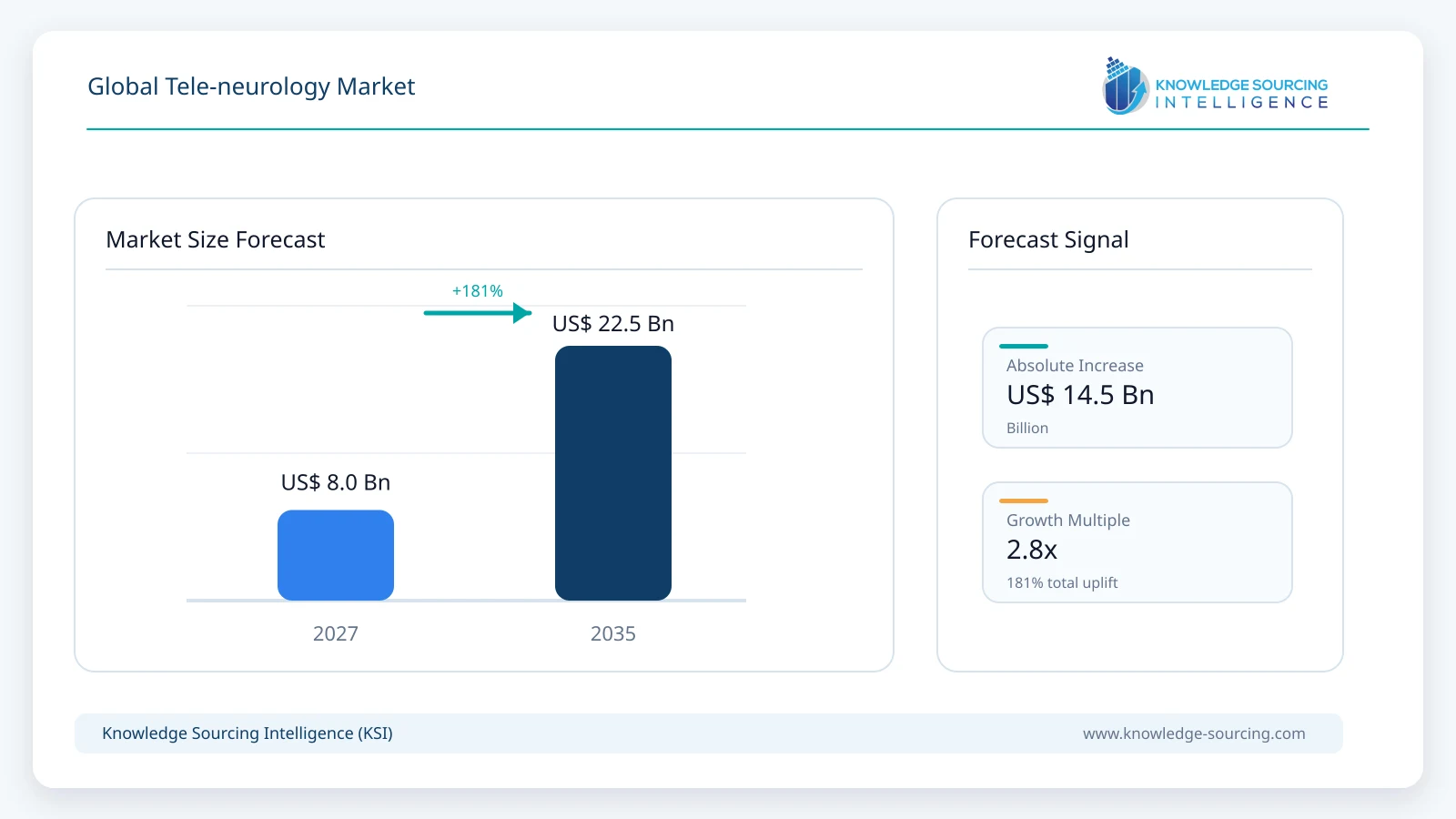
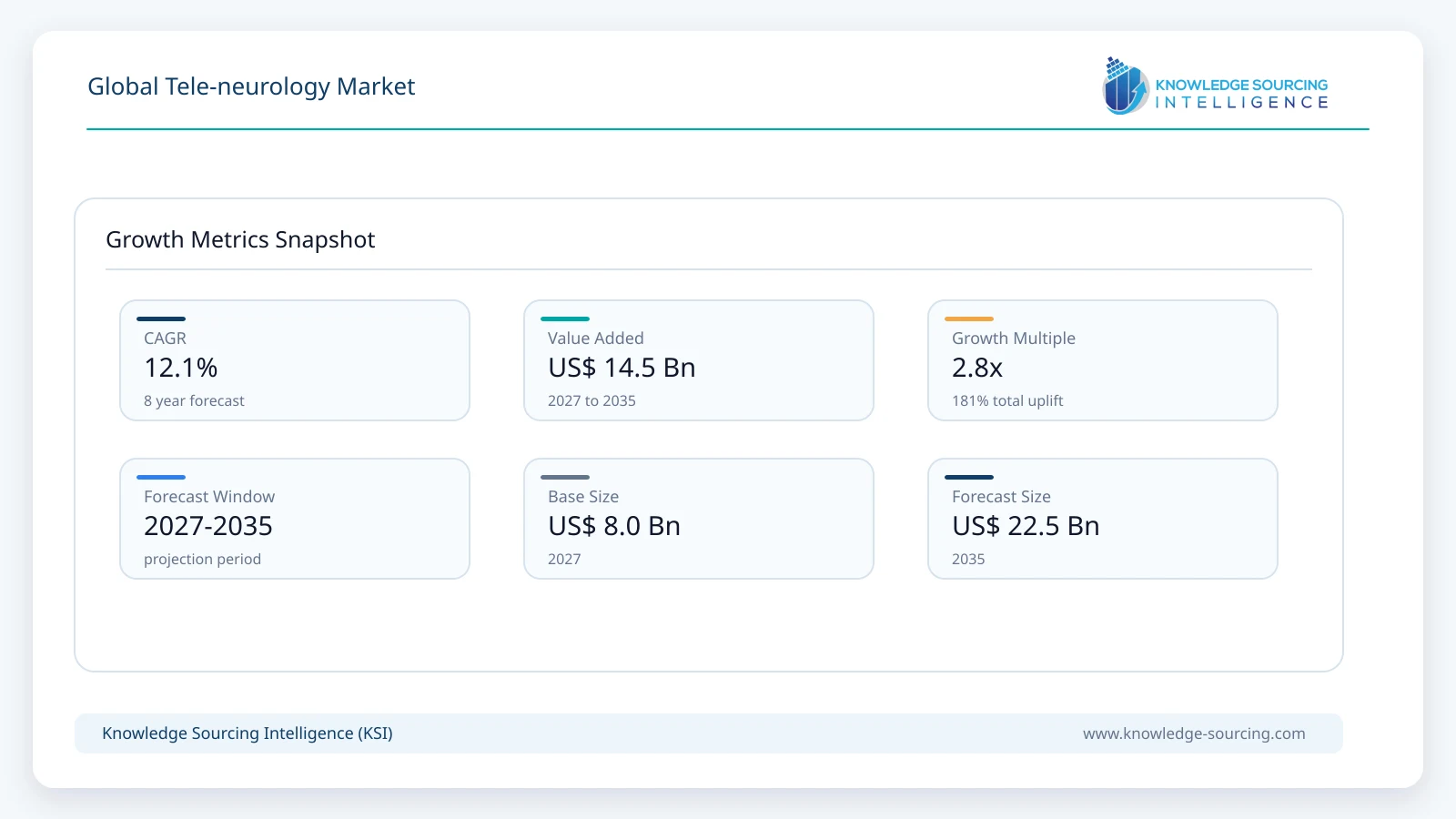
The Global Tele-neurology Market is projected to grow at a CAGR of 12.1% during the forecast period, increasing from USD 8.0 billion in 2026 to USD 22.5 billion by 2035.
Highlights:
- 1Rising neurological disease burden is increasing demand for remote neurological consultation and monitoring services.
- 2Neurologist shortages are driving adoption of tele-neurology networks across hospitals and community healthcare systems.
- 3Growing stroke management requirements are expanding demand for tele-stroke programs that accelerate specialist intervention.
- 4Healthcare digitalization initiatives are increasing investment in cloud-based neurological care platforms.
Tele-neurology enables neurologists to remotely assess, diagnose, monitor, and manage patients through digital communication technologies. The market includes tele-stroke programs, tele-epilepsy services, tele-neurocritical care, remote neurological monitoring, and AI-supported neurological decision tools.
The burden of neurological disorders creates sustained demand because neurological conditions remain among the leading causes of disability worldwide. Healthcare systems are experiencing increasing pressure from aging populations, which raises the prevalence of neurodegenerative diseases. Traditional neurology care depends heavily on specialist availability, which limits access in many regions. Providers are implementing tele-neurology programs to extend specialist reach and improve patient access. The result is broader availability of neurological expertise across healthcare networks.
Regulatory agencies increasingly recognize digital health technologies because healthcare delivery is becoming more dependent on remote care and software-enabled clinical decision-making. Healthcare organizations therefore view tele-neurology as a strategic component of long-term neurological care infrastructure.
Market Dynamics
Market Drivers
Rising Burden of Neurological Disorders: Neurological disorders create substantial healthcare demand because many conditions require long-term specialist management. Patient volumes are increasing as populations age and disease awareness improves. Neurology departments face capacity limitations because specialist growth remains slower than demand growth. Healthcare systems are expanding tele-neurology programs to improve access and reduce delays. The outcome is greater reliance on remote neurological services.
Neurologist Workforce Shortages: Neurology care depends on specialist expertise for diagnosis and treatment planning. Demand is increasing across both acute and chronic neurological conditions. Many healthcare systems face specialist shortages that limit patient access. Hospitals are implementing tele-neurology services to connect patients with remote neurologists. The result is expanded care availability across geographically dispersed populations.
Expansion of Telemedicine Infrastructure: Digital healthcare infrastructure supports remote clinical interaction and data exchange. Healthcare providers are increasing investment in telehealth capabilities because virtual care improves operational flexibility. Traditional in-person care models often limit specialist reach. Organizations are integrating tele-neurology into broader telehealth ecosystems. The outcome is stronger adoption of remote neurological care.
Increasing Demand for Tele-stroke Services: Stroke management depends heavily on rapid neurological evaluation. Demand for timely intervention is increasing because treatment delays worsen clinical outcomes. Rural hospitals often lack immediate neurology expertise. Health systems are expanding tele-stroke networks to support urgent decision-making. The result is broader utilization of tele-neurology platforms.
Market Restraints
Data privacy and cybersecurity requirements increase implementation complexity for healthcare organizations.
Reimbursement policies remain inconsistent across healthcare systems and jurisdictions.
Connectivity limitations reduce service quality in remote and underserved areas.
Market Opportunities
AI-Enabled Neurological Assessment Tools: Remote neurological evaluation depends on accurate clinical observation. Demand is increasing for objective digital assessment capabilities. Traditional remote consultations can limit physical examination depth. Developers are integrating AI-based neurological assessment tools to improve diagnostic support. The outcome is stronger confidence in virtual neurology services.
Remote Patient Monitoring Integration: Neurological diseases often require continuous observation of symptoms and progression. Monitoring needs are increasing as chronic disease prevalence rises. Conventional follow-up visits provide limited real-time insight. Healthcare providers are adopting remote monitoring solutions to improve longitudinal care. The result is growing demand for integrated tele-neurology ecosystems.
Government Regulations
Region | Regulatory Authority | Regulatory Focus |
United States | FDA | Digital Health, Software as Medical Device, Telehealth |
Europe | MDR | Medical Device Software, Clinical Evaluation |
Japan | PMDA | Digital Health and Telemedicine Oversight |
India | CDSCO | Software-Based Medical Devices, Telemedicine |
China | NMPA | Digital Medical Device Registration |
Market Segmentation
By Indication
Stroke represents a major tele-neurology application because treatment decisions require immediate neurological expertise. Demand is increasing for tele-stroke services as healthcare systems seek faster intervention pathways. Epilepsy and Parkinson's disease management increasingly depend on remote monitoring because disease progression requires continuous specialist oversight. Dementia and multiple sclerosis care are also generating demand because aging populations are increasing long-term neurological care requirements. The outcome is broad adoption across multiple neurological indications.
By End-User
Hospitals represent a primary adoption segment because they require specialist neurological support for emergency and inpatient care. Demand is increasing among specialty neurology clinics as virtual consultations improve operational efficiency. Home care settings are becoming more important because patients increasingly prefer remote follow-up and monitoring. Academic and research institutions are also adopting tele-neurology technologies to support clinical research and training. The result is diversified end-user demand.
By Distribution Channel
Cloud-based platforms dominate adoption because healthcare organizations require scalable and interoperable infrastructure. Demand is increasing for mobile-based services as patients seek convenient access to specialists. Web-based platforms continue supporting provider workflows and consultation management. Integrated hospital telemedicine networks are expanding because health systems seek unified care delivery ecosystems. The outcome is increasing platform integration across healthcare environments.
Regional Analysis
North America
North America leads tele-neurology adoption because healthcare systems maintain advanced digital infrastructure and strong telehealth integration. Demand is increasing as neurological disease prevalence rises among aging populations. Neurologist shortages continue affecting both urban and rural healthcare systems. Providers are expanding tele-neurology services to improve specialist access and reduce treatment delays. The outcome is strong regional demand supported by technological maturity and favorable digital health adoption trends.
Europe
European healthcare systems emphasize equitable access to specialist care. Demand is increasing because neurological disorders continue generating substantial healthcare burden. Workforce limitations constrain neurology service availability in several regions. Providers are expanding tele-neurology services to improve access while maintaining care quality. The result is increasing integration of virtual neurological care pathways.
Asia Pacific
Asia Pacific demonstrates significant growth potential because neurological disease burden is increasing alongside digital healthcare adoption. Healthcare infrastructure remains uneven across many regions, which creates access challenges. Governments and healthcare organizations are investing in digital health modernization initiatives. Providers are adopting tele-neurology services to extend specialist availability. The outcome is accelerating market development.
Rest of the World
Latin America, the Middle East, and Africa continue experiencing specialist shortages and healthcare access limitations. Demand is increasing because neurological care remains concentrated in urban centers. Healthcare systems are exploring tele-neurology to address geographic disparities. The result is growing interest in scalable virtual neurology networks.
Regulatory Landscape
The tele-neurology regulatory environment continues evolving because healthcare systems increasingly depend on remote specialist access to address rising neurological disease burden. Regulatory agencies require strong clinical validation and cybersecurity safeguards because tele-neurology platforms directly influence diagnostic accuracy, treatment decisions, and patient outcomes. Technology providers are increasing investment in software validation, interoperability, and data protection capabilities because healthcare organizations require regulatory-compliant solutions. The market therefore increasingly emphasizes clinically validated and secure digital neurology platforms.
The FDA continues supporting digital health innovation because specialist shortages and increasing neurological disease prevalence create demand for scalable care delivery models. The European Medical Device Regulation (MDR) maintains rigorous oversight of software-based medical technologies because remote neurological assessment tools increasingly support clinical decision-making. PMDA, NMPA, and CDSCO continue strengthening digital health frameworks because telemedicine adoption is expanding across their respective healthcare systems. Regulatory oversight therefore increasingly balances innovation with patient safety and data security.
Pipeline development remains closely linked to regulatory evolution because artificial intelligence-enabled neurological assessment tools, remote monitoring platforms, and digital biomarkers require evidence demonstrating clinical utility. Technology developers are strengthening post-market surveillance and cybersecurity capabilities because long-term adoption increasingly depends on provider trust and regulatory compliance. The regulatory landscape therefore continues supporting the expansion of advanced tele-neurology solutions.
Pipeline Analysis
The tele-neurology pipeline increasingly focuses on artificial intelligence-assisted neurological assessment because specialist shortages continue limiting access to timely diagnosis. Demand is increasing for automated clinical decision support tools because stroke, epilepsy, dementia, and Parkinson’s disease require rapid specialist evaluation. Traditional neurological assessment models create access constraints because specialist expertise remains concentrated in major healthcare centers. Technology developers are advancing AI-enabled diagnostic support systems because remote evaluation capabilities may improve clinical efficiency. The pipeline therefore increasingly supports scalable neurological care delivery.
Remote patient monitoring is gaining importance because chronic neurological disorders require continuous observation beyond episodic clinical visits. Demand is increasing for wearable-integrated neurological monitoring platforms because disease progression often requires longitudinal assessment. Conventional follow-up models provide limited real-time visibility into patient status because symptom fluctuations frequently occur between appointments. Healthcare technology providers are developing connected monitoring ecosystems because earlier intervention may improve outcomes. The pipeline therefore increasingly aligns with continuous neurological care management.
Digital biomarkers continue attracting development activity because objective neurological measurements may improve disease monitoring and treatment optimization. Demand is increasing for data-driven neurological assessment because traditional evaluations often rely on intermittent clinical observations. Clinical research programs are incorporating sensor technologies, cognitive assessment tools, and machine learning algorithms because neurological disease progression can be difficult to quantify. The tele-neurology pipeline therefore increasingly combines digital health innovation with advanced neurological analytics.
Competitive Landscape
Teladoc Health
Teladoc Health remains strategically differentiated because its broad virtual care infrastructure enables integration of neurological services within a larger telehealth ecosystem. Demand is increasing for comprehensive specialty care access because healthcare providers seek unified digital health solutions. Specialist shortages continue constraining neurological service availability because many healthcare systems face workforce limitations. Teladoc is expanding enterprise telehealth capabilities because healthcare organizations increasingly prioritize scalable specialist access. The company therefore benefits from extensive virtual care experience and established provider relationships.
Amwell
Amwell maintains strong positioning because its enterprise-focused telehealth platform supports large-scale healthcare network deployments. Demand is increasing for integrated tele-neurology services because hospitals require seamless specialist consultation workflows. Healthcare systems face operational complexity because neurological care often spans multiple facilities and providers. Amwell is strengthening interoperability and digital care coordination capabilities because healthcare organizations increasingly prioritize connected care delivery. The company therefore benefits from strong institutional adoption and scalable platform architecture.
SOC Telemed
SOC Telemed remains strategically important because acute neurological care represents a critical component of emergency telemedicine services. Demand is increasing for tele-stroke and emergency neurology consultations because treatment delays significantly affect patient outcomes. Rural and community hospitals frequently lack immediate neurological expertise because specialist availability remains unevenly distributed. SOC Telemed is expanding acute care telemedicine capabilities because healthcare systems increasingly require rapid specialist access. The company therefore benefits from strong positioning within emergency neurological care delivery.
Eagle Telemedicine
Eagle Telemedicine maintains competitive relevance because its tele-specialty model supports neurological consultation across diverse healthcare settings. Demand is increasing for specialist access because healthcare providers continue addressing workforce shortages. Healthcare facilities require flexible service delivery models because neurological consultation needs vary across patient populations. Eagle Telemedicine is expanding specialty coverage because healthcare organizations increasingly seek outsourced specialist expertise. The company therefore benefits from broad tele-specialty service capabilities.
VSee Health
VSee Health remains differentiated because its technology platform enables customizable telehealth deployments across healthcare environments. Demand is increasing for flexible tele-neurology infrastructure because healthcare providers require tailored virtual care solutions. Standardized systems may not adequately address specialized neurological workflows because clinical requirements vary significantly. VSee is strengthening platform customization capabilities because healthcare organizations increasingly prioritize workflow optimization. The company therefore benefits from adaptable technology architecture.
Oracle Health
Oracle Health maintains strategic importance because healthcare interoperability increasingly influences tele-neurology adoption. Demand is increasing for connected healthcare ecosystems because neurological care often requires multidisciplinary coordination. Fragmented clinical information can reduce care efficiency because patient data frequently resides across multiple systems. Oracle Health is strengthening healthcare data integration capabilities because healthcare organizations increasingly prioritize seamless information exchange. The company therefore benefits from enterprise healthcare technology expertise.
Medtronic
Medtronic remains competitively positioned because neurological monitoring technologies support remote disease management initiatives. Demand is increasing for continuous neurological assessment because chronic neurological disorders require ongoing monitoring. Traditional episodic evaluation limits visibility into disease progression because symptom changes may occur between clinical visits. Medtronic is advancing connected neurological technologies because healthcare providers increasingly seek real-time patient insights. The company therefore benefits from strong neurological device expertise and digital health integration.
Natus Medical Incorporated
Natus Medical remains relevant because neurodiagnostic technologies play a critical role in neurological evaluation and monitoring. Demand is increasing for diagnostic precision because neurological disease management depends on accurate assessment. Healthcare providers require advanced diagnostic capabilities because disease complexity continues increasing. Natus is strengthening neurodiagnostic solutions because healthcare systems increasingly prioritize evidence-based neurological care. The company therefore benefits from specialized expertise in neurological diagnostics.
Key Developments
May 2026: TeleSpecialists, the physician-owned digital healthcare solution provider that hospitals nationwide choose when prioritizing superior quality and effective partnership, announced the continued expansion of its teleneurology programs across rural hospital systems in Georgia, Louisiana, and California.
Strategic Insights and Future Market Outlook
The tele-neurology market is transitioning toward integrated digital neurological care because specialist shortages continue limiting access to traditional in-person services. Demand is increasing for virtual neurological assessment and monitoring capabilities because healthcare systems increasingly prioritize accessibility and operational efficiency. Technology providers are expanding artificial intelligence and remote monitoring capabilities because scalable specialist support remains a critical healthcare requirement. The market therefore increasingly supports digitally enabled neurological care pathways.
Digital biomarkers are becoming strategically important because objective neurological measurements may improve disease monitoring and treatment optimization. Healthcare providers are adopting data-driven approaches because chronic neurological disorders require continuous assessment beyond episodic clinical visits. Technology developers are integrating wearable devices, predictive analytics, and machine learning capabilities because earlier intervention opportunities may improve outcomes. The market therefore increasingly aligns with precision neurology principles.
Healthcare digitalization and neurological disease burden continue expanding because aging populations increasingly require specialist neurological care. Companies capable of combining clinical validation, interoperability, cybersecurity, and scalable virtual care infrastructure are strengthening long-term competitive positioning because provider demand continues growing globally.
The Global Tele-neurology Market therefore continues evolving toward AI-assisted diagnostics, remote patient monitoring ecosystems, digital biomarkers, and broader specialist accessibility as healthcare systems increasingly prioritize efficient and connected neurological care delivery.
Market Segmentation
By Geography
Key Countries Analysis
Regulatory & Policy Landscape
Table of Contents
1. EXECUTIVE SUMMARY
1.1 Market Overview
1.2 Key Findings
1.3 Market Snapshot
1.4 Executive Insights
1.5 Key Strategic Recommendations
1.6 Future Market Outlook
2. DISEASE & EPIDEMIOLOGY ANALYSIS
2.1 Overview of Neurological Disorders
2.1.1 Stroke
2.1.2 Epilepsy
2.1.3 Alzheimer's Disease and Dementia
2.1.4 Parkinson's Disease
2.1.5 Multiple Sclerosis
2.1.6 Migraine and Headache Disorders
2.1.7 Neuromuscular Disorders
2.1.8 Traumatic Brain Injury
2.1.9 Sleep-Related Neurological Disorders
2.2 Global Burden of Neurological Disorders
2.3 Epidemiology by Disease Type
2.3.1 Stroke Incidence and Prevalence
2.3.2 Epilepsy Prevalence
2.3.3 Dementia Patient Population
2.3.4 Parkinson's Disease Patient Population
2.3.5 Multiple Sclerosis Patient Population
2.4 Disease Burden by Age Group
2.5 Disease Burden by Gender
2.6 Neurologist Workforce Shortage Analysis
2.7 Access-to-Care Gap Assessment
2.8 Impact of Neurological Disorders on Healthcare Systems
2.9 Unmet Clinical Needs and Tele-neurology Adoption Drivers
3. MARKET DYNAMICS
3.1 Market Overview
3.2 Market Drivers
3.2.1 Rising Burden of Neurological Disorders
3.2.2 Shortage of Neurologists and Specialists
3.2.3 Growing Adoption of Telemedicine Infrastructure
3.2.4 Increasing Demand for Remote Stroke Management
3.2.5 Expansion of Digital Health Ecosystems
3.3 Market Restraints
3.3.1 Data Privacy and Cybersecurity Concerns
3.3.2 Reimbursement Variability Across Regions
3.3.3 Connectivity and Infrastructure Limitations
3.3.4 Regulatory and Licensing Challenges
3.4 Market Opportunities
3.4.1 AI-Enabled Neurological Assessment Tools
3.4.2 Remote Patient Monitoring Integration
3.4.3 Expansion in Rural and Underserved Areas
3.4.4 Hospital Network Digitalization Programs
3.5 Market Challenges
3.5.1 Cross-Border Telemedicine Regulations
3.5.2 Clinical Validation Requirements
3.5.3 Interoperability Issues
3.6 Porter's Five Forces Analysis
3.7 PESTLE Analysis
3.8 Value Chain Analysis
3.9 Healthcare Ecosystem Analysis
4. COMMERCIAL & MARKET ACCESS
4.1 Commercial Landscape Overview
4.2 Reimbursement Environment
4.2.1 Public Reimbursement Programs
4.2.2 Private Insurance Coverage
4.2.3 Value-Based Care Models
4.3 Pricing Models
4.3.1 Subscription-Based Services
4.3.2 Consultation-Based Models
4.3.3 Enterprise Licensing Models
4.4 Market Access Barriers
4.5 Stakeholder Analysis
4.5.1 Patients
4.5.2 Neurologists
4.5.3 Hospitals and Health Systems
4.5.4 Payers
4.5.5 Government Agencies
4.6 Procurement and Adoption Trends
5. INNOVATION & PIPELINE LANDSCAPE
5.1 Innovation Landscape Overview
5.2 Digital Neurology Technology Trends
5.2.1 Artificial Intelligence-Based Clinical Decision Support
5.2.2 Remote Neurological Examination Tools
5.2.3 Tele-stroke Platforms
5.2.4 Remote Epilepsy Monitoring Solutions
5.2.5 Digital Cognitive Assessment Technologies
5.2.6 Wearable Neurological Monitoring Devices
5.3 Pipeline Landscape by Development Stage
5.3.1 Early-Stage Development Programs
5.3.2 Clinical Validation Programs
5.3.3 Commercialization-Ready Technologies
5.4 Pipeline Analysis by Indication
5.4.1 Stroke Care
5.4.2 Epilepsy Management
5.4.3 Parkinson's Disease Monitoring
5.4.4 Dementia and Cognitive Disorders
5.4.5 Multiple Sclerosis Management
5.4.6 Sleep Neurology Applications
5.5 Pipeline Analysis by Modality
5.5.1 Teleconsultation Platforms
5.5.2 AI-Assisted Diagnostic Platforms
5.5.3 Remote Monitoring Systems
5.5.4 Wearable-Integrated Platforms
5.5.5 Digital Therapeutic Solutions
5.6 Patent Landscape Analysis
5.7 Clinical Research and Validation Landscape
5.8 Strategic Collaborations and Partnerships
5.9 Funding and Investment Trends
6. TREATMENT LANDSCAPE
6.1 Current Neurology Care Delivery Model
6.2 Conventional Neurological Care Pathways
6.2.1 Outpatient Neurology Services
6.2.2 Inpatient Neurology Services
6.2.3 Emergency Stroke Care
6.2.4 Neurorehabilitation Services
6.3 Tele-neurology Care Models
6.3.1 Synchronous Tele-neurology
6.3.2 Asynchronous Tele-neurology
6.3.3 Tele-stroke Services
6.3.4 Tele-epilepsy Services
6.3.5 Tele-neurocritical Care
6.4 Remote Patient Monitoring in Neurology
6.5 Comparative Analysis of Tele-neurology and Traditional Care
6.6 Clinical Outcomes Assessment
6.7 Adoption Trends and Future Treatment Models
7. MARKET SIZE & FORECAST
7.1 Global Market Overview
7.2 Historical Market Analysis (2021–2025)
7.3 Market Forecast (2026–2033)
7.4 Forecast by Indication
7.5 Forecast by End User
7.6 Forecast by Service Type
7.7 Forecast by Delivery Model
7.8 Market Attractiveness Analysis
8. MARKET SEGMENTATION
8.1 By Indication
8.1.1 Stroke
8.1.2 Epilepsy
8.1.3 Alzheimer's Disease and Dementia
8.1.4 Parkinson's Disease
8.1.5 Multiple Sclerosis
8.1.6 Migraine and Headache Disorders
8.1.7 Neuromuscular Disorders
8.1.8 Other Neurological Disorders
8.2 By End User
8.2.1 Hospitals
8.2.2 Specialty Neurology Clinics
8.2.3 Ambulatory Surgical Centers
8.2.4 Home Care Settings
8.2.5 Academic and Research Institutes
8.3 By Distribution Channel
8.3.1 Cloud-Based Tele-neurology Platforms
8.3.2 Web-Based Platforms
8.3.3 Mobile-Based Platforms
8.3.4 Integrated Hospital Telemedicine Networks
9. GEOGRAPHICAL ANALYSIS
9.1 North America
9.1.1 Market Size and Growth Analysis
9.1.2 Demand Drivers
9.1.3 Regional Regulatory Overview
9.1.4 Competitive Intensity Analysis
9.2 Europe
9.2.1 Market Size and Growth Analysis
9.2.2 Demand Drivers
9.2.3 Regional Regulatory Overview
9.2.4 Competitive Intensity Analysis
9.3 Asia-Pacific
9.3.1 Market Size and Growth Analysis
9.3.2 Demand Drivers
9.3.3 Regional Regulatory Overview
9.3.4 Competitive Intensity Analysis
9.4 Latin America
9.4.1 Market Size and Growth Analysis
9.4.2 Demand Drivers
9.4.3 Regional Regulatory Overview
9.4.4 Competitive Intensity Analysis
9.5 Middle East & Africa
9.5.1 Market Size and Growth Analysis
9.5.2 Demand Drivers
9.5.3 Regional Regulatory Overview
9.5.4 Competitive Intensity Analysis
10. KEY COUNTRIES ANALYSIS
10.1 United States
10.2 Canada
10.3 Germany
10.4 United Kingdom
10.5 France
10.6 Italy
10.7 Spain
10.8 China
10.9 Japan
10.10 India
10.11 South Korea
10.12 Australia
10.13 Brazil
10.14 Mexico
10.15 Saudi Arabia
10.16 South Africa
11. REGULATORY & POLICY LANDSCAPE
11.1 Global Regulatory Overview
11.2 United States Regulatory Framework (FDA)
11.2.1 Digital Health and Software as Medical Device (SaMD)
11.2.2 Telemedicine Regulatory Requirements
11.2.3 HIPAA Compliance Requirements
11.3 Europe Regulatory Framework (MDR)
11.3.1 Medical Device Regulation Compliance
11.3.2 CE Marking Requirements
11.3.3 GDPR Compliance Requirements
11.4 Japan Regulatory Framework (PMDA)
11.4.1 Digital Health Approval Pathways
11.4.2 Telemedicine Regulations
11.5 India Regulatory Framework (CDSCO)
11.5.1 Digital Health and Telemedicine Guidelines
11.5.2 Software-Based Medical Device Requirements
11.6 China Regulatory Framework (NMPA)
11.6.1 Digital Medical Device Registration
11.6.2 Data Governance Requirements
11.7 Cross-Border Telemedicine Regulations
11.8 Reimbursement and Payment Policies
11.9 Future Regulatory Trends
12. COMPETITIVE LANDSCAPE
12.1 Market Share Analysis
12.2 Competitive Benchmarking
12.3 Strategic Positioning Analysis
12.4 Mergers and Acquisitions
12.5 Strategic Partnerships and Collaborations
12.6 Product Launches and Service Expansions
12.7 Funding and Investment Analysis
12.8 Competitive Dashboard
13. COMPANY PROFILES
13.1 Teladoc Health
13.2 Amwell
13.3 SOC Telemed
13.4 Eagle Telemedicine
13.5 VSee Health
13.6 Oracle Health
13.7 Medtronic
13.8 Natus Medical Incorporated
13.9 Koninklijke Philips N.V.
13.10 GE HealthCare
14. FUTURE OUTLOOK
14.1 Future Market Evolution
14.2 Expansion of AI-Assisted Tele-neurology
14.3 Remote Monitoring Integration Trends
14.4 Emerging Digital Biomarkers in Neurology
14.5 Healthcare System Transformation Impact
14.6 Reimbursement Evolution Outlook
14.7 Long-Term Growth Opportunities Through 2033
15. METHODOLOGY
15.1 Research Methodology Overview
15.2 Primary Research Framework
15.3 Secondary Research Framework
15.4 Epidemiology Data Collection Methodology
15.5 Market Size Estimation Methodology
15.6 Forecasting Approach
15.7 Data Validation and Triangulation
15.8 Assumptions and Limitations
15.9 Quality Assurance Framework
Navigate
Trusted by the world's leading organizations











