
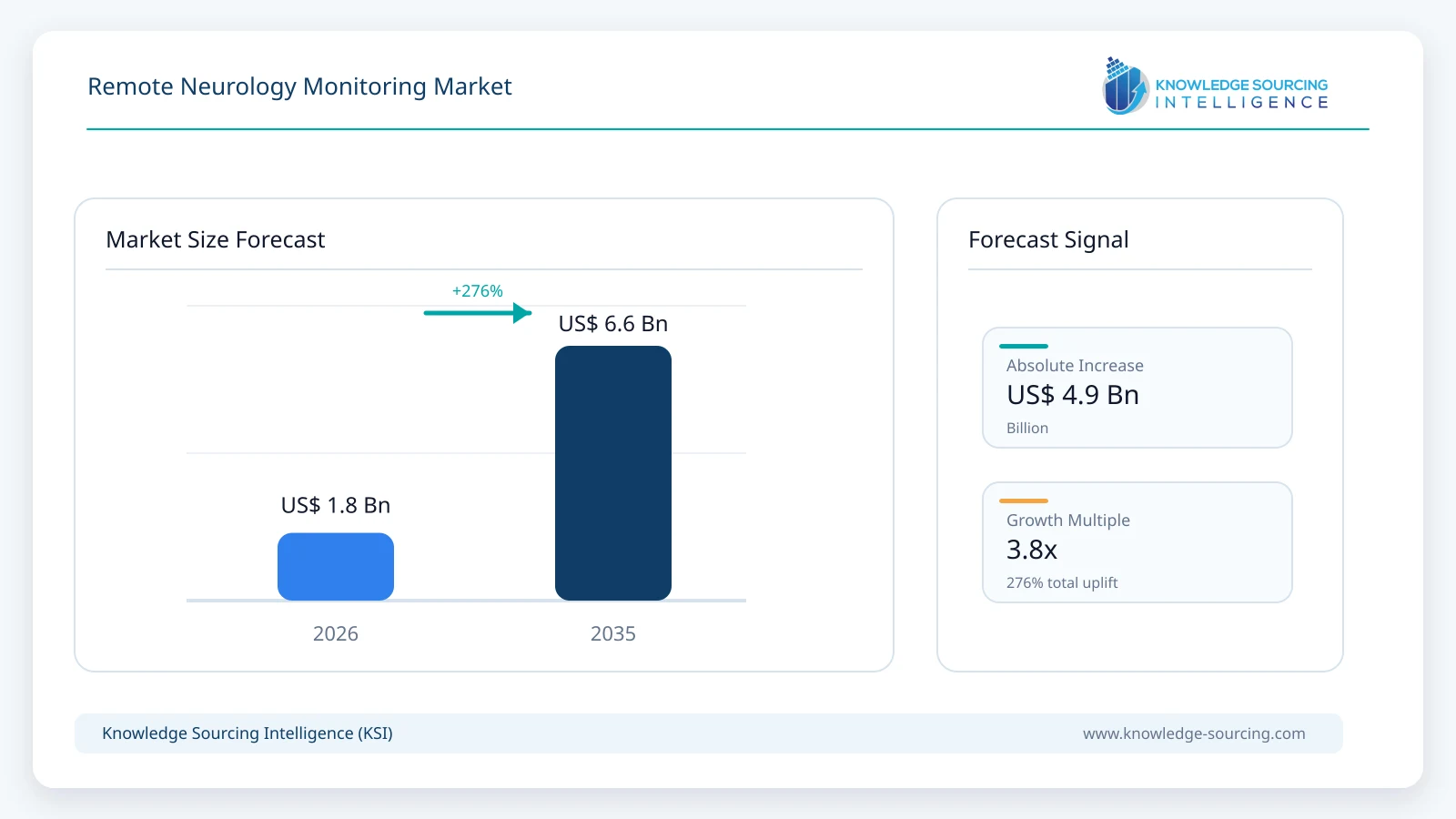
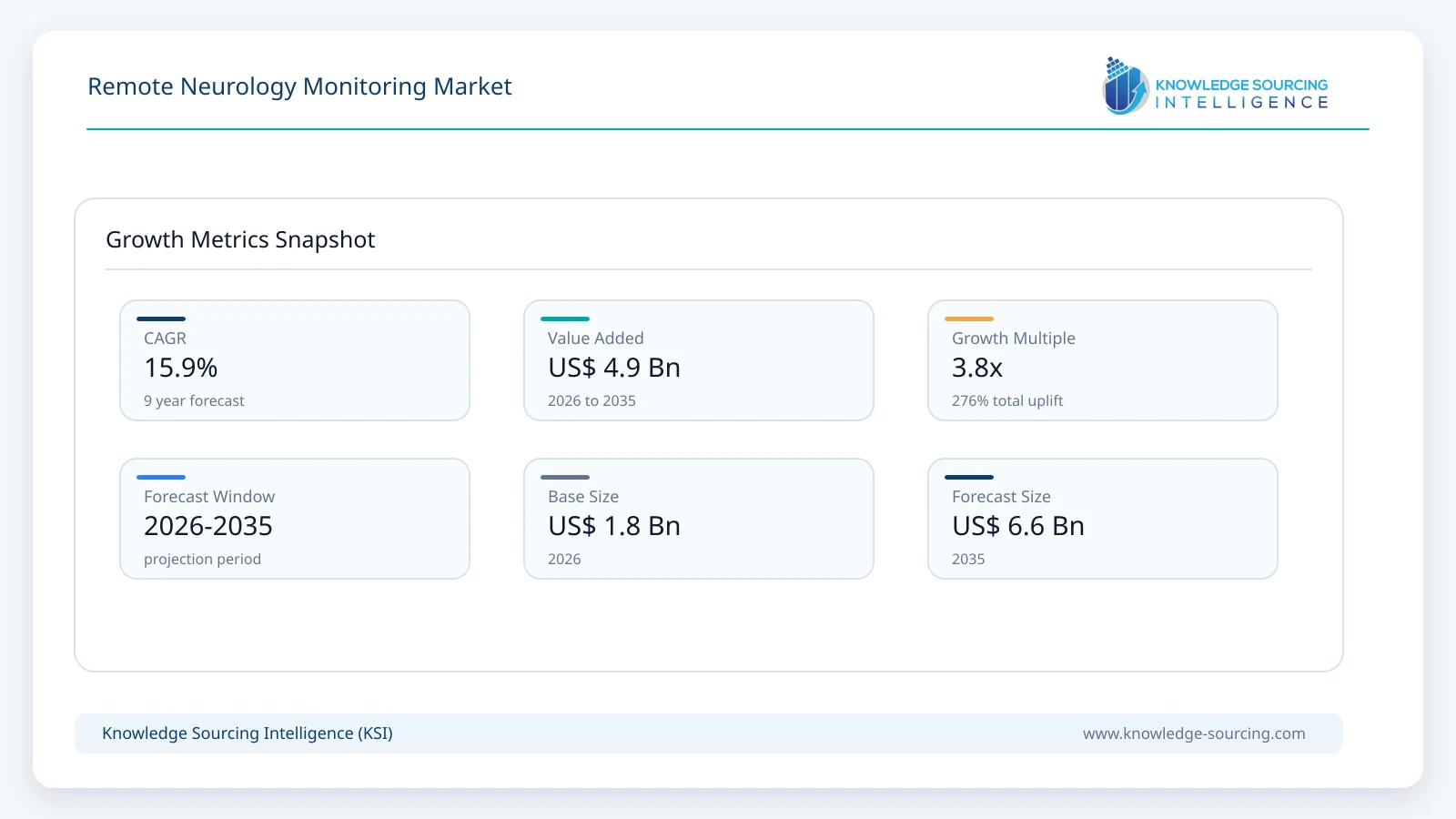
The Global Remote Neurology Monitoring Market is expected to increase at a CAGR of 15.9% the forecast period, growing from USD 1.76 billion in 2026 to USD 6.62 billion by 2035.
Highlights:
- 1Rising neurological disease burden is increasing demand for continuous monitoring technologies that support earlier intervention and treatment optimization.
- 2Expansion of FDA-cleared wearable and AI-enabled neurological monitoring systems is accelerating clinical adoption across epilepsy and critical care neurology settings.
- 3Healthcare systems are shifting toward home-based disease management, increasing demand for remote neurological assessment platforms.
- 4Artificial intelligence integration is reducing interpretation burden for neurologists, improving scalability of remote monitoring programs.
Neurological disorders represent a major global healthcare burden because disease progression often occurs between physician visits. As healthcare systems seek earlier identification of clinical deterioration, providers are increasingly adopting remote monitoring technologies that generate objective patient data outside hospital settings.
The market depends on advances in biosensors, cloud computing, machine learning algorithms, and wireless connectivity. These technologies enable continuous monitoring of seizure frequency, movement disorders, sleep abnormalities, and neurodegenerative disease progression, creating actionable insights for clinicians.
Regulatory oversight plays a central role because neurological monitoring systems increasingly influence clinical decision-making. Regulatory agencies are expanding frameworks for software as a medical device (SaMD), AI-enabled diagnostics, and connected medical devices, strengthening confidence in remote neurological care pathways.
The strategic importance of the market stems from the growing prevalence of epilepsy, Parkinson's disease, dementia, stroke-related disabilities, and multiple sclerosis. Healthcare providers require scalable monitoring approaches that reduce hospital dependence while maintaining clinical visibility across chronic neurological conditions.
Market Dynamics
Market Drivers
Growing Burden of Epilepsy and Chronic Neurological Disorders: Remote neurology monitoring addresses the need for continuous disease observation across chronic neurological conditions. Demand is increasing because epilepsy, Parkinson's disease, and dementia often exhibit fluctuating symptoms that remain underreported during routine consultations. This monitoring gap limits treatment optimization and delays clinical intervention. Healthcare providers are increasingly deploying wearable and connected monitoring systems to capture real-world neurological events. The result is greater reliance on longitudinal patient data for therapeutic decision-making. According to the World Health Organization, epilepsy affects approximately 50 million people globally, making it one of the most common neurological disorders worldwide.
Expansion of Home-Based Healthcare Models: Healthcare delivery increasingly extends beyond hospitals because capacity constraints and cost pressures require alternative care models. Demand is shifting toward home monitoring solutions that maintain clinician oversight without requiring continuous facility visits. Traditional neurological assessments often depend on intermittent observations. Providers are increasingly integrating remote monitoring platforms into chronic disease management programs. This transition strengthens demand for wearable neurological technologies and cloud-based analytics systems.
AI-Enabled Interpretation and Clinical Decision Support: Neurological data volumes continue expanding because continuous monitoring generates large streams of physiological information. Manual interpretation creates workflow challenges for neurologists and neurophysiology teams. Healthcare organizations are increasingly adopting AI-enabled analysis tools that identify clinically relevant patterns and prioritize patient review. This response improves operational efficiency and supports broader deployment of remote neurological monitoring programs.
Increasing Regulatory Validation of Digital Neurology Technologies: Clinical adoption depends on evidence-based validation and regulatory acceptance. Neurological monitoring companies are increasingly pursuing regulatory clearances that demonstrate safety and performance. Regulatory recognition reduces implementation barriers and supports reimbursement discussions. This environment strengthens provider confidence and accelerates market expansion.
Market Restraints
Limited reimbursement consistency across countries restricts large-scale deployment of remote neurology monitoring programs.
Data privacy requirements increase compliance costs for cloud-connected neurological monitoring platforms.
Clinical workflow integration remains challenging because neurological data streams must align with existing electronic health record systems.
Market Opportunities
Digital Biomarker Development: Neurological disease progression often lacks continuous objective measurement. Demand is increasing for digital biomarkers that quantify symptom severity and treatment response outside clinical settings. Technology developers are expanding sensor capabilities and analytics algorithms to address this need. The outcome is a growing opportunity for software-driven neurological monitoring platforms.
Remote Parkinson's Disease Management: Parkinson's symptoms fluctuate throughout the day, creating limitations for clinic-based assessments. Healthcare providers are increasingly seeking objective motor-function measurements captured in real-world environments. Monitoring companies are developing movement analytics platforms that support therapy optimization. This evolution creates substantial commercial opportunities in movement disorder management.
Expansion into Emerging Healthcare Systems: Neurologist shortages affect many healthcare systems. Demand is increasing for scalable technologies that extend specialist reach into underserved regions. Remote monitoring platforms are reducing geographic barriers to neurological care. This shift creates opportunities for device manufacturers and software providers targeting emerging markets.
Integration with Precision Neurology: Neurological treatment increasingly relies on individualized care strategies. Continuous monitoring generates patient-specific datasets that improve disease characterization. Providers are increasingly incorporating these insights into treatment planning. The result is stronger demand for advanced remote neurology monitoring ecosystems.
Disease & Epidemiology Analysis
Neurological disorders represent one of the fastest-growing categories of chronic disease burden globally. Epilepsy remains a primary use case for remote monitoring because seizure occurrence frequently happens outside healthcare settings. The need for objective seizure documentation is increasing demand for wearable detection technologies and remote EEG systems.
Parkinson's disease is creating additional monitoring requirements because symptom severity varies throughout daily activities. Traditional clinic visits capture limited snapshots of disease status. Healthcare providers are increasingly adopting digital tools that quantify tremor, mobility, and motor fluctuations across extended periods.
Dementia and Alzheimer's disease are expanding the addressable market because healthcare systems require scalable approaches for tracking cognitive and behavioral changes. Stroke survivors and multiple sclerosis patients also require ongoing monitoring to support rehabilitation and disease management strategies.
Treatment Guidelines Landscape
Disease Area | Guidelines Focus | Monitoring Relevance |
Epilepsy | Seizure control and treatment optimization | Continuous seizure detection and event documentation |
Parkinson's Disease | Symptom management and medication adjustment | Remote motor assessment and digital biomarkers |
Alzheimer's Disease | Cognitive decline monitoring | Longitudinal behavioral and cognitive tracking |
Market Segmentation
By Product Type
Wearable neurological monitoring devices represent a core market segment because they enable continuous physiological data collection outside healthcare facilities. Demand is increasing as patients seek unobtrusive monitoring solutions that integrate into daily routines. Device accuracy requirements create pressure for advanced sensor technologies and validated algorithms. Manufacturers are increasingly incorporating multimodal sensing capabilities that capture movement, physiological signals, and behavioral patterns. The segment remains central to remote neurology monitoring because wearables provide scalable and patient-friendly monitoring approaches.
By Indication
Epilepsy constitutes the leading indication because seizure events frequently occur outside clinical environments. Demand is increasing for technologies capable of detecting, documenting, and communicating seizure activity in real time. Clinical management depends on accurate event tracking, creating a need for objective monitoring systems. Technology providers are increasingly developing wearable seizure detection devices, remote EEG platforms, and AI-enabled analytics solutions. The segment maintains strong growth potential because continuous monitoring directly addresses major diagnostic and therapeutic challenges in epilepsy care.
By End User
Home care settings represent an increasingly important end-user segment because healthcare delivery is extending beyond hospital environments. Demand is shifting toward technologies that enable clinician oversight while minimizing facility dependence. Chronic neurological disorders require long-term observation, creating operational pressure on traditional care models. Providers are increasingly integrating remote monitoring technologies into home-based management pathways. The segment benefits from improved patient convenience, enhanced data continuity, and reduced healthcare utilization requirements.
Regional Analysis
North America Market Analysis
North America represents the most established market for remote neurology monitoring because the region combines advanced healthcare infrastructure with strong digital health adoption. Demand is increasing as healthcare systems seek scalable approaches for managing chronic neurological diseases. Neurologist workforce limitations create pressure for technologies that extend specialist visibility beyond traditional care settings. Healthcare providers are increasingly implementing wearable monitoring systems, remote EEG technologies, and AI-assisted neurological analytics. The region benefits from robust regulatory pathways, substantial healthcare spending, and active participation from leading medical device manufacturers. The United States remains the primary innovation hub because regulatory clearances continue validating new neurological monitoring technologies. The resulting ecosystem supports rapid commercialization and adoption of remote neurology solutions.
Europe Market Analysis
Europe maintains strong demand for remote neurology monitoring because aging populations are increasing neurological disease prevalence. Healthcare systems emphasize long-term disease management, creating a favorable environment for continuous monitoring technologies. Budgetary constraints place pressure on hospital-centered neurological care models. Providers are increasingly deploying remote monitoring programs that improve care efficiency while supporting patient-centered treatment pathways. Regulatory harmonization through medical device frameworks is strengthening confidence in digital health technologies. The market benefits from extensive telehealth integration and growing acceptance of software-driven clinical decision support systems. These conditions support steady expansion of remote neurological monitoring adoption across the region.
Asia Pacific Market Analysis
Asia Pacific represents a rapidly evolving market because neurological disease burdens are increasing alongside healthcare modernization efforts. Demand is growing as healthcare systems expand digital health infrastructure and improve specialist access. Geographic disparities constrain access to neurological expertise in many countries. Providers are increasingly evaluating remote monitoring technologies that extend care into underserved communities. Technology adoption is accelerating as smartphone penetration and connectivity improve across the region. Government-led digital health initiatives further support deployment of connected healthcare platforms. These factors position Asia Pacific as a significant growth region for remote neurology monitoring technologies.
Rest of the World
The Rest of the World market encompasses emerging healthcare systems that face substantial neurological care access challenges. Demand is increasing because specialist shortages limit timely diagnosis and disease management. Resource constraints reduce the feasibility of traditional monitoring-intensive care pathways. Healthcare organizations are increasingly exploring remote monitoring technologies that expand neurological service coverage without requiring extensive infrastructure investment. Digital health adoption continues to improve across parts of Latin America, the Middle East, and Africa. This transition supports gradual integration of connected neurological monitoring solutions. The resulting market remains smaller than developed regions but presents long-term expansion opportunities.
Regulatory Landscape
Remote neurology monitoring operates within increasingly stringent regulatory frameworks because these technologies influence clinical decision-making and patient management. Regulatory agencies such as the U.S. Food and Drug Administration continue expanding oversight of software as a medical device, AI-enabled diagnostic systems, and connected monitoring platforms. This environment requires manufacturers to demonstrate clinical validity, cybersecurity readiness, and real-world performance.
European regulatory frameworks under the Medical Device Regulation have increased evidence requirements for digital health technologies. Companies are investing in clinical studies and post-market surveillance capabilities because regulatory expectations increasingly emphasize ongoing performance monitoring. These requirements strengthen market credibility while raising development complexity.
Artificial intelligence integration is creating additional regulatory considerations. Authorities increasingly require transparency regarding algorithm performance, clinical validation, and risk management processes. This trend supports greater confidence in AI-assisted neurological monitoring solutions and encourages broader provider adoption.
Pipeline Analysis
The remote neurology monitoring pipeline increasingly focuses on AI-enhanced analytics, digital biomarkers, and next-generation wearable sensing technologies. Companies are developing systems capable of detecting subtle neurological changes before clinical deterioration becomes apparent. This direction reflects growing demand for predictive and preventive neurological care models.
Epilepsy remains the most active innovation area because seizure detection, forecasting, and documentation continue presenting significant unmet needs. Companies are advancing wearable seizure monitoring systems, remote EEG platforms, and algorithm-driven event classification technologies. Empatica continues expanding epilepsy monitoring capabilities through its wearable ecosystem, while Ceribell is advancing AI-assisted EEG interpretation technologies.
Movement disorder monitoring also represents a major development focus. Organizations are increasingly building digital biomarker platforms that quantify Parkinson's disease progression and treatment response. Software-driven analytics are becoming central to neurological monitoring pipelines because they transform continuous patient data into clinically actionable insights.
Competitive Landscape
Medtronic
Medtronic remains strategically distinct because it combines implantable neuromodulation expertise with global healthcare reach. Its neurological portfolio supports continuous data generation and long-term disease management. The company continues investing in connected care ecosystems that improve patient monitoring and therapy optimization. Its scale, clinical evidence base, and physician relationships strengthen competitive positioning across neurological monitoring applications.
NeuroPace
NeuroPace differentiates itself through responsive neurostimulation technologies designed for epilepsy management. Its platform generates clinically relevant neurological data while supporting therapeutic intervention. The company focuses on precision epilepsy care, creating strong alignment with emerging remote monitoring models. Its specialized expertise supports continued relevance within advanced neurological management pathways.
Empatica
Empatica stands out through wearable neurological monitoring technologies and digital biomarker development. Its FDA-cleared epilepsy monitoring solutions demonstrate strong alignment with remote patient management trends. The company continues expanding software-enabled monitoring capabilities that improve real-world neurological data collection. This strategy positions Empatica at the intersection of digital health and neurology.
Ceribell
Ceribell differentiates itself through rapid EEG technologies and AI-assisted seizure detection capabilities. The company's focus on accelerating neurological diagnosis addresses critical workflow challenges in acute care settings. Recent FDA clearance for expanded pediatric seizure detection strengthens its competitive position. Its combination of EEG hardware and analytics supports broader adoption across neurological care environments.
BioSerenity
BioSerenity focuses on connected neurophysiology and remote diagnostic solutions. The company leverages wearable technologies and cloud-enabled services to extend neurological monitoring beyond hospital settings. Its emphasis on digital care pathways aligns with growing demand for decentralized neurological assessment models.
Abbott
Abbott benefits from extensive medical device capabilities and established relationships across healthcare systems. The company continues expanding connected health technologies that support chronic disease management. Its scale and innovation resources provide opportunities to strengthen participation in neurological monitoring markets.
Boston Scientific
Boston Scientific maintains a strong position through neuromodulation expertise and advanced medical technology capabilities. The company increasingly supports data-driven neurological care models that integrate therapeutic and monitoring functions. Its innovation focus supports long-term participation in evolving neurological management ecosystems.
Key Developments
November 2025: The University of Sheffield launched a world-first NHS trial to transform care for people with motor neurone disease (MND) in partnership with Sheffield Teaching Hospitals NHS Foundation Trust, introducing innovative remote monitoring technology that helps patients access breathing support from home and improves their ability to manage the condition at home.
May 2025: Natus officially launched BrainWatch, the FDA-cleared point-of-care EEG solution driven by AI that can be set up in less than five minutes for quick intervention in acute care environments, leveraging the NeuroWorks software platform for seamless EEG review with 24/7 remote neurologist collaboration from any web browser.
April 2025: Nihon Kohden launched its second-generation Live View Panel Pro, an upgraded specialized virtual health system for remote neurophysiological assessment that combines real-time interactive viewing of multiple patients, integrated two-way intercom communication, and centralized data management for EEG, PSG, and IOM data to address staff shortages and fragmented care in neurology.
Strategic Insights and Future Market Outlook
Remote neurology monitoring is evolving from a supplementary technology category into a foundational component of neurological disease management. Continuous monitoring increasingly supports clinical decision-making because chronic neurological disorders require longitudinal visibility rather than episodic assessment. This transition is strengthening demand for integrated ecosystems that combine devices, analytics, and clinician workflows.
Artificial intelligence is becoming a defining competitive factor because neurological monitoring programs generate substantial data volumes. Providers increasingly require automated interpretation capabilities that reduce operational burden while improving clinical responsiveness. Companies that combine validated data acquisition with actionable analytics are likely to strengthen their market positions.
Regulatory validation, reimbursement expansion, and digital biomarker adoption are expected to shape competitive dynamics through 2031. Organizations that demonstrate clinical utility, workflow integration, and measurable healthcare outcomes are likely to capture greater adoption across hospitals, neurology clinics, and home care environments.
The market increasingly reflects a broader transformation in neurological care delivery, where continuous patient visibility supports earlier intervention, improved treatment optimization, and more efficient utilization of specialist resources across chronic neurological disease populations.
Remote Neurology Monitoring Market Scope:
| Report Metric | Details |
|---|---|
| Total Market Size in 2026 | USD 1.76 billion |
| Total Market Size in 2035 | USD 6.62 billion |
| Forecast Unit | USD Billion |
| Growth Rate | 15.9% |
| Study Period | 2021 to 2035 |
| Historical Data | 2021 to 2024 |
| Base Year | 2025 |
| Forecast Period | 2026 – 2035 |
| Segmentation | Product Type, Indication, End User, Geography |
| Companies |
|
Market Segmentation
By Geography
Key Countries Analysis
Regulatory & Policy Landscape
Table of Contents
1. EXECUTIVE SUMMARY
1.1 Market Overview
1.2 Key Findings
1.3 Market Snapshot
1.4 Strategic Insights
1.5 Analyst Recommendations
1.6 Future Growth Opportunities
2. DISEASE & EPIDEMIOLOGY ANALYSIS
2.1 Overview of Neurological Disorders Requiring Remote Monitoring
2.1.1 Epilepsy
2.1.2 Parkinson’s Disease
2.1.3 Alzheimer’s Disease and Other Dementias
2.1.4 Multiple Sclerosis
2.1.5 Stroke and Post-Stroke Monitoring
2.1.6 Sleep-Related Neurological Disorders
2.1.7 Neuromuscular Disorders
2.1.8 Other Chronic Neurological Conditions
2.2 Global Epidemiology Overview
2.2.1 Prevalence Analysis
2.2.2 Incidence Analysis
2.2.3 Mortality and Disability Burden
2.2.4 Disease Progression Trends
2.3 Patient Population Assessment
2.3.1 Diagnosed Population
2.3.2 Treated Population
2.3.3 Eligible Population for Remote Monitoring
2.3.4 High-Risk Patient Population
2.4 Epidemiology by Disease Subtype
2.4.1 Focal Epilepsy
2.4.2 Generalized Epilepsy
2.4.3 Early-Stage Parkinson’s Disease
2.4.4 Advanced Parkinson’s Disease
2.4.5 Mild Cognitive Impairment
2.4.6 Alzheimer’s Disease
2.4.7 Relapsing Multiple Sclerosis
2.4.8 Progressive Multiple Sclerosis
3. MARKET DYNAMICS
3.1 Market Overview
3.2 Market Drivers
3.2.1 Rising Burden of Neurological Disorders
3.2.2 Growing Adoption of Digital Health Technologies
3.2.3 Expansion of Remote Patient Monitoring Programs
3.2.4 Increasing Demand for Continuous Neurological Assessment
3.2.5 Advances in Wearable and Connected Neurology Devices
3.3 Market Restraints
3.3.1 Data Privacy and Cybersecurity Concerns
3.3.2 Reimbursement Challenges
3.3.3 Regulatory Compliance Complexity
3.3.4 Device Cost and Infrastructure Limitations
3.4 Market Opportunities
3.4.1 AI-Enabled Neurological Monitoring
3.4.2 Home-Based Neurology Care Models
3.4.3 Expansion in Emerging Markets
3.4.4 Integration with Telemedicine Platforms
3.5 Market Challenges
3.5.1 Interoperability Issues
3.5.2 Patient Adherence Concerns
3.5.3 Clinical Validation Requirements
3.6 Porter’s Five Forces Analysis
3.7 PESTLE Analysis
3.8 Value Chain Analysis
3.9 Technology Roadmap
4. COMMERCIAL & MARKET ACCESS
4.1 Reimbursement Landscape
4.1.1 Remote Patient Monitoring Reimbursement Models
4.1.2 Digital Health Reimbursement Trends
4.1.3 Neurology-Specific Reimbursement Pathways
4.2 Market Access Challenges
4.3 Healthcare Provider Adoption Trends
4.4 Payer Perspectives
4.5 Patient Acceptance and Utilization Trends
4.6 Pricing Analysis
4.7 Procurement and Purchasing Models
5. INNOVATION & PIPELINE LANDSCAPE
5.1 Innovation Overview
5.2 Emerging Digital Biomarkers
5.3 Artificial Intelligence and Predictive Analytics
5.4 Cloud-Based Neurological Monitoring Platforms
5.5 Wearable Neurological Monitoring Technologies
5.6 Implantable Neuromonitoring Systems
5.7 Remote EEG Monitoring Technologies
5.8 Remote Movement Disorder Monitoring Solutions
5.9 Pipeline Landscape
5.9.1 Phase I Programs
5.9.2 Phase II Programs
5.9.3 Phase III Programs
5.9.4 Investigator-Initiated Studies
5.9.5 Digital Therapeutics and Software-Based Solutions
5.10 Pipeline Analysis by Modality
5.10.1 Wearable Devices
5.10.2 Implantable Devices
5.10.3 Software as a Medical Device (SaMD)
5.10.4 AI-Based Monitoring Platforms
5.11 Pipeline Analysis by Mechanism of Action
5.11.1 Electrophysiological Monitoring
5.11.2 Neurostimulation-Based Monitoring
5.11.3 Motion and Gait Tracking
5.11.4 Cognitive Assessment Technologies
6. TREATMENT LANDSCAPE
6.1 Current Standard of Care
6.2 Role of Remote Neurology Monitoring in Disease Management
6.3 Neurology Care Pathway Analysis
6.4 Remote Monitoring Integration Across Care Continuum
6.5 Clinical Practice Guidelines Overview
6.6 Comparative Assessment of Monitoring Technologies
6.7 Unmet Clinical Needs
7. GLOBAL REMOTE NEUROLOGY MONITORING MARKET SIZE & FORECAST
7.1 Global Market Size Analysis (Historical)
7.2 Global Market Forecast Analysis
7.3 Market Attractiveness Analysis
7.4 Incremental Revenue Opportunity Analysis
7.5 Year-on-Year Growth Analysis
7.6 Absolute Dollar Opportunity Analysis
8. GLOBAL REMOTE NEUROLOGY MONITORING MARKET SEGMENTATION
8.1 By Product Type
8.1.1 Wearable Neurological Monitoring Devices
8.1.2 Implantable Neurological Monitoring Devices
8.1.3 Mobile Health Applications
8.1.4 Software and Analytics Platforms
8.1.5 Others
8.2 By Indication
8.2.1 Epilepsy
8.2.2 Parkinson’s Disease
8.2.3 Alzheimer’s Disease & Dementia
8.2.4 Multiple Sclerosis
8.2.5 Stroke Monitoring
8.2.6 Sleep Disorders
8.2.7 Other Neurological Disorders
8.3 By End User
8.3.1 Hospitals
8.3.2 Neurology Clinics
8.3.3 Ambulatory Surgical Centers
8.3.4 Home Care Settings
8.3.5 Others
9. GEOGRAPHICAL ANALYSIS
9.1 North America
9.1.1 Market Size and Forecast
9.1.2 Demand Drivers
9.1.3 Regional Regulatory Overview
9.1.4 Competitive Intensity
9.2 Europe
9.2.1 Market Size and Forecast
9.2.2 Demand Drivers
9.2.3 Regional Regulatory Overview
9.2.4 Competitive Intensity
9.3 Asia-Pacific
9.3.1 Market Size and Forecast
9.3.2 Demand Drivers
9.3.3 Regional Regulatory Overview
9.3.4 Competitive Intensity
9.4 Latin America
9.4.1 Market Size and Forecast
9.4.2 Demand Drivers
9.4.3 Regional Regulatory Overview
9.4.4 Competitive Intensity
9.5 Middle East & Africa
9.5.1 Market Size and Forecast
9.5.2 Demand Drivers
9.5.3 Regional Regulatory Overview
9.5.4 Competitive Intensity
10. KEY COUNTRIES ANALYSIS
10.1 United States
10.1.1 Market Size
10.1.2 Epidemiology
10.1.3 Regulatory Framework
10.1.4 Reimbursement
10.1.5 Key Companies and Product Presence
10.2 Canada
10.3 Germany
10.4 United Kingdom
10.5 France
10.6 Italy
10.7 Spain
10.8 China
10.9 Japan
10.10 India
10.11 South Korea
10.12 Australia
10.13 Brazil
10.14 Mexico
10.15 Saudi Arabia
10.16 South Africa
11. REGULATORY & POLICY LANDSCAPE
11.1 Global Regulatory Overview
11.2 United States – FDA Framework for Remote Neurology Monitoring Devices
11.3 Europe – MDR and Related Digital Health Regulations
11.4 Japan – PMDA Regulatory Requirements
11.5 India – CDSCO Regulatory Framework
11.6 China – NMPA Regulatory Framework
11.7 Data Privacy and Security Regulations
11.8 Software as a Medical Device (SaMD) Requirements
11.9 Clinical Evidence and Validation Requirements
11.10 Regulatory Trends and Future Outlook
12. COMPETITIVE LANDSCAPE
12.1 Market Share Analysis
12.2 Competitive Benchmarking
12.3 Product Portfolio Comparison
12.4 Technology Benchmarking
12.5 Strategic Developments
12.5.1 Mergers and Acquisitions
12.5.2 Partnerships and Collaborations
12.5.3 Product Launches
12.5.4 Regulatory Approvals
12.5.5 Funding and Investments
13. COMPANY PROFILES
13.1 Medtronic
13.1.1 Company Overview
13.1.2 Approved Products and Devices
13.1.3 Key Indications
13.1.4 Pipeline Programs (Phase I/II/III, if applicable)
13.1.5 Strategic Outlook
13.2 NeuroPace
13.2.1 Company Overview
13.2.2 Approved Products and Devices
13.2.3 Key Indications
13.2.4 Pipeline Programs
13.2.5 Strategic Outlook
13.3 Empatica
13.3.1 Company Overview
13.3.2 Approved Products and Devices
13.3.3 Key Indications
13.3.4 Pipeline Programs
13.3.5 Strategic Outlook
13.4 Ceribell
13.4.1 Company Overview
13.4.2 Approved Products and Devices
13.4.3 Key Indications
13.4.4 Pipeline Programs
13.4.5 Strategic Outlook
13.5 BioSerenity
13.5.1 Company Overview
13.5.2 Approved Products and Devices
13.5.3 Key Indications
13.5.4 Pipeline Programs
13.5.5 Strategic Outlook
13.6 Abbott
13.6.1 Company Overview
13.6.2 Approved Products and Devices
13.6.3 Key Indications
13.6.4 Pipeline Programs
13.6.5 Strategic Outlook
13.7 Boston Scientific
13.7.1 Company Overview
13.7.2 Approved Products and Devices
13.7.3 Key Indications
13.7.4 Pipeline Programs
13.7.5 Strategic Outlook
13.8 Rune Labs
13.8.1 Company Overview
13.8.2 Commercialized Products and Platforms
13.8.3 Key Indications
13.8.4 Pipeline Programs
13.8.5 Strategic Outlook
13.9 Brain Sentinel
13.9.1 Company Overview
13.9.2 Approved Products and Devices
13.9.3 Key Indications
13.9.4 Pipeline Programs
13.9.5 Strategic Outlook
13.10 Masimo
13.10.1 Company Overview
13.10.2 Approved Products and Devices
13.10.3 Key Indications
13.10.4 Pipeline Programs
13.10.5 Strategic Outlook
14. FUTURE OUTLOOK
14.1 Future Market Projections
14.2 Technology Evolution Outlook
14.3 AI and Predictive Neurology Monitoring Trends
14.4 Emerging Business Models
14.5 Investment Opportunities
14.6 Strategic Recommendations
14.7 Long-Term Market Outlook to Forecast Period
15. METHODOLOGY
15.1 Research Objectives
15.2 Market Definition and Scope
15.3 Data Collection Methodology
15.4 Secondary Research Sources
15.5 Primary Research Methodology
15.6 Epidemiology Modeling Approach
15.7 Forecasting Methodology
15.8 Data Validation and Triangulation
15.9 Assumptions and Limitations
15.10 Abbreviations and Definitions
Navigate
Trusted by the world's leading organizations











