
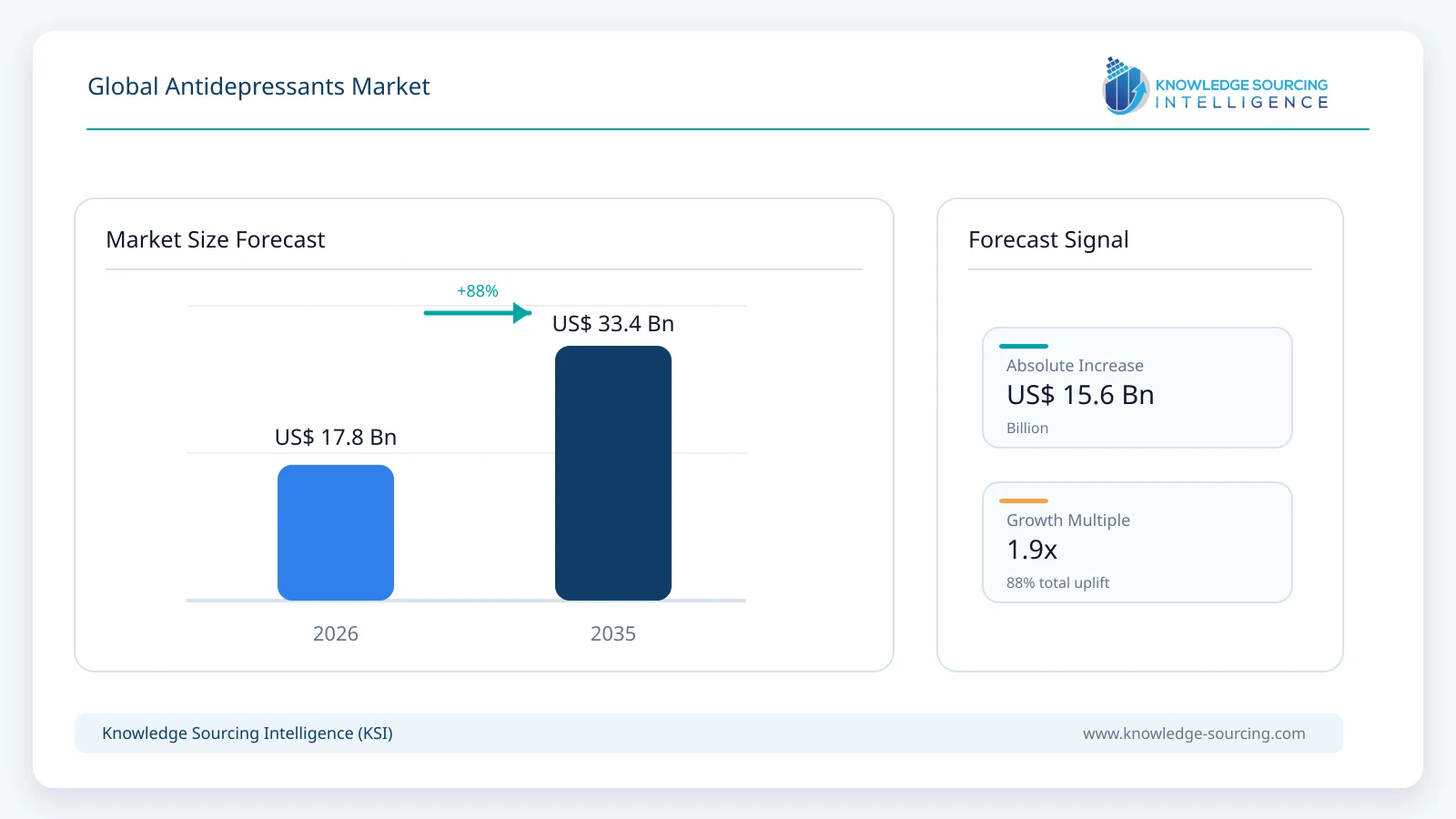
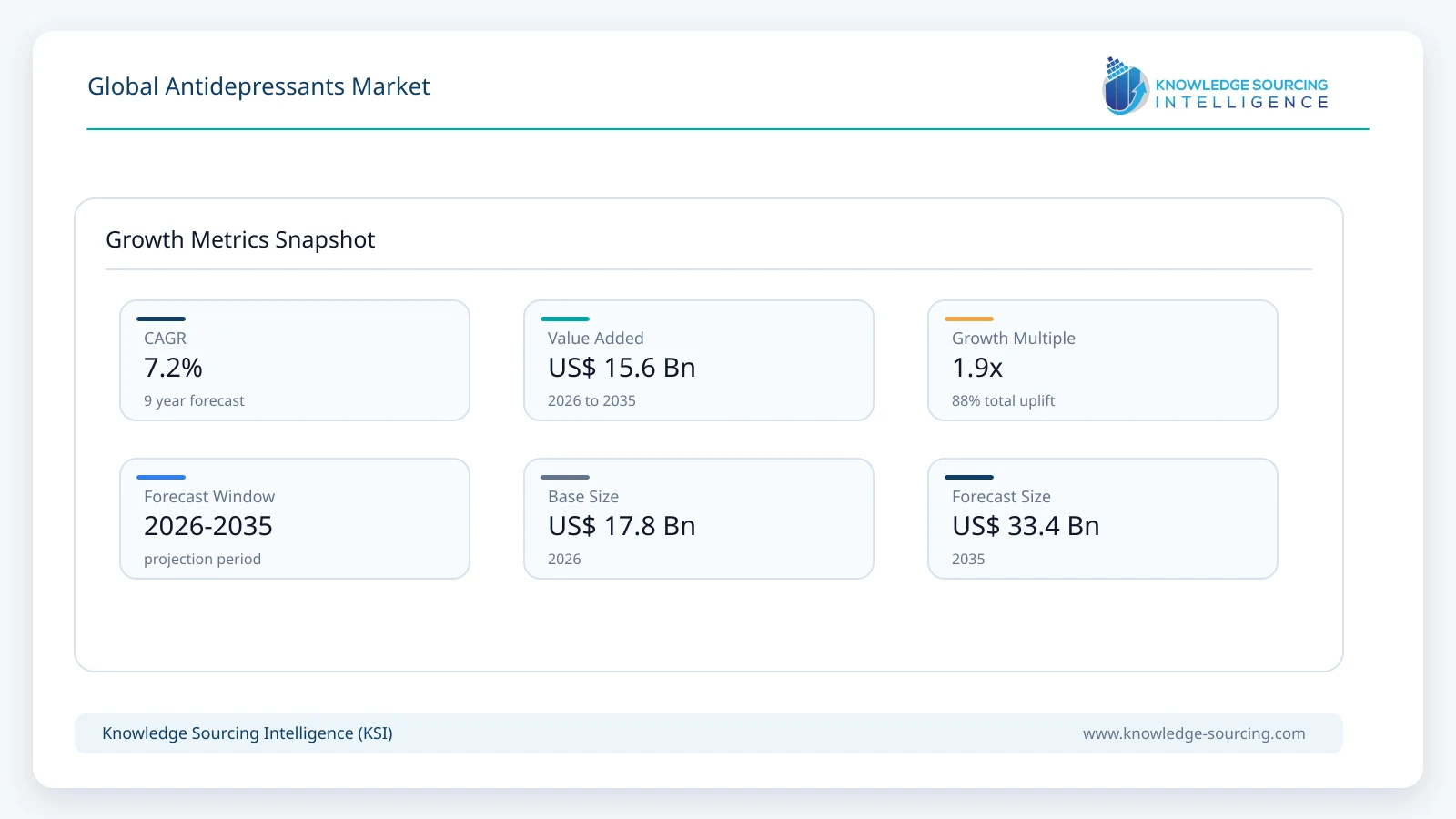
The Global Antidepressants Market is projected to grow at a CAGR of 7.2% the forecast period, increasing from USD 17.8 billion in 2026 to USD 33.4 billion by 2035.
Highlights:
- 1Rising depression diagnosis rates are increasing antidepressant demand because greater awareness continues encouraging treatment initiation.
- 2Growth in treatment-resistant depression is strengthening interest in novel therapies because conventional treatment response remains inconsistent.
- 3Expanding mental healthcare access is increasing prescription volumes because earlier intervention supports long-term disease management.
- 4Development of rapid-acting antidepressants is accelerating innovation because delayed onset remains a major limitation of traditional therapies.
Antidepressants represent a cornerstone of depression management because pharmacological intervention remains one of the most widely utilized treatment approaches across psychiatric care settings. Demand exists because depressive disorders continue affecting patient quality of life, productivity, and long-term health outcomes. Healthcare providers are increasing treatment initiation rates because earlier intervention supports symptom control and disease management. The outcome strengthens demand across multiple antidepressant drug classes.
Mental health awareness initiatives are increasing patient engagement because stigma reduction continues encouraging treatment seeking behavior. Untreated depression creates substantial clinical and economic consequences because disease progression often increases healthcare utilization and functional impairment. Healthcare systems are expanding access to psychiatric services because early diagnosis supports more effective intervention. This trend increases utilization of antidepressant therapies across both developed and emerging healthcare markets.
Regulatory oversight influences market development because antidepressants require extensive clinical evaluation to demonstrate efficacy and safety. Pharmaceutical manufacturers are investing in novel mechanisms of action because treatment-resistant populations continue creating unmet clinical demand. This process supports continued innovation within the antidepressants market.
Market Dynamics
Market Drivers
Increasing Burden of Depressive Disorders: Depressive disorders remain among the leading contributors to disability globally. Demand is increasing because growing diagnosis rates continue expanding the treated patient population. Untreated mental illness creates substantial healthcare and socioeconomic burdens because disease progression affects productivity and quality of life. Healthcare providers are increasing screening and intervention efforts to improve patient outcomes. This trend strengthens antidepressant utilization across healthcare systems.
Expansion of Mental Health Awareness: Mental health awareness improves treatment-seeking behavior because stigma reduction encourages earlier engagement with healthcare providers. Demand is increasing as public education initiatives continue expanding recognition of depressive symptoms. Delayed treatment creates higher disease burden because prolonged symptoms negatively affect patient functioning. Healthcare organizations are strengthening mental health programs to improve access and diagnosis. The outcome supports growth in antidepressant prescriptions.
Emergence of Novel Antidepressant Therapies: Innovation remains critical because a substantial proportion of patients experience inadequate response to conventional therapies. Demand is shifting toward rapid-acting treatments because delayed onset limits effectiveness during acute symptom periods. Clinical challenges persist because treatment-resistant depression remains difficult to manage. Pharmaceutical developers are advancing mechanism-diverse therapies to improve response rates. This process expands market opportunities.
Improving Access to Psychiatric Care: Healthcare accessibility supports treatment uptake because diagnosis often precedes pharmacological intervention. Demand is increasing as healthcare systems continue integrating mental health services into primary care settings. Limited specialist availability constrains patient management in many regions. Providers are expanding collaborative care models to improve treatment access. The result strengthens antidepressant utilization across broader patient populations.
Market Restraints
Adverse effects reduce long-term treatment adherence because tolerability concerns often influence patient persistence.
Generic competition limits revenue growth because many established antidepressants have lost market exclusivity.
Delayed therapeutic response constrains clinical effectiveness because symptom improvement may require several weeks of treatment.
Market Opportunities
Rapid-Acting Antidepressant Development: Rapid symptom relief remains a major unmet clinical need. Demand is increasing because healthcare providers require therapies capable of addressing acute depressive symptoms more effectively. Conventional treatments create response delays that affect patient outcomes. Pharmaceutical companies are advancing rapid-acting mechanisms to improve treatment timelines. This opportunity supports innovation across the market.
Expansion of Precision Psychiatry: Patient response variability creates treatment complexity because biological differences influence therapeutic effectiveness. Demand is shifting toward personalized treatment approaches that improve patient outcomes. Traditional prescribing strategies often rely on trial-and-error approaches. Researchers are expanding biomarker and precision medicine initiatives to support individualized care. This trend creates long-term growth opportunities.
Treatment-Resistant Depression Management: Treatment-resistant depression remains a significant unmet need because many patients fail to achieve adequate symptom control. Demand is increasing for innovative therapeutic approaches capable of addressing refractory disease. Existing treatment pathways frequently require multiple interventions before success is achieved. Pharmaceutical developers are strengthening research programs targeting difficult-to-treat populations. This focus supports future market expansion.
Emerging Market Mental Health Investment: Mental health infrastructure continues expanding across emerging economies because depression increasingly receives recognition as a public health priority. Resource limitations constrain immediate treatment access in many regions. Governments are increasing investment in mental health services to improve diagnosis and care delivery. Pharmaceutical companies are strengthening regional market strategies to support broader accessibility. This process creates new growth opportunities.
Government Regulations
Region | Regulatory Authority | Regulatory Focus |
United States | FDA | NDA approvals, pharmacovigilance, controlled substance oversight where applicable |
Europe | EMA | Marketing authorization, safety monitoring, post-market surveillance |
Japan | PMDA | Drug approval review, efficacy and safety assessment |
China | NMPA | Drug registration, manufacturing compliance, clinical evaluation |
India | CDSCO | Drug approval, quality control, pharmacovigilance |
Market Segmentation
By Drug Class
Selective Serotonin Reuptake Inhibitors (SSRIs) maintain substantial demand because they remain the most widely prescribed first-line antidepressants across major healthcare systems. Demand is shifting toward therapies with improved tolerability because long-term treatment adherence depends heavily on side-effect profiles. Conventional treatment challenges persist because a meaningful proportion of patients experience inadequate symptom control. Pharmaceutical companies are expanding development of differentiated therapies that improve efficacy while maintaining safety. The market therefore continues balancing established SSRI utilization with adoption of newer antidepressant classes.
Serotonin-Norepinephrine Reuptake Inhibitors (SNRIs), Tricyclic Antidepressants (TCAs), Monoamine Oxidase Inhibitors (MAOIs), Atypical Antidepressants, and NMDA receptor modulators address increasingly diverse treatment requirements because patient response variability continues influencing prescribing decisions. Demand is increasing for NMDA receptor modulators because rapid symptom improvement remains a major unmet need. Traditional antidepressants retain importance because affordability and physician familiarity support continued utilization. The market therefore increasingly supports both established and innovative pharmacological approaches.
By Indication
Major Depressive Disorder (MDD) represents the largest indication because it accounts for the majority of antidepressant prescriptions globally. Demand is increasing for earlier intervention because prolonged untreated depression continues worsening long-term outcomes. Treatment-resistant depression is gaining strategic importance because inadequate response to multiple therapies creates substantial clinical burden. Pharmaceutical developers are strengthening innovation efforts because existing treatment pathways do not adequately address all patient populations. The market therefore increasingly focuses on both broad MDD management and specialized treatment-resistant depression solutions.
Postpartum depression is receiving greater clinical attention because earlier diagnosis and dedicated treatment options are improving therapeutic intervention rates. Depression associated with anxiety disorders continues driving antidepressant utilization because comorbid psychiatric conditions remain common. Healthcare providers are expanding integrated treatment strategies because overlapping symptom profiles require comprehensive management approaches. The market therefore increasingly supports indication-specific therapeutic development.
By Route of Administration
Oral antidepressants dominate utilization because they support convenient long-term treatment and broad patient accessibility. Demand is increasing for alternative administration routes because treatment-resistant populations require differentiated therapeutic approaches. Delayed onset and adherence challenges create limitations within conventional oral therapy pathways. Pharmaceutical manufacturers are expanding intranasal and intravenous treatment options because rapid therapeutic response increasingly influences treatment selection. The market therefore continues evolving beyond traditional oral formulations toward diversified administration strategies.
Regional Analysis
North America
North America maintains market leadership because mental health awareness, healthcare access, and prescription utilization remain among the highest globally. Demand is increasing for innovative antidepressants because treatment-resistant depression continues to create significant unmet clinical need. Traditional antidepressant therapies remain widely utilized because established reimbursement frameworks support patient access. Healthcare providers are increasing adoption of rapid-acting therapies because earlier symptom control improves patient outcomes and reduces disease burden. Pharmaceutical manufacturers are strengthening commercialization strategies because regulatory pathways continue supporting innovative psychiatric drug development. The regional market therefore increasingly prioritizes novel therapies, precision psychiatry initiatives, and expanded mental healthcare accessibility.
Europe
Europe maintains substantial antidepressant utilization because public healthcare systems continue prioritizing mental health management and treatment accessibility. Demand is increasing for cost-effective therapies because healthcare expenditure pressures continue influencing prescribing practices. Generic antidepressants retain significant utilization because reimbursement frameworks emphasize affordability and broad patient coverage. Pharmaceutical companies are expanding innovation efforts because treatment-resistant depression remains an important clinical challenge. Healthcare systems are strengthening mental health programs because earlier intervention reduces long-term socioeconomic burden. The regional market therefore increasingly balances cost containment with adoption of innovative psychiatric treatments.
Asia Pacific
Asia Pacific is experiencing rapid market expansion because growing mental health awareness and improving healthcare infrastructure continue increasing diagnosis rates. Demand is increasing for antidepressant therapy because urbanization, lifestyle changes, and socioeconomic pressures continue influencing mental health outcomes. Access disparities remain a challenge because psychiatric care availability varies significantly across countries. Governments are strengthening mental health initiatives because untreated depression increasingly affects productivity and healthcare expenditure. Pharmaceutical companies are expanding regional presence because patient populations continue growing. The regional market therefore increasingly supports broader treatment access and expanding antidepressant adoption.
Rest of the World
Latin America, the Middle East, and Africa continue expanding antidepressant utilization because mental health awareness and healthcare investment are gradually improving. Demand is shifting toward affordable treatment options because resource limitations continue influencing prescribing decisions. Specialist psychiatric infrastructure remains limited because healthcare resources often prioritize other disease categories. Governments are strengthening mental health programs because depression increasingly contributes to healthcare burden and workforce productivity losses. Pharmaceutical manufacturers are increasing regional partnerships because broader treatment accessibility remains a strategic priority. The market therefore increasingly depends on affordable therapies, healthcare expansion, and awareness initiatives.
Regulatory Landscape
The antidepressants regulatory environment continues evolving because psychiatric disorders remain a significant healthcare priority globally. Regulatory agencies require extensive clinical evidence because antidepressant efficacy and safety directly affect long-term patient outcomes. Pharmaceutical developers are increasing investment in clinical research because novel mechanisms of action require comprehensive validation. The market therefore increasingly emphasizes evidence-based therapeutic development.
The FDA continues supporting innovation in psychiatric therapeutics because treatment-resistant depression remains an area of substantial unmet need. The EMA maintains strong emphasis on benefit-risk assessment because long-term treatment often requires extensive safety monitoring. PMDA, NMPA, and CDSCO continue strengthening regulatory frameworks because mental healthcare demand continues expanding across their respective regions. Regulatory oversight therefore increasingly supports both patient safety and therapeutic innovation.
Pipeline development remains closely linked to regulatory evolution because emerging therapies frequently utilize novel mechanisms of action. Pharmaceutical companies are strengthening post-market surveillance capabilities because long-term safety data increasingly influences market adoption. The regulatory landscape therefore continues supporting advancement of differentiated antidepressant therapies.
Pipeline Analysis
The antidepressants pipeline increasingly focuses on rapid-acting therapies because conventional antidepressants often require prolonged treatment periods before symptom improvement occurs. Demand is increasing for novel mechanisms because treatment-resistant depression continues limiting outcomes for many patients. Existing therapeutic approaches create clinical gaps because response rates remain inconsistent across patient populations. Pharmaceutical companies are advancing NMDA receptor modulators, neuroactive steroids, and multimodal therapies because differentiated mechanisms may improve treatment effectiveness. The pipeline therefore increasingly supports innovation beyond traditional monoamine-based approaches.
Precision psychiatry is gaining importance because biological variability continues influencing antidepressant response. Demand is increasing for therapies capable of addressing specific patient subgroups because generalized treatment strategies often produce inconsistent outcomes. Clinical development programs are incorporating biomarker research because improved patient stratification may strengthen treatment success. The pipeline therefore increasingly aligns with personalized medicine principles.
Digital health integration continues expanding because treatment monitoring and patient engagement increasingly influence long-term outcomes. Pharmaceutical developers are exploring complementary technologies because adherence and response assessment remain critical determinants of therapeutic effectiveness. The antidepressants pipeline therefore increasingly combines pharmacological innovation with broader mental healthcare management strategies.
Competitive Landscape
Fujirebio
Pfizer remains strategically differentiated because its extensive neuroscience experience and global pharmaceutical infrastructure support broad psychiatric market participation. Demand is increasing for therapies that improve long-term disease management because depression continues affecting diverse patient populations worldwide. Competitive pressure remains significant because generic products dominate large segments of the antidepressant market. Pfizer is strengthening innovation and lifecycle management initiatives because sustained differentiation increasingly depends on therapeutic value and clinical evidence. The company therefore benefits from scale, research capabilities, and global commercial reach.
H. Lundbeck A/S
Lundbeck remains highly specialized because neuroscience continues representing the core focus of its pharmaceutical strategy. Demand is increasing for innovative psychiatric therapies because treatment-resistant depression continues creating unmet needs. Clinical complexity constrains treatment success because patient response remains highly variable. Lundbeck is expanding partnerships and development programs because advancing differentiated neuroscience therapies remains central to growth. The company therefore benefits from deep expertise within central nervous system disorders.
Otsuka Pharmaceutical Co., Ltd.
Otsuka maintains strong positioning because its psychiatric portfolio addresses multiple mental health conditions across global markets. Demand is increasing for adjunctive and innovative treatment approaches because conventional antidepressant response remains inconsistent. Therapeutic differentiation remains essential because competition across established antidepressant categories continues intensifying. Otsuka is strengthening commercialization and development strategies because broader psychiatric treatment adoption supports long-term growth. The company therefore benefits from diversified mental health expertise and strategic partnerships.
Johnson & Johnson
Johnson & Johnson remains strategically important because Spravato established a differentiated treatment option for treatment-resistant depression. Demand is increasing for rapid-acting therapies because delayed symptom improvement continues limiting traditional treatment pathways. Clinical adoption requires ongoing physician education because novel treatment paradigms differ from conventional antidepressant approaches. Johnson & Johnson is expanding evidence-generation activities because long-term utilization depends on demonstrating sustained value. The company therefore benefits from leadership in innovative psychiatric therapeutics.
AbbVie Inc.
AbbVie maintains relevance because neuroscience remains an important component of its broader pharmaceutical strategy. Demand is increasing for differentiated psychiatric treatments because treatment-resistant patient populations continue expanding. Market competition remains intense because numerous established antidepressants are available globally. AbbVie is strengthening research investments because future growth increasingly depends on innovation-driven differentiation. The company therefore benefits from extensive development resources and commercialization capabilities.
Sage Therapeutics, Inc.
Sage Therapeutics remains strategically differentiated because neuroactive steroid therapies target unmet needs within depression treatment. Demand is increasing for postpartum depression therapies because awareness and diagnosis continue expanding. Conventional treatment limitations create opportunities because faster symptom improvement remains clinically valuable. Sage is strengthening commercialization activities because broader physician adoption depends on continued evidence generation. The company therefore benefits from specialization in novel psychiatric treatment mechanisms.
Takeda Pharmaceutical Company Limited
Takeda maintains competitive relevance because its neuroscience portfolio supports participation in psychiatric treatment markets. Demand is increasing for innovative therapies because treatment-resistant depression continues creating clinical challenges. Healthcare providers require evidence-based differentiation because multiple treatment options remain available. Takeda is expanding research efforts because addressing unmet psychiatric needs supports future growth. The company therefore benefits from global pharmaceutical expertise and diversified therapeutic capabilities.
Eli Lilly and Company
Eli Lilly remains an important participant because its historical experience in psychiatric therapeutics continues supporting neuroscience strategy development. Demand is increasing for improved depression management because mental health disorders continue affecting healthcare systems globally. Innovation remains necessary because existing therapies do not adequately address all patient populations. Lilly is strengthening research initiatives because future psychiatric market opportunities increasingly depend on differentiated treatment approaches. The company therefore benefits from extensive clinical development expertise.
Key Developments
February 2026: Global pharma major Lupin Limited (Lupin) announced that it has signed a licence and supply agreement with Spektus Pharma (Spektus), a specialty pharmaceutical company, to commercialize the novel antidepressant DeslaFlex™ in Canada.
Strategic Insights and Future Market Outlook
The antidepressants market is transitioning toward mechanism-diverse therapies because conventional monoamine-based treatments do not adequately address all patient populations. Demand is increasing for rapid-acting antidepressants because healthcare providers increasingly prioritize earlier symptom improvement and reduced disease burden. Pharmaceutical companies are expanding innovation efforts because treatment-resistant depression continues to create substantial unmet clinical demand. The market therefore increasingly supports differentiated therapeutic approaches.
Precision psychiatry is becoming strategically important because biological variability continues influencing treatment outcomes. Healthcare providers are adopting more individualized treatment strategies because response prediction remains a significant clinical challenge. Pharmaceutical developers are integrating biomarker research because patient stratification may improve therapeutic success rates. The market therefore increasingly aligns with personalized medicine principles.
Mental health awareness and healthcare access continue expanding because depression increasingly receives recognition as a major public health challenge. Companies capable of combining innovative therapies, strong clinical evidence, and broad market access capabilities are strengthening long-term competitive positioning because treatment demand continues growing globally.
The Global Antidepressants Market therefore continues evolving toward rapid-acting therapeutics, precision psychiatry frameworks, and improved treatment accessibility as healthcare systems increasingly prioritize effective and personalized depression management.
Global Antidepressants Market Scope:
| Report Metric | Details |
|---|---|
| Total Market Size in 2026 | USD 17.8 billion |
| Total Market Size in 2035 | USD 33.4 billion |
| Forecast Unit | USD Billion |
| Growth Rate | 7.2% |
| Study Period | 2021 to 2035 |
| Historical Data | 2021 to 2024 |
| Base Year | 2025 |
| Forecast Period | 2026 – 2035 |
| Segmentation | Drug Class, Indication , Route of Administration , Geography |
| Companies |
|
Market Segmentation
By Geography
Key Countries Analysis
Regulatory & Policy Landscape
Table of Contents
1. EXECUTIVE SUMMARY
1.1 Market Overview
1.2 Key Findings
1.3 Strategic Insights
1.4 Market Snapshot
1.5 Key Growth Opportunities
1.6 Executive Recommendations
2. DISEASE & EPIDEMIOLOGY ANALYSIS
2.1 Overview of Depressive Disorders
2.1.1 Major Depressive Disorder (MDD)
2.1.2 Persistent Depressive Disorder (Dysthymia)
2.1.3 Treatment-Resistant Depression (TRD)
2.1.4 Postpartum Depression (PPD)
2.1.5 Depression Associated with Bipolar Disorder
2.2 Disease Burden Analysis
2.2.1 Global Prevalence
2.2.2 Global Incidence
2.2.3 Disability and Socioeconomic Burden
2.3 Epidemiology by Indication
2.3.1 Major Depressive Disorder
2.3.2 Treatment-Resistant Depression
2.3.3 Postpartum Depression
2.3.4 Depression with Anxiety Disorders
2.4 Patient Population Analysis
2.4.1 Diagnosed Population
2.4.2 Treated Population
2.4.3 Untreated Population
2.5 Risk Factor Assessment
2.5.1 Genetic Factors
2.5.2 Chronic Medical Conditions
2.5.3 Social and Environmental Factors
2.6 Unmet Needs in Depression Management
3. MARKET DYNAMICS
3.1 Market Drivers
3.1.1 Rising Prevalence of Depressive Disorders
3.1.2 Increasing Mental Health Awareness
3.1.3 Expansion of Novel Antidepressant Therapies
3.1.4 Improved Access to Mental Healthcare
3.2 Market Restraints
3.2.1 Delayed Treatment Response
3.2.2 Adverse Effects and Treatment Discontinuation
3.2.3 Generic Competition
3.3 Market Opportunities
3.3.1 Rapid-Acting Antidepressants
3.3.2 Precision Psychiatry and Biomarker Development
3.3.3 Digital Therapeutics Integration
3.3.4 Emerging Market Expansion
3.4 Market Challenges
3.5 Porter’s Five Forces Analysis
3.6 Value Chain Analysis
3.7 PESTLE Analysis
4. COMMERCIAL & MARKET ACCESS
4.1 Commercialization Landscape
4.2 Pricing Analysis
4.3 Reimbursement Landscape
4.3.1 Public Healthcare Coverage
4.3.2 Private Insurance Coverage
4.4 Market Access Challenges
4.5 Health Technology Assessment Considerations
4.6 Prescription and Treatment Access Trends
4.7 Stakeholder Analysis
4.7.1 Psychiatrists
4.7.2 Primary Care Physicians
4.7.3 Hospitals and Clinics
4.7.4 Payers
4.7.5 Patients and Advocacy Groups
5. INNOVATION & PIPELINE LANDSCAPE
5.1 Innovation Overview
5.2 Evolution of Antidepressant Therapies
5.3 Pipeline Landscape by Development Stage
5.3.1 Phase I
5.3.2 Phase II
5.3.3 Phase III
5.4 Pipeline Analysis by Mechanism of Action
5.4.1 Selective Serotonin Reuptake Inhibitors (SSRIs)
5.4.2 Serotonin-Norepinephrine Reuptake Inhibitors (SNRIs)
5.4.3 NMDA Receptor Modulators
5.4.4 GABA-A Receptor Positive Allosteric Modulators
5.4.5 Psychedelic-Inspired Therapies
5.4.6 Multimodal Antidepressants
5.5 Pipeline Analysis by Indication
5.5.1 Major Depressive Disorder
5.5.2 Treatment-Resistant Depression
5.5.3 Postpartum Depression
5.6 Clinical Trial Landscape
5.7 Patent and Exclusivity Analysis
5.8 Emerging Technologies and Precision Psychiatry
6. TREATMENT LANDSCAPE
6.1 Current Treatment Paradigm
6.2 Pharmacological Treatment Landscape
6.2.1 SSRIs
6.2.2 SNRIs
6.2.3 Tricyclic Antidepressants (TCAs)
6.2.4 Monoamine Oxidase Inhibitors (MAOIs)
6.2.5 Atypical Antidepressants
6.2.6 NMDA Receptor Modulators
6.3 Treatment Guidelines and Clinical Recommendations
6.4 Combination Therapy Trends
6.5 Treatment-Resistant Depression Management
6.6 Emerging Therapeutic Approaches
7. GLOBAL ANTIDEPRESSANTS MARKET SIZE & FORECAST
7.1 Global Market Overview
7.2 Historical Market Analysis
7.3 Current Market Assessment
7.4 Market Forecast
7.5 Absolute Dollar Opportunity Analysis
7.6 Market Attractiveness Analysis
8. GLOBAL ANTIDEPRESSANTS MARKET SEGMENTATION
8.1 By Drug Class
8.1.1 Selective Serotonin Reuptake Inhibitors (SSRIs)
8.1.2 Serotonin-Norepinephrine Reuptake Inhibitors (SNRIs)
8.1.3 Tricyclic Antidepressants (TCAs)
8.1.4 Monoamine Oxidase Inhibitors (MAOIs)
8.1.5 Atypical Antidepressants
8.1.6 NMDA Receptor Modulators
8.2 By Indication
8.2.1 Major Depressive Disorder
8.2.2 Treatment-Resistant Depression
8.2.3 Postpartum Depression
8.2.4 Depression with Anxiety Disorders
8.2.5 Other Depressive Disorders
8.3 By Route of Administration
8.3.1 Oral
8.3.2 Intranasal
8.3.3 Intravenous
8.4 By Distribution Channel
8.4.1 Hospital Pharmacies
8.4.2 Retail Pharmacies
8.4.3 Online Pharmacies
9. GEOGRAPHICAL ANALYSIS
9.1 North America
9.1.1 Market Size & Growth
9.1.2 Demand Drivers
9.1.3 Regional Regulatory Overview
9.1.4 Competitive Intensity
9.2 Europe
9.2.1 Market Size & Growth
9.2.2 Demand Drivers
9.2.3 Regional Regulatory Overview
9.2.4 Competitive Intensity
9.3 Asia-Pacific
9.3.1 Market Size & Growth
9.3.2 Demand Drivers
9.3.3 Regional Regulatory Overview
9.3.4 Competitive Intensity
9.4 Latin America
9.4.1 Market Size & Growth
9.4.2 Demand Drivers
9.4.3 Regional Regulatory Overview
9.4.4 Competitive Intensity
9.5 Middle East & Africa
9.5.1 Market Size & Growth
9.5.2 Demand Drivers
9.5.3 Regional Regulatory Overview
9.5.4 Competitive Intensity
10. KEY COUNTRIES ANALYSIS
10.1 United States
10.2 Canada
10.3 Germany
10.4 United Kingdom
10.5 France
10.6 Italy
10.7 Spain
10.8 China
10.9 Japan
10.10 India
10.11 South Korea
10.12 Australia
10.13 Brazil
10.14 Mexico
10.15 Saudi Arabia
10.16 South Africa
11. REGULATORY & POLICY LANDSCAPE
11.1 Regulatory Overview
11.2 United States (FDA)
11.2.1 New Drug Application (NDA) Pathways
11.2.2 Controlled Substance Regulations (where applicable)
11.3 Europe (EMA)
11.4 Japan (PMDA)
11.5 India (CDSCO)
11.6 China (NMPA)
11.7 Comparative Regulatory Assessment
11.8 Market Access and Reimbursement Policies
11.9 Pharmacovigilance Requirements
11.10 Future Regulatory Trends
12. COMPETITIVE LANDSCAPE
12.1 Market Structure Analysis
12.2 Competitive Benchmarking
12.3 Market Share Analysis
12.4 Strategic Developments
12.4.1 Product Launches
12.4.2 Licensing Agreements
12.4.3 Collaborations and Partnerships
12.4.4 Mergers and Acquisitions
12.5 Innovation Benchmarking
12.6 SWOT Analysis
13. COMPANY PROFILES
13.1 Pfizer Inc.
13.2 H. Lundbeck A/S
13.3 Otsuka Pharmaceutical Co., Ltd.
13.4 Johnson & Johnson
13.5 AbbVie Inc.
13.6 Sage Therapeutics, Inc.
13.7 Takeda Pharmaceutical Company Limited
13.8 Eli Lilly and Company
13.9 Teva Pharmaceutical Industries Ltd.
13.10 Viatris Inc.
13.11 Sumitomo Pharma Co., Ltd.
13.12 Bristol Myers Squibb
14. FUTURE OUTLOOK
14.1 Future Market Evolution
14.2 Rapid-Acting Antidepressants Outlook
14.3 Precision Psychiatry Trends
14.4 Digital Therapeutics Integration
14.5 Emerging Pipeline Impact
14.6 Investment Opportunities
14.7 Analyst Recommendations
15. METHODOLOGY
15.1 Research Methodology
15.2 Secondary Research Sources
15.3 Primary Research Framework
15.4 Market Estimation Methodology
15.5 Forecasting Methodology
15.6 Data Triangulation
15.7 Assumptions and Limitations
15.8 Abbreviations and Definitions
Navigate
Trusted by the world's leading organizations











