
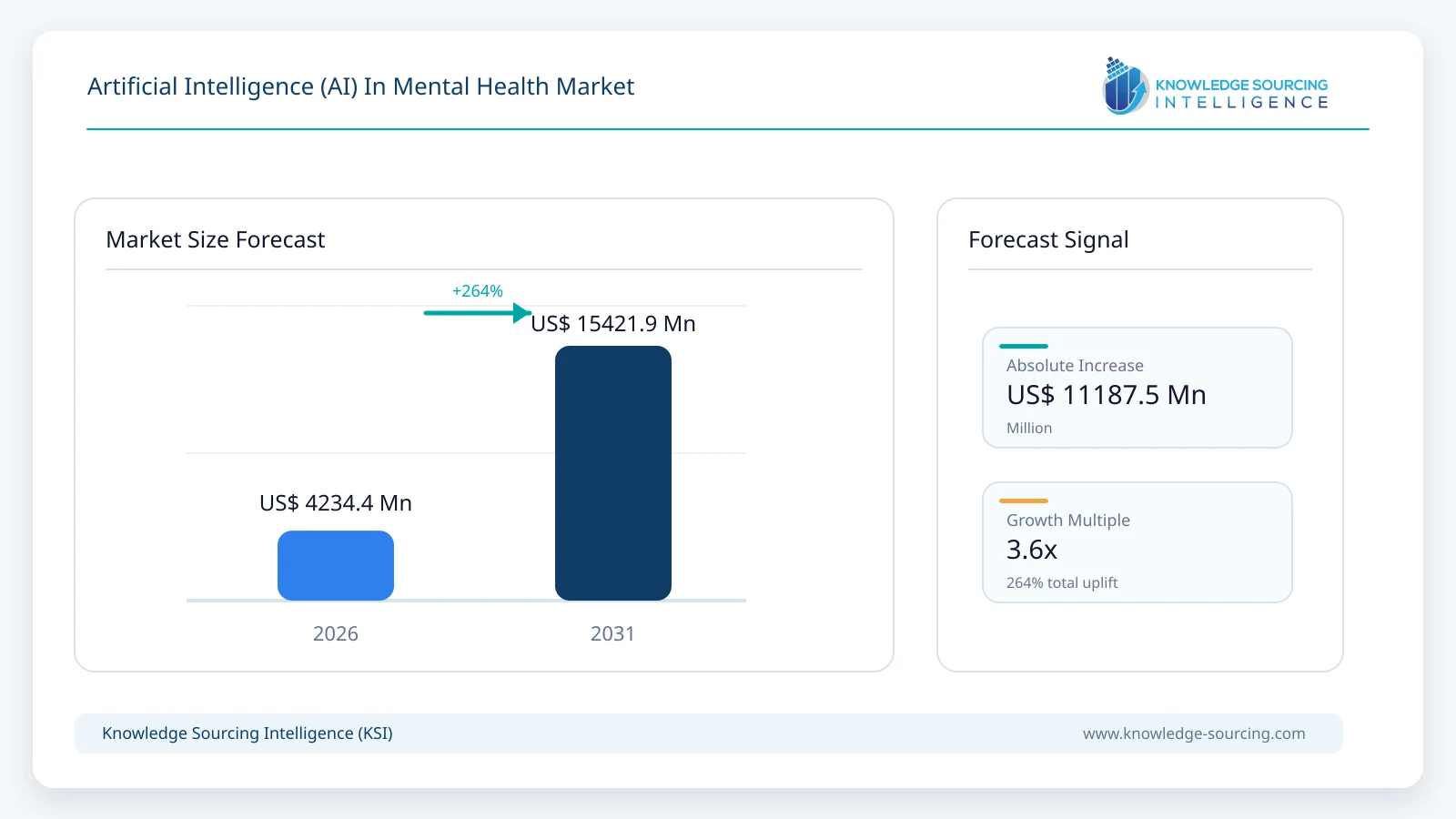
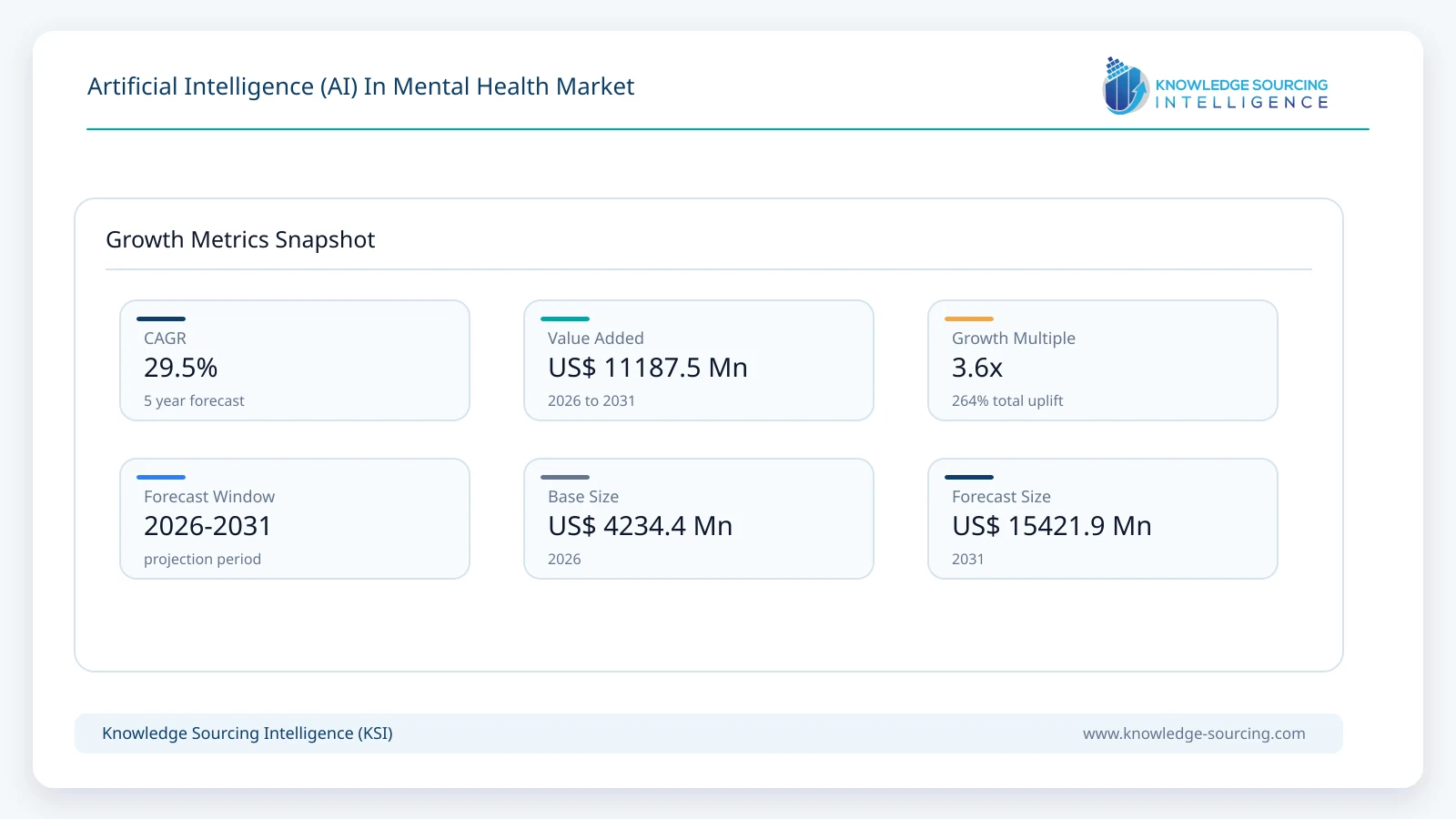
The AI in mental health market is forecast to grow at a CAGR of 29.5%, reaching USD 15,421.9 million in 2031 from USD 4,234.4 million in 2026.
Highlights:
- 1AI enhances mental health care with personalized therapy and real-time emotional support.
- 2NLP-powered chatbots and sentiment analysis improve suicide risk detection and interventions.
- 3Hospitals use AI for accurate diagnoses, individualized treatment, and efficient care delivery.
- 4U.S. leads AI mental health market growth with robust IT infrastructure and funding.
Mental illness remains a global public health concern, affecting millions of individuals worldwide. However, barriers such as limited access to mental healthcare, stigma, and resource constraints hinder effective interventions and treatment. However, embracing AI technologies holds a promising future for mental health.
The AI in the Mental Health Market is witnessing growth driven by increased cases of depressive disorders, schizophrenia, and other psychotic disorders. It is estimated by the WHO that 4.4% of 10–14-year-olds and 5.5% of 15–19-year-olds experience an anxiety disorder.
AI in Mental Health Market Growth Drivers:
Increased mental awareness and reduced stigma contribute to market growth
The increasing prevalence of mental disorders bolsters the AI in mental health market growth. According to the WHO, globally, one in seven 10-19-year-olds experiences a mental disorder, accounting for 15% of the global burden of disease in this age group. Suicide is the third leading cause of death among those aged 15–29 years old. This increasing crisis of mental disorders created challenges for society, like substance use disorder and illicit drug use disorder. 7.74% of adults in America reported having a substance use disorder in 2022.
Moreover, according to Mental Health America, 19.86% of adults are experiencing a mental illness in the US, and about 56% of adults with a mental illness received no treatment in 2022. These unmet people's needs could be fulfilled by using artificial intelligence.
Rising implementation of natural language processing in mental health
NLP in Mental Health is one of the growing market segments utilizing AI for understanding human language for enhanced mental health outcomes. Driven by growing incidences of mental health disorders, improving technologies, higher demand for more individualized care, growth of digital platforms related to mental health, and rising investments into AI and healthcare.
Secretary Blinken, for instance, launched the Partnership for Global Inclusivity on AI (PGIAI) alongside Amazon, Anthropic, Apple, Google, IBM, Meta, Microsoft, Nvidia, and OpenAI on September 23, 2024, in New York.
Moreover, NLP technologies are applied in various ways within mental healthcare. Chatbots and virtual assistants provide support 24/7 and individualized interventions. Sentiment analysis helps identify possible mental health risks by analyzing the patient's data, such as social media posts. Also, predictive modeling forecasts mental health crises and identifies patients who would benefit most from specific interventions.
NeuroFlow, a behavioral health technology and analytics company helping to manage and measure population risk, has published a new paper titled "Using Natural Language Processing to Detect Suicidal Ideation and Prompt Urgent Interventions" in the Journal of Innovations in Digital Health, Diagnostics, and Biomarkers in February 2024. The results highlight the new and emerging capabilities of AI for better detection of suicide risk among populations.
Growing utilization in hospitals and clinics
The AI in the Mental Health Market for Hospitals and Clinics is a rapidly expanding sector, influenced by a mix of factors. The rising number of mental health disorders requires innovative solutions, and improvements in AI technologies provide powerful diagnostic, treatment, and patient care tools.
In this regard, about half of all people in the United States will be diagnosed with a mental disorder at some point in their lifetime. Healthy People 2030 focuses on the prevention, screening, assessment, and treatment of mental disorders and behavioral conditions.
Hospitals and clinics are embracing AI to enhance different aspects of mental healthcare delivery. AI algorithms can analyze patient data to help clinicians make accurate diagnoses of mental health conditions and create individualized treatment plans. This not only improves patient outcomes but also enhances the efficiency of care delivery by automating routine tasks and optimizing resource allocation. Following this, as of 2024, the United States has 6,120 hospitals as stated by the American Hospital Association, which fuels the market growth.
Moreover, as per the International Trade Administration, US$161 billion was spent on healthcare in Brazil representing 9.47% of GDP, which holds the leading position in the healthcare market of Latin America. As of 2023, of the 7191 hospitals, 62% are privately owned in the nation, as shown by the data of the Brazilian Federation of Hospitals (FBH) and the National Healthcare Association (CNSaúde).
Several key trends are shaping the AI in the Mental Health Market for Hospitals and Clinics. Telepsychiatry and remote monitoring are gaining prominence, enabled by AI-powered platforms that facilitate virtual consultations and remote symptom monitoring. The integration of AI with EHRs is smoothing workflows and assisting in better analyses of data, which, in return, leads to more informed decision-making.
AI in Mental Health Market Geographical Outlook:
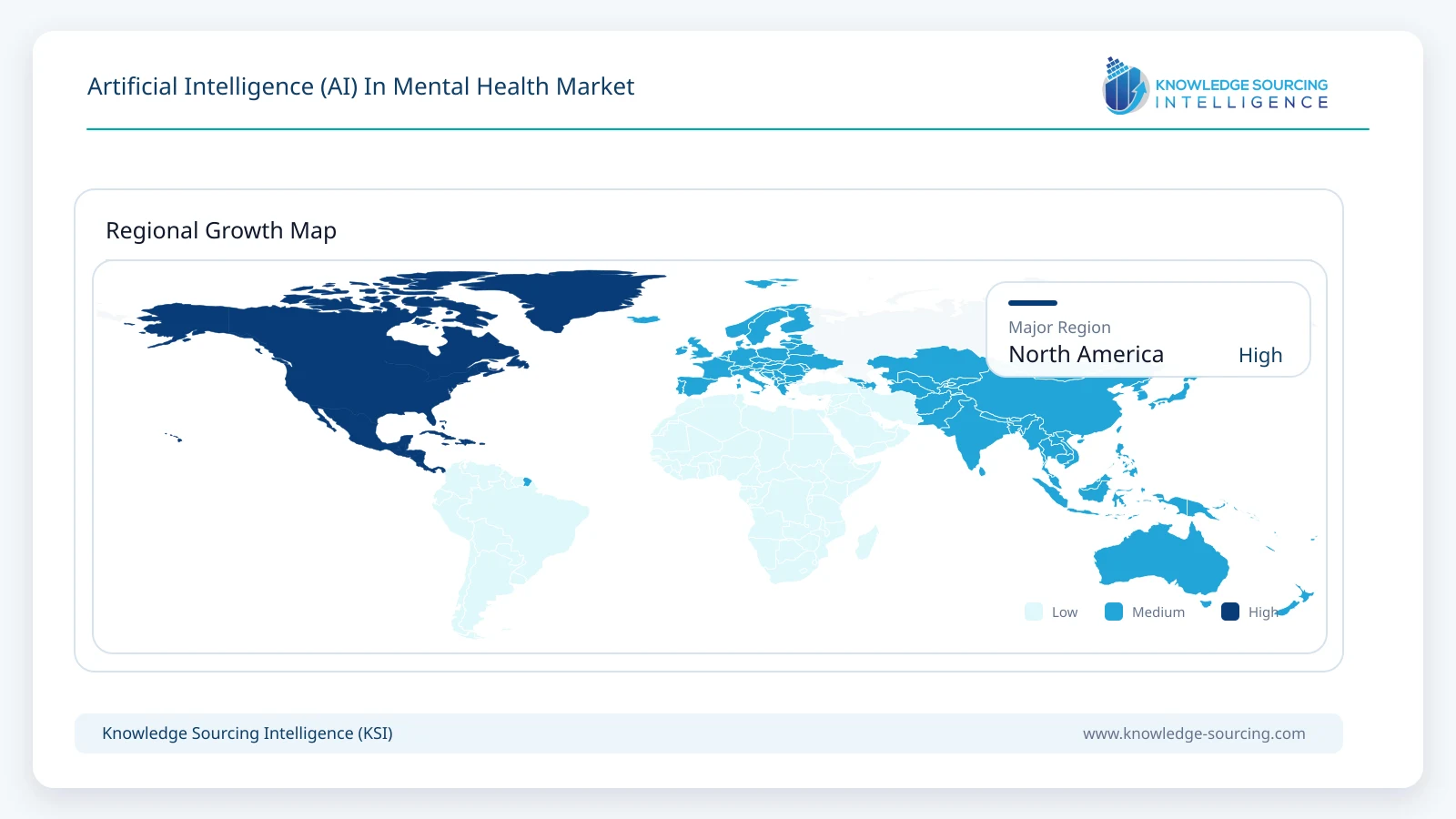
Artificial Intelligence (AI) in the mental health market is anticipated to be significant in the United States
Artificial Intelligence (AI) in the mental health market in the United States has witnessed remarkable growth, which can be attributed to several key drivers, including the increasing prevalence of mental health disorders, advancements in AI technologies, and the growing acceptance of telehealth solutions.
The rising incidence of mental health issues such as anxiety, depression, and PTSD has created a pressing need for effective treatment options. The COVID-19 pandemic exacerbated these challenges, leading to a surge in demand for mental health services as individuals sought help during a time of heightened stress and uncertainty. As traditional healthcare systems struggle to meet this demand, AI technologies are emerging as a viable solution to bridge the gap by providing scalable and accessible mental health care. AI-driven platforms can analyze vast amounts of data to offer personalized therapy and real-time emotional support, making mental health care more efficient and effective.
The U.S. government has recognized the potential of AI in healthcare and has implemented initiatives to foster its development. For example, the American AI Initiative aims to position the U.S. as a leader in artificial intelligence by establishing guidelines for its application across various sectors. Additionally, favorable funding opportunities for mental health technology have attracted investments from both public and private sectors, further driving innovation in this space26. The combination of a robust healthcare IT infrastructure and increasing public awareness about mental health issues has created an environment conducive to the rapid expansion of AI solutions.
AI in Mental Health Market Key Developments:
April 2026: Healthcare Triangle launched ZoraNex, an AI-driven digital self-care therapy platform delivering scalable mental wellness support and preventive behavioral healthcare through mobile-based therapeutic engagement tools.
March 2026: Sword Health launched Dawn, a direct-to-consumer AI mental health solution providing personalized, science-backed conversational support, real-time guidance, and continuous monitoring through proprietary mental health foundation models.
December 2025: Fortis Healthcare launched Adayu, a 36-bed integrated mental health hospital featuring advanced digital technologies and evidence-based psychiatric care programs addressing India’s growing mental healthcare demand.
September 2025: Headway expanded its insurance-native EHR platform with AI-assisted clinical notes and integrated telehealth capabilities, reducing administrative workload for mental health providers and improving patient care coordination.
June 2025: Sword Health launched Mind, an AI-powered mental health care platform combining licensed clinicians with continuous personalized AI support to improve accessibility and proactive behavioral healthcare delivery.
List of Top AI in Mental Health Companies:
Google LLC (Alphabet Inc.)
Microsoft Corporation
IBM Corporation
Amazon Web Services (AWS)
Intel Corporation
AI in Mental Health Market Scope
| Report Metric | Details |
|---|---|
| Total Market Size in 2026 | USD 4,234.4 million |
| Total Market Size in 2031 | USD 15,421.9 million |
| Forecast Unit | Million |
| Growth Rate | 29.5% |
| Study Period | 2021 to 2031 |
| Historical Data | 2021 to 2024 |
| Base Year | 2025 |
| Forecast Period | 2026 – 2031 |
| Segmentation | Technology, Application, End-User, Geography |
| Companies |
|
Market Segmentation
By Technology
- Machine Learning
- Natural Language Processing (NLP)
- Deep Learning
- Computer Vision
- Others
By Application
- Diagnosis And Treatment
- Virtual Assistants and Chatbots
- Mental Health Monitoring
- Predictive Analytics
- Others
By End-User
- Hospitals And Clinics
- Mental Health Centers
- Research Institutions
- Others
By Geography
- North America
- United States
- Canada
- Mexico
- South America
- Brazil
- Argentina
- Others
- Europe
- United Kingdom
- Germany
- France
- Spain
- Others
- Middle East and Africa
- Saudi Arabia
- UAE
- Israel
- Others
- Asia Pacific
- Japan
- China
- India
- South Korea
- Indonesia
- Thailand
- Others
Table of Contents
1. INTRODUCTION
1.1. Market Overview
1.2. Market Definition
1.3. Scope of the Study
1.4. Market Segmentation
1.5. Currency
1.6. Assumptions
1.7. Base and Forecast Years Timeline
1.8. Key Benefits for the Stakeholders
2. RESEARCH METHODOLOGY
2.1. Research Design
2.2. Research Process
3. EXECUTIVE SUMMARY
3.1. Key Findings
3.2. Analyst View
4. MARKET DYNAMICS
4.1. Market Drivers
4.2. Market Restraints
4.3. Porter’s Five Forces Analysis
4.3.1. Bargaining Power of Supplier
4.3.2. Bargaining Power of Buyers
4.3.3. Threat of New Entrants
4.3.4. Threat of Substitutes
4.3.5. Competitive Rivalry in the Industry
4.4. Industry Value Chain Analysis
5. ARTIFICIAL INTELLIGENCE (AI) IN MENTAL HEALTH MARKET BY TECHNOLOGY
5.1. Introduction
5.2. Machine Learning
5.3. Natural Language Processing (NLP)
5.4. Deep Learning
5.5. Computer Vision
5.6. Others
6. ARTIFICIAL INTELLIGENCE (AI) IN MENTAL HEALTH MARKET BY APPLICATION
6.1. Introduction
6.2. Diagnosis And Treatment
6.3. Virtual Assistants And Chatbots
6.4. Mental Health Monitoring
6.5. Predictive Analytics
6.6. Others
7. ARTIFICIAL INTELLIGENCE (AI) IN MENTAL HEALTH MARKET BY END-USER
7.1. Introduction
7.2. Hospitals And Clinics
7.3. Mental Health Centers
7.4. Research Institutions
7.5. Others
8. ARTIFICIAL INTELLIGENCE (AI) IN MENTAL HEALTH MARKET BY GEOGRAPHY
8.1. Introduction
8.2. North America
8.2.1. United States
8.2.2. Canada
8.2.3. Mexico
8.3. South America
8.3.1. Brazil
8.3.2. Argentina
8.3.3. Others
8.4. Europe
8.4.1. United Kingdom
8.4.2. Germany
8.4.3. France
8.4.4. Spain
8.4.5. Others
8.5. Middle East and Africa
8.5.1. Saudi Arabia
8.5.2. UAE
8.5.3. Israel
8.5.4. Others
8.6. Asia Pacific
8.6.1. Japan
8.6.2. China
8.6.3. India
8.6.4. South Korea
8.6.5. Indonesia
8.6.6. Thailand
8.6.7. Others
9. COMPETITIVE ENVIRONMENT AND ANALYSIS
9.1. Major Players and Strategy Analysis
9.2. Market Share Analysis
9.3. Mergers, Acquisitions, Agreements, and Collaborations
9.4. Competitive Dashboard
10. COMPANY PROFILES
10.1. Google Llc (Alphabet Inc.)
10.2. Microsoft Corporation
10.3. IBM Corporation
10.4. Amazon Web Services (AWS)
10.5. Intel Corporation
10.6. Cogito Corporation
10.7. Ginger.io Inc. (Headspace Health)
10.8. Woebot Health
10.9. Pear Therapeutics, Inc.
10.10. HopeLine.ai
10.11. Wysa Ltd
Navigate
Trusted by the world's leading organizations











