
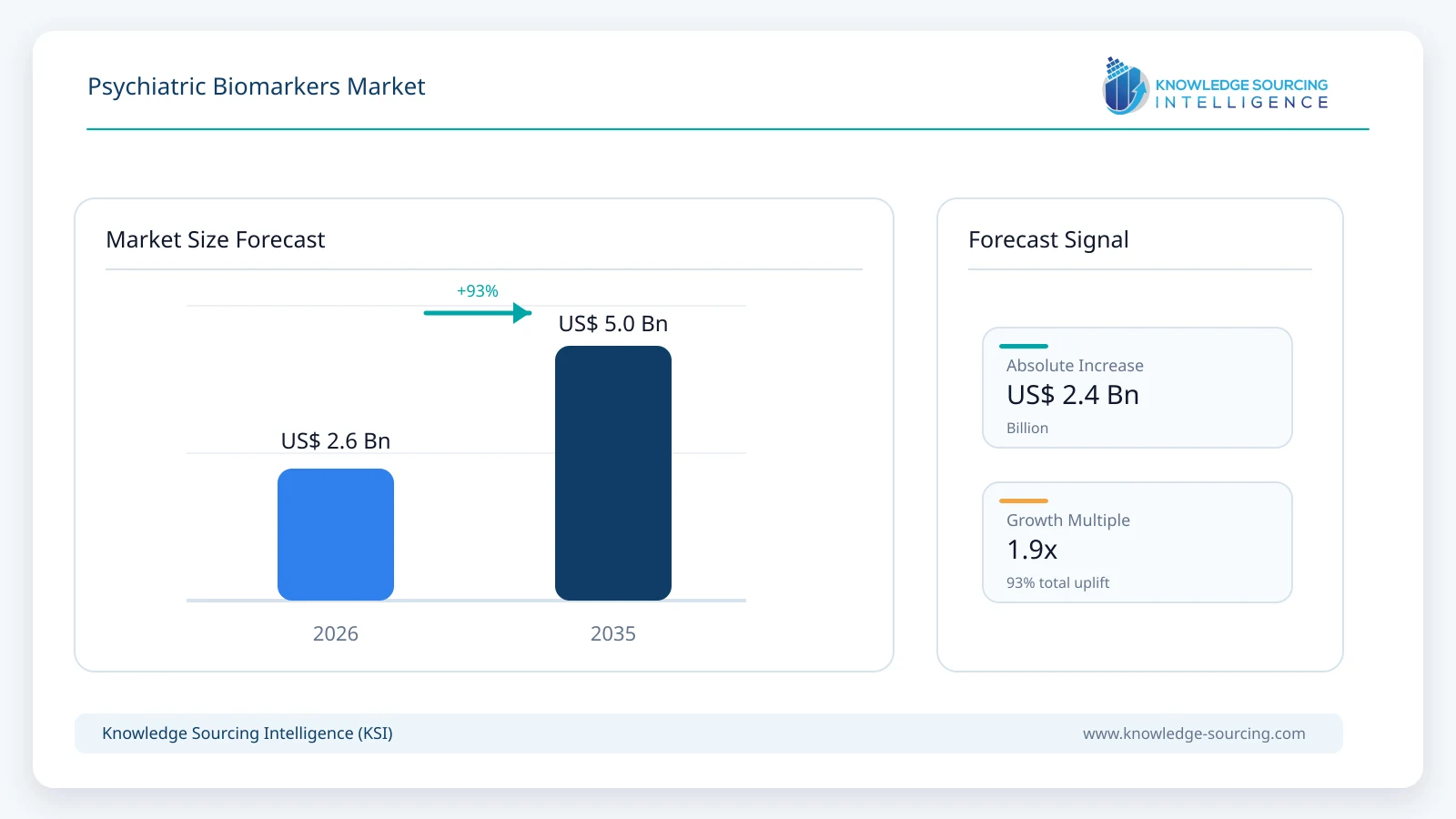
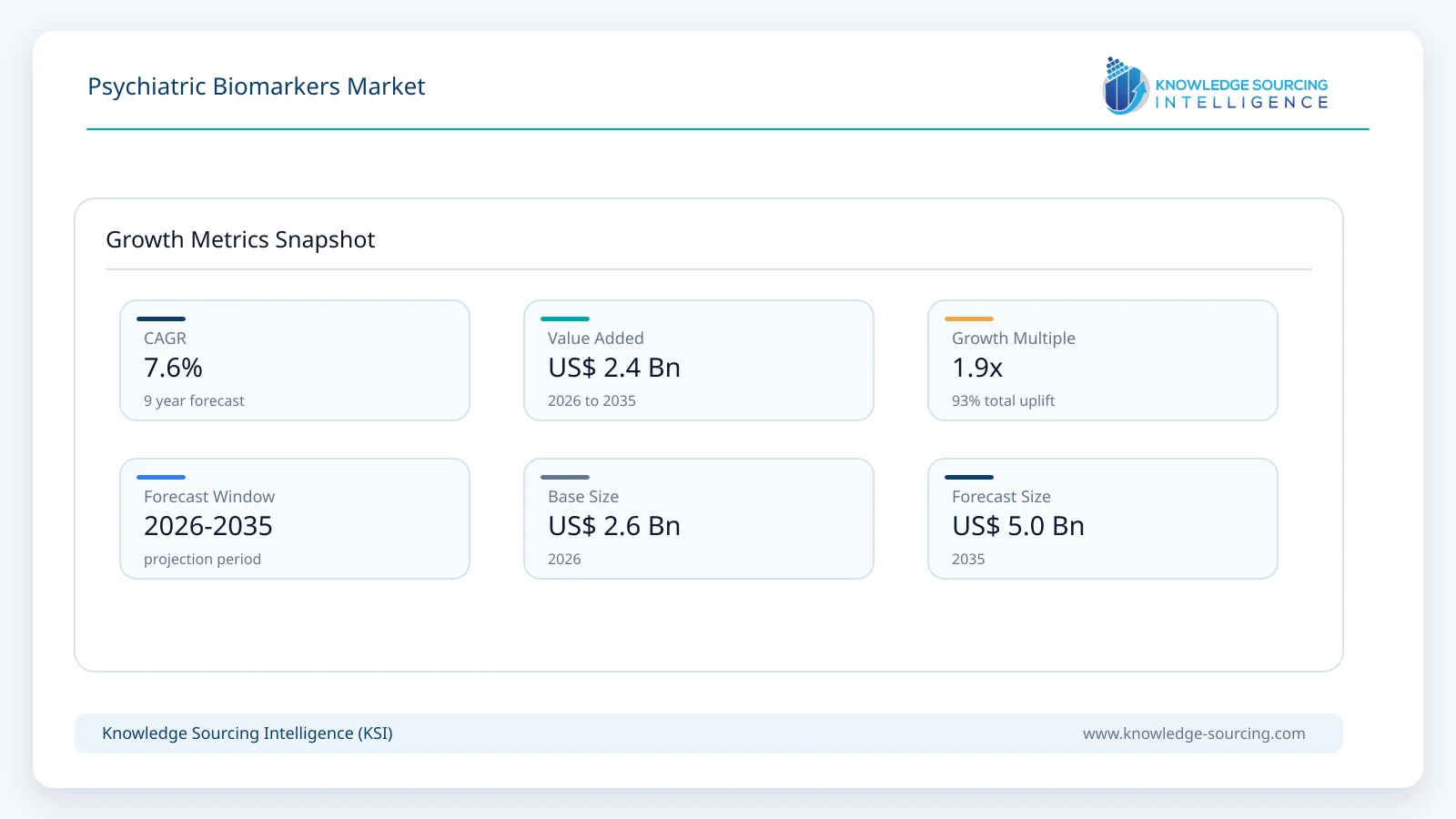
The Global Psychiatric Disorder Biomarkers Market is projected to grow at a CAGR of 7.6% during the forecast period, increasing from USD 2.57 billion in 2026 to USD 4.96 billion by 2035.
Highlights:
- 1Rising prevalence of psychiatric disorders is increasing demand for objective diagnostic tools because symptom-based assessments often create diagnostic variability.
- 2Precision psychiatry adoption is expanding because treatment response heterogeneity continues driving demand for personalized therapeutic strategies.
- 3Pharmacogenomic testing utilization is increasing because clinicians seek improved medication selection and adverse event management.
- 4Digital biomarker development is accelerating because remote patient monitoring enables continuous assessment of behavioral and cognitive changes.
Psychiatric disorder biomarkers represent measurable biological indicators that support diagnosis, prognosis, treatment selection, disease monitoring, and relapse prediction across mental health conditions. Demand is increasing because major depressive disorder, bipolar disorder, schizophrenia spectrum disorders, anxiety disorders, and PTSD continue generating significant healthcare burdens. Conventional diagnostic approaches depend heavily on clinical interviews and symptom reporting because objective laboratory-based tools remain limited. Biomarker research therefore aims to improve diagnostic consistency and treatment effectiveness.
Genomic and pharmacogenomic biomarkers are gaining importance because genetic variation influences medication response and adverse event risk. Neuroimaging biomarkers continue attracting clinical interest because structural and functional brain abnormalities increasingly contribute to disease characterization. Proteomic and metabolomic biomarkers are expanding because molecular signatures may provide insights into disease progression and treatment outcomes. Digital biomarkers are also emerging because wearable devices and mobile technologies enable continuous behavioral monitoring. This diversification broadens market opportunities across multiple technology platforms.
Regulatory agencies increasingly emphasize evidence generation because biomarker-guided psychiatric interventions directly influence treatment decisions. Diagnostic developers are strengthening clinical validation programs because physician adoption depends on demonstrated analytical validity and clinical utility. The market therefore increasingly prioritizes scientifically validated and clinically actionable biomarker solutions.
Market Dynamics
Market Drivers
Rising Burden of Mental Health Disorders: Psychiatric disorders represent a major global healthcare challenge because prevalence rates continue increasing across multiple patient populations. Demand is rising for objective diagnostic approaches because symptom overlap frequently complicates clinical assessment. Traditional treatment pathways create uncertainty because disease heterogeneity influences therapeutic outcomes. Researchers are expanding biomarker validation initiatives because clinicians require more precise tools for diagnosis and treatment planning. This trend supports growing adoption of psychiatric biomarker technologies.
Expansion of Precision Psychiatry: Precision psychiatry increasingly influences clinical practice because treatment response varies significantly among patients with similar diagnoses. Healthcare providers are seeking individualized therapeutic approaches because conventional prescribing often relies on trial-and-error methodologies. Pharmacogenomic and molecular testing adoption continues expanding because biological insights may improve treatment selection. Diagnostic developers are strengthening personalized medicine platforms because demand for precision care continues increasing. This shift supports long-term market growth.
Technological Advancements in Biomarker Discovery: Advances in sequencing technologies, neuroimaging systems, and artificial intelligence improve biomarker discovery capabilities because larger and more complex datasets can be analyzed efficiently. Research institutions are integrating multi-omics approaches because psychiatric disorders involve multiple biological mechanisms. Validation efforts remain extensive because clinical implementation requires reproducible evidence. Developers are increasing investment in advanced analytical platforms because technological innovation drives competitive differentiation. This environment accelerates biomarker development.
Increasing Demand for Treatment Response Prediction: Medication response variability remains a significant challenge because psychiatric therapies often require extended evaluation periods. Demand is increasing for predictive biomarkers because earlier identification of treatment effectiveness may improve patient outcomes. Conventional monitoring approaches create delays because therapeutic response frequently becomes apparent only after weeks or months of treatment. Biomarker-guided assessment strategies are expanding because healthcare providers seek more efficient treatment pathways. This dynamic strengthens market demand.
Market Restraints
Clinical validation remains challenging because psychiatric disorders involve substantial biological and phenotypic heterogeneity.
Reimbursement coverage remains inconsistent because many biomarker applications continue generating long-term clinical utility evidence.
Regulatory approval requirements remain extensive because psychiatric biomarker technologies directly influence therapeutic decision-making.
Market Opportunities
AI-Driven Biomarker Discovery: Artificial intelligence is transforming biomarker research because machine learning algorithms can identify patterns across large genomic, imaging, and behavioral datasets. Demand is increasing for advanced analytics because psychiatric disorders involve complex biological interactions. Conventional analytical methods often limit discovery efficiency because multidimensional datasets require sophisticated interpretation. Developers are integrating AI-driven platforms because precision psychiatry increasingly depends on comprehensive data analysis. This trend creates substantial innovation opportunities.
Expansion of Digital Biomarkers: Digital health technologies continue expanding because smartphones, wearable devices, and remote monitoring systems enable continuous patient assessment. Demand is increasing for behavioral and cognitive monitoring because psychiatric symptoms fluctuate between clinical visits. Traditional episodic evaluations provide limited longitudinal insight because disease progression often occurs outside healthcare settings. Technology developers are expanding digital biomarker platforms because continuous monitoring improves data collection. This trend strengthens market potential.
Growth of Pharmacogenomic Testing: Pharmacogenomic testing adoption is increasing because genetic variation influences psychotropic medication response. Clinicians are increasingly utilizing genetic information because treatment optimization remains a major objective in psychiatric care. Adverse drug reactions continue creating clinical challenges because medication tolerability varies substantially across patients. Diagnostic developers are strengthening pharmacogenomic testing capabilities because personalized prescribing improves therapeutic efficiency. This opportunity supports market expansion.
Multi-Omics Biomarker Platforms: Psychiatric disorders involve interconnected biological pathways because genetic, molecular, metabolic, and environmental factors contribute to disease development. Demand is increasing for integrated biomarker platforms because single-marker approaches often provide limited clinical insight. Researchers are combining genomic, proteomic, and metabolomic technologies because broader biological characterization improves disease understanding. Developers are investing in multi-omics solutions because comprehensive profiling supports precision medicine. This trend enhances future growth prospects.
Government Regulations
Regulatory Authority | Regulatory Focus | Market Impact |
FDA (United States) | Diagnostic devices, pharmacogenomics, software-based diagnostics | Supports validated biomarker adoption |
EMA / IVDR (Europe) | Diagnostic clinical evidence and performance requirements | Strengthens biomarker quality standards |
PMDA (Japan) | Precision medicine and diagnostic approvals | Supports psychiatric diagnostic innovation |
CDSCO (India) | Diagnostic regulation and market access | Expands diagnostic oversight |
NMPA (China) | Clinical validation and commercialization approvals | Strengthens diagnostic standardization |
Market Segmentation
By Biomarker Type
Genomic biomarkers represent one of the fastest-developing segments because advances in sequencing technologies continue identifying genetic variants associated with psychiatric disorders and treatment response variability. Pharmacogenomic biomarkers maintain growing clinical relevance because medication efficacy and tolerability frequently differ among patients with similar diagnoses. Proteomic and metabolomic biomarkers are attracting increasing research attention while investigators continue exploring molecular signatures associated with disease progression, symptom severity, and therapeutic outcomes. Neuroimaging, digital, and electrophysiological biomarkers support disease characterization and monitoring because psychiatric disorders often involve complex neurobiological and behavioral changes. The segment therefore continues benefiting from the growing adoption of precision psychiatry approaches.
By Indication
Major depressive disorder remains a major application area because diagnostic complexity and treatment resistance continue creating significant clinical challenges. Bipolar disorder and schizophrenia spectrum disorders are gaining increasing attention while clinicians seek objective tools capable of improving disease differentiation and treatment selection. Anxiety disorders and PTSD continue driving biomarker research because symptom overlap frequently complicates clinical assessment. Treatment response prediction, relapse monitoring, and disease stratification represent emerging opportunities because these applications address important unmet needs in psychiatric care. The indication segment therefore increasingly supports personalized mental health management strategies.
By End-User
Psychiatric hospitals account for substantial utilization because diagnosis, treatment initiation, and patient monitoring frequently occur within specialized mental healthcare settings. Specialty mental health clinics continue expanding biomarker adoption while providers increasingly implement precision psychiatry approaches to optimize treatment outcomes. Diagnostic laboratories remain central because biomarker testing often requires advanced genomic, molecular, and analytical infrastructure. Academic and research institutions continue driving innovation because biomarker discovery and clinical validation remain heavily dependent on translational research programs. The end-user landscape therefore increasingly supports broader integration of biomarker-guided psychiatric care.
Regional Analysis
North America
North America leads market development because advanced healthcare infrastructure and strong precision medicine initiatives support rapid adoption of psychiatric biomarker technologies. Research institutions continue generating biomarker evidence while healthcare providers increasingly integrate pharmacogenomic testing, neuroimaging, and molecular diagnostics into clinical practice. Regulatory clarity and substantial research funding support innovation. This environment positions the region as a major center for psychiatric biomarker development and commercialization.
Europe
Europe maintains strong market activity because collaborative neuroscience and mental health research programs continue advancing biomarker validation efforts. Healthcare systems increasingly support precision diagnostics while regulatory frameworks emphasize evidence-based implementation and patient safety. Growing awareness of personalized mental healthcare strengthens demand for biomarker-guided clinical approaches. This combination supports sustained biomarker adoption across clinical and academic settings.
Asia Pacific
Asia Pacific is emerging as a high-growth region because mental health awareness and diagnostic capabilities continue improving across major economies. Healthcare investment is increasing while genomic testing infrastructure and precision medicine programs continue expanding. Rising recognition of psychiatric disease burden strengthens demand for objective diagnostic and monitoring tools. This trend supports growing adoption of advanced psychiatric biomarker technologies.
Rest of the World
Emerging healthcare systems are gradually expanding mental health diagnostic capabilities because psychiatric disorders remain significantly underdiagnosed in many regions. Biomarker adoption continues increasing while healthcare modernization efforts improve access to advanced testing technologies and specialized mental healthcare services. Growing government focus on mental health initiatives supports long-term market development. This environment creates opportunities for future expansion of psychiatric biomarker applications.
Regulatory Landscape
The psychiatric disorder biomarkers regulatory environment continues evolving because healthcare systems increasingly require objective biological indicators to support diagnosis, treatment selection, disease monitoring, and relapse prediction. Regulatory agencies require extensive analytical and clinical validation because biomarker results increasingly influence psychiatric treatment decisions and long-term patient outcomes. Diagnostic developers are increasing investment in assay standardization, clinical evidence generation, and regulatory compliance because broader clinical adoption depends on reproducible and validated biomarker performance. The market therefore increasingly prioritizes clinically validated and regulatory-compliant biomarker solutions.
The FDA continues supporting precision medicine and digital health initiatives because psychiatric care increasingly relies on objective patient assessment tools. The European In Vitro Diagnostic Regulation (IVDR) maintains rigorous oversight of diagnostic technologies because biomarker-guided clinical decisions require strong analytical and clinical evidence. PMDA, NMPA, and CDSCO continue strengthening diagnostic regulatory frameworks because genomic, molecular, and digital biomarkers are becoming increasingly important within mental healthcare. Regulatory oversight therefore increasingly balances innovation with analytical reliability, clinical utility, and patient safety.
Biomarker commercialization remains closely linked to regulatory evolution because clinical adoption depends on demonstrated analytical validity, clinical validity, and clinical utility. Diagnostic developers are strengthening post-market evidence generation programs because physician confidence and reimbursement decisions increasingly depend on long-term performance data. The regulatory landscape therefore continues supporting the expansion of precision psychiatry diagnostics.
Pipeline Analysis
The psychiatric disorder biomarker pipeline increasingly focuses on minimally invasive and scalable biomarkers because healthcare providers seek objective tools for diagnosis, treatment optimization, and long-term disease monitoring. Demand is increasing for blood-based, genomic, and pharmacogenomic biomarkers because routine psychiatric assessment requires practical and repeatable testing approaches. Conventional symptom-based evaluations remain clinically important because psychiatric diagnosis continues relying heavily on behavioral assessment. Researchers are advancing biomarker validation programs because broader implementation may improve diagnostic accuracy and personalized treatment planning. The pipeline therefore increasingly supports objective and accessible psychiatric care strategies.
Genomic biomarkers, pharmacogenomic markers, inflammatory biomarkers, neuroimaging biomarkers, and electrophysiological biomarkers are gaining importance because psychiatric disorders involve complex genetic, molecular, and neurobiological mechanisms. Demand is increasing for biomarkers capable of predicting treatment response and disease progression because therapeutic outcomes vary significantly across patient populations. Conventional clinical assessments create limitations because biological changes frequently occur before measurable symptom improvement becomes apparent. Researchers are expanding longitudinal validation studies because stronger evidence supports broader clinical implementation. The pipeline therefore increasingly aligns with precision psychiatry objectives.
Multi-omics and artificial intelligence-driven biomarker discovery continue attracting investment because psychiatric disorders encompass diverse biological pathways and clinical phenotypes. Demand is increasing for integrated biomarker platforms because single-marker approaches may not adequately characterize disease complexity. Clinical research programs are incorporating genomic, proteomic, metabolomic, neuroimaging, digital health, and behavioral data because psychiatric heterogeneity influences diagnosis, prognosis, and treatment response. The biomarker pipeline therefore increasingly combines molecular biology, digital technologies, and personalized mental healthcare strategies.
Competitive Landscape
Myriad Genetics, Inc.
Myriad Genetics remains strategically differentiated because its GeneSight Psychotropic Test supports pharmacogenomic-guided psychiatric treatment decisions. Demand is increasing for personalized medication selection because treatment response variability continues affecting patient outcomes. Conventional prescribing approaches often require prolonged trial-and-error processes because individual genetic differences influence medication effectiveness and tolerability. Myriad continues expanding precision psychiatry applications because clinicians increasingly seek objective guidance for treatment optimization. The company therefore benefits from strong positioning within psychiatric pharmacogenomics.
Quest Diagnostics Incorporated
Quest Diagnostics maintains strong positioning because its extensive laboratory infrastructure supports broad access to pharmacogenomic and molecular testing services. Demand is increasing for clinically validated psychiatric biomarker testing because healthcare providers increasingly integrate precision diagnostics into mental health management. Standardized laboratory processes remain essential because widespread adoption depends on consistent analytical performance. Quest continues expanding specialized testing capabilities because biomarker-guided psychiatric care is becoming increasingly relevant. The company therefore benefits from extensive diagnostic service networks.
Labcorp Holdings Inc.
Labcorp remains competitively relevant because its advanced diagnostic and laboratory capabilities support broader adoption of psychiatric biomarker testing. Demand is increasing for integrated diagnostic solutions because clinicians require reliable biological information to support treatment decisions. Psychiatric biomarker implementation remains complex because extensive validation is required before routine clinical use. Labcorp continues strengthening precision medicine offerings because personalized healthcare continues expanding. The company therefore benefits from broad laboratory and diagnostic expertise.
F. Hoffmann-La Roche Ltd.
Roche maintains strategic importance because its molecular diagnostics expertise supports biomarker discovery and translational psychiatry research. Demand is increasing for clinically validated molecular testing because personalized treatment approaches continue expanding across mental healthcare. Healthcare providers increasingly require reliable biological evidence because treatment optimization depends on accurate patient stratification. Roche continues investing in precision diagnostics because psychiatric biomarker adoption is accelerating. The company therefore benefits from strong global diagnostics capabilities.
Illumina, Inc.
Illumina remains differentiated because next-generation sequencing technologies support identification of genetic variants associated with psychiatric disorders. Demand is increasing for genomic biomarker testing because mental health research increasingly focuses on underlying biological mechanisms. Conventional diagnostic approaches may not fully identify disease susceptibility factors because psychiatric disorders involve complex genetic influences. Illumina continues advancing sequencing technologies because precision psychiatry increasingly depends on genomic insights. The company therefore benefits from leadership in genomic analysis.
Thermo Fisher Scientific Inc.
Thermo Fisher remains strategically positioned because its life science technologies support biomarker discovery, validation, and clinical research activities. Demand is increasing for advanced analytical platforms because psychiatric biomarker research increasingly utilizes multi-omics approaches. Clinical implementation depends on robust scientific evidence because biomarker utility must be demonstrated across diverse patient populations. Thermo Fisher continues expanding research capabilities because innovation drives future diagnostic adoption. The company therefore benefits from broad scientific infrastructure expertise.
Bio-Rad Laboratories, Inc.
Bio-Rad maintains strategic importance because molecular and genomic technologies increasingly support psychiatric biomarker discovery and validation. Demand is increasing for laboratory-based biomarker analysis because precision psychiatry continues expanding. Biomarker development remains complex because robust analytical validation is required before clinical implementation. Bio-Rad continues strengthening research and testing capabilities because scientific evidence remains essential for biomarker adoption. The company therefore benefits from extensive expertise in molecular diagnostics.
Eurofins Scientific SE
Eurofins maintains strong positioning because specialized diagnostic and laboratory services support biomarker validation and translational research initiatives. Demand is increasing for validated psychiatric biomarker testing because healthcare providers increasingly seek objective diagnostic tools. Laboratory standardization remains critical because clinical adoption depends on reliable analytical performance. Eurofins continues expanding specialty testing capabilities because precision diagnostics continue gaining importance. The company therefore benefits from broad laboratory expertise and global operational reach.
Key Developments
May 2026: GrayMatters Health, the pioneers of digital brain biomarkers for mental healthcare, announced the launch of Prism™ Imagine, a generative AI-powered tool for interventional psychiatric clinics to enhance patient engagement.
September 2025: ALCEDIAG, OM Pharma Suisse, and Unilabs announced the launch of EDIT-B®, the world’s first CE-marked and Swissmedic compliant blood test designed to differentiate depression and bipolar disorder, available nationwide in clinical routine in Switzerland and Liechtenstein.
Strategic Insights and Future Market Outlook
The psychiatric disorder biomarkers market is transitioning toward precision mental healthcare because healthcare providers increasingly require objective measures of disease risk, treatment response, and long-term patient outcomes. Demand is increasing for validated biomarker testing because conventional symptom-based assessments may not fully capture underlying biological and neuropsychiatric changes. Diagnostic developers are expanding assay capabilities because earlier diagnosis and personalized treatment strategies increasingly influence clinical outcomes. The market therefore increasingly supports biomarker-guided psychiatric care.
Genomic, pharmacogenomic, molecular, digital, and neuroimaging biomarkers are becoming strategically important because psychiatric management increasingly requires individualized clinical decision-making. Healthcare providers are adopting biomarker-informed approaches because objective biological evidence improves disease classification and treatment optimization. Researchers are integrating genomic, proteomic, metabolomic, imaging, digital health, and AI-enabled analytical technologies because psychiatric heterogeneity requires comprehensive disease characterization. The market therefore increasingly aligns with precision psychiatry principles.
Psychiatric research and diagnostic innovation continue expanding because personalized medicine increasingly influences mental healthcare delivery. Companies capable of combining analytical sensitivity, clinical validation, regulatory compliance, and scalable diagnostic infrastructure are strengthening long-term competitive positioning because demand for biomarker-guided psychiatric management continues growing globally.
The Global Psychiatric Disorder Biomarkers Market therefore continues evolving toward pharmacogenomic diagnostics, AI-enabled behavioral analysis, multi-omics biomarker discovery, digital mental health integration, and personalized psychiatric care as healthcare systems increasingly prioritize objective and data-driven approaches to mental health management.
Global Psychiatric Disorder Biomarkers Market Scope:
| Report Metric | Details |
|---|---|
| Total Market Size in 2026 | USD 2.57 billion |
| Total Market Size in 2035 | USD 4.96 billion |
| Forecast Unit | USD Billion |
| Growth Rate | 7.6% |
| Study Period | 2021 to 2035 |
| Historical Data | 2021 to 2024 |
| Base Year | 2025 |
| Forecast Period | 2026 – 2035 |
| Segmentation | Biomarker Type, Indication, End-User, Geography |
| Companies |
|
Market Segmentation
By Geography
Key Countries Analysis
Regulatory & Policy Landscape
Table of Contents
Executive Summary
1.1 Market Overview
1.1.1 Definition and Scope of Psychiatric Disorder Biomarkers
1.1.2 Market Evolution and Clinical Significance
1.1.3 Biomarker Categories and Applications
1.1.4 Precision Psychiatry and Biomarker Integration
1.1.5 Key Market Trends
1.2 Executive Insights
1.2.1 Key Growth Drivers
1.2.2 Emerging Opportunities
1.2.3 Market Challenges
1.2.4 Strategic Recommendations
1.3 Market Snapshot
1.3.1 Current Market Landscape
1.3.2 Competitive Overview
1.3.3 Innovation Highlights
2. Disease & Epidemiology Analysis
2.1 Psychiatric Disorders Overview
2.1.1 Disease Classification
2.1.2 Neurobiological Basis of Psychiatric Disorders
2.1.3 Burden of Mental Health Disorders
2.2 Epidemiology Analysis
2.2.1 Global Prevalence of Major Depressive Disorder (MDD)
2.2.2 Global Prevalence of Bipolar Disorder
2.2.3 Global Prevalence of Schizophrenia Spectrum Disorders
2.2.4 Global Prevalence of Anxiety Disorders
2.2.5 Global Prevalence of Post-Traumatic Stress Disorder (PTSD)
2.3 Disease Subtype Analysis
2.3.1 Treatment-Resistant Depression
2.3.2 Bipolar I Disorder
2.3.3 Bipolar II Disorder
2.3.4 First-Episode Psychosis
2.3.5 Chronic Schizophrenia
2.3.6 Generalized Anxiety Disorder
2.3.7 Major Neuropsychiatric Comorbidities
2.4 Patient Journey and Biomarker Integration
2.4.1 Early Detection and Risk Assessment
2.4.2 Differential Diagnosis
2.4.3 Treatment Selection
2.4.4 Disease Monitoring
2.4.5 Relapse Prediction
3. Market Dynamics
3.1 Market Drivers
3.1.1 Rising Global Mental Health Burden
3.1.2 Increasing Demand for Objective Psychiatric Diagnostics
3.1.3 Growth of Precision Psychiatry
3.1.4 Expansion of Neuroimaging and Genomic Technologies
3.1.5 Increasing Research Funding for Mental Health Biomarkers
3.2 Market Restraints
3.2.1 Limited Biomarker Validation
3.2.2 Disease Heterogeneity
3.2.3 Reimbursement Challenges
3.2.4 Regulatory Complexity
3.3 Market Opportunities
3.3.1 AI-Driven Biomarker Discovery
3.3.2 Multi-Omics Psychiatric Profiling
3.3.3 Digital Biomarkers and Remote Monitoring
3.3.4 Companion Diagnostics for Psychiatry
3.4 Market Trends
3.4.1 Blood-Based Biomarker Development
3.4.2 Neuroimaging Biomarker Expansion
3.4.3 Pharmacogenomic Testing Adoption
3.4.4 Machine Learning Integration in Psychiatry
4. Commercial & Market Access
4.1 Commercialization Landscape
4.1.1 Clinical Adoption Trends
4.1.2 Precision Psychiatry Implementation
4.1.3 Diagnostic Service Models
4.2 Reimbursement Analysis
4.2.1 Public Healthcare Coverage
4.2.2 Private Insurance Coverage
4.2.3 Pharmacogenomic Test Reimbursement
4.3 Health Economic Assessment
4.3.1 Economic Burden of Psychiatric Disorders
4.3.2 Cost of Diagnostic Delays
4.3.3 Value of Biomarker-Guided Treatment Selection
5. Innovation & Pipeline Landscape
5.1 Biomarker Innovation Overview
5.1.1 Diagnostic Biomarkers
5.1.2 Prognostic Biomarkers
5.1.3 Predictive Biomarkers
5.1.4 Monitoring Biomarkers
5.2 Biomarker Modality Analysis
5.2.1 Genomic Biomarkers
5.2.2 Pharmacogenomic Biomarkers
5.2.3 Proteomic Biomarkers
5.2.4 Metabolomic Biomarkers
5.2.5 Neuroimaging Biomarkers
5.2.6 Digital Biomarkers
5.2.7 Electrophysiological Biomarkers
5.3 Pipeline Landscape by Development Stage
5.3.1 Discovery Stage Programs
5.3.2 Early Clinical Validation Programs
5.3.3 Advanced Clinical Validation Programs
5.3.4 Commercialization-Ready Biomarker Platforms
5.4 Innovation Benchmarking
5.4.1 AI-Based Psychiatric Biomarker Platforms
5.4.2 Digital Mental Health Biomarkers
5.4.3 Multi-Omics Platforms
5.4.4 Precision Psychiatry Decision-Support Systems
6. Treatment Landscape
6.1 Current Treatment Paradigm
6.1.1 Antidepressant Therapy
6.1.2 Antipsychotic Therapy
6.1.3 Mood Stabilizers
6.1.4 Psychotherapy
6.1.5 Neuromodulation Therapies
6.2 Biomarker Applications Across Treatment Pathways
6.2.1 Treatment Selection
6.2.2 Drug Response Prediction
6.2.3 Adverse Event Prediction
6.2.4 Disease Monitoring
6.2.5 Relapse Risk Assessment
6.3 Biomarker Utility Benchmarking
6.3.1 Genomic Biomarkers
6.3.2 Neuroimaging Biomarkers
6.3.3 Blood-Based Biomarkers
6.3.4 Digital Biomarkers
7. Market Size & Forecast
7.1 Historical Market Assessment
7.2 Current Market Analysis
7.3 Market Forecast by Biomarker Type
7.4 Market Forecast by Application
7.5 Market Forecast by End User
7.6 Market Forecast by Region
7.7 Adoption and Utilization Trends
8. Market Segmentation
8.1 By Biomarker Type
8.1.1 Genomic Biomarkers
8.1.2 Pharmacogenomic Biomarkers
8.1.3 Proteomic Biomarkers
8.1.4 Metabolomic Biomarkers
8.1.5 Neuroimaging Biomarkers
8.1.6 Digital Biomarkers
8.1.7 Electrophysiological Biomarkers
8.2 By Indication
8.2.1 Major Depressive Disorder
8.2.2 Bipolar Disorder
8.2.3 Schizophrenia Spectrum Disorders
8.2.4 Anxiety Disorders
8.2.5 PTSD
8.2.6 Other Psychiatric Disorders
8.3 By End User
8.3.1 Psychiatric Hospitals
8.3.2 Specialty Mental Health Clinics
8.3.3 Diagnostic Laboratories
8.3.4 Academic and Research Institutions
9. Geographical Analysis
9.1 North America
9.1.1 Market Size & Growth
9.1.2 Demand Drivers
9.1.3 Regional Regulatory Environment
9.1.4 Competitive Intensity
9.2 Europe
9.2.1 Market Size & Growth
9.2.2 Demand Drivers
9.2.3 Regional Regulatory Environment
9.2.4 Competitive Intensity
9.3 Asia-Pacific
9.3.1 Market Size & Growth
9.3.2 Demand Drivers
9.3.3 Regional Regulatory Environment
9.3.4 Competitive Intensity
9.4 Latin America
9.4.1 Market Size & Growth
9.4.2 Demand Drivers
9.4.3 Regional Regulatory Environment
9.4.4 Competitive Intensity
9.5 Middle East & Africa
9.5.1 Market Size & Growth
9.5.2 Demand Drivers
9.5.3 Regional Regulatory Environment
9.5.4 Competitive Intensity
10. Key Countries Analysis
10.1 United States
10.2 Canada
10.3 Germany
10.4 United Kingdom
10.5 France
10.6 Italy
10.7 Spain
10.8 China
10.9 Japan
10.10 India
10.11 South Korea
10.12 Australia
10.13 Brazil
10.14 Mexico
10.15 Saudi Arabia
10.16 South Africa
11. Regulatory & Policy Landscape
11.1 United States
11.1.1 FDA Diagnostic Regulatory Framework
11.1.2 Pharmacogenomic Testing Oversight
11.1.3 Software as Medical Device (SaMD) Regulations
11.2 Europe
11.2.1 IVDR Framework
11.2.2 CE Marking Requirements
11.2.3 Clinical Evidence Requirements
11.3 Japan
11.3.1 PMDA Diagnostic Approval Pathways
11.3.2 Precision Medicine Regulations
11.4 India
11.4.1 CDSCO Diagnostic Regulations
11.4.2 Market Entry Requirements
11.5 China
11.5.1 NMPA Diagnostic Framework
11.5.2 Local Validation Requirements
11.6 Reimbursement and HTA Landscape
11.6.1 Health Technology Assessment
11.6.2 Coverage Policies
11.6.3 Precision Psychiatry Reimbursement Trends
12. Competitive Landscape
12.1 Market Structure Analysis
12.1.1 Diagnostic Testing Companies
12.1.2 Genomic Testing Companies
12.1.3 Digital Biomarker Developers
12.1.4 Neurotechnology Companies
12.2 Competitive Benchmarking
12.2.1 Technology Platforms
12.2.2 Biomarker Portfolio Analysis
12.2.3 Geographic Presence
12.2.4 Strategic Collaborations
12.3 Strategic Developments
12.3.1 Partnerships
12.3.2 Acquisitions
12.3.3 Licensing Agreements
12.3.4 Research Collaborations
13. Company Profiles
13.1 Myriad Genetics, Inc.
13.1.1 Company Overview
13.1.2 GeneSight Psychotropic Test
13.1.3 Psychiatric Applications
13.1.4 Pipeline and Innovation Activities
13.2 Quest Diagnostics Incorporated
13.2.1 Company Overview
13.2.2 Pharmacogenomic Testing Services
13.2.3 Mental Health Diagnostic Applications
13.2.4 Precision Psychiatry Initiatives
13.3 Labcorp Holdings Inc.
13.3.1 Company Overview
13.3.2 Pharmacogenomic Testing Portfolio
13.3.3 Psychiatric Biomarker Applications
13.4 F. Hoffmann-La Roche Ltd.
13.4.1 Company Overview
13.4.2 Molecular Diagnostics Portfolio
13.4.3 Neuropsychiatric Biomarker Research
13.5 Illumina, Inc.
13.5.1 Company Overview
13.5.2 Sequencing Technologies
13.5.3 Psychiatric Genetics Applications
13.6 Thermo Fisher Scientific Inc.
13.6.1 Company Overview
13.6.2 Genomic and Proteomic Platforms
13.6.3 Biomarker Discovery Applications
13.7 Bio-Rad Laboratories, Inc.
13.7.1 Company Overview
13.7.2 Molecular Diagnostics Technologies
13.7.3 Biomarker Validation Applications
13.8 NeoGenomics, Inc.
13.8.1 Company Overview
13.8.2 Advanced Molecular Testing Capabilities
13.8.3 Biomarker Research Applications
13.9 Eurofins Scientific SE
13.9.1 Company Overview
13.9.2 Specialty Diagnostic Services
13.9.3 Biomarker Validation Activities
13.10 Natera, Inc.
13.10.1 Company Overview
13.10.2 Molecular Diagnostics Platform
13.10.3 Research and Biomarker Development Activities
14. Future Outlook
14.1 Market Evolution Outlook
14.1.1 Precision Psychiatry Adoption
14.1.2 Biomarker-Guided Treatment Selection
14.1.3 Digital Psychiatry Integration
14.2 Innovation Outlook
14.2.1 Multi-Omics Biomarker Platforms
14.2.2 AI-Based Mental Health Diagnostics
14.2.3 Digital Biomarker Expansion
14.3 Strategic Recommendations
14.3.1 Diagnostic Developers
14.3.2 Healthcare Providers
14.3.3 Investors
14.3.4 Research Institutions
15. Methodology
15.1 Research Framework
15.2 Primary Research Methodology
15.3 Secondary Research Methodology
15.4 Epidemiology Modeling Methodology
15.5 Market Forecasting Methodology
15.6 Data Validation Framework
15.7 Assumptions and Limitations
15.8 Data Sources
15.8.1 FDA
15.8.2 EMA / IVDR
15.8.3 PMDA
15.8.4 CDSCO
15.8.5 NMPA
15.8.6 ClinicalTrials.gov
15.8.7 Peer-Reviewed Publications
15.8.8 Company Annual Reports and Filings
15.9 Abbreviations and Definitions
Navigate
Trusted by the world's leading organizations











