
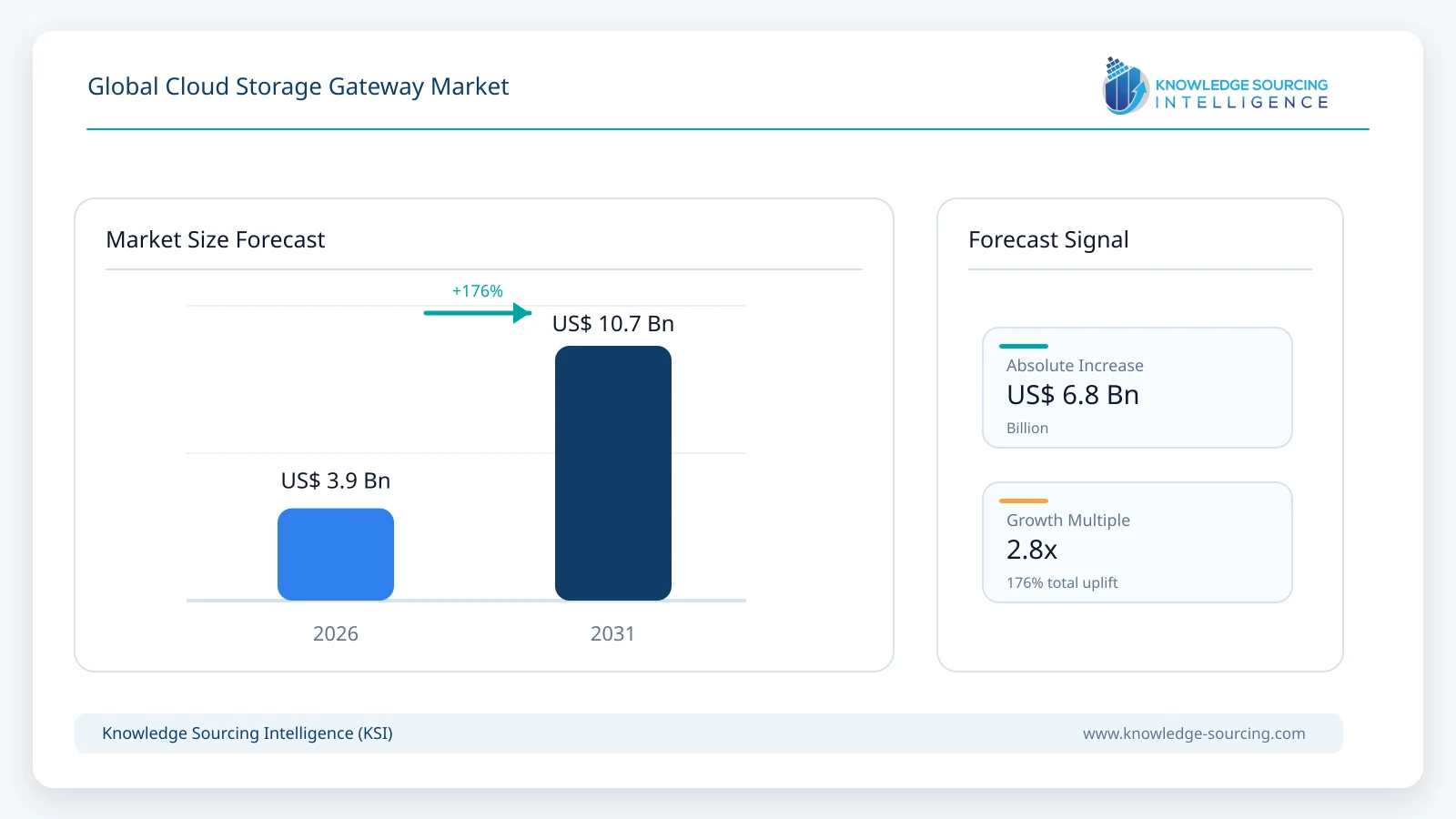
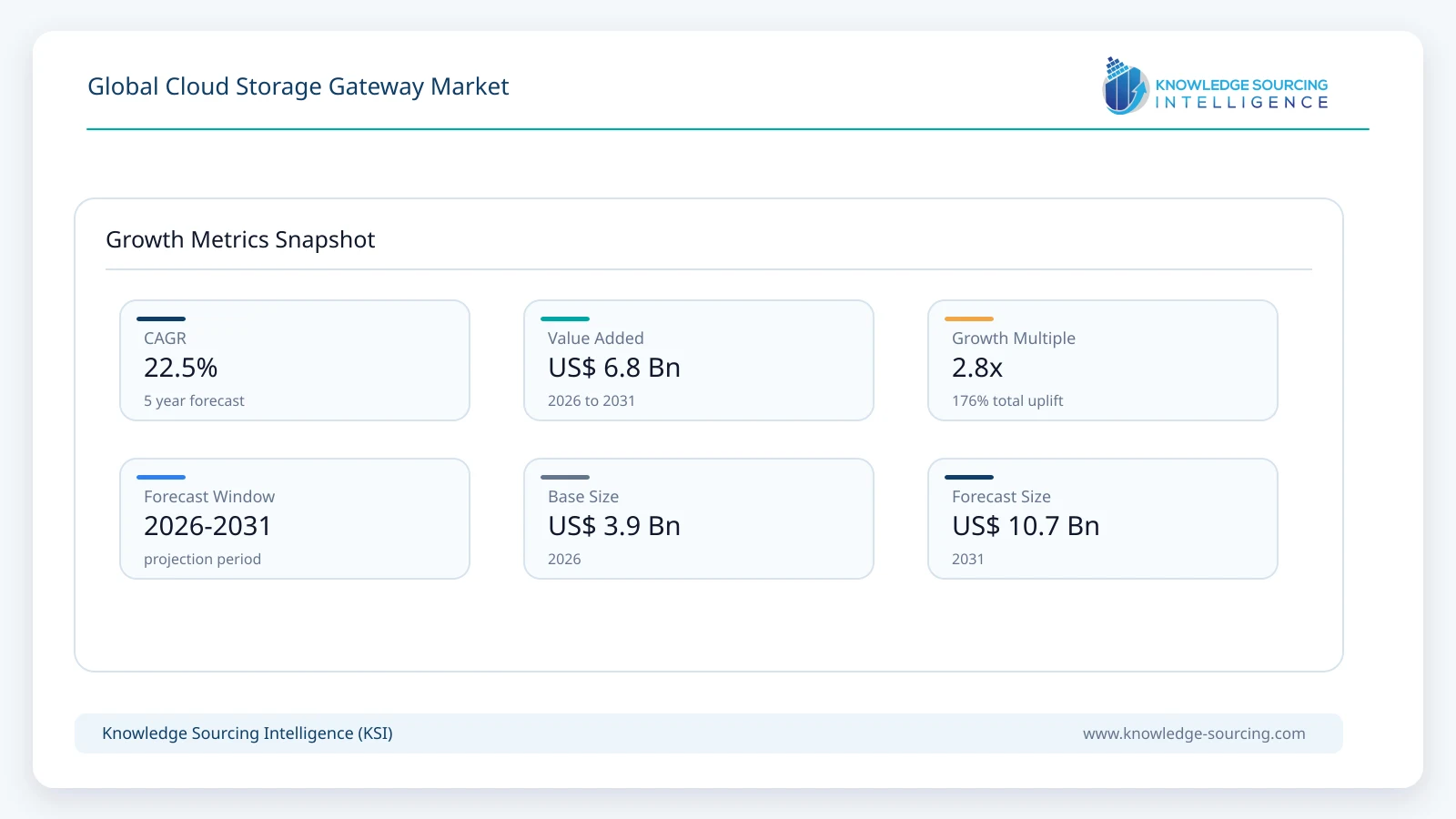
The Global Cloud Storage Gateway Market is forecast to grow at a CAGR of 22.51%, reaching USD 10.68 billion in 2031 from USD 3.87 billion in 2026.
Highlights:
- 1Growing enterprise adoption of hybrid cloud infrastructure continues to strengthen demand for cloud storage gateway solutions.
- 2Hybrid cloud deployment represents a commercially important segment due to its flexibility and regulatory compatibility.
- 3Asia Pacific offers considerable long-term opportunity as enterprises expand digital infrastructure and cloud investments.
- 4AI-driven storage management, intelligent caching, automation, and ransomware protection are becoming important purchasing criteria.
- 5Data sovereignty, cybersecurity, and privacy regulations continue to influence deployment architecture and vendor selection.
- 6Competition increasingly centers on interoperability, multi-cloud compatibility, cybersecurity capabilities, and managed service offerings.
The cloud storage gateway market comprises software and appliance-based platforms that bridge on-premises applications with cloud storage services while preserving file, block, or object access protocols familiar to enterprise environments. These gateways enable organizations to extend existing storage infrastructure into public, private, or hybrid cloud environments without redesigning applications. They also support caching, encryption, compression, data deduplication, policy-based tiering, backup, disaster recovery, and lifecycle management, making them an important component of enterprise data infrastructure.
Demand is being shaped by sustained enterprise data expansion, hybrid IT strategies, and the need to control storage costs while maintaining application performance. Organizations across banking, healthcare, manufacturing, telecommunications, government, and retail are balancing regulatory obligations with increasing reliance on cloud infrastructure. Rather than replacing existing storage assets, many buyers prefer solutions that integrate legacy systems with cloud repositories, creating demand for cloud storage gateways that minimize migration complexity and operational disruption.
Purchasing decisions increasingly extend beyond storage capacity alone. Enterprise buyers evaluate interoperability with multiple cloud platforms, cyber resilience, ransomware recovery capabilities, encryption standards, workload performance, management automation, and compatibility with existing backup software. Procurement teams also assess long-term operational expenditure, vendor support, deployment flexibility, and integration with Kubernetes, virtualization platforms, and enterprise identity management systems before committing to large-scale deployments.
The industry structure combines global cloud infrastructure providers, enterprise storage vendors, infrastructure software companies, and specialist gateway and developers. Competition is influenced by the ability to deliver low-latency access, centralized management, security compliance, and seamless integration across distributed enterprise environments. Suppliers also compete through subscription-based licensing, managed services, and ecosystem partnerships with system integrators and cloud providers.
Hybrid cloud adoption remains a primary commercial driver because many organizations continue operating business-critical applications within their own data centers while storing backups, archives, and secondary workloads in the cloud. This deployment pattern creates recurring demand for gateway technologies capable of maintaining data consistency across multiple environments while reducing network bottlenecks.
Market Drivers
Expansion of Hybrid Cloud Infrastructure
Many enterprises have adopted hybrid operating models that combine private infrastructure with public cloud services. Mission-critical applications often remain on-premises because of latency, compliance, or operational considerations, while archival storage and backup workloads migrate to cloud platforms. Cloud storage gateways simplify this architecture by providing transparent connectivity between existing enterprise storage systems and cloud repositories.
Enterprise buyers value solutions that reduce migration risks while protecting previous infrastructure investments. Vendors continue enhancing policy-driven tiering, intelligent caching, and centralized management features to support increasingly distributed IT environments. This trend supports recurring software licensing, appliance upgrades, and managed storage services.
Escalating Enterprise Data Volumes
Organizations across industries continue generating larger datasets from digital transactions, industrial sensors, connected devices, customer applications, and business analytics. Traditional storage environments often struggle to accommodate sustained capacity growth without increasing capital expenditure.
Cloud storage gateways enable organizations to move infrequently accessed information to lower-cost cloud storage while maintaining local performance for active workloads. Procurement strategies increasingly prioritize storage optimization and lifecycle automation, encouraging wider deployment across enterprise environments.
Stronger Focus on Cyber Resilience
Ransomware attacks have elevated storage resilience from an operational concern to a board-level investment priority. Enterprises require storage architectures that enable rapid recovery while maintaining secure off-site copies of business-critical information.
Modern cloud storage gateways incorporate immutable storage support, encryption, access controls, and integration with enterprise backup platforms. Buyers increasingly evaluate recovery performance alongside storage efficiency, encouraging vendors to expand cybersecurity functionality within gateway offerings.
Multi-Cloud Adoption Across Large Enterprises
Organizations increasingly distribute workloads across multiple cloud providers to improve resilience, optimize costs, and reduce dependency on a single platform. Managing storage across several cloud environments creates operational complexity.
Cloud storage gateways provide unified data management, standardized access protocols, and centralized policy enforcement across multiple cloud environments. Suppliers capable of supporting diverse cloud ecosystems gain competitive advantages during enterprise procurement processes.
Market Restraints and Challenges
Integration Complexity with Legacy Infrastructure
Many enterprises operate storage environments developed over decades using multiple hardware vendors and proprietary management platforms. Integrating modern cloud storage gateways into these heterogeneous environments may require application testing, network redesign, and operational adjustments.
Implementation complexity increases project timelines and consulting costs, particularly for highly regulated organizations. Vendors address these challenges through migration services, interoperability testing, and expanded professional support.
Regulatory Constraints on Data Location
Financial institutions, healthcare providers, and government agencies frequently operate under regulations governing where sensitive information may be stored and processed. Cross-border data transfers can complicate cloud adoption strategies.
Organizations therefore adopt hybrid architectures rather than complete cloud migration, increasing deployment planning requirements and influencing purchasing decisions toward vendors with strong compliance capabilities and regional infrastructure partnerships.
Network Performance Limitations
Gateway performance depends heavily on reliable network connectivity. Organizations operating remote facilities or bandwidth-constrained environments may experience latency that affects application responsiveness.
To address this issue, suppliers continue improving local caching, intelligent synchronization, compression, and bandwidth optimization technologies, although network infrastructure remains a limiting factor in certain deployment scenarios.
Vendor Interoperability Concerns
Enterprises increasingly seek technology investments that remain compatible with evolving cloud strategies. Solutions closely tied to proprietary ecosystems may reduce deployment flexibility over time.
Consequently, procurement teams favor vendors supporting multiple cloud providers, standardized APIs, and broad enterprise platform compatibility, intensifying competitive pressure on suppliers.
Major Segment Analysis
Hybrid Cloud Deployment
Hybrid cloud deployment represents one of the most commercially important segments within the cloud storage gateway market because it addresses practical enterprise requirements rather than requiring complete infrastructure replacement. Organizations continue balancing operational efficiency with regulatory compliance, cybersecurity obligations, and application performance, making hybrid environments a preferred architecture across multiple industries.
Demand remains particularly strong among financial institutions, healthcare organizations, manufacturers, and public sector agencies that must retain portions of their infrastructure on-premises while benefiting from cloud scalability. Buyers seek gateway solutions capable of automating data movement between local storage and cloud repositories without disrupting existing workflows.
Competition within this segment increasingly emphasizes centralized management, policy automation, workload optimization, encryption, ransomware recovery, and compatibility with multiple cloud providers. Revenue opportunities extend beyond gateway software into consulting services, lifecycle support, monitoring, and managed infrastructure operations, creating recurring commercial value for suppliers.
Regional Analysis
North America
North America maintains a strong position due to extensive enterprise cloud adoption, mature hyperscale infrastructure, advanced cybersecurity investments, and widespread hybrid IT deployment. Large enterprises continue investing in storage modernization while addressing compliance requirements across regulated industries. Demand is supported by financial services, healthcare, government, and technology sectors seeking scalable storage management solutions.
Europe
European demand is influenced by stringent data protection requirements, growing sovereign cloud initiatives, and continued enterprise modernization. Organizations increasingly prioritize storage solutions supporting regional compliance, encryption, and secure data governance. Manufacturing, financial services, and public administration remain important customer groups despite varying cloud adoption rates across individual countries.
Asia Pacific
Asia Pacific represents an attractive growth region as enterprises expand digital infrastructure, cloud computing investments, and regional data center capacity. Large-scale digitalization initiatives, expanding internet economies, and growing enterprise software adoption encourage investment in hybrid storage environments. Buyers increasingly seek cost-efficient storage management solutions compatible with diverse cloud ecosystems.
Middle East & Africa
Investment in national digital infrastructure, cloud data centers, and public sector modernization contributes to regional demand. Financial institutions, government agencies, and telecommunications providers continue expanding cloud deployments while emphasizing cybersecurity and regulatory compliance. Infrastructure maturity differs substantially across countries, creating uneven adoption patterns.
South America
South American adoption continues to advance gradually as organizations modernize enterprise IT infrastructure and increase cloud utilization. Economic conditions influence purchasing cycles, encouraging demand for solutions that extend existing infrastructure rather than requiring major capital investments. Financial services, retail, and telecommunications remain among the principal end-user industries.
Competitive Landscape
Competition within the cloud storage gateway market combines global cloud platform providers, enterprise infrastructure vendors, and specialized storage software developers. Suppliers differentiate offerings through deployment flexibility, multi-cloud interoperability, performance optimization, cybersecurity capabilities, centralized administration, and integration with enterprise backup and virtualization platforms.
Strategic partnerships remain an important competitive approach, particularly collaborations involving cloud service providers, systems integrators, cybersecurity vendors, and managed service providers. Vendors also expand subscription licensing, cloud-native management platforms, and software-defined storage capabilities to strengthen customer retention.
Product development increasingly focuses on intelligent workload placement, automation, ransomware resilience, AI-assisted storage management, and broader compatibility with containerized applications. Geographic expansion is frequently supported through regional cloud infrastructure investments and channel partner networks.
The competitive environment includes Amazon Web Services, Inc., Microsoft Corporation, Oracle Corporation, Dell Technologies Inc., Hewlett Packard Enterprise Development LP, IBM Corporation, NetApp, Inc., CTERA Networks Ltd., Riverbed Technology LLC, and Pythian Services Inc.
Recent Developments
June 2026: Amazon Web Services (AWS) released Tape Gateway software version 3.2.7, introducing AWS PrivateLink FIPS endpoint support alongside security and performance improvements for enterprise hybrid cloud storage gateway environments.
May 2026: NetApp, Inc. expanded capabilities within its intelligent data infrastructure portfolio to strengthen cyber resilience and unified data management across hybrid and multi-cloud environments. The enhancements improve enterprise storage flexibility and recovery readiness.
March 2026: NVIDIA unveiled the BlueField-4 STX Storage Architecture, enabling accelerated storage infrastructure for AI workloads, with broad ecosystem support from leading storage vendors including Cloudian, Dell Technologies, HPE, IBM, NetApp, Nutanix, and WEKA.
March 2026: DataCore Software launched the Swarm Appliance, a turnkey edge storage platform designed for cyber resilience, long-term retention, and simplified cloud-connected object storage across distributed edge and remote office environments.
Regulatory and Policy Environment
The regulatory environment continues to influence enterprise storage architecture decisions. Privacy regulations, cybersecurity legislation, and sector-specific compliance frameworks require organizations to maintain strong governance over sensitive information throughout its lifecycle.
Standards governing information security management, cloud security controls, encryption practices, and business continuity increasingly shape procurement specifications. Organizations operating in financial services, healthcare, government, and critical infrastructure sectors typically require suppliers to demonstrate compliance with recognized international standards alongside regional regulatory requirements.
Government investments supporting cloud infrastructure, digital public services, cybersecurity resilience, and national data center development also contribute to enterprise cloud adoption. Procurement teams increasingly request detailed documentation regarding data residency, audit capabilities, identity management, and incident response before approving gateway deployments.
Outlook and Strategic Implications
The cloud storage gateway market is expected to remain closely aligned with enterprise hybrid cloud strategies during the coming years. Organizations are unlikely to migrate all workloads into public cloud environments, sustaining long-term demand for technologies that simplify storage integration across distributed infrastructure.
Future procurement priorities will emphasize cybersecurity, ransomware recovery, AI-assisted storage management, workload automation, and seamless interoperability across multiple cloud providers. Enterprises will also seek greater operational visibility through centralized management platforms capable of supporting geographically dispersed environments.
Suppliers that combine strong security capabilities with broad ecosystem compatibility, simplified deployment, and predictable operating costs are likely to strengthen competitive positioning. Continued investment in software-defined storage, automation, and cloud-native management capabilities should expand recurring revenue opportunities while supporting evolving enterprise storage requirements. Despite ongoing regulatory complexity, network constraints, and integration challenges, organizations continue prioritizing resilient, scalable, and cost-efficient storage architectures, supporting favorable long-term demand for cloud storage gateway solutions.
Cloud Storage Gateway Market Scope
| Report Metric | Details |
|---|---|
| Total Market Size in 2026 | USD 3.87 billion |
| Total Market Size in 2031 | USD 10.68 billion |
| Forecast Unit | BIllion |
| Growth Rate | 22.51% |
| Study Period | 2021 to 2031 |
| Historical Data | 2021 to 2024 |
| Base Year | 2025 |
| Forecast Period | 2026 – 2031 |
| Segmentation | Type, Deployment, End-User Industry, Geography |
| Companies |
|
Market Segmentation
By Type
- Virtual Appliance
- Physical Appliance
By Deployment
- Public Cloud
- Private Cloud
- Hybrid Cloud
By End-User Industry
- BFSI
- Healthcare
- IT and Telecommunications
- Manufacturing
- Retail and E-commerce
- Government and Public Sector
- Media and Entertainment
- Education
- Others
By Geography
- North America
- United States
- Canada
- Mexico
- South America
- Brazil
- Argentina
- Others
- Europe
- United Kingdom
- Germany
- France
- Netherlands
- Spain
- Italy
- Others
- Middle East and Africa
- Saudi Arabia
- UAE
- Others
- Asia Pacific
- China
- Japan
- India
- South Korea
- Australia
- Indonesia
- Thailand
- Taiwan
- Others
Table of Contents
1. INTRODUCTION
1.1. Market Overview
1.2. Market Definition
1.3. Scope of the Study
1.4. Market Segmentation
1.5. Currency
1.6. Assumptions
1.7. Base and Forecast Years Timeline
1.8. Key Benefits for the Stakeholder
2. RESEARCH METHODOLOGY
2.1. Research Design
2.2. Research Processes
3. EXECUTIVE SUMMARY
3.1. Key Findings
4. MARKET DYNAMICS
4.1. Market Drivers
4.2. Market Restraints
4.3. Porter’s Five Forces Analysis
4.3.1. Bargaining Power of Suppliers
4.3.2. Bargaining Power of Buyers
4.3.3. Threat of New Entrants
4.3.4. Threat of Substitutes
4.3.5. Competitive Rivalry in the Industry
4.4. Industry Value Chain Analysis
4.5. Analyst View
5. GLOBAL CLOUD STORAGE GATEWAY MARKET BY TYPE
5.1. Introduction
5.2. Virtual Appliance
5.3. Physical Appliance
6. GLOBAL CLOUD STORAGE GATEWAY MARKET BY DEPLOYMENT
6.1. Introduction
6.2. Public Cloud
6.3. Private Cloud
6.4. Hybrid Cloud
7. GLOBAL CLOUD STORAGE GATEWAY MARKET BY END-USER INDUSTRY
7.1. Introduction
7.2. BFSI
7.3. Healthcare
7.4. IT and Telecommunications
7.5. Manufacturing
7.6. Retail and E-commerce
7.7. Government and Public Sector
7.8. Media and Entertainment
7.9. Education
7.10. Others
8. GLOBAL CLOUD STORAGE GATEWAY MARKET BY GEOGRAPHY
8.1. Introduction
8.2. North America
8.2.1. United States
8.2.2. Canada
8.2.3. Mexico
8.3. South America
8.3.1. Brazil
8.3.2. Argentina
8.3.3. Others
8.4. Europe
8.4.1. United Kingdom
8.4.2. Germany
8.4.3. France
8.4.4. Netherlands
8.4.5. Spain
8.4.6. Italy
8.4.7. Others
8.5. Middle East and Africa
8.5.1. Saudi Arabia
8.5.2. UAE
8.5.3. Others
8.6. Asia Pacific
8.6.1. China
8.6.2. Japan
8.6.3. India
8.6.4. South Korea
8.6.5. Australia
8.6.6. Indonesia
8.6.7. Thailand
8.6.8. Taiwan
8.6.9. Others
9. COMPETITIVE ENVIRONMENT AND ANALYSIS
9.1. Major Players and Strategy Analysis
9.2. Market Share Analysis
9.3. Mergers, Acquisitions, Agreements, and Collaborations
9.4. Competitive Dashboard
10. COMPANY PROFILES
10.1. Amazon Web Services, Inc.
10.2. Microsoft Corporation
10.3. Oracle Corporation
10.4. Dell Technologies Inc.
10.5. Hewlett Packard Enterprise Development LP
10.6. IBM Corporation
10.7. NetApp, Inc.
10.8. CTERA Networks Ltd.
10.9. Riverbed Technology LLC
10.10. Pythian Services Inc.
Navigate
Trusted by the world's leading organizations











