
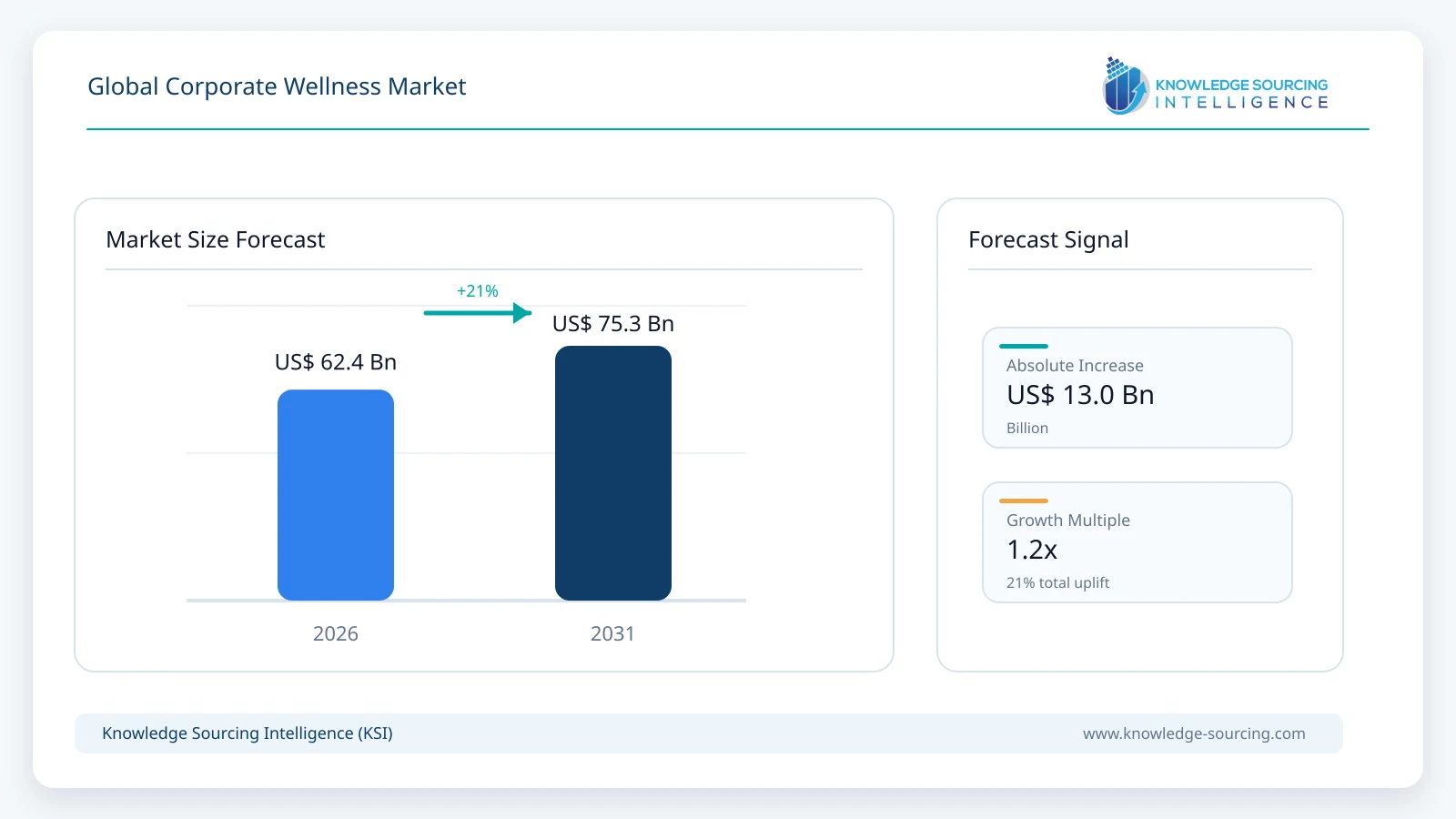
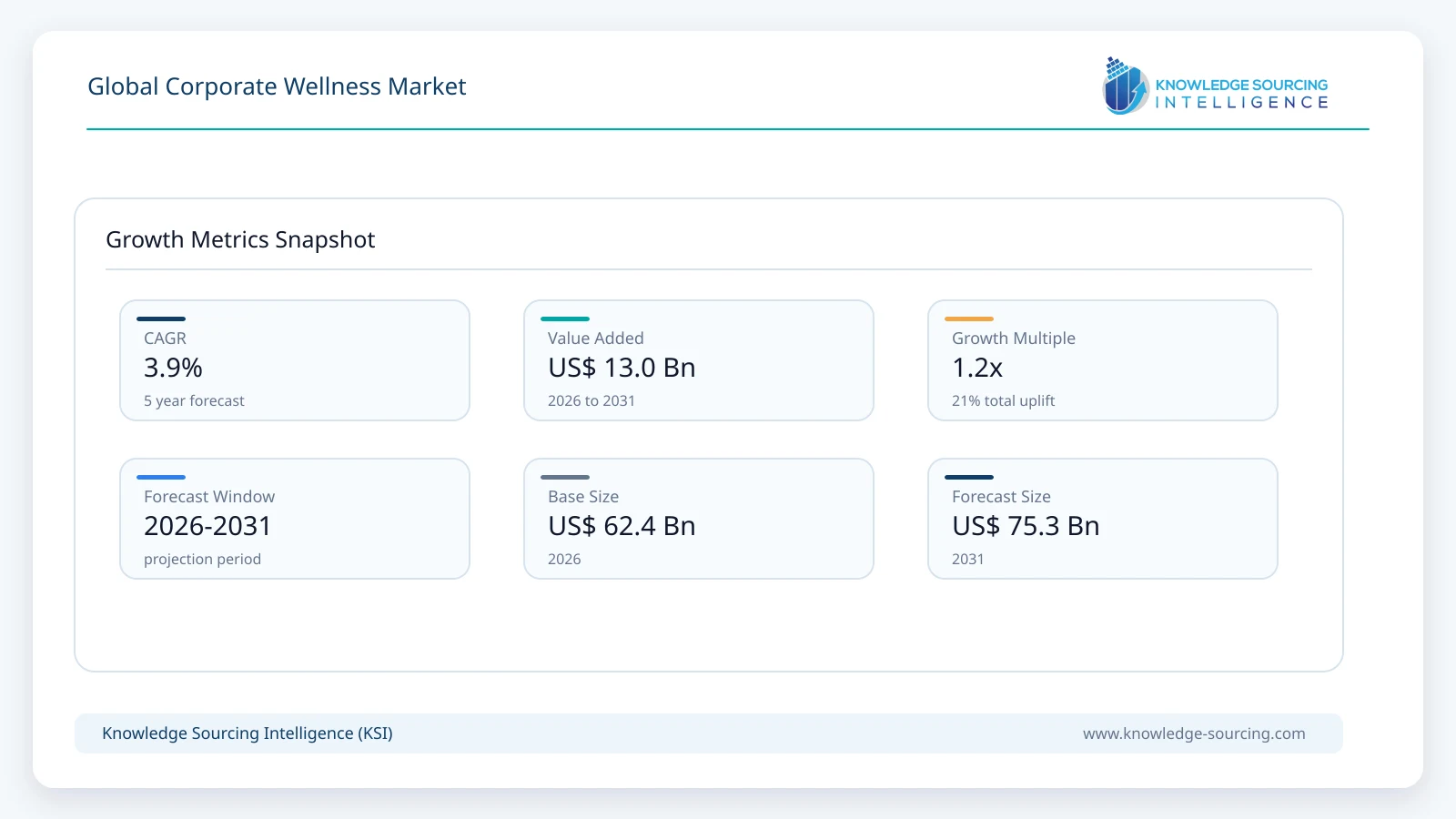
The global corporate wellness market is set to reach USD 75.3 billion in 2031, growing at a CAGR of 3.9% from USD 62.4 billion in 2026.
Highlights:
- 1Weight management and nutrition account for 29.5% of the market in 2026, supported by employer-funded nutrition, coaching and metabolic-health programs.
- 2Stress management is projected to grow at approximately 5.8% annually through 2031, supported by higher employer spending on workforce mental health.
- 3Onsite delivery accounts for 57.1% of the market in 2026, supported by workplace screenings, fitness, coaching and preventive-health programs.
- 4Large enterprises account for 59.7% of corporate wellness spending in 2026, reflecting larger benefits budgets and structured employee-health programs.
- 5North America represents 39.0% of the global market in 2026, supported by an established employer-benefits and workplace-health ecosystem.
Market Overview
The corporate wellness market covers programs, platforms and services purchased, funded or sponsored by employers to improve employee physical health, mental wellbeing, preventive health, lifestyle behavior and workforce resilience. The market includes employer expenditure on weight management and nutrition programs, fitness services, smoking cessation, stress management, employee mental-health support, health coaching, screenings, wellness assessments and integrated wellbeing platforms. These services can be delivered directly at the workplace, through digital platforms, through external provider networks or through hybrid models. The defining factor is the source and purpose of expenditure: the service must form part of an employer-sponsored workforce-health or employee-wellbeing program. This maintains a clear boundary between corporate wellness and the significantly broader consumer wellness, healthcare, fitness and digital-health industries.
General consumer spending is consequently excluded when it is not financed or facilitated by an employer. Independently purchased gym memberships, supplements, consumer meditation subscriptions, pharmaceuticals, general medical treatment and direct-to-consumer weight-management products do not form part of the market. Health-insurance premiums are also excluded. However, an employer may purchase health coaching, preventive care, benefit navigation or behavioral support around a chronic condition, in which case the service expenditure is included while the underlying medical treatment remains outside the market. This distinction is becoming increasingly important as workplace health platforms expand into adjacent health and benefits functions. CDC guidance similarly treats workplace health as a coordinated combination of programs, policies, benefits and environmental support rather than a single intervention, reinforcing the broader shift toward structured employer-led workforce health management.
Corporate wellness is also moving beyond traditional annual health checks and fitness challenges. Employers increasingly combine physical activity, nutrition, mental health, preventive health, resilience, financial wellbeing and employee engagement within a broader workforce strategy. Large organizations can procure these services through integrated health and wellbeing platforms, while digital delivery is reducing the implementation burden for medium and smaller employers. Personify Health illustrates this integration by combining wellbeing, health navigation and benefits capabilities, while Wellhub connects employers and employees with a broad external wellness network. This evolution is changing competition from the provision of isolated wellness activities toward the management of an employee's broader wellbeing experience across multiple programs and delivery channels.
Market Trends
Mental Health Is Becoming a Core Employer Wellness Category
Mental health is moving from a supplementary employee benefit toward a central component of corporate wellness procurement. Employers are increasingly seeking support that addresses stress and burnout before these conditions contribute to prolonged absence, employee turnover or more intensive clinical intervention. The market is therefore expanding beyond traditional Employee Assistance Program referrals toward integrated models combining self-guided resources, coaching, therapy access, manager support, crisis services and care navigation. Lyra Health's 2026 workforce research describes an environment in which employee strain remains high despite improved access to mental-health benefits, while benefits leaders are placing greater emphasis on outcomes and sustained recovery. Headspace has similarly expanded its employer proposition through a population mental health-led EAP model, illustrating the movement toward continuous workforce support rather than assistance that begins only after an employee reaches a crisis point.
Personalized Wellness Is Replacing Uniform Employee Programs
Employer wellness programs are becoming more individualized as companies recognize that employees differ substantially in health risks, life stage, location, work environment and willingness to participate. A uniform package of generic fitness challenges or annual screening events is increasingly being supplemented by health assessments, personalized recommendations, targeted coaching and flexible access to different wellness services. Integrated platforms make this approach easier because employees can enter through a common employer-sponsored environment while receiving different combinations of mental-health support, nutrition programs, physical activity, condition-management resources or preventive care. Personify Health's expanded partnership with Coralisle Group demonstrates this direction, with multiple specialist services integrated into a broader employer wellness program rather than offered as unrelated point solutions. Personalization therefore affects not only employee engagement but also vendor selection, as employers increasingly favor providers capable of coordinating multiple interventions within one employee experience.
Wellness Procurement Is Shifting Toward Integrated Platforms
Employers have accumulated a wide range of health, wellbeing and employee-benefit solutions, creating challenges around navigation, engagement and vendor administration. Corporate wellness procurement is therefore moving toward consolidation, with organizations attempting to reduce the number of disconnected employee-facing services and create clearer pathways into appropriate support. This trend benefits integrated platforms and network-based models while increasing pressure on standalone wellness providers to demonstrate distinct outcomes or integrate with broader ecosystems. The combination of Virgin Pulse and HealthComp under the Personify Health brand illustrates the broader convergence of wellbeing, navigation and benefits administration. Wellhub's expansion through Urban Sports Club shows a different model, aggregating physical and digital wellness access through a common corporate subscription. These models do not eliminate specialist providers, but they increasingly determine how those specialists are distributed to employer populations and incorporated into broader wellbeing strategies.
Employers Are Increasingly Demanding Measurable Outcomes
Corporate wellness is becoming more closely connected to employer objectives around employee health, absence, productivity, retention and healthcare utilization. This is changing how programs are evaluated. Eligibility for a benefit or initial enrollment is no longer sufficient evidence of performance when employee participation remains low or the service operates separately from broader workforce-health priorities. Employers increasingly expect providers to demonstrate engagement, sustained usage and relevant outcomes, particularly when several competing services address similar health needs. CDC's workplace-health model explicitly includes evaluation of worker productivity, healthcare costs, health outcomes and organizational change, while its program-development guidance emphasizes continuous assessment and improvement. This creates an advantage for wellness providers capable of connecting employee engagement with credible outcome measurement and puts greater pressure on programs that function primarily as lightly used employee perks.
Market Drivers
Rising Employer Focus on Workforce Mental Health
Workforce mental health is becoming a stronger driver of corporate wellness spending as employers confront stress, burnout, absence and employee-retention challenges. Lyra Health's 2026 workforce research indicates that employers continue to face increasing mental-health-related pressures even after expanding access to employee support, creating demand for more effective prevention, personalization and resilience strategies. This shifts procurement away from relying only on traditional referral-based EAP models and toward platforms capable of supporting employees across different levels of need. Employer-sponsored coaching, self-guided support, therapy access, manager tools and leave-related services are increasingly being coordinated through broader mental-health programs. The result is not simply an expansion in the number of available benefits but a change in how employers view mental health within overall workforce strategy, supporting continued expenditure on corporate-wellness providers able to demonstrate sustained employee engagement and meaningful outcomes.
Preventive Health is Becoming More Closely Linked to Employer Cost Management
Employers increasingly view workplace wellness through the combined effect of employee health risks, absence, productivity and longer-term healthcare utilization. This creates a stronger commercial case for preventive interventions addressing physical inactivity, nutrition, tobacco use, stress and other modifiable health factors before they contribute to more serious health problems. CDC workplace-health guidance recommends assessing workforce needs, selecting interventions suited to the employee population and evaluating their organizational and health effects, reinforcing the movement toward structured rather than ad hoc wellness programs. The procurement implication is that providers are increasingly expected to support assessment, engagement and outcome measurement in addition to delivering individual wellness activities. Programs that can connect several preventive-health needs within one employer platform are consequently becoming more attractive than isolated services with limited visibility into broader workforce-health objectives.
Digital Platforms are Expanding Access Across Distributed Workforces
The growth of hybrid work and geographically dispersed employee populations is supporting digital and network-based corporate wellness models. Employers can increasingly provide mental-health support, fitness access, nutrition programs and health coaching without replicating the same physical infrastructure at every location. Digital platforms also lower implementation barriers for organizations that lack dedicated wellness teams by centralizing eligibility, communications, employee navigation and program access. Wellhub's expansion across corporate fitness and wellness networks demonstrates how employer-funded platforms can connect employees with a large external provider ecosystem, while Personify Health combines several health and wellbeing functions within a broader personalized platform. These models are creating a distribution layer between employers and specialist wellness providers, supporting broader program access while also increasing competition around employee engagement and platform integration.
Competition for Employees Supports Broader Wellbeing Benefits
Employee benefits remain one mechanism through which organizations compete for skilled workers and attempt to improve retention, particularly in sectors where workforce replacement is costly. Corporate wellness programs have therefore expanded beyond basic physical-health initiatives toward mental health, resilience, financial wellbeing, caregiving and other services affecting employee experience. The commercial opportunity is strongest where employers view wellness as part of their broader people strategy rather than as an isolated HR activity. However, this also raises expectations around relevance. Employees have different needs across age, location, family circumstances and health conditions, making broad but poorly targeted wellness packages less effective. Employers are consequently placing greater emphasis on flexible benefit structures and personalization, which favors platforms capable of offering multiple wellness pathways without requiring separate procurement for every workforce need.
Market Restraints
Low Employee Participation Can Reduce Program Value
Employee eligibility does not necessarily translate into program utilization. Employers can purchase extensive wellbeing portfolios while employees remain unaware of available services, encounter difficult enrollment processes or fail to see the relevance of generic programs. This creates a material challenge because corporate wellness expenditure is increasingly evaluated against engagement and outcomes rather than simply the number of benefits offered. Fragmentation is a particular issue where an employer has accumulated several independent wellness vendors, each requiring separate communication, access and employee navigation. The trend toward integrated platforms partly reflects an attempt to solve this problem by creating fewer entry points and more personalized guidance. Providers unable to demonstrate meaningful employee usage can face greater contract scrutiny as organizations simplify benefits portfolios and redirect expenditure toward services with stronger evidence of workforce relevance.
Smaller Employers Remain Sensitive to Wellness Budgets
Small and some medium-sized employers have fewer administrative resources and less flexibility to add discretionary benefits when compared with large enterprises. Wellness programs compete with compensation, statutory benefits, insurance and other essential workforce costs, which can restrict adoption even when employers recognize the potential value of preventive health and employee wellbeing. Digital subscription models and standardized packages reduce this barrier, but smaller organizations still require simple implementation and clear evidence that employees will use the service. This places pressure on providers to deliver broad functionality without imposing extensive administration or requiring several separate contracts. As a result, market penetration among smaller employers is likely to increase gradually rather than replicate the depth of wellness spending seen among major corporations.
Difficulty Measuring Outcomes Can Slow Procurement
Wellness programs influence outcomes that are often difficult to isolate from other workforce and healthcare factors. Changes in absenteeism, employee retention, healthcare utilization or productivity can result from several variables beyond the wellness program itself, making simplistic return-on-investment claims difficult to substantiate. Employers are therefore becoming more cautious about vendor metrics that focus primarily on registrations, app activity or other easily measured engagement indicators. CDC's workplace-health framework emphasizes systematic evaluation and continuous improvement, reflecting the importance of connecting program implementation with relevant workforce and health measures. Providers that can demonstrate credible methodologies, appropriate outcome measures and sustained participation are likely to be better positioned as employer procurement becomes more evidence-oriented.
Segment Analysis
By Type
Weight Management and Nutrition
Weight management and nutrition remain a major component of employer wellness expenditure as organizations address obesity, metabolic risk and other lifestyle-related health concerns among working populations. Employer programs increasingly combine nutrition guidance with physical-activity support, health coaching, behavioral interventions and broader metabolic-health strategies rather than relying on short-term weight-loss challenges. The expansion of medical obesity treatment is also influencing benefit design, but the pharmaceutical value itself is outside the corporate wellness market. Revenue is included only where employers purchase wellness-related services such as coaching, navigation, nutritional support or behavioral management. This distinction keeps the segment focused on employer-sponsored wellness expenditure rather than allowing the rapidly growing pharmaceutical market to distort corporate wellness estimates. Over the forecast period, greater personalization and integration with preventive-health programs support continued demand even as employers become more selective about measurable employee participation and outcomes.
Fitness
Employer-funded fitness represents approximately USD 16.0 billion in 2026. The segment includes corporate fitness facilities, employer-sponsored or subsidized memberships, structured physical-activity programs and digital fitness access purchased as part of employee-wellness benefits. Delivery is changing as employers with hybrid or geographically distributed workforces move away from dependence on a single onsite facility toward networks that allow employees to select physical or digital activities according to location and preference. Wellhub's corporate model and its combination with Urban Sports Club illustrate the increasing scale of this network approach, which allows an employer to contract centrally while providing employees with access to a broad selection of external wellness partners. Physical fitness remains an important preventive-health component, but competitive differentiation is increasingly based on flexibility, engagement and integration with the employer's wider wellbeing strategy rather than access to exercise facilities alone.
Stress Management
Stress management is becoming one of the most strategically important categories within corporate wellness as employers respond to burnout, mental-health-related absence and increasingly complex employee-support requirements. The category includes employer-funded stress-management programs, wellbeing components of EAP services, resilience programs, mindfulness tools, coaching and other non-consumer mental-wellness services. The distinction from the broader mental healthcare market is important: expenditure is included where the employer sponsors or procures the service for its workforce rather than where an individual independently purchases clinical care. Providers such as Headspace, Lyra Health, Spring Health and Modern Health are expanding employer-facing offerings from conventional counseling access toward population-level mental health, early intervention, workforce resilience and organizational support. This shifts spending from isolated crisis-response services toward continuous programs intended to support employees at different levels of need.
Smoking Cessation
Smoking cessation remains an established preventive-health component within corporate wellness, with employer-funded services including behavioral counseling, educational programs, digital interventions and coaching designed to reduce tobacco and nicotine use. The category is more mature than employer mental-health or integrated digital wellbeing and therefore has a different growth profile. Its commercial relevance remains strongest where organizations connect cessation programs with broader cardiovascular, respiratory and chronic-disease prevention objectives rather than treating them as isolated campaigns. Digital coaching and personalized interventions are improving accessibility for employees who do not work at a central location, while employer health platforms can integrate cessation resources with assessments, incentives and preventive-health communications. The segment remains a stable part of comprehensive workplace-health programs even as faster-growing categories gradually account for a larger proportion of new corporate wellness expenditure.
Others
Other corporate wellness programs cover services such as financial wellbeing, sleep support, musculoskeletal health, caregiving support, wellness assessments and additional workforce-health services not classified within the primary categories. These areas are becoming more relevant as employers adopt a broader understanding of factors affecting employee wellbeing and performance. Financial stress, sleep disruption, caregiving responsibilities and musculoskeletal problems can influence absence, concentration, retention and employee resilience even when they fall outside traditional fitness or nutrition programs. Integrated platforms make it easier for organizations to offer several of these services without establishing separate internal programs or independent vendor relationships for every employee need. The category therefore benefits from the wider movement toward holistic employee wellbeing, although spending remains fragmented across a variety of specialist services and employer priorities.
By Delivery Model
Onsite
Onsite delivery remains important for employers with concentrated workforces, particularly large offices, manufacturing facilities, healthcare organizations and other environments where employees regularly work from a common physical location. Programs include health screenings, workplace fitness, coaching, wellness events, preventive-health assessments and selected occupational-health-linked initiatives. Onsite access can reduce participation barriers for services that require physical interaction and can increase visibility of wellness programs within the workplace. However, onsite services are increasingly being combined with digital tools rather than operating as independent programs. An employee may complete an assessment or screening at work and subsequently receive digital coaching, educational resources or mental-health support remotely. This hybrid structure allows employers to retain the advantages of physical workplace access while providing more continuity and personalization between onsite interactions.
Offsite and Remote
Offsite and remote delivery is becoming increasingly important as hybrid employment, geographically dispersed teams and multinational workforces make a single workplace-based program insufficient. Mental-health services, nutrition coaching, digital fitness, wellness navigation and lifestyle-management programs can be delivered remotely with relatively consistent access across locations. External wellness networks also enable employees to use physical services close to home without requiring the employer to operate facilities directly. For employers, this can simplify expansion of wellness benefits across multiple offices while reducing the fixed infrastructure associated with onsite delivery. The distinction between onsite and remote wellness is consequently becoming less rigid, with leading providers increasingly supporting hybrid models in which digital platforms manage engagement, navigation and personalization while selected interventions continue to take place through physical provider networks.
By Enterprise Size
Small Enterprises
Small enterprises represent a meaningful long-term opportunity because digital platforms and standardized wellness packages reduce many of the administrative barriers that previously limited adoption. These employers usually have fewer dedicated HR and benefits resources, making simplicity of implementation, predictable per-employee pricing and broad service coverage particularly important. They are also more sensitive to low employee utilization because a program must compete with other essential workforce expenditure. Integrated digital services can improve accessibility by allowing a smaller employer to provide fitness, mental-health or preventive-health support without establishing an internal wellness team or onsite infrastructure. Adoption nevertheless remains dependent on the provider's ability to demonstrate clear employee value and avoid complex implementations that require significant administrative involvement.
Medium Enterprises
Medium-sized enterprises occupy an important position between small businesses and large organizations with sophisticated internal benefits teams. These companies often have formal employee-benefit programs but lack the scale or resources to operate multiple specialized wellness initiatives internally. Integrated wellbeing platforms are particularly relevant because they allow the employer to purchase a broader range of services through fewer vendor relationships. Mental-health access, health coaching, fitness networks and preventive-health resources can therefore be offered without recreating the administrative structure of a large enterprise. Growth in this segment is also supported by competition for skilled employees, as medium-sized organizations increasingly use broader employee-benefit packages to strengthen retention and workforce experience while maintaining tighter control over program cost.
Large Enterprises
Large enterprises remain the principal purchasers of comprehensive corporate wellness programs because their workforce scale supports structured benefits teams, multi-service platforms, onsite interventions and specialized health initiatives across several locations. Their procurement priorities are also evolving. Large employers are increasingly attempting to consolidate fragmented point solutions, integrate wellness with wider benefits and navigation platforms, and demand better measurement of employee engagement and program outcomes. Multinational organizations create additional complexity because programs must accommodate different healthcare systems, employee expectations and provider networks across markets. This favors vendors with broad geographic coverage, flexible delivery models and the ability to coordinate specialist services within an integrated employee experience. Large employers also play an important role in shaping vendor expectations around performance measurement, interoperability and program customization.
Regional Outlook
North America
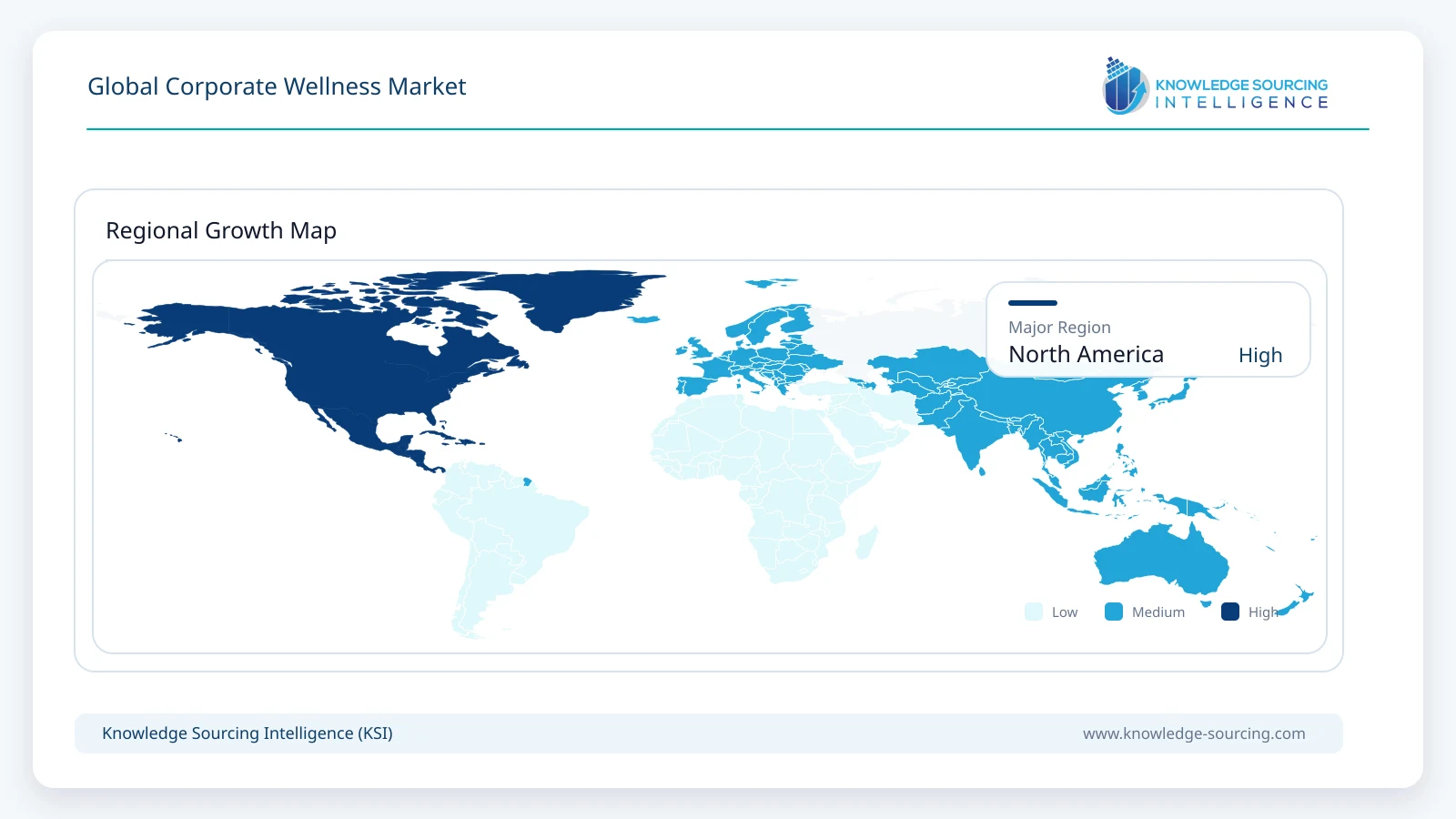
North America remains the largest corporate wellness region, led by the United States and its established employer-benefits ecosystem. Employer-funded programs span physical fitness, preventive health, weight management, mental-health support, EAP services, health coaching and increasingly integrated wellbeing platforms. The region also contains a large concentration of specialist corporate-wellness providers and digital health companies selling directly to employers, supporting innovation but also creating significant vendor fragmentation. Corporate buyers are consequently showing greater interest in benefit consolidation, employee navigation and measurable outcomes. Canada follows many of the same employer-wellness trends but operates within a different healthcare environment, while Mexico provides a smaller but developing corporate-wellness opportunity among formal-sector and multinational employers. The regional outlook remains supported primarily by service innovation and employer efforts to improve workforce-health outcomes rather than by simple expansion in the number of conventional wellness programs.
Europe
Europe has a developed workplace-health environment but differs considerably by country because public healthcare systems, occupational-health requirements and employer-benefit practices influence the role of private corporate wellness services. Employer demand is increasingly concentrated around mental wellbeing, physical activity, preventive health and flexible access for hybrid workforces. The combination of Wellhub and Urban Sports Club strengthens the regional network model by connecting corporate clients with a broad base of physical and digital fitness and wellness providers. Germany and the United Kingdom are important employer-wellness markets, while France, Italy and other European countries provide opportunities shaped by local benefits practices and workforce-health priorities. Digital platforms are particularly useful for multinational organizations seeking to provide a more consistent employee-wellbeing proposition across several European markets while accommodating national differences in healthcare provision.
Asia Pacific
Asia Pacific provides the strongest expansion opportunity from a more varied market base. The region includes mature workplace-health environments such as Japan and Australia alongside rapidly developing corporate-wellness demand in India, China and Southeast Asia. Growth is supported by formal-sector employment, competition for skilled professionals, multinational employer presence and increasing awareness of employee stress and preventive health. Digital delivery is especially important because organizations can support employees across geographically dispersed markets without developing separate physical wellness infrastructure in every location. Local market conditions remain important, however, because employee-benefit expectations, healthcare systems and employer budgets differ substantially between countries. International wellness providers therefore compete alongside regional specialists, particularly in mental health, fitness, health coaching and employee-engagement services.
Middle East and Africa
The Middle East and Africa remain smaller corporate-wellness markets, with adoption concentrated among multinational organizations, large domestic employers and sectors offering relatively developed employee-benefit packages. Gulf markets provide stronger opportunities for employer-funded wellness programs as companies compete for skilled employees and invest in broader workforce-health initiatives. Digital delivery enables providers to serve dispersed employee populations without large physical networks, while onsite programs remain relevant among major corporate and industrial employers. Across Africa, corporate wellness adoption varies significantly according to workforce formality, employer size and available benefits infrastructure. Growth therefore remains more concentrated than in mature markets, but employer attention to mental health, preventive care and workforce resilience is gradually broadening the addressable market.
South America
South American corporate wellness demand is led by Brazil, where large companies and multinational employers support workplace fitness, preventive-health and employee wellbeing programs. Economic conditions can influence the breadth of discretionary benefits, making flexible pricing and demonstrable employee value important for providers. Digital wellness and mental-health services offer opportunities because they can reach employees across multiple cities without extensive onsite infrastructure. Other regional markets remain smaller, with adoption generally stronger among formal-sector and multinational employers. Over the forecast period, corporate wellness growth is expected to remain linked to the modernization of employee benefits and increasing employer attention to workforce engagement rather than uniform adoption across all business sizes.
Competitive Landscape
Competition in corporate wellness increasingly occurs between integrated wellbeing platforms, workforce mental-health companies, corporate fitness networks, employee-assistance providers, preventive-health specialists and onsite health-service companies. Personify Health represents the combined Virgin Pulse and HealthComp organization and brings together wellbeing, health navigation and benefits capabilities within a broader employer-health platform. Wellhub has expanded the network model by connecting corporate clients with physical and digital wellness providers, while TELUS Health strengthened its international employee-wellbeing position through the acquisition of Workplace Options. Headspace, Spring Health, Lyra Health and Modern Health compete strongly in employer-sponsored mental health, while companies including Marathon Health and Premise Health provide broader workplace-health and preventive-care capabilities. Competitive advantage increasingly depends on employee engagement, integration, employer reporting, geographic coverage and the ability to combine several wellness requirements without creating additional benefit fragmentation.
Recent Developments
April 2026: Headspace expanded its employer mental-health proposition with a population mental health-led EAP combining preventive and higher-acuity employee support.
April 2026: Personify Health expanded its Coralisle Group wellbeing partnership by integrating additional mental-health, nutrition and fitness partners into the employer program.
September 2025: Wellhub acquired Urban Sports Club in a USD 600 million transaction, materially expanding its corporate fitness and wellbeing network across Europe.
July 2025: Spring Health launched Mental Health Leave & Accommodations to connect employee mental-health care with leave and return-to-work support.
May 2025: TELUS Health acquired Workplace Options, strengthening its international employee-wellbeing and Employee and Family Assistance Program capabilities.
Market Outlook
Corporate wellness spending through 2031 is expected to shift progressively toward integrated programs that combine physical health, mental wellbeing, preventive support and personalized employee navigation. Weight management and nutrition remain an important expenditure category, while workforce mental health gains importance as employers expand support beyond conventional EAP models. Digital delivery increases access for hybrid and geographically distributed workforces, but onsite services remain relevant where employees work from common facilities and where physical screening or fitness interventions are required. Large enterprises continue to account for the majority of expenditure, although standardized digital programs gradually broaden adoption among medium and smaller businesses. Competitive differentiation is expected to depend increasingly on employee participation, outcome measurement and the ability to reduce benefit fragmentation, making integration and measurable value central to the market's next phase.
Corporate Wellness Market Scope
| Report Metric | Details |
|---|---|
| Total Market Size in 2026 | USD 62.4 billion |
| Total Market Size in 2031 | USD 75.3 billion |
| Forecast Unit | Billion |
| Growth Rate | 3.9% |
| Study Period | 2021 to 2031 |
| Historical Data | 2021 to 2024 |
| Base Year | 2025 |
| Forecast Period | 2026 – 2031 |
| Segmentation | Type, Delivery Model, Enterprise Size, Geography |
| Companies |
|
Market Segmentation
By Type
Weight Management and Nutrition
Fitness
Smoking Cessation
Stress Management
Others
By Delivery Model
Onsite
Offsite/Remote
By Enterprise Size
Small Enterprises
Medium Enterprises
Large Enterprises
By Geography
North America
United States
Canada
Mexico
South America
Brazil
Argentina
Others
Europe
Germany
United Kingdom
France
Spain
Italy
Others
Middle East and Africa
Saudi Arabia
UAE
South Africa
Others
Asia Pacific
China
Japan
India
Australia
South Korea
Others
Table of Contents
1. INTRODUCTION
1.1. Market Overview
1.2. Market Definition
1.3. Market Inclusion and Exclusion Criteria
1.4. Scope of the Study
1.5. Market Segmentation
1.6. Currency
1.7. Assumptions
1.8. Base and Forecast Years
1.9. Key Benefits to Stakeholders
2. RESEARCH METHODOLOGY
2.1. Research Design
2.2. Secondary Research
2.3. Primary Research
2.4. Market Estimation
2.5. Employer Wellness Spending Assessment
2.6. Segment Modelling
2.7. Data Triangulation and Validation
3. EXECUTIVE SUMMARY
3.1. Key Findings
3.2. Global Corporate Wellness Market Size, 2026-2031
3.3. Wellness Program Type Outlook
3.4. Delivery Model Outlook
3.5. Enterprise Size Outlook
3.6. Regional Opportunity Summary
3.7. Analyst View
4. MARKET DYNAMICS
4.1. Market Drivers
4.1.1. Increasing Employer Spending on Workforce Mental Health
4.1.2. Preventive Health and Employer Cost Management
4.1.3. Expansion of Digital and Hybrid Wellness Platforms
4.1.4. Competition for Employees and Broader Wellbeing Benefits
4.2. Market Restraints
4.2.1. Low Employee Participation and Utilization
4.2.2. Budget Constraints Among Smaller Employers
4.2.3. Difficulty Measuring Wellness Program Outcomes
4.3. Market Opportunities
4.4. Porter’s Five Forces Analysis
4.5. Industry Value Chain Analysis
4.6. Employer Wellness Procurement and Spending Outlook
4.7. Employee Engagement and Utilization Outlook
5. CORPORATE WELLNESS SERVICE AND TECHNOLOGY OUTLOOK
5.1. Integrated Employee-Wellbeing Platforms
5.2. Workforce Mental-Health Platforms
5.3. Fitness and Wellness Networks
5.4. Personalized Wellness Programs
5.5. Employee Engagement and Outcomes Measurement
5.6. Integration with Employee Benefits Platforms
6. GLOBAL CORPORATE WELLNESS MARKET BY TYPE
6.1. Introduction
6.2. Weight Management and Nutrition
6.3. Fitness
6.4. Smoking Cessation
6.5. Stress Management
6.6. Others
7. GLOBAL CORPORATE WELLNESS MARKET BY DELIVERY MODEL
7.1. Introduction
7.2. Onsite
7.3. Offsite/Remote
8. GLOBAL CORPORATE WELLNESS MARKET BY ENTERPRISE SIZE
8.1. Introduction
8.2. Small Enterprises
8.3. Medium Enterprises
8.4. Large Enterprises
9. GLOBAL CORPORATE WELLNESS MARKET BY GEOGRAPHY
9.1. North America
9.1.1. By Type
9.1.2. By Delivery Model
9.1.3. By Enterprise Size
9.1.4. By Country
9.1.4.1. United States
9.1.4.2. Canada
9.1.4.3. Mexico
9.2. South America
9.2.1. By Type
9.2.2. By Delivery Model
9.2.3. By Enterprise Size
9.2.4. By Country
9.2.4.1. Brazil
9.2.4.2. Argentina
9.2.4.3. Others
9.3. Europe
9.3.1. By Type
9.3.2. By Delivery Model
9.3.3. By Enterprise Size
9.3.4. By Country
9.3.4.1. Germany
9.3.4.2. United Kingdom
9.3.4.3. France
9.3.4.4. Spain
9.3.4.5. Italy
9.3.4.6. Others
9.4. Middle East and Africa
9.4.1. By Type
9.4.2. By Delivery Model
9.4.3. By Enterprise Size
9.4.4. By Country
9.4.4.1. Saudi Arabia
9.4.4.2. UAE
9.4.4.3. South Africa
9.4.4.4. Others
9.5. Asia Pacific
9.5.1. By Type
9.5.2. By Delivery Model
9.5.3. By Enterprise Size
9.5.4. By Country
9.5.4.1. China
9.5.4.2. Japan
9.5.4.3. India
9.5.4.4. Australia
9.5.4.5. South Korea
9.5.4.6. Others
10. COMPETITIVE ENVIRONMENT AND ANALYSIS
10.1. Major Players and Strategy Analysis
10.2. Integrated Wellbeing Platform Positioning
10.3. Workforce Mental-Health Provider Positioning
10.4. Corporate Fitness and Wellness Network Positioning
10.5. Employer Health and Preventive-Care Capabilities
10.6. Employee Engagement and Personalization Capabilities
10.7. Outcomes Measurement and Reporting
10.8. Partnerships, Acquisitions and Platform Expansion
10.9. Competitive Dashboard
11. COMPANY PROFILES
11.1. Personify Health
11.2. TELUS Health
11.3. Wellhub
11.4. ComPsych Corporation
11.5. Vitality Group
11.6. WebMD Health Services
11.7. EXOS
11.8. Spring Health
11.9. Headspace
11.10. Lyra Health
11.11. Modern Health
11.12. EGYM Wellpass
11.13. Wellable
11.14. HealthCheck360
11.15. Marathon Health
11.16. Premise Health
11.17. Navigate Wellbeing Solutions
11.18. meQuilibrium
11.19. Unmind
11.20. LifeSpeak Inc.
11.21. WellRight
11.22. TotalWellness Health
11.23. Corporate Fitness Works
11.24. Labcorp Employer Services
11.25. Cult.fit
11.26. Truworth Wellness Technologies Pvt. Ltd.
12. APPENDIX
12.1. Market Definition and Scope
12.2. Revenue Inclusion and Exclusion Criteria
12.3. Employer-Funded Wellness Classification
12.4. Currency and Conversion Assumptions
12.5. Base Year and Forecast Period
12.6. Market Estimation Approach
12.7. Segment Modelling Assumptions
12.8. Primary and Secondary Research Framework
12.9. Data Triangulation and Validation
12.10. Abbreviations
12.11. Key Benefits for Stakeholders
Navigate
Trusted by the world's leading organizations











