
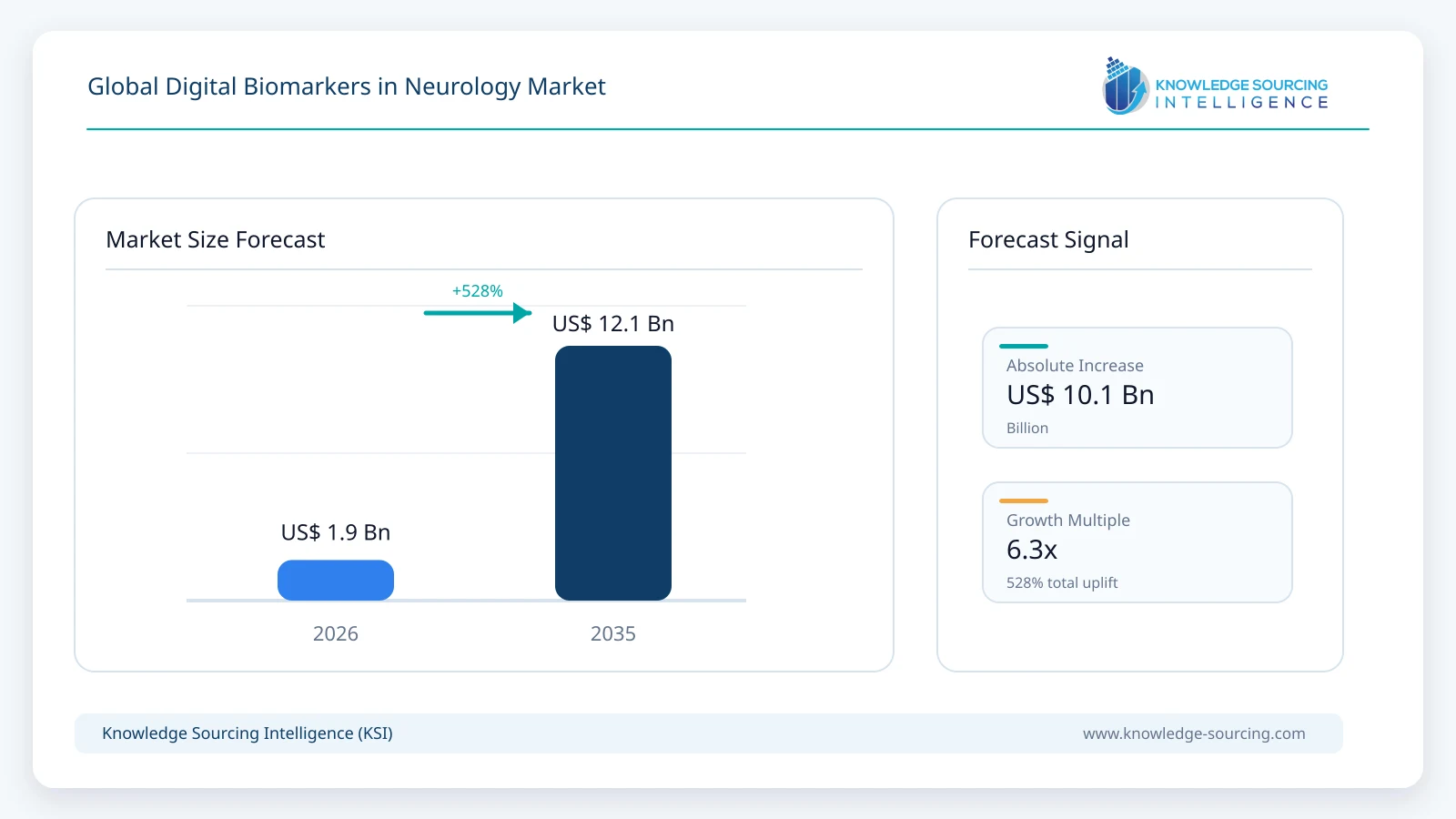
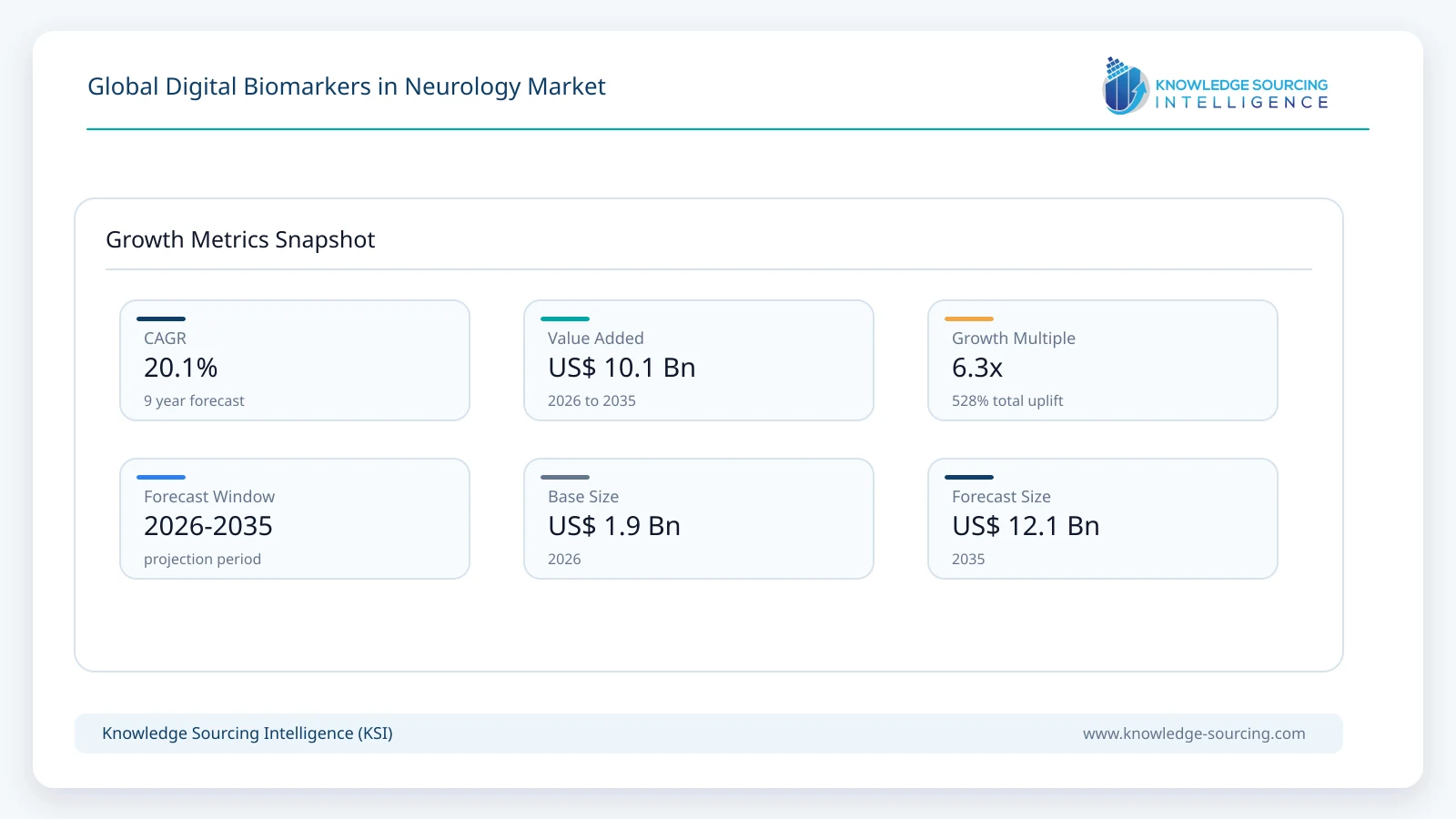
The Global Digital Biomarkers in Neurology Market is forecast to grow at a CAGR of 20.1%, reaching USD 12.05 billion in 2035 from USD 1.92 billion in 2026.
Highlights:
- 1Rising neurological disease prevalence is increasing demand for continuous patient monitoring systems that improve longitudinal disease assessment.
- 2Pharmaceutical companies are adopting digital biomarkers because decentralized clinical trials require scalable remote endpoint monitoring.
- 3AI-enabled analytics platforms are strengthening diagnostic sensitivity, which is accelerating adoption across neurodegenerative disease research programs.
- 4Wearable sensor integration is improving real-world data collection capabilities, which is supporting disease progression tracking outside hospital settings.
- 5Regulatory support for digital endpoints is encouraging investment in validated neurology-focused biomarker platforms.
- 6Aging population growth is increasing demand for cognitive biomarker solutions that enable earlier dementia risk detection.
The digital biomarkers in neurology market addresses the growing need for scalable neurological monitoring systems that extend beyond traditional hospital-based diagnostics. Neurological diseases often progress gradually, which creates dependency on longitudinal data collection for disease monitoring and therapeutic evaluation. Healthcare providers are adopting digital biomarker systems because conventional neurological assessments rely heavily on subjective interpretation and infrequent clinic visits.
Remote monitoring demand is increasing as healthcare systems attempt to reduce hospitalization costs and improve chronic neurological care continuity. Wearable technologies are generating continuous streams of physiological and behavioral data, which is enabling earlier identification of disease deterioration patterns. Smartphone-based assessments are also becoming more relevant because mobile accessibility supports large-scale patient participation in monitoring programs.
Regulatory influence is strengthening across the market because agencies increasingly recognize digital endpoints in neurological research. The U.S. Food and Drug Administration and the European Medicines Agency are supporting frameworks for digital health validation, which is encouraging pharmaceutical companies to integrate digital biomarkers into drug development strategies. Research institutions are also expanding collaborations with technology companies because neurological datasets require advanced AI and cloud analytics capabilities.
Strategic importance is increasing because neurological diseases create significant long-term economic burdens for healthcare systems. Alzheimer’s disease, Parkinson’s disease, epilepsy, and multiple sclerosis require continuous management, which is increasing investment in predictive and monitoring technologies. This structural shift is positioning digital biomarkers as critical infrastructure components within future neurology care pathways.
Market Dynamics
Market Drivers
Expansion of Remote Neurological Monitoring: Neurological disease management increasingly depends on long-term patient observation because disease progression patterns often fluctuate outside clinical environments. Healthcare systems are expanding remote monitoring adoption because neurological specialist availability remains limited across multiple regions. Wearable devices and smartphone-based assessments are generating continuous neurological datasets, which is reducing dependency on episodic in-clinic evaluation. Technology companies are responding through integrated monitoring ecosystems that combine AI analytics with cloud-based patient management tools. This transition strengthens demand for scalable digital biomarker infrastructure across hospitals, research institutions, and pharmaceutical trials.
Growth of Digital Endpoints in Clinical Trials: Neurology drug development requires sensitive outcome measurements because traditional clinical endpoints frequently fail to detect subtle functional changes. Pharmaceutical companies are increasing investment in digital biomarkers because decentralized clinical trials require continuous real-world patient data collection. AI-enabled monitoring systems are improving endpoint granularity, which is helping sponsors measure treatment response with greater precision. Regulatory agencies are supporting qualification pathways for digital endpoints, which is encouraging broader implementation across neurological research programs. This environment strengthens collaboration between pharmaceutical developers and digital health companies.
Increasing Burden of Neurodegenerative Diseases: The global neurological disease burden continues to expand because aging populations are increasing the prevalence of dementia-related disorders. Healthcare providers are adopting digital cognitive assessment tools because early-stage neurodegenerative symptoms often remain undetected during routine clinical evaluations. Continuous behavioral and motor tracking platforms are enabling earlier intervention strategies, which is increasing demand for home-based monitoring systems. Research institutions are expanding longitudinal neurology datasets because predictive analytics capabilities require large-scale patient information. This dynamic reinforces investment in digital biomarker validation programs.
Market Restraints
Clinical validation requirements remain complex because neurological biomarkers require longitudinal evidence across diverse patient populations.
Data privacy regulations create implementation challenges because digital neurology platforms process sensitive behavioral and physiological information.
Reimbursement inconsistency limits adoption because many healthcare systems lack standardized payment frameworks for digital biomarker monitoring.
Market Opportunities
Expansion of Home-Based Neurology Care: Healthcare systems increasingly prioritize home-based disease management because neurological disorders require continuous long-term monitoring. Digital biomarker platforms are supporting this transition through wearable sensors and remote cognitive assessment tools that extend neurological observation beyond hospitals. Technology providers are expanding patient-centric monitoring ecosystems, which are increasingly adopted among chronic neurological disease populations. This shift strengthens opportunities for integrated remote neurology infrastructure providers.
Rising Use of Speech Biomarkers: Speech and voice analysis technologies are gaining strategic relevance because neurological disorders frequently alter vocal and cognitive patterns during early disease stages. AI-based speech analytics platforms are improving detection capabilities for Parkinson’s disease and dementia-related conditions, which is increasing research investment in non-invasive neurological monitoring tools. Pharmaceutical companies are integrating speech biomarkers into trial programs because passive monitoring improves patient participation. This trend creates opportunities for specialized digital neurology analytics developers.
Growing Pharmaceutical Partnerships: Drug developers increasingly depend on digital health companies because neurological clinical trials require scalable monitoring technologies. Digital biomarker vendors are expanding collaborations with pharmaceutical firms, which are accelerating the validation of remote endpoint systems. Continuous patient monitoring is improving clinical trial efficiency because real-world datasets enhance treatment response visibility. This collaborative environment creates long-term commercialization opportunities for digital neurology platform providers.
Supply Chain Analysis
The digital biomarkers in neurology market depends on an interconnected supply chain that combines semiconductor manufacturers, wearable device developers, cloud infrastructure providers, AI software companies, healthcare institutions, and pharmaceutical organizations. Sensor manufacturers supply accelerometers, biosensors, EEG modules, and motion-tracking components that support wearable neurological monitoring systems. Hardware dependency remains significant because neurological biomarker accuracy requires high-frequency data collection and device stability.
Software and analytics providers occupy a central role because raw neurological datasets require AI-enabled interpretation frameworks. Cloud infrastructure demand is increasing because neurological monitoring systems generate continuous real-world data streams that require scalable storage and analytics capacity. Healthcare providers and pharmaceutical companies are integrating these platforms into decentralized care and clinical research workflows, which is strengthening interoperability requirements across vendors.
Regulatory validation remains a critical supply chain constraint because digital biomarker systems require clinical evidence before widespread deployment. Technology developers are therefore increasing partnerships with academic institutions and neurology centers to support validation studies. This collaborative structure is shaping a supply chain environment where software capabilities, regulatory compliance, and clinical credibility increasingly determine competitive positioning.
Government Regulations
Region | Regulatory Body | Regulatory Focus |
United States | U.S. Food and Drug Administration (FDA) | Digital health software validation and digital endpoint guidance |
Europe | European Medicines Agency (EMA) | Clinical evidence standards for digital biomarkers and decentralized trials |
United Kingdom | Medicines and Healthcare products Regulatory Agency (MHRA) | Remote patient monitoring and AI-enabled health technology oversight |
Japan | Pharmaceuticals and Medical Devices Agency (PMDA) | Digital therapeutics and neurology monitoring system approvals |
China | National Medical Products Administration (NMPA) | AI healthcare software and connected medical device regulation |
Market Segmentation
By Technology Type
Wearable technologies remain central to the digital biomarkers in neurology market because neurological disease monitoring increasingly depends on continuous real-world data collection. Motion sensors, smartwatches, EEG-enabled wearables, and AI-supported mobile platforms are improving longitudinal assessment capabilities across movement disorders and neurodegenerative diseases. Smartphone applications are gaining adoption because healthcare providers require scalable patient engagement systems that support remote neurological monitoring. AI-based analytics platforms are strengthening market demand because neurological datasets require predictive interpretation models capable of identifying subtle disease progression patterns. Imaging-integrated biomarker platforms are also expanding because pharmaceutical research programs increasingly depend on multimodal neurological datasets.
By Biomarker Type
Motor biomarkers account for substantial demand because Parkinson’s disease, multiple sclerosis, and stroke management require continuous movement analysis. Cognitive biomarkers are expanding rapidly because dementia screening demand is increasing alongside aging population growth. Speech and behavioral biomarkers are becoming strategically important because AI-supported voice analytics improves early-stage neurological disease detection capabilities. Sleep biomarkers are also gaining relevance because neurological disorders frequently disrupt sleep architecture patterns that influence disease progression assessment. Physiological biomarker demand is increasing because wearable technologies now support continuous heart rate, electrodermal activity, and neurophysiological monitoring.
By Indication
Alzheimer’s disease represents a major demand segment because healthcare systems increasingly prioritize early cognitive decline detection. Parkinson’s disease monitoring adoption is accelerating because wearable motion-tracking systems improve tremor and gait analysis outside clinical settings. Multiple sclerosis applications are expanding because pharmaceutical companies require continuous monitoring systems capable of measuring subtle disease progression changes during clinical trials. Epilepsy monitoring demand remains strong because wearable seizure-detection systems improve patient safety and remote supervision capabilities. Stroke rehabilitation monitoring is also gaining momentum because remote neurological assessment platforms support long-term recovery management.
Regional Analysis
North America Market Analysis
North America maintains a strong position in the digital biomarkers in neurology market because the region combines advanced healthcare infrastructure with significant neurological research investment. Pharmaceutical companies are increasingly incorporating digital biomarkers into decentralized clinical trials because neurological drug development requires continuous patient monitoring capabilities. Healthcare providers are expanding remote neurology programs as chronic neurological disease prevalence increases across aging populations. Regulatory support from the FDA is encouraging digital endpoint validation, which is strengthening commercialization opportunities for wearable and AI-based monitoring systems.
Technology companies and academic research institutions maintain extensive collaboration networks across the region, which accelerates innovation in AI-driven neurological analytics. Venture capital investment remains active because digital neurology platforms support scalable remote care delivery models. Hospitals are adopting integrated neurological monitoring systems that combine wearable technologies with cloud-based analytics because healthcare systems increasingly prioritize long-term disease management efficiency. This environment reinforces North America’s role as a major commercialization hub for digital biomarkers.
Europe Market Analysis
Europe demonstrates strong demand for digital neurological monitoring because aging demographics are increasing the prevalence of neurodegenerative diseases across multiple countries. Public healthcare systems are evaluating remote patient monitoring programs because long-term neurological disease management places substantial financial pressure on hospital infrastructure. Regulatory harmonization through the European Medicines Agency supports digital health innovation, which is encouraging adoption of validated biomarker technologies.
Research collaborations between pharmaceutical companies, academic institutions, and digital health developers remain extensive throughout the region. Multiple sclerosis monitoring programs are particularly active because Europe maintains strong neurological research capabilities and established pharmaceutical infrastructure. AI-supported cognitive assessment systems are gaining adoption because dementia detection initiatives increasingly prioritize early intervention strategies. Cloud-based monitoring platforms are also expanding because healthcare systems require scalable patient management tools capable of supporting chronic disease populations.
Asia Pacific Market Analysis
Asia Pacific is experiencing accelerating demand for digital biomarkers because neurological disease prevalence is increasing alongside population aging and urbanization trends. Smartphone penetration growth is expanding access to app-based neurological monitoring systems, which supports broader implementation outside major hospital networks. Governments are increasing investment in digital health infrastructure because healthcare systems face rising pressure from chronic neurological disease burdens.
Technology companies are introducing lower-cost wearable and AI-supported monitoring solutions that improve accessibility across emerging healthcare markets. Pharmaceutical research activity is also increasing because regional patient populations support large-scale neurological clinical trials. Japan maintains strong adoption of advanced neurological monitoring technologies because the country prioritizes aging-related healthcare innovation. China and India are expanding digital health ecosystems through telemedicine and connected care initiatives, which is strengthening demand for scalable biomarker platforms.
Rest of the World
The Rest of the World region is gradually expanding digital neurology adoption because healthcare systems increasingly recognize the long-term burden associated with neurological disorders. Latin America and the Middle East are improving digital healthcare infrastructure, which supports broader deployment of remote monitoring technologies. Neurological specialist shortages remain significant across several regions, which is increasing demand for scalable wearable and smartphone-based assessment systems.
International technology companies are entering underserved markets through partnerships with hospitals and telehealth providers because remote neurological monitoring improves care accessibility. Cloud-based monitoring systems are gaining traction because healthcare providers require lower-cost infrastructure models capable of supporting chronic disease management. Regulatory fragmentation continues to constrain broader adoption, although governments are increasingly evaluating digital health frameworks to support connected care expansion. This environment gradually strengthens long-term growth opportunities for digital biomarker vendors.
Regulatory Landscape
Regulatory frameworks for digital biomarkers in neurology increasingly focus on clinical validation, cybersecurity compliance, and real-world evidence generation. Regulatory agencies recognize that neurological monitoring technologies influence patient management decisions, which increases scrutiny around software reliability and data accuracy. The FDA is supporting digital health innovation through software guidance frameworks and digital endpoint evaluation pathways, which is encouraging companies to expand neurological monitoring programs.
European regulatory systems are strengthening oversight of AI-enabled medical software because digital biomarkers increasingly depend on machine learning algorithms for disease prediction and monitoring. Data privacy regulations under the General Data Protection Regulation continue shaping platform development strategies because neurological datasets include sensitive behavioral and physiological information. Companies are investing heavily in cybersecurity and compliance infrastructure to support large-scale deployment across healthcare networks.
Asia Pacific regulators are gradually formalizing digital health oversight frameworks because connected care technologies are expanding rapidly across the region. Japan and China are increasing support for AI-enabled healthcare innovation while simultaneously strengthening medical software evaluation standards. These evolving regulatory environments are encouraging technology providers to prioritize clinically validated neurological monitoring solutions.
Pipeline Analysis
The digital biomarkers in neurology pipeline increasingly focuses on AI-supported disease progression analysis, passive monitoring technologies, and multimodal neurological datasets. Companies are developing integrated systems that combine wearable sensors, cognitive assessment tools, speech analysis, and neurophysiological monitoring because neurological diseases require multidimensional evaluation frameworks. Pharmaceutical companies are supporting these initiatives because digital endpoints improve the sensitivity of neurological clinical trials.
Alzheimer’s disease and Parkinson’s disease programs dominate pipeline activity because neurodegenerative disorders require continuous long-term monitoring capabilities. Speech biomarkers and behavioral analytics platforms are gaining research momentum because passive data collection improves patient adherence and real-world monitoring efficiency. Multiple sclerosis monitoring systems are also advancing because pharmaceutical developers increasingly require objective digital endpoints for treatment response measurement.
Research collaborations remain central to pipeline expansion because neurological biomarker validation requires longitudinal clinical evidence. Academic institutions, pharmaceutical firms, and AI technology developers are therefore increasing partnership activity to support large-scale dataset generation. This collaborative environment is accelerating commercialization pathways for digital neurology platforms.
Competitive Landscape
Apple Inc.
Apple Inc. maintains strategic influence in the digital biomarkers in neurology market because its wearable ecosystem combines consumer-scale adoption with expanding health monitoring functionality. The Apple Watch and HealthKit platforms support continuous physiological and behavioral data collection, which positions the company as a major infrastructure provider for digital health integration. Neurological monitoring applications are increasing because wearable sensor capabilities continue expanding across mobility, sleep, and cardiovascular assessment functions linked to neurological disease management.
The company is strengthening research collaborations with academic institutions and healthcare organizations because large-scale validation studies improve clinical credibility. Apple is also expanding AI-enabled analytics capabilities within its health ecosystem, which supports broader integration into neurological monitoring workflows. Its consumer technology scale creates a competitive advantage because healthcare providers increasingly require scalable remote monitoring infrastructure.
Alphabet Inc.
Alphabet Inc. maintains strategic relevance through AI-focused healthcare initiatives and large-scale data analytics capabilities. The company is increasing investment in digital health research because neurological disease monitoring increasingly depends on machine learning-based pattern recognition systems. Neurology-focused research collaborations support development of predictive analytics tools that improve early-stage disease identification.
Cloud infrastructure capabilities strengthen Alphabet’s market position because digital biomarker platforms require scalable real-world data management systems. The company is also expanding healthcare AI initiatives through research partnerships that focus on neurological imaging, behavioral analysis, and digital endpoint development. Its analytics expertise supports growing demand for integrated neurology data ecosystems.
Medtronic plc
Medtronic plc occupies a strong position because the company combines neurology device expertise with connected digital monitoring infrastructure. Neurology-focused platforms support remote patient management across movement disorders and neurostimulation applications, which aligns with increasing demand for continuous neurological monitoring. The company is integrating digital health capabilities into existing neurology portfolios because healthcare systems increasingly prioritize connected care delivery.
Research and innovation activities continue expanding because neurological disease management increasingly depends on real-world patient data. Medtronic is strengthening digital monitoring strategies through AI-supported analytics and connected device ecosystems that improve long-term patient observation. This integration supports the company’s competitive positioning within advanced neurology care pathways.
BioSensics LLC
BioSensics LLC specializes in wearable biomarker technologies focused on movement analysis and neurological monitoring. Demand for gait assessment and mobility tracking systems is increasing because neurological disorders frequently alter motor function patterns outside clinical environments. The company’s wearable platforms support continuous real-world monitoring, which improves disease progression analysis.
Research collaborations remain central to BioSensics’ growth strategy because clinical validation is critical for neurological biomarker adoption. The company is expanding partnerships with healthcare institutions and research organizations to strengthen evidence generation for wearable neurological assessment systems. This focus supports its position within mobility-oriented digital biomarker applications.
Empatica Inc.
Empatica Inc. maintains strategic differentiation through FDA-cleared wearable neurological monitoring technologies focused on epilepsy and seizure detection. Continuous physiological monitoring demand is increasing because healthcare providers require scalable patient safety solutions for neurological disorders. The company’s wearable platforms support remote supervision capabilities that improve long-term patient management.
Research and pipeline activities continue expanding because digital epilepsy monitoring requires increasingly sophisticated physiological analytics. Empatica is strengthening partnerships with healthcare institutions and pharmaceutical organizations to support broader integration of wearable neurological monitoring systems into research and clinical workflows.
Key Developments
January 2026: Linus Health continued expanding deployment of digital cognitive assessment tools for early dementia detection and Alzheimer's risk stratification. The company's platform combines cognitive testing, behavioral analytics, and remote monitoring to generate digital biomarkers for cognitive decline.
January 2026: Altoida remained a major player in smartphone-based neurological assessment, using augmented reality tasks, motor function measurements, eye tracking, and behavioral signals to identify early Alzheimer's-related impairment before traditional clinical symptoms become obvious.
October 2025: Indivi and Clouds of Care, two independent TechBio companies, announced a strategic partnership to advance the use of precision medicine tools in early-phase neuroscience drug development, targeting Alzheimer’s and Parkinson’s disease.
June 2025: Empatica introduced EmbraceMini, a compact wearable designed for clinical research and digital biomarker collection. The device captures continuous activity and sleep data and integrates with the company's neurological monitoring platform.
Strategic Insights and Future Market Outlook
The digital biomarkers in neurology market is evolving from an experimental digital health segment into an operational component of neurological care and pharmaceutical development. Healthcare systems increasingly depend on remote monitoring because neurological disease prevalence continues rising while specialist capacity remains constrained. This imbalance is accelerating demand for wearable monitoring systems, AI-supported analytics, and scalable cloud-based neurology platforms.
Pharmaceutical companies are expected to remain major drivers of market expansion because decentralized clinical trials increasingly require continuous real-world patient data. Digital endpoints are improving treatment response measurement sensitivity, which strengthens their strategic relevance within neurodegenerative disease research. Companies capable of combining clinical validation, AI analytics, and interoperable monitoring infrastructure are likely to strengthen competitive positioning.
Regulatory frameworks are gradually supporting broader adoption because agencies increasingly recognize the importance of digital monitoring technologies in chronic disease management. Continued advances in wearable sensors, speech analytics, cognitive assessment systems, and multimodal neurological datasets are expected to reshape disease monitoring pathways. This transition positions digital biomarkers as foundational infrastructure within future neurology ecosystems.
Digital Biomarkers in Neurology Market Scope:
| Report Metric | Details |
|---|---|
| Total Market Size in 2026 | USD 1.92 Billion |
| Total Market Size in 2035 | USD 12.05 Billion |
| Forecast Unit | USD Billion |
| Growth Rate | 20.1% |
| Study Period | 2021 to 2035 |
| Historical Data | 2021 to 2024 |
| Base Year | 2025 |
| Forecast Period | 2026 – 2035 |
| Segmentation | Technology Type, Biomarker Type, Indication, Geography |
| Companies |
|
Market Segmentation
By Geography
Key Countries Analysis
Regulatory & Policy Landscape
Table of Contents
1. EXECUTIVE SUMMARY
1.1 Market Overview
1.2 Scope of the Report
1.3 Definition of Digital Biomarkers in Neurology
1.4 Key Market Highlights
1.5 Executive Snapshot of Market Trends
1.6 Key Therapeutic Areas Covered
1.7 Key End Users
1.8 Market Size and Forecast Summary
1.9 Competitive Intelligence Highlights
1.10 Strategic Recommendations
2. DISEASE & EPIDEMIOLOGY ANALYSIS
2.1 Overview of Neurological Disorders
2.2 Burden of Neurological Diseases Globally
2.3 Epidemiology by Major Neurological Indications
2.3.1 Alzheimer’s Disease
2.3.2 Parkinson’s Disease
2.3.3 Multiple Sclerosis
2.3.4 Epilepsy
2.3.5 Stroke
2.3.6 Migraine
2.3.7 Amyotrophic Lateral Sclerosis (ALS)
2.3.8 Huntington’s Disease
2.3.9 Sleep Disorders Associated with Neurological Conditions
2.3.10 Cognitive Impairment and Dementia
2.4 Patient Population Analysis
2.4.1 Diagnosed Population
2.4.2 Treated Population
2.4.3 Digitally Monitored Population
2.5 Disease Burden by Age Group
2.6 Disease Burden by Gender
2.7 Epidemiology Trends Influencing Digital Biomarker Adoption
2.8 Unmet Needs in Neurological Monitoring
2.9 Role of Remote Monitoring in Neurology Care Pathways
3. MARKET DYNAMICS
3.1 Market Definition and Evolution
3.2 Market Drivers
3.2.1 Rising Prevalence of Neurological Disorders
3.2.2 Growing Adoption of Wearable Technologies
3.2.3 Expansion of Remote Patient Monitoring
3.2.4 Increasing Use of Artificial Intelligence in Neurology
3.2.5 Demand for Continuous Disease Monitoring
3.2.6 Pharmaceutical Interest in Digital Endpoints for Clinical Trials
3.3 Market Restraints
3.3.1 Data Privacy and Cybersecurity Concerns
3.3.2 Lack of Standardized Validation Frameworks
3.3.3 Reimbursement Challenges
3.3.4 Limited Clinical Integration
3.3.5 Regulatory Complexity Across Regions
3.4 Market Opportunities
3.4.1 Expansion in Decentralized Clinical Trials
3.4.2 Integration with Digital Therapeutics
3.4.3 AI-Driven Predictive Neurology Platforms
3.4.4 Growth Potential in Emerging Markets
3.4.5 Smartphone-Based Neurological Assessments
3.5 Market Challenges
3.5.1 Interoperability Limitations
3.5.2 Patient Adherence Challenges
3.5.3 Clinical Validation Requirements
3.5.4 Limited Physician Awareness
3.6 Porter’s Five Forces Analysis
3.7 PESTLE Analysis
3.8 Value Chain Analysis
3.9 Pricing Analysis
3.10 Technology Adoption Curve
3.11 Impact of Generative AI and Machine Learning
3.12 Strategic Collaborations and Partnerships
4. COMMERCIAL & MARKET ACCESS
4.1 Commercialization Models in Digital Neurology
4.2 Reimbursement Landscape
4.2.1 Public Reimbursement
4.2.2 Private Insurance Coverage
4.2.3 Value-Based Care Models
4.3 Market Access Barriers
4.4 Health Technology Assessment Considerations
4.5 Clinical Utility and Economic Evidence
4.6 Integration with Electronic Health Records
4.7 Hospital Procurement Trends
4.8 Subscription and SaaS-Based Revenue Models
4.9 Market Entry Strategies
4.10 Stakeholder Analysis
4.10.1 Healthcare Providers
4.10.2 Pharmaceutical Companies
4.10.3 Payers
4.10.4 Research Organizations
4.10.5 Patients and Caregivers
5. INNOVATION & PIPELINE LANDSCAPE
5.1 Overview of Innovation Ecosystem
5.2 Evolution of Digital Biomarker Technologies
5.3 Pipeline Analysis by Development Stage
5.3.1 Early-Stage Research
5.3.2 Pilot Validation Programs
5.3.3 Clinical Validation Programs
5.3.4 Commercial Deployment Stage
5.4 Pipeline Analysis by Technology Modality
5.4.1 Wearable Sensors
5.4.2 Smartphone-Based Biomarkers
5.4.3 Voice and Speech Biomarkers
5.4.4 Gait and Motion Analytics
5.4.5 Cognitive Assessment Platforms
5.4.6 EEG-Based Biomarkers
5.4.7 Eye-Tracking Technologies
5.4.8 Sleep Monitoring Platforms
5.4.9 Passive Monitoring Systems
5.5 Pipeline Analysis by Mechanism of Measurement
5.5.1 Physiological Biomarkers
5.5.2 Behavioral Biomarkers
5.5.3 Cognitive Biomarkers
5.5.4 Motor Function Biomarkers
5.5.5 Speech and Language Biomarkers
5.6 AI and Machine Learning Innovations
5.7 Digital Endpoints in Neurology Clinical Trials
5.8 Biomarker Validation Frameworks
5.9 Patent Landscape Analysis
5.10 Strategic Collaborations and Licensing Agreements
5.11 Mergers, Acquisitions, and Funding Trends
5.12 Future Technology Roadmap
6. TREATMENT LANDSCAPE
6.1 Current Standard of Care in Neurology
6.2 Role of Digital Biomarkers in Disease Management
6.3 Integration with Pharmacological Therapies
6.4 Integration with Neuromodulation Therapies
6.5 Integration with Digital Therapeutics
6.6 Remote Patient Monitoring in Neurology
6.7 Clinical Workflow Integration
6.8 Neurology Clinical Trial Applications
6.9 Personalized Neurology and Precision Medicine
6.10 Comparative Assessment of Traditional vs Digital Monitoring
6.11 Physician Adoption Trends
6.12 Patient Engagement and Adherence Trends
7. MARKET SIZE & FORECAST
7.1 Global Market Size Analysis
7.1.1 Historical Market Analysis
7.1.2 Current Market Analysis
7.1.3 Forecast Market Analysis
7.2 Market Forecast by Technology Type
7.3 Market Forecast by Neurological Indication
7.4 Market Forecast by End User
7.5 Market Forecast by Component
7.6 Market Forecast by Deployment Model
7.7 Market Forecast by Region
7.8 Market Attractiveness Analysis
7.9 Incremental Opportunity Analysis
7.10 Absolute Dollar Opportunity Analysis
8. MARKET SEGMENTATION
8.1 By Technology Type
8.1.1 Wearables
8.1.2 Smartphone Applications
8.1.3 Sensor-Based Platforms
8.1.4 Voice and Speech Analysis Tools
8.1.5 EEG and Neurophysiological Monitoring Systems
8.1.6 AI-Based Analytics Platforms
8.1.7 Digital Cognitive Assessment Platforms
8.1.8 Imaging-Integrated Biomarker Platforms
8.2 By Biomarker Type
8.2.1 Motor Biomarkers
8.2.2 Cognitive Biomarkers
8.2.3 Behavioral Biomarkers
8.2.4 Physiological Biomarkers
8.2.5 Speech Biomarkers
8.2.6 Sleep Biomarkers
8.3 By Indication
8.3.1 Alzheimer’s Disease
8.3.2 Parkinson’s Disease
8.3.3 Multiple Sclerosis
8.3.4 Epilepsy
8.3.5 Stroke
8.3.6 Migraine
8.3.7 ALS
8.3.8 Huntington’s Disease
8.3.9 Other Neurological Disorders
8.4 By Component
8.4.1 Software
8.4.2 Devices
8.4.3 Services
8.5 By Deployment Model
8.5.1 Cloud-Based
8.5.2 On-Premise
8.6 By End User
8.6.1 Hospitals and Neurology Clinics
8.6.2 Pharmaceutical and Biotechnology Companies
8.6.3 Academic and Research Institutes
8.6.4 Contract Research Organizations
8.6.5 Home Care Settings
8.7 By Application
8.7.1 Disease Diagnosis
8.7.2 Disease Monitoring
8.7.3 Clinical Trial Endpoint Monitoring
8.7.4 Predictive Analytics
8.7.5 Rehabilitation Monitoring
9. GEOGRAPHICAL ANALYSIS (REGIONAL LEVEL)
9.1 North America
9.1.1 Regional Market Overview
9.1.2 Market Size and Forecast
9.1.3 Key Growth Drivers
9.1.4 Regulatory Environment
9.1.5 Reimbursement Trends
9.1.6 Competitive Landscape
9.2 Europe
9.2.1 Regional Market Overview
9.2.2 Market Size and Forecast
9.2.3 Key Growth Drivers
9.2.4 Regulatory Environment
9.2.5 Reimbursement Trends
9.2.6 Competitive Landscape
9.3 Asia-Pacific
9.3.1 Regional Market Overview
9.3.2 Market Size and Forecast
9.3.3 Key Growth Drivers
9.3.4 Regulatory Environment
9.3.5 Reimbursement Trends
9.3.6 Competitive Landscape
9.4 Latin America
9.4.1 Regional Market Overview
9.4.2 Market Size and Forecast
9.4.3 Key Growth Drivers
9.4.4 Regulatory Environment
9.4.5 Reimbursement Trends
9.4.6 Competitive Landscape
9.5 Middle East & Africa
9.5.1 Regional Market Overview
9.5.2 Market Size and Forecast
9.5.3 Key Growth Drivers
9.5.4 Regulatory Environment
9.5.5 Reimbursement Trends
9.5.6 Competitive Landscape
10. KEY COUNTRIES ANALYSIS
10.1 United States
10.1.1 Market Size and Forecast
10.1.2 Epidemiology Overview
10.1.3 FDA Regulatory Framework
10.1.4 Reimbursement Environment
10.1.5 Key Companies and Product Presence
10.2 Canada
10.2.1 Market Size and Forecast
10.2.2 Epidemiology Overview
10.2.3 Regulatory Framework
10.2.4 Reimbursement Environment
10.2.5 Key Companies and Product Presence
10.3 Germany
10.3.1 Market Size and Forecast
10.3.2 Epidemiology Overview
10.3.3 Regulatory Framework
10.3.4 Reimbursement Environment
10.3.5 Key Companies and Product Presence
10.4 United Kingdom
10.4.1 Market Size and Forecast
10.4.2 Epidemiology Overview
10.4.3 Regulatory Framework
10.4.4 Reimbursement Environment
10.4.5 Key Companies and Product Presence
10.5 France
10.5.1 Market Size and Forecast
10.5.2 Epidemiology Overview
10.5.3 Regulatory Framework
10.5.4 Reimbursement Environment
10.5.5 Key Companies and Product Presence
10.6 Italy
10.6.1 Market Size and Forecast
10.6.2 Epidemiology Overview
10.6.3 Regulatory Framework
10.6.4 Reimbursement Environment
10.6.5 Key Companies and Product Presence
10.7 Spain
10.7.1 Market Size and Forecast
10.7.2 Epidemiology Overview
10.7.3 Regulatory Framework
10.7.4 Reimbursement Environment
10.7.5 Key Companies and Product Presence
10.8 China
10.8.1 Market Size and Forecast
10.8.2 Epidemiology Overview
10.8.3 NMPA Regulatory Framework
10.8.4 Reimbursement Environment
10.8.5 Key Companies and Product Presence
10.9 Japan
10.9.1 Market Size and Forecast
10.9.2 Epidemiology Overview
10.9.3 PMDA Regulatory Framework
10.9.4 Reimbursement Environment
10.9.5 Key Companies and Product Presence
10.10 India
10.10.1 Market Size and Forecast
10.10.2 Epidemiology Overview
10.10.3 CDSCO Regulatory Framework
10.10.4 Reimbursement Environment
10.10.5 Key Companies and Product Presence
10.11 South Korea
10.11.1 Market Size and Forecast
10.11.2 Epidemiology Overview
10.11.3 Regulatory Framework
10.11.4 Reimbursement Environment
10.11.5 Key Companies and Product Presence
10.12 Australia
10.12.1 Market Size and Forecast
10.12.2 Epidemiology Overview
10.12.3 Regulatory Framework
10.12.4 Reimbursement Environment
10.12.5 Key Companies and Product Presence
10.13 Brazil
10.13.1 Market Size and Forecast
10.13.2 Epidemiology Overview
10.13.3 Regulatory Framework
10.13.4 Reimbursement Environment
10.13.5 Key Companies and Product Presence
10.14 Mexico
10.14.1 Market Size and Forecast
10.14.2 Epidemiology Overview
10.14.3 Regulatory Framework
10.14.4 Reimbursement Environment
10.14.5 Key Companies and Product Presence
10.15 Saudi Arabia
10.15.1 Market Size and Forecast
10.15.2 Epidemiology Overview
10.15.3 Regulatory Framework
10.15.4 Reimbursement Environment
10.15.5 Key Companies and Product Presence
10.16 South Africa
10.16.1 Market Size and Forecast
10.16.2 Epidemiology Overview
10.16.3 Regulatory Framework
10.16.4 Reimbursement Environment
10.16.5 Key Companies and Product Presence
11. REGULATORY & POLICY LANDSCAPE
11.1 Overview of Global Regulatory Environment
11.2 United States Regulatory Framework
11.2.1 FDA Digital Health Policies
11.2.2 Software as a Medical Device (SaMD) Regulations
11.2.3 Digital Biomarker Qualification Programs
11.3 Europe Regulatory Framework
11.3.1 EU MDR Requirements
11.3.2 GDPR and Data Privacy Regulations
11.3.3 EMA Digital Endpoint Considerations
11.4 Japan Regulatory Framework
11.4.1 PMDA Digital Health Guidance
11.4.2 Software and AI Regulatory Requirements
11.5 India Regulatory Framework
11.5.1 CDSCO Medical Device Regulations
11.5.2 Digital Health Mission Initiatives
11.6 China Regulatory Framework
11.6.1 NMPA Digital Device Regulations
11.6.2 Data Localization and AI Governance
11.7 Clinical Validation Standards
11.8 Data Privacy and Cybersecurity Policies
11.9 Reimbursement and HTA Policy Trends
11.10 Ethical Considerations in Digital Neurology
12. COMPETITIVE LANDSCAPE
12.1 Market Share Analysis
12.2 Competitive Benchmarking
12.3 Strategic Positioning of Key Players
12.4 Product Portfolio Analysis
12.5 Pipeline Competitiveness Analysis
12.6 Technology Capability Benchmarking
12.7 Strategic Collaborations
12.8 Mergers and Acquisitions
12.9 Funding and Investment Trends
12.10 Start-up Ecosystem Analysis
12.11 SWOT Analysis of Leading Companies
12.12 Future Competitive Outlook
13. COMPANY PROFILES
13.1 Apple Inc.
13.1.1 Company Overview
13.1.2 Neurology-Relevant Digital Health Portfolio
13.1.2.1 Apple Watch
13.1.2.2 HealthKit
13.1.3 Key Neurological Monitoring Applications
13.1.4 Strategic Collaborations
13.1.5 R&D and Innovation Focus
13.2 Alphabet Inc.
13.2.1 Company Overview
13.2.2 Digital Biomarker and AI Health Initiatives
13.2.3 Neurology-Focused Research Programs
13.2.4 Clinical and Research Collaborations
13.2.5 Strategic Developments
13.3 Medtronic plc
13.3.1 Company Overview
13.3.2 Neurology Monitoring and Digital Platforms
13.3.3 Key Neurological Applications
13.3.4 Digital Health Strategy
13.3.5 Pipeline and Innovation Activities
13.4 BioSensics LLC
13.4.1 Company Overview
13.4.2 Wearable Biomarker Technologies
13.4.3 Neurological Disorder Applications
13.4.4 Research Collaborations
13.4.5 Strategic Initiatives
13.5 Empatica Inc.
13.5.1 Company Overview
13.5.2 FDA-Cleared Neurological Monitoring Solutions
13.5.3 Epilepsy and Neurology Applications
13.5.4 Pipeline and Research Activities
13.5.5 Strategic Partnerships
13.6 Roche Holding AG
13.6.1 Company Overview
13.6.2 Digital Neurology Initiatives
13.6.3 Multiple Sclerosis Digital Monitoring Programs
13.6.4 Pharmaceutical-Digital Biomarker Integration
13.6.5 Strategic Collaborations
13.7 Biogen Inc.
13.7.1 Company Overview
13.7.2 Digital Biomarker Research Programs
13.7.3 Alzheimer’s and Multiple Sclerosis Applications
13.7.4 Clinical Trial Digital Endpoint Initiatives
13.7.5 Strategic Partnerships
13.8 Koneksa Health
13.8.1 Company Overview
13.8.2 Digital Biomarker Platform
13.8.3 Neurology Clinical Trial Applications
13.8.4 AI and Analytics Capabilities
13.8.5 Strategic Collaborations
13.9 IXICO plc
13.9.1 Company Overview
13.9.2 Digital Biomarker and Imaging Platforms
13.9.3 Neurology Research Applications
13.9.4 Clinical Development Support Services
13.9.5 Strategic Developments
13.10 Neurotrack Technologies, Inc.
13.10.1 Company Overview
13.10.2 Cognitive Biomarker Solutions
13.10.3 Dementia and Alzheimer’s Applications
13.10.4 Pipeline and Innovation Focus
13.10.5 Strategic Collaborations
13.11 AliveCor, Inc.
13.11.1 Company Overview
13.11.2 AI and Wearable Monitoring Technologies
13.11.3 Neurology and Stroke Risk Applications
13.11.4 Clinical Research Programs
13.11.5 Strategic Partnerships
13.12 Philips
13.12.1 Company Overview
13.12.2 Neurology Monitoring Solutions
13.12.3 Sleep and Neurophysiology Platforms
13.12.4 Digital Health Strategy
13.12.5 Innovation Pipeline
14. FUTURE OUTLOOK
14.1 Future Market Evolution
14.2 Emerging Technology Trends
14.3 AI-Driven Neurology Transformation
14.4 Expansion of Decentralized Neurology Trials
14.5 Future of Passive Monitoring Technologies
14.6 Digital Biomarkers in Precision Neurology
14.7 Regulatory Evolution Outlook
14.8 Reimbursement Outlook
14.9 Strategic Recommendations for Stakeholders
14.10 Long-Term Market Forecast Scenario
15. METHODOLOGY
15.1 Research Methodology Overview
15.2 Secondary Research
15.3 Primary Research
15.4 Data Collection Sources
15.5 Market Estimation Methodology
15.6 Forecasting Methodology
15.7 Epidemiology Modeling Approach
15.8 Competitive Intelligence Methodology
15.9 Validation and Triangulation
15.10 Assumptions and Limitations
Navigate
Trusted by the world's leading organizations











