
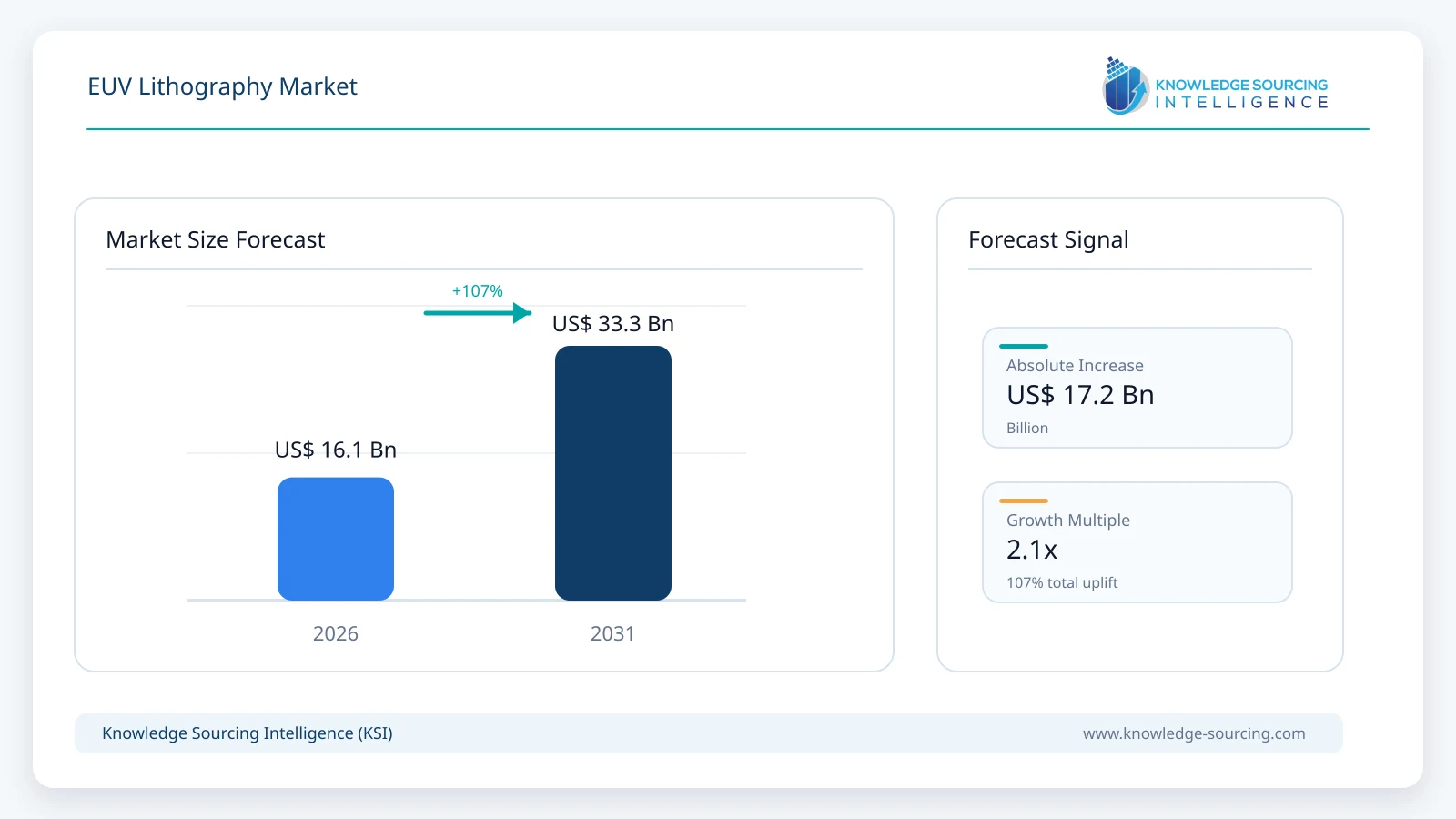
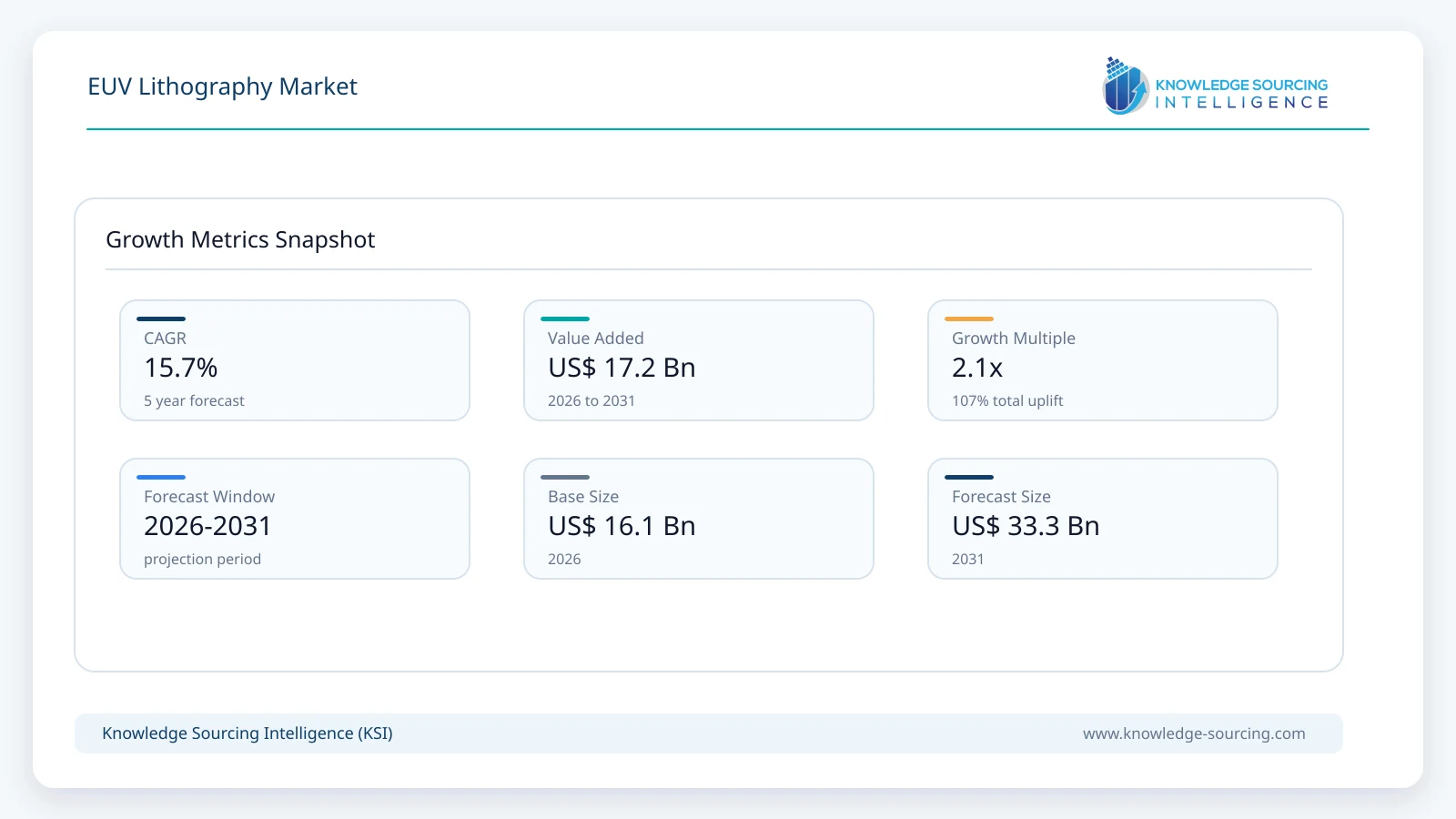
The EUV Lithography Market is forecast to grow at a CAGR of 15.7%, reaching USD 33.3 billion in 2031 from USD 16.1 billion in 2026.
Highlights:
- 1Advanced AI, high-performance computing, and memory demand are increasing lithography intensity at leading semiconductor nodes.
- 2EUV lithography systems and scanners remain the commercially central component because they anchor wider spending on optics, sources, materials, masks, and inspection.
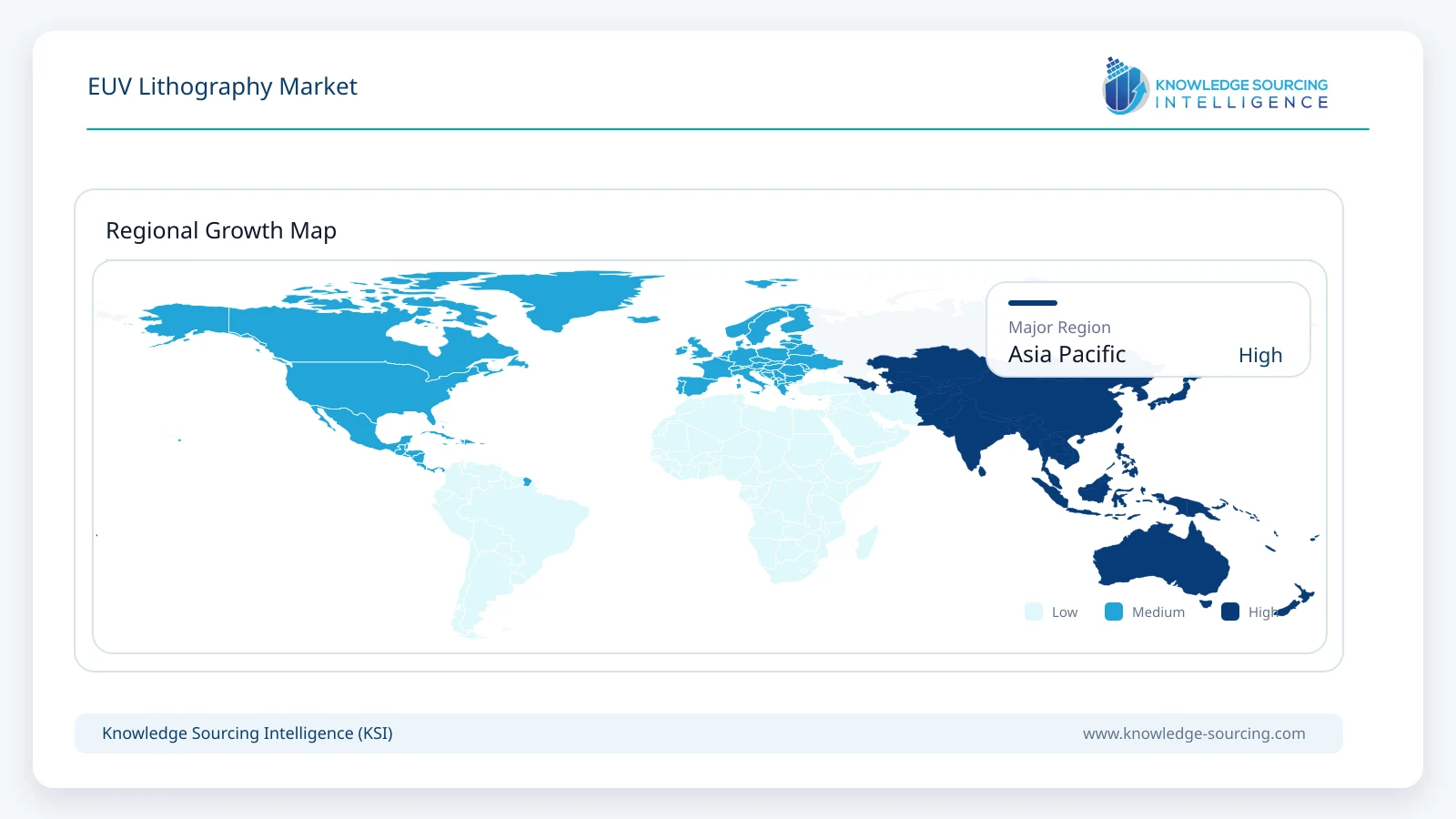
- 3Asia Pacific remains the principal manufacturing demand center, while Europe retains exceptional importance in EUV equipment, optics, and semiconductor technology development.
- 4High-NA EUV is moving from development and qualification toward production use, creating new requirements across the EUV supply chain.
- 5Semiconductor industrial policies in the United States and Europe are supporting advanced manufacturing infrastructure, pilot lines, and supply-chain localization.
- 6Export controls and dual-use regulations are influencing geographic demand, supplier compliance costs, customer qualification, and equipment deployment decisions.
Extreme ultraviolet lithography is the advanced semiconductor patterning technology used to transfer extremely small circuit features onto silicon wafers using 13.5 nm wavelength light. The EUV lithography market therefore extends beyond exposure tools to the specialized ecosystem required to generate, control, reflect, mask, resist, inspect, and measure EUV patterns. Its commercial importance is concentrated in leading-edge logic and memory manufacturing, where conventional optical lithography requires increasingly complex multi-patterning steps to achieve smaller geometries.
The market is structurally unusual because the exposure-system layer has a highly concentrated supply base, while critical value is distributed across optical subsystems, light sources, masks, pellicles, photoresists, metrology, inspection, and field-service capabilities. Purchasers are not buying isolated equipment. They are making long-duration process investments that affect fab design, node development schedules, wafer throughput, yield, operating costs, and the economics of future semiconductor generations.
Demand during the 2026–2031 period will be shaped primarily by investment in advanced logic, advanced memory, and manufacturing capacity serving artificial intelligence infrastructure, high-performance computing, data centers, communications, and other compute-intensive applications. ASML stated in July 2026 that AI-related investment and progress in AI technologies were strengthening demand for advanced logic and memory chips and that customer capacity expansion plans were translating into commitments across its portfolio. The company also planned to increase its 2027 low-NA EUV capacity by 30% from an approximately 65-system 2026 capacity level, while assessing further expansion for 2028.
Buyer priorities are becoming more demanding as EUV moves from adoption into optimization and, increasingly, High-NA qualification. Semiconductor manufacturers evaluate systems and supporting materials according to overlay accuracy, resolution, throughput, availability, defectivity, resist performance, process-window stability, service responsiveness, and total cost of ownership. A lithography tool can represent a major capital commitment, but its economic value depends on how effectively the entire process ecosystem supports acceptable yields at high wafer volumes.
The transition toward High-NA EUV adds another purchasing cycle to the market. High-NA systems increase numerical aperture from 0.33 to 0.55 and are intended to support future logic and memory nodes through improved resolution and process control. However, the transition also creates demand for redesigned masks, optics, resists, inspection capabilities, computational lithography, wafer handling, and fab infrastructure. ASML describes the EXE platform as supporting future scaling, beginning with the 2 nm logic generation and subsequently addressing memory applications at similar transistor-density requirements.
Commercial adoption will not occur uniformly across all semiconductor manufacturers. EUV remains most relevant where device scaling, transistor density, performance, or power efficiency justify the substantial capital and process-development requirements. Leading foundries and integrated device manufacturers therefore account for the principal purchasing activity, while research institutions and pilot facilities influence the earlier stages of technology qualification. The installed base also creates recurring revenue through upgrades, maintenance, replacement components, service contracts, metrology, and process optimization.
ASML's 2025 annual report illustrates the scale of the long-term economic opportunity associated with EUV. In its previously presented 2030 scenarios, the company identified an EUV sales opportunity ranging from approximately €22 billion to €32 billion, depending on market conditions and lithography intensity. These figures are company-specific outlook scenarios rather than an estimate of the total EUV lithography market, but they demonstrate the strategic weight attached to EUV equipment and related demand.
Market Drivers
Rising lithography intensity in advanced logic and memory
The primary driver of EUV lithography demand is not simply overall semiconductor volume. It is the rising lithography intensity associated with advanced nodes. As feature dimensions shrink, manufacturers face a trade-off between using EUV for critical layers and continuing with more complex multi-patterning approaches based on earlier lithography technologies.
For leading-edge chip manufacturers, EUV can reduce process complexity on selected layers, but purchasing decisions depend on throughput, yield, defect performance, and the economics of the complete process flow. This makes lithography procurement a joint engineering and financial decision. A tool purchase must be justified not only by its technical capability but also by its effect on wafer cost and manufacturing capacity.
Advanced logic demand is being reinforced by AI accelerators, processors, networking equipment, and data-center infrastructure. Advanced memory is also becoming more relevant because AI workloads require substantial high-bandwidth and high-capacity memory resources. ASML reported in 2025 that lithography intensity was progressing particularly in DRAM and that EUV adoption was advancing alongside High-NA development.
The commercial implication is that EUV spending can grow even when overall semiconductor unit demand follows a normal cycle. More layers and tighter process requirements can increase lithography content per wafer. Suppliers therefore compete for a greater share of spending around each exposure system through source technology, optics, masks, resists, metrology, inspection, upgrades, and lifecycle services.
High-NA EUV qualification and production deployment
High-NA EUV is creating a new investment requirement across the lithography ecosystem. The technology does not represent a simple replacement of an existing low-NA platform. It changes optical design, exposure conditions, mask requirements, process control, and supporting infrastructure.
Intel Foundry's July 2026 announcement with ASML marked an important production milestone. Intel entered high-volume manufacturing for a subset of its Core Ultra Series 3 processors using ASML's EXE High-NA EUV technology, with specific Intel 18A layers dual-qualified on the platform.
This milestone matters commercially because semiconductor manufacturers generally require extensive process validation before committing a new lithography platform to production. Early High-NA deployment generates operating data on uptime, yields, overlay, source performance, and process integration. That information influences procurement decisions across the broader customer base.
Demand therefore extends beyond the scanner. High-NA adoption requires compatible masks and reticles, advanced photoresists, inspection equipment capable of detecting smaller defects, highly accurate metrology, optical components, computational corrections, and specialized engineering services. Suppliers able to qualify their components alongside production deployment gain an advantage because semiconductor manufacturers are reluctant to introduce unnecessary process risk into high-volume fabs.
Government-backed semiconductor capacity investment
Industrial policy is affecting EUV demand indirectly by expanding advanced semiconductor development and manufacturing infrastructure. Government programs do not guarantee EUV purchases, since many supported facilities focus on mature, analog, automotive, or power technologies. However, programs targeting leading-edge process development and advanced manufacturing increase the addressable infrastructure for EUV tools and related systems.
In Europe, the Chips Act has created mechanisms to support semiconductor capacity, research infrastructure, and supply resilience. The European Commission formally granted Integrated Production Facility and Open EU Foundry status to several projects in October 2025, providing a framework that includes administrative support, streamlined permitting, and access to relevant Chips for Europe infrastructure.
The opening of the NanoIC pilot line at imec in February 2026 provides a more direct link to EUV development. The European Commission reported total investment of €2.5 billion, including €700 million of EU funding and €700 million from national and regional governments, with ASML and other industrial partners providing the remaining funding. The facility is intended to support semiconductor development at technologies beyond two nanometres and includes advanced EUV capability.
Such facilities influence the market before volume production begins. They allow materials suppliers, equipment vendors, foundries, universities, and chip designers to evaluate process technologies under near-industrial conditions. This shortens the path from laboratory development to commercial qualification.
Expansion of the installed base and lifecycle spending
EUV lithography generates revenue after initial equipment shipment. Semiconductor manufacturers require installation, acceptance testing, field support, spare parts, upgrades, source improvements, productivity enhancements, and software and process updates throughout the operational life of the system.
As the installed base grows, procurement shifts partly from one-time capital expenditure toward planned lifecycle investment. Customers assess suppliers according to local service capacity, spare-parts availability, engineering response times, upgrade compatibility, and the ability to improve output without disrupting production.
ASML's July 2026 results showed that Installed Base Management sales were an important contributor to quarterly performance, and the company indicated that it was continuing to expand its upgrade portfolio. The same commercial model benefits specialized suppliers of optics, masks, materials, and metrology equipment, although their replacement cycles and revenue structures differ.
This driver improves the strategic value of installed relationships. Once a component or material has been qualified in a sensitive manufacturing process, replacement is not straightforward. Buyers must evaluate any alternative against process stability and yield risk. Supplier qualification can therefore create recurring demand, but maintaining that position requires continuous technical support.
Market Restraints and Challenges
Extreme capital intensity and long qualification cycles
The largest barrier to EUV adoption is the combination of equipment cost, supporting infrastructure requirements, and extended qualification periods. An EUV scanner alone is only one part of the investment. Semiconductor manufacturers must also provide cleanroom infrastructure, power, facilities support, mask handling, resist processing, inspection, metrology, computational lithography, and specialist engineering resources.
This limits the immediate buyer universe. Many semiconductor manufacturers can benefit from advanced process technologies without having the capital scale or product mix required to justify direct EUV deployment. Smaller IDMs and specialty foundries may instead rely on established lithography methods or external foundry capacity.
Suppliers mitigate this barrier through productivity improvements, modular upgrades, application engineering, and joint process development. Research institutions and pilot lines also reduce customer risk by allowing technology evaluation before full-scale factory investment. Nevertheless, long procurement cycles remain inherent because the buyer is effectively committing to a manufacturing architecture rather than purchasing a standalone production asset.
Supply-chain concentration and manufacturing complexity
EUV depends on highly specialized components that cannot be sourced from a broad commodity supplier base. Precision optics, light-source technology, optical coatings, masks, pellicles, resist chemistry, inspection systems, and high-performance mechanical subsystems each require specialized manufacturing expertise.
The resulting concentration creates supply-chain risk. Capacity expansion can be constrained by the availability of precision components, qualified engineering talent, long-lead manufacturing tools, and specialized materials. Suppliers must balance inventory investment against uncertain semiconductor cycles, while customers seek stronger delivery visibility and supply assurance.
This structure also affects margins and contract negotiations. Semiconductor manufacturers increasingly value delivery certainty and service continuity, but suppliers face high development costs and limited opportunities to substitute components without extensive requalification. Long-term supply relationships and coordinated capacity planning therefore become commercially important.
Yield, defectivity, and stochastic process limitations
EUV adoption is constrained by process challenges that become more severe as feature dimensions shrink. Photoresists must balance sensitivity, resolution, and roughness. Masks and pellicles must maintain performance under demanding exposure conditions. Inspection tools must detect increasingly small defects without creating unacceptable throughput constraints.
For buyers, the critical question is not whether a technology can print a desired feature in development. It is whether the complete process can sustain acceptable yields during high-volume manufacturing. A technically advanced component that creates variability may have limited commercial value.
This places pressure on materials companies, mask manufacturers, metrology specialists, and equipment suppliers to coordinate development with semiconductor fabs. Joint qualification programs and customer-specific process optimization are therefore common features of competition. The commercial impact is a high barrier to entry but also substantial development expense.
Export controls and geopolitical restrictions
EUV equipment and several related technologies operate within a tightening international trade and security environment. Export controls can restrict sales to particular destinations, increase licensing requirements, and alter customers' capital-expenditure plans.
The European Union's 2025 update to its dual-use control list included semiconductor manufacturing and testing equipment and materials, specifically referencing lithography equipment and EUV-related pellicles, masks, and reticles among controlled technology areas. U.S. semiconductor-related export controls also affect the wider equipment ecosystem and create compliance requirements for global suppliers.
These restrictions can reduce addressable demand in certain markets while simultaneously increasing investment in alternative domestic semiconductor capabilities. Suppliers must therefore incorporate regulatory review, customer screening, licensing risk, and supply-chain compliance into commercial planning.
Major Segment Analysis
EUV Lithography Systems and Scanners
EUV lithography systems and scanners represent the most commercially important component segment because they determine the adoption of the wider EUV process ecosystem. A scanner purchase triggers associated demand for masks, resists, metrology, inspection, service, optics, source technology, software, and fab infrastructure.
The segment is characterized by extremely high technological barriers and long product-development cycles. Buyers include leading semiconductor foundries and IDMs producing advanced logic or memory devices. Procurement decisions involve senior manufacturing, process engineering, facilities, finance, and supply-chain teams because the system affects both current production and future node roadmaps.
ASML occupies a distinctive position in commercial EUV exposure systems, which means competition at the scanner level differs from conventional equipment markets. The principal competitive pressures concern system productivity, availability, overlay performance, roadmap execution, installed-base support, and the ability to meet customer capacity schedules. Supporting suppliers compete partly through participation in this ecosystem and partly through direct qualification with semiconductor manufacturers.
The transition from low-NA to High-NA EUV increases the strategic importance of this segment. High-NA systems offer improved resolution, but customers must assess whether the reduction in patterning complexity and the potential scaling benefits outweigh new capital and process costs. Adoption is therefore likely to be phased according to individual node architectures and layer requirements rather than occurring simultaneously across all advanced fabs.
The first high-volume use of High-NA EUV announced in July 2026 is commercially important because it moves the technology discussion beyond laboratory and pilot operation. Intel's use of the platform for selected Intel 18A layers provides an operating reference for subsequent buyers and suppliers.
Revenue implications extend well beyond shipment volumes. Each installed scanner creates a long-duration service relationship and establishes a technical base for future upgrades. As fabs move toward tighter geometries, customers may also require more frequent capability enhancements and process support. The segment consequently acts as the economic center of the EUV value chain.
Regional Analysis
North America
North American demand is driven primarily by advanced logic development, AI computing, memory technology, semiconductor research, and government-supported manufacturing investment. The United States remains the region's central demand source because it combines major semiconductor designers, IDMs, foundry investment, equipment companies, and research institutions.
Buyer behavior in the region emphasizes technology leadership and supply resilience. Advanced manufacturers are investing not only in wafer capacity but also in domestic engineering capabilities, research facilities, and secure equipment supply. High-NA development activity in Oregon illustrates the region's role in qualifying next-generation lithography for commercial use.
Export controls and national-security considerations are also particularly influential. Suppliers serving North American customers must manage compliance requirements alongside production schedules, while policy incentives can support local manufacturing investment. The main constraint is that advanced fabs require long construction timelines, specialized labor, and extensive supplier coordination before EUV equipment can be installed at scale.
Canada has a smaller direct EUV manufacturing base but participates through research and the wider North American semiconductor ecosystem. Mexico's role is more closely connected with electronics manufacturing and supply-chain integration than direct leading-edge EUV deployment.
Europe
Europe holds exceptional strategic importance because it combines advanced lithography equipment, precision optics, materials, semiconductor research, and public policy support. The Netherlands is particularly important through ASML, while Germany supports major semiconductor manufacturing and industrial demand and the region contains important research and equipment ecosystems.
European policy is encouraging additional semiconductor capability. The Chips Act supports capacity, research, pilot infrastructure, and supply resilience, while the proposed Chips Act 2.0 seeks to strengthen advanced chip production and reduce strategic dependencies.
The NanoIC pilot line in Leuven adds a major research and pre-production asset for advanced semiconductor technologies. By providing access to advanced EUV infrastructure before volume manufacturing, the facility can support component qualification and process development across the European ecosystem.
European growth is nevertheless constrained by high energy costs, competition for engineering talent, and the need to translate research strength into sustained high-volume manufacturing. The region's importance to the EUV market therefore extends beyond local equipment purchases. European companies capture value throughout equipment, optics, materials, research, and process development.
Asia Pacific
Asia Pacific is expected to remain the largest center of direct semiconductor manufacturing demand for EUV-related technologies because of its concentration of foundries, memory manufacturers, electronics supply chains, and advanced packaging capabilities. Taiwan, South Korea, Japan, and China are particularly important to the wider semiconductor ecosystem.
Taiwan's importance stems from its concentration of leading-edge foundry capacity. South Korea provides major demand through advanced memory and logic manufacturing. Japan occupies a critical role in semiconductor materials, masks, optics, chemicals, and manufacturing equipment. These countries create both direct demand and supplier opportunities.
China presents a more complex commercial environment. The country's semiconductor investment remains strategically important, but EUV and related advanced equipment demand is shaped by export controls and technology-access restrictions. Suppliers must therefore distinguish between theoretical semiconductor investment demand and the equipment that can legally be supplied to individual customers.
India is currently more important as an emerging semiconductor manufacturing and policy market than as a major direct EUV buyer. Future relevance will depend on the technology mix of domestic fabs, ecosystem development, engineering capacity, and whether investment moves toward leading-edge production. The immediate opportunity is stronger in long-term ecosystem development than in large-scale EUV deployment.
Middle East and Africa
The Middle East and Africa currently represent a smaller direct market for EUV lithography systems. Saudi Arabia and the United Arab Emirates are investing in technology, AI infrastructure, digital industries, and semiconductor-related capabilities, but these initiatives do not automatically translate into near-term demand for leading-edge wafer fabrication equipment.
The regional opportunity is more likely to emerge through research partnerships, chip design, AI infrastructure, strategic investment, and participation in international semiconductor supply chains. Establishing a commercially viable advanced fab requires much more than capital. It requires specialized suppliers, experienced process engineers, materials infrastructure, and access to controlled technologies.
Consequently, the region's medium-term market potential depends on whether government-backed initiatives progress from design and ecosystem development toward high-volume advanced manufacturing. Procurement decisions will remain highly dependent on partnerships with established global technology providers.
South America
South America has limited direct demand for EUV lithography because its semiconductor manufacturing base remains concentrated outside leading-edge process technologies. Brazil represents the largest regional electronics and semiconductor opportunity, but advanced EUV deployment would require substantial changes in local manufacturing scale, infrastructure, and process capability.
Regional governments and companies may participate in semiconductor supply chains through design, assembly, testing, materials, or electronics production before direct EUV demand becomes material. Argentina and other markets face similar constraints related to capital availability, manufacturing scale, and specialized technical infrastructure.
For EUV suppliers, South America is therefore currently more relevant as a future technology ecosystem than as a major source of scanner demand. The commercial challenge is the very high threshold required to justify investment in leading-edge wafer fabrication.
Competitive Landscape
The competitive structure of the EUV lithography market is defined by specialization rather than a large number of interchangeable suppliers. ASML Holding N.V. occupies the central position in commercial EUV exposure systems, while the wider market includes critical participants such as ZEISS Semiconductor Manufacturing Technology, Cymer, LLC, TRUMPF Group, KLA Corporation, JSR Corporation, Shin-Etsu Chemical Co., Ltd., TOPPAN Holdings Inc., and HOYA Corporation.
Competition occurs through technical qualification, manufacturing precision, defect performance, production reliability, and integration with customer process roadmaps. Price is important, but semiconductor manufacturers generally place greater weight on yield risk and qualification history because replacing a proven component can disrupt high-value wafer production.
Partnerships are therefore structurally important. EUV requires coordination between system manufacturers, optical suppliers, source specialists, mask and material producers, metrology companies, and chipmakers. A supplier with an advanced product but limited process integration may face a longer path to commercial adoption than an established supplier working directly within a customer's qualification program.
Technology differentiation is becoming more pronounced with High-NA EUV. Suppliers must redesign or improve products to meet tighter process tolerances and different optical conditions. This favors companies with strong engineering resources and established customer relationships but also creates opportunities for specialists that can solve new defect, inspection, resist, or mask challenges.
Geographic expansion is constrained by the specialized nature of production. Companies cannot easily replicate highly precise manufacturing capacity across multiple regions. Instead, they are likely to combine centralized production with localized engineering, service, applications support, and spare-parts networks near major semiconductor manufacturing clusters.
Recent Developments
July 2026: Intel Foundry began high-volume production of a subset of Intel Core Ultra Series 3 processors using ASML High-NA EUV technology for selected Intel 18A layers. Commercial relevance: the milestone provides a production reference for broader High-NA qualification and ecosystem investment.
February 2026: The European Union opened the €2.5 billion NanoIC pilot line at imec, including €700 million in EU funding and advanced EUV capability for technologies beyond two nanometres. Commercial relevance: the facility expands pre-production access for process, equipment, and materials qualification.
October 2025: The European Commission formally granted Integrated Production Facility or Open EU Foundry status to four semiconductor projects under the EU Chips Act. Commercial relevance: the designations support permitting and infrastructure access, strengthening Europe's broader semiconductor investment environment.
Regulatory and Policy Environment
The EUV lithography market operates under an increasingly important combination of semiconductor industrial policy, export controls, dual-use regulations, environmental compliance, and factory safety requirements.
Export control is particularly significant because advanced lithography equipment and supporting technologies can have strategic applications. Suppliers must manage licensing, end-user screening, destination controls, technology-transfer restrictions, and internal compliance systems. These requirements can influence shipment timing, contract structures, inventory planning, and regional revenue allocation.
The European Union's 2025 update to its dual-use control list included semiconductor manufacturing and testing technologies, with references to lithography equipment and EUV pellicles, masks, and reticles. This demonstrates that regulatory exposure extends beyond complete scanners to important supporting technologies.
Industrial policy is also affecting demand. The European Chips Act supports semiconductor resilience through manufacturing investment, research infrastructure, and mechanisms for designated production facilities. The Commission's 2026 proposal for Chips Act 2.0 further emphasizes reducing strategic dependencies and supporting advanced semiconductor production.
At the manufacturing level, EUV suppliers and users must comply with stringent standards governing cleanroom operation, chemical handling, vacuum systems, radiation-related equipment safety, worker protection, waste management, and controlled materials. Compliance costs are material because process changes often require validation before production deployment.
The practical result is that regulation has a dual effect. Industrial incentives can expand semiconductor infrastructure and research spending, while export restrictions can limit addressable markets and increase transaction complexity. Companies with established compliance capabilities and geographically diversified operations are better positioned to manage this environment.
Outlook and Strategic Implications
The EUV lithography market during 2026–2031 will be influenced less by broad semiconductor unit growth than by the pace of advanced-node adoption, AI-related infrastructure investment, memory scaling, and the economics of High-NA EUV deployment.
Capital investment will remain concentrated among a relatively small group of semiconductor manufacturers. This means supplier success will depend heavily on customer roadmaps and long-term technical relationships. Winning a qualification can create multi-year revenue opportunities, while losing technical relevance at a major process transition can have lasting consequences.
Procurement behavior is likely to place greater emphasis on delivery assurance and installed-base performance. Buyers will seek evidence that suppliers can support capacity expansion while maintaining component quality and field-service responsiveness. Semiconductor manufacturers will also scrutinize suppliers' exposure to export restrictions and geographically concentrated production.
High-NA EUV will be a central technology variable. Its adoption will depend on whether improved resolution and process simplification justify the additional infrastructure and ecosystem requirements at specific layers and nodes. The July 2026 production milestone demonstrates that the technology has entered a more commercially relevant phase, but deployment will remain customer- and application-specific rather than universal.
The competitive environment will continue to reward specialization. System performance alone will not determine market success. Optical quality, source reliability, mask accuracy, resist chemistry, defect inspection, metrology precision, and engineering support must work as an integrated production system.
Strategically, suppliers should prioritize qualification capacity, manufacturing scalability, supply-chain resilience, and direct collaboration with advanced semiconductor manufacturers and research institutions. Investment in High-NA-compatible products will become increasingly important, particularly for suppliers of masks, resists, optics, metrology, and inspection technologies.
The principal risks remain capital-spending cyclicality, customer concentration, long development cycles, component bottlenecks, export restrictions, and slower-than-expected High-NA adoption. However, these risks are balanced by exceptionally high barriers to entry and the growing importance of lithography intensity in advanced semiconductor production.
The market's direction over the next five years will ultimately depend on a simple commercial equation: whether each successive semiconductor generation requires EUV to deliver economically viable improvements in density, performance, power efficiency, and manufacturing complexity. As advanced logic and memory producers move toward tighter process requirements, EUV will remain a critical enabling technology, while High-NA EUV and its supporting ecosystem will determine the next phase of competitive investment.
EUV Lithography Market Scope
| Report Metric | Details |
|---|---|
| Total Market Size in 2026 | USD 16.1 billion |
| Total Market Size in 2031 | USD 33.3 billion |
| Forecast Unit | Billion |
| Growth Rate | 15.7% |
| Study Period | 2021 to 2031 |
| Historical Data | 2021 to 2024 |
| Base Year | 2025 |
| Forecast Period | 2026 – 2031 |
| Segmentation | Components, End-User, Geography |
| Companies |
|
Market Segmentation
By Component
By End User
By Geography
Table of Contents
1. EXECUTIVE SUMMARY
2. MARKET SNAPSHOT
2.1. Market Overview
2.2. Market Definition
2.3. Scope of the Study
2.4. Market Segmentation
3. BUSINESS LANDSCAPE
3.1. Market Drivers
3.2. Market Restraints
3.3. Market Opportunities
3.4. Porter's Five Forces Analysis
3.5. Industry Value Chain Analysis
3.6. Policies and Regulations
3.7. Strategic Recommendations
4. TECHNOLOGICAL OUTLOOK
4.1. Conventional EUV Lithography
4.2. High-NA EUV Lithography
4.3. EUV Light Source Technology
4.4. EUV Optical Technology
4.5. Emerging Technological Developments
5. EUV LITHOGRAPHY MARKET BY COMPONENT
5.1. Introduction
5.2. EUV Lithography Systems and Scanners
5.3. EUV Light Sources
5.4. EUV Optical Systems
5.5. EUV Masks and Reticles
5.6. EUV Photoresists and Related Materials
5.7. Metrology and Inspection Systems
5.8. Other Supporting Components and Systems
6. EUV LITHOGRAPHY MARKET BY END USER
6.1. Introduction
6.2. Integrated Device Manufacturers (IDMs)
6.3. Semiconductor Foundries
6.4. Research and Academic Institutions
6.5. Others
7. EUV LITHOGRAPHY MARKET BY GEOGRAPHY
7.1. Introduction
7.2. North America
7.2.1. United States
7.2.2. Canada
7.2.3. Mexico
7.3. South America
7.3.1. Brazil
7.3.2. Argentina
7.3.3. Others
7.4. Europe
7.4.1. Germany
7.4.2. Netherlands
7.4.3. France
7.4.4. United Kingdom
7.4.5. Others
7.5. Middle East and Africa
7.5.1. Saudi Arabia
7.5.2. United Arab Emirates
7.5.3. Others
7.6. Asia Pacific
7.6.1. China
7.6.2. Japan
7.6.3. India
7.6.4. South Korea
7.6.5. Taiwan
7.6.6. Others
8. COMPETITIVE ENVIRONMENT AND ANALYSIS
8.1. Major Players and Strategy Analysis
8.2. Market Share Analysis
8.3. Mergers, Acquisitions, Agreements, and Collaborations
8.4. Competitive Dashboard
9. COMPANY PROFILES
9.1. ASML Holding N.V.
9.2. ZEISS Semiconductor Manufacturing Technology
9.3. Cymer, LLC
9.4. TRUMPF Group
9.5. KLA Corporation
9.6. JSR Corporation
9.7. Shin-Etsu Chemical Co., Ltd.
9.8. TOPPAN Holdings Inc.
9.9. HOYA Corporation
10. RESEARCH METHODOLOGY
LIST OF FIGURES
LIST OF TABLES
Navigate
Trusted by the world's leading organizations











