
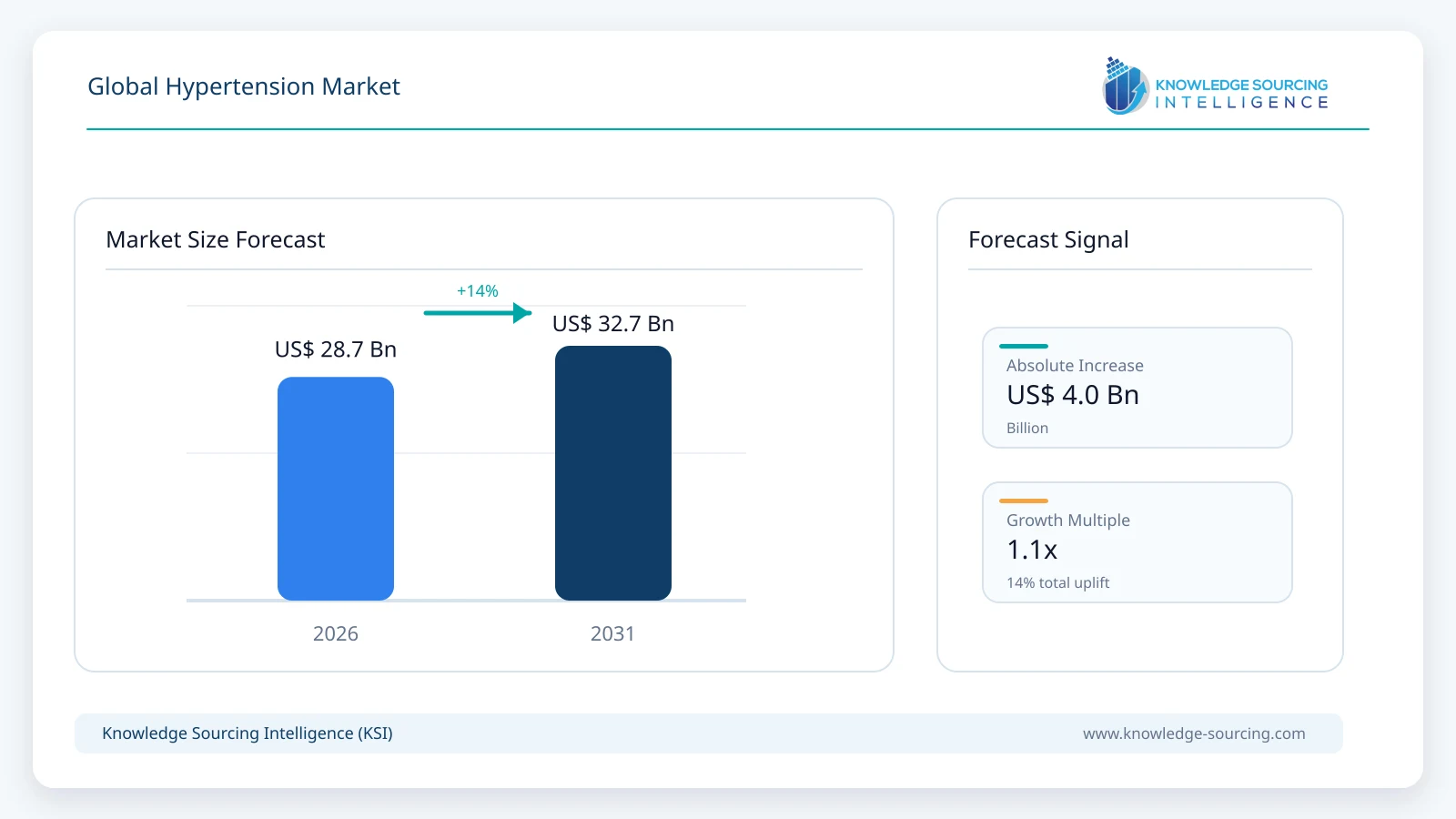
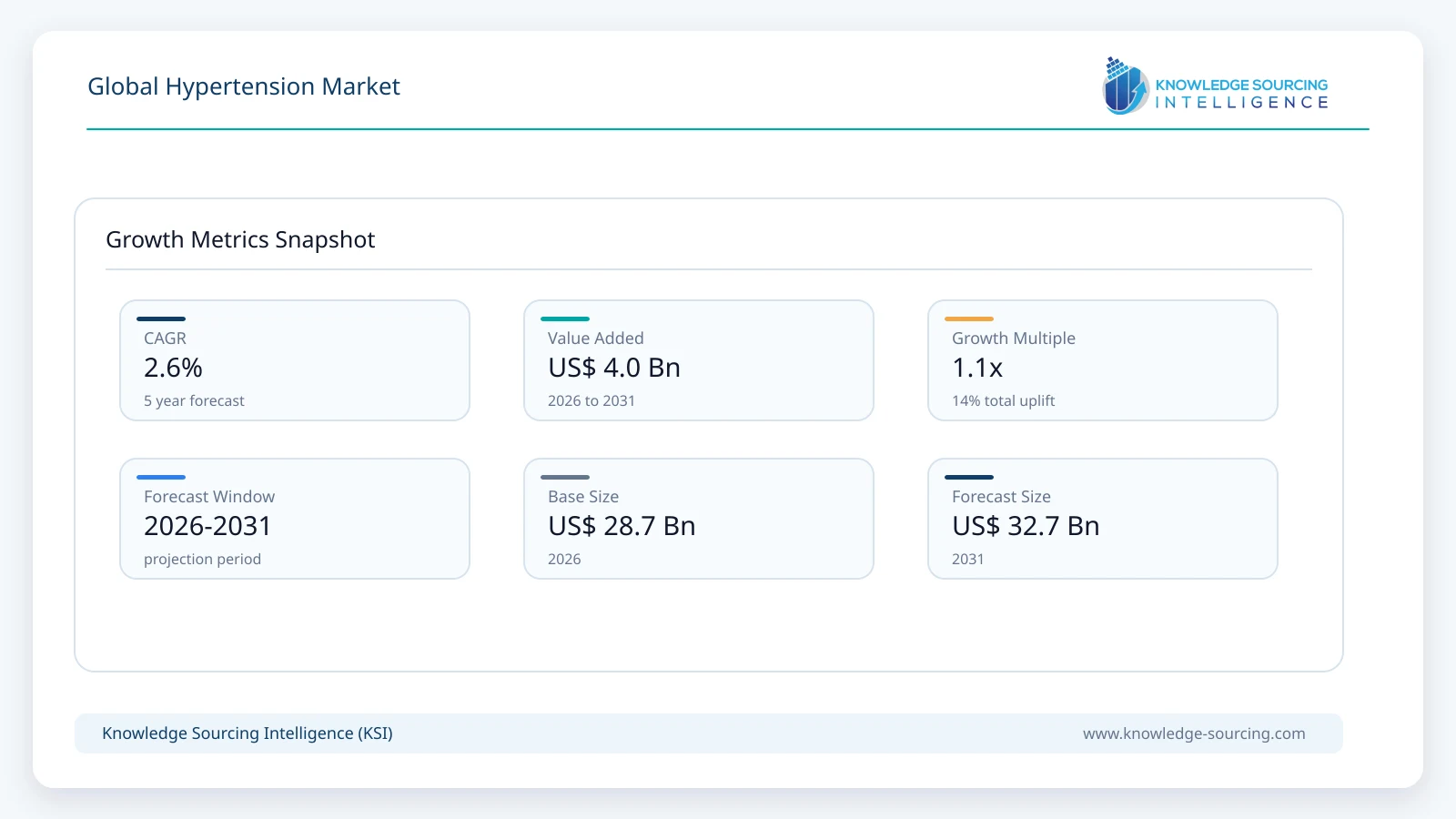
The Global hypertension market is projected to grow at a CAGR of 2.6% over the forecast period, increasing from USD 28.7 billion in 2026 to USD 32.7 billion by 2031.
Highlights:
- 1Aging populations are increasing hypertension prevalence because vascular stiffness and metabolic dysfunction continue expanding chronic cardiovascular disease burden.
- 2Demand is shifting toward combination antihypertensive therapies because multidrug intervention increasingly improves blood pressure control outcomes.
- 3Healthcare systems are expanding remote monitoring infrastructure because uncontrolled hypertension continues increasing stroke and heart failure hospitalization burden.
- 4Digital blood pressure monitoring adoption is increasing because continuous outpatient surveillance improves treatment adherence and early intervention capability.
Hypertension management increasingly depends on continuous outpatient cardiovascular monitoring because asymptomatic disease progression frequently delays diagnosis and long-term intervention. Demand for combination therapies is increasing because monotherapy frequently fails to achieve optimal blood pressure control across aging and metabolically complex patient populations. This clinical transition is strengthening dependence on long-duration pharmacological intervention, connected monitoring systems, and preventive cardiovascular infrastructure.
Healthcare providers are expanding remote blood pressure monitoring programs because uncontrolled hypertension continues increasing long-term stroke and renal disease burden. Demand is shifting toward digital hypertension management platforms because continuous cardiovascular surveillance improves treatment adherence and early therapeutic adjustment. Pharmaceutical manufacturers are strengthening fixed-dose combination therapy development because simplified treatment regimens increasingly improve long-term patient compliance.
Regulatory systems continue accelerating cardiovascular prevention initiatives because hypertension-related morbidity continues placing pressure on healthcare expenditure sustainability. Device manufacturers are integrating AI-enabled monitoring technologies because predictive cardiovascular analytics increasingly influence preventive disease management strategies. This transformation is strengthening the strategic importance of integrated hypertension management ecosystems combining therapeutics, diagnostics, and connected cardiovascular monitoring.
Market Dynamics
Market Drivers
Increasing Burden of Lifestyle-Associated Cardiovascular Disease: Hypertension prevalence continues increasing because obesity, sedentary lifestyles, diabetes, and excessive sodium intake remain strongly associated with chronic cardiovascular dysfunction. Healthcare systems are experiencing rising outpatient cardiovascular management demand because uncontrolled blood pressure continues driving stroke and renal disease burden. Treatment complexity remains elevated because cardiometabolic populations frequently require multidrug intervention and continuous monitoring. Pharmaceutical manufacturers are expanding fixed-dose combination therapy portfolios because simplified treatment regimens improve long-term adherence. This epidemiological transition sustains long-term hypertension treatment demand.
Growing Adoption of Combination Antihypertensive Therapies: Combination therapy increasingly defines hypertension management because single-agent treatment frequently fails to achieve guideline-recommended blood pressure control. Demand is increasing for ARB- and calcium channel blocker-based combinations because physicians continue prioritizing therapies improving adherence and cardiovascular risk reduction. Reimbursement pressure remains significant because long-duration multidrug therapy continues increasing outpatient treatment expenditure. Pharmaceutical companies are strengthening combination therapy lifecycle strategies because treatment differentiation increasingly depends on adherence efficiency and cardiovascular outcomes. This transition strengthens demand for integrated antihypertensive regimens.
Expansion of Remote Blood Pressure Monitoring: Continuous blood pressure monitoring increasingly influences hypertension management because asymptomatic progression frequently delays therapeutic intervention. Healthcare providers are expanding home-based cardiovascular monitoring programs because outpatient disease management reduces long-term hospitalization burden. Data integration challenges remain substantial because connected cardiovascular monitoring generates continuous patient information streams. Device manufacturers are integrating AI-enabled blood pressure analytics because predictive intervention increasingly determines preventive cardiovascular care success. This shift strengthens long-term demand for digital hypertension management platforms.
Increasing Demand for Resistant Hypertension Management: Resistant hypertension treatment demand continues expanding because chronic metabolic disease burden increasingly limits the effectiveness of conventional monotherapy approaches. Healthcare systems are increasing adoption of advanced cardiovascular interventions because uncontrolled hypertension continues driving long-term renal and cerebrovascular complications. Infrastructure limitations remain significant because resistant hypertension management requires specialist cardiovascular expertise and advanced monitoring capabilities. Companies are expanding renal denervation and precision cardiovascular research because treatment-resistant populations continue increasing globally. This transition supports long-term innovation across hypertension management.
Market Restraints
Poor long-term treatment adherence continues limiting blood pressure control because chronic asymptomatic disease frequently reduces patient compliance motivation.
Generic drug pricing pressure continues constraining premium therapy expansion because healthcare systems prioritize cost-sensitive cardiovascular management.
Limited access to cardiovascular specialists restricts advanced hypertension care because emerging healthcare systems continue facing workforce shortages.
Market Opportunities
Expansion of Digital Hypertension Management Platforms: Digital cardiovascular management increasingly influences hypertension treatment because outpatient disease monitoring improves early therapeutic adjustment and adherence tracking. Healthcare systems are increasing investment in connected monitoring ecosystems because long-term cardiovascular prevention depends on continuous surveillance. Interoperability challenges remain substantial because digital health systems frequently operate across fragmented healthcare infrastructure. Technology companies are strengthening AI-enabled cardiovascular analytics because predictive intervention increasingly shapes preventive healthcare models. This transition creates strong opportunities across connected hypertension management.
Growth in Resistant Hypertension Therapies: Resistant hypertension management continues to gain commercial importance because conventional multidrug intervention frequently fails in metabolically complex cardiovascular populations. Demand is increasing for renal denervation and advanced antihypertensive combinations because uncontrolled blood pressure continues driving cardiovascular complications. Clinical adoption barriers remain significant because long-term outcome validation remains essential for reimbursement expansion. Manufacturers are strengthening cardiovascular intervention research because treatment-resistant hypertension continues increasing globally. This trend supports long-term innovation opportunities.
Expansion of Remote Cardiovascular Care Infrastructure: Healthcare systems increasingly prioritize outpatient hypertension management because chronic cardiovascular disease continues increasing hospital resource utilization. Demand is shifting toward remote monitoring technologies because early intervention reduces stroke and renal complication burden. Infrastructure standardization remains limited because connected monitoring adoption varies substantially across regional healthcare systems. Providers are expanding telecardiology integration because preventive cardiovascular care increasingly depends on decentralized disease management. This transition strengthens long-term growth opportunities across remote cardiovascular infrastructure.
Increasing Adoption Across Emerging Healthcare Markets: Emerging economies are expanding cardiovascular prevention programs because urbanization and lifestyle transitions continue increasing hypertension prevalence. Pharmaceutical and device manufacturers are strengthening regional commercialization strategies because blood pressure diagnosis and treatment rates continue improving across developing healthcare systems. Affordability limitations remain substantial because advanced cardiovascular monitoring and branded therapies frequently exceed reimbursement capacity. Companies are expanding localized partnerships and physician training initiatives because governments continue prioritizing noncommunicable disease management. This expansion supports long-term market penetration opportunities.
Government Regulations
Region | Regulatory Authority | Regulatory Focus |
United States | FDA | Antihypertensive drug approvals, cardiovascular device pathways, post-market surveillance |
Europe | EMA / EU MDR | Drug safety evaluation, digital monitoring compliance, cardiovascular risk management |
Japan | PMDA | Cardiovascular therapy approvals and long-term safety assessment |
India | CDSCO | Drug and medical device approvals, pharmacovigilance oversight |
China | NMPA | Accelerated cardiovascular therapy review and localized clinical validation |
Market Segmentation
By Therapy Type
Pharmacological therapies remain central to hypertension management because long-term blood pressure stabilization depends heavily on sustained cardiovascular intervention. Demand is shifting toward renal denervation devices because resistant hypertension populations continue increasing across metabolically complex patient groups. Blood pressure monitoring devices continue gaining strategic importance because continuous cardiovascular surveillance improves early intervention and treatment optimization. Digital therapeutics and remote monitoring platforms are expanding because healthcare systems increasingly prioritize decentralized outpatient cardiovascular management. This transition strengthens long-term demand for integrated hypertension treatment ecosystems.
By Drug Class
ARBs and calcium channel blockers maintain dominant utilization because physicians increasingly prioritize therapies demonstrating strong cardiovascular protection and long-term tolerability. ACE inhibitors remain clinically important because guideline-directed hypertension management continues emphasizing renin-angiotensin system modulation. Beta blockers and diuretics continue supporting multidrug treatment strategies because complex cardiovascular populations frequently require combination intervention. Mineralocorticoid receptor antagonists are expanding across resistant hypertension management because conventional therapies frequently fail to achieve target blood pressure control. Competitive intensity remains elevated because long-term cardiovascular outcomes increasingly determine therapeutic differentiation.
By Indication
Primary hypertension remains the dominant treatment segment because lifestyle-associated cardiovascular dysfunction continues driving large-scale chronic disease prevalence globally. Demand is increasing for resistant hypertension management because obesity, diabetes, and chronic kidney disease continue complicating blood pressure control outcomes. Secondary hypertension treatment maintains specialist dependency because endocrine and renal causes frequently require advanced diagnostic evaluation. Pulmonary arterial hypertension management continues expanding because targeted cardiovascular intervention increasingly improves long-term patient survival. This indication structure strengthens demand for multidimensional hypertension management strategies.
Regional Analysis
North America Market Analysis
North America maintains leadership in hypertension management because advanced cardiovascular infrastructure supports broad adoption of combination therapies, remote monitoring systems, and preventive cardiovascular programs. Demand is increasing for connected blood pressure monitoring because healthcare systems continue prioritizing outpatient cardiovascular management and early intervention strategies. Healthcare expenditure remains elevated because chronic hypertension continues driving stroke, renal disease, and heart failure burden across aging populations. Hospitals and outpatient clinics are expanding remote cardiovascular care programs because healthcare systems continue attempting to reduce long-term hospitalization costs. Regulatory agencies continue accelerating cardiovascular prevention initiatives because uncontrolled hypertension remains a major contributor to chronic disease expenditure. The region maintains strong competitive intensity because pharmaceutical and device manufacturers continue expanding integrated cardiovascular management ecosystems.
Europe Market Analysis
Europe maintains a strong hypertension treatment ecosystem because universal healthcare systems support broad access to antihypertensive therapies and cardiovascular prevention programs. Demand is shifting toward fixed-dose combination therapies because European clinical guidelines increasingly prioritize rapid blood pressure stabilization and treatment adherence improvement. Reimbursement pressure continues affecting premium therapy expansion because centralized healthcare systems remain highly cost-sensitive. Healthcare providers are increasing adoption of remote cardiovascular monitoring technologies because outpatient hypertension management reduces long-term hospitalization burden. Regulatory oversight remains stringent because cardiovascular drug safety and connected device monitoring continue expanding under EMA and MDR frameworks. The region maintains strong adoption of digital cardiovascular management technologies because aging populations continue increasing chronic disease prevalence.
Asia Pacific Market Analysis
Asia Pacific represents a rapidly expanding hypertension market because urbanization, dietary transition, and aging populations continue increasing cardiovascular disease burden across major economies. Demand is increasing for antihypertensive therapies and home monitoring systems because governments are improving cardiovascular prevention infrastructure and chronic disease management programs. Access disparities remain significant because rural healthcare systems frequently lack advanced cardiovascular expertise and connected monitoring capabilities. Healthcare providers are expanding digital cardiovascular programs because outpatient disease management reduces long-term healthcare resource utilization. International pharmaceutical and device manufacturers continue strengthening regional partnerships because hypertension diagnosis and treatment rates are improving across urban healthcare systems. The region maintains strong long-term growth potential because chronic cardiovascular disease prevalence continues increasing substantially.
Rest of the World
Rest of the World markets maintain uneven hypertension treatment accessibility because healthcare infrastructure variability limits advanced cardiovascular care availability. Demand is increasing for early blood pressure diagnosis and preventive cardiovascular intervention because untreated hypertension continues contributing significantly to stroke and renal disease burden across underserved regions. Financial limitations continue restricting access to branded therapies and advanced monitoring technologies because reimbursement infrastructure remains inconsistent. Governments are increasing noncommunicable disease management investment because chronic cardiovascular conditions continue placing pressure on public healthcare sustainability. International partnerships are supporting cardiovascular infrastructure expansion because specialist shortages continue constraining advanced hypertension management. Long-term market expansion depends on healthcare modernization, reimbursement development, and preventive cardiovascular program expansion.
Regulatory Landscape
Regulatory systems increasingly prioritize long-term cardiovascular outcome evidence because advanced hypertension therapies and connected monitoring technologies require extensive safety and effectiveness validation across chronic patient populations. The FDA maintains accelerated cardiovascular review pathways because uncontrolled hypertension continues contributing substantially to stroke, renal disease, and healthcare expenditure burden. European MDR frameworks continue strengthening connected monitoring surveillance because digital cardiovascular technologies require extensive long-term safety assessment.
Drug and device approval complexity remains substantial because hypertension management increasingly combines pharmacological therapies, remote monitoring systems, AI-enabled diagnostics, and minimally invasive intervention technologies within integrated cardiovascular pathways. Regulatory agencies are increasing real-world evidence integration because chronic cardiovascular disease management depends heavily on long-term effectiveness evaluation. Manufacturers continue expanding post-market surveillance and cardiovascular registry programs because connected monitoring technologies require continuous lifecycle oversight.
Global regulatory harmonization remains limited because antihypertensive reimbursement systems, digital health policies, and cardiovascular device approval pathways differ substantially across regional healthcare systems. Companies are expanding regional regulatory partnerships because long-term hypertension therapy adoption increasingly depends on localized clinical validation and reimbursement alignment. Regulatory evolution continues shaping advanced cardiovascular prevention and monitoring innovation pathways.
Pipeline Analysis
The hypertension pipeline increasingly focuses on precision cardiovascular intervention because resistant hypertension prevalence continues limiting long-term blood pressure control outcomes. Renal denervation development programs continue expanding because device-based intervention may improve blood pressure stabilization across treatment-resistant populations. Companies are increasing investment in aldosterone synthase inhibitors, endothelin receptor antagonists, and RNA-based cardiovascular therapies because conventional multidrug intervention frequently remains insufficient in complex hypertensive populations.
Digital hypertension management technologies are progressing because continuous blood pressure surveillance increasingly determines early therapeutic adjustment and long-term adherence optimization. Device manufacturers are integrating AI-enabled predictive cardiovascular analytics because outpatient disease management continues gaining strategic importance. Clinical development remains complex because cardiovascular prevention validation requires extensive patient monitoring and long-term outcome assessment.
Remote cardiovascular monitoring platforms are expanding because healthcare systems increasingly prioritize preventive outpatient hypertension management and decentralized care delivery. Technology companies are integrating wearable monitoring systems and predictive analytics because continuous cardiovascular surveillance improves long-term intervention timing. The pipeline increasingly reflects integration between therapeutics, diagnostics, connected monitoring technologies, and preventive cardiovascular infrastructure.
Competitive Landscape
Novartis
Novartis maintains strong cardiovascular positioning because Diovan and Exforge established broad clinical relevance across long-term hypertension management pathways. Demand continues increasing because healthcare providers prioritize ARB-based combination therapies improving blood pressure stabilization and cardiovascular risk reduction. The company continues strengthening cardiovascular lifecycle management because long-term differentiation increasingly depends on adherence efficiency and clinical outcome validation.
Pfizer
Pfizer remains strategically important because Norvasc maintains broad physician adoption across chronic hypertension management pathways. Demand is shifting toward calcium channel blocker-based combination strategies because outpatient cardiovascular care increasingly prioritizes multidrug treatment optimization. The company continues strengthening cardiovascular commercialization initiatives because long-term hypertension prevalence continues increasing globally.
Bayer AG
Bayer maintains cardiovascular relevance because Adalat supports chronic blood pressure management across multiple cardiovascular populations. Healthcare systems are increasing utilization because calcium channel blocker therapies continue supporting long-term outpatient hypertension control. The company continues strengthening cardiovascular market participation because preventive cardiovascular care increasingly defines chronic disease management strategies.
Merck & Co.
Merck & Co. maintains strong antihypertensive positioning because Cozaar established broad clinical adoption across chronic hypertension treatment frameworks. Demand is increasing because ARB therapies continue demonstrating strong cardiovascular and renal protection outcomes. The company continues expanding cardiovascular evidence generation because reimbursement systems increasingly prioritize long-term disease prevention efficiency.
Sanofi
Sanofi strengthens cardiovascular participation because Aprovel/Avapro supports integrated hypertension and renal disease management pathways. Healthcare providers are increasing dependence on ARB therapies because diabetic and renal populations frequently require long-term cardiovascular protection strategies. The company continues strengthening chronic disease management initiatives because metabolic disorders continue increasing hypertension burden globally.
Boehringer Ingelheim
Boehringer Ingelheim remains strategically important because Micardis supports long-duration outpatient blood pressure management across high-risk cardiovascular populations. Demand continues increasing because hypertension treatment increasingly depends on therapies supporting cardiometabolic risk reduction. The company continues expanding cardiovascular partnerships because preventive outpatient disease management remains commercially significant.
AstraZeneca
AstraZeneca maintains strong hypertension relevance because Atacand continues supporting guideline-directed cardiovascular intervention strategies. Healthcare systems are increasing adoption because chronic cardiovascular disease management increasingly prioritizes long-term blood pressure stabilization and renal protection. The company continues strengthening cardiovascular prevention research because hypertension burden continues expanding globally.
Otsuka Pharmaceutical
Otsuka Pharmaceutical maintains cardiovascular market participation because Samsca supports complex fluid and cardiovascular management across specialized patient populations. Demand is increasing because advanced cardiovascular and renal complications continue requiring multidimensional therapeutic intervention. The company continues strengthening specialty cardiovascular positioning because chronic disease complexity continues increasing globally.
Key Developments
May 2026: AstraZeneca’s Baxfendy (baxdrostat) has been approved in the US as a first-in-class aldosterone synthase inhibitor (ASI) for the treatment of hypertension in combination with other antihypertensive medications, to lower blood pressure in adults who are not adequately controlled.
May 2026: Mineralys Therapeutics, Inc., a biopharmaceutical company focused on developing medicines to target hypertension and related comorbidities such as chronic kidney disease (CKD), obstructive sleep apnea (OSA) and other diseases driven by dysregulated aldosterone, announced that new data from its Phase 3 Launch-HTN trial in participants with hypertension and CKD will be featured in an oral presentation at the 35th European Meeting on Hypertension and Cardiovascular Protection (ESH 2026), taking place in Gda?sk, Poland.
Strategic Insights and Future Market Outlook
The hypertension market continues transitioning toward integrated preventive cardiovascular management because aging populations and lifestyle-associated metabolic disorders continue increasing sustained treatment dependency globally. Demand is shifting toward combination therapies, connected monitoring systems, and remote cardiovascular management because healthcare systems are reducing reliance on episodic in-clinic intervention. This transition strengthens long-term adoption of ARBs, calcium channel blockers, AI-enabled blood pressure monitoring, and renal denervation technologies.
Healthcare systems are increasing investment in outpatient cardiovascular surveillance because early blood pressure stabilization directly improves long-term stroke prevention and healthcare resource optimization. Pharmacological and digital monitoring technologies continue evolving because chronic hypertensive populations frequently require multidimensional treatment and long-term adherence management. Manufacturers are integrating therapeutics, diagnostics, and predictive monitoring systems because hypertension management increasingly depends on continuous cardiovascular care pathways.
The competitive landscape will continue emphasizing integrated cardiovascular ecosystems because predictive analytics, digital therapeutics, and connected blood pressure monitoring remain accelerating globally. Emerging healthcare markets are expanding cardiovascular prevention infrastructure because chronic disease burden continues increasing substantially across urbanizing populations. Long-term market development depends on reimbursement expansion, digital health integration, specialist workforce growth, and continued advancement in precision cardiovascular management technologies.
Hypertension management increasingly reflects a prevention-oriented cardiovascular care model because advances in pharmacological intervention, remote monitoring, and predictive cardiovascular analytics continue transforming long-term chronic disease outcomes across global patient populations.
Global Hypertension Market Scope:
| Report Metric | Details |
|---|---|
| Total Market Size in 2026 | USD 28.7 billion |
| Total Market Size in 2031 | USD 32.7 billion |
| Forecast Unit | USD Billion |
| Growth Rate | 2.6% |
| Study Period | 2021 to 2031 |
| Historical Data | 2021 to 2024 |
| Base Year | 2025 |
| Forecast Period | 2026 – 2031 |
| Segmentation | Therapy Type, Drug Class, Indication, Geography |
| Companies |
|
Market Segmentation
By Geography
Key Countries Analysis
Regulatory & Policy Landscape
Table of Contents
1. EXECUTIVE SUMMARY
1.1 Market Overview
1.2 Key Findings
1.3 Snapshot of Global Hypertension Market
1.4 Key Therapeutic Trends
1.5 Market Attractiveness Analysis
1.6 Strategic Recommendations
1.7 Future Market Outlook
2. DISEASE & EPIDEMIOLOGY ANALYSIS
2.1 Introduction to Hypertension
2.1.1 Definition and Clinical Overview
2.1.2 Pathophysiology of Hypertension
2.1.3 Classification of Hypertension
2.1.3.1 Primary (Essential) Hypertension
2.1.3.2 Secondary Hypertension
2.1.3.3 Resistant Hypertension
2.1.3.4 Isolated Systolic Hypertension
2.1.3.5 Pulmonary Arterial Hypertension
2.2 Etiology and Risk Factors
2.2.1 Obesity and Sedentary Lifestyle
2.2.2 High Sodium Intake
2.2.3 Diabetes Mellitus
2.2.4 Chronic Kidney Disease
2.2.5 Smoking and Alcohol Consumption
2.2.6 Aging Population
2.2.7 Genetic Predisposition
2.3 Disease Burden and Epidemiology
2.3.1 Global Prevalence of Hypertension
2.3.2 Incidence Trends Analysis
2.3.3 Mortality and Morbidity Assessment
2.3.4 Cardiovascular Complications Associated with Hypertension
2.3.5 Hypertension-Related Stroke Burden
2.3.6 Epidemiology by Gender
2.3.7 Epidemiology by Age Group
2.3.8 Epidemiology by Hypertension Type
2.4 Diagnostic Pathway Analysis
2.4.1 Blood Pressure Monitoring
2.4.2 Ambulatory Blood Pressure Monitoring
2.4.3 Home Blood Pressure Monitoring
2.4.4 Biomarker and Renal Function Testing
2.4.5 Cardiovascular Risk Assessment
2.4.6 AI-Enabled Blood Pressure Monitoring Systems
2.4.7 Clinical Practice Guidelines for Diagnosis
3. MARKET DYNAMICS
3.1 Market Drivers
3.1.1 Rising Prevalence of Lifestyle Disorders
3.1.2 Growing Aging Population
3.1.3 Increasing Adoption of Combination Therapies
3.1.4 Expanding Use of Digital Blood Pressure Monitoring
3.1.5 Rising Awareness Regarding Cardiovascular Risk Prevention
3.2 Market Restraints
3.2.1 Poor Long-Term Treatment Adherence
3.2.2 Generic Drug Pricing Pressure
3.2.3 Underdiagnosis in Low-Income Regions
3.2.4 Limited Access to Advanced Hypertension Care
3.3 Market Opportunities
3.3.1 Expansion of Digital Hypertension Management Platforms
3.3.2 Growth in Resistant Hypertension Therapies
3.3.3 Increasing Adoption of Remote Monitoring Technologies
3.3.4 Development of Precision Cardiovascular Medicine
3.4 Market Challenges
3.4.1 High Prevalence of Asymptomatic Cases
3.4.2 Complex Multidrug Treatment Requirements
3.4.3 Variability in Reimbursement Systems
3.4.4 Healthcare Infrastructure Gaps in Emerging Markets
3.5 Porter’s Five Forces Analysis
3.6 PESTLE Analysis
3.7 Unmet Needs Assessment
3.8 Value Chain Analysis
4. COMMERCIAL & MARKET ACCESS
4.1 Pricing Analysis
4.1.1 Antihypertensive Drug Pricing Trends
4.1.2 Digital Monitoring Device Pricing Analysis
4.1.3 Combination Therapy Cost Assessment
4.2 Reimbursement Landscape
4.2.1 Public Reimbursement Systems
4.2.2 Private Insurance Coverage
4.2.3 Value-Based Cardiovascular Care Models
4.2.4 Reimbursement Challenges in Emerging Markets
4.3 Market Access Challenges
4.3.1 Access to Cardiovascular Specialists
4.3.2 Medication Affordability Challenges
4.3.3 Regional Healthcare Accessibility Gaps
4.4 Healthcare Infrastructure Assessment
4.4.1 Primary Care Infrastructure
4.4.2 Cardiovascular Care Facilities
4.4.3 Remote Monitoring Infrastructure
5. INNOVATION & PIPELINE LANDSCAPE
5.1 Innovation Trends in Hypertension Management
5.2 Evolution of Combination Antihypertensive Therapies
5.3 Pipeline Landscape Overview
5.4 Pipeline Candidates by Clinical Phase
5.4.1 Phase I Pipeline Candidates
5.4.2 Phase II Pipeline Candidates
5.4.3 Phase III Pipeline Candidates
5.5 Pipeline Analysis by Mechanism of Action
5.5.1 Renin Inhibitors
5.5.2 Endothelin Receptor Antagonists
5.5.3 Mineralocorticoid Receptor Antagonists
5.5.4 Aldosterone Synthase Inhibitors
5.5.5 RNA-Based Therapies
5.6 Pipeline Analysis by Modality
5.6.1 Small Molecules
5.6.2 Biologics
5.6.3 Medical Devices
5.6.4 Digital Therapeutics
5.6.5 AI-Based Monitoring Platforms
5.7 Clinical Trial Landscape
5.7.1 Ongoing Clinical Trials
5.7.2 Trials by Phase
5.7.3 Trials by Geography
5.7.4 Key Clinical Endpoints and Outcomes
6. TREATMENT LANDSCAPE
6.1 Current Treatment Algorithm
6.2 Pharmacological Treatment Landscape
6.2.1 ACE Inhibitors
6.2.2 Angiotensin II Receptor Blockers (ARBs)
6.2.3 Calcium Channel Blockers
6.2.4 Beta Blockers
6.2.5 Diuretics
6.2.6 Vasodilators
6.2.7 Mineralocorticoid Receptor Antagonists
6.2.8 Combination Therapies
6.3 Approved Drug Analysis
6.3.1 Cozaar (losartan)
6.3.2 Diovan (valsartan)
6.3.3 Norvasc (amlodipine)
6.3.4 Micardis (telmisartan)
6.3.5 Benicar (olmesartan)
6.3.6 Tekturna/Rasilez (aliskiren)
6.3.7 Lopressor (metoprolol)
6.3.8 Aldactone (spironolactone)
6.4 Medical Device Landscape
6.4.1 Ambulatory Blood Pressure Monitoring Devices
6.4.2 Home Blood Pressure Monitoring Systems
6.4.3 Wearable Cardiovascular Monitoring Devices
6.4.4 Renal Denervation Systems
6.4.5 AI-Enabled Monitoring Platforms
6.5 Interventional Treatment Landscape
6.5.1 Renal Denervation Therapy
6.5.2 Catheter-Based Hypertension Management
6.5.3 Device-Based Resistant Hypertension Therapies
6.6 Clinical Practice Guidelines
6.6.1 ACC/AHA Guidelines
6.6.2 ESC/ESH Guidelines
6.6.3 ISH Guidelines
6.6.4 Regional Guideline Comparisons
7. GLOBAL HYPERTENSION MARKET SIZE & FORECAST
7.1 Global Hypertension Market Overview
7.2 Historical Market Analysis (2021–2024)
7.3 Market Forecast Analysis (2025–2035)
7.4 Revenue Forecast by Therapy Type
7.5 Revenue Forecast by Drug Class
7.6 Revenue Forecast by Indication
7.7 Revenue Forecast by Route of Administration
7.8 Revenue Forecast by End User
7.9 Revenue Forecast by Distribution Channel
7.10 Market Forecast by Region
8. GLOBAL HYPERTENSION MARKET SEGMENTATION
8.1 By Therapy Type
8.1.1 Pharmacological Therapies
8.1.2 Renal Denervation Devices
8.1.3 Blood Pressure Monitoring Devices
8.1.4 Digital Therapeutics
8.1.5 Remote Monitoring Platforms
8.2 By Drug Class
8.2.1 ACE Inhibitors
8.2.2 ARBs
8.2.3 Calcium Channel Blockers
8.2.4 Beta Blockers
8.2.5 Diuretics
8.2.6 Mineralocorticoid Receptor Antagonists
8.2.7 Others
8.3 By Indication
8.3.1 Primary Hypertension
8.3.2 Secondary Hypertension
8.3.3 Resistant Hypertension
8.3.4 Pulmonary Arterial Hypertension
8.4 By Route of Administration
8.4.1 Oral
8.4.2 Intravenous
8.4.3 Catheter-Based
8.4.4 Implantable/Connected Monitoring
8.5 By End User
8.5.1 Hospitals
8.5.2 Cardiology Clinics
8.5.3 Ambulatory Care Centers
8.5.4 Homecare Settings
8.6 By Distribution Channel
8.6.1 Hospital Pharmacies
8.6.2 Retail Pharmacies
8.6.3 Online Pharmacies
8.6.4 Specialty Distribution Channels
9. GEOGRAPHICAL ANALYSIS
9.1 North America
9.1.1 Market Size and Growth
9.1.2 Demand Drivers
9.1.3 Regulatory Overview
9.1.4 Competitive Intensity
9.2 Europe
9.2.1 Market Size and Growth
9.2.2 Demand Drivers
9.2.3 Regulatory Overview
9.2.4 Competitive Intensity
9.3 Asia-Pacific
9.3.1 Market Size and Growth
9.3.2 Demand Drivers
9.3.3 Regulatory Overview
9.3.4 Competitive Intensity
9.4 Latin America
9.4.1 Market Size and Growth
9.4.2 Demand Drivers
9.4.3 Regulatory Overview
9.4.4 Competitive Intensity
9.5 Middle East & Africa
9.5.1 Market Size and Growth
9.5.2 Demand Drivers
9.5.3 Regulatory Overview
9.5.4 Competitive Intensity
10. KEY COUNTRIES ANALYSIS
10.1 United States
10.1.1 Market Size and Forecast
10.1.2 Epidemiology Analysis
10.1.3 FDA Regulatory Framework
10.1.4 Reimbursement Landscape
10.1.5 Key Companies and Product Presence
10.2 Canada
10.2.1 Market Size and Forecast
10.2.2 Epidemiology Analysis
10.2.3 Regulatory Framework
10.2.4 Reimbursement Landscape
10.2.5 Key Companies and Product Presence
10.3 Germany
10.3.1 Market Size and Forecast
10.3.2 Epidemiology Analysis
10.3.3 EMA and National Regulatory Framework
10.3.4 Reimbursement Landscape
10.3.5 Key Companies and Product Presence
10.4 United Kingdom
10.4.1 Market Size and Forecast
10.4.2 Epidemiology Analysis
10.4.3 Regulatory Framework
10.4.4 Reimbursement Landscape
10.4.5 Key Companies and Product Presence
10.5 France
10.5.1 Market Size and Forecast
10.5.2 Epidemiology Analysis
10.5.3 Regulatory Framework
10.5.4 Reimbursement Landscape
10.5.5 Key Companies and Product Presence
10.6 Italy
10.6.1 Market Size and Forecast
10.6.2 Epidemiology Analysis
10.6.3 Regulatory Framework
10.6.4 Reimbursement Landscape
10.6.5 Key Companies and Product Presence
10.7 Spain
10.7.1 Market Size and Forecast
10.7.2 Epidemiology Analysis
10.7.3 Regulatory Framework
10.7.4 Reimbursement Landscape
10.7.5 Key Companies and Product Presence
10.8 China
10.8.1 Market Size and Forecast
10.8.2 Epidemiology Analysis
10.8.3 NMPA Regulatory Framework
10.8.4 Reimbursement Landscape
10.8.5 Key Companies and Product Presence
10.9 Japan
10.9.1 Market Size and Forecast
10.9.2 Epidemiology Analysis
10.9.3 PMDA Regulatory Framework
10.9.4 Reimbursement Landscape
10.9.5 Key Companies and Product Presence
10.10 India
10.10.1 Market Size and Forecast
10.10.2 Epidemiology Analysis
10.10.3 CDSCO Regulatory Framework
10.10.4 Reimbursement Landscape
10.10.5 Key Companies and Product Presence
10.11 South Korea
10.11.1 Market Size and Forecast
10.11.2 Epidemiology Analysis
10.11.3 Regulatory Framework
10.11.4 Reimbursement Landscape
10.11.5 Key Companies and Product Presence
10.12 Australia
10.12.1 Market Size and Forecast
10.12.2 Epidemiology Analysis
10.12.3 Regulatory Framework
10.12.4 Reimbursement Landscape
10.12.5 Key Companies and Product Presence
10.13 Brazil
10.13.1 Market Size and Forecast
10.13.2 Epidemiology Analysis
10.13.3 Regulatory Framework
10.13.4 Reimbursement Landscape
10.13.5 Key Companies and Product Presence
10.14 Mexico
10.14.1 Market Size and Forecast
10.14.2 Epidemiology Analysis
10.14.3 Regulatory Framework
10.14.4 Reimbursement Landscape
10.14.5 Key Companies and Product Presence
10.15 Saudi Arabia
10.15.1 Market Size and Forecast
10.15.2 Epidemiology Analysis
10.15.3 Regulatory Framework
10.15.4 Reimbursement Landscape
10.15.5 Key Companies and Product Presence
10.16 South Africa
10.16.1 Market Size and Forecast
10.16.2 Epidemiology Analysis
10.16.3 Regulatory Framework
10.16.4 Reimbursement Landscape
10.16.5 Key Companies and Product Presence
11. REGULATORY & POLICY LANDSCAPE
11.1 United States FDA Regulatory Framework
11.1.1 Drug Approval Pathways
11.1.2 Cardiovascular Device Approval Pathways
11.1.3 Remote Monitoring Regulatory Oversight
11.2 Europe Regulatory Framework
11.2.1 EMA Drug Approval Process
11.2.2 EU MDR Compliance
11.2.3 HTA and Reimbursement Integration
11.3 Japan PMDA Regulatory Framework
11.4 India CDSCO Regulatory Framework
11.5 China NMPA Regulatory Framework
11.6 Pharmacovigilance and Post-Marketing Surveillance
11.7 Cardiovascular Clinical Practice Guidelines
11.8 Intellectual Property and Patent Landscape
12. COMPETITIVE LANDSCAPE
12.1 Market Share Analysis
12.2 Competitive Benchmarking
12.3 Strategic Initiatives
12.3.1 Product Launches
12.3.2 Mergers and Acquisitions
12.3.3 Licensing and Partnership Agreements
12.3.4 Clinical Collaborations
12.4 SWOT Analysis
12.5 Emerging Market Participants
12.6 Competitive Positioning by Technology Platform
13. COMPANY PROFILES
13.1 Novartis
13.1.1 Company Overview
13.1.2 Approved Product Portfolio
13.1.2.1 Diovan (valsartan)
13.1.2.2 Exforge (amlodipine/valsartan)
13.1.3 Key Indications
13.1.4 Pipeline Candidates and Clinical Development
13.1.5 Financial Performance
13.1.6 Strategic Developments
13.2 Pfizer
13.2.1 Company Overview
13.2.2 Approved Product Portfolio
13.2.2.1 Norvasc (amlodipine)
13.2.3 Key Indications
13.2.4 Pipeline Candidates and Clinical Development
13.2.5 Strategic Developments
13.3 Bayer AG
13.3.1 Company Overview
13.3.2 Approved Product Portfolio
13.3.2.1 Adalat (nifedipine)
13.3.3 Key Indications
13.3.4 Pipeline Candidates and Clinical Development
13.3.5 Strategic Developments
13.4 Merck & Co.
13.4.1 Company Overview
13.4.2 Approved Product Portfolio
13.4.2.1 Cozaar (losartan)
13.4.3 Key Indications
13.4.4 Pipeline Candidates and Clinical Development
13.4.5 Strategic Developments
13.5 Sanofi
13.5.1 Company Overview
13.5.2 Approved Product Portfolio
13.5.2.1 Aprovel/Avapro (irbesartan)
13.5.3 Key Indications
13.5.4 Pipeline Candidates and Clinical Development
13.5.5 Strategic Developments
13.6 Boehringer Ingelheim
13.6.1 Company Overview
13.6.2 Approved Product Portfolio
13.6.2.1 Micardis (telmisartan)
13.6.3 Key Indications
13.6.4 Pipeline Candidates and Clinical Development
13.6.5 Strategic Developments
13.7 AstraZeneca
13.7.1 Company Overview
13.7.2 Approved Product Portfolio
13.7.2.1 Atacand (candesartan)
13.7.3 Key Indications
13.7.4 Pipeline Candidates and Clinical Development
13.7.5 Strategic Developments
13.8 Otsuka Pharmaceutical
13.8.1 Company Overview
13.8.2 Approved Product Portfolio
13.8.2.1 Samsca (tolvaptan)
13.8.3 Key Indications
13.8.4 Pipeline Candidates and Clinical Development
13.8.5 Strategic Developments
13.9 Omron Healthcare
13.9.1 Company Overview
13.9.2 Approved Device Portfolio
13.9.2.1 Omron Blood Pressure Monitors
13.9.3 Key Indications
13.9.4 Digital Monitoring Innovations
13.9.5 Strategic Developments
13.10 Medtronic
13.10.1 Company Overview
13.10.2 Approved Device Portfolio
13.10.2.1 Symplicity Spyral Renal Denervation System
13.10.3 Key Indications
13.10.4 Pipeline and Innovation Programs
13.10.5 Strategic Developments
14. FUTURE OUTLOOK
14.1 Future Market Projections
14.2 Evolution of Combination Therapy Strategies
14.3 Expansion of Digital Hypertension Management
14.4 Growth of Remote Cardiovascular Monitoring
14.5 Personalized Cardiovascular Treatment Approaches
14.6 Strategic Recommendations for Stakeholders
14.7 Long-Term Outlook Through 2035
15. METHODOLOGY
15.1 Research Methodology Overview
15.2 Secondary Research Sources
15.3 Primary Research Methodology
15.4 Market Size Estimation Techniques
15.5 Forecasting Methodology
15.6 Data Triangulation
15.7 Assumptions and Limitations
15.8 Abbreviations and Definitions
Navigate
Trusted by the world's leading organizations











