
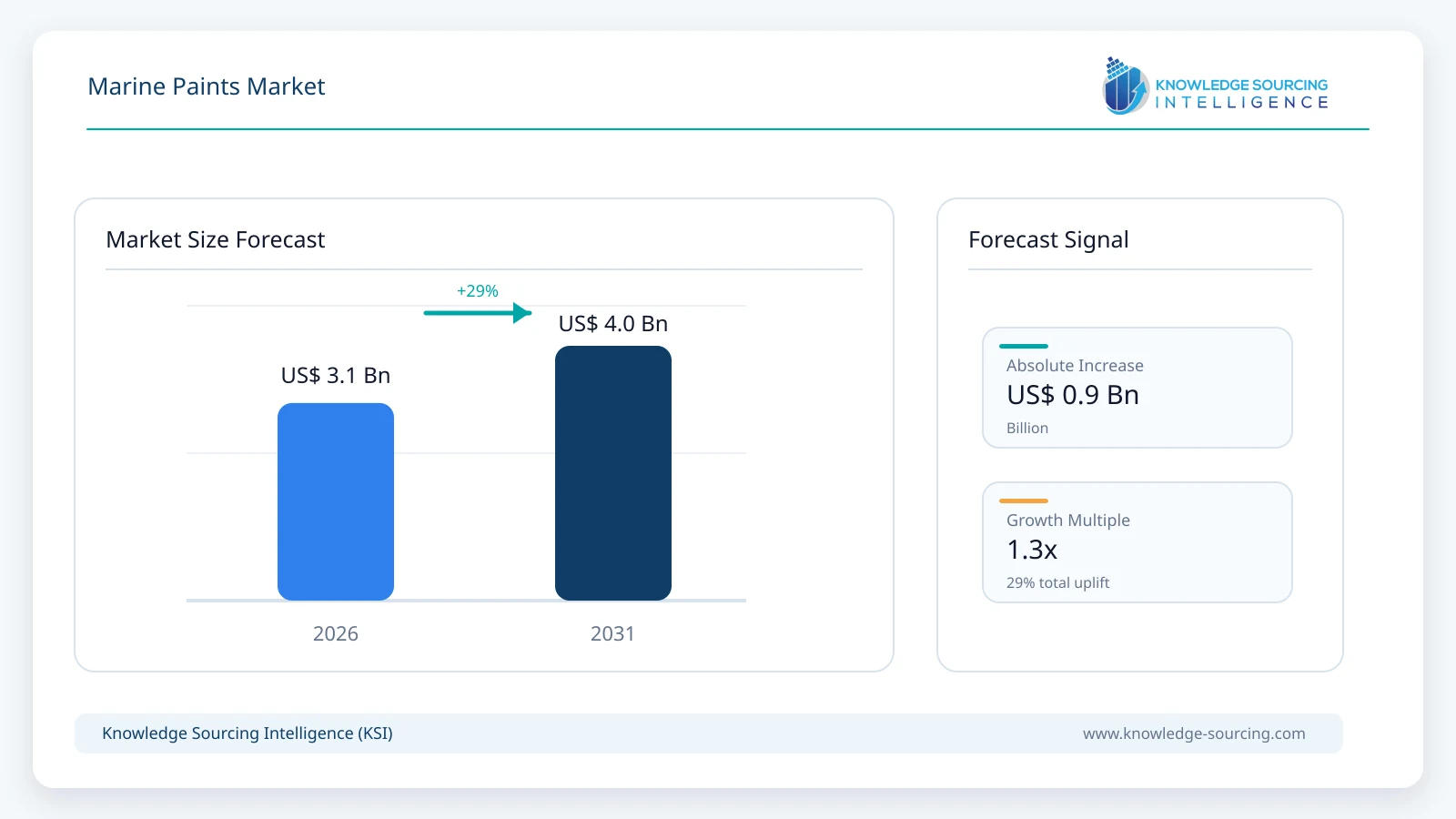
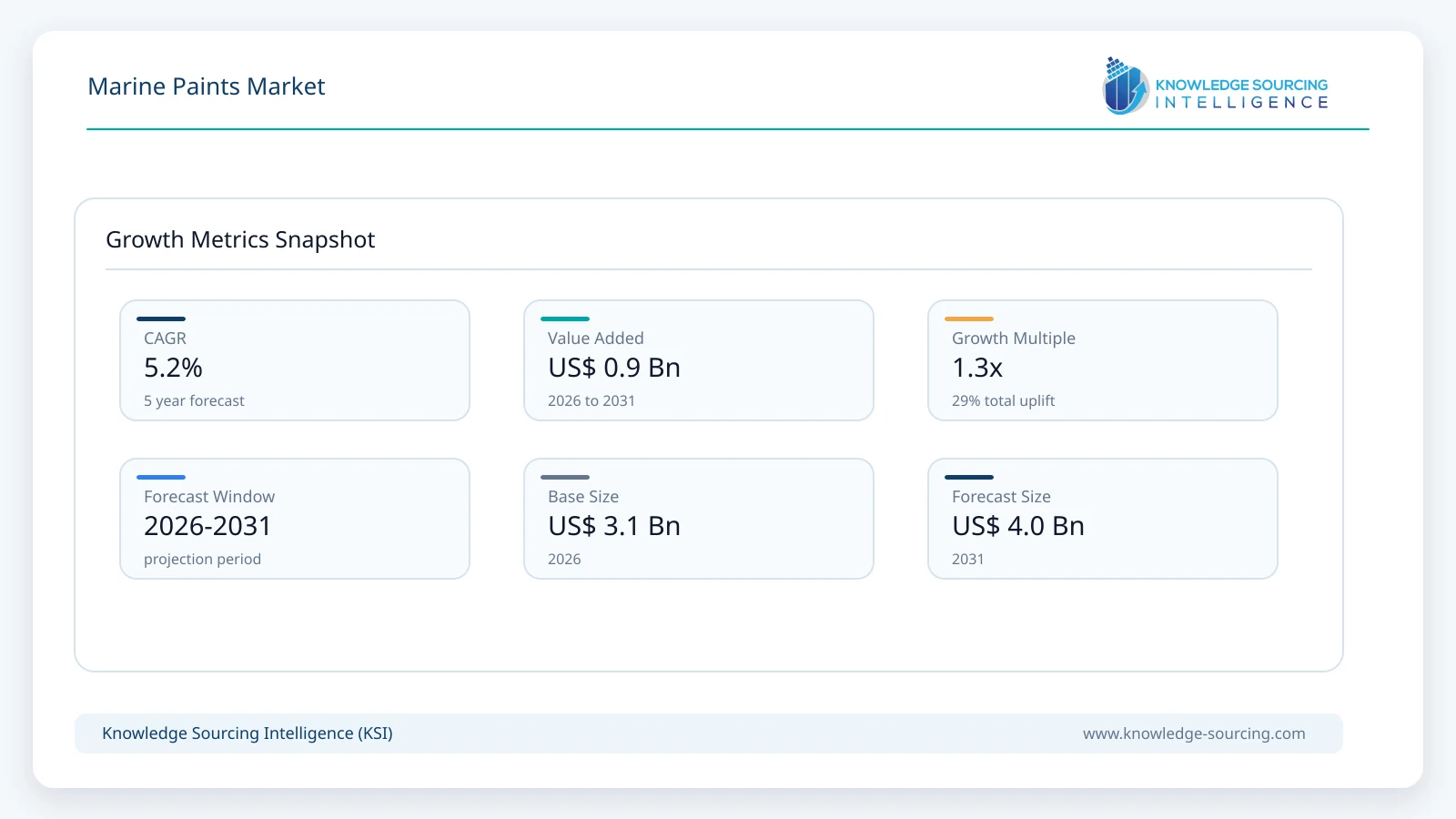
The Global Marine Paints market is forecast to grow at a CAGR of 5.2%, reaching USD 4.01 billion in 2031 from USD 3.11 billion in 2026.
Highlights:
- 1Marine paints revenue is forecast to rise from USD 3.11 billion in 2026 to USD 4.01 billion in 2031, reflecting a 5.2% CAGR.
- 2Asia-Pacific has the largest newbuild exposure, with China, Japan, and South Korea accounting for 91% of 2025 ship completions by gross tonnage.
- 3Commercial vessel applications represent the core coating demand base because cargo fleets require repeated corrosion protection and antifouling maintenance.
- 4Anti-fouling and fouling-release systems are gaining commercial importance as shipowners assess coatings through fuel use, hull performance, and maintenance intervals.
- 5The installed fleet of about 116,000 vessels creates recurring maintenance demand beyond new vessel construction and reduces dependence on newbuild cycles.
- 6Marine coating suppliers are shifting competition toward documented hull performance, application efficiency, environmental compliance, technical service, and lifecycle operating cost.
Market Overview
The market serves two closely connected demand pools: newbuild vessels and the existing fleet requiring periodic maintenance. Newbuild projects generate demand for complete coating systems, while dry-docking creates recurring requirements for corrosion protection, antifouling, fouling-release, and topcoat applications.
Coating selection is rarely based on price alone. Shipowners, shipyards, coating contractors, and fleet managers assess corrosion resistance, antifouling performance, expected service life, application time, dry-dock schedules, fuel-efficiency effects, environmental compliance, and technical support. For large commercial vessels, the financial effect of hull condition can extend beyond coating cost because fouling and surface roughness increase resistance and can raise fuel consumption.
UNCTAD reported approximately 116,000 merchant vessels of at least 100 gross tons at the beginning of 2026. Around 62,000 were above 1,000 gross tons, showing the large installed base that can generate recurring maintenance and recoating requirements. At the same time, 91% of ships completed in 2025 by gross tonnage were built in China, Japan, or the Republic of Korea, concentrating newbuilding-related coating demand in East Asia.
The demand environment is also being shaped by shipping decarbonisation. IMO measures already require technical and operational energy-efficiency measures for ships, while the organisation continues work on additional greenhouse-gas measures. This increases the commercial value of coatings that can maintain a smoother hull and reduce fouling during service.
Why is demand for marine paints increasing?
Demand is being supported by fleet expansion, new vessel construction, vessel maintenance, and tighter efficiency requirements. UNCTAD reported that the global merchant fleet reached about 116,000 vessels of at least 100 gross tons at the start of 2026, while 91% of ships completed in 2025 by gross tonnage were built in China, Japan, or the Republic of Korea. The concentration of shipbuilding in Asia-Pacific therefore has a direct effect on newbuild coating demand, while the installed global fleet sustains recurring repair and dry-docking demand.
Key Market Indicators
Indicator | Latest Evidence | Commercial Meaning |
|---|---|---|
Global merchant fleet | ~116,000 vessels at the start of 2026 | A large installed fleet supports recurring maintenance and recoating demand. |
Vessels above 1,000 gross tons | ~62,000 at the start of 2026 | Larger vessels provide an important base for commercial marine coating consumption. |
Ships completed in China, Japan and South Korea | 91% of 2025 completions by gross tonnage | Newbuild coating demand remains heavily concentrated in East Asian shipyards. |
Container ship fleet | 6,033 vessels in April 2025 | Container shipping provides a sizeable coating application base across newbuild and maintenance cycles. |
Maritime trade growth | 2.2% in 2024 | Higher seaborne trade supports vessel utilisation and maintenance activity, although trade conditions remain uneven. |
Market Drivers
Expansion and renewal of the commercial fleet.
The global fleet provides a recurring demand base for protective and antifouling coatings. UNCTAD's 2026 fleet data shows about 116,000 vessels of at least 100 gross tons, while shipbuilding activity remains concentrated in Asian production centres. New vessels require coating systems during construction, and older vessels generate demand during scheduled dry-docking. This two-part demand structure reduces the market's dependence on a single procurement cycle.
Lower hull resistance is becoming a purchasing consideration.
Shipowners increasingly evaluate hull coatings as part of vessel efficiency management. IMO's energy-efficiency framework requires technical and operational measures that reduce emissions, while hull fouling and surface condition directly affect resistance. Jotun's product strategy illustrates this shift. Its marine portfolio includes antifouling systems and hull-performance solutions designed to maintain clean hulls and reduce resistance. Coating suppliers can therefore compete on measurable operating performance rather than only corrosion life.
Recurring dry-dock activity sustains replacement demand.
Marine coatings operate within a maintenance cycle that includes inspection, surface preparation, repair, and recoating. This creates demand even when new vessel orders weaken. Hempel reported double-digit volume growth in both drydock and newbuilding in 2025, with Marine segment organic sales rising 9.8% to EUR 750 million. The company also reported record volumes for its Hempaguard range. Such disclosures indicate that maintenance and performance coatings can generate material supplier revenue alongside newbuild contracts.
Biofouling control is gaining operational and environmental relevance.
The IMO's Biofouling Guidelines address the management of organisms attached to ships because biofouling can contribute to invasive-species transfer and higher fuel use. The IMO's TEST-Biofouling project, running through 2026, is demonstrating practical approaches to biofouling management. This creates demand for antifouling and fouling-management systems that can satisfy both vessel-performance and environmental objectives.
Newbuild activity in Asia-Pacific supports supplier volumes.
China, Japan, and South Korea accounted for 91% of ships completed in 2025 by gross tonnage. Coating suppliers with technical teams, approved products, production capacity, and customer relationships close to these shipyards have an advantage when new contracts are awarded. The geographic concentration also raises the value of local application support and reliable delivery schedules because coating work is integrated into tightly controlled vessel construction programs.
Market Restraints and Challenges
Raw-material cost exposure can compress coating margins.
Marine coatings depend on resins, pigments, solvents, additives, curing agents, and other chemical inputs whose costs can fluctuate. Supplier disclosures show that coating companies continue to manage input costs and price-mix effects across their businesses. The commercial problem is not limited to material prices. Shipowners and shipyards can resist price increases when coating specifications are already embedded in project budgets, forcing suppliers to balance input-cost recovery with contract retention.
Newbuilding cycles create exposure to shipyard activity.
Coating suppliers serving newbuild vessels remain exposed to changes in vessel ordering and construction schedules. Jotun has previously identified reduced newbuilding activity as a factor affecting Marine Coatings sales, while UNCTAD continues to describe global shipping as exposed to trade uncertainty, higher costs, and changing routes. A slowdown in new vessel construction can therefore affect order intake even when the installed fleet continues to generate maintenance demand.
Environmental rules constrain formulation choices.
Antifouling coatings must control biological growth without creating unacceptable environmental effects. The IMO's Anti-Fouling Systems framework restricts harmful substances used in ship coatings, while the organisation's biofouling work places greater attention on controlling the environmental consequences of organisms carried on hulls. Suppliers must therefore balance biological performance, coating durability, application characteristics, and regulatory acceptance.
Application conditions can affect coating performance.
Marine coating systems require controlled surface preparation, correct film thickness, suitable environmental conditions, and trained application teams. Poor preparation or incorrect application can reduce service life even when the coating formulation performs as designed. This makes technical service and contractor capability commercially important, particularly for large vessels where dry-dock time is costly and coating work must fit within a narrow maintenance window.
Major Segment Analysis
Anti-Fouling Coatings
Anti-fouling coatings are commercially important because they address a recurring operating problem rather than only protecting the substrate. Marine organisms attached to a hull increase surface roughness and resistance, affecting vessel efficiency. Jotun's marine portfolio includes silyl-based antifouling products and proactive hull-cleaning solutions, while its product information links antifouling performance with hull performance.
Buyer criteria in this segment are shifting toward the total operating effect of the coating. Shipowners assess service duration, fouling protection, fuel-use implications, vessel speed, trading route, idle periods, and cleaning requirements. Hempel's 2025 results provide evidence of strong customer demand for premium marine solutions, with its Marine segment recording double-digit volume growth in drydock and newbuilding.
The segment also faces tighter environmental scrutiny. The IMO's biofouling program links effective hull management with both lower emissions and reduced transfer of invasive aquatic species. Suppliers therefore compete on coating chemistry, verified hull performance, durability, application support, and lifecycle cost. The ability to prove performance under actual operating conditions can support premium pricing, particularly for high-value commercial fleets.
Regional Analysis
Region | Main Demand Signal | Principal Constraint |
|---|---|---|
Asia-Pacific | Concentrated shipbuilding and large maritime fleets | Dependence on shipyard cycles and intense local competition |
Europe | Established shipowners, drydock activity, environmental rules, and efficiency focus | High regulatory and technical requirements |
North America | Commercial shipping, offshore assets, naval activity, and recreational vessels | Uneven vessel construction cycles and project-specific demand |
Middle East & Africa | Ports, offshore activity, oil and gas infrastructure, and fleet maintenance | Uneven industrial capacity and dependence on imported coating systems |
South America | Commercial fleets, offshore activity, and vessel maintenance | Cyclical investment and foreign-exchange exposure |
Asia-Pacific
China, Japan, and South Korea form the central newbuild cluster for marine coatings. UNCTAD reported that these three countries accounted for 91% of ships completed in 2025 by gross tonnage. This concentration supports coating demand during hull construction and creates a strong need for suppliers capable of working directly with shipyards, applicators, classification requirements, and shipowners.
China also provides a large operating fleet and an extensive repair ecosystem. Jotun's June 2026 agreement with COSCO-related entities covering 125 newbuilding vessels shows how supplier relationships can connect coating demand directly to large fleet and shipyard programs.
Europe
European demand is influenced by established fleet ownership, ship management, dry-docking infrastructure, and environmental regulation. European buyers tend to place greater weight on lifecycle performance and compliance when coating systems affect fuel use, maintenance intervals, and environmental exposure. The region also remains important for marine coating suppliers because several established manufacturers maintain headquarters, technical operations, and customer networks across Europe.
North America
North American demand spans commercial vessels, naval fleets, offshore assets, ports, and recreational marine applications. Purchasing decisions vary widely between these groups. Commercial operators focus on vessel availability and lifecycle cost, while government and naval procurement can place greater weight on qualification, specification compliance, durability, and supply assurance. The market is therefore less uniform than the concentrated Asian newbuild segment.
Middle East & Africa
Offshore energy activity and port infrastructure support marine coating demand in parts of the Middle East and Africa. Corrosion exposure can be particularly demanding where assets operate in warm, saline, or harsh marine environments. Suppliers with local technical support and reliable distribution can reduce application delays, while import dependence can increase exposure to logistics costs and delivery risk.
South America
Brazil provides an important commercial base because of its shipping and offshore industries. Demand is influenced by fleet maintenance, offshore projects, vessel repair, and port activity. Currency movements and investment cycles can affect purchasing decisions, making project timing and product availability important considerations for suppliers.
Competitive Landscape
The competitive structure combines global coatings groups with marine-focused specialists. The companies covered in this market include PPG Industries, Kansai Paint, Nippon Paint Holdings, Hempel, Chugoku Marine Paints, BASF Coatings, Jotun, KCC, Akzo Nobel, and Axalta Coating Systems. Their competitive positions differ because marine coatings require more than formulation capability. Shipyard approvals, technical service, application support, geographic availability, product qualification, and long-term customer relationships can influence supplier selection.
Jotun and Hempel illustrate the increasing emphasis on measurable vessel performance. Jotun has obtained DNV verification for selected hull-performance products using ISO 19030 methodology and in-service operational data. In February 2026, Jotun also reported that DNV independently verified an estimated 11.8 million tonnes of avoided CO2 emissions for vessels coated with its products in 2025. Such verification gives suppliers evidence that can be used in discussions with shipowners focused on fuel consumption and emissions.
Hempel's 2025 results show a similar move toward premium performance. The company reported EUR 750 million in Marine organic sales and record Hempaguard volumes, supported by double-digit growth in drydock and newbuilding. Its next-generation Hempaguard NB system was applied to Tangier Mærsk, the first of a six-vessel series of 9,000 TEU ships ordered by Maersk.
Chugoku Marine Paints maintains a strong technical focus on antifouling and anticorrosion systems. Its official technical material states that its antifouling products are developed according to sea area, vessel type, and operating conditions. This reflects an important competitive feature of marine coatings: product selection often depends on the vessel's route and operating profile rather than a single universal specification.
The proposed combination of Akzo Nobel and Axalta also has implications for competitive structure. The companies announced an all-stock merger in November 2025, and AkzoNobel reported in August 2026 that shareholders had voted in favour of the intended transaction. The transaction could alter portfolio breadth, geographic reach, purchasing scale, and resource allocation across coatings businesses if completed.
Recent Developments
August 2026: Nippon Paint Marine announced that 2,557 vessels using its hull-coating technologies had been registered on RightShip, validating coating contributions toward improved vessel GHG ratings and sustainable shipping performance.
July 2026: Nippon Paint Marine announced an agreement to supply FASTAR XI hull coating and EVER COOL exterior coating for two WAN HAI newbuild vessels, supporting lower energy consumption and improved vessel efficiency.
July 2026: PPG reported that SIGMAGLIDE 2390, its biocide-free silicone-based fouling-release marine coating, received an American Chemical Society Green Chemistry Award for safer, more sustainable vessel protection.
June 2026: Jotun COSCO Marine Coatings signed an agreement covering 125 newbuilding vessels, with high-performance antifouling systems intended to reduce resistance, optimise fuel consumption, and lower emissions. Selected vessels may also be evaluated for Hull Skating Solutions.
March 2026: AkzoNobel announced it would supply 280,000 liters of International marine coatings for three new ferries, providing hull protection and supporting efficient, lower-impact vessel operations.
February 2026: Hempel completed the first applications of its next-generation Hempaguard NB silicone hull coating on newbuild vessels, including Tangier Mærsk at Yangzijiang Shipyard in China. The application was completed without affecting the vessel's launch schedule, supporting the product's positioning for newbuild operations.
Regulatory and Policy Environment
IMO rules influence marine coating demand through two linked areas: pollution control and vessel efficiency. The International Convention on the Control of Harmful Anti-Fouling Systems on Ships restricts harmful antifouling substances, while MARPOL Annex VI establishes requirements covering air pollution and ship energy efficiency.
The regulatory direction increases the need for coating suppliers to maintain compliant formulations and documentation. Antifouling products must deliver biological control while meeting restrictions on harmful substances. At the same time, hull-performance products are gaining relevance because shipping operators face stronger pressure to reduce energy use and emissions.
The IMO's biofouling work adds another dimension. Its guidelines address management practices intended to limit the transfer of invasive aquatic species, while the TEST-Biofouling project is demonstrating approaches in developing countries through 2026. Suppliers that can connect coating performance with documented fouling control, cleaning requirements, and environmental compliance are better positioned for specification-driven projects.
What are marine coating buyers prioritising?
Shipowners increasingly assess marine coatings through lifecycle economics rather than purchase price alone. The relevant criteria include expected coating life, fuel-use impact, fouling protection, dry-dock time, application productivity, repair requirements, regulatory compliance, and technical support. Large fleet operators also have greater incentive to standardise coating systems because common specifications can simplify purchasing, training, maintenance planning, and performance tracking.
Shipyards place greater emphasis on application speed, surface preparation, compatibility with construction schedules, and reliable supply. A coating that requires additional curing time or creates application problems can affect vessel delivery schedules. This makes supplier production capacity and local technical teams important commercial factors.
How are marine coating companies responding to current market trends?
Suppliers are moving beyond conventional corrosion protection toward complete hull-performance systems. Jotun's verified speed-loss data, antifouling portfolio, and Hull Skating Solutions show how coatings are being combined with hull-management services. Hempel is extending high-performance silicone technology into newbuild applications, while Chugoku Marine Paints continues to tailor antifouling systems to vessel and operating conditions.
The competitive response is also becoming more service-oriented. Technical advice, application inspection, digital documentation, performance measurement, and lifecycle support can help suppliers protect customer relationships when product chemistry becomes harder to differentiate. This approach also gives coating manufacturers more opportunities to participate in maintenance planning rather than competing only during product tenders.
Outlook and Strategic Implications
The Marine Paints Market is expected to benefit from the combined effect of fleet maintenance, new vessel construction, hull-efficiency requirements, and environmental controls. The 2026 global fleet provides a large installed base for recurring coating demand, while the concentration of shipbuilding in Asia-Pacific creates a substantial newbuild opportunity. However, the market remains exposed to shipping cycles, raw-material costs, vessel-order timing, and regulatory changes.
The commercial opportunity will increasingly favour suppliers that can quantify coating performance and connect it with vessel economics. Independent verification, longer service intervals, lower fouling, faster application, and reduced fuel use can support premium product positioning when the financial benefit is clear to fleet operators.
For manufacturers, proximity to shipyards, secure raw-material supply, formulation capability, and technical service remain important. For shipowners, the relevant purchasing comparison is increasingly the lifecycle cost of the coating system rather than its initial price. For investors and strategic suppliers, the most important indicators are therefore newbuilding activity, fleet age, drydock demand, regulatory changes, premium-coating volumes, raw-material costs, and evidence that performance-based products can sustain higher margins.
The market's 2026–2031 performance will depend on how effectively coating suppliers balance three requirements: reliable corrosion and fouling protection, compliance with tighter environmental expectations, and measurable improvements in vessel operating efficiency. Companies able to combine formulation expertise with shipyard access, technical service, and verified performance should be better positioned as purchasing decisions become more closely linked to total vessel economics.
Marine Paints Market Scope:
| Report Metric | Details |
|---|---|
| Total Market Size in 2026 | USD 3.11 billion |
| Total Market Size in 2031 | USD 4.01 billion |
| Forecast Unit | Billion |
| Growth Rate | 5.2% |
| Study Period | 2021 to 2031 |
| Historical Data | 2021 to 2024 |
| Base Year | 2025 |
| Forecast Period | 2026 – 2031 |
| Segmentation | Resin, Product Type, Application, Geography |
| Companies |
|
Market Segmentation
By Resin
- Epoxy
- Alkyd
- Polyurethane
By Product Type
- Anticorrosion coatings
- Antifouling coatings
By Application
- Cargo ships
- Passenger ships
- Boats
By Geography
- North America
- USA
- Canada
- Mexico
- South America
- Brazil
- Argentina
- Others
- Europe
- United Kingdom
- Germany
- France
- Italy
- Spain
- Others
- Middle East and Africa
- Saudi Arabia
- UAE
- Others
- Asia Pacific
- China
- Japan
- India
- South Korea
- Australia
- Others
Table of Contents
1. INTRODUCTION
1.1 Market Overview
1.2 Market Definition
1.3 Scope of the Study
1.4 Market Segmentation
1.5 Currency
1.6 Assumptions
1.7 Base and Forecast Years Timeline
1.8 Key Benefits to Stakeholders
2. RESEARCH METHODOLOGY
2.1 Research Design
2.2 Research Process
2.3 Data Validation
2.4 Analyst Approach
3. EXECUTIVE SUMMARY
3.1 Key Findings
3.2 CXO Perspective
3.3 Market Snapshot
4. MARKET DYNAMICS
4.1 Market Drivers
4.2 Market Restraints
4.3 Market Opportunities
4.4 Porter’s Five Forces Analysis
4.4.1 Bargaining Power of Suppliers
4.4.2 Bargaining Power of Buyers
4.4.3 Threat of New Entrants
4.4.4 Threat of Substitutes
4.4.5 Competitive Rivalry in the Industry
4.5 Industry Value Chain Analysis
4.6 Analyst View
5. GLOBAL MARINE PAINTS MARKET BY RESIN
5.1 Introduction
5.2 Epoxy
5.3 Alkyd
5.4 Polyurethane
5.5 Acrylic
5.6 Silicone
5.7 Vinyl
5.8 Others
6. GLOBAL MARINE PAINTS MARKET BY PRODUCT TYPE
6.1 Introduction
6.2 Anti-Corrosion Coatings
6.3 Anti-Fouling Coatings
6.4 Fouling Release Coatings
6.5 Self-Polishing Coatings
6.6 Others
7. GLOBAL MARINE PAINTS MARKET BY APPLICATION
7.1 Introduction
7.2 Cargo Ships
7.3 Tankers
7.4 Container Ships
7.5 Passenger Ships
7.6 Offshore Vessels & Platforms
7.7 Naval Vessels
7.8 Yachts & Boats
7.9 Others
8. GLOBAL MARINE PAINTS MARKET BY GEOGRAPHY
8.1 Introduction
8.2 North America
8.2.1 By Resin
8.2.2 By Product Type
8.2.3 By Application
8.2.4 By Country
8.2.4.1 United States
8.2.4.2 Canada
8.2.4.3 Mexico
8.3 South America
8.3.1 By Resin
8.3.2 By Product Type
8.3.3 By Application
8.3.4 By Country
8.3.4.1 Brazil
8.3.4.2 Argentina
8.3.4.3 Others
8.4 Europe
8.4.1 By Resin
8.4.2 By Product Type
8.4.3 By Application
8.4.4 By Country
8.4.4.1 United Kingdom
8.4.4.2 Germany
8.4.4.3 France
8.4.4.4 Italy
8.4.4.5 Spain
8.4.4.6 Others
8.5 Middle East & Africa
8.5.1 By Resin
8.5.2 By Product Type
8.5.3 By Application
8.5.4 By Country
8.5.4.1 Saudi Arabia
8.5.4.2 United Arab Emirates
8.5.4.3 Others
8.6 Asia-Pacific
8.6.1 By Resin
8.6.2 By Product Type
8.6.3 By Application
8.6.4 By Country
8.6.4.1 China
8.6.4.2 Japan
8.6.4.3 India
8.6.4.4 South Korea
8.6.4.5 Indonesia
8.6.4.6 Taiwan
8.6.4.7 Others
9. COMPETITIVE ENVIRONMENT AND ANALYSIS
9.1 Major Players and Strategy Analysis
9.2 Market Share Analysis
9.3 Mergers, Acquisitions, Agreements, and Collaborations
9.4 Competitive Dashboard
10. COMPANY PROFILES
10.1 PPG Industries, Inc.
10.2 Kansai Paint Co., Ltd.
10.3 Nippon Paint Holdings Co., Ltd.
10.4 Hempel A/S
10.5 Chugoku Marine Paints, Ltd.
10.6 BASF Coatings GmbH
10.7 Jotun A/S
10.8 KCC Corporation
10.9 Akzo Nobel N.V.
10.10 Axalta Coating Systems Ltd.
10.11 The Sherwin-Williams Company
10.12 Teknos Group Oy
10.13 RPM International Inc.
10.14 Boero YachtCoatings
10.15 HMG Paints Ltd.
LIST OF TABLES
LIST OF FIGURES
Navigate
Trusted by the world's leading organizations











