
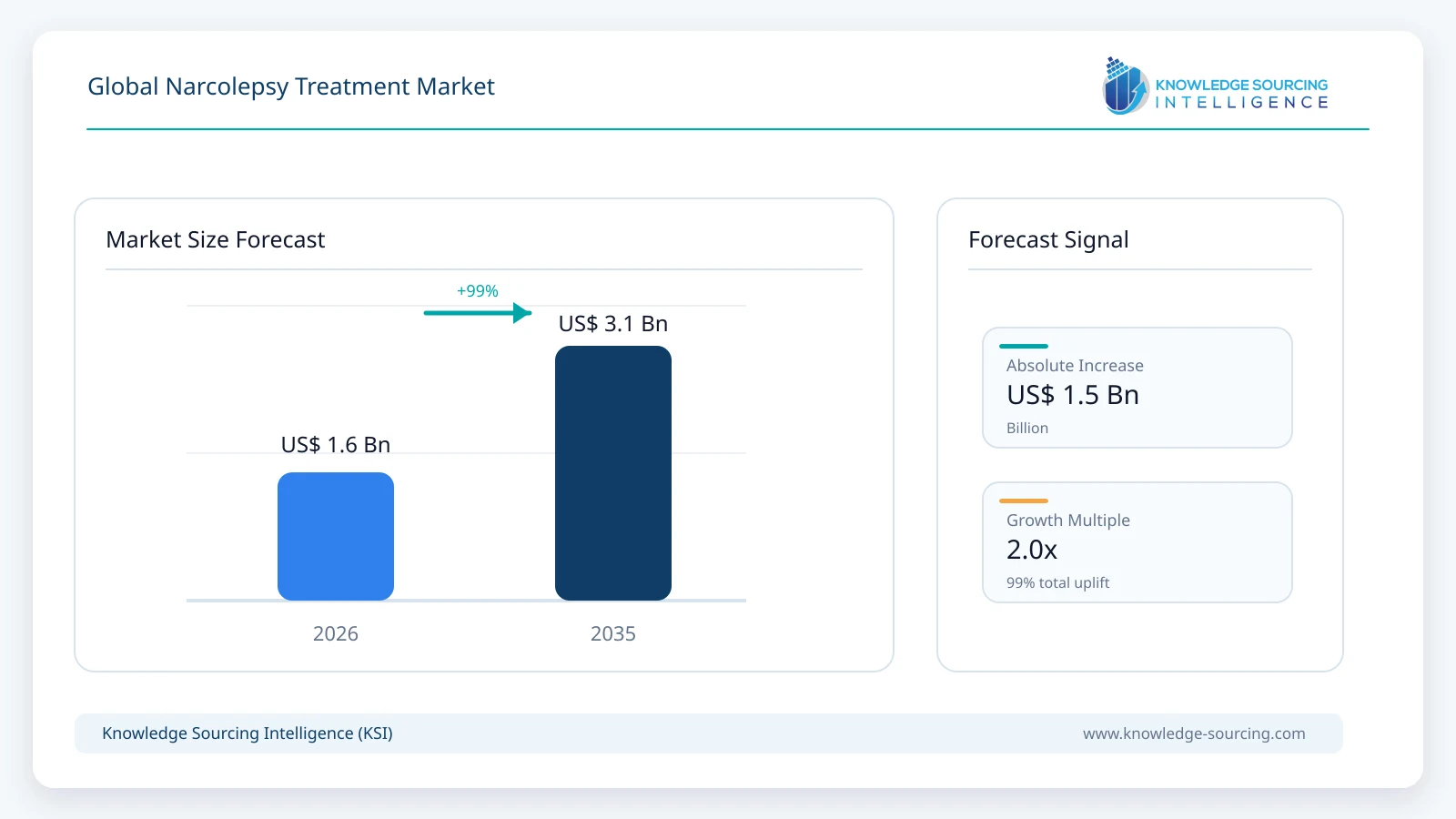
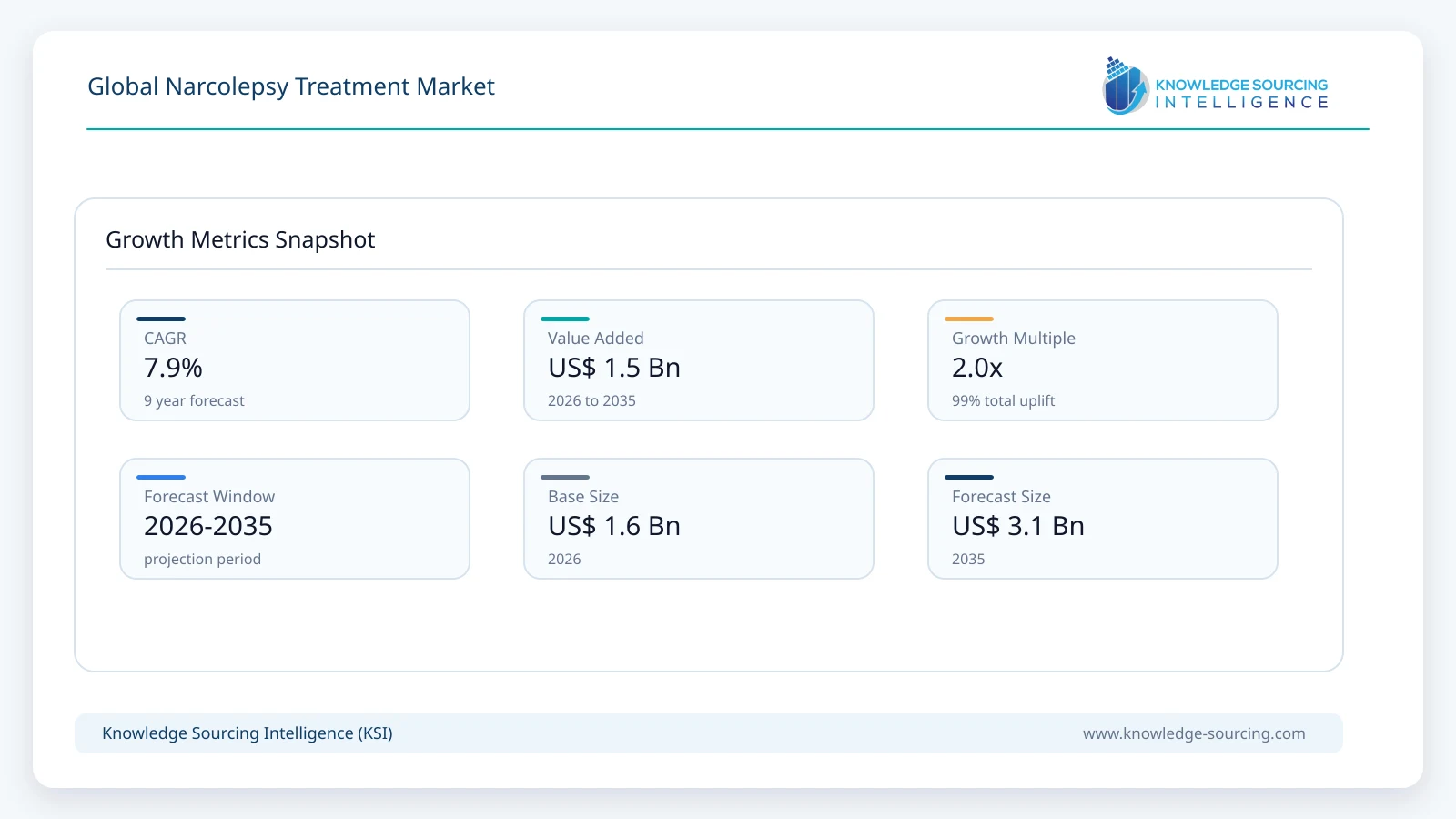
The Global Narcolepsy Treatment Market is set to reach USD 3.10 billion in 2035, growing at a CAGR of 7.9% from USD 1.56 billion in 2026.
Highlights:
- 1Growing understanding of orexin deficiency is increasing investment in mechanism-driven development programs.
- 2Rising diagnosis rates are expanding commercial and clinical opportunities for emerging therapies.
- 3Competitive differentiation increasingly depends on disease-modifying potential rather than symptomatic improvement alone.
- 4Strategic collaborations are accelerating development timelines and strengthening innovation capabilities.
Narcolepsy remains a chronic neurological sleep disorder characterized by excessive daytime sleepiness, disrupted nighttime sleep, cataplexy, hallucinations, and sleep paralysis. Current treatment approaches focus primarily on symptom management because approved therapies do not fully address underlying disease mechanisms. Demand therefore continues to increase for treatments capable of improving functional outcomes and reducing long-term disease burden.
Clinical practice increasingly incorporates individualized treatment selection because symptom severity, patient age, comorbidities, and treatment response vary substantially. Therapeutic utilization is shifting toward integrated management approaches that combine pharmacological interventions with behavioral and lifestyle strategies. The result is a progressively sophisticated treatment environment driven by both clinical necessity and scientific advancement.
Market Dynamics
Market Drivers
Orexin deficiency remains central to Narcolepsy Type 1 pathophysiology. Scientific advances are improving target validation. Companies are prioritizing orexin receptor agonists and related technologies. Competitive focus therefore continues shifting toward disease biology.
Diagnostic capabilities continue improving across sleep medicine centers. More patients are entering treatment pathways. Sponsors are increasing clinical investments accordingly. Competitive activity therefore remains strong.
Current treatment regimens may require complex dosing schedules. Patient preference is increasingly favoring simplified administration. Companies are developing differentiated delivery systems. Market competition consequently extends beyond efficacy alone.
Rare disease development incentives remain attractive for innovative sponsors. Regulatory agencies continue supporting novel approaches. Development activity therefore remains robust.
Market Restraints
Limited patient populations constrain recruitment efficiency and competitive benchmarking.
Long diagnostic delays reduce early patient identification opportunities.
Clinical endpoint standardization remains challenging across development programs.
Market Opportunities
Orexin Receptor Agonist Leadership
Disease-modifying ambitions continue attracting strategic investment. Orexin-focused programs are advancing across multiple stages. Competitive leadership opportunities therefore remain significant.
Pediatric Narcolepsy Expansion
Pediatric diagnosis rates are increasing. Dedicated clinical development programs are emerging. Future differentiation consequently extends into younger patient populations.
Precision Patient Stratification
Biological characterization continues improving. Sponsors are exploring more targeted development strategies. Clinical success probabilities therefore may improve.
Disease & Epidemiology Analysis
Narcolepsy remains a rare neurological disorder with substantial unmet clinical need. Disease burden is influenced by delayed diagnosis because symptoms often overlap with psychiatric and neurological conditions. Growing awareness is increasing identification rates, creating larger diagnosed populations eligible for future therapies.
Narcolepsy Type 1 accounts for the majority of biologically defined cases because hypocretin deficiency provides a measurable disease mechanism. This characteristic is increasing interest in orexin-targeted therapies. Development strategies are consequently becoming more mechanism-specific and scientifically focused.
Treatment Guidelines Landscape
Organization | Guideline Focus | Clinical Impact |
American Academy of Sleep Medicine | Diagnosis and treatment | Standardizes clinical management |
European Sleep Research Society | Diagnostic pathways | Supports evidence-based practice |
American Academy of Neurology | Neurological management | Improves treatment consistency |
National Institute for Health and Care Excellence | Healthcare delivery | Supports structured care approaches |
Market Segmentation
Narcolepsy Type 1
Current treatment practices focus on controlling excessive daytime sleepiness and cataplexy because hypocretin deficiency drives many clinical manifestations. Sodium oxybate therapies and wake-promoting agents remain widely utilized. Treatment utilization is increasing as diagnosis improves and specialist referral pathways expand. Future treatment evolution is expected to emphasize orexin restoration strategies capable of addressing underlying disease biology rather than symptoms alone.
Narcolepsy Type 2
Treatment approaches primarily target excessive daytime sleepiness because cataplexy is generally absent. Wake-promoting therapies remain central to disease management. Utilization trends continue strengthening as diagnostic awareness improves and more patients receive specialist evaluation. Future treatment development is likely to focus on targeted wakefulness enhancement and improved long-term symptom control.
Pediatric Narcolepsy
Current management emphasizes symptom control while minimizing treatment-related burden because pediatric patients require careful long-term monitoring. Diagnosis rates are increasing as awareness among pediatric specialists improves. Treatment utilization continues expanding accordingly. Future development is expected to prioritize age-specific therapeutic evidence and optimized safety profiles.
Regional Analysis
North America
North America leads narcolepsy treatment adoption because diagnostic infrastructure, specialist availability, and treatment access remain highly developed. Earlier diagnosis is increasing treated patient populations. Utilization of advanced therapies therefore continues expanding. Emerging orexin-based treatments are expected to further strengthen regional treatment innovation.
Europe
European treatment utilization continues increasing because sleep disorder awareness and specialist care networks remain well established. Reimbursement systems support access to approved therapies in many countries. Treatment optimization efforts are expanding accordingly. Clinical adoption therefore continues strengthening.
Asia Pacific
Treatment demand continues rising throughout Asia Pacific because healthcare providers are improving recognition of sleep disorders. Diagnostic capabilities are expanding. More patients are entering treatment pathways. Utilization growth therefore remains significant across the region.
Rest of the World
Healthcare systems are gradually strengthening sleep medicine services because awareness of neurological sleep disorders is increasing. Access remains variable across countries. Treatment adoption is improving where specialist infrastructure expands. Long-term growth therefore continues.
Regulatory Landscape
Regulatory agencies continue encouraging innovation in narcolepsy because substantial unmet needs persist despite available treatment options. Orphan drug incentives and expedited review mechanisms are supporting development activity. Treatment innovation therefore remains active.
Evidence requirements increasingly emphasize meaningful improvements in wakefulness, daily functioning, and patient quality of life. Sponsors are adapting clinical development strategies accordingly. Regulatory expectations therefore continue influencing treatment development priorities.
Pipeline Analysis
The narcolepsy pipeline increasingly centers on orexin pathway restoration because hypocretin deficiency represents a well-characterized biological mechanism. Developers are pursuing orexin receptor agonists designed to normalize sleep-wake regulation. This focus is reshaping clinical development priorities.
Several sponsors are evaluating next-generation wake-promoting therapies capable of improving efficacy while reducing treatment burden. Small molecules remain dominant because neurological delivery requirements favor orally active compounds. Pipeline expansion consequently continues across multiple therapeutic classes.
Clinical progression is increasingly concentrated within Phase I and Phase II studies because emerging candidates require validation of novel mechanisms. Successful mid-stage results are expected to determine future competitive positioning. Development-stage advancement therefore remains a critical industry focus.
Reimbursement Landscape
Reimbursement decisions primarily focus on clinical benefit, safety, and long-term disease management value. Access to established therapies remains available across many developed healthcare systems. Utilization therefore continues growing among diagnosed patients.
Emerging therapies are expected to face increasing scrutiny regarding comparative effectiveness and patient outcomes. Manufacturers are generating stronger clinical evidence accordingly. Reimbursement success therefore is becoming closely linked to demonstrated real-world value.
Competitive Landscape
Jazz Pharmaceuticals plc
Jazz Pharmaceuticals remains strategically significant because its narcolepsy portfolio has historically shaped treatment adoption patterns. The company focuses on expanding patient identification and supporting awareness initiatives that improve diagnosis rates.
Harmony Biosciences Holdings, Inc.
Harmony Biosciences emphasizes excessive daytime sleepiness management. Its strategic focus aligns with growing recognition of symptomatic disease burden and increasing treatment access among diagnosed populations.
Avadel Pharmaceuticals plc
Avadel focuses on innovative formulations designed to improve treatment convenience and adherence. This approach supports long-term disease management and enhances patient engagement.
Takeda Pharmaceutical Company Limited
Takeda maintains expertise in neuroscience and sleep medicine research. Its capabilities support continued involvement in disorders affecting sleep-wake regulation.
Axsome Therapeutics, Inc.
Axsome leverages central nervous system development expertise. Its strategic positioning reflects increasing interest in neurological mechanisms influencing sleep disorders.
Centessa Pharmaceuticals plc
Centessa pursues innovation-driven neurological development programs. The company benefits from expanding scientific understanding of sleep-related disorders.
NLS Pharmaceutics Ltd.
NLS Pharmaceutics concentrates on wakefulness-related conditions. Its strategy aligns with growing clinical demand for improved management of excessive daytime sleepiness.
Alkermes plc
Alkermes applies neuroscience expertise across neurological conditions. Its development capabilities support potential future engagement within sleep medicine.
Idorsia Ltd.
Idorsia focuses on sleep-related therapeutic innovation. Continued investment in sleep science strengthens its positioning within the broader narcolepsy ecosystem.
Aardvark Therapeutics, Inc.
Aardvark Therapeutics explores neurological pathways relevant to disease burden and symptom management. Its research focus supports future opportunities in sleep-related disorders.
Key Developments
January 2026 – Continued expansion of narcolepsy awareness initiatives across major sleep medicine networks.
September 2025 – Increased adoption of standardized diagnostic criteria in specialist sleep centers.
June 2025 – Expansion of pediatric sleep disorder assessment programs in several developed healthcare systems.
March 2025 – Broader integration of digital sleep monitoring technologies into diagnostic workflows.
Strategic Insights and Future Market Outlook
The narcolepsy treatment landscape is increasingly transitioning toward mechanism-based intervention because advances in sleep neuroscience are improving understanding of disease biology. Orexin-targeted therapies are attracting substantial attention. Treatment innovation therefore continues accelerating.
Patient expectations are evolving because long-term disease management requires durable efficacy, convenient administration, and improved quality of life outcomes. Sponsors are responding through differentiated development strategies. Competitive treatment innovation consequently continues strengthening.
Through 2035, treatment paradigms are expected to move progressively beyond symptomatic management toward biologically targeted interventions. Orexin restoration approaches, improved wake-promoting therapies, and personalized treatment strategies are likely to shape future clinical practice. Organizations capable of combining scientific innovation with meaningful patient benefit are expected to lead treatment evolution across the narcolepsy landscape.
The future treatment environment will increasingly reflect precision neuroscience principles, creating opportunities for more effective and individualized management of narcolepsy while supporting improved outcomes across adult and pediatric patient populations.
Narcolepsy Treatment Market Scope:
| Report Metric | Details |
|---|---|
| Total Market Size in 2026 | USD 1.56 billion |
| Total Market Size in 2035 | USD 3.10 billion |
| Forecast Unit | USD Billion |
| Growth Rate | 7.9% |
| Study Period | 2021 to 2035 |
| Historical Data | 2021 to 2024 |
| Base Year | 2025 |
| Forecast Period | 2026 – 2035 |
| Segmentation | Treatment Type, Disease Type, End User, Geography |
| Companies |
|
Market Segmentation
By Disease Type
By Symptom Management
Emerging Treatment Landscape
Treatment Guidelines And Clinical Practice
By Geography
Key Countries Analysis
Table of Contents
1. EXECUTIVE SUMMARY
1.1 Report Scope and Objectives
1.2 Key Findings
1.3 Treatment Landscape Highlights
1.4 Current Standard of Care Overview
1.5 Emerging Treatment Trends
1.6 Unmet Needs Assessment
1.7 Strategic Insights
1.8 Future Outlook
2. DISEASE OVERVIEW
2.1 Introduction to Narcolepsy
2.2 Disease Classification
2.2.1 Narcolepsy Type 1
2.2.2 Narcolepsy Type 2
2.2.3 Secondary Narcolepsy
2.3 Disease Pathophysiology
2.4 Orexin/Hypocretin Deficiency Mechanism
2.5 Epidemiology Overview
2.6 Clinical Manifestations
2.6.1 Excessive Daytime Sleepiness
2.6.2 Cataplexy
2.6.3 Sleep Paralysis
2.6.4 Hypnagogic Hallucinations
2.6.5 Fragmented Nighttime Sleep
2.7 Disease Burden Assessment
2.8 Unmet Medical Needs
3. TREATMENT LANDSCAPE OVERVIEW
3.1 Evolution of Narcolepsy Treatment
3.2 Historical Treatment Milestones
3.3 Current Treatment Paradigm
3.4 Treatment Algorithm Analysis
3.5 Patient Journey and Treatment Flow
3.6 Treatment Challenges
3.7 Future Treatment Direction
4. PHARMACOLOGICAL TREATMENT LANDSCAPE
4.1 Wake-Promoting Agents
4.1.1 Treatment Overview
4.1.2 Clinical Benefits
4.1.3 Safety Profile
4.1.4 Prescribing Trends
4.1.5 Future Outlook
4.2 Sodium Oxybate Therapies
4.2.1 Treatment Overview
4.2.2 Clinical Benefits
4.2.3 Safety Profile
4.2.4 Prescribing Trends
4.2.5 Future Outlook
4.3 Low-Sodium Oxybate Therapies
4.3.1 Treatment Overview
4.3.2 Clinical Benefits
4.3.3 Safety Profile
4.3.4 Prescribing Trends
4.3.5 Future Outlook
4.4 Histamine H3 Receptor Antagonists/Inverse Agonists
4.4.1 Treatment Overview
4.4.2 Clinical Benefits
4.4.3 Safety Profile
4.4.4 Prescribing Trends
4.4.5 Future Outlook
4.5 Central Nervous System Stimulants
4.5.1 Treatment Overview
4.5.2 Clinical Benefits
4.5.3 Safety Profile
4.5.4 Prescribing Trends
4.5.5 Future Outlook
4.6 Antidepressants for Cataplexy Management
4.6.1 Treatment Overview
4.6.2 Clinical Benefits
4.6.3 Safety Profile
4.6.4 Prescribing Trends
4.6.5 Future Outlook
5. NON-PHARMACOLOGICAL TREATMENT LANDSCAPE
5.1 Lifestyle Management Approaches
5.1.1 Scheduled Naps
5.1.2 Sleep Hygiene Interventions
5.1.3 Behavioral Modifications
5.1.4 Future Outlook
5.2 Cognitive and Behavioral Interventions
5.2.1 Cognitive Behavioral Therapy
5.2.2 Patient Education Programs
5.2.3 Supportive Care Strategies
5.2.4 Future Outlook
5.3 Multidisciplinary Care Models
5.3.1 Sleep Specialist Management
5.3.2 Neurology-Based Care
5.3.3 Integrated Care Approaches
5.3.4 Future Outlook
6. TREATMENT LANDSCAPE BY DISEASE TYPE
6.1 Narcolepsy Type 1
6.1.1 Current Treatment Practices
6.1.2 Treatment Utilization Trends
6.1.3 Future Outlook
6.2 Narcolepsy Type 2
6.2.1 Current Treatment Practices
6.2.2 Treatment Utilization Trends
6.2.3 Future Outlook
6.3 Pediatric Narcolepsy
6.3.1 Current Treatment Practices
6.3.2 Treatment Utilization Trends
6.3.3 Future Outlook
6.4 Adult Narcolepsy
6.4.1 Current Treatment Practices
6.4.2 Treatment Utilization Trends
6.4.3 Future Outlook
7. TREATMENT LANDSCAPE BY SYMPTOM MANAGEMENT
7.1 Excessive Daytime Sleepiness
7.1.1 Current Treatment Options
7.1.2 Treatment Adoption Trends
7.1.3 Future Outlook
7.2 Cataplexy
7.2.1 Current Treatment Options
7.2.2 Treatment Adoption Trends
7.2.3 Future Outlook
7.3 Sleep Paralysis
7.3.1 Current Treatment Options
7.3.2 Treatment Adoption Trends
7.3.3 Future Outlook
7.4 Hallucinations
7.4.1 Current Treatment Options
7.4.2 Treatment Adoption Trends
7.4.3 Future Outlook
7.5 Nighttime Sleep Disturbances
7.5.1 Current Treatment Options
7.5.2 Treatment Adoption Trends
7.5.3 Future Outlook
8. EMERGING TREATMENT LANDSCAPE
8.1 Orexin Receptor Agonists
8.1.1 Clinical Development Status
8.1.2 Mechanism of Action
8.1.3 Competitive Assessment
8.1.4 Future Outlook
8.2 Novel Wake-Promoting Agents
8.2.1 Clinical Development Status
8.2.2 Mechanism of Action
8.2.3 Competitive Assessment
8.2.4 Future Outlook
8.3 Immunomodulatory Therapies
8.3.1 Clinical Development Status
8.3.2 Mechanism of Action
8.3.3 Competitive Assessment
8.3.4 Future Outlook
8.4 Gene and Cell-Based Therapies
8.4.1 Clinical Development Status
8.4.2 Mechanism of Action
8.4.3 Competitive Assessment
8.4.4 Future Outlook
9. TREATMENT GUIDELINES AND CLINICAL PRACTICE
9.1 International Treatment Guidelines
9.2 American Academy of Sleep Medicine Recommendations
9.3 European Treatment Recommendations
9.4 Japanese Treatment Recommendations
9.5 Treatment Sequencing Strategies
9.6 Physician Prescribing Patterns
9.7 Future Guideline Evolution
10. GEOGRAPHICAL ANALYSIS
10.1 North America
10.1.1 Treatment Utilization Trends
10.1.2 Standard of Care Assessment
10.1.3 Access to Treatment
10.1.4 Reimbursement Environment
10.1.5 Key Market Drivers
10.1.6 Growth Opportunities
10.2 Europe
10.2.1 Treatment Utilization Trends
10.2.2 Standard of Care Assessment
10.2.3 Access to Treatment
10.2.4 Reimbursement Environment
10.2.5 Key Market Drivers
10.2.6 Growth Opportunities
10.3 Asia-Pacific
10.3.1 Treatment Utilization Trends
10.3.2 Standard of Care Assessment
10.3.3 Access to Treatment
10.3.4 Reimbursement Environment
10.3.5 Key Market Drivers
10.3.6 Growth Opportunities
10.4 Latin America
10.4.1 Treatment Utilization Trends
10.4.2 Standard of Care Assessment
10.4.3 Access to Treatment
10.4.4 Reimbursement Environment
10.4.5 Key Market Drivers
10.4.6 Growth Opportunities
10.5 Middle East & Africa
10.5.1 Treatment Utilization Trends
10.5.2 Standard of Care Assessment
10.5.3 Access to Treatment
10.5.4 Reimbursement Environment
10.5.5 Key Market Drivers
10.5.6 Growth Opportunities
11. KEY COUNTRIES ANALYSIS
11.1 United States
11.1.1 Treatment Utilization Trends
11.1.2 Prescribing Patterns
11.1.3 Access to Treatment
11.1.4 Reimbursement Environment
11.1.5 Key Market Drivers
11.1.6 Growth Opportunities
11.2 Canada
11.2.1 Treatment Utilization Trends
11.2.2 Prescribing Patterns
11.2.3 Access to Treatment
11.2.4 Reimbursement Environment
11.2.5 Key Market Drivers
11.2.6 Growth Opportunities
11.3 Germany
11.3.1 Treatment Utilization Trends
11.3.2 Prescribing Patterns
11.3.3 Access to Treatment
11.3.4 Reimbursement Environment
11.3.5 Key Market Drivers
11.3.6 Growth Opportunities
11.4 United Kingdom
11.4.1 Treatment Utilization Trends
11.4.2 Prescribing Patterns
11.4.3 Access to Treatment
11.4.4 Reimbursement Environment
11.4.5 Key Market Drivers
11.4.6 Growth Opportunities
11.5 France
11.5.1 Treatment Utilization Trends
11.5.2 Prescribing Patterns
11.5.3 Access to Treatment
11.5.4 Reimbursement Environment
11.5.5 Key Market Drivers
11.5.6 Growth Opportunities
11.6 Italy
11.6.1 Treatment Utilization Trends
11.6.2 Prescribing Patterns
11.6.3 Access to Treatment
11.6.4 Reimbursement Environment
11.6.5 Key Market Drivers
11.6.6 Growth Opportunities
11.7 Spain
11.7.1 Treatment Utilization Trends
11.7.2 Prescribing Patterns
11.7.3 Access to Treatment
11.7.4 Reimbursement Environment
11.7.5 Key Market Drivers
11.7.6 Growth Opportunities
11.8 China
11.8.1 Treatment Utilization Trends
11.8.2 Prescribing Patterns
11.8.3 Access to Treatment
11.8.4 Reimbursement Environment
11.8.5 Key Market Drivers
11.8.6 Growth Opportunities
11.9 Japan
11.9.1 Treatment Utilization Trends
11.9.2 Prescribing Patterns
11.9.3 Access to Treatment
11.9.4 Reimbursement Environment
11.9.5 Key Market Drivers
11.9.6 Growth Opportunities
11.10 India
11.10.1 Treatment Utilization Trends
11.10.2 Prescribing Patterns
11.10.3 Access to Treatment
11.10.4 Reimbursement Environment
11.10.5 Key Market Drivers
11.10.6 Growth Opportunities
11.11 South Korea
11.11.1 Treatment Utilization Trends
11.11.2 Prescribing Patterns
11.11.3 Access to Treatment
11.11.4 Reimbursement Environment
11.11.5 Key Market Drivers
11.11.6 Growth Opportunities
11.12 Australia
11.12.1 Treatment Utilization Trends
11.12.2 Prescribing Patterns
11.12.3 Access to Treatment
11.12.4 Reimbursement Environment
11.12.5 Key Market Drivers
11.12.6 Growth Opportunities
12. COMPANY PROFILES
12.1 Jazz Pharmaceuticals plc
12.1.1 Overview
12.1.2 Financials
12.1.3 Narcolepsy Treatment Portfolio
12.1.4 Commercial Strategy
12.1.5 Key Products
12.1.6 Market Position
12.1.7 Strategic Collaborations
12.1.8 Recent Developments
12.2 Harmony Biosciences Holdings, Inc.
12.2.1 Overview
12.2.2 Financials
12.2.3 Narcolepsy Treatment Portfolio
12.2.4 Commercial Strategy
12.2.5 Key Products
12.2.6 Market Position
12.2.7 Strategic Collaborations
12.2.8 Recent Developments
12.3 Avadel Pharmaceuticals plc
12.3.1 Overview
12.3.2 Financials
12.3.3 Narcolepsy Treatment Portfolio
12.3.4 Commercial Strategy
12.3.5 Key Products
12.3.6 Market Position
12.3.7 Strategic Collaborations
12.3.8 Recent Developments
12.4 Takeda Pharmaceutical Company Limited
12.4.1 Overview
12.4.2 Financials
12.4.3 Narcolepsy Treatment Portfolio
12.4.4 Commercial Strategy
12.4.5 Key Products
12.4.6 Market Position
12.4.7 Strategic Collaborations
12.4.8 Recent Developments
12.5 Axsome Therapeutics, Inc.
12.5.1 Overview
12.5.2 Financials
12.5.3 Narcolepsy Treatment Portfolio
12.5.4 Commercial Strategy
12.5.5 Key Products
12.5.6 Market Position
12.5.7 Strategic Collaborations
12.5.8 Recent Developments
12.6 Centessa Pharmaceuticals plc
12.6.1 Overview
12.6.2 Financials
12.6.3 Narcolepsy Treatment Portfolio
12.6.4 Commercial Strategy
12.6.5 Key Products
12.6.6 Market Position
12.6.7 Strategic Collaborations
12.6.8 Recent Developments
12.7 Alkermes plc
12.7.1 Overview
12.7.2 Financials
12.7.3 Narcolepsy Treatment Portfolio
12.7.4 Commercial Strategy
12.7.5 Key Products
12.7.6 Market Position
12.7.7 Strategic Collaborations
12.7.8 Recent Developments
12.8 NLS Pharmaceutics Ltd.
12.8.1 Overview
12.8.2 Financials
12.8.3 Narcolepsy Treatment Portfolio
12.8.4 Commercial Strategy
12.8.5 Key Products
12.8.6 Market Position
12.8.7 Strategic Collaborations
12.8.8 Recent Developments
12.9 Aardvark Therapeutics, Inc.
12.9.1 Overview
12.9.2 Financials
12.9.3 Narcolepsy Treatment Portfolio
12.9.4 Commercial Strategy
12.9.5 Key Products
12.9.6 Market Position
12.9.7 Strategic Collaborations
12.9.8 Recent Developments
12.10 Zevra Therapeutics, Inc.
12.10.1 Overview
12.10.2 Financials
12.10.3 Narcolepsy Treatment Portfolio
12.10.4 Commercial Strategy
12.10.5 Key Products
12.10.6 Market Position
12.10.7 Strategic Collaborations
12.10.8 Recent Developments
13. TREATMENT GAP ANALYSIS
13.1 Unmet Clinical Needs
13.2 Treatment Limitations Assessment
13.3 Access and Affordability Challenges
13.4 Innovation Opportunities
13.5 Future Treatment Potential
14. FUTURE OUTLOOK AND STRATEGIC RECOMMENDATIONS
14.1 Emerging Treatment Trends
14.2 Orexin-Based Therapy Market Potential
14.3 Innovation Roadmap
14.4 Strategic Opportunities for Stakeholders
14.5 Future Treatment Landscape Outlook
15. RESEARCH METHODOLOGY
15.1 Primary Research
15.2 Secondary Research
15.3 Treatment Landscape Assessment Framework
15.4 Data Validation and Triangulation
15.5 Assumptions and Limitations
16. APPENDIX
16.1 Abbreviations
16.2 Glossary of Terms
16.3 References
16.4 List of Tables
16.5 List of Figures
16.6 Regulatory Sources
16.7 Company Sources
16.8 Clinical Guidelines Sources
16.9 Scientific Literature Sources
Navigate
Trusted by the world's leading organizations











