
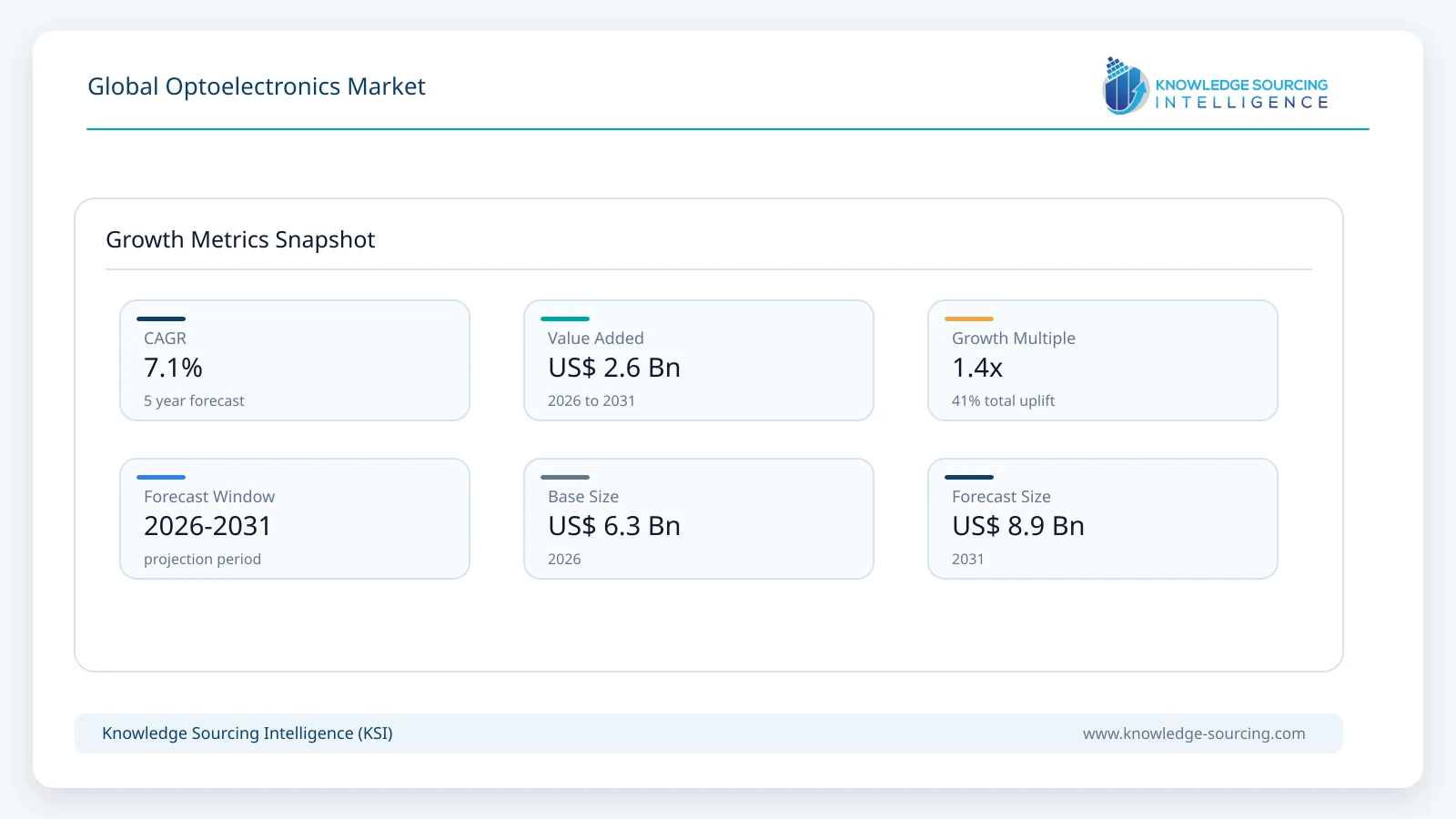
Global Optoelectronics Market For Consumer Electronics Industry is forecast to grow at a CAGR of 7.1%, reaching USD 8.94 billion in 2031 from USD 6.34 billion in 2026.
Highlights:
- 1Consumer electronics OEMs are integrating higher-value optoelectronic components to enable AI-enabled imaging, sensing, display quality, and spatial computing capabilities.
- 2CMOS image sensors remain a commercially important product category as camera performance increasingly differentiates premium consumer devices.
- 3Asia Pacific continues to anchor manufacturing capacity through vertically integrated semiconductor, display, packaging, and electronics supply chains.
- 4Display technologies are shifting toward higher brightness, lower power consumption, and improved color accuracy, supporting demand for advanced LEDs and OLED-related optoelectronic components.
- 5Optical sensing technologies, including VCSELs, photodiodes, and optical sensors, are expanding beyond facial recognition into proximity sensing, gesture control, health monitoring, and AR/VR applications.
- 6Competition increasingly depends on manufacturing yield, semiconductor process capability, optical performance, long-term customer relationships, and supply-chain resilience rather than component pricing alone.
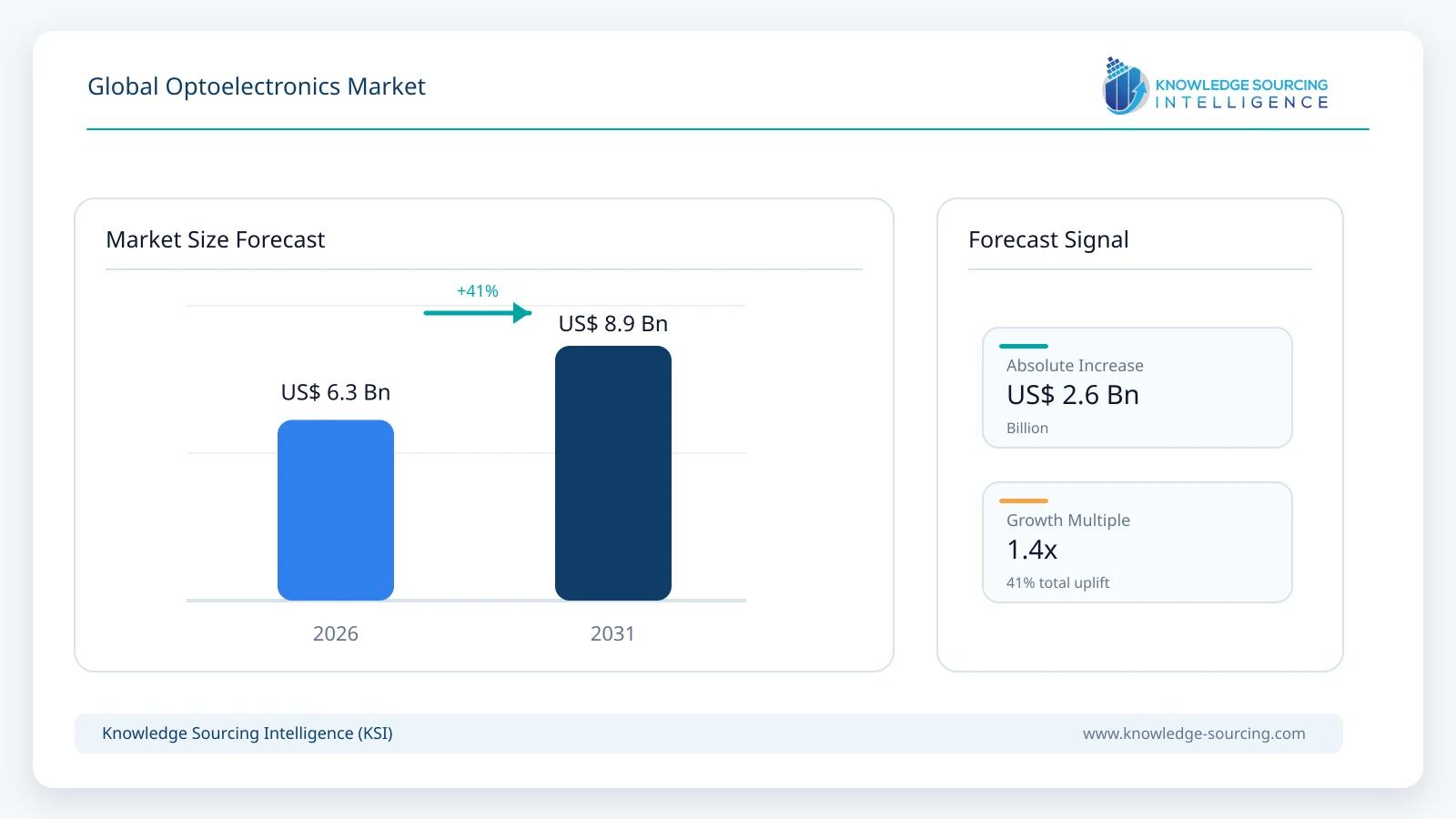
The market includes semiconductor devices that generate, detect, transmit, or control light, including CMOS image sensors, display technologies, LEDs, laser diodes, VCSELs, photodiodes, and optical sensors used in smartphones, tablets, televisions, laptops, wearables, gaming systems, smart home products, AR/VR devices, and digital imaging equipment. Rather than functioning as standalone components, these devices increasingly determine product differentiation through camera quality, display brightness, low-light performance, depth sensing, and power efficiency.
Purchasing decisions are becoming more performance-oriented. Consumer electronics manufacturers increasingly evaluate optical components on pixel performance, quantum efficiency, response speed, thermal management, package size, reliability, software compatibility, and manufacturing consistency instead of component cost alone. Long product qualification cycles and strict reliability requirements encourage procurement from suppliers capable of maintaining stable production volumes and consistent process quality. Official disclosures from major suppliers indicate continued investment in advanced semiconductor fabrication, wafer processing, display manufacturing, and sensor technologies to meet these customer requirements.
Demand is also becoming more diversified across applications. Smartphones continue to account for a large share of component consumption, while wearable electronics, augmented and virtual reality devices, smart home equipment, automotive-inspired sensing technologies entering consumer products, and AI-enabled edge devices are creating additional opportunities for optical sensing and imaging solutions. Suppliers increasingly compete through higher integration, lower power consumption, miniaturization, software compatibility, and manufacturing scale rather than purely expanding product portfolios. Capacity investments, supply-chain localization, and process innovation are expected to remain important competitive priorities throughout the forecast period.
Key Market Indicators
Indicator | Latest Evidence | Commercial Meaning |
Global smartphone shipments | Approximately 1.24 billion units (2024) | Smartphones remain the largest consumer of CMOS image sensors, optical sensors, VCSELs, and LEDs. |
Sony image sensor investment | Continued investment in next-generation image sensor manufacturing (2026) | Camera performance remains a strategic purchasing criterion for consumer electronics OEMs. |
Samsung display and semiconductor investment | Ongoing investment in advanced semiconductor and display technologies (2026) | Vertical integration strengthens component supply, manufacturing efficiency, and product development. |
Consumer device functionality | Multiple cameras, facial recognition, LiDAR, health sensing, OLED displays | Device makers increasingly require several optoelectronic components within a single product generation. |
Advanced manufacturing trend | Higher wafer-level integration and packaging complexity | Manufacturing capability increasingly determines supplier competitiveness and qualification success. |
Market Drivers
Increasing camera complexity in smartphones and premium consumer devices
Smartphone manufacturers continue to improve computational photography, low-light imaging, autofocus performance, video stabilization, and AI-assisted image processing, increasing demand for higher-performance CMOS image sensors and associated optical components. Rather than expanding camera counts alone, manufacturers are adopting larger sensors, stacked architectures, higher dynamic range, and improved light sensitivity to differentiate flagship products. Sony Semiconductor Solutions continues investing in next-generation image sensor technology and manufacturing capacity, reflecting sustained customer demand from premium smartphone manufacturers. These developments support higher component value per device and encourage suppliers to invest in advanced semiconductor fabrication capabilities.
Expansion of optical sensing across consumer electronics
Optical sensing functions are extending beyond facial recognition into wearable health monitoring, gesture recognition, proximity sensing, environmental sensing, smart home automation, and immersive AR/VR interfaces. VCSELs, photodiodes, infrared emitters, and optical sensors increasingly operate together to enable three-dimensional sensing and biometric authentication while maintaining low power consumption. Consumer device manufacturers are integrating multiple sensing functions into compact form factors, increasing demand for miniaturized optoelectronic packages with improved reliability and lower thermal output. This trend expands supplier opportunities beyond traditional camera modules and supports higher-value component integration across multiple product categories.
Display technology upgrades supporting higher-value optoelectronic components
Display quality remains one of the most visible purchasing criteria in televisions, smartphones, laptops, tablets, gaming devices, and wearable electronics. Manufacturers continue introducing brighter displays, higher refresh rates, improved color accuracy, lower energy consumption, and thinner product designs through advanced LED technologies and OLED-based architectures. Samsung, LG Display, BOE Technology, and AUO continue investing in advanced display manufacturing and production technologies to improve performance while reducing manufacturing costs and power consumption. These investments reinforce long-term demand for display-related optoelectronic components throughout the consumer electronics value chain.
Market Restraints and Challenges
Complex semiconductor manufacturing and yield management. Manufacturing optoelectronic components requires advanced wafer fabrication, lithography, packaging, and precision testing processes where small process variations can materially affect device performance. CMOS image sensors, VCSELs, and display drivers demand high manufacturing yields to remain commercially viable because production costs increase rapidly when defect rates rise. Several manufacturers, including Sony Semiconductor Solutions, STMicroelectronics, and onsemi, continue investing in process optimization, automation, and advanced packaging to improve production efficiency. Yield improvement remains a continuous operational requirement rather than a one-time manufacturing objective, particularly as pixel dimensions shrink and sensing functions become more sophisticated.
Dependence on geographically concentrated semiconductor supply chains. Consumer optoelectronics manufacturing remains heavily dependent on semiconductor fabrication, display manufacturing, and advanced packaging facilities concentrated in East Asia. Supply disruptions caused by geopolitical tensions, export controls, logistics constraints, or natural disasters can delay production schedules for consumer electronics manufacturers worldwide. Company disclosures increasingly identify supply-chain resilience as a strategic priority, prompting investments in supplier diversification, inventory management, regional manufacturing expansion, and dual-sourcing strategies. Although these measures reduce operational risk, they also increase procurement complexity and capital requirements.
Intense pricing pressure from consumer electronics manufacturers. Large consumer electronics OEMs possess considerable purchasing power because component suppliers compete for long-term design wins in high-volume products. Once selected, suppliers benefit from multi-year production programs, but winning these contracts requires continuous improvements in cost efficiency, manufacturing consistency, and product performance. Price negotiations become particularly challenging in mature applications such as LEDs and conventional display components where technological differentiation is limited. Suppliers increasingly seek higher-margin opportunities in premium imaging, optical sensing, and advanced display technologies to offset pricing pressure in commodity product categories.
Major Segment Analysis
CMOS Image Sensors
CMOS image sensors represent one of the most commercially important product categories within consumer optoelectronics because imaging quality has become a primary differentiator across smartphones, tablets, laptops, wearable devices, and digital cameras. Device manufacturers increasingly prioritize larger sensor formats, higher dynamic range, faster autofocus, improved low-light performance, and AI-assisted image processing when selecting imaging components. These purchasing criteria favor suppliers with advanced semiconductor manufacturing capabilities, proven fabrication yields, and close collaboration with OEM design teams.
Competition extends beyond sensor resolution alone. Buyers increasingly evaluate pixel architecture, power efficiency, readout speed, stacked sensor technology, thermal performance, software compatibility, and long-term supply reliability before awarding production programs. Sony Semiconductor Solutions and Samsung Electronics continue expanding investments in stacked CMOS technologies and advanced manufacturing processes to address evolving customer requirements. Although optical sensing technologies are gaining wider adoption in wearable devices and AR/VR products, CMOS image sensors remain central to consumer electronics innovation because camera performance directly influences purchasing decisions across multiple device categories while supporting higher component value per finished product.
Regional Analysis
Region | Main Demand Signal | Principal Constraint |
Americas | Premium consumer electronics demand, semiconductor design expertise, AI-enabled device development | Limited large-scale consumer display manufacturing compared with Asia Pacific |
Europe, Middle East and Africa | Automotive-derived optical technologies, industrial semiconductor expertise, premium consumer electronics market | Higher manufacturing costs and dependence on imported consumer electronics assembly |
Asia Pacific | Concentrated semiconductor fabrication, display manufacturing, electronics assembly, and component ecosystem | Geopolitical risks, export controls, and supply-chain concentration |
Americas
The United States remains an important center for semiconductor design, consumer electronics research, software ecosystems, and AI-enabled device development, supporting demand for advanced optoelectronic components integrated into premium consumer products. Companies increasingly prioritize high-performance imaging, optical sensing, and energy-efficient display technologies for flagship devices, while Canada contributes specialized semiconductor research and photonics development. Brazil represents the region's largest consumer electronics market in Latin America, although production remains dependent on imported semiconductor components and globally integrated supply chains. The region continues to influence product specifications despite comparatively limited high-volume display manufacturing.
Europe, Middle East and Africa
Germany, France, Italy, and the United Kingdom contribute through semiconductor engineering, photonics research, precision manufacturing, and advanced sensing technologies rather than large-scale consumer electronics assembly. European expertise in optical sensing, semiconductor equipment, and industrial automation increasingly supports consumer applications such as wearable health monitoring, imaging systems, and smart home devices. Environmental regulations and energy-efficiency standards also encourage adoption of lower-power display technologies and efficient lighting solutions. Across the Middle East and Africa, consumer demand is expanding through higher smartphone penetration and digital infrastructure development, although most finished devices continue to rely on imported optoelectronic components.
Asia Pacific
Asia Pacific remains the operational center of the global consumer optoelectronics value chain. China, Japan, Taiwan, India, and other regional economies collectively host semiconductor fabrication facilities, display manufacturing plants, electronics assembly operations, advanced packaging capacity, and extensive supplier ecosystems. Japan continues to strengthen its position in image sensor technology and optical materials, while Taiwan remains essential for semiconductor manufacturing and packaging. China combines large-scale electronics production with rapidly expanding domestic demand, and India continues attracting electronics manufacturing investments under production-linked incentive programs. Vertical integration across component manufacturing, assembly, logistics, and final product manufacturing enables shorter development cycles and efficient large-scale production, reinforcing the region's strategic importance despite ongoing geopolitical and trade-related risks.
Competitive Landscape
Competition within the consumer optoelectronics industry is technology-intensive and moderately concentrated, with differentiation increasingly determined by semiconductor process capability, optical performance, manufacturing scale, intellectual property, and long-term customer relationships. Sony Semiconductor Solutions, Samsung Electronics, LG Display, BOE Technology, AUO Corporation, and Nichia maintain competitive positions through continuous investment in imaging, display, and LED technologies, while ams-OSRAM, STMicroelectronics, onsemi, ROHM, Everlight Electronics, and TDK strengthen portfolios across optical sensing, photonics, power devices, and component integration.
Manufacturers increasingly compete through advanced wafer processing, miniaturized packaging, lower power consumption, higher production yields, and application-specific product development rather than broad product portfolios alone. Capacity expansion, regional manufacturing diversification, automation, and closer collaboration with consumer electronics OEMs remain common strategic responses to supply-chain uncertainty and evolving customer specifications. High qualification requirements, long product development cycles, and substantial capital investment create meaningful barriers for new entrants, while established supplier relationships continue to influence procurement decisions across premium consumer electronics applications.
Recent Developments
July 2026: ams OSRAM completed the sale of its non-optical analog and mixed-signal sensor business to Infineon, sharpening its strategic focus on digital photonics, optical sensing, AR smart glasses, and consumer optoelectronic technologies.
June 2026: Sony Semiconductor Solutions introduced an advanced 1/2-type CMOS image sensor featuring the industry's first RB2×2 OCL pixel structure, delivering over 20% higher definition for smartphone cameras and premium mobile consumer electronics.
May 2026: ams OSRAM announced the sale of its CMOS image sensor business to indie Semiconductor for €40 million, concentrating investments on AI photonics, advanced display technologies, and augmented reality smart glasses.
March 2026: ams OSRAM unveiled an ultra-efficient microLED array leveraging its EVIYOS technology, advancing toward commercialization for next-generation display and photonic applications while strengthening expertise applicable to consumer electronics and AR devices.
Regulatory and Policy Environment
Government policies increasingly influence investment decisions across the consumer optoelectronics value chain by shaping semiconductor manufacturing, technology security, energy efficiency, environmental compliance, and international trade. Rather than regulating optoelectronic components directly, governments are implementing broader semiconductor and electronics policies that affect manufacturing capacity, research investment, and supply-chain resilience.
The United States continues to support domestic semiconductor manufacturing through incentives established under the CHIPS and Science Act, encouraging investment in advanced wafer fabrication and semiconductor research while strengthening long-term supply security for electronics manufacturers. Similar industrial policies in Japan, South Korea, Taiwan, India, and the European Union seek to expand regional semiconductor production, reduce supply-chain concentration, and strengthen technological competitiveness. These initiatives support capital investment in semiconductor fabrication, advanced packaging, and component manufacturing that ultimately benefits consumer optoelectronics.
Environmental regulation is also becoming more influential. Requirements under the European Union's Restriction of Hazardous Substances (RoHS) Directive, Registration, Evaluation, Authorisation and Restriction of Chemicals (REACH) Regulation, Ecodesign requirements, and Waste Electrical and Electronic Equipment (WEEE) Directive continue to influence material selection, product design, recycling practices, and manufacturing processes. Compliance increasingly forms part of supplier qualification, particularly for multinational consumer electronics manufacturers operating across multiple jurisdictions.
Trade measures, export controls, and technology transfer restrictions continue affecting procurement strategies for semiconductor equipment, advanced manufacturing technologies, and certain optoelectronic products. Manufacturers increasingly respond by diversifying production locations, expanding regional supply networks, strengthening inventory management, and increasing collaboration with local manufacturing partners to reduce operational exposure while maintaining customer delivery commitments.
Outlook and Strategic Implications
Consumer optoelectronics will continue evolving as imaging quality, intelligent sensing, display performance, and energy efficiency become increasingly important purchasing criteria across consumer electronics. Future demand is expected to depend less on overall device shipment growth and more on higher semiconductor content per device, increased sensing capability, AI-assisted imaging, and advanced display architectures. This shift supports higher-value optoelectronic components even as mature consumer electronics categories experience longer replacement cycles.
Investment priorities are also changing across the supply chain. Manufacturers are directing capital toward advanced semiconductor fabrication, wafer-level packaging, miniaturization, heterogeneous integration, and production automation to improve yields while supporting increasingly complex product designs. These investments require substantial financial resources and technical expertise, reinforcing the competitive advantages of established suppliers with proven manufacturing capabilities and long-standing relationships with global consumer electronics OEMs.
Several strategic considerations are likely to shape market performance during the forecast period:
Manufacturers will prioritize production efficiency, advanced process technologies, and resilient regional supply chains to reduce operational risk while supporting higher-performance consumer devices.
Consumer electronics OEMs will increasingly select suppliers capable of delivering consistent quality, long-term manufacturing capacity, software compatibility, and rapid product development support.
Component suppliers are expected to expand investment in AI-enabled imaging, optical sensing, advanced LEDs, VCSELs, and integrated photonic solutions to capture higher-value design opportunities.
Investors will continue evaluating companies based on manufacturing competitiveness, capital allocation, technology differentiation, intellectual property, and exposure to premium consumer electronics applications rather than shipment volumes alone.
Policymakers will remain focused on semiconductor self-sufficiency, supply-chain resilience, and sustainable electronics manufacturing, influencing future capacity expansion and regional investment decisions.
Although pricing pressure and geopolitical uncertainty will continue affecting procurement strategies, the long-term commercial outlook remains supported by increasing optical functionality within consumer electronics. Imaging systems, intelligent sensing, and advanced display technologies are expected to account for a larger share of device value, encouraging continued investment in high-performance optoelectronic components and strengthening their strategic importance across the global consumer electronics industry.
Market Scope:
| Report Metric | Details |
|---|---|
| Total Market Size in 2026 | USD 6.34 billion |
| Total Market Size in 2031 | USD 8.94 billion |
| Forecast Unit | Billion |
| Growth Rate | 7.1% |
| Study Period | 2021 to 2031 |
| Historical Data | 2021 to 2024 |
| Base Year | 2025 |
| Forecast Period | 2026 – 2031 |
| Segmentation | Type, Application, Geography |
| Companies |
|
Market Segmentation
By Type
- CMOS Image Sensors
- Displays
- Light Emitting Diodes (LEDs)
- Laser Diodes and VCSELs (Vertical-Cavity Surface-Emitting Lasers)
- Optical Sensors
- Photodiodes
- Others
By Application
- Smartphones and Tablets
- Televisions and Smart Displays
- Laptops and Personal Computers
- Wearable Devices
- Gaming Devices
- Smart Home Devices
- AR/VR Devices
- Digital Cameras and Imaging Devices
- Others
By Geography
- Americas
- USA
- Canada
- Brazil
- Others
- Europe, Middle East and Africa
- Germany
- France
- United Kingdom
- Italy
- Others
- Asia Pacific
- China
- Japan
- India
- Taiwan
- Others
Table of Contents
1. INTRODUCTION
1.1. MARKET OVERVIEW
1.2. MARKET DEFINITION
1.3. SCOPE OF THE STUDY
1.4. CURRENCY
1.5. ASSUMPTIONS
1.6. BASE AND FORECAST YEARS TIMELINE
2. RESEARCH METHODOLOGY
2.1. RESEARCH DESIGN
2.2. SECONDARY SOURCES
3. EXECUTIVE SUMMARY
4. MARKET DYNAMICS
4.1. MARKET SEGMENTATION
4.2. MARKET DRIVERS
4.3. MARKET RESTRAINTS
4.4. MARKET OPPORTUNITIES
4.5. PORTER’S FIVE FORCE ANALYSIS
4.5.1. BARGAINING POWER OF SUPPLIERS
4.5.2. BARGAINING POWER OF BUYERS
4.5.3. THREAT OF NEW ENTRANTS
4.5.4. THREAT OF SUBSTITUTES
4.5.5. COMPETITIVE RIVALRY IN THE INDUSTRY
4.6. LIFE CYCLE ANALYSIS - REGIONAL SNAPSHOT
4.7. MARKET ATTRACTIVENESS
5. GLOBAL OPTOELECTRONICS FOR CONSUMER ELECTRONICS INDUSTRY MARKET BY TYPE
5.1. CMOS IMAGE SENSORS
5.2. DISPLAYS
5.3. LIGHT EMITTING DIODES (LEDS)
5.4. LASER DIODES AND VCSELS (VERTICAL-CAVITY SURFACE-EMITTING LASERS)
5.5. OPTICAL SENSORS
5.6. PHOTODIODES
5.7. OTHERS
6. GLOBAL OPTOELECTRONICS FOR CONSUMER ELECTRONICS INDUSTRY MARKET BY APPLICATION
6.1. SMARTPHONES AND TABLETS
6.2. TELEVISIONS AND SMART DISPLAYS
6.3. LAPTOPS AND PERSONAL COMPUTERS
6.4. WEARABLE DEVICES
6.5. GAMING DEVICES
6.6. SMART HOME DEVICES
6.7. AR/VR DEVICES
6.8. DIGITAL CAMERAS AND IMAGING DEVICES
6.9. OTHERS
7. GLOBAL OPTOELECTRONICS FOR CONSUMER ELECTRONICS INDUSTRY MARKET BY GEOGRAPHY
7.1. AMERICAS
7.1.1. USA
7.1.2. CANADA
7.1.3. BRAZIL
7.1.4. OTHERS
7.2. EUROPE MIDDLE EAST AND AFRICA
7.2.1. GERMANY
7.2.2. FRANCE
7.2.3. UNITED KINGDOM
7.2.4. ITALY
7.2.5. OTHERS
7.3. ASIA PACIFIC
7.3.1. CHINA
7.3.2. JAPAN
7.3.3. INDIA
7.3.4. TAIWAN
7.3.5. OTHERS
8. COMPETITIVE INTELLIGENCE
8.1. COMPETITIVE BENCHMARKING AND ANALYSIS
8.2. RECENT INVESTMENT AND DEALS
8.3. STRATEGIES OF KEY PLAYERS
9. COMPANY PROFILES
9.1. SONY SEMICONDUCTOR SOLUTIONS CORPORATION
9.2. SAMSUNG ELECTRONICS CO., LTD.
9.3. LG DISPLAY CO., LTD.
9.4. BOE TECHNOLOGY GROUP CO., LTD.
9.5. AMS-OSRAM AG
9.6. STMICROELECTRONICS N.V.
9.7. ONSEMI
9.8. NICHIA CORPORATION
9.9. ROHM CO., LTD.
9.10. EVERLIGHT ELECTRONICS CO., LTD.
9.11. TDK CORPORATION
9.12. AUO CORPORATION
Navigate
Trusted by the world's leading organizations











