Knowledge Sourcing Intelligence (KSI)
Download Free SampleBuy Now
Home/Semiconductor/Electronics/Global Laptop Market

Global Laptop Market - Strategic Insights and Forecasts (2026-2031)

Laptop Market Size, Share, Trends & Analysis By Type (Traditional (Clamshell) Laptops, 2-in-1 Laptops (Convertible and Detachable)), Screen Size (Up to 13.9 inches, 14–15.9 inches, 16 inches and Above), Operating System (Mac OS, Windows, ChromeOS, Linux, Others), End-Use (Consumer, Commercial / Business, Gaming, Education), and Geography

Market Size in 2026
See Report
Market Size in 2031
See Report
CAGR
See Report
Study Period
2021-2031
$3,950
Single User License
Report OverviewSegmentationTable of ContentsCustomize Report

Global Laptop Market is projected to register a strong CAGR during the forecast period (2026-2031).

Highlights:

  1. 1
    Commercial notebook refresh cycles remain a primary source of demand across enterprise and public-sector buyers.
  2. 2
    AI-enabled laptops are changing procurement priorities toward higher memory, processing capability, and battery efficiency.
  3. 3
    Supply-chain resilience and component sourcing continue to influence vendor pricing and product availability.
  4. 4
    Enterprise security, device management, and lifecycle services increasingly affect purchasing decisions beyond hardware specifications.
  5. 5
    Asia Pacific remains central to manufacturing capacity, while North America and Europe drive premium commercial demand.

Procurement decisions increasingly balance computing performance, security, battery endurance, service support, software compatibility, and lifecycle management instead of focusing solely on hardware specifications. Commercial replacement programmes, hybrid working practices, educational digitalisation initiatives, and the introduction of AI-capable personal computers are reshaping product development and purchasing behaviour across multiple customer groups.

Enterprise buyers are accelerating device replacement as support for older operating systems approaches its end, while educational institutions continue structured procurement through public funding programmes. Consumer purchasing remains more selective, with replacement cycles extending in mature markets because incremental hardware improvements alone are insufficient to justify frequent upgrades. Consequently, manufacturers are introducing differentiated product portfolios that combine AI acceleration, improved energy efficiency, higher-resolution displays, and enhanced collaboration capabilities to preserve average selling prices.

Competition extends beyond notebook hardware. Vendors increasingly compete through operating-system ecosystems, enterprise management tools, warranty services, security capabilities, software integration, and global support networks. These factors have become particularly relevant for multinational organisations seeking consistent deployment standards across geographically distributed workforces.

Value creation across the market is also becoming more service-oriented. Device lifecycle management, managed deployment, cloud integration, subscription-based software, accidental damage protection, and extended maintenance contracts contribute an increasing share of vendor revenue. At the same time, fluctuations in semiconductor, memory, and storage component costs continue to affect product pricing and inventory planning, requiring manufacturers to balance profitability with competitive positioning.

Key Market Indicators

Indicator

Latest Evidence

Commercial Meaning

Windows 10 end of support

October 2025

Enterprise replacement programmes continue to support commercial laptop procurement.

Global traditional PC shipments

273 million units (2025 forecast)

Commercial demand remains the primary contributor to shipment stability.

Commercial PC shipments (excluding education)

138.0 million units (2025)

Enterprise IT spending continues to underpin notebook procurement.

Education PC shipments

41.7 million units (2025)

Government-funded education programmes remain an important demand source.

Worldwide PC shipments

278.7 million units (2025)

Vendor production recovered before component cost pressures intensified.

Key indicator: 138.0 million commercial PCs were forecast for shipment during 2025.

Commercial meaning: Enterprise refresh programmes remain the most dependable source of notebook demand across global markets.

Market Drivers

  • Enterprise replacement driven by operating-system migration. Support deadlines for legacy operating systems are compelling organisations to replace ageing laptop fleets instead of extending maintenance programmes. Many enterprises are selecting newer notebooks capable of supporting enhanced security functions, AI-assisted productivity applications, and longer software support lifecycles. Device procurement is increasingly bundled with deployment, endpoint management, and cybersecurity services, creating additional revenue opportunities for manufacturers and channel partners. Corporate refresh programmes also provide suppliers with greater shipment visibility than consumer demand because purchasing follows structured budgeting cycles.

  • Growing demand for AI-capable notebooks across commercial users. Hardware platforms incorporating dedicated neural processing units are beginning to influence procurement specifications, particularly among knowledge-intensive organisations seeking local AI processing, lower latency, and improved privacy. Manufacturers are responding by redesigning premium product portfolios around AI-enabled processors, larger memory configurations, and higher battery efficiency rather than relying only on processor speed improvements. Although AI functionality has not yet become a universal purchasing criterion, enterprise buyers increasingly view AI readiness as a way to extend device useful life over multiple refresh cycles.

  • Education and public-sector digital programmes sustaining procurement activity. Government-funded education initiatives continue purchasing notebooks to support digital learning, classroom management platforms, remote instruction, and standardised testing environments. Institutions increasingly prioritise durability, centralised device administration, long battery life, and lower maintenance costs over premium hardware specifications. Vendors have expanded education-focused product portfolios featuring reinforced designs, simplified servicing, and cloud-based management capabilities. Procurement typically occurs through large framework agreements, providing manufacturers with predictable order volumes while intensifying price competition during public tenders.

  • Premium device differentiation supporting revenue quality. Manufacturers are placing greater emphasis on premium notebooks that combine lightweight construction, OLED displays, extended battery life, advanced security features, and integrated collaboration technologies. This strategy reflects longer replacement cycles among consumers, making average selling price improvement increasingly important for maintaining profitability. Company investments increasingly prioritise premium product development, ecosystem integration, and software-enabled services instead of competing solely on entry-level pricing. The approach also helps vendors offset higher component costs and supply-chain volatility affecting notebook manufacturing.

Market Restraints and Challenges

  • Volatility in memory and storage component pricing. Laptop manufacturers remain exposed to fluctuations in DRAM and NAND flash pricing because memory and storage account for a considerable share of notebook bill-of-material costs. Industry supply adjustments and changing demand from data centres and AI infrastructure have periodically tightened component availability, affecting procurement costs for PC manufacturers. Several vendors have responded by optimising inventory levels, diversifying component suppliers, and adjusting product configurations, yet sustained price increases continue to compress margins, particularly in entry-level consumer models where pricing flexibility is limited. According to Omdia, tightening memory and storage supply conditions are expected to remain an important consideration for PC manufacturers during the forecast period.

  • Lengthening consumer replacement cycles. Improvements in processor efficiency, battery life, and overall hardware durability have extended the practical lifespan of consumer laptops. Many households now retain devices for several years because existing systems continue to meet everyday productivity, entertainment, and educational needs. This trend reduces replacement frequency, particularly in mature markets where device ownership is already high. Manufacturers increasingly rely on premium features such as AI capabilities, OLED displays, enhanced graphics, and ecosystem integration to encourage upgrades, although these additions do not always justify replacement for price-sensitive buyers.

  • Dependence on concentrated manufacturing and component supply chains. Notebook production remains heavily concentrated across East Asian manufacturing hubs, where contract manufacturers assemble products using globally sourced processors, displays, batteries, memory, and storage devices. Natural disasters, geopolitical tensions, export controls, logistics disruptions, or trade policy changes can interrupt production schedules and extend delivery lead times. Several global vendors have expanded manufacturing capacity into countries such as Vietnam and India to reduce geographic concentration risk, but supply-chain diversification requires sustained capital investment, supplier qualification, and workforce development before it materially improves resilience.

  • Intense price competition in commercial procurement. Enterprise and education procurement increasingly occurs through competitive tenders where buyers evaluate total ownership cost alongside device performance, warranty support, software compatibility, and security capabilities. Large multinational contracts frequently involve aggressive pricing, extended service commitments, and customised deployment requirements. Smaller manufacturers may find it difficult to compete against vendors with broader service networks, established distribution partners, and stronger lifecycle management capabilities. This pricing pressure affects profitability even when shipment volumes remain stable, encouraging manufacturers to expand higher-margin software and support services.

Major Segment Analysis

Commercial / Business End-use

Commercial and business customers represent one of the most strategically important demand categories within the global laptop market because purchasing decisions are generally linked to structured IT investment plans, operating-system migration, cybersecurity requirements, and employee productivity objectives rather than discretionary spending. Large organisations increasingly evaluate laptops as part of broader digital workplace strategies that include endpoint security, cloud collaboration, device management, and lifecycle services. Consequently, procurement decisions extend well beyond processor performance or hardware specifications.

Purchasing criteria within this segment increasingly emphasise security architecture, AI readiness, battery efficiency, remote device administration, repairability, and long-term software support. Organisations also seek standardised hardware platforms that simplify fleet management across multiple locations. Vendors compete through enterprise service capabilities, global support infrastructure, warranty programmes, and software integration alongside hardware innovation. Although gaming and premium consumer devices continue attracting product investment, commercial procurement remains particularly important because it provides predictable replacement cycles, larger contract values, and recurring revenue opportunities through managed services, deployment support, and extended maintenance agreements.

Regional Analysis

Region

Main Demand Signal

Principal Constraint

North America

Enterprise refresh cycles, AI PC adoption, hybrid work

Longer consumer replacement cycles

Europe

Digital workplace investment, sustainability and repair regulations

Cost pressure and public procurement budgets

Asia Pacific

Manufacturing base, education demand, expanding enterprise digitisation

Supply-chain concentration and geopolitical risks

South America

Business digitalisation and education procurement

Import dependence and currency volatility

Middle East and Africa

Government digital transformation and education programmes

Uneven ICT infrastructure and budget constraints

North America

Commercial procurement remains the primary demand driver across North America, supported by enterprise device refresh programmes, hybrid work policies, and investment in AI-enabled computing platforms. The United States accounts for the largest share of regional purchasing due to its concentration of large enterprises, technology firms, higher education institutions, and public-sector organisations. Organisations increasingly prioritise endpoint security, remote device management, and compatibility with cloud productivity platforms when selecting suppliers. Premium notebooks also maintain comparatively strong demand because buyers place greater value on lifecycle cost, performance, and after-sales support than on initial acquisition price.

Europe

European demand is influenced by enterprise digital transformation, public-sector procurement, and sustainability-focused purchasing policies. Corporate buyers increasingly consider energy efficiency, repairability, product longevity, and environmental reporting alongside technical specifications. Regulatory initiatives supporting electronic waste reduction and the right to repair are encouraging manufacturers to improve product serviceability and extend software support periods. Germany, the United Kingdom, France, Italy, and Spain remain commercially important markets because of their large enterprise bases, educational institutions, and established IT distribution networks. Public procurement frameworks continue providing stable demand despite budgetary pressures affecting some government organisations.

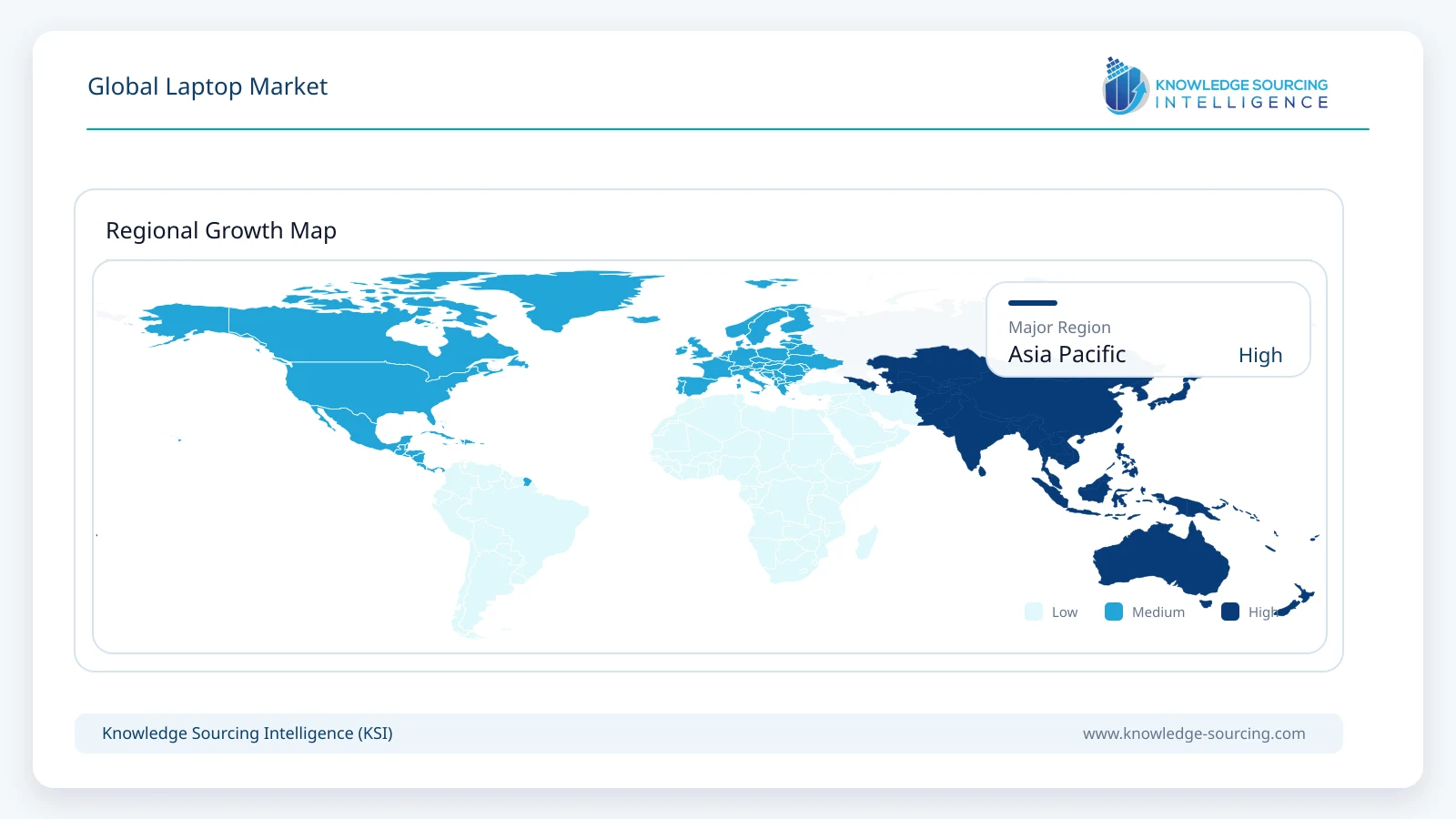
Global Laptop Market - Strategic Insights and Forecasts (2026-2031) Regional Growth Map infographic

Asia Pacific

Asia Pacific performs two critical functions within the laptop market: it represents the world's largest manufacturing ecosystem and one of the fastest-expanding customer bases for notebook computers. China remains central to component production and final assembly, while Taiwan continues supplying processors, motherboards, and contract manufacturing expertise. India, Vietnam, and Indonesia are receiving increasing manufacturing investment as vendors diversify production capacity and respond to government incentive programmes. Growing enterprise digitisation, expanding higher education enrolment, and digital public services continue supporting regional demand, although geopolitical uncertainty and export restrictions require manufacturers to strengthen supply-chain resilience.

South America

Brazil and Argentina account for a substantial proportion of regional notebook demand, supported by enterprise IT upgrades, education initiatives, and gradual digitalisation across financial services, healthcare, and government sectors. However, procurement remains sensitive to currency fluctuations, import duties, and inflationary pressure because many devices and components are sourced internationally. Local assembly operations help improve market access in selected countries, although dependence on imported semiconductors and advanced components continues to influence pricing and product availability.

Middle East and Africa

Government investment in digital education, public administration, healthcare modernisation, and smart city initiatives supports notebook procurement across several Middle Eastern economies. Saudi Arabia and the United Arab Emirates continue investing in digital government services and technology-enabled education, creating opportunities for enterprise-class laptops with advanced security and management features. Across many African markets, demand remains constrained by infrastructure limitations, purchasing power, and uneven broadband availability, resulting in stronger demand for affordable, durable notebook models rather than premium configurations.

Competitive Landscape

Competition in the global laptop market is characterised by a relatively concentrated group of multinational manufacturers with extensive product portfolios, established distribution networks, and broad after-sales service capabilities. The companies covered in this report, including Apple Inc., Dell Technologies, Lenovo, HP Inc., Acer Inc., ASUS, Microsoft, Samsung Electronics, Razer Inc., and Micro-Star International (MSI), compete across consumer, commercial, education, and gaming segments through differentiated product positioning rather than price alone.

Enterprise procurement increasingly favours vendors capable of combining hardware with lifecycle management, endpoint security, software integration, and global support services. As a result, suppliers continue investing in AI-enabled devices, premium display technologies, longer battery life, repairability, and device management platforms. Several manufacturers are also expanding manufacturing flexibility by increasing production outside traditional assembly locations to reduce geopolitical and supply-chain risks. Brand ecosystem integration, operating-system compatibility, channel partnerships, and long-term customer relationships remain important barriers to entry, particularly in enterprise and public-sector contracts where supplier credibility, warranty support, and deployment capability often outweigh initial hardware pricing.

Recent Developments

  • January 2026 – HP launched the OmniBook Ultra 14 at CES 2026. The premium AI laptop features an ultra-thin forged-aluminium chassis, Intel Core Ultra platform and enhanced durability, targeting professionals seeking high-performance mobile computing worldwide.

  • January 2026 – ASUS introduced its expanded AI PC portfolio at CES 2026, including new Zenbook Duo, Zenbook A14, Zenbook A16 and ExpertBook Ultra models. The launches emphasize on-device AI, productivity and premium mobile computing experiences.

  • January 2025 – Lenovo announced the ThinkBook Plus Gen 6 Rollable AI PC at CES 2025. Featuring the world's first commercially available rollable OLED laptop display, it expands screen space on demand for productivity and multitasking users.

  • January 2025 – Dell unveiled the redesigned Dell Pro, Dell Pro Max and Dell Plus laptop families, replacing legacy Inspiron, Latitude and XPS branding. The AI-focused portfolio simplifies product segmentation while delivering improved enterprise and consumer performance.

Regulatory and Policy Environment

Laptop manufacturers operate within an increasingly complex regulatory environment covering product safety, environmental compliance, cybersecurity, trade policy, and electronic waste management. These requirements affect product development, sourcing strategies, manufacturing investment, and after-sales support throughout the value chain.

Environmental legislation continues to influence notebook design. The European Union's Ecodesign framework, Energy Labelling Regulation, Waste Electrical and Electronic Equipment (WEEE) Directive, Restriction of Hazardous Substances (RoHS) Directive, and Right-to-Repair initiatives require manufacturers to improve energy efficiency, reduce hazardous materials, increase product durability, and simplify repair or component replacement. Compliance increasingly affects supplier qualification and procurement decisions among enterprise and public-sector buyers.

Trade and industrial policies are also reshaping manufacturing strategies. Government programmes supporting domestic electronics manufacturing, including India's Production Linked Incentive (PLI) scheme for IT hardware, encourage global manufacturers to diversify assembly capacity beyond traditional production hubs. Similar localisation efforts in several economies seek to strengthen supply-chain resilience while reducing dependence on concentrated manufacturing locations.

Cybersecurity requirements continue expanding across commercial procurement. Public-sector organisations and regulated industries increasingly require hardware-level security, trusted firmware, secure boot processes, encryption support, and remote device management before approving large-scale deployments. Vendors therefore compete not only through product performance but also through compliance with evolving security standards and certification requirements.

Outlook and Strategic Implications

Demand during the 2026-2031 forecast period is expected to depend more on replacement cycles and technology transitions than on first-time device ownership. Enterprise refresh programmes, AI-capable computing platforms, operating-system migration, and digital workplace investment are likely to remain the strongest commercial drivers. Consumer purchasing is expected to remain comparatively selective as longer device lifecycles reduce replacement frequency, encouraging manufacturers to differentiate products through performance, battery efficiency, AI functionality, display quality, and integrated software ecosystems.

Supply-chain resilience will remain an important competitive consideration. Manufacturers are expected to continue diversifying production locations, strengthening supplier relationships, and expanding regional manufacturing capacity to reduce exposure to geopolitical uncertainty, logistics disruptions, and component shortages. At the same time, increasing adoption of AI-enabled processors will influence hardware specifications, memory configurations, thermal management, and power efficiency across premium and commercial notebook categories.

Strategic priorities across the industry are becoming increasingly aligned with long-term service value rather than hardware shipments alone.

  • Manufacturers are expected to expand AI-enabled product portfolios, improve repairability, and strengthen lifecycle service offerings to protect margins.

  • Enterprise buyers will increasingly evaluate security, software compatibility, manageability, and total cost of ownership alongside hardware performance.

  • Component suppliers are likely to prioritise advanced processors, memory technologies, displays, batteries, and AI acceleration capabilities as notebook specifications evolve.

  • Channel partners and managed service providers are expected to benefit from increasing demand for deployment, configuration, maintenance, asset management, and device lifecycle services.

  • Governments and policymakers will continue influencing manufacturing investment through localisation incentives, environmental regulations, cybersecurity requirements, and digital education initiatives.

Overall, competitive advantage during the forecast period will depend less on incremental hardware improvements and more on an organisation's ability to integrate hardware, software, security, AI capability, and lifecycle services into a consistent commercial offering. Vendors capable of balancing product innovation with supply-chain resilience, regulatory compliance, and enterprise service capability are likely to be better positioned to capture procurement opportunities across both mature and emerging markets.

Global Laptop Market Scope:

Report Metric Details
Forecast Unit Billion
Study Period 2021 to 2031
Historical Data 2021 to 2024
Base Year 2025
Forecast Period 2026 – 2031
Segmentation Type, Screen Size, Operating System, End-Use, Geography
Companies
  • Apple Inc
  • Dell
  • Lenovo
  • HP Inc.
  • Acer Inc.
  • AsusTek Computer Inc.

Market Segmentation

By Type
  • Traditional (Clamshell) Laptops
  • 2-in-1 Laptops (Convertible and Detachable)
By Screen Size
  • Up to 13.9 inches
  • 14–15.9 inches
  • 16 inches and Above
By Operating System
  • Mac OS
  • Windows
  • ChromeOS
  • Linux
  • Others
By End-Use
  • Consumer
  • Commercial / Business
  • Gaming
  • Education
By Geography
  • North America
  • USA
  • Canada
  • Mexico
  • South America
  • Brazil
  • Argentina
  • Others
  • Europe
  • UK
  • Germany
  • France
  • Italy
  • Spain
  • Others
  • Middle East and Africa
  • Saudi Arabia
  • UAE
  • Others
  • Asia Pacific
  • China
  • Japan
  • India
  • South Korea
  • Australia
  • Indonesia
  • Others

Table of Contents

1. INTRODUCTION

1.1. Market Overview

1.2. Market Definition

1.3. Scope of the Study

1.4. Market Segmentation

1.5. Currency

1.6. Assumptions

1.7. Base and Forecast Years Timeline

2. RESEARCH METHODOLOGY

2.1. Research Data

2.2. Assumptions

3. EXECUTIVE SUMMARY

3.1. Research Highlights

4. MARKET DYNAMICS

4.1. Market Drivers

4.2. Market Restraints

4.3. Market Opportunities

4.4. Porter’s Five Force Analysis

4.4.1. Bargaining Power of Suppliers

4.4.2. Bargaining Power of Buyers

4.4.3. Threat of New Entrants

4.4.4. Threat of Substitutes

4.4.5. Competitive Rivalry in the Industry

4.5. Industry Value Chain Analysis

5. GLOBAL LAPTOP MARKET ANALYSIS, BY TYPE

5.1. Introduction

5.2. Traditional (Clamshell) Laptops

5.3. 2-in-1 Laptops (Convertible and Detachable)

6. GLOBAL LAPTOP MARKET ANALYSIS, BY SCREEN SIZE

6.1. Introduction

6.2. Up to 13.9 inches

6.3. 14–15.9 inches

6.4. 16 inches and Above

7. GLOBAL LAPTOP MARKET ANALYSIS, BY OPERATING SYSTEM

7.1. Introduction

7.2. Mac OS

7.3. Windows

7.4. ChromeOS

7.5. Linux

7.6. Others

8. GLOBAL LAPTOP MARKET ANALYSIS, BY END-USE

8.1. Introduction

8.2. Consumer

8.3. Commercial / Business

8.4. Gaming

8.5. Education

9. GLOBAL LAPTOP MARKET ANALYSIS, BY GEOGRAPHY

9.1. Introduction

9.2. North America

9.2.1. USA

9.2.2. Canada

9.2.3. Mexico

9.3. South America

9.3.1. Brazil

9.3.2. Argentina

9.3.3. Others

9.4. Europe

9.4.1. UK

9.4.2. Germany

9.4.3. France

9.4.4. Italy

9.4.5. Spain

9.4.6. Others

9.5. Middle East and Africa

9.5.1. Saudi Arabia

9.5.2. UAE

9.5.3. Others

9.6. Asia Pacific

9.6.1. China

9.6.2. Japan

9.6.3. India

9.6.4. South Korea

9.6.5. Australia

9.6.6. Indonesia

9.6.7. Others

10. COMPETITIVE ENVIRONMENT AND ANALYSIS

10.1. Major Players and Strategy Analysis

10.2. Emerging Players and Market Lucrativeness

10.3. Mergers, Acquisitions, Agreements, and Collaborations

10.4. Vendor Competitiveness Matrix

11. COMPANY PROFILES

11.1. Apple Inc

11.2. Dell

11.3. Lenovo

11.4. HP Inc

11.5. Acer Inc

11.6. AsusTek Computer Inc

11.7. Razer Inc

11.8. Microsoft

11.9. Samsung Electronics Co

11.10. Micro-Star International Co Ltd

LIST OF FIGURES

LIST OF TABLES

Need Assistance?

Our research team is available to answer your questions.

Contact Us
Report IDKSI061614311
Last updated
Pages156
FormatPDF, Excel, PPT, Dashboard
Frequently Asked Questions

The Global Laptop Market is projected to register a strong Compound Annual Growth Rate (CAGR) during the forecast period of 2026-2031. This growth is primarily fueled by ongoing commercial notebook refresh cycles, the increasing adoption of AI-enabled laptops, and widespread digitalization initiatives in both educational and hybrid working environments.

Commercial and enterprise demand is significantly driven by accelerated device replacement programs, largely due to the approaching end of support for older operating systems like Windows 10 in October 2025. Additionally, hybrid working practices, educational digitalization initiatives, and the introduction of AI-capable personal computers are reshaping procurement behaviors, focusing on higher memory, processing capability, and battery efficiency.

Asia Pacific remains central to global laptop manufacturing capacity and supply chain resilience. Conversely, North America and Europe are key drivers of premium commercial demand, emphasizing higher-value products and comprehensive service solutions. These regions also seek consistent deployment standards for multinational organizations with geographically distributed workforces.

Competition is increasingly extending beyond physical hardware, with vendors competing through comprehensive operating-system ecosystems, enterprise management tools, and robust security capabilities. Value creation is also becoming more service-oriented, with offerings like device lifecycle management, managed deployment, cloud integration, and subscription-based software contributing a growing share of vendor revenue.

AI-enabled laptops are significantly changing procurement priorities, shifting focus towards higher memory, advanced processing capability, and improved battery efficiency. Manufacturers are responding by introducing differentiated product portfolios that combine AI acceleration, enhanced energy efficiency, and higher-resolution displays to preserve average selling prices and justify upgrades.

Enterprise procurement decisions are increasingly balancing computing performance, security, battery endurance, and comprehensive service support with software compatibility and lifecycle management, moving beyond solely hardware specifications. Factors such as enterprise security, robust device management tools, and lifecycle services are becoming critical considerations in purchasing decisions, especially for multinational organizations.

Need data specifically for your business?Request Custom Research β†’

Trusted by the world's leading organizations

Weber Shandwick
veolia
Tri
tls
TeamViewer
GE Healthcare
Intel
Proctor and Gamble
ABB
Elkem
Defense Logistics Agency
Amazon