
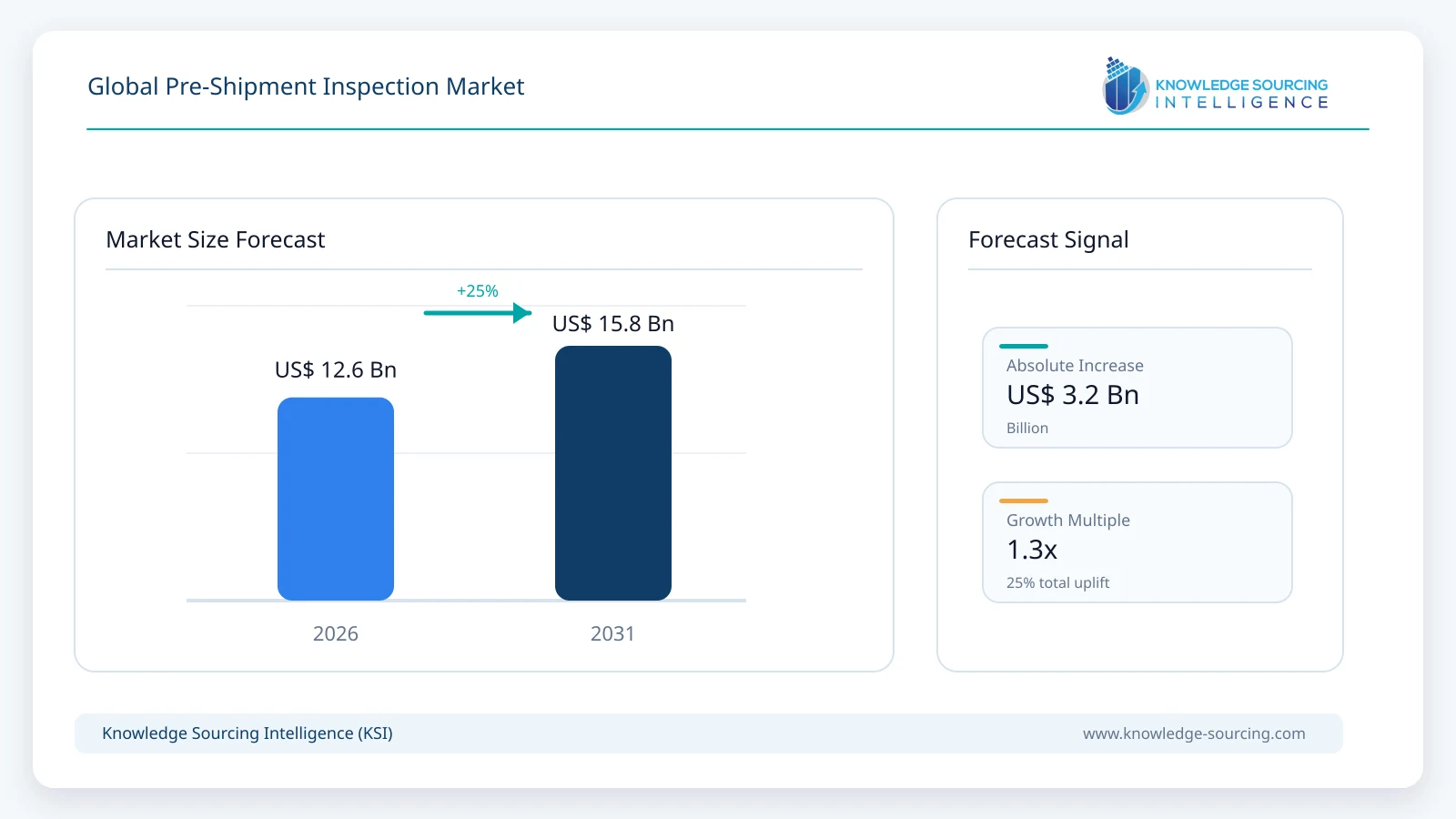
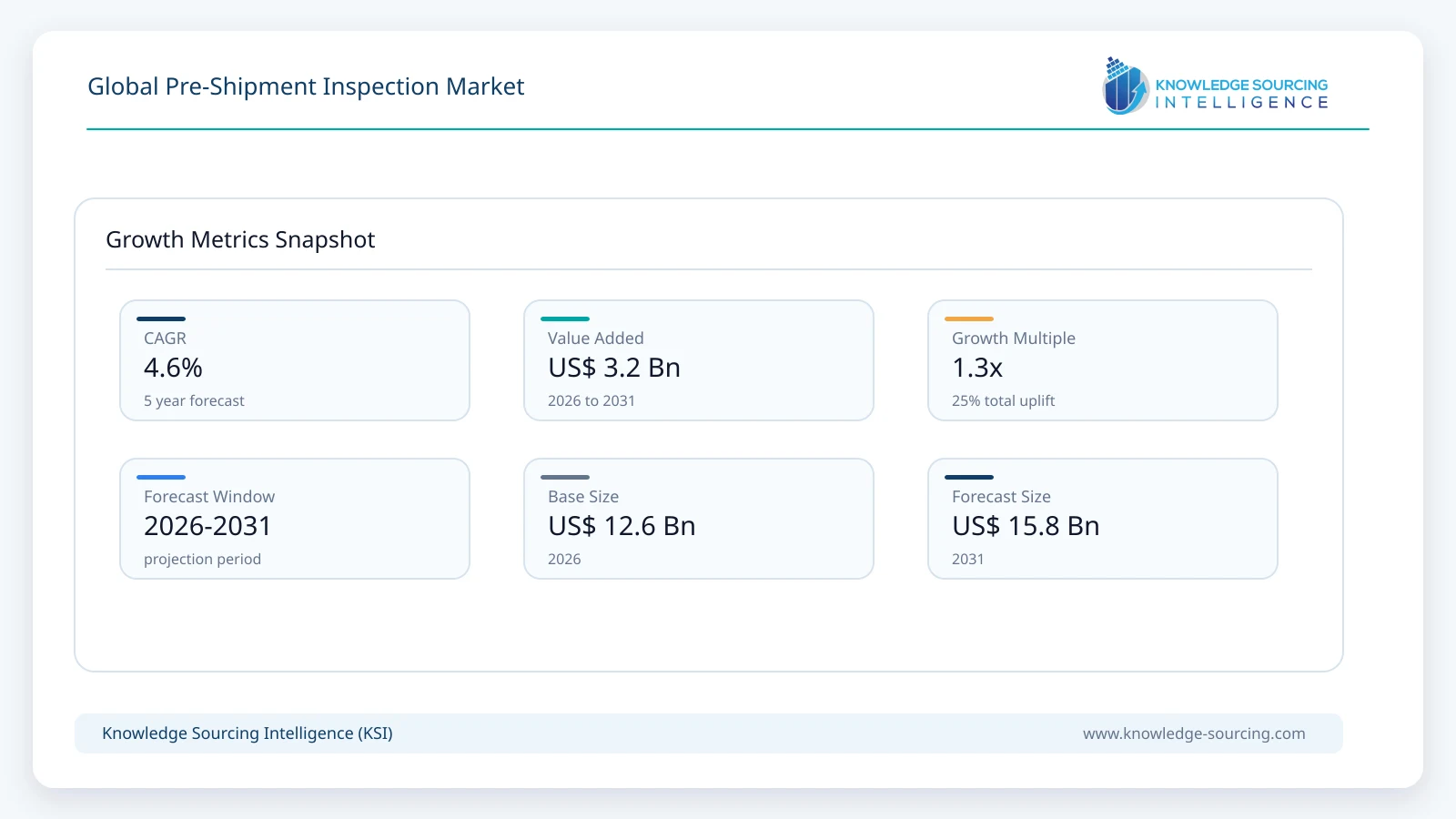
The Pre-Shipment Inspection Market is forecast to grow at a CAGR of 4.6%, reaching USD 15.8 billion in 2031 from USD 12.6 billion in 2026.
Highlights:
- 1Demand catalystGreater reliance on cross-border sourcing increases the financial importance of independent verification before goods leave the supplier's facility.
- 2Important service areaQuality and quantity inspection remains commercially central because it directly tests whether delivered goods correspond with contractual requirements.
- 3Regional opportunityAsia Pacific remains strategically important because it combines major manufacturing bases with extensive export activity and complex supplier networks.
- 4Technology trendDigital inspection reporting, mobile evidence capture, data integration, and risk-based inspection planning are improving traceability and turnaround times.
- 5Regulatory influenceCustoms authorities increasingly use advance cargo information and risk management to identify shipments requiring greater scrutiny before or during border processing.
- 6Competitive trendLeading providers are broadening integrated testing, inspection, certification, and laboratory capabilities rather than competing solely on physical inspection manpower.
The Pre-Shipment Inspection Market covers third-party inspection, verification, testing, and documentation services performed before goods leave the exporting country or before the shipment reaches the importing market. The scope includes verification of quality, quantity, specifications, packaging, marking, loading conditions, documentation, customs classification, valuation, sampling, and laboratory results. The market serves both government-mandated inspection programs and privately commissioned supply-chain quality assurance activities.
The commercial role of pre-shipment inspection is broader than physical product checking. Importers use inspection agencies to reduce the probability of receiving non-conforming goods, while exporters use independent verification to demonstrate contractual compliance and reduce disputes. Government authorities can also use inspection programs to strengthen customs valuation, tariff classification, revenue protection, and import-control processes. The World Trade Organization defines preshipment inspection activities around verification of quality, quantity, price, financial terms, and customs classification, while its Agreement on Preshipment Inspection establishes obligations for governments, exporters, and inspection entities.
Demand therefore originates from several distinct purchasing mechanisms. Government procurement is generally linked to import-control policy, customs administration, foreign-exchange protection, revenue collection, or product conformity requirements. Corporate procurement is driven by the financial consequences of defective shipments, inaccurate specifications, counterfeit products, damaged cargo, incorrect documentation, and supplier non-compliance. The economic value of inspection rises when the cost of a failed shipment exceeds the cost of independent verification.
The buyer's selection criteria also vary by application. Government clients place greater weight on independence, geographic coverage, accreditation, auditability, data security, reporting consistency, and the ability to operate within defined regulatory procedures. Importers and manufacturers generally prioritize turnaround time, technical competence, supplier coverage, inspection availability, reporting quality, and the ability to combine physical inspection with laboratory testing or certification.
International customs policy is creating an additional demand layer around pre-arrival data and risk assessment. The World Customs Organization promotes advance submission of import information and risk-based control, with customs administrations expected to concentrate intervention on higher-risk consignments while facilitating lower-risk trade. This does not make every pre-shipment inspection mandatory, but it increases the commercial value of accurate shipment information before goods enter the destination market.
The market is also moving toward integrated service procurement. A buyer may begin with factory inspection and subsequently require product sampling, laboratory analysis, container loading supervision, document verification, and conformity assessment. This creates opportunities for suppliers that can coordinate multiple inspection disciplines through one international operating network.
Technology is changing how inspection evidence is collected and delivered. Digital inspection reports, mobile data capture, photographic evidence, remote document review, laboratory information systems, geolocation records, automated anomaly detection, and risk-based inspection planning can reduce administrative processing and improve traceability. However, physical verification remains essential for many products because dimensions, workmanship, packaging condition, quantity, labeling, loading practices, and material characteristics cannot always be established from documentation alone.
Industry structure is consequently based on a combination of global networks, specialist laboratories, local inspection personnel, technical experts, and accreditation capabilities. Large providers compete on geographic reach and service breadth, while specialist firms can differentiate through sector expertise, faster response, or focused inspection programs.
Market Drivers
Expansion of Cross-Border Manufacturing and Supplier Networks
International sourcing creates a verification gap between the buyer's contractual requirements and the physical goods prepared for shipment. Buyers may not have employees or technical teams located near overseas factories, particularly when procurement is distributed across multiple countries.
Pre-shipment inspection addresses this gap by creating an independent checkpoint before ownership, transportation, and customs costs increase the consequences of non-conformity. An importer can identify quantity shortages, manufacturing defects, incorrect specifications, packaging failures, labeling errors, or visible damage before the shipment leaves the supplier's facility.
The commercial mechanism is particularly relevant for companies purchasing from unfamiliar suppliers or managing large numbers of contract manufacturers. Inspection providers can standardize supplier verification across countries, allowing procurement teams to apply common acceptance criteria across factories.
The resulting demand is not limited to government-mandated programs. Private buyers increasingly have an economic reason to commission inspection when rejected shipments would generate freight costs, production interruptions, customer claims, rework, or inventory write-offs.
Stronger Customs Risk Management and Advance Cargo Controls
Modern customs systems increasingly depend on information received before cargo arrives. The WCO's trade facilitation framework supports advance electronic submission of import documentation and risk-based selection of consignments for control.
The European Union provides a clear example. Its Import Control System 2 requires economic operators bringing goods into or through the EU to provide safety and security data through Entry Summary Declarations. Customs authorities use this information for pre-arrival risk analysis and targeted controls. Since September 2025, ICS2 safety and security data requirements have applied across air, maritime, road, and rail modes under the relevant deployment framework.
This regulatory direction strengthens demand for accurate shipment information and supporting verification. Inspection providers can contribute by validating physical and documentary information before shipment, although the inspection itself does not replace customs control.
Growth in Product Conformity and Technical Requirements
International trade increasingly involves products subject to technical regulations, safety requirements, labeling rules, material restrictions, and sector-specific standards. A shipment that meets the commercial specification of a buyer may still fail destination-market requirements.
Inspection companies therefore receive demand from importers and exporters that need independent confirmation before dispatch. This is especially relevant for machinery, electrical products, consumer goods, automotive components, chemicals, healthcare products, and industrial equipment.
The economic rationale is straightforward. Detecting a conformity issue at the factory is normally less expensive than correcting the same problem after export. Pre-shipment verification can prevent non-compliant inventory from entering the logistics chain, where return freight, customs delays, storage, and customer disruption can multiply the original problem.
Increasing Need for Independent Supplier Verification
Procurement organizations are placing greater emphasis on supplier qualification and measurable compliance. Independent inspection reduces reliance on supplier-issued declarations and internal quality reports.
The requirement becomes stronger when buyers operate across multiple tiers of suppliers. A procurement organization may have direct contractual visibility over a manufacturer but limited visibility over subcontractors, component suppliers, or processing facilities.
Inspection agencies can bridge this information gap through factory visits, production monitoring, product sampling, loading supervision, and documentary checks. Their commercial value comes from converting supplier performance into standardized evidence that procurement and quality teams can use.
Expansion of Testing and Inspection Bundling
Inspection demand is increasingly connected to laboratory and certification requirements. A shipment may require visual inspection, dimensional checks, material testing, chemical analysis, microbiological testing, electrical safety testing, or product certification.
Integrated service procurement reduces coordination requirements for the buyer. A single provider can manage inspection scheduling, sampling, laboratory testing, technical reporting, and certification-related documentation.
This model also supports higher-value engagements because laboratory and technical services can be attached to conventional inspection assignments. Providers with international laboratories and specialist technical personnel therefore have an advantage when customers want one accountable service relationship.
Market Restraints and Challenges
Cost Sensitivity Among Small and Medium-Sized Importers
Inspection fees add another cost to international procurement. For low-value shipments, buyers may conclude that inspection costs exceed the expected loss from defects or shortages.
This creates a pricing challenge for inspection companies because the commercial value of inspection depends on shipment risk, product complexity, and the buyer's loss exposure. Providers can address the issue through risk-based sampling, digital workflows, bundled inspection programs, and differentiated service levels rather than applying the same inspection intensity to every shipment.
Fragmented Regulatory Requirements
Inspection procedures differ considerably between importing countries, product categories, and government programs. A supplier operating in several destinations may need to understand different documentation, conformity, labeling, customs, and certification requirements.
Fragmentation increases the technical knowledge required from inspection agencies and raises the cost of maintaining qualified personnel. Providers must continuously update regulatory databases, procedures, training programs, and technical capabilities.
For buyers, regulatory fragmentation can also create uncertainty over which inspection or certification is actually required. Inspection firms with strong local regulatory knowledge can therefore differentiate through interpretation and execution, not only physical inspection.
Inspection Timing and Supply Chain Coordination
Pre-shipment inspection must occur at the correct point in the production and logistics cycle. An inspection conducted too early may not reflect the final shipment, while an inspection conducted too late may delay loading.
Coordination becomes more complicated when production schedules change, containers arrive earlier than expected, or suppliers operate across different time zones. Missed inspection windows can create additional costs for importers and exporters.
Digital scheduling, mobile inspection systems, supplier portals, and real-time communication can reduce these operational problems. However, the requirement for qualified personnel at the physical site remains a constraint for complex or remote assignments.
Maintaining Independence and Evidence Quality
The commercial credibility of third-party inspection depends on independence. A buyer must be able to rely on the inspection report when negotiating with suppliers, insurers, customs authorities, or other stakeholders.
Inconsistent sampling methods, incomplete photographic evidence, weak chain-of-custody procedures, or poorly trained inspectors can reduce the value of the service. Large providers therefore need consistent global procedures while allowing sufficient technical specialization for different products.
Pressure on Pricing and Standardized Inspection Services
Routine inspection assignments can become price-sensitive when buyers compare multiple accredited providers. Basic quantity, visual, packaging, and loading inspections may have limited differentiation when technical complexity is low.
Providers need to protect margins through efficient scheduling, digital reporting, standardized procedures, laboratory integration, and specialized technical services. Differentiation becomes more defensible when an inspection assignment requires sector-specific expertise, advanced testing, regulatory interpretation, or complex international coordination.
Major Segment Analysis
Quality and Quantity Inspection
Quality and Quantity Inspection represents one of the most commercially important service areas because it addresses the fundamental question of whether the shipment physically corresponds with the buyer's purchase requirements.
The service normally verifies characteristics such as product quantity, dimensions, workmanship, appearance, model or specification conformity, packaging condition, labeling, and visible defects. Depending on the commodity, inspection may also involve weighing, counting, measurement, sampling, or comparison against approved specifications.
The demand mechanism differs between industries. Consumer-product importers may use inspection to identify defects or packaging inconsistencies before containerization. Industrial buyers may require dimensional or functional checks because a non-conforming component can interrupt downstream production. Commodity buyers may place greater emphasis on quantity, sampling methodology, grading, or material characteristics.
Buyer requirements increasingly extend beyond a simple pass-or-fail decision. Procurement teams want inspection evidence that can be linked to purchase orders, supplier records, photographs, sampling plans, and corrective actions. This makes reporting quality commercially important.
The service also provides a practical mechanism for managing supplier performance. If repeated inspections identify the same production defects, buyers can use the inspection data to modify supplier acceptance criteria, production controls, or sourcing decisions.
Competition in this segment is influenced by geographic availability, inspector density, turnaround time, accreditation, sector knowledge, and reporting systems. A provider with a broad local network can reach factories quickly, while a technically specialized provider may win assignments involving machinery, electrical equipment, chemicals, automotive components, or other complex products.
The revenue opportunity is therefore connected not only to the number of inspections but also to inspection complexity. Basic visual checks can be highly competitive on price, while technical inspection programs can command greater value because they require qualified personnel, specialized equipment, sampling expertise, and laboratory support.
Regional Analysis
North America
North American demand is supported by large import flows, sophisticated procurement organizations, extensive manufacturing supply chains, and strict product compliance expectations. The United States combines high import volumes with extensive customs enforcement, while Canada and Mexico are deeply integrated into North American manufacturing networks.
Buyers commonly emphasize supplier qualification, product conformity, traceability, and prevention of downstream quality failures. Mexico's role in automotive, electronics, machinery, and industrial manufacturing also creates inspection requirements associated with cross-border production.
The region's mature corporate procurement environment can constrain demand for basic inspection when buyers maintain internal quality teams. However, third-party services remain valuable for overseas supplier verification, specialized laboratory testing, independent dispute resolution, and complex international supply programs.
Europe
European demand is influenced by extensive product safety, environmental, customs, and technical compliance requirements. The European Commission's customs framework places strong emphasis on pre-arrival information, risk assessment, and targeted intervention.
The implementation of ICS2 across transport modes has increased the importance of complete and accurate advance cargo information. Economic operators must provide required Entry Summary Declaration data, allowing customs authorities to conduct risk analysis before goods arrive.
Germany, France, the United Kingdom, and other European markets also have substantial industrial, automotive, chemical, machinery, and consumer-product supply chains. Buyers therefore require inspection providers with both physical inspection capacity and strong regulatory knowledge.
The principal constraint is regulatory complexity. European buyers may already operate sophisticated internal quality systems, limiting demand for basic inspection. Opportunities are stronger where third-party independence, technical testing, supplier oversight, or cross-border conformity expertise is required.
Asia Pacific
Asia Pacific is strategically important because it combines major manufacturing centers with substantial intra-regional and global exports. China, Japan, South Korea, India, and Southeast Asian production centers support large supplier ecosystems across electronics, consumer goods, machinery, automotive, chemicals, textiles, and industrial products.
China's customs framework demonstrates the importance of physical verification. Official customs rules provide for inspection of imported and exported goods to verify whether declared information corresponds with actual goods and to determine matters including classification, valuation, and origin.
India's expanding manufacturing base and international sourcing relationships create demand for supplier inspection, product testing, quantity verification, and export documentation support. Japan and South Korea add demand from sophisticated automotive, electronics, chemicals, and industrial supply chains.
The region also presents strong opportunities for inspection networks because international buyers frequently require verification at the manufacturing source rather than after cargo reaches the destination.
Middle East and Africa
Demand across the Middle East and Africa is influenced by import dependence in several product categories, national conformity programs, infrastructure investment, industrial procurement, and customs modernization.
Saudi Arabia provides a clear example of government-supported digital conformity processes. The Saudi Standards, Metrology and Quality Organization operates the Saber platform, through which importers can obtain consignment certificates for commercial products and work with conformity assessment bodies.
This type of regulatory architecture creates demand for inspection and conformity-assessment capabilities connected to import clearance. The UAE similarly benefits from its role as a regional logistics and distribution hub, while South Africa has demand across mining, industrial equipment, agriculture, consumer goods, and manufacturing.
The major constraints include fragmented regulations, varying inspection infrastructure, geographic distances, and differences in enforcement capacity. Providers with established local networks can reduce these operational barriers.
South America
South American demand is linked to agricultural exports, industrial imports, mining, consumer goods, chemicals, automotive supply chains, and customs compliance. Brazil represents the largest commercial opportunity within the regional grouping because of its diversified industrial base and extensive international trade activity.
Commodity-related inspection is particularly relevant because quantity, quality, grading, sampling, moisture, composition, and loading conditions can affect shipment value. Industrial importers also require inspection when equipment or components are sourced internationally.
Market development is constrained by economic volatility, regulatory complexity, logistics challenges, and differing inspection requirements between countries. Local technical capacity combined with international reporting standards can therefore provide a competitive advantage.
Competitive Landscape
The competitive structure includes large international testing, inspection, and certification groups alongside specialized inspection providers. The supplied competitive universe comprises Bureau Veritas, Intertek Group plc, HQTS Group, SGS SA, QIMA, DEKRA SE, Eurofins Scientific SE, Applus+, TÜV SÜD AG, and TÜV Rheinland AG.
These providers compete through different combinations of geographic coverage, technical specialization, laboratory capability, accreditation, digital reporting, sector expertise, and customer relationships. Their broader testing and certification portfolios can also support cross-selling into inspection programs.
Large global groups benefit from established networks and the ability to serve multinational customers across multiple production countries. For multinational procurement teams, this reduces the administrative burden of managing several local inspection providers.
Specialist providers compete by emphasizing speed, supplier proximity, digital workflow, category expertise, and tailored inspection procedures. The distinction is commercially important because a buyer sourcing standardized consumer goods has different requirements from an EPC contractor inspecting industrial machinery or a government authority operating a national import-control program.
The competitive model is also shifting toward integrated service packages. Intertek's 2025 reporting, for example, describes its global offering as an integrated Assurance, Testing, Inspection and Certification model and reported 2025 revenue of £3.43 billion. SGS maintains an integrated reporting structure covering its global testing, inspection, and certification operations.
TÜV Rheinland's 2025 results also demonstrate the importance of technical expansion and international coverage. The company reported 2025 revenue of EUR 2.98 billion and highlighted continued investment in future technologies, while international operations represented more than half of its business in the preceding year.
The competitive advantage therefore increasingly depends on combining physical inspection capacity with laboratories, regulatory expertise, digital evidence management, and sector-specific technical knowledge. Geographic expansion alone is insufficient where customers require technically defensible results.
Recent Developments
August 2026: DGFT enhanced the PSIA/PSIC process on August 25, standardizing inspection-date formats and strengthening digital compliance, transparency, and reducing manual intervention through the DGFT portal.
June 2026: Intertek was appointed by Nigeria’s Standards Organisation to deliver SONCAP conformity assessment services, expanding inspection, testing, and certification support for regulated imports before shipment.
May 2026: DGFT enlisted 14 new Pre-Shipment Inspection Agencies on May 8 and authorized two existing agencies to add approved radiation meters and spectrometers.
February 2026: Intertek was appointed by Kenya Bureau of Standards as a conformity assessment body under Kenya’s PVoC programme, covering inspection, testing, certification, and compliance before shipment.
February 2026: DNV launched Industrial Services on February 19, consolidating its inspection capabilities into a dedicated global business serving energy, infrastructure, and complex industrial supply chains.
Regulatory and Policy Environment
The regulatory foundation of the market is strongly influenced by the WTO Agreement on Preshipment Inspection. The agreement recognizes preshipment inspection activities involving verification of quality, quantity, price, financial terms, and customs classification. It also establishes obligations for user and exporter members and provides an independent review mechanism for disputes involving exporters and inspection entities.
The agreement is commercially important because it establishes a framework for government-mandated PSI programs while recognizing the need to avoid unnecessary delays and discriminatory treatment. Inspection providers operating under government mandates must therefore balance revenue protection and compliance objectives with trade facilitation.
The WCO's standards provide another important policy layer. Customs administrations are expected to use risk management and risk analysis to determine which goods require examination and the appropriate level of control. The WCO framework specifically supports concentration of controls on higher-risk consignments while facilitating lower-risk shipments.
Pre-arrival processing is becoming a core element of this approach. The WCO supports advance electronic submission of import information, allowing customs authorities to begin processing before goods arrive. This creates a regulatory environment in which accurate documentation and reliable shipment data have greater operational value.
The EU's ICS2 framework illustrates how these principles are being implemented through digital customs systems. Entry Summary Declaration information is used for security and safety risk analysis, and inaccurate or incomplete data can result in filing problems and delays.
The United Kingdom similarly requires entry summary declarations for applicable imports, with HM Revenue & Customs describing the declarations as an important part of frontier risk assessment. The information is submitted before goods arrive so that customs authorities can assess risk in advance.
National conformity systems also influence inspection demand. Saudi Arabia's Saber platform, for example, connects importers with conformity assessment bodies and supports the issuance of consignment certificates for commercial products.
China's customs rules provide for inspection of imported and exported goods to verify declared information against actual goods and to determine classification, valuation, and origin.
For inspection providers, the policy implication is clear. Regulatory compliance is no longer limited to physical examination. Providers need personnel, procedures, digital systems, laboratories, accreditation, and documentation processes that can support increasingly data-driven customs and conformity regimes.
Outlook and Strategic Implications
The Pre-Shipment Inspection Market is expected to remain closely linked to international trade volumes, supplier dispersion, product regulation, customs modernization, and corporate quality-risk management during 2026–2031. The strongest commercial opportunities will not necessarily arise from the highest shipment volumes alone. They will emerge where the financial consequences of non-conformity are high and where buyers require independent evidence before committing cargo to international logistics.
Inspection providers should prioritize digital evidence systems that connect inspection findings with purchase orders, supplier records, photographs, sampling information, laboratory results, and compliance documentation. The commercial benefit is greater traceability and faster decision-making rather than technology adoption for its own sake.
Procurement organizations are also likely to favor service providers capable of consolidating inspection, testing, certification, and regulatory support. A single supplier can reduce coordination costs and create consistent inspection standards across several sourcing markets.
Risk-based service design will become more important. Not every shipment requires the same inspection intensity. Buyers can allocate more inspection resources to high-value, high-risk, technically complex, or newly onboarded suppliers while applying lighter controls to established suppliers with strong performance records.
Laboratory integration is another strategic priority. As product specifications become more technical, visual inspection alone may not provide sufficient assurance. Chemical analysis, material testing, electrical testing, microbiological analysis, mechanical testing, and other specialist capabilities can increase the value of inspection engagements.
Geographic investment should remain concentrated around major manufacturing clusters, ports, logistics hubs, and export-oriented industrial zones. Asia Pacific is particularly important because inspection performed at the source can prevent defects before goods enter long-distance transportation.
The competitive environment will also favor providers that can combine global reach with local execution. A global buyer needs standardized reporting and governance, but inspection itself often requires personnel with detailed knowledge of local factories, production processes, regulations, languages, and logistics conditions.
Regulatory change presents both an opportunity and a risk. New customs data requirements can increase demand for compliance support, but providers must continuously update procedures and technical knowledge. Failure to maintain regulatory accuracy can expose both the provider and its clients to delays, rejected documentation, or commercial disputes.
The market's long-term commercial proposition therefore rests on risk reduction. Buyers will continue to pay for inspection when independent evidence can prevent a larger downstream loss. Providers that demonstrate measurable reductions in rejected shipments, supplier disputes, customs problems, and non-conforming deliveries will be better positioned than suppliers competing primarily on inspection price.
Pre-Shipment Inspection Market Scope:
| Report Metric | Details |
|---|---|
| Total Market Size in 2026 | USD 12.6 billion |
| Total Market Size in 2031 | USD 15.8 billion |
| Forecast Unit | Billion |
| Growth Rate | 4.6% |
| Study Period | 2021 to 2031 |
| Historical Data | 2021 to 2024 |
| Base Year | 2025 |
| Forecast Period | 2026 – 2031 |
| Segmentation | Service Type, End User, Industry, Geography |
| Companies |
|
| Customization Scope | 15% Free Customization included with purchase — Request Custom Breakdown → |
| Sample & Data Access | PDF Sample, Excel Databook & Analyst Briefing — Download Free Sample → |
Market Segmentation
By Service Type
Quality and Quantity Inspection
Product Conformity and Specification Verification
Packaging and Marking Inspection
Loading and Container Inspection
Documentation and Customs Verification
Valuation and Tariff Classification
Sampling and Laboratory Testing
Others
By End User
Government and Customs Authorities
Importers and Traders
Exporters and Manufacturers
Retailers and Distributors
Project Owners and EPC Contractors
Others
By Industry
Consumer Products
Agriculture and Food
Minerals and Metals
Oil and Gas
Chemicals and Petrochemicals
Automotive
Electronics and Electrical Products
Healthcare
Industrial Equipment and Machinery
Others
By Geography
North America
United States
Canada
Mexico
South America
Brazil
Argentina
Others
Europe
Germany
France
United Kingdom
Spain
Others
Middle East and Africa
Saudi Arabia
United Arab Emirates
Israel
South Africa
Others
Asia Pacific
China
Japan
South Korea
India
Australia
Others
Table of Contents
1. INTRODUCTION
1.1. Market Overview
1.2. Market Definition
1.3. Scope of the Study
1.4. Currency
1.5. Assumptions
1.6. Base and Forecast Years Timeline
2. RESEARCH METHODOLOGY
2.1. Research Design
2.2. Secondary Sources
3. EXECUTIVE SUMMARY
4. MARKET DYNAMICS
4.1. Market Segmentation
4.2. Market Drivers
4.3. Market Restraints
4.4. Market Opportunities
4.5. Porter’s Five Forces Analysis
4.5.1. Bargaining Power of Suppliers
4.5.2. Bargaining Power of Buyers
4.5.3. Threat of New Entrants
4.5.4. Threat of Substitutes
4.5.5. Competitive Rivalry in the Industry
4.6. Regional Market Life Cycle Analysis
4.7. Market Attractiveness Analysis
5. GLOBAL PRE-SHIPMENT INSPECTION MARKET BY SERVICE TYPE
5.1. Quality and Quantity Inspection
5.2. Product Conformity and Specification Verification
5.3. Packaging and Marking Inspection
5.4. Loading and Container Inspection
5.5. Documentation and Customs Verification
5.6. Valuation and Tariff Classification
5.7. Sampling and Laboratory Testing
5.8. Others
6. GLOBAL PRE-SHIPMENT INSPECTION MARKET BY END USER
6.1. Government and Customs Authorities
6.2. Importers and Traders
6.3. Exporters and Manufacturers
6.4. Retailers and Distributors
6.5. Project Owners and EPC Contractors
6.6. Others
7. GLOBAL PRE-SHIPMENT INSPECTION MARKET BY INDUSTRY
7.1. Consumer Products
7.2. Agriculture and Food
7.3. Minerals and Metals
7.4. Oil and Gas
7.5. Chemicals and Petrochemicals
7.6. Automotive
7.7. Electronics and Electrical Products
7.8. Healthcare
7.9. Industrial Equipment and Machinery
7.10. Others
8. GLOBAL PRE-SHIPMENT INSPECTION MARKET BY GEOGRAPHY
8.1. North America
8.1.1. United States
8.1.2. Canada
8.1.3. Mexico
8.2. South America
8.2.1. Brazil
8.2.2. Argentina
8.2.3. Others
8.3. Europe
8.3.1. Germany
8.3.2. France
8.3.3. United Kingdom
8.3.4. Spain
8.3.5. Others
8.4. Middle East and Africa
8.4.1. Saudi Arabia
8.4.2. United Arab Emirates
8.4.3. Israel
8.4.4. South Africa
8.4.5. Others
8.5. Asia Pacific
8.5.1. China
8.5.2. Japan
8.5.3. South Korea
8.5.4. India
8.5.5. Australia
8.5.6. Others
9. COMPETITIVE INTELLIGENCE
9.1. Competitive Benchmarking and Analysis
9.2. Recent Investments and Deals
9.3. Strategies of Key Players
10. COMPANY PROFILES
10.1. Bureau Veritas
10.2. Intertek Group plc
10.3. HQTS Group
10.4. SGS SA
10.5. QIMA
10.6. DEKRA SE
10.7. Eurofins Scientific SE
10.8. Applus+
10.9. TÜV SÜD AG
10.10. TÜV Rheinland AG
LIST OF FIGURES
LIST OF TABLES





Frequently asked questions
What is the projected growth trajectory for the Global Pre-Shipment Inspection Market from 2026 to 2031?
The Global Pre-Shipment Inspection Market is forecast to grow at a Compound Annual Growth Rate (CAGR) of 4.6% during the 2026-2031 period. The market is projected to reach USD 15.8 billion in 2031, up from USD 12.6 billion in 2026, as detailed in the "Global Pre-Shipment Inspection Market - Strategic Insights and Forecasts (2026-2031)" report.
What key factors are driving the demand in the Global Pre-Shipment Inspection Market?
The demand for pre-shipment inspection services is primarily driven by growing international trade and improving trade relations between countries. Additionally, increasing global concerns regarding piracy and counterfeiting, along with the trend towards outsourcing these services to specialized providers, are significant market propellers identified in the report.
Which geographic region is expected to show significant growth in the Pre-Shipment Inspection Market by 2031?
The Asia Pacific region is anticipated to experience impressive growth in the Pre-Shipment Inspection Market throughout the forecast period (2026-2031). This surge is attributed to the implementation of export-oriented policies and improved trade relations by developing countries within the region.
Who are the major players analyzed in the "Global Pre-Shipment Inspection Market - Strategic Insights and Forecasts (2026-2031)" report?
The report profiles key participants in the Global Pre-Shipment Inspection Market, including prominent companies such as Bureau Veritas, Intertek Group PLC, HQTS Group, Ltd., SGS SA, QIMA, Dekra Certification B.V., Eurofins Scientific, Applus+, TUV SUD, and TUV Rheinland. These companies play a crucial role in shaping the market landscape.
What potential challenges might hinder the growth of the Pre-Shipment Inspection Market between 2026 and 2031?
The "Global Pre-Shipment Inspection Market - Strategic Insights and Forecasts (2026-2031)" report highlights that the slow process often associated with pre-shipment inspections may act as a hindering factor for market growth during the next five years. This operational challenge could impact overall market expansion.
What is the primary purpose of pre-shipment inspection services covered in this market analysis?
Pre-shipment inspection services are conducted to ensure that orders, specifically pertaining to components, equipment, and materials, adhere to the precise specifications provided by customers. This crucial verification process helps mitigate risks associated with international trade, such as counterfeiting and non-conformity, as highlighted in the market report.
Cite this report
Knowledge Sourcing Intelligence. (Sep 2026). Global Pre-Shipment Inspection Market - Strategic Insights and Forecasts (2026-2031). https://www.knowledge-sourcing.com/report/global-pre-shipment-inspection-market