
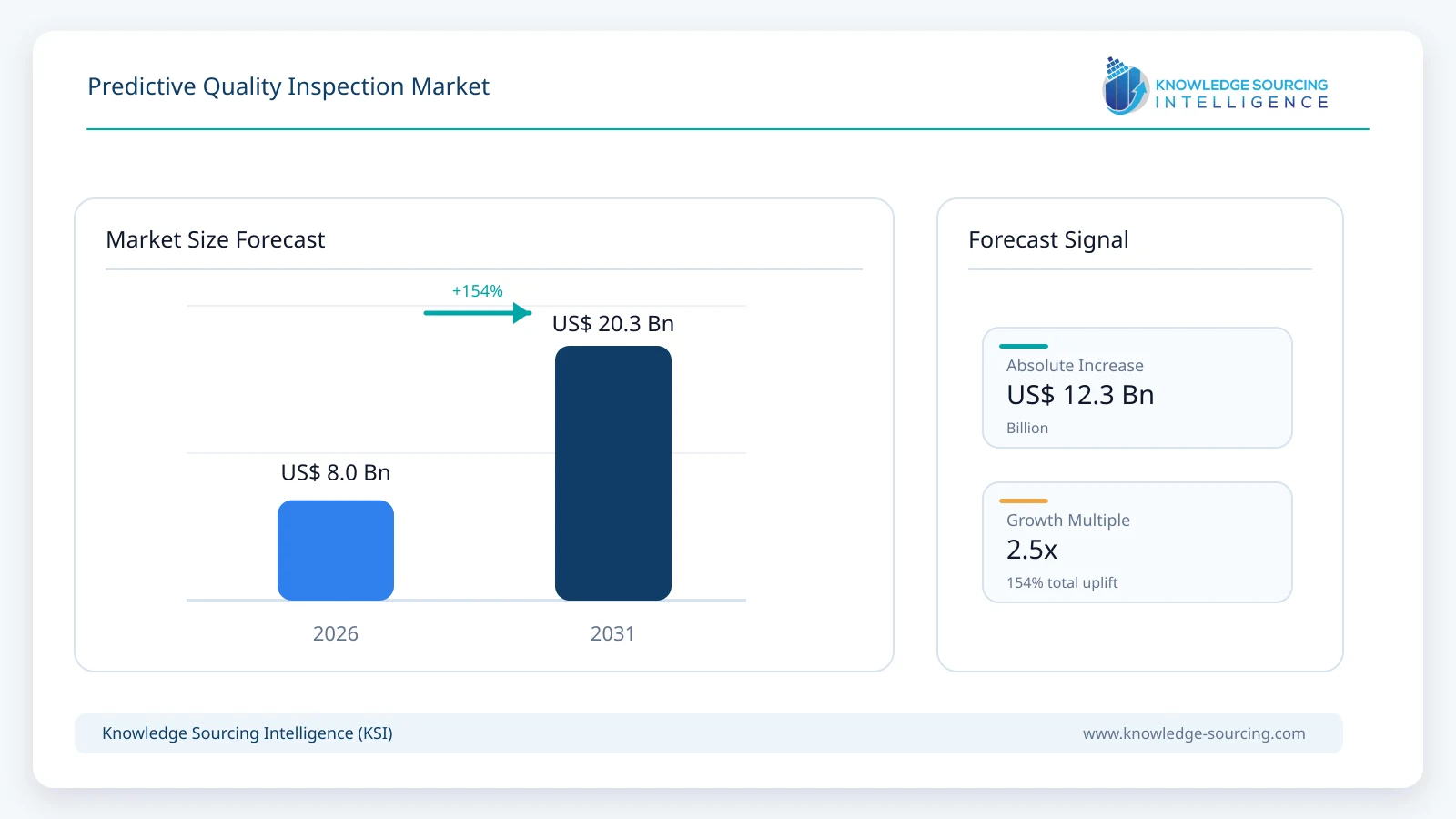
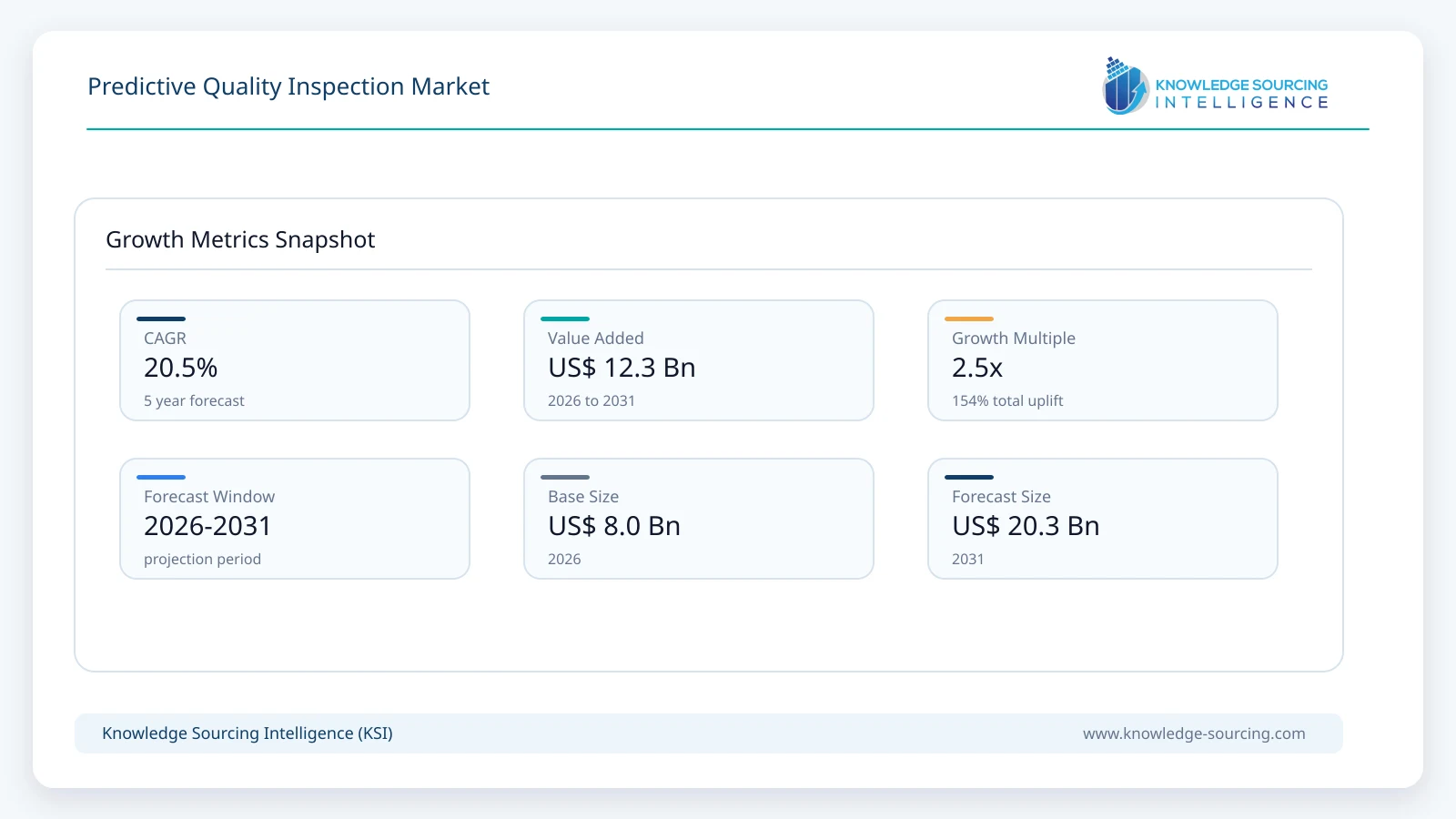
The Predictive Quality Inspection Market is forecast to grow at a CAGR of 20.5%, reaching USD 20.3 billion in 2031 from USD 8.0 billion in 2026.
Highlights:
- 1Transition to Zero-Defect ManufacturingAutomotive manufacturers are no longer relying on sampling methods and are preferring 100 per cent inline inspection using AI. The goal is to achieve near-zero defect rates for their components.
- 2Rise of Edge AI IntegrationTo sustain production takt time, the inspection logic begins to shift away from the central clouds and towards the edge of the network.
- 3Expansion of EV Production LinesDue to the quality demands for EV battery cells and power devices, there is a growing demand for 3D predictive inspection solutions.
- 4Technical AdvancementsTechnological convergence, particularly that involving Edge Computing and Cloud-native AI, is facilitating rapid market uptake, particularly in terms of lowering the latency of analysis.
The predictive quality inspection market is at a fundamental pivot as the world moves beyond traditional automated optical inspection systems into an intelligence-based foresight approach for industries globally. The driving factor behind this change is the requirement to remove the cost of poor quality (CoPQ), which encompasses traditional issues like scrap, rework, and warranty claims. The use of high-frequency sensor-based data provides the ability to detect the underlying quality drivers that cause issues prior to the underlying defect showing up in the end product. In addition, the need for such a solution has been growing within environments that require high precision, where there is no room for error. In the pharmaceutical and aviation industries, it has been felt due to regulations. Similarly, the need began to arise in the electronics industry with the miniaturisation of components. Accordingly, the trend is to focus on implementing closed-loop systems, where the data acquired by the testing and inspection is fed directly back into the production controllers to automatically regulate process parameters in real-time. This will ensure total yield maximisation and operational resilience.
Predictive Quality Inspection Market Analysis
Growth Drivers
Integration of AI & ML algorithms: The main driver for the increasing market demands in predictive quality inspection is the quick maturation and democratization of Artificial Intelligence (AI) and Machine Learning (ML) algorithms. In traditional vision inspection systems, rules-based programming is used. In contrast, predictive quality inspection utilizing AI and ML technologies has shown the capacity for detecting non-trivial defects or features. Further, as these technologies become more refined and less labeled training sets are required, the categories of supply will have a direct consequent effect on demand. In addition, defects within semiconductor wafers or inconsistencies in composite aircraft parts may initially seem insignificant.; however, the capability of detecting these changes via AI and ML would have a considerable market-driver consequence.
Shifting Towards Industry 4.0: The second major driver relates to the global shift to Industry 4.0 and associated smart manufacturing platforms. The convergence offered by industrial Internet of Things technology enables a data platform that allows for quality prediction. Fast sensors have enabled huge volumes of environmental and equipment data, such as temperature, vibration, and pressure readings, and visual inspection data. This type of multi-modal data, comprehensively, would enable any manufacturer to predict when there will be a change in the operation of their machines to cause a quality defect. As such, the necessity for such technology arises from the move to the concept of "zero-defects." This means that, rather than throwing away faulty goods, processes should be adjusted to correct them.
Growing Shortage of Skilled Labor: With an increased shortage of labor and rising rates for skilled quality technicians, businesses are now being driven to adopt automatic inspection systems. Further, manual inspection carries with it an element of error, fatigue, and subjectivity. This means quality levels throughout an organization or across multiple facilities will always be inconsistent. With predictive quality systems, a certain level of consistency and efficiency is guaranteed. This is different from humans, especially for large-volume manufacturing facilities. By automating cognitive quality inspection, such as the good or bad decisions made throughout this process, while skilled people can be used for other purposes, hence increasing demand for robotics-based inspection devices.
Stringent Regulatory Compliance and Traceability: The push for stricter regulatory compliance and traceability has created a favourable environment for the market. This has been quite beneficial, especially in industries such as pharmaceuticals, food & beverage, and healthcare. Predictive quality systems deliver a manufacturing certificate for every product, providing a record for product inspections and creating a verifiable auditing trail.
Challenges and Opportunities
The biggest constraint when it comes to market demands is the large initial capital investment required for the integration of predictive systems into the existing manufacturing systems. The existing manufacturing systems do not have the required integration capability for the streaming of data. This could lead to the emergence of a technological challenge where companies have to invest in expensive alterations or changes in their hardware. On the contrary, with the advent of edge computing, there lies a substantial growth opportunity. In processing inspection data, rather than in the cloud, as in machine-computing schemes, latency as well as costs can be substantially reduced. This is particularly important on high-speed production lines where a delay of a mere millisecond can translate into a wastage of many products.
Key Development
August 2026: Rockwell Automation integrated Plex Quality Management System with FactoryTalk Analytics VisionAI, enabling AI-powered visual inspection workflows, improved defect detection, traceability, serialization, and inspection-history management.
April 2026: ABB signed a Memorandum of Understanding with Alcemy to explore AI-driven cement and concrete quality prediction, combining ABB automation with Alcemy’s machine-learning-based predictive quality technology.
April 2026: Siemens announced general availability of its Industrial AI Suite while expanding Industrial Edge partnerships with machine-vision and quality-inspection providers, supporting scalable AI-driven manufacturing inspection.
October 2025: Cognex Corporation announced the release of its new Solutions Experience (SLX) Logistics Portfolio. It utilizes advanced machine vision technology for the enhancement in traceability and accurate sorting, and is developed for application specific solution in the high-volume logistics sector.
September 2025: KPM Analytics launched its new original equipment manufacturer (OEM) business devision ehich id designed specifically for the integration of its advanced vision inspection and contaminant detection technologies. It also includes their AI-driven application for the food manufacturing process control and quality check.
Market Segmentation
The market is segmented by component, technology, application, end-use industry, and geography.
By Technology: Artificial Intelligence & Machine Learning (AI/ML)
The segment of AI/ML constitutes the underlying technology for the shift towards reactive and then to predictive. The underlying driver for the AI/ML segment can be attributed to the potential of deep learning models for complex feature extraction on raw images. There exists a drive for the adoption of the segment on account of the growing need for self-learning systems, particularly for manufacturing industries. In the context of the electronics industry, with the product lifecycle characteristics being relatively low. The underlying drive for the AI models to utilize the potential for quick retraining using synthetic or transferred learning remains of paramount importance. There also exists the potential to utilize the underlying AI segment with a shift towards the adoption of the "cloud" for the management of the underlying inspection models for different manufacturing sites across the world.
By End-Use Industry: Automotive
The automobile sector represents a large demand segment in terms of predictive quality inspection. This demand arises due to the electric vehicle and autonomous driving technologies used in this industry, which demand unprecedented reliability. Predictive inspection is being used in making EV batteries, which consist of batteries that have electrodes coated with specific thickness levels, along with welded materials. In batteries, when there is just a single defect, thermal runaways will occur, which affects safety, making it imperative. In addition, carmakers are using predictive quality to manage their quality with their suppliers, thus holding Tier 1 and Tier 2 suppliers to strict quality levels. This quality approach, or "tiering," ensures that the requirement for predictive will trickle down to the whole automotive industry.
By Application: Quality Control & Defect Detection
The quality control & defect detection segment has the core functionalities pertaining to the identification of deviations with reference to specific standards. The demand has shifted to the introduction of 3D visual inspections. Using volumes to identify defects that would have otherwise been ignored using 2D. In high-speed packaging environments, seal quality and correct alignment are major benefits.
Regional Analysis
North America Market Analysis
North America, led by the United States, dominates the predictive quality market due to its highly advanced industrial base and early adopters of AI. Strong demand is recorded from high-technology sectors such as Aerospace and Defense. US-based manufacturers significantly invest in predictive inspection to hold their own against low-labor-cost regions. Besides, major regional technology providers like IBM and Intel create an excellent ecosystem for AI research and development in the country. Government initiatives also spur demand; for instance, the CHIPS and Science Act encourages domestic production of semiconductors, a sector critically dependent on high-precision predictive inspection to ensure yield and profitability.
South America Market Analysis
The South American market is represented by growing demand from the food & beverage and mining sectors. In Brazil, predictive quality systems are becoming increasingly used as a part of processed food export duties to ensure international standards in food safety, thereby reducing the risk of export rejections. The demand remains low and concentrated on packaging inspection and the detection of surface defects in high-volume production lines. Although the adoption rate is modest compared to North America or Europe, for several industries, updating the aging infrastructure with newer technologies to stay competitive in global commodity markets creates stable, long-term drivers in the incremental deployment of predictive technologies.
Europe Market Analysis
In Europe, demand for predictive quality inspection due to the tough environmental and safety norms of the region. This is especially driven by Germany, which is considered to be the global hub of the automotive and machinery manufacturing sectors. The "Industry 4.0" initiative in Europe has created an atmosphere where digital twins and predictive analytics coexist. Demand is particularly high for solutions that promote sustainability; through the prediction and prevention of defects, a manufacturer can save a huge amount of material wastage and energy consumption. Additionally, Privacy-by-Design AI inspection tools, where AI can collect and analyze data without invading employee privacy, are encouraged by EU regulations, such as their focus on data privacy.
Middle East and Africa Market Analysis
The Middle East and African region has major markets for the product, which are the energy and chemicals sectors. There have been heavy industrialization efforts in terms of creating the concept of smart cities and smart industry zones, such as in the United Arab Emirates, Saudi Arabia, and the new 'NEOM' zone under development. This has created the need for predictive inspection systems that can operate under extreme environmental conditions to ensure the integrity and operation of critical infrastructure and oil and gas products. Here, the concept of zero downtime becomes very relevant, wherein predictive quality ensures the output of continuous processes, detecting any abnormal chemical properties in the product and correcting them.
Asia Pacific Market Analysis
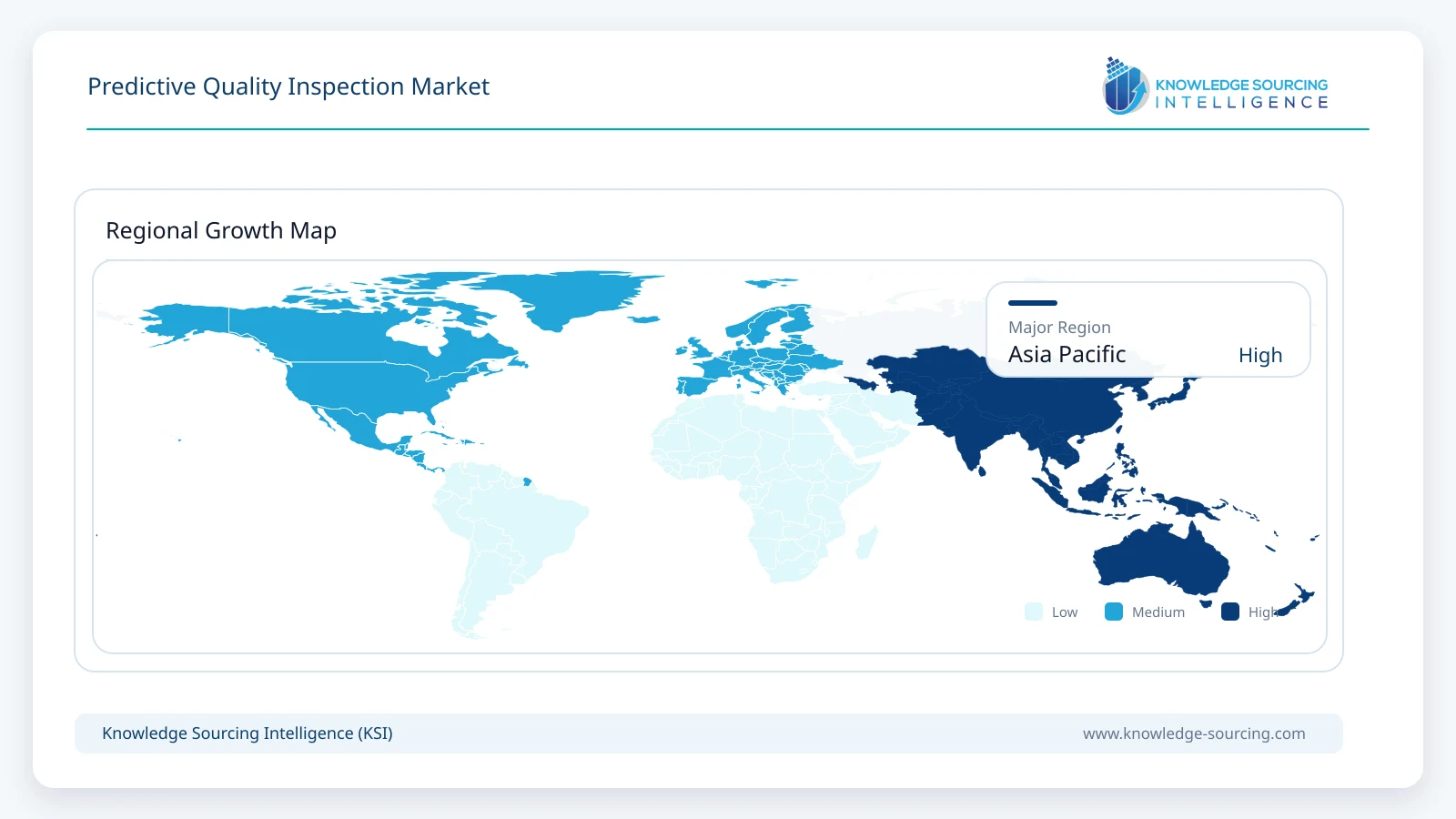
The Asia Pacific region is significantly rising in the market due to the huge growth in industrialisation across countries such as China, India, and other Asian countries. It is driven by its position as the world’s factory, especially across the electronics and semiconductor industries. As these industries are facing mounting pressures to expand their gross margin and product complexities, they are shifting focus from manpower to automated predictive solutions. Further, subsidies offered under the government-initiated smart manufacturing in China are propelling the adoption of AI-driven inspection solutions for industries like automotive and consumer electronics. For instance, the China Ministry of Industry and Information Technology (MIIT) announced in February 2025 that the country constructed more than 30,000 smart factories. Additionally, a prominent demand market is being identified for the Indian market, where the requirement to scale their local manufacturing base through the "Make in India" is growing, which promotes moving away from inspection solutions and moving towards AI-driven quality assurance solutions.
List of Companies
Cognex Corporation
Keyence Corporation
Omron Corporation
Basler AG
Teledyne Technologies Inc
Hexagon AB
IBM
Robert Bosch GmbH
Intel Corporation
SwitchOn
The predictive quality inspection market is an ecosystem that consists of dominant players in the industrial automation sector and niche AI software providers. Dominant companies are buying into niche AI companies and integrating their sophisticated machine learning solutions into their existing hardware offerings. Positioning is based on ease of use and seamless integration, where companies are trying to deliver the most user-friendly interface that does not require deep data science skills.
Keyence Corporation
Keyence is a major player in providing precise sensor and vision solutions. The competitive advantage of the company is its direct sales strategy and high rate of innovation. Keyence-developed products, such as the CV-X and XG-X series, are designed for high-speed operation while offering high resolution for inspections. The contributions of Keyence products lie in their ability to offer end-to-end solutions in multiple inspection modes such as 2D, 3D, and line scan. The Keyence products find applications across many industries, particularly in industries such as electronic devices and automotive.
Cognex Corporation
Cognex Corporation is a global leader in machine vision. The major focus for this enterprise in machine vision involves incorporating AI, and an essential product offered involves an "In-Sight SnAPP" Vision Sensor. The product allows for automation through AI counting and inspection toolsets. The enterprise positions itself through high-performance products. The emphasis on edge learning allows for first-to-market factory deployments. The products offered help automate mission-critical tasks for logistics and manufacturing.
Predictive Quality Inspection Market Scope:
| Report Metric | Details |
|---|---|
| Total Market Size in 2026 | USD 8.0 billion |
| Total Market Size in 2031 | USD 20.3 billion |
| Forecast Unit | Billion |
| Growth Rate | 20.5% |
| Study Period | 2021 to 2031 |
| Historical Data | 2021 to 2024 |
| Base Year | 2025 |
| Forecast Period | 2026 – 2031 |
| Segmentation | Component, Technology, Application, End User, Geography |
| Companies |
|
Market Segmentation
By Component
By Technology
By Application
By End User
By Geography
Table of Contents
1. EXECUTIVE SUMMARY
2. MARKET SNAPSHOT
2.1. Market Overview
2.2. Market Definition
2.3. Scope of the Study
2.4. Market Segmentation
3. BUSINESS LANDSCAPE
3.1. Market Drivers
3.2. Market Restraints
3.3. Market Opportunities
3.4. Porter’s Five Forces Analysis
3.5. Industry Value Chain Analysis
3.6. Policies and Regulations
3.7. Strategic Recommendations
4. TECHNOLOGICAL OUTLOOK
5. PREDICTIVE QUALITY INSPECTION MARKET BY COMPONENT
5.1. Introduction
5.2. Software
5.3. Hardware
5.4. Services
6. PREDICTIVE QUALITY INSPECTION MARKET BY TECHNOLOGY
6.1. Introduction
6.2. Artificial Intelligence & Machine Learning (AI/ML)
6.3. Edge Computing
6.4. Computer Vision & Deep Learning
6.5. Robotics-Enabled Inspection
6.6. Others
7. PREDICTIVE QUALITY INSPECTION MARKET BY APPLICATION
7.1. Introduction
7.2. Quality Control & Defect Detection
7.3. Assembly Verification
7.4. Dimensional Measurement
7.5. Packaging Inspection
7.6. Surface & Visual Inspection
7.7. Others
8. PREDICTIVE QUALITY INSPECTION MARKET BY END USER
8.1. Introduction
8.2. Manufacturing
8.3. Automotive
8.4. Electronics & Semiconductors
8.5. Aerospace & Defence
8.6. Food & Beverage
8.7. Pharmaceuticals
8.8. Others
9. PREDICTIVE QUALITY INSPECTION MARKET BY GEOGRAPHY
9.1. Introduction
9.2. North America
9.2.1. USA
9.2.2. Canada
8.2.3. Mexico
9.3. South America
9.3.1. Brazil
9.3.2. Argentina
9.3.3. Others
9.4. Europe
9.4.1. United Kingdom
9.4.2. Germany
9.4.3. France
9.4.4. Spain
9.4.5. Others
9.5. Middle East and Africa
9.5.1. Saudi Arabia
9.5.2. UAE
9.5.3. Others
9.6. Asia Pacific
9.6.1. China
9.6.2. India
9.6.3. Japan
9.6.4. South Korea
9.6.5. Indonesia
9.6.6. Thailand
9.6.7. Others
10. COMPETITIVE ENVIRONMENT AND ANALYSIS
10.1. Major Players and Strategy Analysis
10.2. Market Share Analysis
10.3. Mergers, Acquisitions, Agreements, and Collaborations
10.4. Competitive Dashboard
11. COMPANY PROFILES
11.1. Cognex Corporation
11.2. Keyence Corporation
11.3. Omron Corporation
11.4. Basler AG
11.5. Teledyne Technologies Inc
11.6. Hexagon AB
11.7. IBM
11.8. Robert Bosch GmbH
11.9. Intel Corporation
11.10. SwitchOn
12. APPENDIX
12.1. Currency
12.2. Assumptions
12.3. Base and Forecast Years Timeline
12.4. Key benefits for the stakeholders
12.5. Research Methodology
12.6. Abbreviations
Navigate
Trusted by the world's leading organizations











