
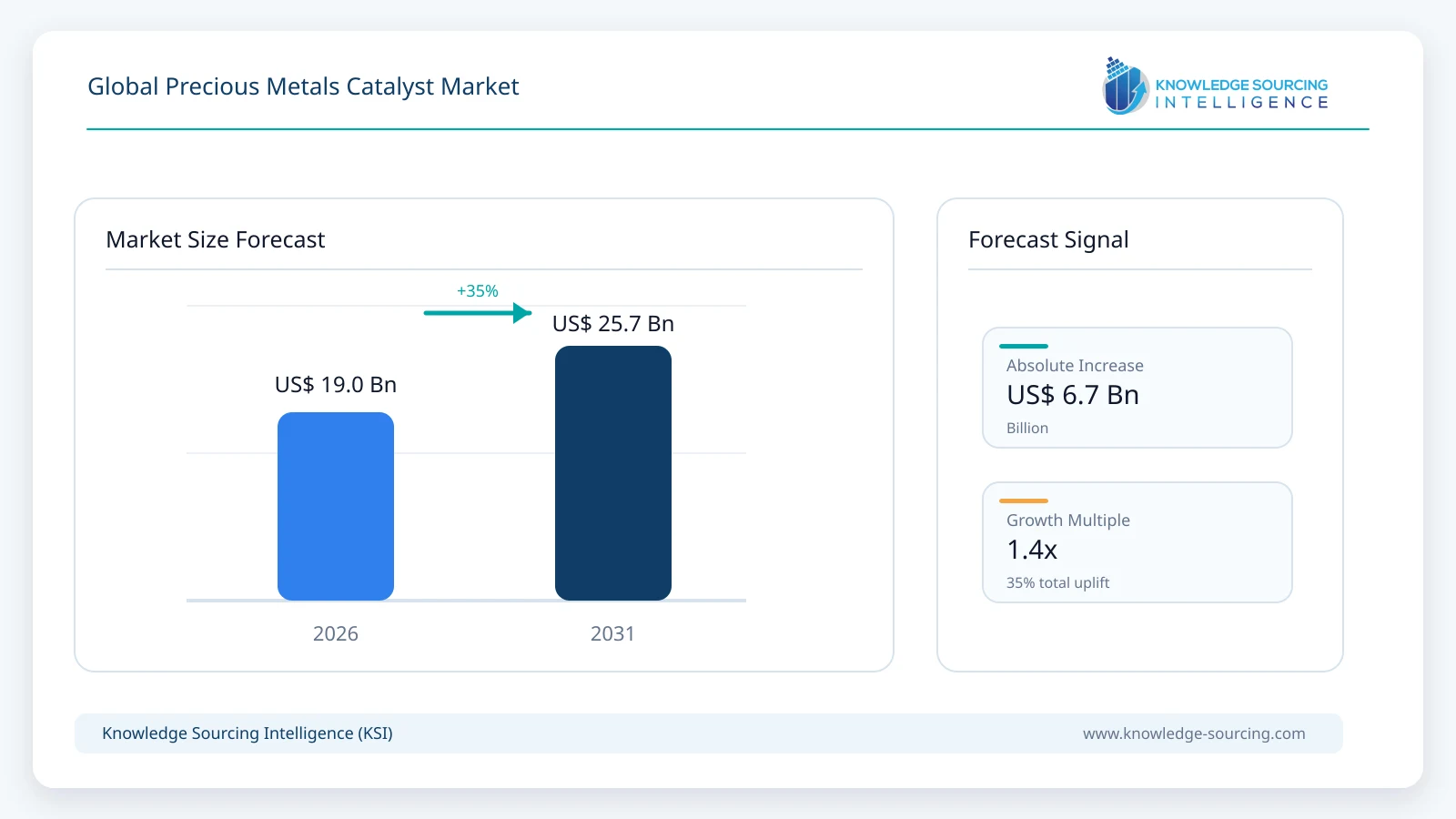
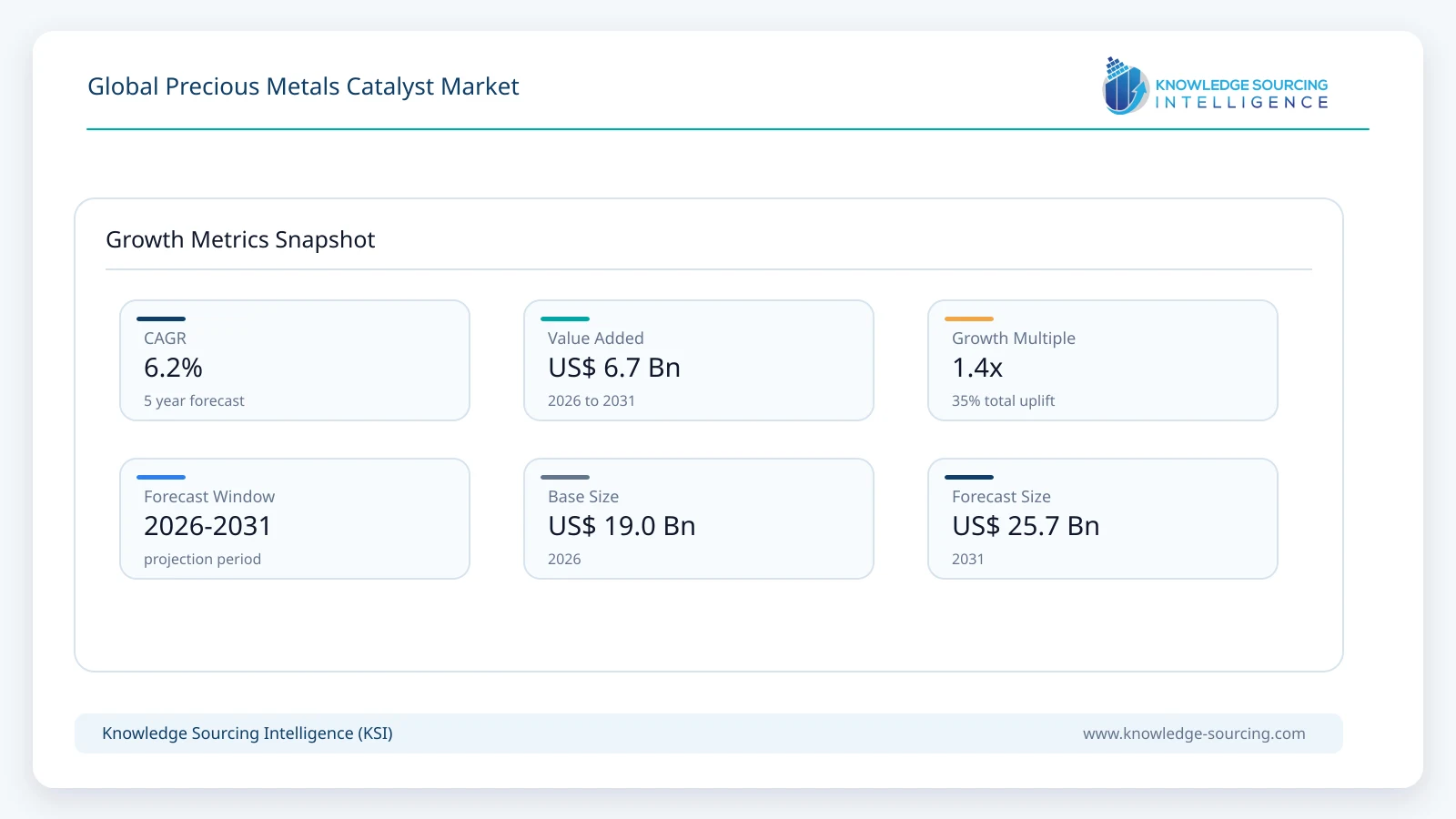
The Global Precious Metals Catalyst Market is forecast to grow at a CAGR of 6.2%, reaching USD 25.67 billion in 2031 from USD 19.00 billion in 2026.
Highlights:
- 1Automotive emissions control remains a major demand base, although electrification is shifting the catalyst mix toward hybrids, commercial vehicles, and industrial applications.
- 2Platinum represents a strategically important catalyst metal, supported by chemical processing, emissions control, hydrogen, and fuel-cell applications.
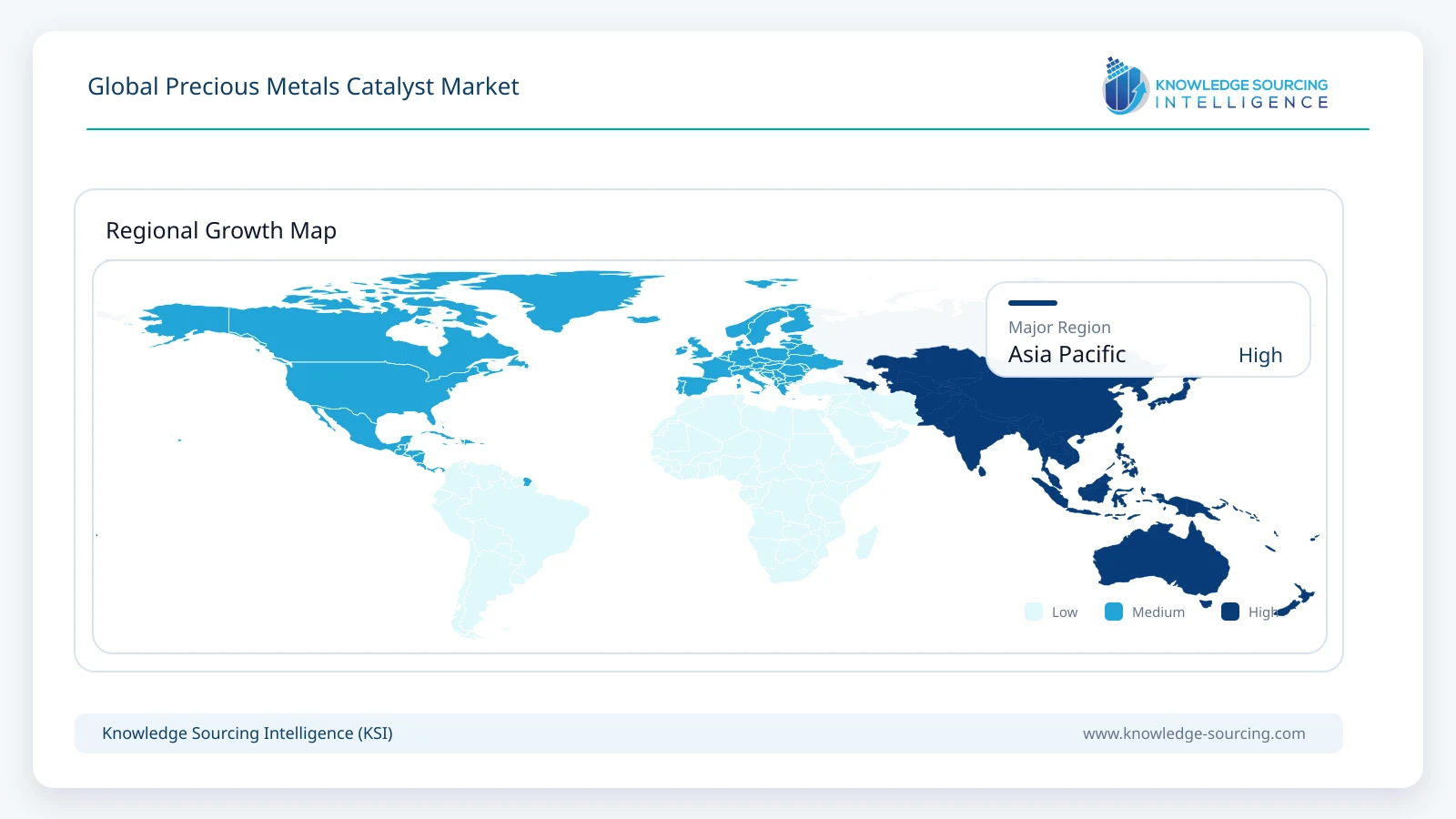
- 3Asia Pacific provides the broadest industrial demand platform, combining large automotive, chemical, refining, pharmaceutical, electronics, and hydrogen value chains.
- 4Precious-metal recycling is becoming a core procurement consideration, helping customers reduce exposure to primary supply disruptions and metal-price volatility.
- 5Lower metal loading is becoming a central technology objective, particularly for PEM fuel cells and electrolyzers where iridium and platinum intensity affects system economics.
- 6Emission regulations are sustaining catalyst requirements, with Euro 7 introducing tighter requirements and longer lifetime provisions for road vehicles.
The Precious Metals Catalyst Market covers catalyst systems, catalyst precursors, supported catalysts, homogeneous catalysts, catalyst-coated components, and related precious-metal formulations in which platinum, palladium, rhodium, ruthenium, iridium, or other precious metals provide catalytic activity. These materials are used to accelerate chemical reactions, improve selectivity, reduce reaction temperatures, control pollutants, and enable industrial processes that would otherwise require higher energy input or generate greater quantities of unwanted by-products.
The commercial scope extends beyond the value of the catalyst itself. Precious-metal catalyst suppliers increasingly participate in metal sourcing, catalyst design, formulation, technical support, recovery, refining, and metal-return programs. This creates a market structure in which catalyst sales are closely connected with precious-metal management. For large industrial buyers, the economic decision is therefore based on total process performance, metal loading, operating life, recoverability, and exposure to metal prices rather than catalyst purchase price alone.
The market serves several distinct demand pools. Automotive manufacturers and emissions-system suppliers purchase catalysts to meet increasingly stringent pollutant limits. Chemical and petrochemical producers use precious-metal catalysts for hydrogenation, oxidation, dehydrogenation, selective synthesis, and other conversion processes. Pharmaceutical and fine-chemical companies require highly selective catalysts for complex molecular transformations. Refineries, oil and gas operators, and fertilizer producers deploy catalyst technologies in process units where conversion efficiency and product quality directly affect operating economics. Environmental applications rely on catalyst systems for controlling nitrogen oxides, carbon monoxide, hydrocarbons, and other pollutants. Hydrogen and fuel-cell applications are creating another specialized demand stream for platinum, iridium, ruthenium, and related catalyst materials.
Buyer priorities differ materially across these applications. Automotive customers place strong emphasis on emissions conversion, durability, thermal stability, packaging, metal loading, and cost per vehicle. Chemical producers are more concerned with activity, selectivity, catalyst lifetime, regeneration, impurity tolerance, and product yield. Pharmaceutical manufacturers generally value reaction selectivity, reproducibility, regulatory consistency, and reliable supply of specialized catalyst formulations. Hydrogen technology developers are focused on reducing precious-metal loading without sacrificing electrochemical performance, because metal intensity can materially affect system economics.
Precious-metal prices remain a central commercial variable. Johnson Matthey reported in May 2026 that platinum, ruthenium, and iridium were expected to remain in deficit during 2026, while palladium and rhodium could move into small surpluses. The company also reported that stronger precious-metal prices were supporting a recovery in autocatalyst recycling. These conditions influence procurement contracts, inventory policies, recycling economics, and the extent to which catalyst manufacturers use metal-saving technologies.
The supply side is consequently more integrated than in many conventional specialty-chemical markets. Major suppliers increasingly combine catalyst manufacturing with precious-metal trading, recycling, refining, and technical services. BASF, for example, describes its Environmental Catalyst and Metal Solutions division as combining emissions catalysts with precious-metal sourcing, trading, recycling, and risk-management capabilities. Its operations recover platinum, palladium, and rhodium from spent catalysts and scrap, creating secondary supply for customers and internal requirements.
The automotive market remains an important volume base, but the long-term demand profile is becoming more differentiated. Battery-electric vehicles do not require conventional tailpipe catalysts, creating structural pressure on automotive platinum, palladium, and rhodium consumption. At the same time, hybrid vehicles, plug-in hybrids, commercial vehicles, industrial engines, and stationary power systems continue to use emissions-control technologies. Johnson Matthey reported that automotive platinum demand was expected to decline in 2025 as battery-electric powertrains gained share, while industrial platinum consumption benefited from capacity additions in chemicals, glass, biofuels, and synthetic fuels.
This shift makes non-automotive applications strategically important. Ruthenium and iridium, for example, have demand exposure to chemical processing, electronics, data-storage technologies, electrolysis, and fuel-cell systems. Platinum retains applications in chemical processing, hydrogen technologies, and emissions control. The result is a market where growth is not determined by vehicle production alone but by the balance between automotive substitution and industrial process demand.
Over 2026–2031, procurement decisions are expected to place greater weight on circular supply. Catalyst users face incentives to recover precious metals because high metal values make spent catalysts economically valuable. Suppliers with closed-loop capabilities can offer metal-return arrangements that reduce customers' working-capital exposure and improve security of supply. BASF's current portfolio explicitly links recycling with precious-metal sourcing and catalyst manufacturing, while Heraeus also emphasizes recycling as an integral part of its precious-metal catalyst model.
The market therefore represents a specialized intersection of advanced materials, chemical processing, emissions control, precious-metal economics, and circular manufacturing. Competitive advantage depends less on supplying metal alone and more on controlling the complete catalyst lifecycle from formulation and deployment through recovery and refining.
Market Drivers
Expansion of Emissions-Control Requirements
Environmental regulation remains one of the strongest structural drivers for precious-metal catalyst demand. Vehicle and stationary-emission regulations require manufacturers and operators to achieve pollutant limits under increasingly demanding operating conditions. Catalyst systems provide the chemical conversion mechanism required to meet these standards without redesigning the entire combustion process.
The commercial effect is particularly important for heavy-duty applications. Regulations must address different operating temperatures, transient loads, engine configurations, and long operating lifetimes. Catalyst suppliers therefore compete on conversion efficiency across a wide temperature range rather than simply on nominal precious-metal loading.
The European Union's Euro 7 regulation introduces stricter requirements covering exhaust pollutants, durability, and other emissions, while maintaining regulatory pressure on combustion vehicles during the transition toward zero-emission mobility.
For catalyst manufacturers, tighter standards create demand for improved formulations and substrate designs. For vehicle manufacturers, purchasing decisions increasingly involve technical validation, durability testing, integration capability, and cost per vehicle. The result favors suppliers with established engineering relationships and proven production-scale technologies.
Precious-Metal Demand from Chemical and Fine-Chemical Processing
Chemical production provides a more diversified demand base than automotive applications because catalyst requirements vary widely across individual processes. Platinum, palladium, ruthenium, rhodium, and iridium can provide reaction pathways that improve selectivity, conversion rates, or operating efficiency.
Pharmaceutical and fine-chemical producers are particularly sensitive to reaction selectivity. A catalyst that reduces unwanted side products can lower purification requirements and improve the economics of high-value molecules. Consequently, buyers may accept a higher catalyst cost when the formulation produces better yield or reduces downstream processing.
The increasing complexity of pharmaceutical synthesis also supports specialized homogeneous and heterogeneous catalyst systems. Umicore's Precious Metals Chemistry business, for example, supplies precious-metal chemistry for automotive, fine-chemical, and pharmaceutical applications and has expanded its technical capabilities in ligand chemistry and high-throughput screening.
Growth of Hydrogen and Fuel-Cell Applications
Hydrogen technologies are creating a technically demanding catalyst market because precious-metal intensity can materially influence equipment cost. Platinum is important in PEM fuel cells, while iridium is particularly relevant to PEM electrolyzers.
The commercial challenge is clear: electrolyzer and fuel-cell deployment can increase catalyst demand, but excessive precious-metal loading can restrict scalability because supply is limited and prices are volatile. Catalyst suppliers are therefore pursuing higher activity, improved durability, and lower metal loading simultaneously.
Heraeus has highlighted the need to reduce iridium intensity in PEM electrolysis and has developed catalyst approaches designed to lower iridium requirements while maintaining performance.
This creates a different competitive model from conventional catalyst markets. Suppliers are not simply selling more catalyst; they are attempting to reduce the quantity of precious metal required per unit of hydrogen production or electrical output. Successful technologies can therefore expand addressable deployment even when physical metal consumption per system declines.
Rising Economic Value of Catalyst Recycling
High precious-metal prices improve the economics of catalyst recovery. Spent automotive catalysts, industrial catalysts, and production residues contain recoverable metal that can re-enter the supply chain after collection, processing, and refining.
Recycling provides two benefits to buyers. First, it creates a secondary source of strategically important metals. Second, it can reduce exposure to mining disruptions, geopolitical risks, and long procurement cycles.
Johnson Matthey reported in 2026 that higher PGM prices were supporting a recovery in autocatalyst recycling. BASF similarly operates recycling capabilities that recover precious metals from spent catalysts and scrap for use within its own requirements and customer supply chains.
Suppliers that combine catalyst sales with recycling can therefore offer more comprehensive commercial contracts. This can include metal leasing, metal-return arrangements, recovery services, and price-risk management.
Industrial Capacity Expansion and Process Efficiency
Investment in chemical, refining, petrochemical, synthetic-fuel, and specialty-material production supports catalyst demand because new or expanded process capacity requires catalyst loading and periodic replacement.
The purchasing decision is usually based on process economics. A catalyst that provides higher conversion, longer operating life, lower pressure drop, or better selectivity can generate savings that exceed the initial premium. This makes technical performance a central competitive factor.
BASF's continued investment in catalyst research illustrates this relationship. In May 2026, the company opened a refinery catalyst R&D center in Georgia, positioning development work close to its largest refinery catalyst production site. The facility is intended to shorten the path from laboratory development to production testing and commercialization.
Market Restraints and Challenges
Volatility in Precious-Metal Prices
Precious-metal prices can materially change catalyst economics. A sudden increase in platinum, palladium, rhodium, ruthenium, or iridium prices raises the working-capital requirement for catalyst manufacturers and can increase customers' inventory exposure.
The effect is not limited to final pricing. Catalyst suppliers must manage metal procurement, hedging, customer contracts, inventories, and recovery values. Buyers may delay orders when prices rise sharply, while suppliers may seek contract structures that pass through metal costs separately from catalyst manufacturing margins.
The principal mitigation strategy is improved metal efficiency combined with recycling and contractual metal-management mechanisms.
Limited Primary Supply and Geographic Concentration
PGM supply is concentrated in a relatively small number of producing regions. Operational disruptions, mine restructuring, energy constraints, labor conditions, sanctions, or logistical interruptions can affect global availability.
Johnson Matthey's 2025 and 2026 assessments illustrate the sensitivity of the market to primary supply constraints. The company reported that South African production conditions affected platinum-group metal supply and that Russian palladium production was also an important factor in the 2026 balance.
Catalyst manufacturers therefore have a strong incentive to maintain multiple sourcing channels and expand recycling. Customers with long catalyst lifecycles also prefer suppliers capable of maintaining metal availability throughout the product-support period.
Electrification Pressure on Automotive Catalyst Demand
Vehicle electrification presents a structural challenge for conventional automotive catalyst consumption. Battery-electric vehicles do not use internal combustion exhaust after-treatment systems, reducing long-term demand for traditional autocatalysts.
The transition will not eliminate automotive catalyst demand immediately. Hybrid vehicles, plug-in hybrids, gasoline vehicles, diesel commercial vehicles, and heavy-duty applications continue to require emissions control. However, suppliers must adjust manufacturing footprints and technology investments to reflect a changing powertrain mix.
This creates a strategic tension: automotive catalysts remain commercially important, but suppliers cannot assume historical vehicle-production relationships will persist through 2031.
Catalyst Qualification and Switching Costs
Industrial catalyst substitution is technically difficult. Customers cannot simply replace one catalyst formulation with another because changes can affect reaction kinetics, yield, impurities, pressure drop, temperature requirements, product quality, and regulatory compliance.
Qualification periods can therefore be lengthy. This favors established suppliers with process data and application expertise but creates barriers for new technologies. For buyers, the cost of an unsuccessful catalyst change can exceed the price difference between competing products.
The result is a relationship-driven procurement environment in which reliability and technical support carry substantial commercial value.
Precious-Metal Intensity in Hydrogen Technologies
Hydrogen and fuel-cell markets could create new demand for precious metals while simultaneously imposing pressure to reduce their use. If catalyst intensity remains high, metal availability and cost could restrict deployment.
The challenge is particularly relevant for iridium-based PEM electrolysis. Catalyst developers must achieve lower loading without compromising durability and efficiency. Similar requirements apply to platinum-based fuel-cell catalysts.
This restraint is partly technological rather than purely economic. Successful catalyst engineering can convert the constraint into an opportunity, but the pace of improvement will influence the scale and economics of future deployment.
Major Segment Analysis
Platinum
Platinum represents the most commercially diversified segment within the Precious Metals Catalyst Market because it participates in automotive emissions control, chemical processing, fuel cells, hydrogen technologies, petroleum refining, and several specialized industrial processes.
Its importance comes from its combination of catalytic activity, thermal stability, corrosion resistance, and suitability for demanding operating environments. Buyers generally select platinum when reaction performance and durability justify the metal's high value.
Automotive applications remain a major demand base, although their long-term contribution is being moderated by electrification. Johnson Matthey reported that automotive platinum demand was expected to decline in 2025, while industrial demand was supported by capacity expansion in chemicals, fibreglass, biofuels, and synthetic fuels.
Industrial applications therefore provide an important counterbalance. Chemical producers use platinum catalysts where high selectivity, durability, and process stability influence plant economics. In these environments, the catalyst is a production asset rather than a consumable chemical input.
Platinum is also important to hydrogen and fuel-cell applications. PEM fuel cells use platinum-based catalysts because the metal provides the electrochemical activity required for hydrogen oxidation and oxygen reduction. Catalyst manufacturers are working to reduce platinum loading while maintaining power density and durability.
The buyer relationship is consequently technical and long-term. Automotive OEMs and Tier 1 suppliers require validated formulations at high production volumes. Chemical and pharmaceutical companies demand process-specific catalyst development. Hydrogen technology companies require performance improvements alongside metal-intensity reductions.
Competition within the platinum segment increasingly revolves around metal efficiency, recycling, technical service, and supply assurance. Suppliers with access to primary and secondary platinum can reduce customers' exposure to procurement volatility. Closed-loop recovery also allows catalyst manufacturers to capture value after the catalyst reaches the end of its operating life.
The segment's revenue relevance is therefore broader than the quantity of platinum physically consumed. Higher-value formulations, specialized catalyst development, metal-management services, and recycling can all increase commercial value while reducing the amount of metal required per unit of output.
Regional Analysis
North America
North America has a diversified demand base spanning automotive emissions control, refining, petrochemicals, chemical manufacturing, pharmaceuticals, stationary power, and hydrogen technologies. The United States accounts for the largest regional demand pool because of its industrial capacity and extensive regulatory framework.
Automotive catalyst demand is influenced by federal emissions standards and the continued production of gasoline, hybrid, diesel, and heavy-duty vehicles. Stationary emissions control is also important for power-generation and industrial installations.
The region has a strong commercial rationale for recycling because high-value PGMs create incentives to recover metal from spent automotive and industrial catalysts. Suppliers with domestic refining, manufacturing, and service capabilities can reduce logistics exposure.
Investment in catalyst technology remains active. BASF opened a new refinery catalyst R&D center in Georgia in May 2026, integrating development and production capabilities at a major catalyst manufacturing location.
Canada contributes through mining, refining, chemical processing, and industrial applications, while Mexico is important as an automotive manufacturing base and a production location within North American supply chains. The main constraint is exposure to vehicle electrification and uncertainty surrounding future automotive production patterns.
Europe
Europe remains an important technology and regulatory center. Automotive emissions legislation has historically encouraged high-performance catalyst systems, and Euro 7 adds further requirements related to emissions and durability.
Germany, France, Italy, Spain, and the United Kingdom provide established automotive, chemical, pharmaceutical, refining, and industrial markets. Germany is particularly important for catalyst engineering and chemical manufacturing.
European buyers place strong emphasis on lifecycle economics, emissions compliance, supply transparency, and recycling. The region's environmental policy framework also supports secondary metal use where it can reduce resource intensity.
However, Europe's vehicle electrification targets create a long-term constraint for conventional automotive catalyst volumes. Suppliers are consequently expanding into industrial emissions, hydrogen, stationary power, chemical catalysis, and recycling.
Asia Pacific
Asia Pacific is expected to remain the broadest demand center because it combines large-scale vehicle manufacturing with chemical, refining, pharmaceutical, electronics, fertilizer, and hydrogen industries.
China is particularly important because of its automotive manufacturing scale and extensive chemical-processing base. Its transition toward electrified vehicles is reducing some conventional autocatalyst demand while maintaining demand for catalysts in hybrids, commercial vehicles, chemical processes, and environmental applications.
India offers an expanding combination of automotive manufacturing, refining, pharmaceuticals, chemicals, and industrial emissions-control demand. Japan and South Korea have sophisticated automotive, chemical, electronics, and hydrogen supply chains. Taiwan adds demand from advanced electronics and chemical processing, while Thailand and Indonesia contribute automotive and industrial manufacturing capacity.
The region also provides attractive opportunities for catalyst localization. Umicore reported strong catalytic activity across Europe, China, and India in early 2026, while its fuel-cell and stationary catalyst activities remained linked to Asian demand conditions.
The principal constraint is uneven regulatory implementation and considerable variation in industrial economics between countries. Nevertheless, the breadth of end-use industries gives Asia Pacific a stronger demand-diversification profile than regions dependent mainly on automotive consumption.
Middle East and Africa
The Middle East and Africa provide demand primarily through refining, petrochemicals, oil and gas, fertilizer, environmental control, and emerging hydrogen projects.
Saudi Arabia and the United Arab Emirates are particularly important because of large refining and petrochemical investments. Precious-metal catalysts can improve conversion efficiency and product quality in processes where operators manage high-value feedstocks.
Hydrogen investment provides an additional long-term opportunity, particularly where large-scale renewable power and industrial infrastructure are being developed. However, the catalyst market will depend on whether projects progress from announced capacity to operating plants.
Africa remains strategically important to the precious-metal supply chain because of its PGM production base, particularly in southern Africa. This creates a distinctive regional role: the region is both a source of raw material and a potential consumer of catalyst technologies.
South America
South America has a smaller but increasingly diversified catalyst market. Brazil provides the principal demand base through automotive manufacturing, refining, chemicals, biofuels, agriculture, and industrial processing.
Brazil's automotive catalyst market remains commercially relevant, while its refining and biofuel industries create additional demand for catalytic technologies. Umicore reported market-share gains in Brazil within its light-duty catalyst business during 2025, demonstrating the importance of the country within global automotive catalyst competition.
Argentina contributes through chemicals, refining, agriculture, and automotive activity. The rest of South America remains smaller and more project-driven.
Regional constraints include currency volatility, uneven industrial investment, and infrastructure limitations. Suppliers with local technical support and recycling capabilities can reduce logistics and procurement challenges.
Competitive Landscape
The competitive structure includes integrated specialty-chemical companies, precious-metal specialists, catalyst manufacturers, refining groups, and advanced-material suppliers. The provided competitive set includes BASF SE, Evonik Industries AG, Clariant, Heraeus Precious Metals, Johnson Matthey, TANAKA Precious Metals, Hindustan Platinum, Umicore Precious Metals Chemistry, Catalytic Products International, Chimet S.p.A., J&J Materials, Stanford Advanced Materials, and American Elements.
Competition is based on more than catalyst formulation. Suppliers differentiate through precious-metal sourcing, catalyst design, application engineering, production scale, recycling, technical service, qualification capability, and geographic coverage.
Integrated companies can offer customers a broader commercial proposition. BASF's ECMS model combines catalyst manufacturing with precious-metal sourcing, trading, recycling, and risk management. Heraeus similarly connects precious-metal processing, catalyst development, and recycling capabilities.
Johnson Matthey has historically combined emissions-control technology with PGM expertise and recycling. Its 2026 strategic direction also demonstrates the importance of portfolio specialization. In May 2026, the company agreed to acquire Cormetech, strengthening its Clean Air Solutions position in stationary emissions control in North America.
Umicore competes through automotive catalysts, fuel-cell and stationary catalysts, precious-metal chemistry, and recycling. Its 2025 investor materials highlighted a global automotive footprint and relationships with major OEMs, while its Precious Metals Chemistry business serves fine chemicals and pharmaceutical applications.
Technology differentiation is becoming more important as buyers seek lower metal loadings and higher catalyst productivity. Suppliers that can demonstrate longer catalyst life, higher conversion, lower pressure drop, or improved metal recovery can command stronger customer relationships.
Partnerships also matter because catalyst development often requires customer-specific process data. Long qualification cycles encourage collaboration between catalyst suppliers, OEMs, chemical producers, refiners, and technology developers.
Geographic production is another competitive factor. Customers increasingly value local manufacturing and technical support because catalyst supply interruptions can affect entire production lines. Regional facilities also help suppliers adapt formulations to local regulations and process conditions.
The market is therefore likely to remain concentrated around companies with technical depth and precious-metal capabilities, while specialist suppliers can compete effectively in customized catalysts, research-scale materials, niche applications, and specialized metal chemistries.
Recent Developments
May 2026: Johnson Matthey agreed to acquire Cormetech to expand its Clean Air Solutions business in stationary emissions control. The transaction strengthens its presence in SCR catalysts for power-generation and industrial applications and adds a large installed base with recurring replacement demand.
March 2026: BASF started operations at the world's first industrial-scale production plant for its X3D 3D-printed catalyst technology in Ludwigshafen. The technology can be applied to precious- and base-metal catalyst systems and is designed to improve reactor geometry, pressure drop, active surface area, and energy efficiency.
January 2026: Umicore Precious Metals Chemistry expanded its portfolio by adding high-throughput screening and specialty ligand capabilities acquired from Solvias, strengthening its ability to support homogeneous catalysis and catalyst development. Commercially, the move broadens its service proposition beyond catalyst supply toward research and process-development support.
Regulatory and Policy Environment
Regulation is a structural component of precious-metal catalyst demand because many major applications exist specifically to meet environmental, process-safety, or product-quality requirements.
In Europe, Regulation (EU) 2024/1257 establishes the Euro 7 framework for motor-vehicle emissions and battery durability. The regulation addresses exhaust emissions and introduces additional requirements concerning durability and non-exhaust emissions. For catalyst suppliers, the important commercial implication is that combustion vehicles remain subject to demanding emissions requirements during the transition toward zero-emission vehicles.
The European regulatory framework also creates incentives for longer-lasting emission-control systems. Catalyst manufacturers must demonstrate performance across extended vehicle lifetimes rather than optimizing solely for laboratory certification.
In the United States, federal vehicle and stationary-source emissions requirements continue to influence catalyst specifications. Heavy-duty emission regulations are particularly relevant to SCR and oxidation catalyst suppliers because trucks, buses, industrial engines, and stationary power systems require long-duration pollutant control.
China, Japan, South Korea, and India are also important regulatory markets because their vehicle-emission standards and industrial pollution controls influence catalyst loading and formulation. Local standards increasingly require suppliers to demonstrate performance under regional driving cycles, fuel conditions, and operating environments.
Hydrogen projects introduce another regulatory dimension. Electrolyzer and fuel-cell developers must meet technical, safety, and performance requirements while managing the sourcing of strategically important catalyst metals. As public policy supports hydrogen deployment, catalyst suppliers must demonstrate both performance and scalable supply.
Recycling policy is becoming increasingly relevant because spent catalysts contain valuable metals. Regulatory frameworks governing hazardous materials, waste transport, refining, and material recovery can influence the economics of closed-loop catalyst systems. Suppliers with compliant collection and refining infrastructure can convert these requirements into a procurement advantage.
Outlook and Strategic Implications
The 2026–2031 outlook will be shaped by the interaction between automotive electrification, industrial capacity investment, environmental regulation, hydrogen deployment, and precious-metal supply conditions.
Automotive catalysts will remain an important revenue source, but their composition is likely to change. Hybrid and plug-in hybrid vehicles can extend the life of combustion-based catalyst demand, while commercial vehicles and stationary engines remain important because electrification is progressing at different rates across vehicle categories.
The more durable growth opportunity lies in demand diversification. Chemical processing, pharmaceutical synthesis, refining, environmental control, fuel cells, electrolyzers, and specialized industrial applications can offset some of the pressure from battery-electric vehicle adoption.
Procurement strategies will increasingly incorporate metal-price management. Large buyers are likely to favor suppliers capable of separating metal value from catalyst conversion costs, providing hedging mechanisms, and recovering metals after use. This reduces the customer's exposure to inventory swings and supply interruptions.
Recycling will consequently become a strategic capability rather than an ancillary service. BASF's full-loop model and Johnson Matthey's PGM activities demonstrate how catalyst manufacturing, metal management, and recovery can be commercially interconnected.
Technology investment will focus on reducing precious-metal intensity. Platinum and iridium loading in hydrogen applications must decline if large-scale deployment is to avoid creating new supply constraints. The same principle applies to automotive catalysts, where manufacturers seek lower PGM usage without sacrificing emissions performance.
Catalyst architecture will also become more important. BASF's industrialization of 3D-printed catalyst structures demonstrates how geometry, surface area, pressure drop, and material distribution can improve process economics independently of the underlying metal chemistry.
For suppliers, regional manufacturing will remain strategically valuable. Asia Pacific will require localized production for automotive, chemical, pharmaceutical, electronics, and hydrogen customers. North America offers opportunities in stationary emissions control, refining, chemicals, and power generation. Europe will remain important for advanced catalyst engineering and regulated emissions applications.
Competitive positioning will increasingly depend on lifecycle economics. A supplier offering a slightly more expensive catalyst can win business if it demonstrates longer operating life, better conversion, lower metal loading, higher product yield, or superior recovery value.
The principal strategic risk is a mismatch between catalyst investment and end-use technology transition. Suppliers that remain overly dependent on conventional gasoline and diesel platforms could face declining volumes as electrification expands. Conversely, companies that move too aggressively into hydrogen before project economics and infrastructure mature could face underutilized capacity.
The strongest strategic position is therefore a balanced portfolio. Suppliers should maintain profitable emissions-control franchises while expanding industrial catalysis, recycling, precious-metal chemistry, stationary emissions control, and hydrogen-related technologies.
Overall, the Precious Metals Catalyst Market is moving toward a more integrated model in which catalyst performance, precious-metal security, recycling, regulatory compliance, and process economics are evaluated together. From 2026 through 2031, buyers are likely to place greater value on suppliers capable of reducing metal intensity while maintaining performance and securing the complete catalyst lifecycle. The companies best positioned for this environment will be those combining catalyst science with reliable metal management, regional manufacturing, customer-specific engineering, and economically viable recovery systems.
Precious Metals Catalyst Market Scope:
| Report Metric | Details |
|---|---|
| Total Market Size in 2026 | USD 19.0 billion |
| Total Market Size in 2031 | USD 25.7 billion |
| Forecast Unit | Billion |
| Growth Rate | 6.2% |
| Study Period | 2021 to 2031 |
| Historical Data | 2021 to 2024 |
| Base Year | 2025 |
| Forecast Period | 2026 – 2031 |
| Segmentation | Type, Application, Geography |
| Companies |
|
Market Segmentation
By Type
- Platinum
- Palladium
- Rhodium
- Ruthenium
- Iridium
- Others
By Application
- Automotive
- Chemical and Petrochemical
- Pharmaceutical and Fine Chemicals
- Refining and Oil & Gas
- Fertilizer and Agrochemicals
- Environmental and Emission Control
- Hydrogen and Fuel Cells
- Others
By Geography
- North America
- United States
- Canada
- Mexico
- South America
- Brazil
- Argentina
- Rest of South America
- Europe
- United Kingdom
- Germany
- France
- Italy
- Spain
- Rest of Europe
- Middle East and Africa
- Saudi Arabia
- United Arab Emirates
- Rest of the Middle East and Africa
- Asia-Pacific
- China
- India
- Japan
- South Korea
- Taiwan
- Thailand
- Indonesia
- Rest of Asia-Pacific
Table of Contents
1. INTRODUCTION
1.1. Market Overview
1.2. Market Definition
1.3. Scope of the Study
1.4. Market Segmentation
1.5. Currency
1.6. Assumptions
1.7. Base and Forecast Years Timeline
1.8. Key benefits for the stakeholders
2. RESEARCH METHODOLOGY
2.1. Research Design
2.2. Research Process
3. EXECUTIVE SUMMARY
3.1. Key Findings
3.2. Analyst View
4. MARKET DYNAMICS
4.1. Market Drivers
4.1.1. Growing Demand from End-Use Sectors
4.1.2. Environmental Concerns
4.2. Market Restraints
4.2.1. High Cost
4.2.2. Supply Constraints
4.3. Porter’s Five Forces Analysis
4.3.1. Bargaining Power of Suppliers
4.3.2. Bargaining Power of Buyers
4.3.3. The Threat of New Entrants
4.3.4. Threat of Substitutes
4.3.5. Competitive Rivalry in the Industry
4.4. Industry Value Chain Analysis
5. GLOBAL PRECIOUS METAL CATALYSTS MARKET BY TYPE
5.1. Introduction
5.2. Platinum
5.3. Palladium
5.4. Rhodium
5.5. Ruthenium
5.6. Iridium
5.7. Others
6. GLOBAL PRECIOUS METAL CATALYSTS MARKET BY APPLICATION
6.1. Introduction
6.2. Automotive
6.3. Chemical and Petrochemical
6.4. Pharmaceutical and Fine Chemicals
6.5. Refining and Oil & Gas
6.6. Fertilizer and Agrochemicals
6.7. Environmental and Emission Control
6.8. Hydrogen and Fuel Cells
6.9. Others
7. GLOBAL PRECIOUS METAL CATALYSTS MARKET BY GEOGRAPHY
7.1. Global Overview
7.2. North America
7.2.1. United States
7.2.2. Canada
7.2.3. Mexico
7.3. South America
7.3.1. Brazil
7.3.2. Argentina
7.3.3. Rest of South America
7.4. Europe
7.4.1. United Kingdom
7.4.2. Germany
7.4.3. France
7.4.4. Italy
7.4.5. Spain
7.4.6. Rest of Europe
7.5. Middle East and Africa
7.5.1. Saudi Arabia
7.5.2. United Arab Emirates
7.5.3. Rest of the Middle East and Africa
7.6. Asia-Pacific
7.6.1. China
7.6.2. India
7.6.3. Japan
7.6.4. South Korea
7.6.5. Taiwan
7.6.6. Thailand
7.6.7. Indonesia
7.6.8. Rest of Asia-Pacific
8. COMPETITIVE ENVIRONMENT AND ANALYSIS
8.1. Major Players and Strategy Analysis
8.2. Market Share Analysis
8.3. Mergers, Acquisitions, Agreements, and Collaborations
8.4. Competitive Dashboard
9. COMPANY PROFILES
9.1. BASF SE
9.2. Evonik Industries AG
9.3. Clariant
9.4. Heraeus Precious Metals
9.5. Johnson Matthey
9.6. TANAKA Precious Metals
9.7. Hindustan Platinum
9.8. Umicore Precious Metals Chemistry
9.9. Catalytic Products International
9.10. Chimet S.p.A.
9.11. J&J Materials
9.12. Stanford Advanced Materials
9.13. American Elements
Navigate
Trusted by the world's leading organizations











