
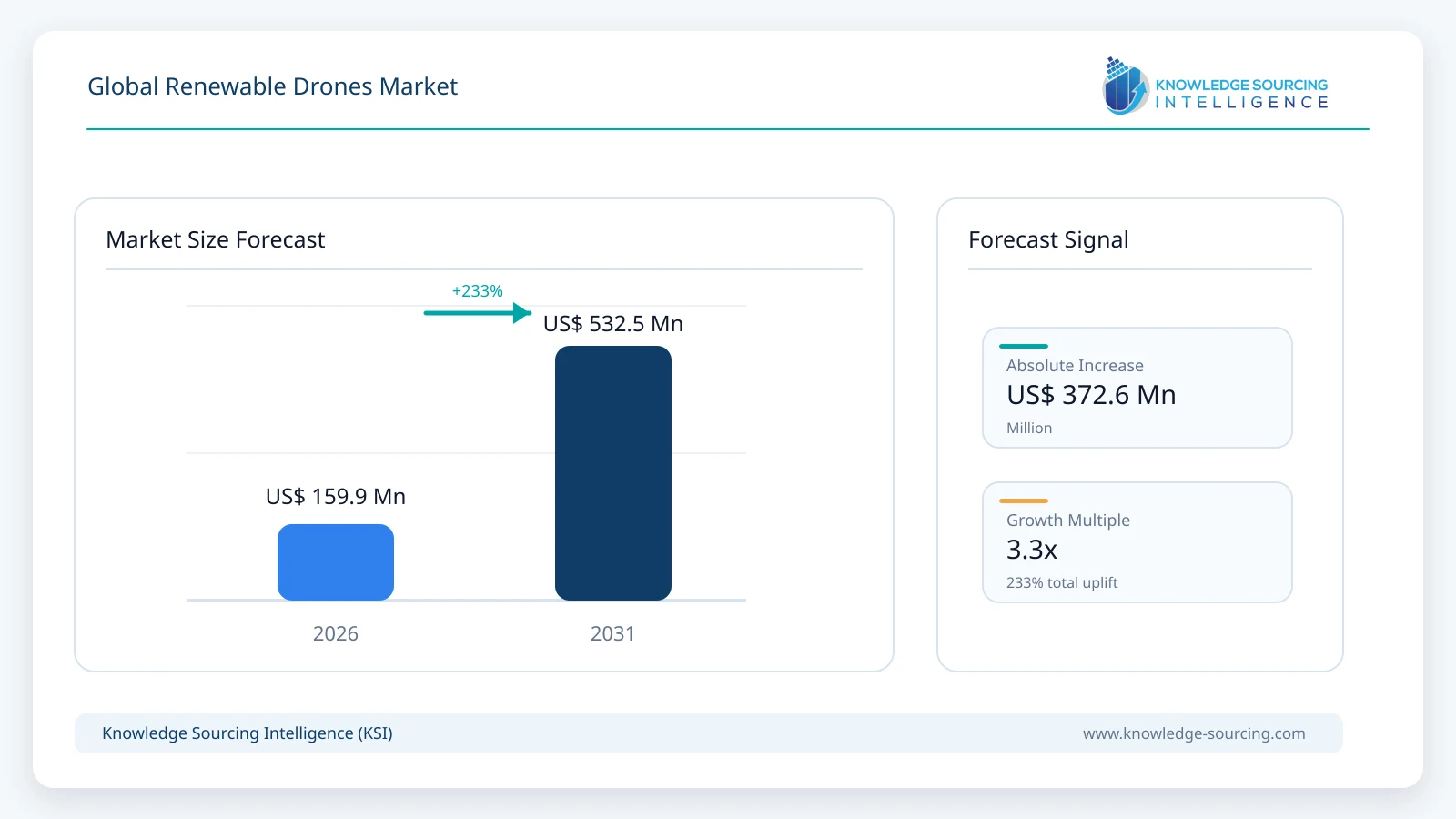
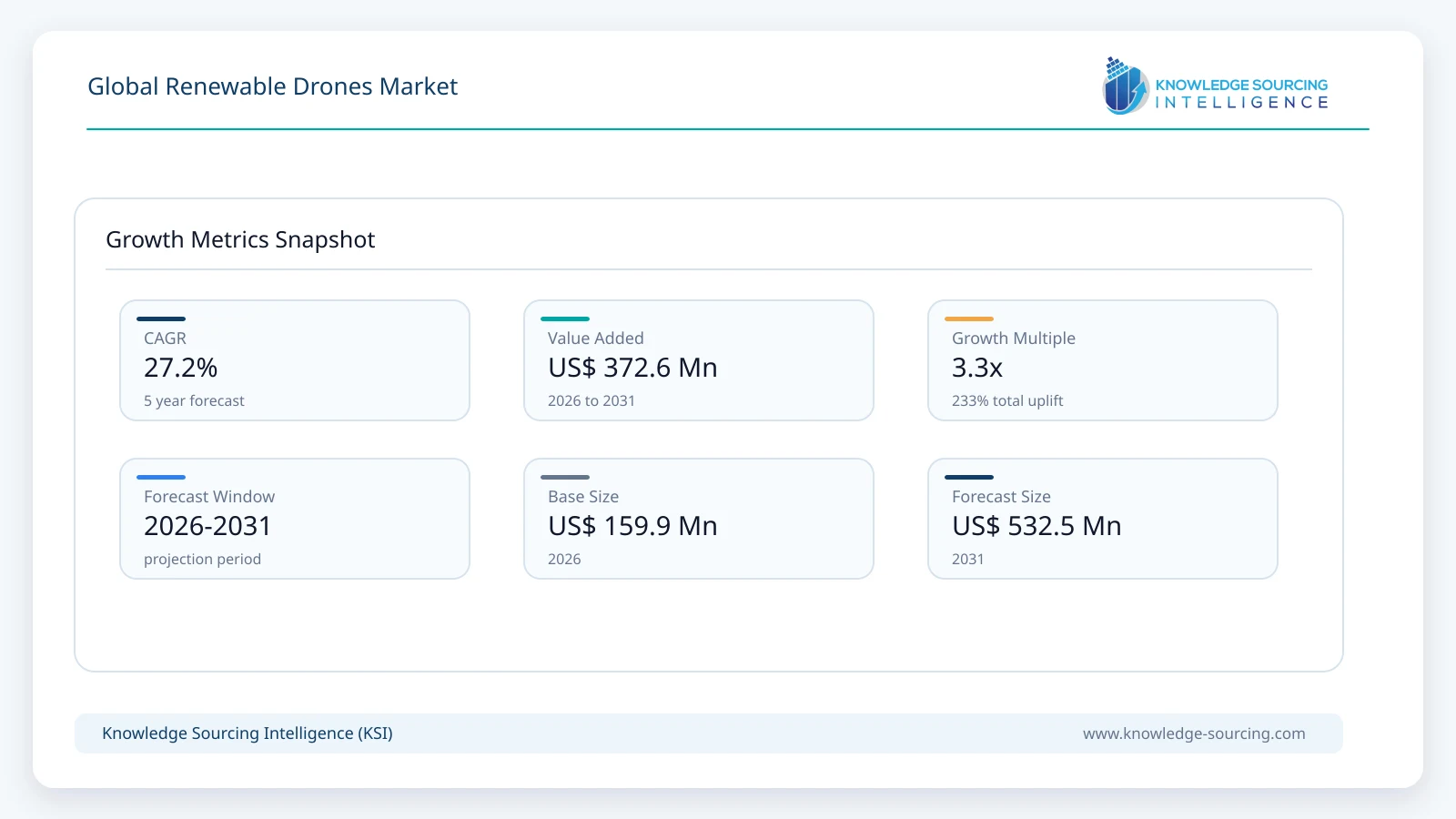
The Global Renewable Drones Market is forecast to grow at a CAGR of 27.2%, reaching USD 532.5 million in 2031 from USD 159.9 million in 2026.
Highlights:
- 1Renewable asset owners are adopting drones to reduce inspection exposure, shorten field activity, and improve the frequency of asset-condition assessments.
- 2Inspection represents the most commercially important application because recurring condition assessment creates a direct link between drone deployment and maintenance expenditure.
- 3Solar and wind projects are creating different requirements for thermal imaging, high-resolution photography, LiDAR, automated flight planning, and defect analytics.
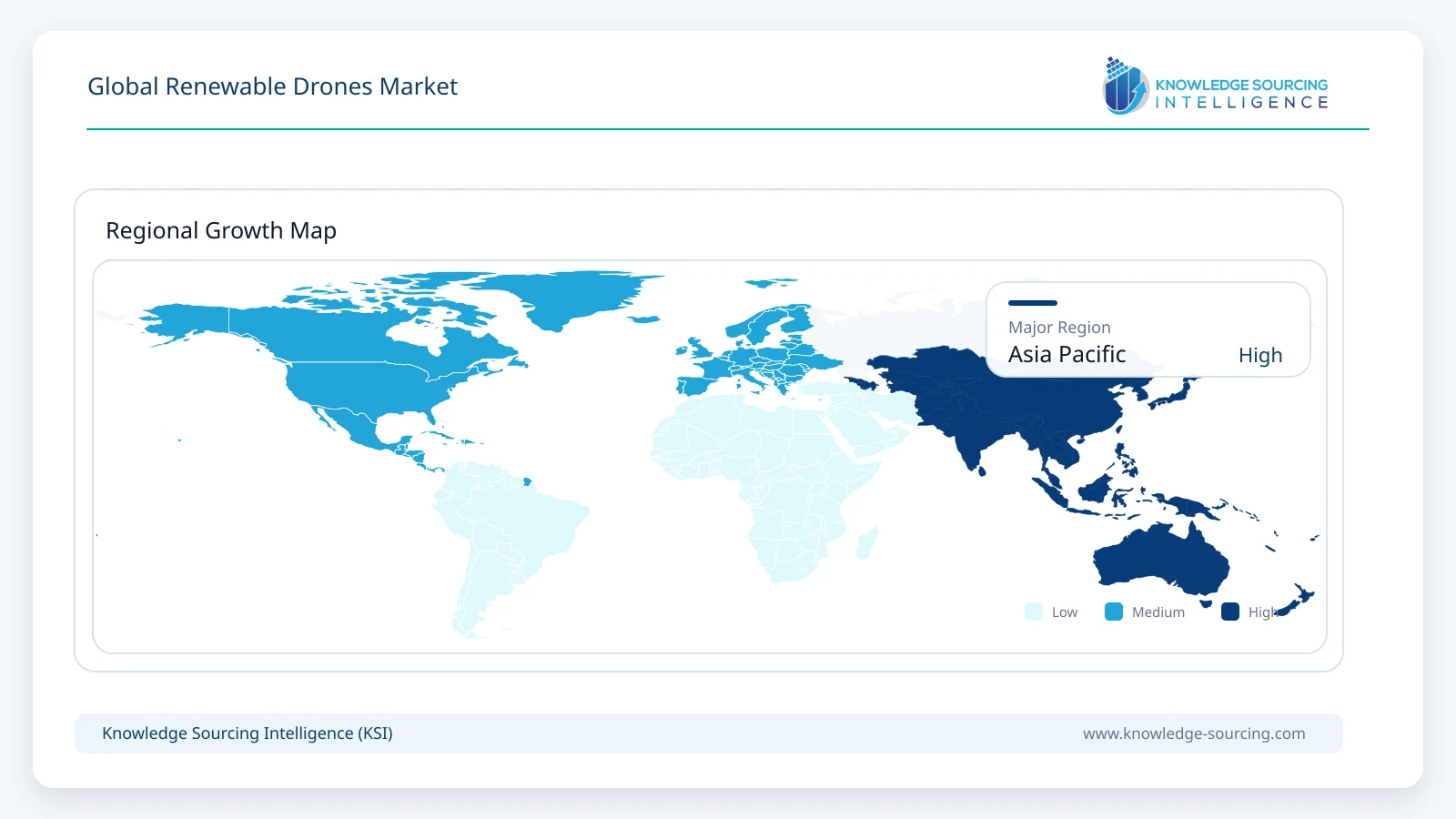
- 4North America and Europe benefit from large renewable asset bases, established drone-service ecosystems, and regulatory frameworks supporting more sophisticated commercial UAS operations.
- 5Asia Pacific offers a broad deployment base because of renewable capacity additions, large solar parks, expanding wind infrastructure, and growing domestic drone capabilities.
- 6Competition is shifting from aircraft supply toward integrated hardware, sensors, software, analytics, compliance support, and recurring inspection services.
The Renewable Drones Market covers unmanned aerial vehicles, associated sensors, flight systems, data-processing software, analytics, and drone-enabled services used across the development, construction, inspection, monitoring, and maintenance of renewable energy assets. The market primarily serves solar photovoltaic facilities, onshore and offshore wind farms, renewable-energy transmission infrastructure, substations, construction sites, and associated balance-of-plant assets. Commercial offerings range from individual drone platforms and payloads to managed inspection services and integrated software environments that convert aerial data into engineering or maintenance decisions.
Demand is being shaped less by the cost of the aircraft itself and more by the economic value of the information collected during each flight. Renewable energy operators manage assets distributed across large geographical areas, often in locations where conventional inspection requires technicians, access equipment, shutdowns, or lengthy site preparation. Drones can place high-resolution visual, thermal, LiDAR, multispectral, or other sensor capabilities close to these assets without requiring personnel to physically access every inspection point. The U.S. Department of Energy has identified aerial drones as an existing tool for visually inspecting wind-turbine blades and improving inspection speed and personnel safety, while also identifying further opportunities for automated inspection and robotic maintenance technologies.
The commercial buyer base includes renewable energy developers, independent power producers, utilities, engineering and construction companies, operations and maintenance contractors, asset managers, equipment manufacturers, insurers, and specialized drone-service providers. Procurement decisions increasingly depend on the complete workflow rather than aircraft specifications alone. Buyers assess sensor quality, flight endurance, wind tolerance, positioning accuracy, data-processing capability, defect-detection reliability, reporting speed, regulatory compliance, cybersecurity, interoperability with existing asset-management systems, and the supplier's ability to execute repeat inspections across multiple sites.
The market therefore has a multi-layered industry structure. Hardware manufacturers compete on flight performance, payload compatibility, safety systems, endurance, portability, and environmental resistance. Software companies compete on mapping, inspection analytics, automated defect identification, reporting, data management, and integration with engineering workflows. Drone-service companies compete on operational coverage, qualified pilots, regulatory execution, turnaround time, inspection quality, and the ability to provide customers with usable engineering outputs rather than raw imagery.
Solar and wind projects create different demand patterns. Solar operators typically require large-area mapping, thermal inspection, module-level defect identification, construction documentation, and periodic asset monitoring. Wind operators require close-range blade inspection, thermal and visual analysis, tower inspection, nacelle assessment, and increasingly detailed documentation of defects. DJI, for example, positions its enterprise systems for wind-turbine inspection using high-resolution visual and thermal payloads, while its photovoltaic solutions use visual and infrared sensing for systematic solar-panel inspection.
The economic case is strongest where conventional inspection creates high labor exposure, extended downtime, difficult site access, or large recurring inspection costs. Offshore wind is particularly relevant because weather windows, vessel availability, technician safety, and turbine accessibility can materially influence maintenance economics. The U.S. Department of Energy has specifically highlighted the importance of automated inspection and repair technologies as offshore turbines become larger and operating conditions become more demanding.
Market Drivers
Expansion of Large Renewable Asset Portfolios
The physical scale of renewable infrastructure is a primary demand driver for drone-based inspection. Utility-scale solar projects can contain thousands or millions of modules distributed across large sites, while wind farms can contain turbines spread across difficult terrain or offshore locations. Manual inspection methods become less economical as asset portfolios expand because inspection teams must cover more equipment while maintaining consistent documentation.
Buyers therefore increasingly evaluate inspection technologies according to coverage per operating day, data quality, repeatability, and the ability to identify problems before they become expensive failures. DroneDeploy's renewable-energy workflow, for example, combines aerial mapping, RGB and thermal data, 3D models, and repeatable inspection records across solar, wind, and substation environments.
For suppliers, this creates demand for longer flight endurance, automated mission planning, reliable positioning, improved payload integration, and software that can process large volumes of imagery. The commercial implication is a shift toward repeatable fleet operations rather than one-time drone purchases.
Rising Economic Value of Preventive Inspection
Renewable-energy assets generate revenue only when they remain available and productive. A defect that remains undetected can cause energy losses, secondary equipment damage, warranty disputes, or an expensive corrective intervention. Drone inspection allows operators to identify visual and thermal abnormalities without sending technicians immediately to every asset.
Solar thermography illustrates this mechanism. Sitemark's inspection platform is designed to identify thermal and visual anomalies, including hotspots, diode issues, electrical problems, cracks, shading, and other module-level conditions. Its 2025 product documentation also introduced a high-resolution RGB inspection approach for identifying fine defects that can be difficult to detect manually across utility-scale solar plants.
The resulting purchasing decision is increasingly based on the cost of missed defects rather than the acquisition cost of the drone. Providers that can connect inspection findings to repair prioritization and asset-management workflows can therefore command greater commercial relevance than suppliers offering imagery alone.
Safety Requirements in Difficult Inspection Environments
Wind turbines, elevated solar infrastructure, substations, and associated electrical assets can expose personnel to falls, electrical hazards, difficult terrain, extreme weather, and confined or inaccessible areas. Offshore wind introduces additional operational constraints because technicians may depend on vessels, helicopters, weather windows, and specialized access systems.
Drone inspection changes the allocation of human labor by moving the initial visual assessment away from hazardous physical access. DJI's wind-turbine inspection solutions, for example, are designed to capture high-resolution visual and thermal information while allowing inspection teams to remain on the ground.
The commercial impact extends beyond safety. Lower exposure can influence insurance requirements, work planning, technician utilization, and the frequency with which assets can be assessed. Suppliers therefore compete on flight stability, obstacle sensing, weather resistance, sensor performance, and operational reliability in addition to image quality.
Increasing Use of Data-Driven Asset Management
The value proposition of renewable drones is moving from data collection toward structured asset intelligence. Operators increasingly need historical records that allow defects to be compared over time, mapped to specific assets, and connected with maintenance decisions.
A drone platform that simply produces thousands of photographs can create another data-management burden. In contrast, systems that automatically organize imagery, georeference findings, identify anomalies, and generate reports can reduce the workload required after the flight. AIRPIX describes an end-to-end model covering drone data acquisition, processing, analysis, and web or mobile application integration, including RGB and thermal inspection of wind turbines and solar assets.
This is encouraging suppliers to build recurring software and service revenue around hardware deployments. Buyers benefit from standardized inspection records and reduced dependence on individual pilot expertise.
Regulatory Progress Toward More Advanced Drone Operations
Regulation remains a constraint, but regulatory frameworks are also creating clearer pathways for commercial drone deployment. In the United States, the Federal Aviation Administration published a proposed framework in August 2025 addressing Beyond Visual Line of Sight operations, including aircraft requirements, operational authorization, separation from other aircraft, security, and reporting.
Europe has established U-space rules intended to support complex drone operations, including operations beyond the direct visual line of sight under defined conditions. In May 2025, EASA certified its first U-space service provider, marking an operational step toward broader U-space implementation.
These developments matter commercially because large renewable sites can require repeat flights across extensive areas. As regulatory mechanisms become more capable, suppliers can develop more automated and remotely supervised operating models, although authorization and safety requirements will continue to determine where those models can be deployed.
Market Restraints and Challenges
Airspace Restrictions and Operational Authorizations
Renewable facilities are not always located in unrestricted airspace. Solar farms and wind projects may be close to airports, military areas, urban zones, transmission corridors, or other controlled environments. Regulatory requirements can determine whether a mission can proceed, what altitude is permitted, whether visual line of sight is required, and which pilot qualifications are necessary.
The U.S. framework continues to impose operational requirements for small commercial UAS, including visual-line-of-sight provisions under Part 107. In India, the regulatory system uses designated drone airspace zones, while the Directorate General of Civil Aviation has continued migrating drone-related regulatory services to the eGCA platform.
These requirements can increase project preparation time and create additional compliance costs. Service providers mitigate the issue through regulatory expertise, standardized operating procedures, trained pilots, and mission planning systems that account for airspace restrictions before deployment.
Weather and Environmental Conditions
Wind, rain, heat, dust, icing, lightning, and offshore weather can restrict drone operations. This is particularly important for wind-turbine inspections because the drone must remain stable close to large moving structures while operating in potentially turbulent air.
The U.S. Department of Energy has noted that offshore wind conditions can include stronger storms, icing, lightning, and difficult sea conditions, all of which influence inspection and maintenance activities.
Weather constraints can reduce fleet utilization and force operators to reschedule missions. Suppliers respond through improved environmental protection, wind resistance, sensor stabilization, mission-planning tools, and more capable aircraft. However, no hardware improvement eliminates the need for operational judgment, making weather a continuing cost factor.
Data Accuracy and False Defect Identification
A drone can collect high-resolution imagery quickly, but accurate interpretation remains essential. False positives can lead to unnecessary maintenance, while false negatives can allow defects to progress. Thermal inspection is particularly sensitive to environmental conditions, irradiance, panel orientation, wind, surface temperature, and flight timing.
This creates a commercial requirement for standardized data-acquisition procedures and validated analytics. Sitemark's guidance on solar inspection, for example, emphasizes controlling flight conditions and mission design to maintain comparable thermal measurements across large sites.
For buyers, the issue affects confidence in automated inspection outputs. Suppliers must therefore combine reliable aircraft operation with sensor calibration, consistent flight procedures, analytics validation, and engineering review.
Fragmented Procurement and Skills Requirements
Some renewable operators prefer internal drone teams, while others outsource inspections or use hybrid models. The appropriate approach depends on asset geography, inspection frequency, internal aviation capability, regulatory requirements, and portfolio size.
Sitemark's June 2025 industry webinar explicitly addressed the choice among in-house, outsourced, and hybrid solar inspection models, highlighting licensing, pilot training, logistics, compliance, and long-term cost considerations.
This fragmentation makes market penetration less straightforward for hardware vendors. A technically capable aircraft may still lose a procurement decision if the supplier cannot provide pilots, regulatory support, data processing, or integration with the buyer's maintenance workflow.
Major Segment Analysis
By Application: Inspection
Inspection is the most commercially important application in the Renewable Drones Market because it creates a recurring operational requirement across the entire renewable asset lifecycle. Unlike one-time surveying or construction mapping, inspection continues after commissioning and becomes part of ongoing operations and maintenance.
For wind assets, drones can inspect blades, towers, nacelles, and associated infrastructure using high-resolution visual and thermal sensors. The primary buyer requirement is not simply image capture. Operators need accurate defect localization, consistent inspection coverage, repeatability, and outputs that maintenance teams can act upon.
The economic rationale is particularly strong where physical access is expensive or hazardous. Traditional rope-access inspection can require substantial preparation, specialized technicians, safety systems, and turbine downtime. Drone-based inspection can reduce the need for personnel to reach the asset during the initial assessment. DJI's current wind-turbine solutions combine high-resolution cameras, thermal sensing, laser rangefinding, and automated or semi-automated inspection workflows.
Solar inspection has a different operating model. The principal challenge is scale. A utility-scale site may contain extensive module fields where small thermal anomalies or physical defects can be difficult to identify from the ground. Drone-based RGB and infrared surveys can create a structured view of the entire array, enabling maintenance teams to focus field visits on identified problem areas.
Sitemark's solar inspection platform demonstrates the increasing importance of combining drone acquisition with automated anomaly detection and structured reporting. DroneDeploy similarly combines aerial maps, thermal inspection, historical records, and asset documentation for renewable-energy projects.
Inspection demand also supports recurring revenue. Once a developer or asset manager establishes a drone inspection protocol, the same supplier can receive repeat assignments across quarterly, annual, post-storm, warranty, or maintenance-related inspections. This makes inspection more commercially durable than a standalone drone hardware transaction.
Competition within this segment is consequently moving toward workflow ownership. Hardware providers seek stronger payload and flight capabilities, software companies seek deeper analytics and reporting functions, while service providers compete on geographic coverage, pilot availability, regulatory execution, and turnaround time. The suppliers with the strongest commercial position are those that can reduce the number of steps between data collection and an approved maintenance action.
Regional Analysis
North America
North America benefits from a large installed base of utility-scale renewable infrastructure and a mature ecosystem of utilities, developers, engineering contractors, and specialized drone operators. The United States is particularly relevant because commercial drone regulation is well established, while the FAA is working on frameworks that could expand more sophisticated BVLOS operations.
Wind inspection remains commercially attractive because of the geographic dispersion and physical scale of wind farms. Solar operators also have strong incentives to automate module-level inspection as project portfolios expand. Procurement is increasingly influenced by data integration, cybersecurity, operational authorization, and the ability to execute repeatable inspections across multiple states.
Canada presents opportunities in large renewable projects and geographically dispersed infrastructure, although weather conditions and remote-site logistics can influence operating costs. Mexico offers demand connected to renewable assets and industrial infrastructure, with local aviation requirements remaining an important procurement consideration.
Europe
Europe has a mature renewable-energy base and a structured regulatory environment for commercial drone operations. The EU's UAS framework includes risk-based operating categories, technical requirements, and U-space provisions for more complex operations.
The region is particularly relevant for offshore wind because of extensive development in the North Sea and other maritime areas. Offshore inspection economics create demand for drones that can operate reliably around large turbines while reducing unnecessary technician exposure and vessel dependence.
Germany, France, the United Kingdom, Spain, and other European markets also provide demand from large solar portfolios. Competition is characterized by specialist service providers, software platforms, aircraft manufacturers, and engineering companies. Compliance capability is a meaningful differentiator because commercial buyers need documented operating procedures and repeatable data quality.
Asia Pacific
Asia Pacific combines extensive renewable deployment with growing domestic drone capabilities. China represents a major manufacturing and renewable-energy market, while India is developing both renewable infrastructure and domestic drone capabilities. Japan and South Korea have strong technology ecosystems, while Southeast Asian markets offer additional opportunities as solar and wind infrastructure expands.
India's regulatory architecture includes the Drone Rules, airspace mapping, and digital regulatory systems designed to support broader UAS adoption. The government has also identified drones as useful for sectors including infrastructure inspection and geospatial mapping.
The region's principal commercial advantage is scale. Large solar parks and wind installations can create substantial recurring inspection demand. However, buyers remain sensitive to acquisition costs, pilot availability, regulatory permissions, local service support, and the availability of reliable after-sales capabilities.
Middle East and Africa
The Middle East offers strong opportunities for drone-based renewable inspection because of large solar developments, high solar irradiation, expansive project sites, and growing utility-scale renewable investment. Saudi Arabia and the UAE are particularly relevant for large projects where automated surveying and inspection can reduce the logistical burden associated with extensive sites.
High temperatures, dust, and occasional extreme weather place greater demands on aircraft environmental performance and sensor reliability. Buyers therefore evaluate operating temperature, dust resistance, flight endurance, thermal-camera performance, and maintenance support.
Africa presents a more fragmented opportunity. Solar projects, distributed renewable systems, and infrastructure development create demand, but purchasing decisions can be constrained by financing availability, local technical capacity, regulatory maturity, and service-network coverage. Service-led models may therefore have greater relevance than direct fleet ownership in some markets.
South America
Brazil represents the largest commercial opportunity within South America because of its extensive renewable-energy infrastructure and substantial wind and solar development. Wind farms in northeastern Brazil create inspection requirements across geographically dispersed assets, while large solar projects support aerial mapping and thermal inspection.
Argentina and other South American markets offer opportunities tied to new renewable installations and existing asset maintenance. However, currency conditions, project financing, local aviation rules, and availability of trained operators can influence procurement.
The regional market is likely to favor suppliers that combine equipment with local service capability. For developers managing remote projects, the ability to mobilize qualified teams and deliver standardized reports can be more important than purchasing the lowest-cost drone platform.
Competitive Landscape
The competitive structure of the Renewable Drones Market spans aircraft manufacturers, specialized drone-service providers, inspection software companies, geospatial technology providers, and renewable-energy inspection specialists. Competition is therefore based on the complete operational workflow rather than on aircraft specifications alone.
DJI has a broad enterprise hardware position, with current renewable-energy offerings covering wind-turbine and photovoltaic inspection through aircraft, thermal and visual payloads, positioning technologies, and third-party software compatibility.
Drone Volt combines professional UAV products with inspection services and energy applications spanning solar panels, wind turbines, and related infrastructure. Its 2025 investor disclosures show activity around partnerships, distribution, LiDAR, and infrastructure-oriented drone solutions.
Airpix has positioned itself around end-to-end drone data acquisition, processing, inspection, and analytics, including renewable-energy applications.
DroneDeploy, Inc. competes primarily through software-led workflows that combine aerial mapping, thermal inspection, asset documentation, historical records, and renewable-energy site management.
ABJ Renewables, Sitemark, Nano Net Technologies Inc., SPH Engineering, ideaForge Technology Limited, and Terra Drone Corporation add further competitive depth across drone hardware, software, inspection, surveying, analytics, and specialized services.
A notable competitive trend is the move toward integrated procurement. Renewable-energy customers increasingly want fewer disconnected systems. A single engagement that includes flight planning, regulatory execution, data capture, thermal or visual analysis, defect identification, reporting, and historical comparison can reduce internal coordination costs.
Another competitive dimension is the balance between end-to-end solutions and point solutions. End-to-end providers can capture more value per customer relationship but must maintain capabilities across hardware, pilots, software, analytics, and support. Point-solution providers can specialize more deeply in areas such as thermography, mapping, LiDAR, or analytics and may integrate with customers' existing drone fleets.
Partnerships are consequently important. Hardware companies can expand market reach through software integrations and service networks, while software providers can remain hardware-agnostic to increase addressable demand. Service companies can differentiate through regional regulatory expertise and operational execution.
Recent Developments
August 2026: Ascent Solar Technologies announced orders from two Eastern European drone manufacturers to integrate its lightweight thin-film photovoltaic products into aircraft wing designs.
March 2026: VisionWave announced SolarDrone's agreement to acquire a 51% controlling interest in Junko Solar, integrating solar panel cleaning and maintenance operations into its drone infrastructure platform.
February 2026: SolarDrone reported completed executive meetings with prospective customers and partners from Egypt and the UAE, following live demonstrations of its solar infrastructure cleaning drone technology.
January 2026: HPCL signed an investment agreement with Maraal Aerospace, providing ?2 crore to accelerate development, testing and validation of its solar-powered long-endurance drone platform.
July 2025: India's Directorate General of Civil Aviation announced the migration of drone-related regulatory services from the Digital Sky platform to the eGCA portal. Commercial relevance: Consolidating regulatory services into a single-window system can reduce administrative friction for commercial drone operators and inspection providers.
Regulatory and Policy Environment
Drone deployment in renewable energy is governed by aviation safety requirements rather than renewable-energy regulation alone. Operators must consider aircraft registration or identification requirements, pilot qualifications, operating categories, airspace restrictions, flight permissions, remote identification where applicable, privacy requirements, and safety procedures.
In the United States, commercial small-UAS operations are governed principally by FAA Part 107 unless another authorization or operating framework applies. Current FAA requirements include visual-line-of-sight operation and restrictions relating to people and other aircraft. The FAA's August 2025 BVLOS proposal is particularly relevant to renewable-energy inspection because extensive solar fields and geographically dispersed wind assets could benefit from operations that do not require continuous visual contact with the aircraft.
Europe follows a risk-based regulatory architecture under Regulation (EU) 2019/947 and associated technical requirements under Regulation (EU) 2019/945. U-space provides an additional framework for designated airspace where specific digital services support more complex UAS operations.
The European regulatory environment is also becoming more operationally mature. EASA's certification of the first U-space service provider in May 2025 provides evidence that the framework is progressing from regulation toward practical service deployment.
India's Drone Rules, 2021 established a liberalized regulatory framework alongside the Digital Sky platform and designated drone airspace. Government policy has emphasized UAS traffic management and wider economic applications, including infrastructure inspection and geospatial mapping. The 2025 migration of drone-related regulatory services to eGCA represents another administrative development affecting operators and service providers.
For renewable-energy buyers, regulatory compliance increasingly forms part of supplier qualification. Developers operating across multiple jurisdictions prefer providers that can manage documentation, flight permissions, pilot credentials, operating procedures, and data requirements. This creates a commercial advantage for suppliers with established compliance systems rather than relying solely on aircraft capability.
Data governance is another consideration. Drone inspections can generate detailed images of industrial facilities, electrical infrastructure, workers, and surrounding property. Operators must therefore establish appropriate controls for data storage, access, transmission, retention, and cybersecurity. As drone fleets become more connected and automated, cybersecurity requirements are likely to become more relevant to enterprise procurement.
Outlook and Strategic Implications
The 2026–2031 outlook for the Renewable Drones Market will be shaped by the economics of renewable-asset operations rather than by drone adoption in isolation. The strongest opportunities will arise where renewable developers and asset managers can demonstrate that aerial inspection reduces inspection time, limits hazardous access, improves defect detection, or enables more targeted maintenance.
Inspection is expected to remain the commercial anchor because renewable assets require recurring condition assessment throughout their operating lives. The next stage of adoption will depend on moving from individual flights toward standardized inspection programs. Buyers will increasingly evaluate suppliers according to how reliably they can repeat the same inspection process across months and years, not merely how impressive a single dataset appears.
Procurement is likely to favor integrated solutions that combine aircraft, payloads, flight planning, data processing, analytics, reporting, and asset-management integration. This model addresses a major weakness of hardware-only procurement: the customer must otherwise assemble and manage multiple technical components internally.
Automation will remain an important technology direction. Automated mission planning, obstacle avoidance, repeatable flight paths, thermal analytics, automated defect classification, and remote fleet management can reduce the amount of manual work required per inspection. However, automation will not eliminate human oversight. Engineering validation remains necessary where an inspection finding can trigger a major repair or affect an asset's operational status.
The role of docked drones and autonomous inspection systems is also likely to expand where site economics justify permanent deployment. Solar plants and substations provide controlled environments where repeatable routes can be established. DroneDeploy's current renewable-energy offering already includes docked drones and ground robots as part of a broader inspection workflow.
Offshore wind presents a higher-value opportunity but also a more demanding technical environment. Large turbines, difficult weather, vessel costs, and limited maintenance windows increase the value of accurate remote inspection. The U.S. Department of Energy's offshore wind roadmap identifies automated inspection and robotic technologies as areas requiring further development, suggesting that drone deployment will increasingly intersect with broader robotic maintenance systems.
Regulatory evolution will influence the pace of adoption. Expanded BVLOS permissions in the United States, practical implementation of U-space in Europe, and streamlined digital administration in markets such as India could reduce operational friction. Nevertheless, regulatory approvals will remain jurisdiction-specific, meaning suppliers need local compliance capabilities even when the underlying aircraft and software are standardized.
Competitive positioning will increasingly depend on recurring customer relationships. Hardware suppliers can strengthen their position through software compatibility and service networks. Software companies can expand by supporting multiple aircraft and integrating with enterprise asset-management systems. Drone-service companies can compete through operational expertise, geographic coverage, and faster reporting. Renewable-energy specialists can differentiate by developing inspection methodologies tailored to specific asset classes.
For buyers, the strategic priority should be to evaluate drone programs using total inspection economics. Relevant measures include inspection duration, technician exposure, turbine or plant downtime, defect-detection accuracy, reporting turnaround, repeatability, travel requirements, data-processing labor, regulatory administration, and the percentage of detected issues that translate into actionable maintenance.
The principal market risks include regulatory delays, adverse weather, inconsistent data quality, cybersecurity concerns, insufficient pilot availability, rapid hardware obsolescence, and uncertainty over the accuracy of automated defect classification. Buyers can mitigate these risks through standardized operating procedures, vendor qualification, pilot training, data-quality controls, equipment redundancy, and integration testing.
Over the next five years, the most attractive commercial opportunities are likely to sit at the intersection of renewable asset expansion and recurring operations expenditure. The market will therefore move beyond the question of whether drones can inspect renewable infrastructure. The more important commercial question will be whether suppliers can deliver reliable, repeatable, regulatorily compliant inspection intelligence that directly improves asset availability and maintenance decisions. That distinction will shape purchasing behavior, supplier economics, and competitive positioning across the Renewable Drones Market through 2031.
Renewable Drones Market Scope:
| Report Metric | Details |
|---|---|
| Total Market Size in 2026 | USD 159.9 million |
| Total Market Size in 2031 | USD 532.5 million |
| Forecast Unit | Million |
| Growth Rate | 27.2% |
| Study Period | 2021 to 2031 |
| Historical Data | 2021 to 2024 |
| Base Year | 2025 |
| Forecast Period | 2026 – 2031 |
| Segmentation | Type, Solution, Application, Renewable Energy Source, Geography |
| Companies |
|
Market Segmentation
By Type
By Solution
By Application
By Renewable Energy Source
By Geography
Table of Contents
1. EXECUTIVE SUMMARY
2. MARKET SNAPSHOT
2.1. Market Overview
2.2. Market Definition
2.3. Scope of the Study
2.4. Market Segmentation
3. BUSINESS LANDSCAPE
3.1. Market Drivers
3.2. Market Restraints
3.3. Market Opportunities
3.4. Porter’s Five Forces Analysis
3.5. Industry Value Chain Analysis
3.6. Regulatory and Policy Environment
3.7. Strategic Recommendations
4. TECHNOLOGICAL OUTLOOK
4.1. Introduction
4.2. Autonomous Flight and Mission Planning
4.3. AI-Based Inspection and Defect Detection
4.4. Thermal and Multispectral Imaging
4.5. LiDAR and 3D Mapping
4.6. Drone-in-a-Box Systems
4.7. Cloud-Based Analytics
4.8. Digital Twin Integration
5. GLOBAL RENEWABLE DRONES MARKET BY TYPE
5.1. Introduction
5.2. Multi-Rotor
5.3. Fixed-Wing
5.4. Hybrid VTOL
5.5. Others
6. GLOBAL RENEWABLE DRONES MARKET BY SOLUTION
6.1. Introduction
6.2. End-to-End Solutions
6.3. Point Solutions
7. GLOBAL RENEWABLE DRONES MARKET BY APPLICATION
7.1. Introduction
7.2. Inspection
7.3. Surveying and Mapping
7.4. Monitoring
7.5. Construction and Project Development
7.6. Asset Management and Maintenance
7.7. Security and Surveillance
7.8. Others
8. GLOBAL RENEWABLE DRONES MARKET BY RENEWABLE ENERGY SOURCE
8.1. Introduction
8.2. Solar Energy
8.3. Wind Energy
8.4. Other Renewable Energy Sources
9. GLOBAL RENEWABLE DRONES MARKET BY GEOGRAPHY
9.1. Introduction
9.2. North America
9.2.1. United States
9.2.2. Canada
9.2.3. Mexico
9.3. South America
9.3.1. Brazil
9.3.2. Argentina
9.3.3. Others
9.4. Europe
9.4.1. Germany
9.4.2. France
9.4.3. United Kingdom
9.4.4. Spain
9.4.5. Others
9.5. Middle East and Africa
9.5.1. Saudi Arabia
9.5.2. UAE
9.5.3. Others
9.6. Asia Pacific
9.6.1. China
9.6.2. India
9.6.3. Japan
9.6.4. South Korea
9.6.5. Indonesia
9.6.6. Thailand
9.6.7. Others
10. COMPETITIVE ENVIRONMENT AND ANALYSIS
10.1. Major Players and Strategic Analysis
10.2. Market Share Analysis
10.3. Mergers, Acquisitions, Agreements, and Collaborations
10.4. Competitive Dashboard
11. COMPANY PROFILES
11.1. DJI
11.2. Drone Volt
11.3. Airpix
11.4. DroneDeploy, Inc.
11.5. ABJ Renewables
11.6. Sitemark
11.7. Nano Net Technologies Inc.
11.8. SPH Engineering
11.9. ideaForge Technology Limited
11.10. Terra Drone Corporation
12. APPENDIX
12.1. Currency
12.2. Assumptions
12.3. Base Year and Forecast Period
12.4. Key Benefits for Stakeholders
12.5. Research Methodology
12.6. Abbreviations
LIST OF FIGURES
LIST OF TABLES
Navigate
Trusted by the world's leading organizations











