
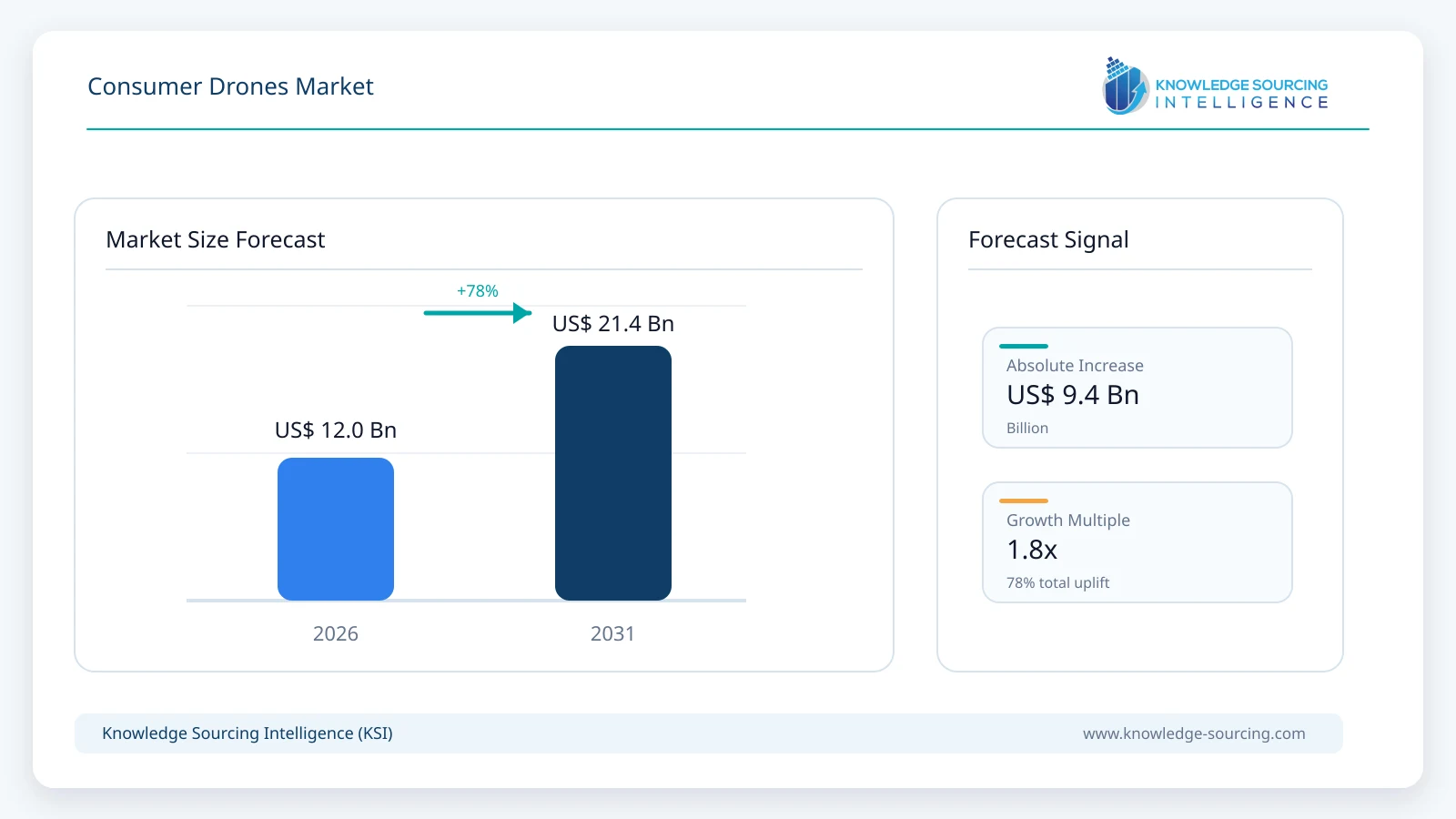
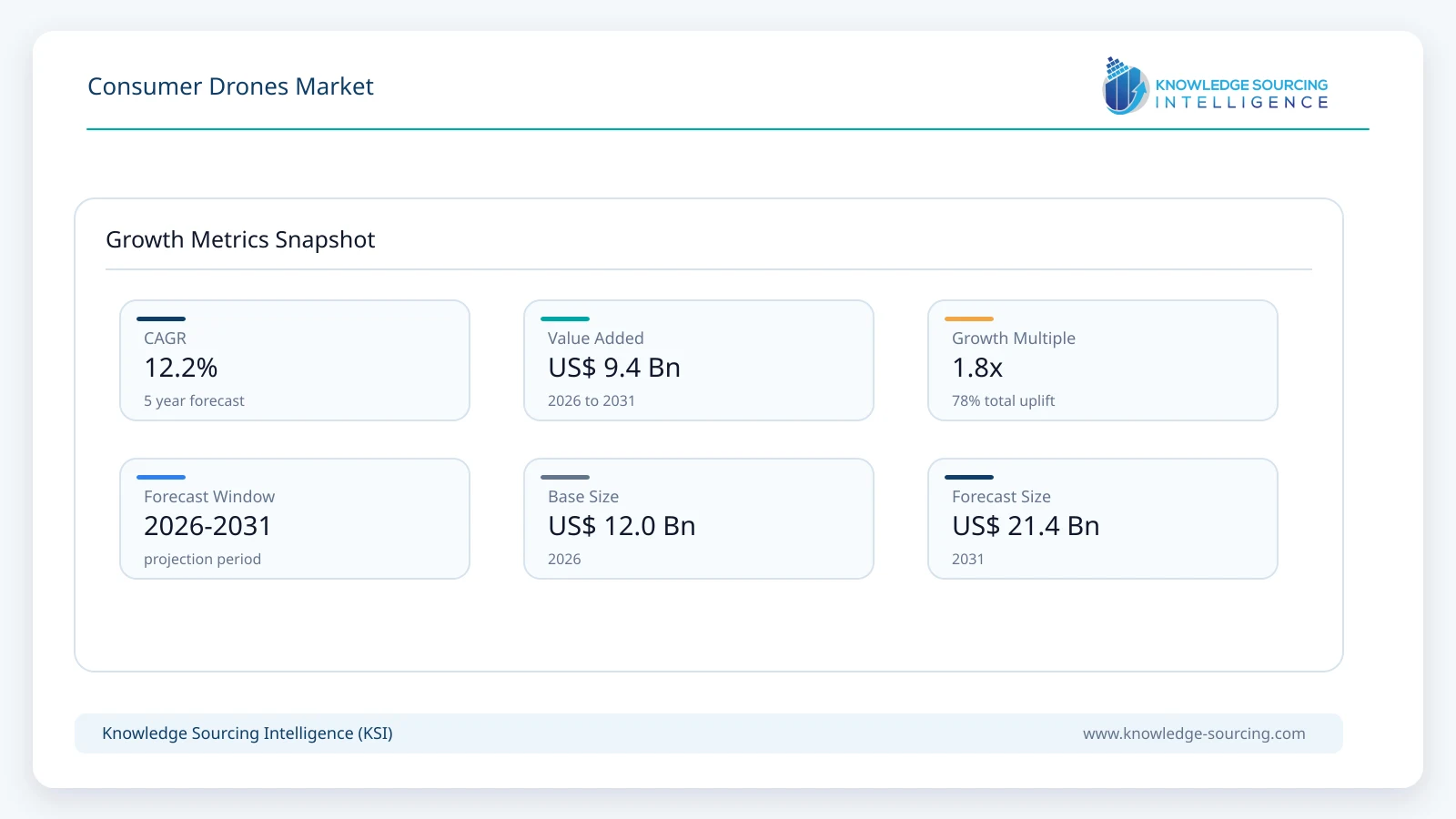
The Consumer Drones Market is forecast to grow at a CAGR of approximately 12.2%, increasing from USD 12.0 billion in 2026 to USD 21.4 billion by 2031.
Highlights:
- 1Rotary-blade drones account for approximately 92% of global consumer drone revenue in 2026.
- 2Aerial photography and videography generate about USD 8.31 billion of market value in 2026.
- 3Asia Pacific represents approximately 41% of global consumer drone revenue in 2026.
- 4Aerial photography applications are projected to grow at approximately 13.2% annually through 2031.
- 5Sub-250 gram drones are reducing entry barriers for travel, recreation and everyday content creation.
- 6AI tracking and autonomous shooting are widening demand beyond experienced drone pilots.
Consumer drones have moved from specialist hobby products toward portable imaging devices. The largest products now combine stabilized cameras, satellite positioning, return-to-home functions and automated shooting modes in compact foldable designs. Entry-level models focus on ease of use and price. Premium consumer models add larger sensors, multiple cameras, stronger obstacle sensing and longer transmission range. FPV products serve a different user group that values speed, immersive control and maneuverability.
Regulation has a direct influence on product design. In the European Union, the open category is the main operating framework for leisure drone use and applies different requirements by drone class and weight. C0 drones under 250 grams can operate under relatively light requirements, although camera-equipped drones may still require operator registration. Manufacturers are therefore designing more capable products around the sub-250 gram threshold. Remote identification and local airspace restrictions remain important in the United States and other major markets.
Product economics vary sharply across the market. Entry-level camera drones compete on price, basic stabilization and simple automated modes. Mainstream products add stronger transmission links, better wind resistance and more capable imaging. Premium consumer drones command much higher prices through larger sensors, multi-camera systems, omnidirectional sensing and advanced controllers. Accessories are an important secondary revenue stream. Extra batteries, charging hubs, controllers, filters, goggles and replacement propellers increase spending after the initial aircraft purchase.
Market Trends
Consumer drones are becoming autonomous flying cameras rather than manually operated aircraft
The fastest product innovation is occurring around automated capture. New drones can launch from the hand, recognize a person, follow movement and select preset camera paths with limited pilot input. DJI's Neo line and HOVERAir's products are examples of this shift toward personal flying cameras. HOVERAir expanded the concept in August 2026 with VERSA, which combines handheld gimbal shooting and self-flying aerial capture in one device. This design direction brings drones closer to action cameras and creator tools.
Camera quality is improving while compact drones remain below important weight thresholds
Small drones are receiving larger image sensors and more advanced video modes. Potensic's ATOM 3 remains below 249 grams while offering a 1/1.3-inch sensor, 4K video at up to 60 frames per second and AI tracking. DJI's Mini 5 Pro also keeps a lightweight form factor while adding a 1-inch sensor and advanced obstacle sensing. This combination of portability and imaging capability supports higher average selling prices without forcing users into larger prosumer aircraft.
FPV and immersive capture are creating a distinct enthusiast growth pocket
First-person-view flying remains smaller than mainstream camera-drone demand but supports a highly engaged customer base. FPV users purchase aircraft, goggles, radio systems, batteries and replacement parts more frequently than casual camera-drone buyers. The category is also moving closer to mainstream content creation as stabilized video, digital transmission and easier assisted flight reduce the learning curve. DJI's Avata family and specialist brands such as BETAFPV, iFlight and GEPRC illustrate the two ends of this market. The result is a consumer segment that combines recreation, racing and video creation rather than operating as a pure hobby category.
Market Drivers
Aerial content creation and social media are expanding the consumer use case
Travelers, outdoor users and content creators increasingly use drones to add aerial perspectives that are difficult to reproduce with handheld cameras. Vertical video, automated subject tracking and preset cinematic movements reduce the skill needed to create usable footage. Manufacturers are responding with products designed for hiking, cycling, skiing, water sports and family travel. This increases the addressable market beyond traditional aviation hobbyists.
Lower operating friction for lightweight drones supports first-time adoption
Weight-based regulation is encouraging demand for compact drones. In Europe, C0 products under 250 grams can operate in the A1 open subcategory with lighter pilot requirements than heavier classes. Many consumer brands now build flagship or mainstream products around this threshold. Lower weight also improves portability and reduces the need for large cases, which makes drones easier to carry during travel and outdoor activities.
Broader retail distribution and simplified controls are improving first-time conversion
Consumer drones are becoming easier to discover and purchase through electronics retailers, specialist e-commerce stores and direct brand channels. The buying decision is also becoming simpler because manufacturers package intelligent flight modes, subject tracking and screen-equipped controllers into complete kits. A first-time user no longer needs to assemble a system or understand complex manual flight settings before creating usable footage. This is important for market growth because the next group of buyers is increasingly composed of travelers, families and creators rather than traditional radio-control enthusiasts.
Market Restraint
Airspace restrictions, safety concerns and short replacement cycles limit frictionless expansion
Consumer drone ownership still requires users to understand local flight rules, restricted airspace and privacy requirements. Operations near airports, crowded events and sensitive locations can be limited or prohibited. Battery life remains another practical constraint because most compact camera drones provide less than one hour of flight on a single battery. The market also faces rapid product turnover, which can reduce resale values and make consumers delay upgrades until camera or autonomy improvements become significant.
Privacy concerns can further restrict use in residential and tourism settings. Camera drones may be technically easy to operate but are not always socially acceptable around private property or crowded public spaces. Weather also limits utilization because high wind, rain and cold temperatures reduce safe flight time for many small products. These factors can lower actual usage after purchase and reduce the urgency of replacement for casual owners.
Segment Analysis
By Product Type - Rotary Blade Drone
Rotary-blade drones dominate the consumer market because they can hover, take off vertically and hold a stable position for photography. The segment accounts for approximately 92% of market value in 2026, equivalent to about USD 11.07 billion. It is projected to reach approximately USD 19.91 billion by 2031. Fixed-wing consumer drones remain a niche category for longer-distance hobby flying. Hybrid designs are also limited because their added mechanical complexity provides less value for mainstream photography and recreation.
Within the rotary category, compact foldable camera drones generate most revenue because they serve both beginners and experienced creators. Follow-me drones are gaining share from a smaller base as hands-free tracking improves. FPV quadcopters remain more specialized and have a higher accessory attachment rate. Fixed-wing products retain advantages in endurance, but their launch, landing and control requirements make them less suitable for mass-market photography.
By Application - Aerial Photography and Videography
Aerial photography and videography form the largest application segment. The segment is estimated at approximately USD 8.31 billion in 2026 and is projected to reach about USD 15.42 billion by 2031. Growth is supported by better sensors, automated subject tracking and easier editing for social platforms. Hobby and gaming applications remain important through FPV flying, racing and recreational use. This segment is projected to reach approximately USD 6.00 billion by 2031.
Photography demand is also broadening beyond landscape footage. Users increasingly capture sports, travel, property, family events and social-media content. Automated tracking and vertical video make the drone relevant to short-form platforms, while larger sensors support more serious photo and video production. Hobby and gaming demand is driven by FPV racing, freestyle flying and recreational ownership. Its growth is slower because the user base requires greater interest in piloting rather than content capture.
By Geography - Asia Pacific
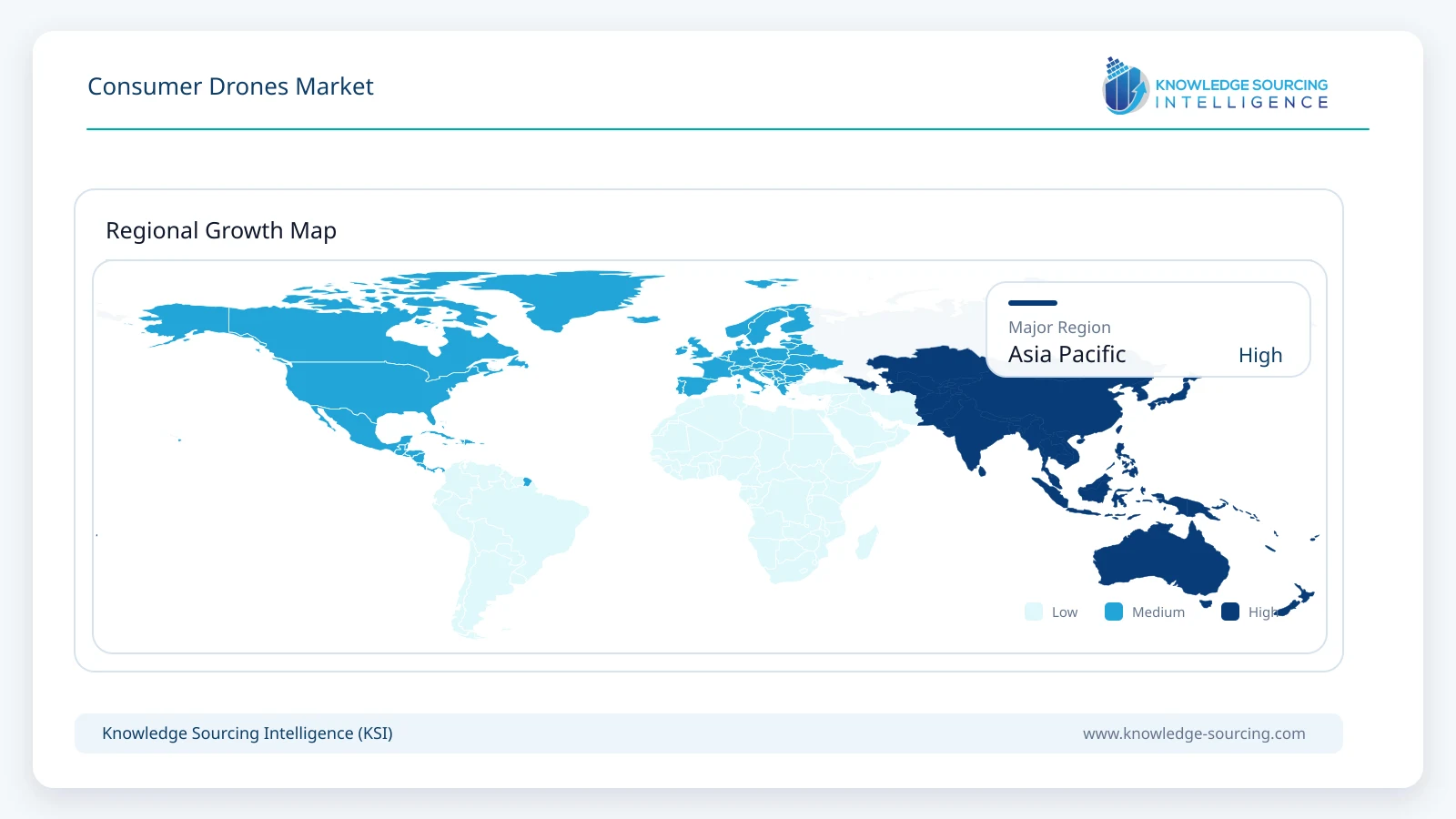
Asia Pacific is the largest regional market and accounts for approximately 41% of global consumer drone revenue in 2026. The region is projected to reach about USD 9.42 billion by 2031. China is central to the global supply base and hosts many leading drone manufacturers. Japan, South Korea, India and Southeast Asian markets add demand through travel, photography and expanding creator communities. North America remains a major premium market, while Europe benefits from a clearly defined open-category regulatory framework.
North America is estimated at approximately USD 3.25 billion in 2026 and remains a high-value market for premium camera drones and FPV equipment. Europe is estimated at approximately USD 2.41 billion and benefits from a harmonized regulatory framework across the European Union. South America and the Middle East and Africa remain smaller markets, but improving e-commerce access and creator adoption support gradual expansion.
Competitive Environment
DJI leads the market through a broad portfolio that spans entry-level follow-me drones, lightweight camera drones, FPV products and premium prosumer systems. Its 2026 lineup includes the Mini 5 Pro, Neo 2, Lito series, Avata 360, Air 3S and Mavic 4 Pro. This range gives the company coverage across beginner, travel, creator and enthusiast buyers.
Potensic competes strongly in the value and mid-range camera-drone segment. Its ATOM 3 combines a sub-249 gram design with a larger sensor, longer transmission range and AI-assisted shooting. HOVERAir focuses on autonomous personal flying cameras and action-sports use. Autel Robotics continues to compete in compact camera drones, while Hubsan and FIMI remain active in value-focused products.
FPV demand supports a separate group of specialist manufacturers. BETAFPV, iFlight, GEPRC and EMAX serve racing and freestyle users with ready-to-fly systems and components. Competition in this segment depends on control response, video transmission, repairability and ecosystem compatibility. Across the broader market, camera quality, obstacle avoidance, autonomy, portability and regulatory compliance are the main areas of differentiation.
HOVERAir differentiates through autonomous follow-me use rather than conventional controller-led flying. Its AQUA extends this approach into water sports, while VERSA combines ground and aerial capture. Potensic competes on value by bringing higher-end imaging functions into lower price bands. This creates pressure on established brands to improve camera performance and autonomy without materially increasing weight.
The market also has a long tail of lower-cost brands sold through online channels. These suppliers compete mainly on price, bundled accessories and ease of purchase. Their presence keeps entry-level pricing competitive, but premium share remains tied to reliability, flight software, imaging quality and after-sales support. Brand trust is especially important because a drone combines aircraft control, camera hardware, batteries and mobile software in one product.
Recent Developments
August 2026: HOVERAir launched VERSA, a 4K pocket camera that converts into a self-flying camera with an optional flight kit.
September 2026: DJI showcased a refreshed consumer lineup at IFA 2026, including Mini 5 Pro, Neo 2, Lito 1, Lito X1 and Avata 360.
June 2026: Potensic expanded its ATOM platform with ATOM 3, a sub-249 gram camera drone with 4K/60fps video and AI Tracking 2.0.
June 2026: HOVERAir launched the 99-gram X1 Smart in the United Kingdom and expanded retail availability across major stores.
May 2026: HOVERAir began retail sales of AQUA, an IP67 waterproof self-flying camera designed for water sports.
January 2026: Potensic presented its consumer camera-drone portfolio at CES 2026, including ATOM 2 and screen-controller accessories.
Consumer Drones Market Scope
| Report Metric | Details |
|---|---|
| Total Market Size in 2026 | USD 12.0 billion |
| Total Market Size in 2031 | USD 21.4 billion |
| Forecast Unit | Billion |
| Growth Rate | 12.2% |
| Study Period | 2021 to 2031 |
| Historical Data | 2021 to 2024 |
| Base Year | 2025 |
| Forecast Period | 2026 – 2031 |
| Segmentation | Product Type, Application, Geography |
| Companies |
|
Market Segmentation
By Product Type
Fixed Wing Drone
Rotary Blade Drone
Hybrid Drone
By Application
Hobbyist and Gaming
Aerial Photography and Videography
By Geography
North America
United States
Canada
Mexico
South America
Brazil
Argentina
Others
Europe
United Kingdom
Germany
France
Spain
Italy
Others
Middle East and Africa
Saudi Arabia
UAE
Israel
Others
Asia Pacific
China
Japan
India
South Korea
Indonesia
Thailand
Others
Table of Contents
1. EXECUTIVE SUMMARY
2. MARKET SNAPSHOT
2.1. Market Overview
2.2. Market Definition
2.3. Market Segmentation
3. BUSINESS LANDSCAPE
3.1. Market Drivers
3.1.1. Aerial Content Creation and Social Media are Expanding the Consumer Use Case
3.1.2. Lower Operating Friction for Lightweight Drones Supports First-Time Adoption
3.2. Market Restraint
3.2.1. Airspace Restrictions, Safety Concerns and Short Replacement Cycles Limit Frictionless Expansion
3.3. Market Opportunities
3.4. Porter's Five Forces Analysis
3.5. Industry Value Chain Analysis
3.6. Policies and Regulations
3.7. Strategic Recommendations
4. TECHNOLOGICAL OUTLOOK
4.1. AI Tracking and Autonomous Flight
4.2. Obstacle Sensing and Navigation
4.3. Camera Sensors and Stabilization
4.4. FPV Video Transmission
4.5. Battery and Lightweight Airframe Development
5. CONSUMER DRONES MARKET BY PRODUCT TYPE
5.1. Introduction
5.2. Fixed Wing Drone
5.3. Rotary Blade Drone
5.4. Hybrid Drone
6. CONSUMER DRONES MARKET BY APPLICATION
6.1. Introduction
6.2. Hobbyist and Gaming
6.3. Aerial Photography and Videography
7. CONSUMER DRONES MARKET BY GEOGRAPHY
7.1. Introduction
7.2. North America
7.2.1. United States
7.2.2. Canada
7.2.3. Mexico
7.3. South America
7.3.1. Brazil
7.3.2. Argentina
7.3.3. Others
7.4. Europe
7.4.1. United Kingdom
7.4.2. Germany
7.4.3. France
7.4.4. Spain
7.4.5. Italy
7.4.6. Others
7.5. Middle East and Africa
7.5.1. Saudi Arabia
7.5.2. UAE
7.5.3. Israel
7.5.4. Others
7.6. Asia Pacific
7.6.1. China
7.6.2. Japan
7.6.3. India
7.6.4. South Korea
7.6.5. Indonesia
7.6.6. Thailand
7.6.7. Others
8. COMPETITIVE ENVIRONMENT AND ANALYSIS
8.1. Major Players and Strategy Analysis
8.2. Market Share Analysis
8.3. Product and Pricing Positioning
8.4. Mergers, Acquisitions, Agreements and Collaborations
8.5. Competitive Dashboard
9. COMPANY PROFILES
9.1. SZ DJI Technology Co., Ltd.
9.2. Autel Robotics Co., Ltd.
9.3. Potensic
9.4. Zero Zero Robotics (HOVERAir)
9.5. Antigravity
9.6. Shenzhen Hubsan Technology Co., Ltd.
9.7. FIMI Technology Ltd.
9.8. Holy Stone
9.9. Ruko
9.10. BETAFPV
9.11. iFlight Innovation Technology Limited
9.12. GEPRC
9.13. EMAX
9.14. Walkera Technology Co., Ltd.
9.15. IZI
9.16. SwellPro
10. APPENDIX
10.1. Currency
10.2. Assumptions
10.3. Base and Forecast Years Timeline
10.4. Key Benefits for Stakeholders
10.5. Research Methodology
10.6. Abbreviations
Navigate
Trusted by the world's leading organizations











