
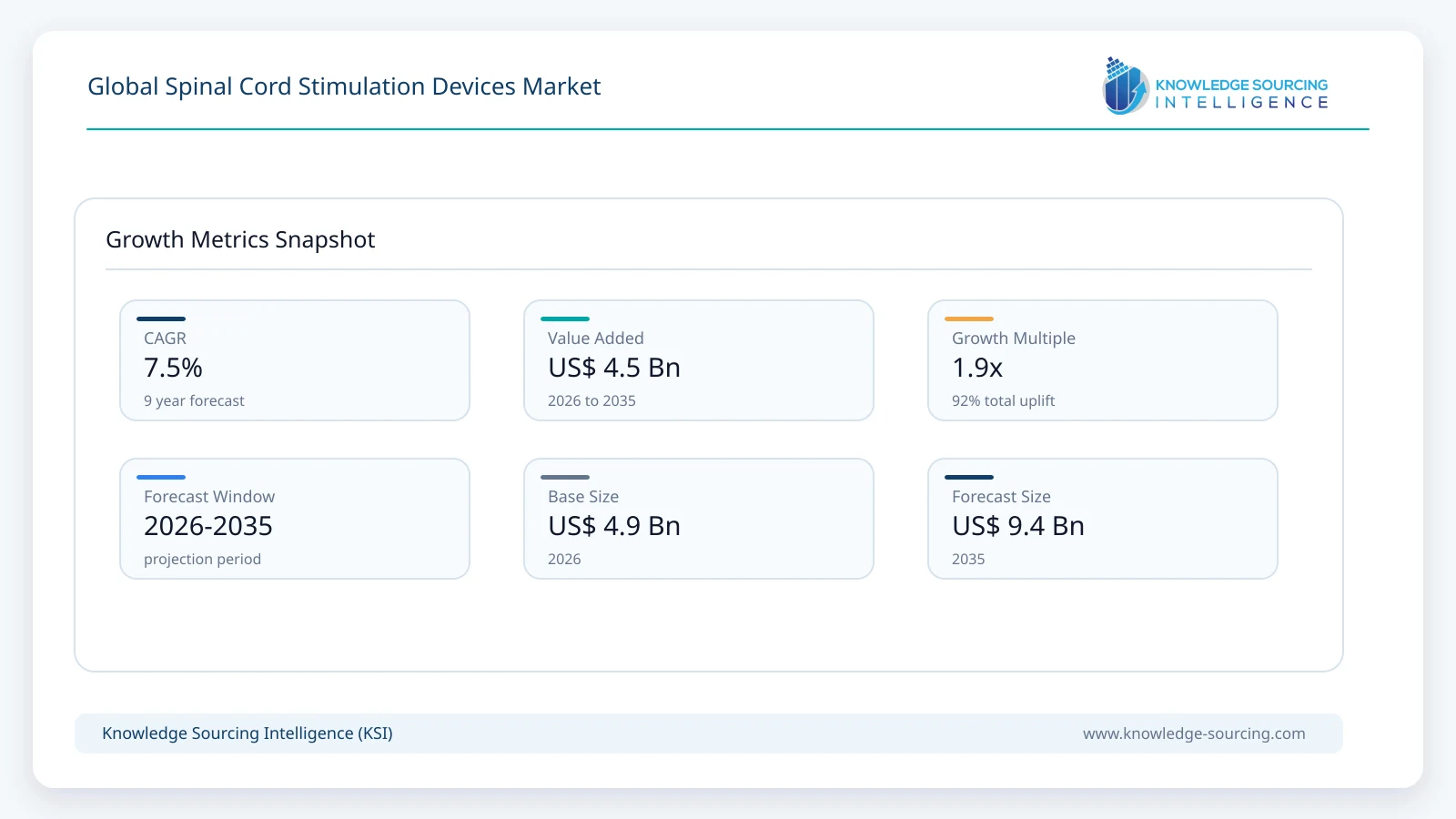
The Global Spinal Cord Stimulation Devices Market is set to reach USD 9.45 billion in 2035, growing at a CAGR of 7.5 % from USD 4.91 billion in 2026.
Highlights:
- 1Rising prevalence of chronic neuropathic pain is increasing demand for spinal cord stimulation therapies.
- 2Healthcare providers are expanding non-opioid treatment strategies, accelerating neuromodulation adoption.
- 3High-frequency and burst stimulation technologies are improving therapeutic outcomes.
- 4Closed-loop neuromodulation systems are strengthening personalized pain management approaches.
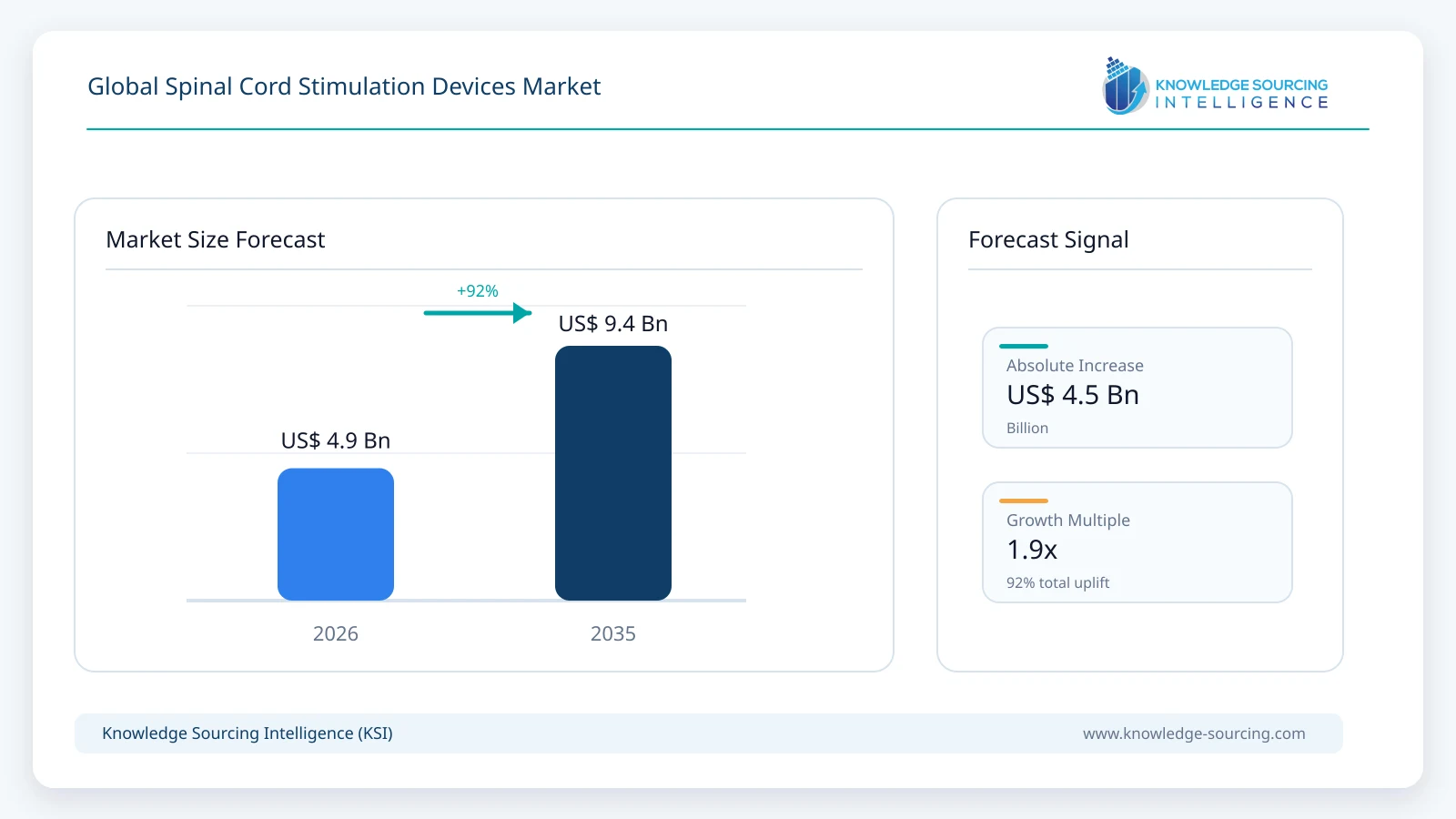
Spinal cord stimulation utilizes implantable neuromodulation systems that deliver electrical impulses to the spinal cord to alter pain signal transmission. Healthcare professionals employ these devices because chronic neuropathic pain frequently persists despite medication, surgery, or physical rehabilitation interventions.
Chronic pain management increasingly depends on non-pharmacological solutions because long-term medication exposure creates safety, adherence, and effectiveness concerns. Spinal cord stimulation addresses these challenges because targeted neuromodulation can reduce pain perception while limiting systemic treatment exposure.
Healthcare systems are expanding neuromodulation programs because chronic pain generates substantial clinical and economic burdens. Physicians are recommending spinal cord stimulation earlier in treatment pathways because growing clinical evidence supports long-term therapeutic benefits in selected patient populations.
Strategic importance continues to increase because healthcare providers seek sustainable solutions for chronic pain management. Spinal cord stimulation therefore occupies an increasingly important position within interventional pain medicine.
Market Dynamics
Market Drivers
Increasing Burden of Chronic Pain Disorders
Chronic pain remains a major healthcare challenge because millions of patients continue experiencing persistent symptoms despite conventional treatment. Physicians are expanding neuromodulation utilization because effective long-term alternatives remain limited. This trend strengthens demand for spinal cord stimulation devices.
Shift Toward Non-Opioid Pain Management
Healthcare systems prioritize opioid-sparing treatment approaches because long-term opioid utilization creates safety and dependency concerns. Pain specialists are increasingly recommending spinal cord stimulation because neuromodulation offers targeted symptom management. This transition supports market growth.
Technological Advancements in Neuromodulation
Manufacturers continue developing advanced stimulation technologies because clinicians seek improved patient outcomes and greater therapy customization. Healthcare providers are adopting newer platforms because technological innovation improves therapeutic flexibility. This development accelerates device adoption.
Growing Clinical Evidence Base
Clinical studies continue demonstrating therapeutic benefits across multiple chronic pain indications because long-term outcome data remain important for physician confidence. Healthcare providers are integrating spinal cord stimulation into broader treatment algorithms because evidence-based adoption continues expanding. This factor supports market development.
Market Restraints
High procedural and device costs create affordability challenges in some healthcare systems.
Patient selection complexity limits utilization among certain chronic pain populations.
Device implantation procedures require specialized expertise and infrastructure.
Market Opportunities
Expansion of Closed-Loop Neuromodulation
Pain management increasingly requires adaptive therapy because symptom intensity fluctuates over time. Manufacturers are advancing closed-loop systems because real-time physiological feedback improves therapy optimization. This opportunity supports future innovation.
Growth in Emerging Healthcare Markets
Healthcare infrastructure continues improving across developing economies because governments prioritize advanced medical technologies. Providers are expanding neuromodulation services because chronic pain prevalence continues increasing. This trend creates substantial growth opportunities.
Increasing Earlier-Stage Intervention
Clinicians increasingly evaluate neuromodulation before exhausting all conventional therapies because prolonged untreated pain often reduces quality of life. Healthcare providers are considering earlier implantation strategies because outcomes may improve with timely intervention. This development expands addressable patient populations.
Integration of Digital Health Technologies
Manufacturers continue incorporating connectivity and remote monitoring capabilities because healthcare providers require ongoing therapy management. Neuromodulation platforms are becoming increasingly data-driven because personalized care models continue evolving. This opportunity strengthens market expansion.
Disease & Epidemiology Analysis
Chronic pain disorders continue driving substantial demand for spinal cord stimulation because conventional treatment approaches frequently fail to provide sustained symptom relief. Healthcare providers increasingly recognize chronic pain as a significant public health challenge because long-term disability and healthcare utilization continue increasing.
Failed back surgery syndrome represents one of the most important indications because many patients continue experiencing persistent pain after spinal interventions. Physicians increasingly utilize spinal cord stimulation because neuromodulation can improve outcomes when additional surgery provides limited benefit.
Complex regional pain syndrome, neuropathic pain, and chronic back and leg pain continue generating strong clinical demand because these conditions often demonstrate limited responsiveness to traditional therapies. Healthcare systems are expanding specialized pain management programs because chronic pain prevalence continues increasing globally.
According to the World Health Organization, chronic pain contributes substantially to disability and reduced quality of life worldwide.
The International Association for the Study of Pain continues to emphasize multidisciplinary and evidence-based pain management strategies because chronic pain remains a major healthcare burden.
Treatment Guidelines Landscape
Clinical Area | Current Direction | Demand Impact |
Failed Back Surgery Syndrome | Earlier neuromodulation consideration | Increases SCS utilization |
Neuropathic Pain | Expanded interventional approaches | Strengthens device demand |
Complex Regional Pain Syndrome | Long-term symptom management focus | Supports advanced stimulation adoption |
Chronic Back and Leg Pain | Personalized treatment pathways | Expands candidate population |
Opioid Reduction Programs | Alternative therapy implementation | Accelerates neuromodulation demand |
Market Segmentation
By Product Type
Rechargeable spinal cord stimulators account for significant demand because patients and healthcare providers seek longer device lifespans and reduced replacement procedures. Implantable pulse generators remain central to therapy delivery because they provide the electrical stimulation required for neuromodulation. Leads and electrodes continue generating demand because accurate stimulation targeting directly influences treatment effectiveness. External controllers and accessories are becoming increasingly important because clinicians require flexible therapy management and patient customization capabilities.
By Technology
Conventional tonic stimulation continues to maintain clinical relevance because healthcare providers possess extensive experience with established neuromodulation approaches. High-frequency stimulation is gaining adoption because paresthesia-free therapy improves patient acceptance and comfort. Burst stimulation continues expanding utilization because clinicians seek more physiologic neuromodulation strategies. Closed-loop stimulation is emerging as a major growth area because real-time therapy adjustment improves treatment personalization and clinical outcomes.
By Application
Failed back surgery syndrome represents a leading application because persistent postoperative pain continues affecting large patient populations. Complex regional pain syndrome generates strong demand because treatment options remain limited in many cases. Chronic back and leg pain continues to support substantial utilization because musculoskeletal and neuropathic pain prevalence remains high. Neuropathic pain applications are expanding because clinicians increasingly recognize neuromodulation as an effective long-term treatment strategy. Ischemic pain syndromes and other chronic pain conditions continue broadening the clinical scope of spinal cord stimulation technologies.
Regional Analysis
North America
North America leads the spinal cord stimulation market because healthcare systems maintain advanced pain management infrastructure and strong neuromodulation expertise. Physicians increasingly recommend spinal cord stimulation because chronic pain prevalence remains substantial across the region. Healthcare providers are expanding non-opioid treatment strategies because long-term opioid utilization continues to face regulatory and clinical scrutiny. Hospitals strengthen neuromodulation capabilities because evidence supporting spinal cord stimulation continues growing. These factors sustain regional leadership.
Europe
European healthcare systems continue expanding neuromodulation adoption because chronic pain management remains a major healthcare priority. Pain specialists increasingly utilize advanced stimulation technologies because healthcare providers seek durable alternatives to pharmacological interventions. Hospitals strengthen interventional pain programs because patient demand for long-term symptom management continues increasing. Healthcare organizations adopt newer stimulation platforms because technological innovation improves therapeutic flexibility. These developments support continued market growth.
Asia Pacific
Asia Pacific demonstrates strong growth potential because healthcare infrastructure investment continues accelerating. Healthcare providers are increasing awareness of neuromodulation because chronic pain prevalence continues rising across aging populations. Hospitals strengthen specialized pain management services because patients increasingly seek advanced treatment options. Manufacturers expand regional commercialization efforts because healthcare modernization improves access to sophisticated medical technologies. These factors create substantial opportunities.
Rest of the World
Healthcare systems across Latin America, the Middle East, and Africa continue expanding advanced pain management capabilities because chronic disease burden remains significant. Governments invest in specialized healthcare services because chronic pain contributes to disability and healthcare utilization. Providers strengthen neuromodulation programs because demand for innovative therapies continues increasing. Technology companies expand regional partnerships because healthcare access and awareness continue improving. These trends support gradual market expansion.
Regulatory Landscape
Regulatory agencies focus on device safety, long-term performance, clinical effectiveness, and cybersecurity because spinal cord stimulation systems directly influence patient outcomes. Authorities increasingly evaluate advanced stimulation technologies because innovation continues accelerating across neuromodulation platforms.
The U.S. Food and Drug Administration reviews implantable neuromodulation devices through rigorous clinical and technical assessment pathways because patient safety remains a regulatory priority.
European regulatory authorities emphasize post-market surveillance and clinical evidence requirements because implantable devices require ongoing safety monitoring. These frameworks support innovation while maintaining therapeutic reliability and patient protection.
Pipeline Analysis
Manufacturers continue developing next-generation spinal cord stimulation systems because clinicians require improved therapeutic precision and patient-specific treatment capabilities. Research programs increasingly focus on adaptive stimulation technologies because physiological variability influences treatment effectiveness.
Closed-loop neuromodulation remains a major area of innovation because real-time feedback enables continuous therapy optimization. Companies are expanding advanced sensing capabilities because automated adjustment may improve long-term clinical outcomes.
Developers continue enhancing battery technology, miniaturization, and connectivity features because patients and providers seek more convenient treatment experiences. These innovations are expanding future opportunities across chronic pain management.
Reimbursement Landscape
Healthcare payers increasingly recognize spinal cord stimulation as a valuable intervention because chronic pain generates substantial healthcare utilization and productivity losses. Coverage pathways support utilization across multiple chronic pain indications because clinical evidence demonstrates long-term therapeutic benefits in appropriately selected patients.
Reimbursement expansion is occurring in several healthcare systems because non-opioid treatment strategies remain a policy priority. Coverage variability nevertheless persists because procedural costs, patient selection criteria, and evidence requirements differ across jurisdictions.
Competitive Landscape
Medtronic plc
Medtronic maintains a leading position through extensive neuromodulation expertise and a broad spinal cord stimulation portfolio. The company continues investing in advanced stimulation technologies because healthcare providers increasingly demand personalized pain management solutions.
Abbott Laboratories
Abbott leverages strong neuromodulation capabilities to support chronic pain management. The company strengthens therapy customization features because clinicians increasingly seek individualized treatment approaches.
Boston Scientific Corporation
Boston Scientific focuses on advanced neuromodulation innovation and broad clinical application support. The company expands technology development because demand for minimally invasive chronic pain therapies continues increasing.
Nevro Corp.
Nevro differentiates itself through high-frequency spinal cord stimulation technology. The company strengthens clinical adoption because healthcare providers increasingly value paresthesia-free treatment approaches.
Saluda Medical Pty Ltd.
Saluda Medical specializes in closed-loop neuromodulation technologies that enable adaptive therapy delivery. The company advances physiological feedback systems because personalized stimulation remains a major market trend.
Mainstay Medical Holdings plc
Mainstay Medical develops innovative neurostimulation solutions focused on chronic pain management and functional improvement. The company expands technology capabilities because healthcare providers increasingly prioritize long-term therapeutic outcomes.
BIOTRONIK SE & Co. KG
BIOTRONIK leverages expertise in implantable medical technologies to support neuromodulation development. The company strengthens innovation initiatives because implantable device demand continues expanding.
Integer Holdings Corporation
Integer Holdings supports the market through advanced medical device manufacturing and component expertise. The company strengthens neuromodulation supply capabilities because technological complexity continues increasing.
Cirtec Medical Corporation
Cirtec Medical provides specialized design and manufacturing services supporting implantable neuromodulation systems. The company expands development capabilities because demand for sophisticated stimulation platforms continues growing.
Synapse Biomedical Inc.
Synapse Biomedical contributes specialized neurostimulation expertise supporting innovation within neurological and pain management applications. The company advances technology development because neuromodulation continues expanding across clinical indications.
Key Developments
January 2026: Medtronic expanded advanced neuromodulation technologies supporting chronic pain management programs.
December 2025: Abbott strengthened spinal cord stimulation capabilities through enhancements in personalized therapy management.
November 2025: Boston Scientific expanded neuromodulation solutions supporting broader chronic pain treatment applications.
October 2025: Saluda Medical advanced closed-loop spinal cord stimulation technologies focused on adaptive therapy delivery.
Strategic Insights and Future Market Outlook
Spinal cord stimulation is becoming increasingly central to chronic pain management because healthcare systems seek effective and sustainable alternatives to long-term pharmacological therapy. Clinicians continue expanding neuromodulation utilization because evidence supporting long-term therapeutic value continues strengthening.
Technological innovation will remain a primary competitive factor because healthcare providers increasingly require personalized and adaptive treatment capabilities. Manufacturers are accelerating development of closed-loop systems, advanced programming platforms, and digital connectivity features because therapy optimization remains a critical clinical objective.
Non-opioid treatment strategies will continue supporting demand because healthcare systems prioritize approaches that reduce medication dependence while improving patient outcomes. Healthcare providers increasingly incorporate spinal cord stimulation into broader pain management pathways because earlier intervention may improve long-term results.
The spinal cord stimulation devices market will continue evolving toward intelligent, connected, and patient-specific neuromodulation ecosystems. Advanced stimulation technologies, expanding clinical evidence, precision pain management strategies, and increasing healthcare investment in chronic pain treatment will drive long-term demand across hospitals, specialty pain centers, and neuromodulation programs worldwide.
Global Spinal Cord Stimulation Devices Market Scope:
| Report Metric | Details |
|---|---|
| Total Market Size in 2026 | USD 4.91 billion |
| Total Market Size in 2035 | USD 9.45 billion |
| Forecast Unit | USD Billion |
| Growth Rate | 7.5% |
| Study Period | 2021 to 2035 |
| Historical Data | 2021 to 2024 |
| Base Year | 2025 |
| Forecast Period | 2026 – 2035 |
| Segmentation | Product Type, Technology, Application, Geography |
| Companies |
|
Market Segmentation
By Product Type
- Rechargeable Spinal Cord Stimulators
- Non-Rechargeable Spinal Cord Stimulators
- Implantable Pulse Generators
- Leads and Electrodes
- External Controllers and Accessories
By Technology
- Conventional Tonic Stimulation
- High-Frequency Stimulation
- Burst Stimulation
- Closed-Loop Stimulation
By Application
- Failed Back Surgery Syndrome
- Complex Regional Pain Syndrome
- Chronic Back and Leg Pain
- Neuropathic Pain
- Ischemic Pain Syndromes
- Other Chronic Pain Conditions
By End User
- Hospitals
- Ambulatory Surgical Centers
- Specialty Pain Management Clinics
- Neurology and Neurosurgery Centers
By Geography
- North America
- Europe
- Asia-Pacific
- Latin America
- Middle East & Africa
Table of Contents
1.EXECUTIVE SUMMARY
1.1 Global Spinal Cord Stimulation Devices Market Scope and Objectives
1.2 Key Market Insights and Strategic Highlights
1.3 Spinal Cord Stimulation Procedure Volume and Adoption Trends
1.4 Market Growth Outlook and Revenue Forecast
1.5 Strategic Conclusions
2.Global Spinal Cord Stimulation Devices Market Overview
2.1 Definition and Scope of Global Spinal Cord Stimulation Devices Market
2.2 Global Spinal Cord Stimulation Devices Market Size Analysis 2021–2024
2.3 Global Spinal Cord Stimulation Devices Market Size Forecast 2025–2035
2.4 Market Drivers
2.4.1 Rising Prevalence of Chronic Pain Disorders
2.4.2 Increasing Preference for Minimally Invasive Pain Management Solutions
2.4.3 Technological Advancements in Neuromodulation Devices
2.4.4 Growing Adoption of Rechargeable and MRI-Compatible Systems
2.5 Market Restraints
2.5.1 High Device and Procedure Costs
2.5.2 Reimbursement and Access Challenges
2.5.3 Surgical Risks and Device-Related Complications
2.6 Market Opportunities
2.6.1 Expansion of Indications for Neuromodulation Therapy
2.6.2 Development of Closed-Loop Stimulation Systems
2.6.3 Growth Opportunities in Emerging Markets
2.7 Global Spinal Cord Stimulation Devices Market Segmentation
2.7.1 By Product Type
2.7.1.1 Rechargeable Spinal Cord Stimulators
2.7.1.2 Non-Rechargeable Spinal Cord Stimulators
2.7.1.3 Implantable Pulse Generators
2.7.1.4 Leads and Electrodes
2.7.1.5 External Controllers and Accessories
2.7.2 By Technology
2.7.2.1 Conventional Tonic Stimulation
2.7.2.2 High-Frequency Stimulation
2.7.2.3 Burst Stimulation
2.7.2.4 Closed-Loop Stimulation
2.7.3 By Application
2.7.3.1 Failed Back Surgery Syndrome
2.7.3.2 Complex Regional Pain Syndrome
2.7.3.3 Chronic Back and Leg Pain
2.7.3.4 Neuropathic Pain
2.7.3.5 Ischemic Pain Syndromes
2.7.3.6 Other Chronic Pain Conditions
2.7.4 By End User
2.7.4.1 Hospitals
2.7.4.2 Ambulatory Surgical Centers
2.7.4.3 Specialty Pain Management Clinics
2.7.4.4 Neurology and Neurosurgery Centers
3.DISEASE EPIDEMIOLOGY AND PROCEDURE DEMAND ANALYSIS
3.1 Global Burden of Chronic Pain Disorders
3.2 Failed Back Surgery Syndrome Epidemiology
3.3 Complex Regional Pain Syndrome Epidemiology
3.4 Neuropathic Pain Prevalence Analysis
3.5 Chronic Lower Back Pain Burden
3.6 Forecast of Spinal Cord Stimulation Implant Procedures
4.DISEASE AND UNMET NEED ANALYSIS
4.1 Need for Long-Term Chronic Pain Management Solutions
4.2 Limitations of Pharmacological Pain Therapies
4.3 Challenges in Opioid Dependency Reduction
4.4 Need for Personalized Neuromodulation Approaches
4.5 Unmet Needs in Refractory Chronic Pain Management
5.Technology and Innovation Landscape
5.1 Evolution of Spinal Cord Stimulation Technologies
5.2 High-Frequency Stimulation Technology Analysis
5.3 Burst Stimulation Technology Analysis
5.4 Closed-Loop Neuromodulation Systems
5.5 MRI-Compatible Device Innovations
5.6 Artificial Intelligence and Digital Monitoring Integration
5.7 Comparative Clinical Performance Analysis
6.CLINICAL AND COMMERCIAL INTELLIGENCE
6.1 Clinical Guideline Positioning
6.2 Spinal Cord Stimulation Utilization Trends
6.3 Comparative Effectiveness Benchmarking
6.4 Pricing Trends and Reimbursement Dynamics
6.5 Market Share Analysis by Technology
6.6 Provider Adoption and Referral Trends
6.7 Lifecycle Management Strategies
6.8 Regulatory Approval and Compliance Analysis
7.PRODUCT BENCHMARKING
7.1 Rechargeable Device Benchmarking
7.2 Non-Rechargeable Device Benchmarking
7.3 High-Frequency Stimulation System Benchmarking
7.4 Burst Stimulation System Benchmarking
7.5 Closed-Loop Stimulation Platform Benchmarking
7.6 Competitive Differentiation Analysis
8.Market Forecast and Risk Analysis
8.1 Revenue Forecast Modeling
8.2 Implant Procedure Volume Forecast
8.3 Technology Adoption Forecast
8.4 Pricing and Reimbursement Sensitivity Analysis
8.5 Key Risk Factors
8.5.1 Regulatory and Compliance Risks
8.5.2 Product Safety Risks
8.5.3 Reimbursement Risks
8.5.4 Competitive Technology Risks
8.6 Sensitivity and Scenario Analysis
9.COMPETITIVE LANDSCAPE
9.1 Market Share Analysis by Company
9.2 Competitive Positioning of Spinal Cord Stimulation Technologies
9.3 Innovation and Patent Landscape Analysis
9.4 Product Portfolio Breadth Analysis
9.5 Strategic Collaborations and Partnerships
9.6 Mergers, Acquisitions, and Investment Activity
10.GEOGRAPHIC ANALYSIS
10.1 North America
10.2 Europe
10.3 Asia-Pacific
10.4 Latin America
10.5 Middle East and Africa
11.KEY COUNTRIES ANALYSIS
11.1 United States
11.2 Canada
11.3 Germany
11.4 United Kingdom
11.5 France
11.6 Italy
11.7 Spain
11.8 China
11.9 Japan
11.10 India
11.11 South Korea
11.12 Australia
11.13 Brazil
11.14 Mexico
11.15 Saudi Arabia
11.16 South Africa
12.Company Profiles
12.1 Medtronic plc
12.1.1 Overview
12.1.2 Financials
12.1.3 Product Portfolio
12.1.4 Recent Developments
12.2 Abbott Laboratories
12.2.1 Overview
12.2.2 Financials
12.2.3 Product Portfolio
12.2.4 Recent Developments
12.3 Boston Scientific Corporation
12.3.1 Overview
12.3.2 Financials
12.3.3 Product Portfolio
12.3.4 Recent Developments
12.4 Nevro Corp.
12.4.1 Overview
12.4.2 Financials
12.4.3 Product Portfolio
12.4.4 Recent Developments
12.5 Saluda Medical Pty Ltd.
12.5.1 Overview
12.5.2 Financials
12.5.3 Product Portfolio
12.5.4 Recent Developments
12.6 Mainstay Medical Holdings plc
12.6.1 Overview
12.6.2 Financials
12.6.3 Product Portfolio
12.6.4 Recent Developments
12.7 BIOTRONIK SE & Co. KG
12.7.1 Overview
12.7.2 Financials
12.7.3 Product Portfolio
12.7.4 Recent Developments
12.8 Integer Holdings Corporation
12.8.1 Overview
12.8.2 Financials
12.8.3 Product Portfolio
12.8.4 Recent Developments
12.9 Cirtec Medical Corporation
12.9.1 Overview
12.9.2 Financials
12.9.3 Product Portfolio
12.9.4 Recent Developments
12.10 Synapse Biomedical Inc.
12.10.1 Overview
12.10.2 Financials
12.10.3 Product Portfolio
12.10.4 Recent Developments
13.FUTURE OUTLOOK AND STRATEGIC INSIGHTS
13.1 Expansion of Closed-Loop Neuromodulation Systems
13.2 Growth of High-Frequency and Burst Stimulation Technologies
13.3 Increasing Adoption of Personalized Pain Management Solutions
13.4 Opportunities in Emerging Markets and Expanded Indications
13.5 Strategic Recommendations
14.METHODOLOGY AND DATA FRAMEWORK
14.1 Data Sources
14.2 Epidemiology and Procedure Volume Modeling Approach
14.3 Market Sizing and Forecasting Methodology
14.4 Competitive Benchmarking Framework
14.5 Assumptions and Limitations
Navigate
Trusted by the world's leading organizations











