
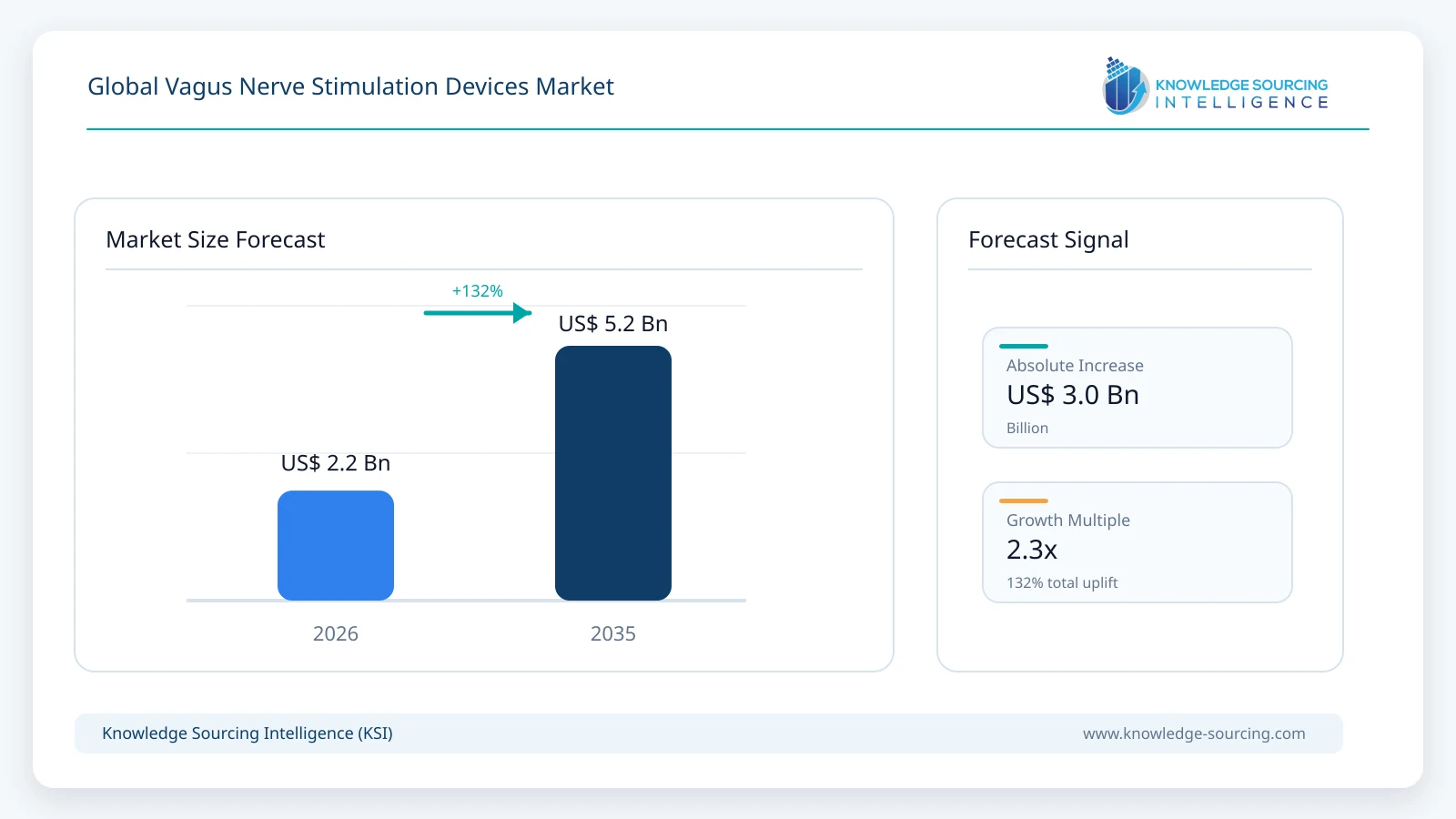
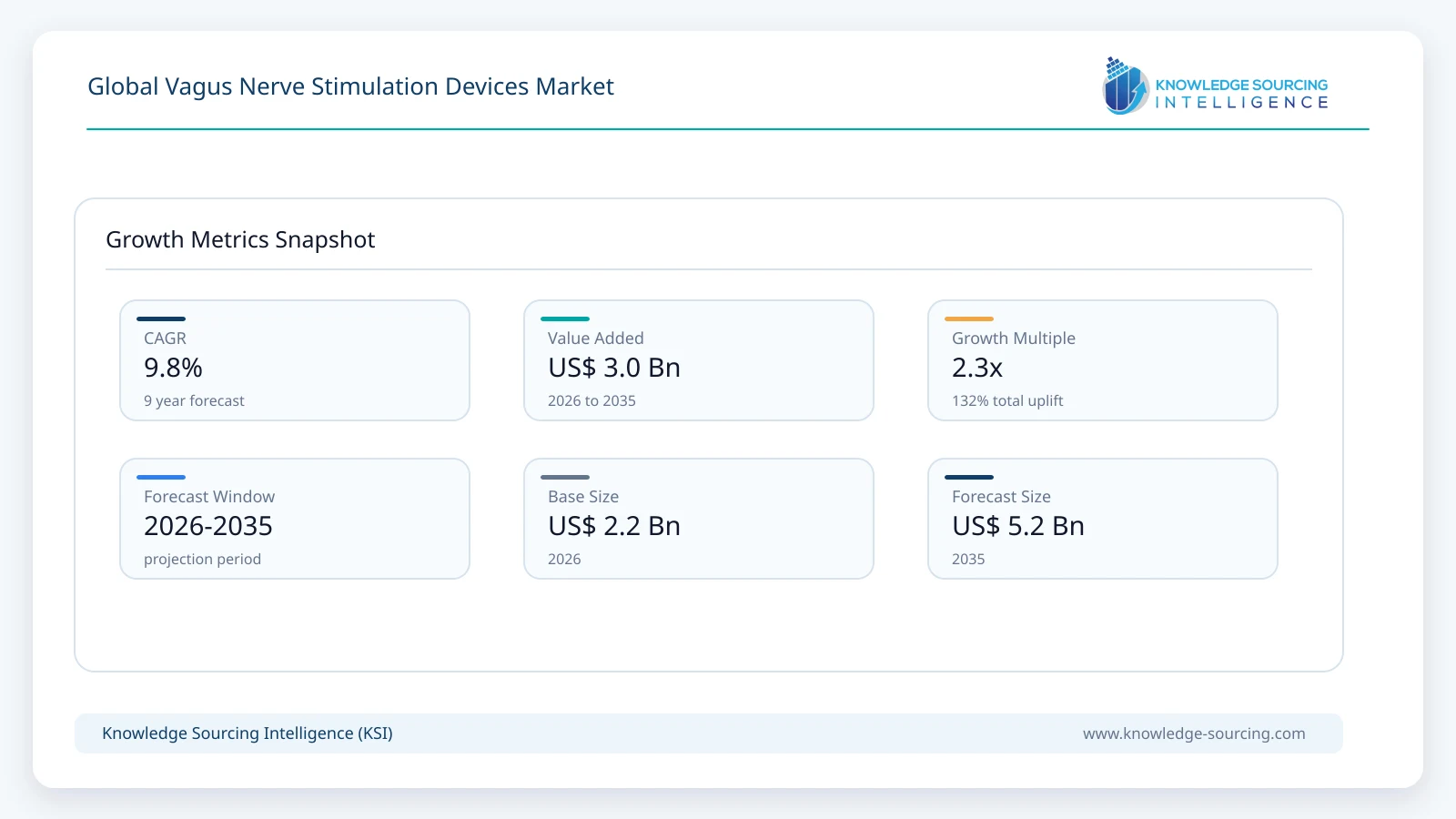
The global vagus nerve stimulation devices market is estimated to account for USD 5.19 billion in 2035, with a CAGR of 9.8% from an initial market size of USD 2.24 billion in 2026.
Highlights:
- 1The growing prevalence of drug-resistant epilepsy is increasing demand for adjunctive neuromodulation therapies because a substantial proportion of epilepsy patients do not achieve seizure control with medication alone.
- 2Expansion of stroke rehabilitation programs is supporting VNS adoption because neuroplasticity-focused recovery strategies are gaining clinical attention.
- 3Rising interest in non-invasive neuromodulation is increasing investment in transcutaneous VNS technologies because providers seek lower-risk treatment pathways.
- 4Treatment-resistant depression remains a significant demand driver because patients with inadequate response to multiple therapies require alternative interventions.
Vagus nerve stimulation modifies neural signaling through controlled electrical stimulation of vagal pathways. The technology primarily addresses conditions where conventional pharmacological interventions fail to achieve adequate therapeutic control. This treatment mechanism creates demand in populations characterized by chronic disease burden, treatment resistance, and recurrent healthcare utilization. VNS is FDA-approved for drug-resistant epilepsy, treatment-resistant depression, and stroke rehabilitation in specific settings.
Demand is increasing because neurological disorders are imposing long-term healthcare costs while many patients continue experiencing inadequate symptom control despite medication optimization. This clinical gap supports investment in device-based therapies that provide continuous neuromodulation without introducing additional systemic drug exposure. The resulting adoption trend is strengthening collaboration among neurologists, neurosurgeons, rehabilitation specialists, and device manufacturers.
Regulatory oversight remains a defining market factor because VNS devices require evidence demonstrating safety, efficacy, and durable clinical benefit. Clinical validation, therefore, determines commercialization success, reimbursement expansion, and physician adoption. The market consequently depends on ongoing clinical studies, post-market surveillance, and real-world evidence generation.
Market Dynamics
Market Drivers
Rising Burden of Drug-Resistant Epilepsy: Drug-resistant epilepsy remains one of the largest addressable populations for VNS devices. Demand is increasing because a significant subset of patients continues experiencing seizures despite optimized pharmacological treatment. This therapeutic limitation creates pressure on clinicians to identify alternative interventions that reduce seizure frequency and improve quality of life. Device manufacturers are expanding evidence generation programs in response. The outcome is sustained utilization of implantable VNS systems within specialized epilepsy care pathways.
Expansion of Neurorehabilitation Programs: Stroke rehabilitation increasingly emphasizes interventions that promote neuroplasticity and functional recovery. Clinical interest is growing because rehabilitation outcomes directly influence long-term healthcare costs and patient independence. Traditional rehabilitation alone often produces variable recovery trajectories. Device developers are integrating VNS into rehabilitation protocols to enhance motor recovery. This trend supports broader adoption across rehabilitation centers and neurological institutions.
Growing Acceptance of Bioelectronic Medicine: Bioelectronic medicine provides targeted physiological modulation through electrical stimulation. Healthcare providers are evaluating these approaches because chronic neurological disorders frequently require long-term management. Pharmacological therapies often introduce tolerability concerns and adherence challenges. Industry participants are investing in next-generation stimulation platforms that improve personalization. The result is increasing recognition of VNS as a strategic therapeutic modality.
Growth of Non-Invasive Neuromodulation: Non-invasive VNS technologies reduce procedural barriers associated with surgical implantation. Demand is increasing because patients and providers seek treatment options with lower intervention risk. Conventional implantable approaches require surgery and long-term follow-up. Manufacturers are developing wearable and transcutaneous systems to address these limitations. The outcome is expanding accessibility across broader patient populations.
Market Restraints
Surgical implantation requirements limit adoption among risk-averse patients and healthcare providers.
Reimbursement variability across countries restricts equitable access to advanced neuromodulation therapies.
Clinical response variability creates uncertainty regarding patient selection and treatment optimization.
Market Opportunities
Expansion into Neuropsychiatric Disorders: Neuropsychiatric disorders represent a substantial unmet clinical need. Research activity is increasing because conventional therapies fail to achieve durable outcomes in many patients. This challenge is encouraging investigation of neuromodulation-based interventions. Companies are expanding clinical programs targeting broader psychiatric applications. The resulting evidence base may create new commercialization pathways.
Personalized Stimulation Platforms: Precision medicine increasingly influences neurological care. Demand is shifting toward individualized treatment strategies because patient responses differ considerably across disease states. Standard stimulation parameters may not maximize therapeutic outcomes. Manufacturers are developing adaptive and data-driven programming technologies. This evolution supports differentiation and long-term market growth.
Integration with Digital Health Ecosystems: Digital monitoring tools enhance patient management through continuous data collection. Healthcare systems are adopting connected technologies because outcome tracking supports value-based care initiatives. Traditional follow-up models provide limited longitudinal insight. Companies are integrating device analytics and remote monitoring capabilities. The result is improved therapy management and patient engagement.
Emerging Inflammatory and Autoimmune Applications: The vagus nerve plays a role in immune regulation. Research activity is expanding because inflammatory disorders continue to generate a substantial healthcare burden. Existing therapies often involve chronic medication use and high treatment costs. Developers are evaluating VNS-based bioelectronic interventions in immune-mediated conditions. This trend creates opportunities beyond traditional neurology markets.
Disease & Epidemiology Analysis
Epilepsy remains the most established disease segment within the VNS market. The condition affects millions of individuals globally, while a meaningful proportion experiences drug-resistant disease despite treatment optimization. This treatment gap creates sustained demand for adjunctive neuromodulation therapies. Clinical evidence supports VNS as an option for reducing seizure frequency in appropriately selected patients.
Treatment-resistant depression represents another important epidemiological segment. Many patients fail multiple medication regimens and psychotherapy approaches before alternative interventions are considered. This therapeutic pathway increases interest in implantable neuromodulation systems capable of influencing mood-regulating neural circuits. FDA-approved use in treatment-resistant depression supports continued clinical utilization.
Migraine and stroke rehabilitation are emerging demand areas. Neurological disability associated with these conditions creates pressure to improve functional outcomes and reduce healthcare utilization. Clinical investigations continue to evaluate how VNS may influence recovery pathways and symptom burden. These expanding indications are broadening the addressable patient population.
Treatment Guidelines Landscape
Condition | Typical Position of VNS Therapy | Treatment Approach |
Epilepsy | Adjunct therapy after inadequate medication response | Drug-resistant epilepsy |
Treatment-Resistant Depression | Later-line intervention | Failure of multiple therapies |
Stroke Rehabilitation | Rehabilitation adjunct | Motor recovery enhancement |
Migraine | Selected patient populations | Neuromodulation-based symptom management |
Market Segmentation
By Product Type
Implantable vagus nerve stimulation devices represent the established foundation of the market because regulatory approvals and long-term clinical evidence primarily originate from implanted systems. Demand remains concentrated within refractory neurological conditions where durable stimulation and physician-controlled programming are required. Surgical intervention creates an adoption constraint, yet clinical familiarity supports continued utilization in specialized centers. Manufacturers are improving battery life, programming flexibility, and sensing capabilities. The segment consequently maintains a strong position in epilepsy and treatment-resistant depression management.
External and non-invasive vagus nerve stimulation devices are gaining momentum because healthcare providers seek less invasive treatment pathways. Demand is increasing among patients who prefer avoiding surgical procedures while still accessing neuromodulation therapies. Clinical validation remains essential for broader reimbursement acceptance. Developers are expanding evidence generation and wearable technology integration. The outcome is increasing competition between implantable and non-invasive approaches.
By Indication
Epilepsy remains the leading indication because drug-resistant patients require alternatives when pharmacological therapies fail to provide adequate seizure control. Demand continues to increase within tertiary neurology centers where complex epilepsy cases concentrate. Treatment limitations associated with medications create pressure for adjunctive interventions. Manufacturers are generating long-term outcome data to support physician confidence. The result is sustained market leadership for epilepsy-focused applications.
Depression, migraine, stroke rehabilitation, and other indications are collectively expanding the market scope. Clinical interest is growing because neurological and psychiatric disorders frequently involve unmet treatment needs. Conventional therapeutic pathways often fail to deliver durable outcomes across all patients. Research organizations are evaluating broader neuromodulation applications. This trend supports diversification beyond epilepsy.
| Report Metric | Details |
|---|---|
| Total Market Size in 2026 | USD 2.24 billion |
| Total Market Size in 2035 | USD 5.19 billion |
| Forecast Unit | USD Billion |
| Growth Rate | 9.8% |
| Study Period | 2021 to 2035 |
| Historical Data | 2021 to 2024 |
| Base Year | 2025 |
| Forecast Period | 2026 – 2035 |
| Segmentation | Product Type , Indication, End User, Geography |
| Companies |
|
By End User
Hospitals represent the primary end-user segment because implantation procedures, neurological evaluations, and multidisciplinary care pathways are concentrated within hospital settings. Demand is increasing as specialized neuroscience programs expand. Complex patient management requirements reinforce hospital-centered treatment models. Providers are investing in neuromodulation capabilities. The outcome is continued hospital dominance.
Specialty neurology centers and rehabilitation centers are gaining importance because patient referral networks increasingly emphasize specialized care delivery. Demand is shifting toward centers with expertise in neuromodulation programming and long-term management. General clinical settings often lack dedicated infrastructure. Healthcare systems are expanding specialist-led treatment pathways. This shift strengthens the role of specialized providers.
Regional Analysis
North America Market Analysis
North America represents the most mature VNS market because regulatory approvals, reimbursement frameworks, and specialized neuroscience infrastructure support adoption. Demand is increasing as healthcare providers seek alternatives for refractory neurological disorders. High diagnosis rates create visibility into eligible patient populations. Manufacturers are expanding clinical evidence and physician education programs. The region maintains leadership in commercialization, innovation, and clinical implementation.
Europe Market Analysis
Europe benefits from established neuromodulation expertise and strong academic research activity. Demand is increasing because healthcare systems emphasize long-term management of chronic neurological diseases. Reimbursement differences across countries create adoption variability. Device developers are strengthening collaborations with academic centers. The outcome is steady market expansion supported by evidence-based medicine.
Asia Pacific Market Analysis
Asia Pacific presents significant growth potential because the neurological disease burden continues to increase across large populations. Healthcare infrastructure is expanding, which improves access to advanced medical technologies. Cost sensitivity remains an important constraint. Regional manufacturers and healthcare institutions are increasing investment in neuromodulation programs.
Rest of the World
Markets across Latin America, the Middle East, and Africa remain at earlier stages of adoption. Demand is emerging because neurological disorders create a substantial healthcare burden. Limited specialist availability restricts widespread utilization. Healthcare modernization initiatives are improving access to advanced therapies. The outcome is gradual but meaningful market development.
Regulatory Landscape
The regulatory framework for VNS devices centers on safety, efficacy, and long-term performance validation. Regulatory agencies require robust clinical evidence because neuromodulation technologies directly influence neural pathways. This requirement increases development timelines but strengthens physician confidence following approval. Regulatory compliance, therefore, remains a critical competitive differentiator.
FDA approvals have established important precedents for epilepsy, treatment-resistant depression, and stroke rehabilitation applications. These approvals shape global regulatory strategies because many jurisdictions evaluate international clinical evidence during review processes. Manufacturers are expanding post-market evidence generation to support reimbursement and guideline inclusion.
Regulatory expectations are increasingly emphasizing real-world evidence, cybersecurity considerations for connected devices, and long-term patient outcome monitoring. This evolution encourages investment in digital infrastructure and post-commercialization surveillance capabilities.
Pipeline Analysis
The VNS development pipeline is expanding beyond traditional epilepsy applications. Research programs are evaluating psychiatric disorders, neurorehabilitation indications, inflammatory conditions, and personalized neuromodulation strategies. This diversification reflects growing scientific understanding of vagal pathway physiology and systemic neuromodulatory effects.
Non-invasive VNS technologies constitute a major pipeline focus because developers aim to reduce procedural barriers while preserving therapeutic benefit. Clinical studies are examining transcutaneous and auricular stimulation approaches across multiple disease categories. These programs seek to expand patient eligibility and improve accessibility.
Artificial intelligence and predictive analytics are increasingly entering the development landscape. Research groups are investigating biomarkers and machine-learning models capable of identifying likely responders before treatment initiation. This trend supports the transition toward precision neuromodulation.
Competitive Landscape
LivaNova
LivaNova remains the dominant participant in the global vagus nerve stimulation devices market because it possesses the longest commercial track record in implantable VNS therapy and the broadest body of clinical evidence supporting therapeutic use. The company's VNS Therapy platform has been utilized in more than 175,000 patients globally and maintains regulatory approvals across major neurological indications, including drug-resistant epilepsy and treatment-resistant depression.
electroCore
electroCore occupies a strategically distinct position because it focuses exclusively on non-invasive vagus nerve stimulation technologies rather than implantable systems. The company's gammaCore platform addresses a growing market segment seeking neuromodulation benefits without surgical intervention.
MicroTransponder
MicroTransponder has established a differentiated position through its focus on neuroplasticity-driven rehabilitation. The company's Vivistim® Paired VNS™ System became the first FDA-approved vagus nerve stimulation device specifically designed to improve upper-extremity function in chronic ischemic stroke patients when combined with rehabilitation therapy.
SetPoint Medical
SetPoint Medical differentiates itself through its emphasis on bioelectronic medicine and immune-system modulation. Unlike many VNS companies that primarily target neurological disorders, SetPoint focuses on leveraging vagal pathways to influence inflammatory responses associated with chronic autoimmune and inflammatory diseases.
Parasym
Parasym focuses on transcutaneous vagus nerve stimulation solutions that enable therapy delivery through auricular stimulation without requiring surgical implantation. This approach directly addresses one of the largest adoption barriers associated with implantable VNS systems: procedural intervention.
TVNS Technologies GmbH
tVNS Technologies GmbH maintains a strong presence within the non-invasive neuromodulation segment through its focus on auricular vagus nerve stimulation systems. The company has been active in advancing transcutaneous stimulation methodologies that seek to replicate therapeutic benefits traditionally associated with implanted VNS devices.
Soterix Medical
Soterix Medical possesses extensive expertise in non-invasive neuromodulation technologies spanning transcranial electrical stimulation, brain stimulation systems, and advanced neuroengineering platforms. Although the company operates across broader neuromodulation categories, its technological capabilities position it as an important participant within the evolving VNS ecosystem.
Cerbomed GmbH
Cerbomed GmbH has been recognized as an early innovator in auricular vagus nerve stimulation technologies and played a significant role in advancing non-invasive VNS development in Europe. The company focused on establishing clinical evidence supporting transcutaneous stimulation as a viable therapeutic alternative to implanted systems.
Key Developments
May 2026: King George's Medical University (KGMU) and IIT Kanpur were granted a utility patent for an ear-worn device that uses vagus nerve stimulation to help manage anxiety and panic attacks, marking the third utility patent granted under SIB SHInE for medical device technologies.
January 2026: A Parkinson's UK-funded study showed that a handheld neck-stimulation vagus nerve device is safe and easy for people with Parkinson's to use at home, but found no significant long-term benefits on walking or cognition symptoms.
March 2025: The Feinstein Institutes for Medical Research received a $3 million NIH grant from NINDS in collaboration with imec to develop precision vagus nerve stimulation devices using a novel "interferential stimulation" method that selectively activates specific nerve fibers to minimize side effects while maximizing therapeutic benefits for inflammatory conditions like rheumatoid arthritis, IBD, and heart failure.
Strategic Insights and Future Market Outlook
The future of the VNS devices market depends on expanding clinical utility beyond established epilepsy applications. Demand is increasingly linked to healthcare systems seeking durable, non-pharmacological interventions for chronic neurological and psychiatric disorders. This shift supports investment in evidence generation, patient stratification tools, and digital monitoring capabilities.
Non-invasive technologies are expected to influence competitive dynamics because they address key adoption barriers associated with surgery. Clinical validation remains essential for long-term success. Manufacturers that demonstrate comparable outcomes while reducing procedural complexity are likely to strengthen market positioning.
The market is evolving toward precision neuromodulation models that combine stimulation technologies with predictive analytics, biomarkers, and digital health infrastructure. This transition supports individualized therapy optimization and broader integration within value-based healthcare frameworks.
The Global Vagus Nerve Stimulation Devices Market remains fundamentally driven by unmet needs in refractory neurological and psychiatric conditions. As evidence continues expanding and device technologies become more personalized, VNS is expected to strengthen its position within the broader neuromodulation and bioelectronic medicine landscape. Data regarding the overall market size and CAGR remains unavailable from verified public sources and, therefore, has not been estimated in this report.
Global Vagus Nerve Stimulation Devices Market Scope:
Market Segmentation
By Geography
Key Countries Analysis
Regulatory & Policy Landscape
Table of Contents
1. EXECUTIVE SUMMARY
1.1 Market Overview
1.2 Key Findings
1.3 Market Snapshot
1.4 Key Growth Drivers
1.5 Key Challenges and Risks
1.6 Emerging Opportunities
1.7 Competitive Intelligence Highlights
1.8 Innovation and Technology Trends
1.9 Regulatory Milestones Summary
1.10 Future Market Outlook
2. DISEASE & EPIDEMIOLOGY ANALYSIS
2.1 Introduction to Vagus Nerve Stimulation (VNS) Therapy
2.2 Anatomy and Physiological Role of the Vagus Nerve
2.3 Mechanism of Action of VNS Devices
2.4 Clinical Applications of VNS Therapy
2.4.1 Drug-Resistant Epilepsy
2.4.2 Treatment-Resistant Depression (TRD)
2.4.3 Cluster Headache
2.4.4 Migraine
2.4.5 Stroke Rehabilitation
2.4.6 Inflammatory Disorders
2.4.7 Other Investigational Indications
2.5 Epidemiology of Drug-Resistant Epilepsy
2.5.1 Global Prevalence
2.5.2 Age-wise Distribution
2.5.3 Gender-wise Distribution
2.6 Epidemiology of Treatment-Resistant Depression
2.6.1 Global Disease Burden
2.6.2 Diagnosed and Treated Population
2.7 Epidemiology of Headache Disorders
2.7.1 Migraine Population Analysis
2.7.2 Cluster Headache Population Analysis
2.8 Stroke Burden and Rehabilitation Population
2.9 Patient Eligibility for VNS Therapy
2.10 Addressable Patient Pool Assessment
3. MARKET DYNAMICS
3.1 Market Introduction
3.2 Market Drivers
3.2.1 Rising Prevalence of Neurological Disorders
3.2.2 Increasing Adoption of Neuromodulation Therapies
3.2.3 Expanding Clinical Evidence for VNS Therapy
3.2.4 Growing Demand for Non-Pharmacological Treatments
3.2.5 Technological Advancements in Implantable and Non-Invasive Devices
3.3 Market Restraints
3.3.1 High Device and Procedure Costs
3.3.2 Reimbursement Challenges
3.3.3 Limited Awareness in Emerging Markets
3.3.4 Surgical Risks and Complications
3.4 Market Opportunities
3.4.1 Expansion into New Therapeutic Areas
3.4.2 Development of Wearable and Non-Invasive Platforms
3.4.3 Emerging Market Penetration
3.5 Market Challenges
3.6 Porter’s Five Forces Analysis
3.7 PESTLE Analysis
3.8 Value Chain Analysis
3.9 Unmet Needs Assessment
4. COMMERCIAL & MARKET ACCESS ANALYSIS
4.1 Market Access Overview
4.2 Reimbursement Landscape
4.2.1 Public Reimbursement Programs
4.2.2 Private Insurance Coverage
4.3 Pricing Analysis
4.4 Health Economic Evaluation
4.5 Patient Access Pathways
4.6 Procurement Models
4.7 Market Entry Barriers
4.8 Stakeholder Analysis
4.8.1 Physicians
4.8.2 Hospitals
4.8.3 Payers
4.8.4 Patients
5. INNOVATION & PIPELINE LANDSCAPE
5.1 Innovation Overview
5.2 Technology Evolution in VNS Devices
5.3 Implantable VNS Technologies
5.4 Non-Invasive VNS Technologies
5.5 Digital Health Integration and Remote Monitoring
5.6 Artificial Intelligence and Closed-Loop Neuromodulation
5.7 Pipeline Analysis by Development Stage
5.7.1 Commercialized Products
5.7.2 Late-Stage Development Programs
5.7.3 Mid-Stage Development Programs
5.7.4 Early-Stage Development Programs
5.8 Pipeline Analysis by Modality
5.8.1 Implantable Devices
5.8.2 Transcutaneous Cervical VNS
5.8.3 Auricular VNS
5.9 Pipeline Analysis by Mechanism of Action
5.10 Ongoing Clinical Trials Assessment
5.11 Patent Landscape Analysis
5.12 Research Collaborations and Partnerships
6. TREATMENT LANDSCAPE
6.1 Current Treatment Paradigm
6.2 Role of VNS in Neurological Disorders
6.3 Alternative Neuromodulation Therapies
6.3.1 Deep Brain Stimulation
6.3.2 Responsive Neurostimulation
6.3.3 Transcranial Magnetic Stimulation
6.3.4 Spinal Cord Stimulation
6.4 Pharmacological Management of Target Indications
6.5 Treatment Algorithm Assessment
6.6 Comparative Clinical Benefits of VNS Therapy
6.7 Clinical Practice Guidelines Review
7. GLOBAL VAGUS NERVE STIMULATION DEVICES MARKET SIZE & FORECAST (2021–2035)
7.1 Market Overview
7.2 Historical Market Analysis (2021–2024)
7.3 Market Forecast (2025–2035)
7.4 Market Forecast by Product Type
7.5 Market Forecast by Indication
7.6 Market Forecast by End User
7.7 Market Forecast by Region
7.8 Absolute Dollar Opportunity Analysis
7.9 Incremental Growth Opportunity Analysis
8. GLOBAL VAGUS NERVE STIMULATION DEVICES MARKET SEGMENTATION
8.1 By Product Type
8.1.1 Implantable Vagus Nerve Stimulation Devices
8.1.2 External/Non-Invasive Vagus Nerve Stimulation Devices
8.2 By Indication
8.2.1 Epilepsy
8.2.2 Depression
8.2.3 Migraine
8.2.4 Stroke Rehabilitation
8.2.5 Other Indications
8.3 By End User
8.3.1 Hospitals
8.3.2 Specialty Neurology Centers
8.3.3 Ambulatory Surgical Centers
8.3.4 Rehabilitation Centers
9. GEOGRAPHICAL ANALYSIS (REGIONAL LEVEL)
9.1 North America
9.1.1 Market Size and Forecast
9.1.2 Demand Drivers
9.1.3 Regional Regulatory Overview
9.1.4 Competitive Intensity Analysis
9.2 Europe
9.2.1 Market Size and Forecast
9.2.2 Demand Drivers
9.2.3 Regional Regulatory Overview
9.2.4 Competitive Intensity Analysis
9.3 Asia-Pacific
9.3.1 Market Size and Forecast
9.3.2 Demand Drivers
9.3.3 Regional Regulatory Overview
9.3.4 Competitive Intensity Analysis
9.4 Latin America
9.4.1 Market Size and Forecast
9.4.2 Demand Drivers
9.4.3 Regional Regulatory Overview
9.4.4 Competitive Intensity Analysis
9.5 Middle East & Africa
9.5.1 Market Size and Forecast
9.5.2 Demand Drivers
9.5.3 Regional Regulatory Overview
9.5.4 Competitive Intensity Analysis
10. KEY COUNTRIES ANALYSIS
10.1 United States
10.1.1 Market Size
10.1.2 Epidemiology Assessment
10.1.3 Regulatory Framework
10.1.4 Reimbursement Landscape
10.1.5 Key Companies and Products Presence
10.2 Canada
10.3 Germany
10.4 United Kingdom
10.5 France
10.6 Italy
10.7 Spain
10.8 China
10.9 Japan
10.10 India
10.11 South Korea
10.12 Australia
10.13 Brazil
10.14 Mexico
10.15 Saudi Arabia
10.16 South Africa
11. REGULATORY & POLICY LANDSCAPE
11.1 Global Regulatory Overview
11.2 United States – Regulatory Framework
11.2.1 FDA Device Classification
11.2.2 Premarket Approval (PMA) Pathway
11.2.3 Post-Market Surveillance Requirements
11.3 Europe – Regulatory Framework
11.3.1 European Medical Device Regulation (MDR)
11.3.2 CE Marking Requirements
11.4 Japan – PMDA Regulatory Framework
11.4.1 Approval Process
11.4.2 Post-Marketing Requirements
11.5 India – CDSCO Regulatory Framework
11.5.1 Medical Device Registration
11.5.2 Import and Manufacturing Regulations
11.6 China – NMPA Regulatory Framework
11.6.1 Registration Requirements
11.6.2 Clinical Evaluation Requirements
11.7 International Standards and Guidelines
11.8 Regulatory Trends and Future Changes
12. COMPETITIVE LANDSCAPE
12.1 Market Share Analysis
12.2 Competitive Benchmarking
12.3 Product Portfolio Assessment
12.4 Strategic Developments
12.4.1 Product Launches
12.4.2 Regulatory Approvals
12.4.3 Collaborations and Partnerships
12.4.4 Mergers and Acquisitions
12.5 Innovation Benchmarking
12.6 SWOT Analysis of Leading Companies
13. COMPANY PROFILES
13.1 LivaNova
13.1.1 Company Overview
13.1.2 Approved Products
13.1.2.1 VNS Therapy™ System
13.1.2.2 SenTiva™ VNS System
13.1.2.3 SenTiva DUO™
13.1.2.4 Symmetry™ (Depression Indication in CE-Mark Regions)
13.1.3 Key Indications
13.1.4 Pipeline and Clinical Development Activities
13.1.5 Financial Overview
13.1.6 Recent Developments
13.2 electroCore
13.2.1 Company Overview
13.2.2 Approved Products
13.2.2.1 gammaCore™
13.2.2.2 gammaCore Sapphire™
13.2.3 Key Indications
13.2.4 Pipeline Programs
13.2.5 Recent Developments
13.3 MicroTransponder
13.3.1 Company Overview
13.3.2 Approved Products
13.3.2.1 Vivistim® Paired VNS System
13.3.3 Key Indications
13.3.4 Pipeline Activities
13.3.5 Recent Developments
13.4 SetPoint Medical
13.4.1 Company Overview
13.4.2 Approved Products and Programs
13.4.3 Key Indications
13.4.4 Clinical Pipeline
13.4.5 Recent Developments
13.5 Parasym
13.5.1 Company Overview
13.5.2 Commercial Product Portfolio
13.5.3 Key Indications
13.5.4 Clinical Development Programs
13.6 tVNS Technologies GmbH
13.6.1 Company Overview
13.6.2 Product Portfolio
13.6.3 Key Indications
13.6.4 Development Programs
13.7 tVNS Health GmbH
13.7.1 Company Overview
13.7.2 Product Portfolio
13.7.3 Key Indications
13.7.4 Development Activities
13.8 Soterix Medical
13.8.1 Company Overview
13.8.2 VNS-Related Product Portfolio
13.8.3 Key Indications
13.8.4 Research Pipeline
13.9 Cerbomed GmbH
13.9.1 Company Overview
13.9.2 Product Portfolio
13.9.3 Key Indications
13.9.4 Development Activities
13.10 Beijing PINS Medical Co., Ltd.
13.10.1 Company Overview
13.10.2 Neuromodulation Portfolio
13.10.3 VNS Development Activities
13.10.4 Strategic Initiatives
14. FUTURE OUTLOOK
14.1 Future Market Evolution
14.2 Technology Adoption Forecast
14.3 Emerging Clinical Applications
14.4 AI and Machine Learning Integration Outlook
14.5 Investment and Funding Trends
14.6 Competitive Outlook Through Forecast Period
14.7 Key Strategic Recommendations
14.8 Long-Term Industry Outlook
15. METHODOLOGY
15.1 Research Objectives
15.2 Market Definition and Scope
15.3 Secondary Research Methodology
15.4 Primary Research Methodology
15.5 Data Validation and Triangulation
15.6 Forecasting Methodology
15.7 Assumptions and Limitations
15.8 Abbreviations and Definitions
15.9 Sources and References
Navigate
Trusted by the world's leading organizations











