
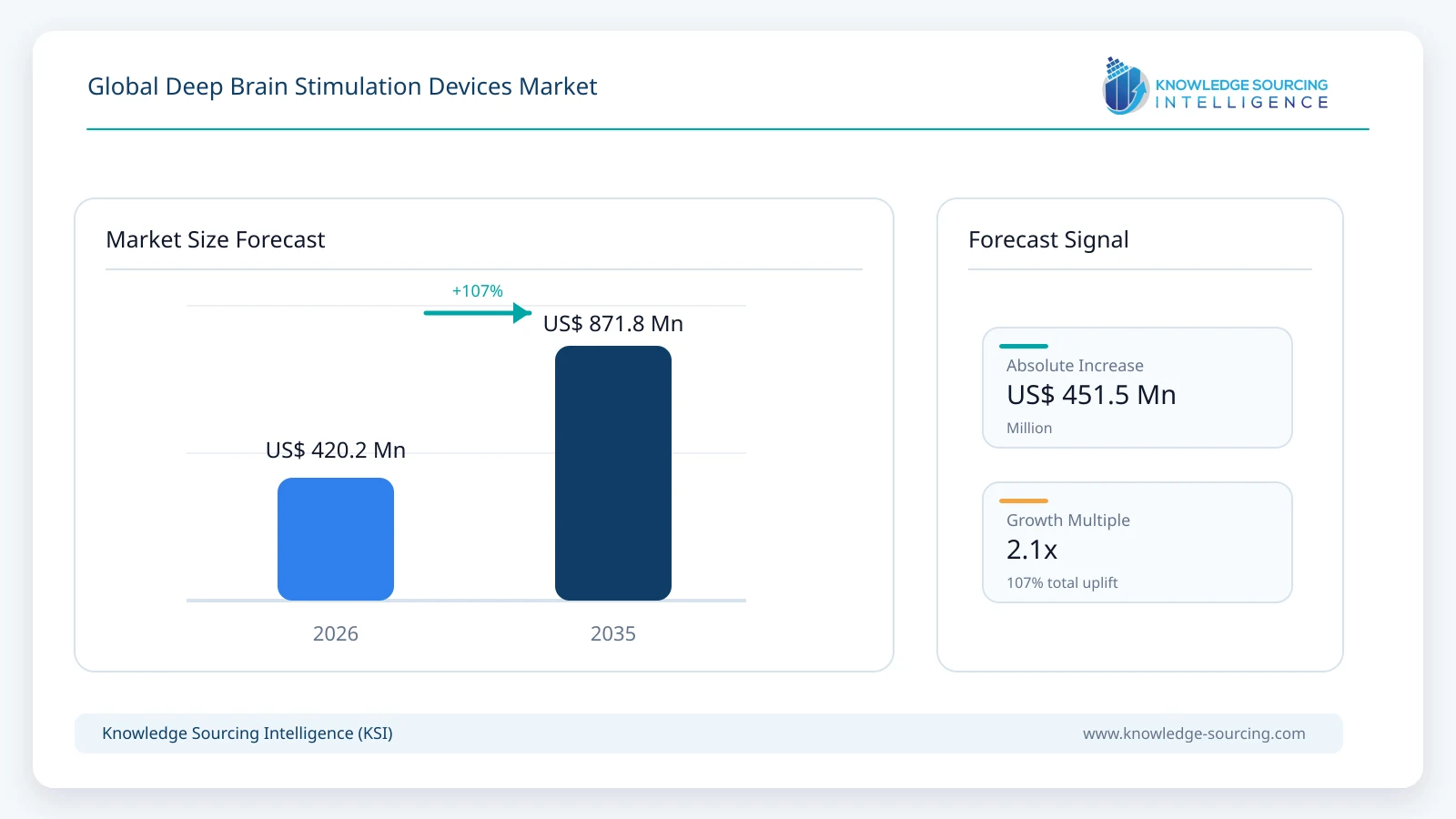
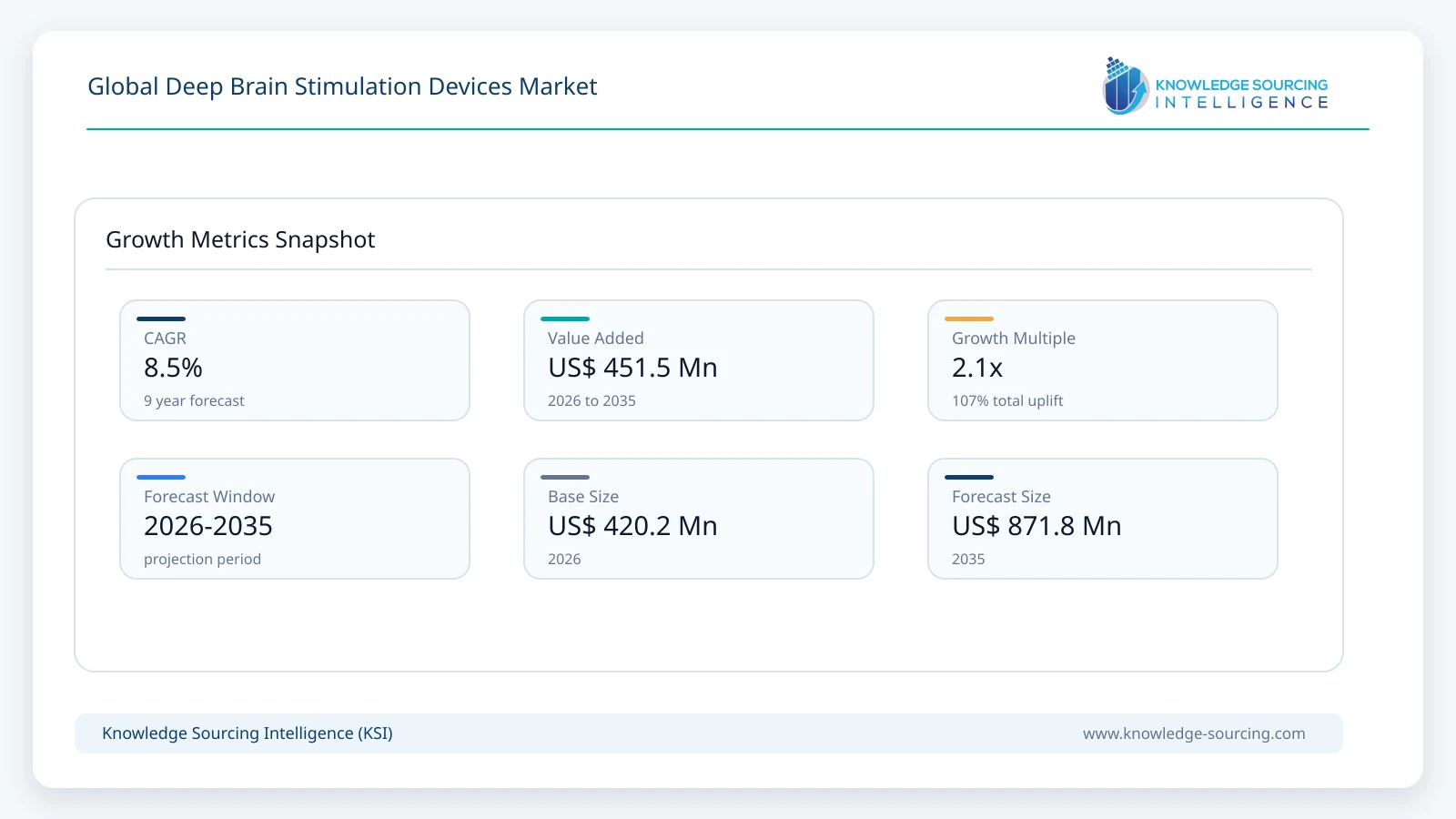
The global deep brain stimulation devices market is projected to grow at a CAGR of 8.5% the forecast period, increasing from USD 420.24 million in 2026 to USD 871.76 million by 2035.
Highlights:
- 1Rising Parkinson’s disease prevalence is increasing demand for long-duration symptom management, which is strengthening adoption of implantable neuromodulation systems.
- 2Medication-related motor complications are creating treatment limitations, which is pushing clinicians toward DBS interventions for advanced disease management.
- 3Sensing-enabled neurostimulators are entering commercial practice because physicians require real-time neural feedback to optimize therapy delivery.
- 4Regulatory approvals for adaptive DBS platforms are accelerating technology upgrades, which is increasing replacement demand for next-generation implant systems.
Deep-brain stimulation devices address neurological disorders that progressively weaken motor control, functional independence, and quality of life. The market exists because neurodegenerative conditions create persistent treatment gaps after pharmacological therapies lose efficacy or generate intolerable side effects. Parkinson’s disease remains the largest demand generator because disease progression frequently produces motor fluctuations that cannot be fully controlled through medication alone.
Healthcare systems increasingly depend on DBS therapy because aging populations are expanding the number of patients experiencing chronic movement disorders. This demographic pressure is increasing referrals to specialized neurology centers, while clinicians are identifying candidates earlier in disease progression to preserve long-term functional outcomes.
Regulatory oversight strongly influences market development because DBS systems require extensive clinical validation, surgical precision, and long-term safety monitoring. Manufacturers are responding through investments in adaptive stimulation algorithms, sensing-enabled implants, and remote programming capabilities. These developments are positioning DBS technologies as central components of precision neuromodulation strategies rather than standalone implantable devices.
Market Dynamics
Market Drivers
Increasing Burden of Parkinson’s Disease and Movement Disorders: The DBS market depends heavily on neurological disease prevalence because treatment demand emerges when symptoms become resistant to medication-based management. Parkinson’s disease remains a major clinical burden, while aging populations are increasing the number of patients experiencing tremor, rigidity, and motor instability. Medication effectiveness gradually declines in many advanced cases, which creates pressure for alternative interventions. Neurology centers are expanding surgical referral pathways because DBS improves symptom control in carefully selected patients. This transition strengthens long-term procedural volumes and supports sustained device demand.
Transition Toward Personalized Neuromodulation: DBS therapy increasingly focuses on individualized neural modulation rather than uniform stimulation delivery. Disease manifestations vary substantially between patients, which limits the effectiveness of fixed-output systems. Manufacturers are integrating sensing technologies and directional leads because clinicians require more precise stimulation targeting. Hospitals are adopting advanced programming workflows to improve therapeutic outcomes while reducing stimulation-related adverse effects. This shift increases the value proposition of premium neuromodulation platforms and supports technology-driven market expansion.
Regulatory Support for Advanced Neurostimulation Platforms: The market benefits from regulatory recognition of DBS as an established therapeutic approach for movement disorders. Clinical evidence continues to support neuromodulation safety and efficacy, which maintains physician confidence in procedural adoption. Regulatory agencies are approving next-generation systems with adaptive capabilities, while manufacturers are accelerating commercialization strategies. This environment improves technology availability and expands competitive differentiation across device portfolios.
Expansion of Specialized Neuroscience Centers: DBS implantation requires multidisciplinary expertise, which concentrates procedures within advanced neurological centers. Healthcare providers are expanding movement disorder programs because demand for specialized care continues to increase. Surgical infrastructure investments are improving patient access, while neurosurgeons and neurologists are strengthening collaborative treatment models. This ecosystem development supports procedural growth and improves long-term therapy management.
Market Restraints
High procedural and post-operative programming costs limit adoption in healthcare systems with restricted reimbursement coverage.
Limited availability of specialized neurosurgical centers reduces access in developing healthcare markets.
Surgical risks, device revisions, and long-term follow-up requirements continue affecting patient eligibility and treatment acceptance.
Market Opportunities
Adaptive and Closed-Loop DBS Development: Conventional stimulation systems provide continuous output regardless of symptom variability. Neurological activity fluctuates throughout the day, which is increasing interest in adaptive stimulation approaches. Manufacturers are developing closed-loop platforms capable of responding to neural biomarkers in real time. This capability improves therapy personalization and creates opportunities for premium technology adoption.
Expansion into Neuropsychiatric Disorders: Movement disorders currently dominate clinical utilization, yet research activity is expanding into psychiatric and behavioral conditions. Treatment-resistant obsessive-compulsive disorder and other neurological disorders are attracting investigational interest because conventional therapies frequently generate inconsistent outcomes. Clinical programs are evaluating broader neuromodulation applications, which could significantly expand addressable patient populations.
Growth of Rechargeable and Remote Programming Systems: Battery replacement procedures create long-term healthcare costs and patient inconvenience. Device manufacturers are introducing rechargeable neurostimulators because healthcare providers are seeking extended device longevity. Digital programming capabilities are also improving physician oversight, which enhances therapy management efficiency. These advancements strengthen product differentiation and support recurring upgrade cycles.
Emerging Demand Across Asia-Pacific: Neurological disease diagnosis rates are improving across Asian healthcare systems because neurology infrastructure is expanding. Governments are increasing investments in advanced medical technologies, while tertiary hospitals are developing neuromodulation capabilities. This structural expansion creates opportunities for regional manufacturers and international device suppliers.
Disease & Epidemiology Analysis
Parkinson’s disease remains the primary epidemiological driver of the DBS market because disease progression frequently generates disabling motor complications that become increasingly difficult to manage pharmacologically. The disorder affects older populations disproportionately, which creates a direct relationship between demographic aging and neuromodulation demand. Clinical progression gradually reduces medication responsiveness, while levodopa-associated complications increase therapeutic complexity. This treatment gap supports long-term demand for DBS implantation.
Essential tremor represents another major indication because persistent tremor significantly impairs daily function. Medication resistance is creating demand for device-assisted symptom control, particularly among elderly patients seeking improved quality of life. Dystonia also contributes to procedural volumes because abnormal muscle contractions often require long-term intervention when pharmacological management produces inadequate outcomes.
Epilepsy and obsessive-compulsive disorder remain smaller but strategically important segments because investigational neuromodulation programs are expanding clinical evidence generation. These developments are increasing interest in broader DBS utilization and supporting pipeline diversification.
Treatment Guidelines Landscape
Organization | Guideline Focus | DBS Recommendation |
ational Institute for Health and Care Excellence (NICE) | Parkinson’s Disease | Recommends DBS for appropriately selected patients with advanced disease and inadequate response to medical therapy. |
National Institute of Neurological Disorders and Stroke (NINDS) | Movement Disorders | Recognizes DBS as an effective treatment for selected movement disorders and epilepsy. |
Multidisciplinary Movement Disorder Programs | Patient Selection | Emphasize specialist evaluation, long-term follow-up, and individualized programming approaches. |
Market Segmentation
By Product Type
Implantable Pulse Generators (IPGs) represent the core revenue-generating component because therapeutic delivery depends on stimulation generation and programming capability. Device manufacturers are integrating rechargeable architectures, sensing functions, and wireless connectivity into IPGs because clinicians require longer device lifecycles and greater therapy customization. Battery replacement concerns create pressure for durability improvements, which is increasing demand for rechargeable systems. Hospitals are prioritizing advanced IPGs because programming flexibility directly influences treatment outcomes. This trend strengthens premium device adoption and reinforces the strategic importance of neurostimulator innovation.
By Technology
Directional DBS systems are gaining clinical attention because conventional stimulation frequently affects adjacent neural structures. Precision targeting reduces stimulation-related side effects, which improves therapeutic efficiency. Manufacturers are expanding directional lead portfolios because neurologists increasingly demand individualized treatment optimization. Sensing and closed-loop systems are advancing simultaneously because symptom variability requires adaptive responses. These technologies improve neural signal interpretation and support real-time therapy adjustments. The market consequently shifts toward intelligent neuromodulation platforms that combine stimulation delivery with neurological data acquisition.
By Indication
Parkinson’s disease remains the dominant indication because disease progression creates persistent motor dysfunction despite pharmacological treatment. Patients increasingly require intervention when medication fluctuations reduce functional independence. Essential tremor generates substantial demand because symptom severity often affects daily activities and occupational performance. Obsessive-compulsive disorder and epilepsy continue attracting investigational interest because treatment-resistant cases require alternative therapeutic approaches. This diversification broadens clinical utilization and reduces long-term dependence on a single disease category.
Regional Analysis
North America Market Analysis
North America maintains a leading position because advanced neurological care infrastructure supports high procedural volumes and rapid technology adoption. The region benefits from strong neurosurgical expertise, specialized movement disorder centers, and established reimbursement pathways. Parkinson’s disease management increasingly incorporates DBS because clinicians are seeking long-term alternatives to escalating medication complexity. Device manufacturers are launching sensing-enabled and adaptive stimulation platforms across the region, which strengthens replacement demand among existing patient populations. Regulatory approvals continue accelerating innovation because healthcare providers actively integrate advanced neuromodulation technologies into clinical practice. The presence of major manufacturers also supports physician training, post-implant programming services, and clinical research expansion. These factors collectively sustain strong demand for premium DBS systems.
Europe Market Analysis
Europe remains a significant market because neurological disease management relies heavily on evidence-based treatment pathways. DBS adoption benefits from established clinical guidelines and multidisciplinary patient selection frameworks. Healthcare systems emphasize long-term therapeutic value, which supports utilization among appropriately selected Parkinson’s disease and essential tremor patients. Academic medical centers are conducting neuromodulation research because healthcare providers require stronger evidence for emerging indications. Technology adoption continues expanding, while reimbursement evaluations increasingly focus on long-term reductions in disease burden. Manufacturers are strengthening regional partnerships to improve access to advanced stimulation systems. This environment supports gradual migration toward sensing-enabled and directional DBS platforms.
Asia Pacific Market Analysis
Asia Pacific is emerging as the fastest-transforming regional market because neurological disease diagnosis rates are increasing alongside healthcare modernization. Large aging populations are expanding the burden of Parkinson’s disease, which creates substantial long-term demand potential. Governments are investing in tertiary care infrastructure because advanced neurological procedures are becoming strategic healthcare priorities. Regional manufacturers are strengthening competitive positions through localized production and cost-focused commercialization strategies. International companies are expanding distribution networks because procedural awareness is improving among clinicians and patients. Neuroscience centers are increasing DBS capabilities, while clinical expertise continues developing across major urban healthcare institutions. These structural changes are improving accessibility and supporting regional market expansion.
Rest of the World
The Rest of the World market remains comparatively smaller because neuromodulation access depends heavily on healthcare infrastructure availability. Specialized neurosurgical expertise remains concentrated within selected urban centers, which limits procedural penetration. Neurological disease burden continues increasing, while healthcare systems are gradually investing in advanced treatment capabilities. International manufacturers are exploring partnership models because emerging markets require physician training and technology transfer support. Reimbursement constraints remain important barriers, yet demand for movement disorder management continues strengthening. Expansion of tertiary hospitals and growing awareness of advanced neurological interventions support gradual adoption across Latin America, the Middle East, and parts of Africa.
Regulatory Landscape
The regulatory environment plays a central role in DBS commercialization because implantable neuromodulation systems require extensive clinical evidence, safety validation, and post-market surveillance. Regulatory agencies evaluate long-term therapeutic performance, device reliability, and programming safety before approving commercial deployment. These requirements increase development timelines but strengthen physician confidence in approved technologies.
Recent approvals indicate that regulators are increasingly supporting adaptive neuromodulation capabilities. Sensing-enabled systems are receiving regulatory attention because real-time neurological monitoring improves treatment personalization. This trend is encouraging manufacturers to prioritize software integration, biomarker analysis, and closed-loop control systems during product development.
International guideline frameworks also influence market access because reimbursement decisions frequently depend on demonstrated clinical effectiveness. Multidisciplinary patient selection requirements remain central across major healthcare systems, which reinforces the importance of specialized neurological care networks. Regulatory convergence around evidence-based neuromodulation continues supporting broader clinical adoption.
Pipeline Analysis
The DBS pipeline is increasingly focusing on adaptive stimulation because conventional systems provide continuous output regardless of symptom fluctuation. Researchers are developing closed-loop platforms that respond to neural biomarkers in real time, which improves precision and reduces unnecessary stimulation exposure. Academic and industry collaborations are advancing algorithm-driven therapy optimization models because neurological activity patterns vary significantly across patients.
Artificial intelligence integration is becoming a major development area because large neurological datasets enable predictive therapy adjustment. Investigational systems are evaluating reinforcement learning and model predictive control architectures to improve stimulation efficiency. These approaches aim to reduce side effects while enhancing symptom suppression.
Pipeline activity is also expanding into neuropsychiatric and cognitive disorders because unmet clinical needs remain substantial. Companies and research institutions are assessing broader neuromodulation applications, which could significantly increase future addressable patient populations. This diversification supports long-term market resilience and reduces reliance on movement disorder indications alone.
Competitive Landscape
Medtronic plc
Medtronic remains strategically distinct because it combines long-standing DBS clinical experience with aggressive investment in sensing-enabled neuromodulation. The company continues expanding its Percept platform through adaptive stimulation and BrainSense technologies, which strengthen personalization capabilities.
Abbott Laboratories
Abbott differentiates itself through neuromodulation platform flexibility and patient-centered programming capabilities. The company focuses on improving physician control over stimulation delivery, which supports individualized therapy management. Its neurological device portfolio benefits from broader healthcare infrastructure and commercialization capabilities.
Boston Scientific Corporation
Boston Scientific strengthens its competitive position through directional stimulation technologies and advanced DBS platform development. The company emphasizes precision targeting because improved stimulation control reduces unintended neural activation. Recent regulatory approvals reinforce portfolio expansion efforts and support broader clinical adoption.
NeuroPace, Inc.
NeuroPace maintains strategic relevance through expertise in responsive neurostimulation and neurological signal interpretation. The company’s experience with closed-loop neuromodulation concepts supports broader industry movement toward adaptive therapy models. Its technological foundation positions it favorably within evolving data-driven neuromodulation ecosystems.
Functional Neuromodulation Ltd.
Functional Neuromodulation differentiates itself through research-driven neurological therapy development. The company focuses on expanding DBS utility across complex neurological disorders, which supports future indication diversification. Its clinical development activities strengthen participation in evolving neuromodulation markets.
Newronika S.p.A.
Newronika concentrates on adaptive DBS innovation and data-responsive stimulation technologies. The company’s strategy aligns closely with market migration toward closed-loop neuromodulation. Ongoing development of intelligent stimulation systems supports competitive positioning within next-generation neurological therapies.
Key Developments
April 2026: Medtronic launched its Adaptive Deep Brain Stimulation (aDBS) system in India for Parkinson's patients, introducing technology that automatically adjusts therapy based on real-time brain signals to provide more consistent symptom management, as India is projected to become the second-highest country globally for Parkinson's cases within five years.
October 2025: Medtronic's BrainSense™ Adaptive Deep Brain Stimulation (aDBS), the world's first closed-loop DBS system for Parkinson's patients, was named to TIME's 2025 Best Inventions list in the Medical & Healthcare category after receiving FDA and CE Mark approval earlier that year, with over 1,000 patients already treated worldwide.
February 2025: The U.S. FDA approved adaptive deep brain stimulation (aDBS) as a breakthrough therapy that continuously monitors brain activity and delivers precise electric pulses in real time to prevent Parkinson's stiffness and involuntary movements, based on positive results from the global ADAPT-PD clinical trial.
Strategic Insights and Future Market Outlook
The DBS market is entering a technology transition phase because healthcare providers increasingly require individualized neurological therapy rather than fixed-output stimulation. Sensing-enabled neurostimulators are improving clinical visibility into neural activity, which supports more precise therapy adjustments. Manufacturers are responding through software-driven innovation, adaptive algorithms, and integrated data analytics platforms.
Clinical expansion beyond movement disorders is creating a broader strategic opportunity. Investigational programs targeting psychiatric and neurological disorders are increasing because conventional treatment pathways frequently generate inconsistent outcomes. Successful clinical validation across additional indications could substantially expand long-term demand.
Competition is increasingly shifting from hardware differentiation toward ecosystem development. Companies are investing in programming software, remote monitoring capabilities, physician decision-support tools, and adaptive therapy algorithms. This evolution strengthens the role of DBS platforms as integrated neurological management systems rather than isolated implantable devices.
The global deep brain stimulation devices market remains structurally linked to the growing burden of chronic neurological disease. Aging populations are increasing treatment demand, while adaptive neuromodulation technologies are improving therapeutic precision. Regulatory support for advanced stimulation systems, expanding neuroscience infrastructure, and continued innovation in closed-loop therapy collectively position the market for sustained long-term clinical relevance and technology-driven evolution.
Global Deep Brain Stimulation Devices Market Scope:
| Report Metric | Details |
|---|---|
| Total Market Size in 2026 | USD 420.24 million |
| Total Market Size in 2035 | USD 871.76 million |
| Forecast Unit | USD Million |
| Growth Rate | 8.5% |
| Study Period | 2021 to 2035 |
| Historical Data | 2021 to 2024 |
| Base Year | 2025 |
| Forecast Period | 2026 – 2035 |
| Segmentation | Product Type, Technology, Indication, Rechargeability |
| Companies |
|
Market Segmentation
By Geography
Key Countries Analysis
Regulatory & Policy Landscape
Table of Contents
1. EXECUTIVE SUMMARY
1.1 Market Snapshot
1.2 Key Findings
1.3 Executive Insights
1.4 Market Attractiveness Analysis
1.5 Strategic Opportunity Assessment
1.6 Competitive Positioning Overview
1.7 Future Growth Outlook
2. DISEASE & EPIDEMIOLOGY ANALYSIS
2.1 Introduction to Deep Brain Stimulation (DBS) Therapy
2.2 Clinical Overview of Neurological Disorders Treated with DBS
2.3 Disease Burden and Epidemiology Overview
2.4 Parkinson’s Disease Epidemiology
2.4.1 Global Prevalence and Incidence
2.4.2 Age-Based Distribution
2.4.3 Gender-Based Distribution
2.4.4 Advanced Parkinson’s Disease Population Eligible for DBS
2.5 Essential Tremor Epidemiology
2.5.1 Prevalence Analysis
2.5.2 Age-Specific Burden
2.5.3 Treatment-Eligible Population
2.6 Dystonia Epidemiology
2.6.1 Primary Dystonia
2.6.2 Secondary Dystonia
2.6.3 DBS-Eligible Population
2.7 Obsessive-Compulsive Disorder (OCD) Epidemiology
2.7.1 Treatment-Resistant OCD Population
2.7.2 DBS Candidate Assessment
2.8 Epilepsy Epidemiology Relevant to DBS Therapy
2.9 Unmet Clinical Needs
2.10 Patient Journey Analysis
2.11 Treatment Eligibility Assessment
3. MARKET DYNAMICS
3.1 Market Overview
3.2 Market Drivers
3.2.1 Rising Prevalence of Parkinson’s Disease and Movement Disorders
3.2.2 Increasing Adoption of Neuromodulation Technologies
3.2.3 Advancements in Directional Leads and Adaptive DBS Systems
3.2.4 Growing Preference for Minimally Invasive Neurological Procedures
3.2.5 Expanding Clinical Evidence Supporting DBS Therapy
3.3 Market Restraints
3.3.1 High Device and Surgical Costs
3.3.2 Limited Accessibility in Emerging Markets
3.3.3 Surgical Risks and Complications
3.3.4 Reimbursement Limitations
3.4 Market Opportunities
3.4.1 Closed-Loop and Adaptive DBS Systems
3.4.2 Expansion into Psychiatric Indications
3.4.3 AI-Enabled Programming Platforms
3.4.4 Emerging Market Penetration
3.5 Market Challenges
3.6 Porter’s Five Forces Analysis
3.7 PESTLE Analysis
3.8 Value Chain Analysis
3.9 Technology Evolution Analysis
4. COMMERCIAL & MARKET ACCESS
4.1 Market Access Overview
4.2 Reimbursement Landscape
4.3 Health Technology Assessment Trends
4.4 Pricing Analysis
4.5 Hospital Procurement Trends
4.6 Public vs Private Healthcare Adoption
4.7 Physician Adoption Trends
4.8 Patient Access Challenges
4.9 Commercialization Strategies of Leading Manufacturers
5. INNOVATION & PIPELINE LANDSCAPE
5.1 Innovation Overview
5.2 Evolution of DBS Technology
5.3 Adaptive (Closed-Loop) DBS Systems
5.4 Directional Stimulation Technologies
5.5 Rechargeable Neurostimulator Innovations
5.6 Brain Signal Sensing Technologies
5.7 Digital Programming and Remote Monitoring Platforms
5.8 Pipeline Analysis by Development Stage
5.8.1 Early-Stage Research
5.8.2 Feasibility and Pilot Studies
5.8.3 Pivotal Clinical Development Programs
5.9 Pipeline Analysis by Indication
5.9.1 Parkinson’s Disease
5.9.2 Essential Tremor
5.9.3 Dystonia
5.9.4 Obsessive-Compulsive Disorder
5.9.5 Epilepsy
5.10 Pipeline Analysis by Modality
5.10.1 Adaptive DBS
5.10.2 Directional DBS
5.10.3 Sensing-Enabled DBS
5.10.4 Remote Programming Platforms
5.11 Clinical Trial Landscape
5.12 Patent Analysis
5.13 Future Technology Roadmap
6. TREATMENT LANDSCAPE
6.1 Current Treatment Paradigm
6.2 Pharmacological Management of Parkinson’s Disease
6.3 Pharmacological Management of Essential Tremor
6.4 Pharmacological Management of Dystonia
6.5 Surgical Treatment Options
6.6 Deep Brain Stimulation Therapy Overview
6.7 Patient Selection Criteria
6.8 Target Brain Structures for DBS
6.8.1 Subthalamic Nucleus (STN)
6.8.2 Globus Pallidus Internus (GPi)
6.8.3 Ventral Intermediate Nucleus (VIM)
6.8.4 Anterior Limb of Internal Capsule / Ventral Capsule-Ventral Striatum (VC/VS)
6.8.5 Anterior Nucleus of Thalamus (ANT)
6.9 Comparative Analysis of DBS Versus Alternative Treatments
6.10 Clinical Guidelines and Treatment Algorithms
7. GLOBAL DEEP BRAIN STIMULATION DEVICES MARKET SIZE & FORECAST
7.1 Global Market Size Analysis (Historical)
7.2 Global Market Forecast
7.3 Market Forecast by Product Type
7.4 Market Forecast by Indication
7.5 Market Forecast by End User
7.6 Market Forecast by Region
7.7 Revenue Opportunity Analysis
7.8 Installed Base Analysis
7.9 Procedure Volume Analysis
7.10 Scenario Analysis
8. GLOBAL DEEP BRAIN STIMULATION DEVICES MARKET SEGMENTATION
8.1 By Product Type
8.1.1 Implantable Pulse Generators (IPGs)
8.1.2 DBS Leads and Electrodes
8.1.3 Extensions and Connectors
8.1.4 Accessories and Consumables
8.2 By Technology
8.2.1 Conventional DBS Systems
8.2.2 Directional DBS Systems
8.2.3 Sensing &Closed-Loop DBS Systems
8.3 By Indication
8.3.1 Parkinson’s Disease
8.3.2 Essential Tremor
8.3.3 Dystonia
8.3.4 Obsessive-Compulsive Disorder
8.3.5 Epilepsy
8.3.6 Other Investigational Indications
8.4 By Rechargeability
8.4.1 Rechargeable Systems
8.4.2 Non-Rechargeable Systems
8.5 By End User
8.5.1 Hospitals
8.5.2 Neurosurgery Centers
8.5.3 Academic and Research Institutes
9. GEOGRAPHICAL ANALYSIS (REGIONAL LEVEL)
9.1 North America
9.1.1 Market Size and Forecast
9.1.2 Demand Drivers
9.1.3 Regional Regulatory Environment
9.1.4 Competitive Intensity
9.2 Europe
9.2.1 Market Size and Forecast
9.2.2 Demand Drivers
9.2.3 Regional Regulatory Environment
9.2.4 Competitive Intensity
9.3 Asia-Pacific
9.3.1 Market Size and Forecast
9.3.2 Demand Drivers
9.3.3 Regional Regulatory Environment
9.3.4 Competitive Intensity
9.4 Latin America
9.4.1 Market Size and Forecast
9.4.2 Demand Drivers
9.4.3 Regional Regulatory Environment
9.4.4 Competitive Intensity
9.5 Middle East & Africa
9.5.1 Market Size and Forecast
9.5.2 Demand Drivers
9.5.3 Regional Regulatory Environment
9.5.4 Competitive Intensity
10. KEY COUNTRIES ANALYSIS
10.1 United States
10.1.1 Market Size and Forecast
10.1.2 Epidemiology Assessment
10.1.3 FDA Regulatory Framework
10.1.4 Reimbursement Landscape
10.1.5 Key Companies and Products Presence
10.2 Canada
10.2.1 Market Size and Forecast
10.2.2 Epidemiology Assessment
10.2.3 Regulatory Framework
10.2.4 Reimbursement Landscape
10.2.5 Key Companies and Products Presence
10.3 Germany
10.3.1 Market Size and Forecast
10.3.2 Epidemiology Assessment
10.3.3 Regulatory Framework
10.3.4 Reimbursement Landscape
10.3.5 Key Companies and Products Presence
10.4 United Kingdom
10.4.1 Market Size and Forecast
10.4.2 Epidemiology Assessment
10.4.3 Regulatory Framework
10.4.4 Reimbursement Landscape
10.4.5 Key Companies and Products Presence
10.5 France
10.5.1 Market Size and Forecast
10.5.2 Epidemiology Assessment
10.5.3 Regulatory Framework
10.5.4 Reimbursement Landscape
10.5.5 Key Companies and Products Presence
10.6 Italy
10.6.1 Market Size and Forecast
10.6.2 Epidemiology Assessment
10.6.3 Regulatory Framework
10.6.4 Reimbursement Landscape
10.6.5 Key Companies and Products Presence
10.7 Spain
10.7.1 Market Size and Forecast
10.7.2 Epidemiology Assessment
10.7.3 Regulatory Framework
10.7.4 Reimbursement Landscape
10.7.5 Key Companies and Products Presence
10.8 China
10.8.1 Market Size and Forecast
10.8.2 Epidemiology Assessment
10.8.3 NMPA Regulatory Framework
10.8.4 Reimbursement Landscape
10.8.5 Key Companies and Products Presence
10.9 Japan
10.9.1 Market Size and Forecast
10.9.2 Epidemiology Assessment
10.9.3 PMDA Regulatory Framework
10.9.4 Reimbursement Landscape
10.9.5 Key Companies and Products Presence
10.10 India
10.10.1 Market Size and Forecast
10.10.2 Epidemiology Assessment
10.10.3 CDSCO Regulatory Framework
10.10.4 Reimbursement Landscape
10.10.5 Key Companies and Products Presence
10.11 South Korea
10.11.1 Market Size and Forecast
10.11.2 Epidemiology Assessment
10.11.3 Regulatory Framework
10.11.4 Reimbursement Landscape
10.11.5 Key Companies and Products Presence
10.12 Australia
10.12.1 Market Size and Forecast
10.12.2 Epidemiology Assessment
10.12.3 Regulatory Framework
10.12.4 Reimbursement Landscape
10.12.5 Key Companies and Products Presence
10.13 Brazil
10.13.1 Market Size and Forecast
10.13.2 Epidemiology Assessment
10.13.3 Regulatory Framework
10.13.4 Reimbursement Landscape
10.13.5 Key Companies and Products Presence
10.14 Mexico
10.14.1 Market Size and Forecast
10.14.2 Epidemiology Assessment
10.14.3 Regulatory Framework
10.14.4 Reimbursement Landscape
10.14.5 Key Companies and Products Presence
10.15 Saudi Arabia
10.15.1 Market Size and Forecast
10.15.2 Epidemiology Assessment
10.15.3 Regulatory Framework
10.15.4 Reimbursement Landscape
10.15.5 Key Companies and Products Presence
10.16 South Africa
10.16.1 Market Size and Forecast
10.16.2 Epidemiology Assessment
10.16.3 Regulatory Framework
10.16.4 Reimbursement Landscape
10.16.5 Key Companies and Products Presence
11. REGULATORY & POLICY LANDSCAPE
11.1 Regulatory Overview for Neuromodulation Devices
11.2 United States FDA Framework
11.2.1 Premarket Approval (PMA) Pathway
11.2.2 Post-Market Surveillance Requirements
11.3 Europe MDR Framework
11.3.1 CE Marking Requirements
11.3.2 Clinical Evaluation Requirements
11.4 Japan PMDA Framework
11.5 India CDSCO Framework
11.6 China NMPA Framework
11.7 Clinical Trial Requirements Across Major Markets
11.8 Device Safety and Vigilance Reporting
11.9 Reimbursement and Coverage Policies
11.10 Future Regulatory Trends
12. COMPETITIVE LANDSCAPE
12.1 Market Structure Analysis
12.2 Market Share Analysis
12.3 Competitive Benchmarking
12.4 Product Portfolio Comparison
12.5 Technology Benchmarking
12.6 Pricing Analysis
12.7 Strategic Developments
12.7.1 Product Launches
12.7.2 Regulatory Approvals
12.7.3 Collaborations and Partnerships
12.7.4 Mergers and Acquisitions
12.8 SWOT Analysis of Major Market Participants
13. COMPANY PROFILES
13.1 Medtronic plc
13.1.1 Company Overview
13.1.2 DBS Portfolio
13.1.2.1 Percept™ PC with BrainSense™ Technology
13.1.2.2 Percept™ RC
13.1.2.3 Activa™ DBS Systems (Legacy Installed Base)
13.1.3 Approved Indications
13.1.4 Technology and Clinical Developments
13.1.5 Verified Pipeline and Ongoing Clinical Programs
13.2 Abbott Laboratories
13.2.1 Company Overview
13.2.2 DBS Portfolio
13.2.2.1 Infinity™ DBS System
13.2.3 Approved Indications
13.2.4 Technology and Clinical Developments
13.2.5 Verified Pipeline and Ongoing Clinical Programs
13.3 Boston Scientific Corporation
13.3.1 Company Overview
13.3.2 DBS Portfolio
13.3.2.1 Vercise™ DBS System
13.3.2.2 Vercise™ PC DBS System
13.3.2.3 Vercise Genus™ DBS System
13.3.3 Approved Indications
13.3.4 Technology and Clinical Developments
13.3.5 Verified Pipeline and Ongoing Clinical Programs
13.4 NeuroPace, Inc.
13.4.1 Company Overview
13.4.2 Neuromodulation Portfolio
13.4.3 Relevant Neurological Indications
13.4.4 Clinical Development Activities
13.4.5 Strategic Positioning in Brain Stimulation Technologies
13.5 LivaNova PLC
13.5.1 Company Overview
13.5.2 Neuromodulation Portfolio
13.5.3 Neurological Disorder Focus Areas
13.5.4 Clinical Development Activities
13.5.5 Strategic Outlook
13.6 Aleva Neurotherapeutics SA
13.6.1 Company Overview
13.6.2 DBS Technology Platform
13.6.3 Directional Lead Innovations
13.6.4 Clinical Development Activities
13.6.5 Strategic Outlook
13.7 Functional Neuromodulation Ltd.
13.7.1 Company Overview
13.7.2 DBS Development Programs
13.7.3 Target Indications
13.7.4 Clinical Trial Activities
13.7.5 Strategic Outlook
13.8 Newronika S.p.A.
13.8.1 Company Overview
13.8.2 Adaptive DBS Technology Platform
13.8.3 Clinical Development Programs
13.8.4 Pipeline Assessment
13.8.5 Strategic Outlook
13.9 SceneRay Corporation
13.9.1 Company Overview
13.9.2 DBS Product Portfolio
13.9.3 Approved Indications
13.9.4 Clinical and Commercial Developments
13.9.5 Strategic Outlook
13.10 Beijing Pins Medical Co., Ltd.
13.10.1 Company Overview
13.10.2 DBS Product Portfolio
13.10.3 Approved Indications
13.10.4 Clinical and Commercial Developments
13.10.5 Strategic Outlook
14. FUTURE OUTLOOK
14.1 Market Growth Projections
14.2 Emerging Technology Trends
14.3 Evolution of Adaptive DBS Systems
14.4 AI and Data-Driven Neuromodulation
14.5 Expansion into Psychiatric Disorders
14.6 Investment Landscape
14.7 Strategic Recommendations
14.8 Long-Term Industry Outlook
15. METHODOLOGY
15.1 Research Methodology Overview
15.2 Secondary Research Sources
15.3 Primary Research Methodology
15.4 Market Estimation Framework
15.5 Forecasting Methodology
15.6 Epidemiology Modeling Approach
15.7 Data Triangulation
15.8 Assumptions and Limitations
15.9 Quality Control and Validation Process
15.10 Abbreviations and Definitions
Navigate
Trusted by the world's leading organizations











